What Does “Scrub” Mean in Slang? The slang term scrub describes someone who doesn’t make an effort in dating or relationships, especially if they talk a big game but don’t follow through.
The phrase became famous through No Scrubs, the popular hit classic by TLC in the late 1990s, turning the word into a memorable cultural moment. You can still find it in old songs, memes, TikTok, comments, and everyday conversations.
People often search for scrub slang after seeing it in a text or social media post. Its everyday slang use often points to dating red flags, lazy exes, and people who avoid putting in the work. Younger generations may know it from No Scrubs rather than regular conversation.
However, scrub can also relate to cleaning or hospital gear, so context matters. This guide will look into where it came from, its origin, the meaning of the phrase, how to use correctly, and how it compares with similar words, so you won’t have to guess.
Quick Answer
In slang, “scrub” usually means a person who is seen as unsuccessful, unambitious, irresponsible, or overly dependent on others. The meaning depends on context, but it often describes someone who expects attention, money, or support without putting in much effort. In dating, a “scrub” can mean an undesirable partner who lacks ambition or responsibility. The term became especially well known through TLC’s 1999 song “No Scrubs.”
What Does “Scrub” Mean in Slang?
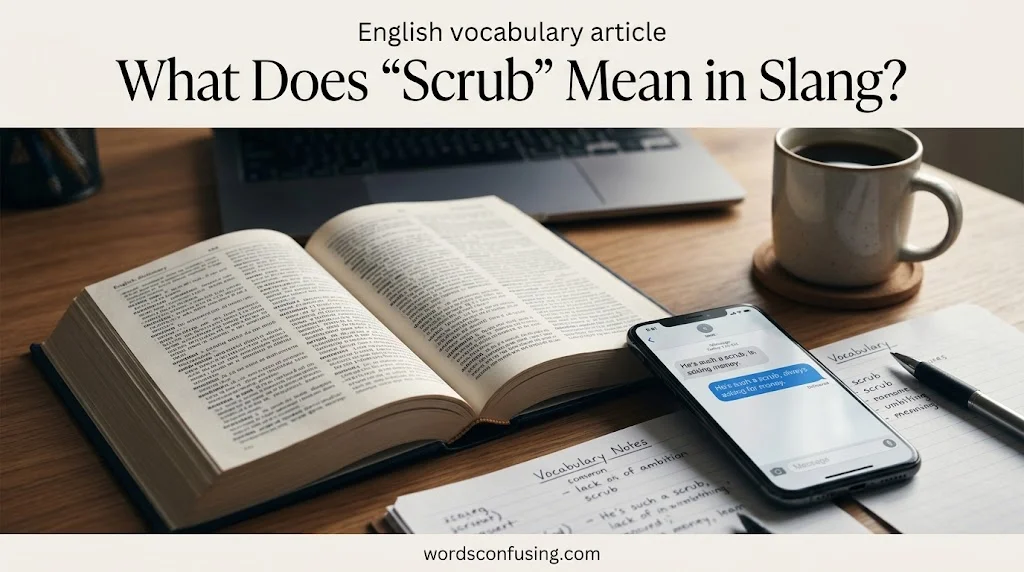
In slang, a scrub is generally a person whom the speaker considers unsuccessful, unimpressive, dependent, or lacking ambition.
The word often describes someone who expects benefits from other people without making a comparable effort. In dating, for example, a person might call someone a scrub if that person expects romantic attention while showing little responsibility or ambition.
The meaning isn’t limited to money. A scrub might be criticized for their attitude, behavior, effort, or approach to relationships.
For example:
“He never works, never helps anyone, and always expects other people to pay. He’s such a scrub.”
Here, scrub doesn’t simply mean someone who has little money. The speaker is criticizing the person’s behavior and lack of responsibility.
Simple Definition of “Scrub” in Slang
A simple definition is:
Scrub: An informal and usually insulting term for someone viewed as unsuccessful, unambitious, irresponsible, dependent, or generally undesirable.
The exact trait being criticized depends on context.
For instance, these two sentences have slightly different implications:
- “He’s a scrub because he never tries to improve his situation.”
This focuses on ambition and effort. - “He’s a scrub because he always expects me to pay.”
This focuses on dependence and contribution.
The word therefore works as a broad insult rather than a precise description.
What Does “Scrub” Mean When Describing a Person?
When people use scrub as slang for a person, they usually express a negative judgment about that person’s behavior or circumstances.
The term can suggest several traits:
- Lack of ambition
- Poor effort
- Irresponsibility
- Dependence on others
- Low social status
- Lack of direction
- Poor contribution in a relationship
- Expecting benefits without earning them
Not every use includes all these characteristics. Context does the heavy lifting.
Someone could call another person a scrub because they don’t contribute financially. Another speaker might use the same word for someone who lacks ambition. A third person might use it casually to mean someone they don’t respect.
Is “Scrub” a Bad Word?
Scrub isn’t generally considered profanity. You won’t normally see it grouped with swear words or explicit language.
However, it can still be insulting and disrespectful.
Calling someone a scrub attacks their perceived value, behavior, or social position. That’s why the word can create tension even though it isn’t a traditional curse word.
Among close friends, the term may appear as playful teasing:
“Quit being a scrub and come help me move this couch.”
In a serious argument, however, the same word can sound openly contemptuous.
The relationship between the speakers matters. Tone matters too.
What Does “Scrub” Mean in Dating?
The dating meaning of scrub is one of the most recognizable modern uses.
In this context, a scrub often describes someone who wants romantic attention or benefits without bringing much effort, responsibility, ambition, or stability to the relationship.
The person might:
- Constantly ask their partner for money.
- Expect someone else to solve their problems.
- Avoid responsibility.
- Show little ambition.
- Demand attention without offering genuine commitment.
- Depend heavily on another person while contributing little.
For example:
“She doesn’t want to date someone who expects her to handle every responsibility.”
Someone might describe that partner as a scrub.
However, the word shouldn’t be treated as a factual measurement of someone’s worth. It expresses the speaker’s negative judgment about particular behavior.
“Scrub” in Romantic Conversations
The term often appears when someone discusses what they don’t want in a partner.
Consider this example:
“I’m looking for someone independent. I don’t want a scrub who expects me to pay for everything.”
Here, scrub communicates several ideas at once. The speaker wants independence, responsibility, and mutual effort.
That makes the slang convenient. One short word can summarize a long list of complaints.
Read more: Why Does an Alarm “Go Off” and Not “Go On”? Full Explanation!
What Does “Scrub” Mean in Texting and Social Media?
On social media and in text messages, scrub usually keeps the same informal meaning.
Because texting lacks vocal tone and facial expressions, the surrounding message becomes especially important.
Someone might write:
- “Don’t be a scrub 😂”
- “He turned out to be a scrub.”
- “I’m done dealing with scrubs.”
- “Why are you acting like a scrub?”
The first example could be playful. The second sounds more serious. The third expresses a broad dislike of certain behavior.
An emoji can soften the message, but it doesn’t automatically make the insult friendly.
How Context Changes the Meaning
Compare these examples:
| Sentence | Likely Meaning |
| “Don’t be a scrub.” | Don’t behave lazily, poorly, or irresponsibly. |
| “He’s a scrub.” | The speaker considers him undesirable or unsuccessful. |
| “I used to be a scrub.” | The speaker describes their past behavior negatively. |
| “Stop acting like a scrub.” | The speaker criticizes someone’s current behavior. |
| “No scrubs allowed.” | People considered undesirable or unsuitable aren’t wanted. |
The surrounding conversation tells you which interpretation makes the most sense.
Examples of “Scrub” Used as Slang
Here are several natural examples showing how the term works.
Example 1: Financial Dependence
“He always borrows money but never pays anyone back. They call him a scrub.”
The speaker focuses on financial irresponsibility.
Example 2: Lack of Ambition
“She worked hard while he refused to look for a job. She didn’t want to stay with a scrub.”
Here, scrub refers primarily to a perceived lack of effort and ambition.
Example 3: Casual Teasing
“You ate the last slice and didn’t save me any? You’re such a scrub.”
This usage may be humorous rather than genuinely hostile.
Example 4: Relationship Expectations
“I don’t want to date someone who expects me to handle everything.”
In a more direct conversation, someone might replace the longer description with:
“I don’t want to date a scrub.”
The slang condenses several complaints into two words.
Example 5: Self-Description
“I was a scrub in college, but I eventually got serious about my career.”
Here, the speaker uses the term about themselves. It suggests a period of low ambition, poor direction, or unproductive behavior.
Where Did the Slang Word “Scrub” Come From?
The history of scrub as slang is older than the modern dating expression.
The English word scrub has long carried associations with things that are small, inferior, insignificant, or of limited value. The word has also been used for low-growing vegetation and rough land.
Those older meanings helped create a broader figurative sense.
Over time, scrub became associated with people viewed as inferior, unsuccessful, or lacking status. The slang meaning then developed further in different communities and contexts.
It’s important not to reduce the history to one exact moment. Slang rarely appears fully formed overnight. Words often accumulate figurative meanings gradually as speakers reuse them in new situations.
The Development of the Modern Slang Meaning
The basic progression can be understood like this:
Literal or descriptive uses → figurative idea of something inferior → description of an unimpressive person → modern slang insult
That evolution explains why scrub can sound natural as a description of someone considered low-status or unsuccessful.
What Does “No Scrubs” Mean?
The phrase “no scrubs” became widely recognizable through the 1999 song “No Scrubs” by TLC.
The song describes a particular type of undesirable romantic partner. Its scrub isn’t simply someone who has little money. The lyrics portray someone who lacks ambition and tries to gain romantic attention without bringing meaningful value or effort.
The song helped cement the word’s dating-related meaning in mainstream American popular culture.
That distinction matters.
TLC didn’t invent the word “scrub.” The term already existed. Instead, the song gave a highly recognizable cultural expression to one particular meaning of the word.
What Does “Scrub” Mean in “No Scrubs”?
Within the song’s context, a scrub is essentially an undesirable man who lacks ambition and tries to pursue a woman without having much to offer.
The song emphasizes characteristics such as:
- Lack of ambition
- Dependence
- Empty romantic attention
- Limited personal responsibility
- Expecting access without meaningful contribution
The cultural impact of “No Scrubs” helped make the phrase part of everyday conversational English.
“Scrub” vs. the Literal Meaning of “Scrub”
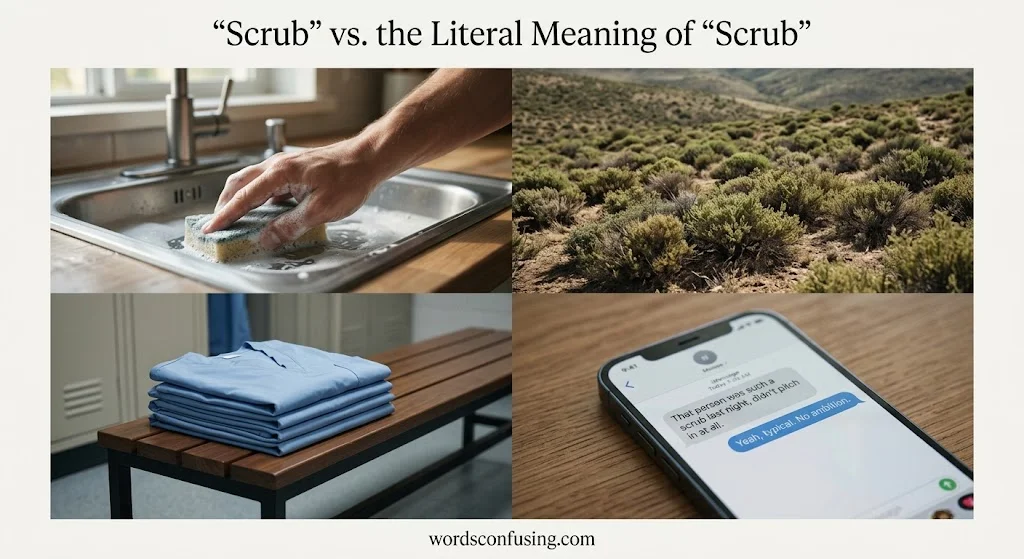
Not every appearance of scrub involves slang.
The word has several ordinary English meanings.
As a verb, scrub commonly means to clean something by rubbing it firmly.
For example:
“Scrub the pan before the food dries.”
You might also hear:
“She scrubbed the bathroom floor.”
That has nothing to do with the slang meaning.
“Scrub” as a Noun
The noun scrub can also refer to low-growing vegetation, particularly rough or sparse bushes and plants.
For example:
“The hikers moved through thick scrub.”
Again, this is a literal meaning rather than slang.
Medical workers may also wear scrubs, referring to the loose-fitting clothing commonly worn in healthcare settings.
Therefore, context becomes essential.
| Use | Meaning | Example |
| Verb | Clean by rubbing | “Scrub the sink.” |
| Vegetation | Low-growing plants | “The trail passed through scrub.” |
| Medical clothing | Healthcare workwear | “The nurse changed into scrubs.” |
| Slang noun | An undesirable or unimpressive person | “He’s acting like a scrub.” |
How to Tell Which Meaning of “Scrub” Someone Means
Look at the grammar and surrounding words.
If someone says:
“Scrub the floor.”
They’re using the verb.
If someone says:
“The area is covered in scrub.”
They’re referring to vegetation.
If someone says:
“The doctor changed into scrubs.”
They’re talking about medical clothing.
If someone says:
“He’s a scrub.”
They’re using the slang noun.
This simple context test prevents most misunderstandings.
Synonyms for “Scrub” in Slang
Several slang terms overlap with scrub, but they aren’t perfect substitutes.
| Term | General Meaning | Typical Tone |
| Loser | Someone viewed as unsuccessful | Harsh |
| Bum | Someone perceived as lazy or unproductive | Negative |
| Deadbeat | Someone who avoids responsibilities | Strongly negative |
| Freeloader | Someone who takes without contributing | Negative |
| Slacker | Someone who avoids effort or responsibility | Mild to negative |
| Nobody | Someone viewed as unimportant | Dismissive |
| User | Someone who takes advantage of others | Negative |
The differences matter.
For example, freeloader specifically emphasizes taking benefits without contributing. Deadbeat often focuses on failure to meet responsibilities. Slacker usually centers on avoiding work or effort.
Scrub can overlap with all three, but it has a broader and more informal flavor.
What Is the Opposite of “Scrub”?
There isn’t one perfect antonym because the slang word can describe several undesirable traits.
Depending on context, possible contrasts include:
- Hard worker
- Go-getter
- Achiever
- Responsible person
- Independent person
- Ambitious person
- Reliable partner
- Contributor
For example, if scrub means someone who avoids responsibility, responsible provides a natural contrast.
If it means someone without ambition, ambitious works better.
If the discussion involves financial dependence, independent may provide the clearest opposite.
How to Use “Scrub” in a Sentence
If you’re learning English slang, these sentence patterns can help.
Calling Someone a Scrub
“He’s a scrub who never takes responsibility.”
This directly insults the person.
Talking About Past Behavior
“I acted like a scrub when I was younger.”
This frames the word as a description of past behavior.
Using It Casually
“Don’t be a scrub. Come help us clean up.”
The speaker may be teasing rather than seriously attacking someone.
Talking About Dating
“She doesn’t want to date a scrub.”
The word describes an undesirable romantic partner.
Talking About a Group
“They’re tired of dealing with scrubs who never contribute.”
The plural scrubs refers to multiple people.
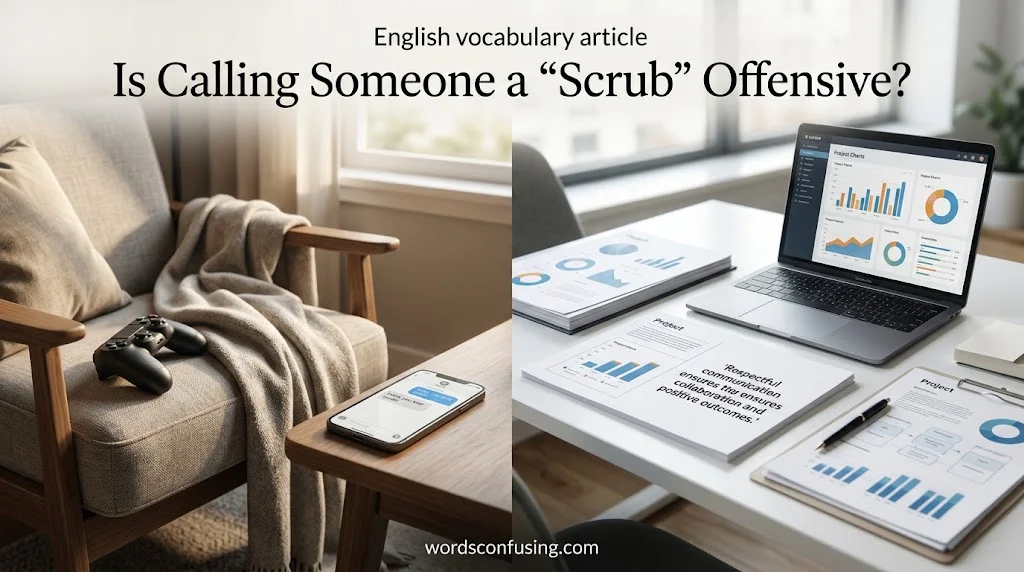
Is Calling Someone a “Scrub” Offensive?
It can be.
The word doesn’t contain profanity, but profanity isn’t the only way language can offend someone. Scrub can belittle a person’s character, status, effort, or lifestyle.
The seriousness depends on several factors:
- Who says it
- Who hears it
- The relationship between them
- The speaker’s tone
- The behavior being discussed
- Whether the comment is playful or hostile
- Whether the person being described accepts the joke
Calling a close friend a scrub after losing a video game may be harmless teasing.
Calling a coworker a scrub during an argument can sound openly disrespectful.
Is “Scrub” Appropriate at Work?
Usually, specific professional language works better.
Instead of saying:
“He’s a scrub.”
A workplace conversation could say:
“He hasn’t been contributing to the project.”
Or:
“He hasn’t met the responsibilities assigned to him.”
These alternatives describe observable behavior instead of attacking someone’s identity.
More Respectful Alternatives to “Scrub”
When you want to communicate the underlying problem without insulting someone, try:
- “He isn’t taking responsibility.”
- “She isn’t contributing equally.”
- “They aren’t putting in enough effort.”
- “He’s relying heavily on other people.”
- “She hasn’t shown much ambition in this situation.”
- “They aren’t meeting their commitments.”
Specific language usually makes the actual problem clearer.
Read more: Hers or Her’s or Hers’: Which Is Correct?
Why Context Matters So Much With Slang
Slang works differently from technical vocabulary.
A technical term often has a defined meaning. Slang depends heavily on community, culture, tone, age, relationship, and situation.
Consider:
“You’re a scrub.”
That sentence could be an insult.
Now consider:
“Stop being a scrub and help me carry these boxes.”
The second sentence could be playful teasing between friends.
The words remain almost identical. The social context changes the force.
That’s why dictionary definitions alone don’t always capture how slang works in real conversations.
A Quick Case Study: Understanding “Scrub” in Context
Imagine someone receives this text:
“I’m done dating scrubs. I want someone who has goals.”
The word scrubs doesn’t mean the sender wants someone wealthy.
The next sentence provides the clue: “someone who has goals.”
That tells you the speaker associates scrub with a perceived lack of ambition.
Now consider another message:
“He keeps borrowing money and never pays me back. He’s a scrub.”
Here, the context points toward financial dependence and irresponsibility.
Finally:
“You lost the game again, scrub 😂.”
The laughing emoji and gaming context suggest playful trash talk rather than a serious judgment about someone’s lifestyle.
What These Examples Teach
The same slang term can point toward different traits:
| Context | Likely Meaning |
| Dating | Undesirable or unambitious partner |
| Money | Dependent or irresponsible person |
| Work | Unproductive or low-effort person |
| Friendship | Someone who takes without contributing |
| Gaming | Insult or playful trash talk |
| Social media | General negative description |
The surrounding words provide the missing information.
FAQs
What does “scrub” mean in slang?
In slang, scrub usually describes someone who doesn’t put in effort, especially in dating or relationships.
Where did the slang word “scrub” come from?
The term has older uses, but its modern popularity grew significantly after TLC released “No Scrubs” in 1999.
Is calling someone a scrub an insult?
Usually, yes. Calling someone a scrub can suggest that they’re unsuccessful, lazy, or unwilling to make an effort.
What does “No Scrubs” mean?
In TLC’s song, “no scrub” refers to a man who lacks ambition and tries to rely on someone else rather than putting in his own effort.
Is “scrub” still used as slang today?
Yes. It still appears in social media posts, memes, dating conversations, and references to TLC’s famous song, although it may be less common in everyday speech than it was in the late 1990s.
Can “scrub” have a meaning besides slang?
Yes. Scrub can also refer to cleaning, scrubbing something, scrub vegetation, or medical scrubs worn by healthcare workers. The surrounding context tells you which meaning applies.
Conclusion
The slang scrub is more than just a word from a famous TLC song. It describes someone who doesn’t put in the effort, especially in dating or relationships. While the term became widely known through “No Scrubs,” you can still see it in memes, social media, and casual conversations today.
Just remember that scrub has other meanings, too, so the context matters. Whether you spot it in a text, hear it in a song, or see it in a comment, understanding the situation usually makes the meaning clear.

Franklin Hayes is a writer and editor at WordsConfusing.com, focused on making English vocabulary, grammar, and commonly confused words easy to understand. He writes clear, practical articles with simple explanations and useful examples to help readers improve their English with confidence.
His goal is simple: Making Confusing Words Simple.