Understanding Spoke or Spoken: What is difference ? becomes easier when you know how each verb form works.
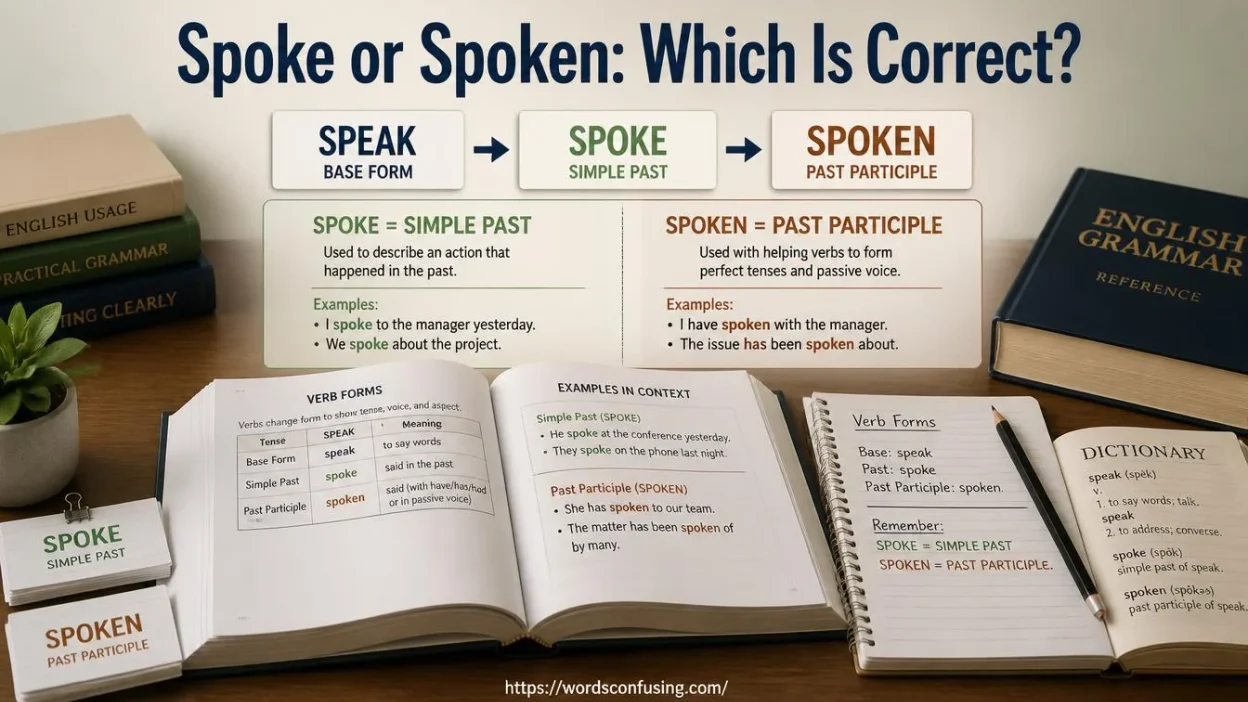
Spoke is the past simple form of speak, so you use it for a completed past action. For example, “She spoke clearly during the meeting yesterday.” Spoken is the past participle form, so it usually needs helping verbs such as has, have, or had.
For example, “She has spoken about the issue many times.” This difference depends on tense, sentence structure, and the intended grammatical structure. Learning these English grammar rules helps you choose the correct form naturally.
In everyday conversation, spoke describes something that happened and finished in the past, while spoken commonly appears in perfect tense constructions. You might say, “I spoke to my teacher yesterday,” but “I have spoken to my teacher already.”
Understanding this simple difference can improve your writing skills, speaking skills, and overall communication skills. It also helps prevent common mistakes when you’re choosing between these two forms. Once you understand the pattern, using spoke and spoken becomes much simpler.
Quick Answer
Spoke and spoken are two different forms of the irregular verb speak.
| Word | Verb form | Main use | Example |
| Speak | Base form | Present tense, infinitives, after modal verbs | I speak English. |
| Spoke | Simple past | Completed action in the past | I spoke to him yesterday. |
| Spoken | Past participle | Perfect tenses and some passive constructions | I have spoken to him. |
The easiest rule to remember is this:
Use “spoke” for a simple past action. Use “spoken” when the sentence requires a past participle.
Consider these two sentences:
- I spoke with my teacher yesterday.
- I have spoken with my teacher already.
The first sentence describes a completed event at a specific point in the past. The second connects a past action to the present and therefore uses the present perfect construction have + spoken.
A quick comparison
Spoke:
Maria spoke to her manager this morning.
Spoken:
Maria has spoken to her manager already.
Both sentences describe communication. The grammatical structure determines the correct verb form.
What Does “Spoke” Mean?
Spoke is the simple past form of speak.
You use it when you describe something that happened in the past. The action may have happened yesterday, five minutes ago, last year, or at another definite or understood time.
For example:
- I spoke to James yesterday.
- She spoke during the meeting.
- They spoke about the problem last night.
- He spoke with his parents after dinner.
- We spoke about the project earlier.
Notice something important. None of these sentences needs have, has, or had before the verb.
The sentence simply reports a past event.
When “Spoke” Describes a Completed Past Action
Use spoke when you’re looking back at a completed action.
For example:
I spoke to my doctor yesterday.
The conversation happened yesterday. The sentence presents that conversation as a completed past event.
Another example:
The president spoke at the event last Friday.
Again, the action occurred at a definite time in the past.
Common time expressions that often appear with the simple past include:
- yesterday
- last night
- last week
- last month
- last year
- two days ago
- an hour ago
- earlier
- this morning, when the morning has ended
- in 2024
- when I was younger
These expressions don’t automatically require spoke, but they frequently appear with the simple past when the sentence describes a completed event.
Examples of “Spoke”
Here are several natural examples:
- She spoke to her brother yesterday.
- I spoke with the customer earlier.
- The teacher spoke about the assignment.
- He spoke clearly during the presentation.
- We spoke for nearly an hour.
- They spoke after the meeting ended.
- The witness spoke about what happened.
The word spoke can describe the act of talking, addressing someone, expressing an idea, or delivering a speech.
What Does “Spoken” Mean?
Spoken is the past participle of speak.
Unlike spoke, it usually doesn’t function as the simple past form by itself.
Instead, spoken commonly appears with auxiliary verbs such as has, have, and had.
For example:
- I have spoken to him.
- She has spoken with the manager.
- They had spoken before the meeting.
- We have spoken about this issue before.
In each sentence, spoken works as part of a larger verb construction.
Why “Spoken” Needs a Different Structure
Compare these sentences:
I spoke to John yesterday.
I have spoken to John already.
The first sentence uses the simple past:
spoke
The second uses the present perfect:
have + spoken
This difference isn’t just a matter of style. The verb forms perform different grammatical jobs.
Think of spoke as a complete simple-past form. Spoken, by contrast, is a participle that usually needs another verb to complete the tense or construction.
Speak, Spoke, Spoken: The Three Forms
The three principal forms of speak are:
| Form | Word | Example |
| Base form | speak | I speak English. |
| Simple past | spoke | I spoke English yesterday. |
| Past participle | spoken | I have spoken English for years. |
This pattern is worth memorizing:
speak → spoke → spoken
Because speak is an irregular verb, you can’t form its past tense by simply adding -ed.
You don’t say:
- speaked
- have speaked
Instead, English uses the irregular forms spoke and spoken.
Where “Speak” Fits Into the Pattern
The base form speak appears in several structures where neither spoke nor spoken belongs.
For example:
- I speak English every day.
- She wants to speak with you.
- They can speak French.
- Did you speak to him?
- Please speak slowly.
The last two examples are particularly useful because they show how auxiliary verbs affect the main verb.
After did, use the base form speak, not spoke.
After can, use the base form speak, not spoke or spoken.
When to Use “Spoke”
Use “Spoke” for the Simple Past
The most important use of spoke is the simple past.
Use it when you want to describe a completed action that occurred in the past.
Examples include:
I spoke to my sister last night.
He spoke at the conference yesterday.
We spoke about your proposal earlier.
She spoke with the teacher after class.
The action is finished. That’s the key point.
You don’t need another auxiliary verb before spoke in these ordinary statements.
“Spoke” With Definite Past Time
When you mention a completed past time, spoke often fits naturally.
For example:
- I spoke to him yesterday.
- She spoke at the ceremony last year.
- We spoke two hours ago.
- They spoke about the issue last week.
Compare this with the present perfect:
I have spoken to him.
This sentence doesn’t specify a completed past time such as yesterday. Instead, it emphasizes the fact that the conversation has occurred.
The distinction can be subtle, but it matters.
“Spoke” in Questions and Negatives
Here’s where many learners make a common mistake.
After did, use speak, not spoke.
Correct:
Did you speak to Sarah?
Incorrect:
Did you spoke to Sarah?
Why?
Because did already carries the past-tense marking. The main verb returns to its base form.
The same principle applies to negative sentences:
I didn’t speak to him.
Not:
I didn’t spoke to him.
The pattern is:
did + speak
didn’t + speak
The same rule applies to many irregular verbs:
- Did you go? — not Did you went?
- Did she eat? — not Did she ate?
- Did they write? — not Did they wrote?
- Did he speak? — not Did he spoke?
Once you understand this pattern, the mistake becomes much easier to avoid.
Read more: United States’ vs. United States’s: Which Possessive Is Correct?
When to Use “Spoken”
“Spoken” With Has, Have, and Had
One of the clearest signals for spoken is the presence of has, have, or had.
Examples:
- I have spoken to him.
- She has spoken with the client.
- They have spoken about the problem.
- He had spoken to his parents before leaving.
- We had spoken about the issue earlier.
These constructions use a perfect tense.
The basic patterns are:
have/has + spoken
had + spoken
For example:
She has spoken to the manager.
This is present perfect.
She had spoken to the manager before the meeting.
This is past perfect.
The auxiliary verb changes according to the tense, but spoken remains the past participle.
Present Perfect With “Spoken”
Use has spoken or have spoken when the sentence uses the present perfect.
Examples:
- I have spoken to him.
- You have spoken clearly.
- We have spoken about this before.
- They have spoken with several customers.
- She has spoken to the director.
The present perfect often connects a past event with the present situation.
For example:
I have spoken to the manager, so we can proceed.
The conversation happened in the past. However, its result matters now.
Past Perfect With “Spoken”
Use had spoken when you’re discussing an action that happened before another past event.
For example:
I had spoken to Sarah before the meeting started.
Two past events appear here:
- The conversation with Sarah happened first.
- The meeting started afterward.
The word had establishes the earlier past action.
Another example:
They had spoken about the problem before the manager arrived.
Again, had spoken shows that one past event happened before another.
“Spoken” in Passive Constructions
Spoken can also appear in passive constructions.
For example:
English is spoken in many countries.
Here, spoken is part of the passive construction is spoken.
Another example:
The words were spoken in anger.
In this sentence, were spoken forms the passive voice.
You can also encounter more complex constructions:
- The issue has been spoken about repeatedly.
- The words had been spoken before anyone could respond.
- Several languages are spoken in the region.
The important point is that spoken is the past participle form.
It can appear in perfect constructions and passive structures because both require a past participle.
Spoke vs. Spoken in Different Tenses
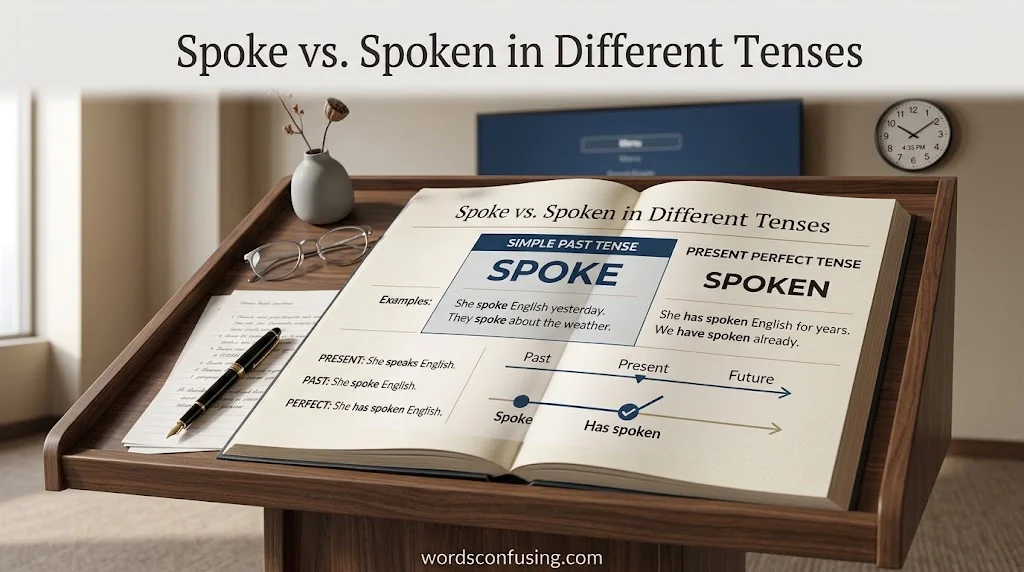
Understanding the larger tense system makes this distinction much clearer.
| Tense | Correct form | Example |
| Simple present | speak/speaks | She speaks English. |
| Simple past | spoke | She spoke English yesterday. |
| Present perfect | has/have spoken | She has spoken English for years. |
| Past perfect | had spoken | She had spoken to him earlier. |
| Simple future | will speak | She will speak tomorrow. |
| Present continuous | is speaking | She is speaking now. |
| Past continuous | was speaking | She was speaking when I arrived. |
| Future perfect | will have spoken | She will have spoken by then. |
This table reveals an important pattern.
Spoke belongs specifically to the simple past.
Spoken appears in perfect constructions when combined with an appropriate auxiliary.
Meanwhile, speak appears in the base form after words such as did, can, will, and to.
Common Mistakes With Spoke and Spoken
Several errors appear repeatedly because English learners sometimes treat all past forms as interchangeable.
Mistake: “I Have Spoke to Him”
Incorrect:
I have spoke to him.
Correct:
I have spoken to him.
Why? Have requires the past participle in the present perfect.
The pattern is:
have + spoken
Mistake: “I Spoken to Him Yesterday”
Incorrect:
I spoken to him yesterday.
Correct:
I spoke to him yesterday.
Why? There’s no auxiliary verb requiring a past participle. The sentence uses the simple past.
Mistake: “Did You Spoke to Her?”
Incorrect:
Did you spoke to her?
Correct:
Did you speak to her?
Why? Did already marks the sentence as past tense. The main verb must return to its base form.
Mistake: “She Had Spoke With Them”
Incorrect:
She had spoke with them.
Correct:
She had spoken with them.
Why? Had introduces the past perfect, which requires the past participle.
The pattern is:
had + spoken
Mistake: “He Has Spoke About It”
Incorrect:
He has spoke about it.
Correct:
He has spoken about it.
Again, has requires the past participle spoken.
Spoke or Spoken: A Simple Sentence Test
When you’re unsure which form to choose, use this quick test.
Step One: Look for “Did”
If the sentence contains did or didn’t, use speak.
- Did you speak to him?
- I didn’t speak to her.
Don’t use spoke after did.
Step Two: Look for “Has,” “Have,” or “Had”
If the sentence uses has, have, or had as an auxiliary verb, you generally need spoken.
- She has spoken to him.
- We have spoken before.
- They had spoken earlier.
Step Three: Look for a Straightforward Past Action
If you’re simply describing something that happened in the past, use spoke.
- I spoke to him yesterday.
- She spoke during the meeting.
- They spoke last night.
Step Four: Check the Larger Verb Construction
Sometimes spoken appears with forms of be in passive structures.
- English is spoken here.
- The words were spoken carefully.
- The issue has been spoken about.
Don’t choose the word based only on whether the event happened in the past. Grammar determines the form.
Spoke vs. Spoken Examples in Everyday English
The difference becomes easier when you see these forms in realistic situations.
In Conversations
Simple past:
I spoke to my brother yesterday.
Present perfect:
I’ve spoken to my brother already.
The first sentence gives a completed past event. The second emphasizes the completed experience or its present relevance.
In the Workplace
Simple past:
She spoke with the client this morning.
Present perfect:
She has spoken with the client.
The second sentence focuses on the fact that contact has already occurred.
In School
Simple past:
The teacher spoke about grammar yesterday.
Present perfect:
The teacher has spoken about this topic before.
The first sentence identifies a past event. The second describes previous experience without necessarily naming a finished past time.
In Formal Situations
Simple past:
The witness spoke during the hearing.
Past perfect:
The witness had spoken to investigators before the hearing.
The second sentence establishes the order of two past events.
A Practical Case Study: Choosing Between “Spoke” and “Spoken”
Imagine that Alex called a coworker yesterday.
Alex could say:
I spoke to Mark yesterday.
That’s correct because the conversation happened at a definite time in the past.
Now suppose Alex doesn’t care about specifying when the conversation happened. The important information is simply that the conversation has already happened.
Alex could say:
I have spoken to Mark.
The grammatical choice changes because the meaning and tense change.
Now imagine another situation:
I had spoken to Mark before the meeting began.
Here, had spoken tells the reader that Alex’s conversation occurred before another past event.
This small comparison shows why memorizing a single rule isn’t enough. You need to recognize the verb structure and time relationship.
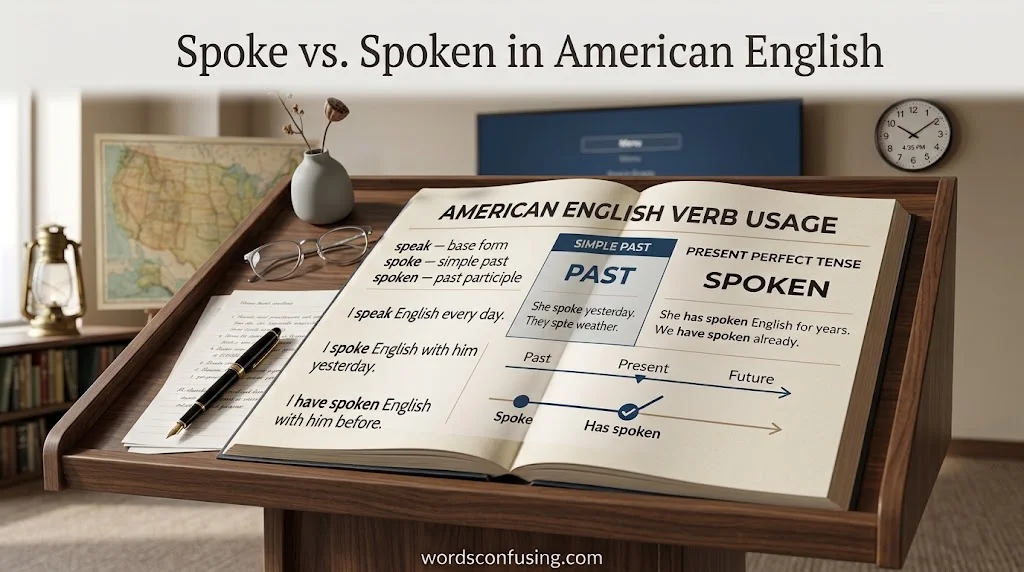
Spoke vs. Spoken in American English
The distinction between spoke and spoken applies in American English just as it does in standard English grammar generally.
American English speakers use:
- speak as the base form
- spoke as the simple past
- spoken as the past participle
For example:
1. I speak English every day.
2. I spoke English with him yesterday.
3. I have spoken English with him before.
The basic grammar doesn’t change simply because the sentence uses American English.
Pronunciation can vary between speakers and regions. However, that variation doesn’t change the grammatical roles of spoke and spoken.
Spoke vs. Spoken: Comparison Table
| Feature | Spoke | Spoken |
| Base verb | Speak | Speak |
| Verb form | Simple past | Past participle |
| Main function | Completed past action | Perfect and passive constructions |
| Example | I spoke to him. | I have spoken to him. |
| Used after “did” | No | No |
| Used after “have” | No | Yes |
| Used after “has” | No | Yes |
| Used after “had” | No | Yes |
| Example with definite past time | I spoke yesterday. | Usually not used alone this way |
| Example with perfect tense | Not normally used | I have spoken already. |
How “Spoke” and “Spoken” Work With “Speak”
The easiest way to remember the entire family is to learn all three forms together.
Speak
Use speak as the base form.
- I speak English.
- I want to speak to her.
- Can you speak more slowly?
- Did you speak to John?
Spoke
Use spoke as the simple past form.
- I spoke to John yesterday.
- She spoke during the meeting.
- They spoke for an hour.
Spoken
Use spoken as the past participle.
- I have spoken to John.
- She has spoken with the manager.
- They had spoken before the meeting.
- English is spoken here.
A useful memory chain is:
Speak today. Spoke yesterday. Have spoken before.
It isn’t a complete grammar rule, but it’s a handy reminder.
Read more: Given vs. Gave: Meaning, Grammar and Correct Usage
Why “Spoke” and “Spoken” Aren’t Interchangeable
At first glance, spoke and spoken may seem like two versions of the same past idea. They are related, but English assigns them different grammatical jobs.
Consider:
She spoke to the customer.
This sentence uses the simple past.
Now change it slightly:
She has spoken to the customer.
Adding has changes the grammatical structure. The verb must change from spoke to spoken.
You can’t simply insert has without changing the verb:
❌ She has spoke to the customer.
The correct form is:
✅ She has spoken to the customer.
This pattern occurs with many irregular verbs:
| Base | Simple past | Past participle |
| speak | spoke | spoken |
| write | wrote | written |
| break | broke | broken |
| choose | chose | chosen |
| drive | drove | driven |
| take | took | taken |
| give | gave | given |
Learning irregular verbs as three-part patterns can make English grammar far more predictable.
Quick Practice: Choose Spoke or Spoken
Try completing each sentence before checking the answers.
- I ___ to her yesterday.
- She has ___ to the manager.
- They ___ about the problem last night.
- We have ___ about this before.
- He ___ during the ceremony.
- She had ___ to him before the meeting.
- I ___ with the customer earlier.
- Have you ___ to your teacher?
- The witness ___ during the hearing.
- English is ___ in many countries.
Answers
- spoke
- spoken
- spoke
- spoken
- spoke
- spoken
- spoke
- spoken
- spoke
- spoken
The reason becomes clear when you examine the structure around each blank.
Spoke appears in simple past sentences.
Spoken appears after perfect-tense auxiliaries or as part of a passive construction.
FAQs
Is “spoke” the past tense of “speak”?
Yes. Spoke is the simple past form of speak. Use it for an action that happened and finished in the past. For example, “I spoke with my friend yesterday.”
Is “spoken” a past tense word?
Spoken is the past participle form of speak, not the simple past. It usually works with has, have, or had, as in “They have spoken about the problem.”
Can I use “spoken” by itself?
Usually, no. Spoken generally needs a helping verb in standard English sentences. Saying “I spoken to her” is incorrect; say “I spoke to her” or “I have spoken to her.”
What is the easiest way to remember spoke and spoken?
Think of spoke as the simple past and spoken as the participle. If you see has, have, or had, spoken will often be the form you need.
Is “I spoke to him” correct?
Yes. “I spoke to him” is grammatically correct because spoke works as the simple past form of speak. It describes a completed conversation or speaking action.
Is “I have spoke to her” correct?
No. After have, you need the past participle spoken. The correct sentence is “I have spoken to her.”
Conclusion
The difference between spoke and spoken becomes much clearer once you look at the sentence around them. Spoke works as the simple past form when you describe something that happened in the past. Spoken, however, usually needs a helping verb such as has, have, or had. Think of spoke as a complete past action, while spoken needs another verb to support its role.
A useful way to remember this is to check what comes before the verb. If you see has, have, or had, spoken will usually fit. If you’re simply describing something that happened yesterday, last week, or earlier, spoke may be the form you need. With a little practice, this small grammar distinction becomes almost automatic, making your writing and speaking clearer and more natural.

Shafiq Ur Rehman is a writer and content contributor at WordsConfusing.com. He enjoys exploring the English language, common word confusions, vocabulary, and practical writing tips. His goal is to make English easier to understand through clear, simple, and useful articles.