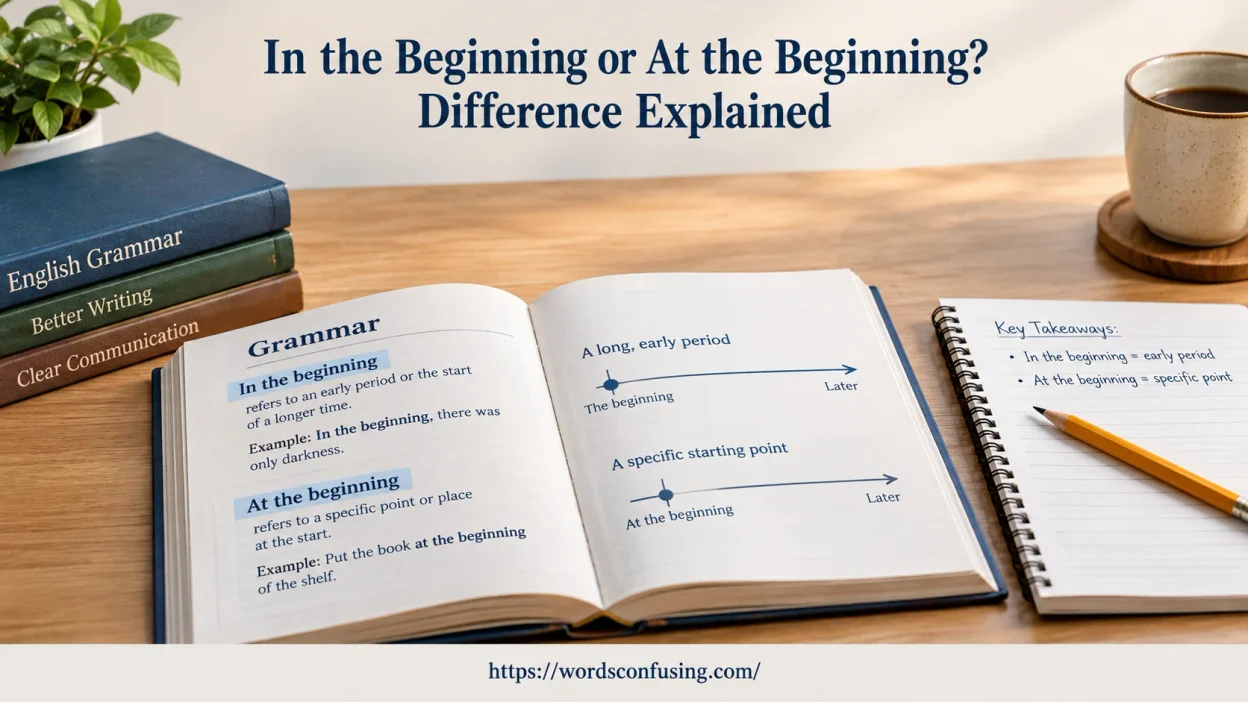
In the Beginning or At the Beginning? Difference Explained shows how these phrases can change meaning when you describe time or a starting point.
Prepositions such as at and in may seem like small words, yet they can have a profound impact on the overall meaning of a phrase. When you examine the differences between “in the beginning” and “at the beginning,” the main difference becomes clear.
“In the beginning” usually describes an early period or first stage, while “at the beginning” points to a specific starting point. For instance, learning grammar may feel difficult in the beginning, but an article may explain its main rule at the beginning.
From my experience, this simple time-based distinction makes the choice much easier. Knowing which one to use depends on the meaning of your sentence and its context. In everyday writing, these phrases can look almost identical, but they don’t always describe the same idea. You can discuss the beginning of an event, story, lesson, or process with either expression when the context supports it.
The key distinction is that “at the beginning” often marks the point where something starts, while “in the beginning” usually describes what happened during the early part. Once this difference is explained, choosing the right expression becomes more natural.
Quick Answer
“In the beginning” refers to an early period or initial stage, while “at the beginning” points to the starting point of something specific. For example, “In the beginning, I struggled with English” describes an early experience. “At the beginning of the class, the teacher explained the lesson” identifies what happened when the class started.
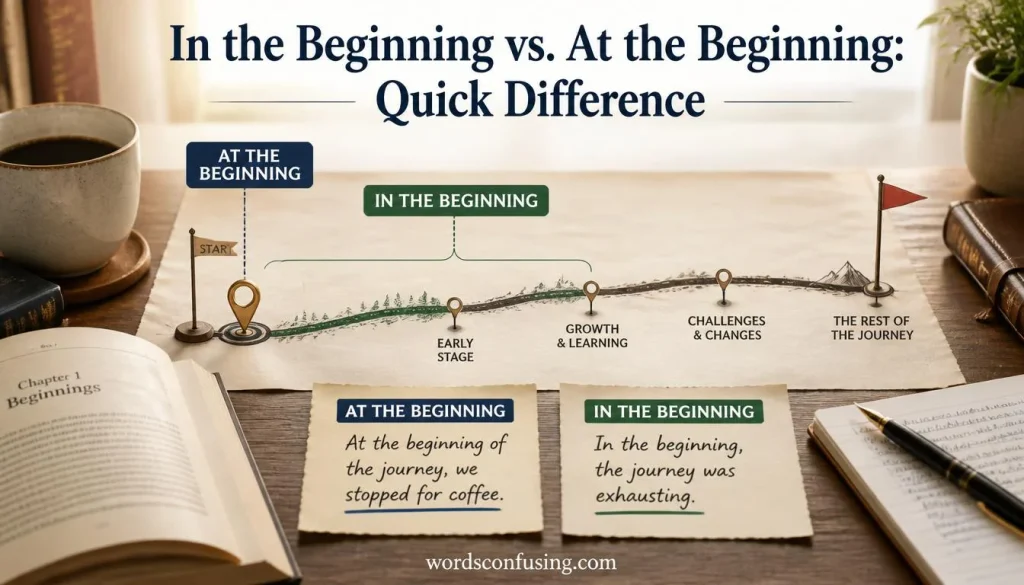
In the Beginning vs. At the Beginning: Quick Difference
Here’s the fastest way to separate the two expressions:
| Expression | Main meaning | Common use | Example |
| In the beginning | During an early period; initially | Experiences, changes, stories, development | In the beginning, I didn’t like the course. |
| At the beginning | At the starting point | Meetings, books, movies, classes, events | At the beginning of the class, the teacher explained the rules. |
The key distinction is period versus point.
When you say in the beginning, you usually have an early stretch of time in mind. That period might last minutes, weeks, months, or even years.
When you say at the beginning, you usually identify where something starts. Think of it as pointing to the first spot on a timeline.
A simple memory trick
Think about a journey.
In the beginning describes the early part of the journey.
At the beginning points to the place where the journey starts.
For example:
In the beginning, the journey was exhausting.
This describes your experience during the early part.
At the beginning of the journey, we stopped for coffee.
This identifies a particular point near the start.
That distinction works in many everyday situations.
What Does “In the Beginning” Mean?
“In the beginning” means during the early stage of something or initially.
The expression often describes a situation that changes later. You might use it when someone’s opinion changes, a project develops, a relationship grows, or a difficult task becomes easier.
For example:
In the beginning, learning French seemed impossible.
The sentence doesn’t necessarily describe one exact moment. Instead, it describes the speaker’s experience during the early stage of learning French.
Later, that situation might change:
In the beginning, the course seemed difficult, but it became easier after a few weeks.
Here, in the beginning contrasts with what happened afterward.
That’s one reason the expression appears frequently in stories and personal experiences. It naturally establishes an initial situation before something changes.
Examples of “In the Beginning”
Consider these examples:
- In the beginning, I didn’t understand the instructions.
- In the beginning, the company had only five employees.
- In the beginning, they rarely talked to each other.
- In the beginning, the new software seemed confusing.
- In the beginning, she wasn’t sure whether she had made the right decision.
- In the beginning, the children were nervous about school.
Notice the pattern. Each sentence describes an initial condition.
The situation may continue for some time. More importantly, the speaker isn’t necessarily pointing to one exact instant.
“In the Beginning” Often Suggests Change
One useful clue is what happens after the phrase.
If the sentence describes something that later changed, “in the beginning” often fits naturally.
For example:
In the beginning, I hated running. Now I look forward to it.
The expression establishes the first stage of an evolving situation.
Another example:
In the beginning, the business struggled to find customers. Eventually, sales increased.
The contrast between in the beginning and eventually makes the time relationship especially clear.
You can think of the phrase as opening a story:
In the beginning → development → later result
That doesn’t mean “in the beginning” always requires a later contrast. It simply explains why the phrase often feels natural when something develops over time.
What Does “At the Beginning” Mean?
“At the beginning” refers to the starting point of something specific.
It commonly appears when you can identify the thing that has a beginning.
For example:
- at the beginning of the meeting
- at the beginning of the movie
- at the beginning of the book
- at the beginning of the semester
- at the beginning of the lesson
- at the beginning of the year
- at the beginning of the presentation
The phrase frequently uses the structure:
at the beginning of + noun
For example:
At the beginning of the meeting, everyone introduced themselves.
The meeting has a recognizable starting point. The sentence identifies something that happened there.
Another example:
At the beginning of the movie, the main character leaves town.
The sentence points to events near the movie’s opening.
Examples of “At the Beginning”
Here are several natural examples:
- At the beginning of the class, the teacher took attendance.
- At the beginning of the meeting, the manager announced the changes.
- At the beginning of the book, the author introduces the main character.
- At the beginning of the semester, students received their schedules.
- At the beginning of the interview, she seemed nervous.
- At the beginning of the race, all the runners stayed together.
In each case, at the beginning identifies a starting point within a defined event, activity, or period.
In the Beginning vs. At the Beginning: The Main Difference
The easiest distinction is this:
“In the beginning” focuses on an early period. “At the beginning” focuses on a starting point.
That difference becomes clearer when you place similar sentences side by side.
Early Period vs. Starting Point
Compare:
In the beginning, the project seemed impossible.
This sentence describes an early phase of the project.
Now compare:
At the beginning of the project, we created a schedule.
This sentence identifies what happened when the project started.
Both sentences can refer to the same project. However, they highlight different aspects of time.
The first focuses on experience and development.
The second focuses on position in the timeline.
General vs. Specific Reference
“In the beginning” can stand alone:
In the beginning, everything felt strange.
You don’t need to identify a specific noun after it.
“At the beginning” can also stand alone:
At the beginning, nobody knew what to expect.
However, it frequently becomes more precise with of + noun:
At the beginning of the conference, nobody knew what to expect.
That structure makes the reference specific.
Change Over Time
The idea of change provides another useful clue.
Suppose you say:
In the beginning, I didn’t enjoy working remotely.
The sentence naturally leaves room for a later change.
You might continue:
After a few months, however, I became comfortable with it.
Now compare:
At the beginning of my first remote-work session, I couldn’t find the right software.
This sentence doesn’t necessarily suggest a long-term change. It simply identifies something that happened near the start of one particular session.
That’s the practical difference.
Read more: 15 Best Replies to “You’re Mine” Funny and Confident
Can “In the Beginning” and “At the Beginning” Be Used Interchangeably?
Sometimes, but not always.
English gives you some flexibility because the expressions can overlap in certain contexts. However, changing one phrase for the other can subtly change the meaning.
Consider:
In the beginning, the team worked from a small office.
This describes the team’s early period.
Now:
At the beginning of the project, the team worked from a small office.
This identifies the starting stage of a particular project.
The second sentence sounds more precise because the project provides a specific reference point.
When They Overlap
You might hear:
At the beginning, I didn’t understand the system.
You could also say:
In the beginning, I didn’t understand the system.
Both sentences can work. The difference is subtle.
At the beginning emphasizes the initial point or stage.
In the beginning emphasizes the early period.
In casual conversation, the intended meaning may be almost identical.
When They Don’t Overlap Naturally
Consider:
At the beginning of the chapter, the author introduces three characters.
Replacing it with:
In the beginning of the chapter, the author introduces three characters.
is generally less natural.
When you identify a specific starting location within something, at the beginning of is usually the better choice.
Likewise:
In the beginning, I was afraid of public speaking.
Here, in the beginning works naturally because you’re describing an early experience.
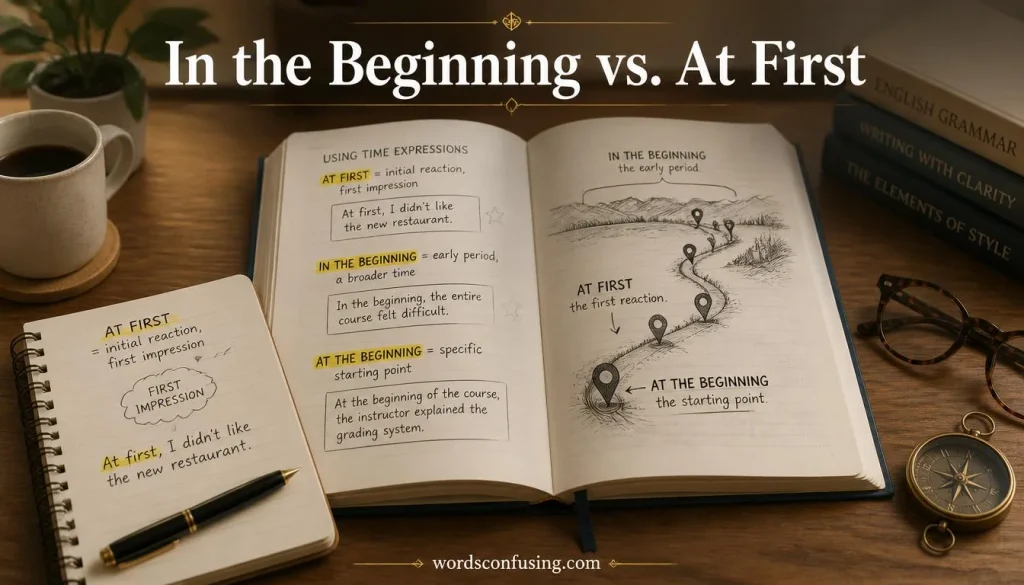
“In the Beginning” vs. “At First”
Another common comparison involves “at first.”
The expressions overlap, but they’re not always identical.
At first usually means initially or before something changed.
For example:
At first, I didn’t like the new restaurant.
You could also say:
In the beginning, I didn’t like the new restaurant.
Both can work.
However, at first often sounds more direct and conversational when describing an initial reaction.
Compare:
At first, she was nervous.
In the beginning, she was nervous.
The first sentence focuses strongly on her initial reaction. The second can suggest a broader early period.
A Useful Comparison
| Expression | Main emphasis |
| At first | Initial reaction, opinion, or condition |
| In the beginning | Early period or initial stage |
| At the beginning | Starting point of something specific |
For example:
At first, the instructions confused me.
In the beginning, the entire course felt difficult.
At the beginning of the course, the instructor explained the grading system.
All three sentences refer to an early time. Yet each expression frames that time differently.
“At the Beginning” vs. “At the Start”
“At the start” and “at the beginning” often mean the same thing.
Compare:
At the beginning of the meeting, we reviewed the agenda.
At the start of the meeting, we reviewed the agenda.
Both sentences are natural.
The difference is mostly stylistic. At the beginning is extremely common and works across everyday, academic, and professional writing.
At the start can sound slightly more direct or concise in some contexts.
You can usually choose either one when you’re identifying the starting point of a specific event.
Examples
- At the beginning of the movie, the family moves to Texas.
- At the start of the movie, the family moves to Texas.
- At the beginning of the semester, students receive their schedules.
- At the start of the semester, students receive their schedules.
The meaning remains essentially the same.
“In the Beginning” vs. “At the Beginning” With “Of”
This is where many learners hesitate.
The common structures are:
- in the beginning
- in the beginning of + noun
- at the beginning
- at the beginning of + noun
Although in the beginning of can appear in English, at the beginning of is usually the more natural choice when you’re identifying the start of a specific thing.
For example:
At the beginning of the book, the narrator describes the setting.
This sounds natural and precise.
You’d generally choose at the beginning of when the noun identifies a defined item, event, or period.
Common Natural Patterns
1. At the beginning of the year
At the beginning of the year, the company announced its new goals.
2. At the beginning of the class
At the beginning of the class, students completed a short quiz.
3. At the beginning of the story
At the beginning of the story, the family lives in a small village.
4. At the beginning of the meeting
At the beginning of the meeting, the director reviewed the agenda.
Meanwhile, in the beginning works especially well when the phrase stands independently:
In the beginning, everything seemed simple.
That difference gives you a practical shortcut.
“In the Beginning” vs. “At the Beginning” in Everyday Conversation
Everyday speech uses both expressions naturally.
Imagine someone describing a new job:
In the beginning, I was nervous.
This tells you about their early experience.
Now imagine someone describing the first day:
At the beginning of my first day, I met the manager.
This points to a particular point during that day.
The context usually makes the intended meaning obvious.
Everyday Examples
In the beginning, I couldn’t remember everyone’s names.
At the beginning of the training session, we watched a short video.
In the beginning, my new neighborhood felt unfamiliar.
At the beginning of the move, we packed everything into boxes.
Notice how naturally the expressions divide their jobs.
“In the Beginning” vs. “At the Beginning” in Academic Writing
Academic writing often needs precise time references.
If you’re discussing a course, experiment, semester, study, or research process, at the beginning of can clearly identify a particular stage.
For example:
At the beginning of the study, researchers collected demographic information.
The phrase identifies a defined stage of the study.
However, in the beginning can work when describing how something developed:
In the beginning, the researchers faced several technical problems.
The sentence focuses on the early phase rather than one specific starting point.
That distinction can make academic writing more precise.
“In the Beginning” vs. “At the Beginning” in Business Writing
Business communication provides plenty of examples.
Consider a project:
At the beginning of the project, the team created a timeline.
This tells the reader when the action occurred.
Now consider:
In the beginning, the project required more staff than expected.
This describes an early condition.
The distinction becomes especially useful in reports because it prevents vague time references.
Business Examples
- At the beginning of the quarter, sales were below expectations.
- In the beginning, the company struggled to establish its brand.
- At the beginning of the meeting, the manager reviewed the agenda.
- In the beginning, employees needed additional training.
- At the beginning of the campaign, the company tested several messages.
Each sentence gives the reader a different kind of time information.
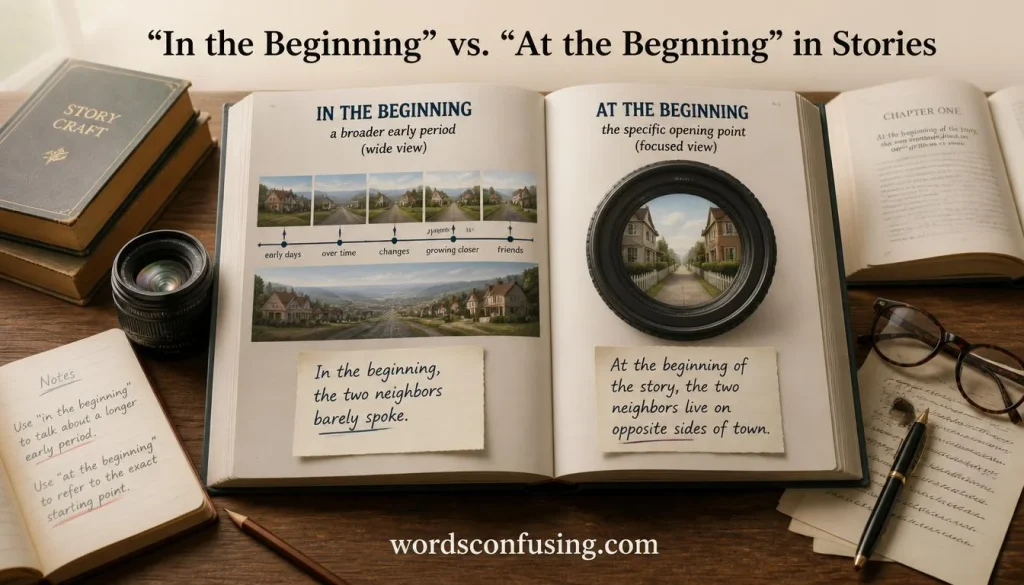
“In the Beginning” vs. “At the Beginning” in Stories
Stories often favor in the beginning because narratives describe development.
For example:
In the beginning, the two neighbors barely spoke. Over time, they became close friends.
The phrase sets up the first stage of a story.
At the beginning, however, works when you’re talking about a specific part of a story:
At the beginning of the story, the two neighbors live on opposite sides of town.
The distinction resembles a camera lens.
In the beginning gives you a wider view of the early period.
At the beginning points the camera toward the opening scene.
That simple image can make the difference easier to remember.
Common Mistakes to Avoid
Understanding the rules matters, but recognizing common mistakes makes them easier to apply.
Mistake: Treating Both Expressions as Exactly the Same
They overlap, but they aren’t perfect substitutes.
In the beginning, the business had three employees.
This describes an early period.
At the beginning of the business, the owner created a simple budget.
This points toward the starting stage of a specific business.
The intended emphasis changes.
Mistake: Automatically Using “In” Before “Beginning of”
When you have a specific noun after beginning of, at is usually the natural choice:
1. At the beginning of the semester
2. At the beginning of the movie
3. At the beginning of the year
4. At the beginning of the meeting
Don’t choose the preposition simply because the word beginning appears. Look at the meaning of the whole sentence.
Mistake: Assuming “At the Beginning” Always Means One Exact Second
The phrase can refer to a starting stage rather than a literal instant.
For example:
At the beginning of the semester, students often need time to adjust.
The sentence doesn’t claim that adjustment happens during one precise second. It refers broadly to the early stage of the semester.
Mistake: Using “In the Beginning” Only for Stories
Although the phrase works beautifully in storytelling, it isn’t limited to narratives.
You can use it for:
- jobs
- relationships
- businesses
- courses
- projects
- hobbies
- learning
- personal experiences
- historical developments
For example:
In the beginning, coding felt overwhelming.
That’s perfectly natural even though no storybook is involved.
Read more: 25 Best Replies to “Just Kidding” When It’s Used as a Bad Excuse
How to Choose the Right Phrase
When you’re unsure, ask one simple question:
Am I describing an early period or identifying a starting point?
If you’re describing an early period, choose:
In the beginning
If you’re identifying the starting point of something specific, choose:
At the beginning
Quick Decision Guide
Use “in the beginning” when:
- You mean initially.
- You’re describing an early stage.
- You’re discussing how something developed.
- You want to contrast an early situation with a later one.
- The phrase can stand naturally without a specific noun.
Use “at the beginning” when:
- You’re identifying the start of something.
- You’re referring to a particular event or period.
- You’re using of + noun.
- You’re describing something that happened near the opening of an event, text, or activity.
The One-Line Rule
Think “early phase” for “in the beginning” and “starting point” for “at the beginning.”
That rule won’t solve every stylistic question, but it handles most everyday situations correctly.
In the Beginning vs. At the Beginning: Examples
The following examples show how the meaning shifts.
| Sentence | Best choice | Reason |
| In the beginning, I disliked my new job. | In the beginning | Describes an early experience |
| At the beginning of my new job, I completed training. | At the beginning | Identifies a specific starting stage |
| In the beginning, the software seemed confusing. | In the beginning | Describes an early period |
| At the beginning of the tutorial, the instructor explained the controls. | At the beginning | Points to the tutorial’s opening |
| In the beginning, they didn’t trust each other. | In the beginning | Describes an early relationship stage |
| At the beginning of the meeting, they discussed the schedule. | At the beginning | Identifies the meeting’s starting point |
| In the beginning, the business had very few customers. | In the beginning | Describes an early business period |
| At the beginning of the year, the company announced its goals. | At the beginning | Refers to a defined point in the year |
Example: A New Job
In the beginning, I found the new job stressful.
The sentence describes an early period.
At the beginning of my first day, I met my supervisor.
The sentence identifies something that happened near the starting point.
Example: Learning a Skill
In the beginning, playing the guitar hurt my fingers.
The speaker describes an early stage of learning.
At the beginning of my first lesson, the instructor showed me how to hold the guitar.
The speaker identifies what happened at the start of a particular lesson.
Example: A Movie
At the beginning of the movie, the family moves to a new city.
The phrase identifies a specific part of the movie.
You could also say:
In the beginning, the family doesn’t understand why they moved.
Here, the focus shifts toward the early part of the story and the family’s initial situation.
A Closer Look at the Grammar
The prepositions in and at create the central distinction.
We commonly use in when we think about being within a period, space, or situation.
For example:
- in the morning
- in July
- in the early stages
- in the beginning
The idea is that something occurs within a broader span.
By contrast, at often identifies a point or position.
For example:
- at noon
- at the entrance
- at the start
- at the beginning
That doesn’t mean “at” always refers to a mathematically precise point. Language isn’t that rigid. Instead, the preposition frames the beginning as a location on a timeline.
This is why:
at the beginning of the meeting
sounds natural.
You’re mentally locating an event near the meeting’s starting point.
Is “In the Beginning” Grammatically Correct?
Yes. “In the beginning” is grammatically correct.
It commonly means initially, during the early stage, or during the earliest period of something.
Examples include:
1. In the beginning, I wasn’t sure about the decision.
2. In the beginning, the project moved slowly.
3. In the beginning, everything seemed unfamiliar.
The expression can function as an introductory time phrase at the beginning of a sentence.
Is “At the Beginning” Grammatically Correct?
Yes. “At the beginning” is also grammatically correct.
It commonly identifies the starting point or early portion of a specific event, period, activity, or text.
Examples include:
1. At the beginning of the class, students reviewed yesterday’s lesson.
2. At the beginning of the book, the narrator introduces the setting.
3. At the beginning of the meeting, we discussed the budget.
It can also appear without a following noun:
At the beginning, nobody knew what would happen.
Should You Say “In the Beginning of” or “At the Beginning of”?
When you’re referring to the start of a specific thing, “at the beginning of” is usually the better choice.
For example:
1. At the beginning of the semester, students choose their courses.
2. At the beginning of the movie, the character arrives in town.
3. At the beginning of the meeting, the manager reviewed the agenda.
However, “in the beginning” works naturally when you’re talking about an early period without identifying a particular starting point:
In the beginning, the company struggled.
The difference is subtle but useful.
Is “In the Beginning” the Same as “At First”?
Not always, although they can overlap.
Both expressions can describe an initial situation.
At first, I didn’t understand the lesson.
In the beginning, I didn’t understand the lesson.
The first often sounds more immediate and conversational. The second can suggest a broader early period.
If you’re describing a quick first reaction, at first may be the sharper choice.
If you’re describing an extended early phase, in the beginning often fits better.
Can “At the Beginning” Mean “Initially”?
Yes, depending on context.
For example:
At the beginning, I wasn’t sure about the plan.
Here, at the beginning means something close to initially.
However, at the beginning of + noun is more specific:
At the beginning of the project, I wasn’t sure about the plan.
The second sentence clearly identifies the project as the relevant timeline.
Quick Comparison: In the Beginning vs. At the Beginning
| Feature | In the Beginning | At the Beginning |
| Core meaning | Early period | Starting point |
| Similar expression | Initially, at first | At the start |
| Often stands alone | Yes | Yes |
| Common with “of + noun” | Less common in this meaning | Very common |
| Focus | Development or early experience | Location in a timeline |
| Example | In the beginning, I struggled. | At the beginning of the course, I struggled. |
The easiest takeaway is simple:
In the beginning = early stage.
At the beginning = starting point.
FAQs
Is “in the beginning” grammatically correct?
Yes. “In the beginning” is grammatically correct and usually describes an early period, stage, or phase of something.
Is “at the beginning” grammatically correct?
Yes. “At the beginning” is also correct. It usually points to a specific starting point, such as the beginning of a meeting, book, lesson, or event.
What is the main difference between “in the beginning” and “at the beginning”?
“In the beginning” focuses on an early period, while “at the beginning” focuses on the starting point itself. The surrounding context usually tells you which expression fits.
Can I use “in the beginning” for a specific event?
You can, but “at the beginning” often sounds more natural when you mean the exact start of an event. For example, “At the beginning of the movie, the main character leaves home.”
Can “in the beginning” and “at the beginning” be used interchangeably?
Not always. They sometimes overlap, but replacing one with the other can slightly change the meaning. “In the beginning” often suggests a period, whereas “at the beginning” identifies a point.
Which phrase should I use in formal writing?
Both are appropriate in formal writing. Choose “in the beginning” when discussing an early stage and “at the beginning” when identifying where something starts.
Conclusion
Understanding “in the beginning” or “at the beginning” becomes much easier when you focus on the idea of time. Use “in the beginning” when you’re talking about an early period, experience, or stage. Choose “at the beginning” when you mean a specific starting point in an event, story, lesson, or process.
This small difference can make your writing sound more natural and precise. When you’re unsure, ask yourself one simple question: am I describing an early period or pointing to the exact start? That quick check usually gives you the right answer.