
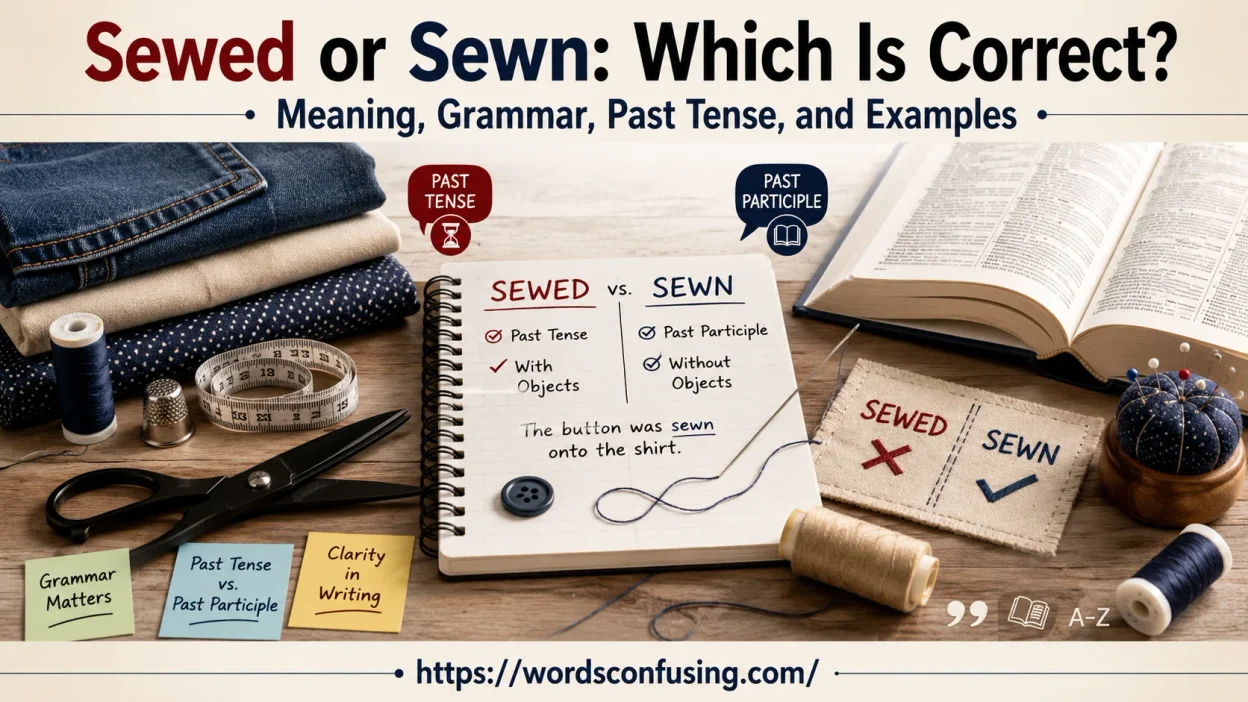
Sewed or Sewn: Which Is Correct? Many English learners get confused because sewed and sewn come from the verb sew, yet each form has a different role.
In everyday English, both words describe the same action of joining fabric with a needle and thread, but the difference is easy to understand once you learn the simple rule. Sewed works as the simple past tense and may also work as a past participle, while sewn only works as the past participle and usually requires an auxiliary verb before it.
This overlap makes sew an irregular verb with an unusual pattern and multiple forms, which can seem tricky or difficult at first. The good news is that you can remember the pattern by looking at clear examples. “She sewed the dress yesterday” uses the simple past, while “She has sewn the dress” uses the past participle.
In this article, I’ll explain the case of sew in clear, beginner-friendly language, so you can figure out how these two different forms work and use both correctly. English learners should know that plenty of examples can make this difference easier to remember.
Quick Answer
Both “sewed” and “sewn” are correct, but they usually appear in different grammatical situations.
- Sewed = simple past: She sewed the dress yesterday.
- Sewn = past participle: She has sewn the dress.
- Sewed can also be used as a past participle: She has sewed several costumes.
Quick rule: Use sewed for a simple past action. Use sewn after has, have, or had in most cases.
Sewed or Sewn: What’s the Difference?
The easiest way to understand sewed vs. sewn is to look at their grammatical jobs.
| Word | Verb form | Main use | Example |
| sew | Base form | Present tense, infinitive, commands | I sew clothes. |
| sews | Third-person singular | Present tense with he, she, it | She sews dresses. |
| sewed | Simple past | Completed action in the past | She sewed the dress yesterday. |
| sewn | Past participle | Perfect tenses and many passive constructions | She has sewn the dress. |
| sewed | Past participle | Alternative participle form | She has sewed several costumes. |
| sewing | -ing form | Continuous tenses and gerunds | She is sewing a dress. |
This distinction matters because verb tense determines which form fits naturally.
Consider these two sentences:
She sewed the dress yesterday.
She has sewn the dress already.
Both sentences describe sewing. The difference lies in the grammatical structure.
The first sentence uses sewed as the simple past. The second uses sewn as a past participle after has.
That’s the key.
What Does “Sewed” Mean?
Sewed is the simple past form of the verb sew.
The verb sew means to join, repair, attach, or make something with a needle and thread. Merriam-Webster defines it as joining or fastening something by stitches.
When you use sewed, you’re talking about an action that happened in the past.
Examples of “Sewed”
- She sewed a button onto her coat.
- I sewed the torn pocket last night.
- He sewed the patch onto his backpack.
- Maria sewed her daughter’s costume.
- We sewed the pieces together by hand.
- The tailor sewed the hem before lunch.
- They sewed curtains for the new house.
- My grandmother sewed quilts for years.
- I sewed the rip in my jeans.
- The designer sewed the final seam herself.
Notice the pattern:
Subject + sewed + object
For example:
She + sewed + the dress.
The action happened in the past. That’s why sewed works.
What Is the Past Tense of “Sew”?
The past tense of sew is sewed.
This point is straightforward. Cambridge Dictionary identifies sewed as the past-tense form of sew, while Merriam-Webster lists sewed first among the verb’s inflected forms.
Simple Past Examples
- I sewed a pillowcase yesterday.
- She sewed the button back on.
- He sewed a patch onto his uniform.
- We sewed the costumes last weekend.
- They sewed the fabric together.
- The tailor sewed the sleeve back into place.
Time expressions often make the simple-past meaning especially clear.
Common examples include:
- yesterday
- last night
- last week
- last month
- two days ago
- earlier today
- in 2025
- when I was younger
- during the summer
For example:
She sewed the entire costume last weekend.
You wouldn’t normally replace sewed with sewn in that sentence.
Incorrect:
❌ She sewn the entire costume last weekend.
Correct:
✅ She sewed the entire costume last weekend.
The problem isn’t the meaning. The problem is the verb form.
What Is the Past Participle of “Sew”?
The past participle of sew can be sewn or sewed.
This is where the topic gets more interesting.
Oxford Learner’s Dictionaries explicitly lists both sewed and sewn as past participles. Cambridge does the same. Merriam-Webster gives sewn and sewed as accepted forms as well.
Still, sewn is the form you’ll commonly encounter in many perfect-tense and passive constructions.
For example:
She has sewn the dress.
The button was sewn onto the jacket.
They had sewn the pieces together.
These sentences sound natural because sewn functions as the past participle.
“Have,” “Has,” and “Had” + Sewn
Perfect tenses normally use a helping verb followed by a past participle.
The basic patterns are:
have + sewn
has + sewn
had + sewn
Examples:
- I have sewn three dresses.
- She has sewn the final seam.
- They have sewn the patches onto the uniforms.
- He had sewn the costume before the show.
- We had sewn all the pieces together by noon.
This structure makes sewn a natural choice.
Can “Sewed” Also Be a Past Participle?
Yes.
This is one of the most important facts about sewed vs. sewn.
Some grammar explanations incorrectly tell readers that sewed is only the past tense. That’s too restrictive. Major dictionaries recognize sewed as an alternative past participle.
That means these sentences can both be grammatically acceptable:
She has sewn several costumes.
She has sewed several costumes.
The first version is often the more familiar choice. However, the second isn’t automatically wrong.
Merriam-Webster lists the verb as “sewed; sewn or sewed; sewing,” while Oxford gives both forms in its verb-form table.
So, if you’re writing polished standard American English, sewn is usually the safest and most natural past participle to choose.
That doesn’t make sewed grammatically impossible.
Sewed vs. Sewn in American English
American English uses both forms.
Oxford’s American English entry lists:
- past simple: sewed
- past participle: sewed
- past participle: sewn
- -ing form: sewing
Cambridge’s American Dictionary entry also gives sewed as the past tense and sewn or sewed as the past participle.
Therefore, you don’t need to treat sewn as the only possible participle.
However, if you’re choosing the form that will sound most familiar to most readers, sewn usually makes the cleaner choice in constructions such as:
- has sewn
- have sewn
- had sewn
- was sewn
- were sewn
- hand-sewn
- machine-sewn
Think of sewn as the polished default for many participial structures.
Sewed or Sewn: Simple Comparison
Here’s the quickest way to see the difference.
| Sentence | Correct? | Why? |
| She sewed the dress yesterday. | ✅ | Simple past |
| She sewn the dress yesterday. | ❌ | “Sewn” isn’t the simple past form |
| She has sewn the dress. | ✅ | Past participle |
| She has sewed the dress. | ✅ | Alternative past participle |
| She had sewn the dress. | ✅ | Past participle |
| She had sewed the dress. | ✅ | Alternative past participle |
| The dress was sewn by hand. | ✅ | Past participle in passive construction |
| The dress was sewed by hand. | ✅ | Alternative past participle |
| She is sewing the dress. | ✅ | -ing form |
| She sew the dress yesterday. | ❌ | Base form doesn’t fit simple past |
The table reveals an important pattern: grammar determines the form more than the meaning does.
When to Use “Sewed”
Use sewed when you’re describing a completed action in the simple past.
The action happened before now. You don’t need has, have, or had to form the tense.
Common Pattern
Subject + sewed + object
Examples:
- I sewed a button onto my shirt.
- She sewed a tear in the curtain.
- He sewed a badge onto his jacket.
- We sewed the quilt together.
- They sewed costumes for the theater production.
“Sewed” With Specific Past Times
Specific time expressions often signal the simple past.
I sewed the button yesterday.
She sewed the costume last weekend.
We sewed the curtains two days ago.
He sewed the patch this morning.
The important thing isn’t the time expression alone. The sentence structure matters too.
For example:
I have sewn the button on.
This sentence refers to a completed action too. However, it uses the present perfect, so sewn functions as the participle.
When to Use “Sewn”
Use sewn primarily as a past participle.
You’ll often see it after has, have, and had.
Sentences Using “Has Sewn”
- She has sewn the final seam.
- He has sewn several costumes.
- Maria has sewn a new dress.
- The tailor has sewn the lining into the jacket.
Examples of “Have Sewn” in a Sentence
- We have sewn the pieces together.
- They have sewn every patch by hand.
- I have sewn the torn fabric back together.
- You have sewn the buttons in the wrong position.
How to Use “Had Sewn” in Sentences
- She had sewn the dress before the ceremony.
- We had sewn the costumes before rehearsal.
- He had sewn the patch onto his jacket.
- They had sewn the pieces together before the machine broke.
The pattern is simple:
has/have/had + sewn
Once you recognize that structure, the choice becomes much easier.
Sewn in Passive Constructions
Sewn also appears frequently in passive sentences.
A passive construction usually follows this pattern:
Subject + form of “be” + past participle
For example:
The dress was sewn by hand.
Here, was acts as the helping verb while sewn supplies the past participle.
More examples include:
- The buttons were sewn onto the coat.
- The costumes were sewn by professional tailors.
- The patch was sewn onto the sleeve.
- The lining was sewn into the jacket.
- The wound was sewn closed.
Cambridge specifically uses sewn in examples involving stitches and medical treatment.
That medical use is worth noting because sew doesn’t only describe fabric. The verb can also describe joining the edges of a wound with stitches.
Can You Say “Was Sewed”?
Yes.
Because sewed can function as a past participle, the sentence isn’t automatically grammatically wrong.
For example:
The costume was sewed by hand.
However, was sewn is generally the more familiar and natural wording for many readers:
The costume was sewn by hand.
This distinction matters when you’re polishing formal or professional writing. If both options are acceptable, choosing the more widely familiar form can make your sentence feel smoother.
Sewed, Sewn, and Sewing: Complete Verb Forms
The verb sew has several useful forms.
| Form | Word | Example |
| Base form | sew | I sew clothes. |
| Third-person singular | sews | She sews dresses. |
| Simple past | sewed | She sewed a dress. |
| Past participle | sewn | She has sewn a dress. |
| Past participle | sewed | She has sewed several costumes. |
| Present participle | sewing | She is sewing a dress. |
Oxford confirms these forms in its current verb-form listing.
Sew
Use sew for the base form.
I like to sew.
She wants to sew a new dress.
Can you sew this button on?
Sews
Use sews with he, she, or it in the present tense.
She sews her own clothes.
My grandmother sews beautifully.
Sewed
Use sewed as the simple past.
I sewed the tear yesterday.
Sewn
Use sewn as a past participle.
I have sewn the tear shut.
Sewing
Use sewing in continuous forms and as a gerund.
She is sewing a new dress.
Sewing takes patience and practice.
Oxford defines sewing as the activity of making, repairing, or decorating cloth items with a needle and thread.
20 Examples of “Sewed” in Sentences
The best way to master sewed or sewn is to see the forms working in real sentence patterns.
Here are examples using sewed as the simple past:
- I sewed a button onto my coat.
- She sewed the torn pocket last night.
- He sewed a patch onto his jeans.
- We sewed the costumes for the school play.
- Maria sewed a beautiful quilt by hand.
- The tailor sewed the hem before noon.
- They sewed the fabric together carefully.
- My aunt sewed curtains for the living room.
- I sewed the loose strap back onto the bag.
- The designer sewed the final seam herself.
- She sewed a zipper into the jacket.
- He sewed the badge onto his uniform.
- We sewed several pieces of fabric together.
- The tailor sewed the lining into the coat.
- I sewed the hole in my favorite shirt.
- She sewed the costume during the weekend.
- They sewed decorative patterns onto the fabric.
- He sewed the ripped cushion cover.
- My grandmother sewed blankets for the family.
- The artisan sewed every detail by hand.
Notice how sewed works naturally without a perfect-tense helping verb.
20 Examples of “Sewn” in Sentences
Now look at sewn in participial constructions:
- She has sewn three dresses this month.
- I have sewn the button back onto the shirt.
- He has sewn the patch onto his jacket.
- We have sewn all the pieces together.
- They have sewn the costumes by hand.
- She had sewn the dress before the ceremony.
- He had sewn the torn seam before leaving.
- We had sewn the patches onto the uniforms.
- The dress was sewn by hand.
- The buttons were sewn onto the coat.
- The patch was sewn onto the sleeve.
- The costume was sewn by a local tailor.
- The lining was sewn into the jacket.
- The pieces were sewn together carefully.
- The label was sewn into the collar.
- The quilt was sewn from dozens of fabric pieces.
- The bag was sewn from recycled material.
- She had sewn the final seam before dinner.
- The decorative pattern was sewn into the fabric.
- Every button had been sewn on by hand.
These examples show why sewn appears so frequently in polished writing.
Read more: Great Minds Think Alike: Meaning and Origin
Sewed vs. Sewn: A Real-World Grammar Case Study
Consider a tailor who finishes a jacket on Monday.
If the sentence simply tells us what happened on Monday, use sewed:
The tailor sewed the buttons onto the jacket on Monday.
Now suppose the speaker focuses on the completed result rather than the specific past event:
The tailor has sewn the buttons onto the jacket.
The action is still the same. The grammatical perspective has changed.
Here’s the comparison:
| Meaning | Sentence | Form |
| Completed past action | The tailor sewed the buttons yesterday. | Simple past |
| Present result | The tailor has sewn the buttons on. | Present perfect |
| Earlier completed action | The tailor had sewn the buttons before noon. | Past perfect |
| Focus on the jacket | The buttons were sewn onto the jacket. | Passive |
Think of the verb forms as different camera angles.
Sewed tells you about the past event.
Sewn often connects that event to another grammatical structure.
That small shift explains most cases of sewed vs. sewn.
Common Mistakes With Sewed and Sewn
Mistake: Using “Sewn” as the Simple Past
A frequent error looks like this:
❌ She sewn the dress yesterday.
The corrected version is:
✅ She sewed the dress yesterday.
Why?
Because the sentence uses the simple past. Sewn is a past participle rather than the standard simple-past form.
Mistake: Assuming “Sewed” Is Always Wrong
This rule goes too far:
❌ “She has sewed the dress” is always incorrect.
That’s not accurate.
Dictionaries recognize sewed as an alternative past participle.
Therefore:
✅ She has sewn the dress.
and
✅ She has sewed the dress.
can both be acceptable.
Still, has sewn is usually the smoother choice for standard modern writing.
Mistake: Confusing “Sewn” With “Sewing”
These words have different grammatical jobs.
Sewn = past participle
Sewing = -ing form
Compare:
The dress was sewn yesterday.
She is sewing the dress now.
The first sentence describes a completed result. The second describes an ongoing activity.
Mistake: Writing “Sew” for the Past
Another common error is:
❌ She sew the dress yesterday.
The correct sentence is:
✅ She sewed the dress yesterday.
The base form sew doesn’t normally serve as the simple past.
Sewed or Sewn in Questions
The same grammar rules apply when you ask questions.
Simple Past Questions
Use did + sew.
Did she sew the dress?
Have you sewn the button back on?
Were they able to sew the costumes themselves?
Notice something important: after did, use the base form sew, not sewed.
Incorrect:
❌ Did she sewed the dress?
Correct:
✅ Did she sew the dress?
That’s because did already carries the past tense.
Present Perfect Questions
Use has/have + sewn.
Has she sewn the dress?
Have you sewn the button on?
Have they sewn the costumes yet?
Again, the grammatical structure controls the form.
Sewed or Sewn in Negative Sentences
Negative sentences follow the same patterns.
Simple Past
Use didn’t + sew:
She didn’t sew the dress yesterday.
I didn’t sew the button back on.
They didn’t sew the costumes themselves.
Present Perfect
Use hasn’t/haven’t + sewn:
She hasn’t sewn the dress yet.
I haven’t sewn the button back on.
They haven’t sewn the patches onto the jackets.
This is a useful shortcut:
didn’t → sew
hasn’t/haven’t → sewn
Sewed or Sewn in Formal Writing
For formal writing, academic work, professional documents, and polished web content, sewn often provides the most natural past-participle choice.
For example:
The labels were sewn into the garments.
sounds more familiar to many readers than:
The labels were sewed into the garments.
Both forms can be supported by dictionary usage. However, style isn’t only about grammatical possibility. Naturalness matters too.
When two accepted forms exist, writers often prefer the one that readers encounter more frequently in that construction.
That makes sewn a useful default when you’re unsure.
“Hand-Sewn” and Other Uses of Sewn
The word sewn can also appear in compound adjectives.
Common examples include:
- hand-sewn
- machine-sewn
- custom-sewn
- professionally sewn
Examples:
She bought a hand-sewn leather bag.
The costume features hand-sewn decorations.
The jacket has a machine-sewn lining.
These expressions describe something that has been produced or finished through sewing.
Merriam-Webster’s current examples include compounds such as hand-sewn, which reflects how naturally this form appears in modern English.
Sew vs. So vs. Sow
There’s another reason sew causes confusion: pronunciation.
In American English, sew is pronounced like “so.” Oxford identifies sew, so, and sow as homophones.
Their meanings are completely different.
| Word | Meaning | Example |
| sew | Join with needle and thread | I can sew a button on. |
| so | Used to indicate result, degree, or addition | The fabric was so soft. |
| sow | Plant seeds | Farmers sow seeds in spring. |
The pronunciation can create confusion in speech, but spelling makes the distinction clear.
Sewed or Sewn: Which One Should You Use?
If you’re still unsure, use this practical guide.
| If you’re writing… | Use |
| A simple past statement | sewed |
| A sentence with did | sew |
| A sentence with has | Usually sewn |
| A sentence with have | Usually sewn |
| A sentence with had | Usually sewn |
| A passive construction | Usually sewn |
| A compound adjective | sewn |
| An -ing construction | sewing |
The simplest rule
Use “sewed” for the simple past.
She sewed the dress yesterday.
Use “sewn” for the past participle in most polished constructions.
She has sewn the dress.
Remember that “sewed” can also be a past participle.
She has sewed the dress.
This final point separates an accurate grammar explanation from an oversimplified one.
FAQs
1. Is “sewed” or “sewn” correct?
Both sewed and sewn are correct forms of the verb sew. The right choice depends on how you use the verb in a sentence.
2. Is “sewed” the past tense of “sew”?
Yes. Sewed is the simple past tense of sew. For example: “She sewed a button onto her shirt yesterday.”
3. Is “sewn” the past tense of “sew”?
No. Sewn is normally used as the past participle. It usually appears with an auxiliary verb such as has, have, or had.
4. Can “sewed” be used as a past participle?
Yes. Sewed can also function as a past participle, although sewn is very common in many constructions. For example: “She has sewed the pieces together.”
5. Which sounds more natural: “sewed” or “sewn”?
It depends on the sentence. “She sewed the dress” is natural for the simple past, while “She has sewn the dress” is natural when using the present perfect.
6. How can I remember the difference between “sewed” and “sewn”?
A simple way to remember it is sewed = simple past and sewn = commonly used past participle. Look for an auxiliary verb before sewn to spot the pattern quickly.
Conclusion
Knowing the difference between sewed and sewn is easier than it first seems. Sewed is commonly used as the simple past tense, while sewn is generally used as a past participle, often with an auxiliary verb. For example, “She sewed the dress yesterday” uses the simple past, while “She has sewn the dress” uses the past participle.
Once you understand this simple pattern, you won’t need to second-guess these two forms every time you write or speak. A little practice with everyday examples can help you recognize when sewed or sewn sounds right and use both forms with confidence.

Franklin Hayes is a writer and editor at WordsConfusing.com, focused on making English vocabulary, grammar, and commonly confused words easy to understand. He writes clear, practical articles with simple explanations and useful examples to help readers improve their English with confidence.
His goal is simple: Making Confusing Words Simple.