

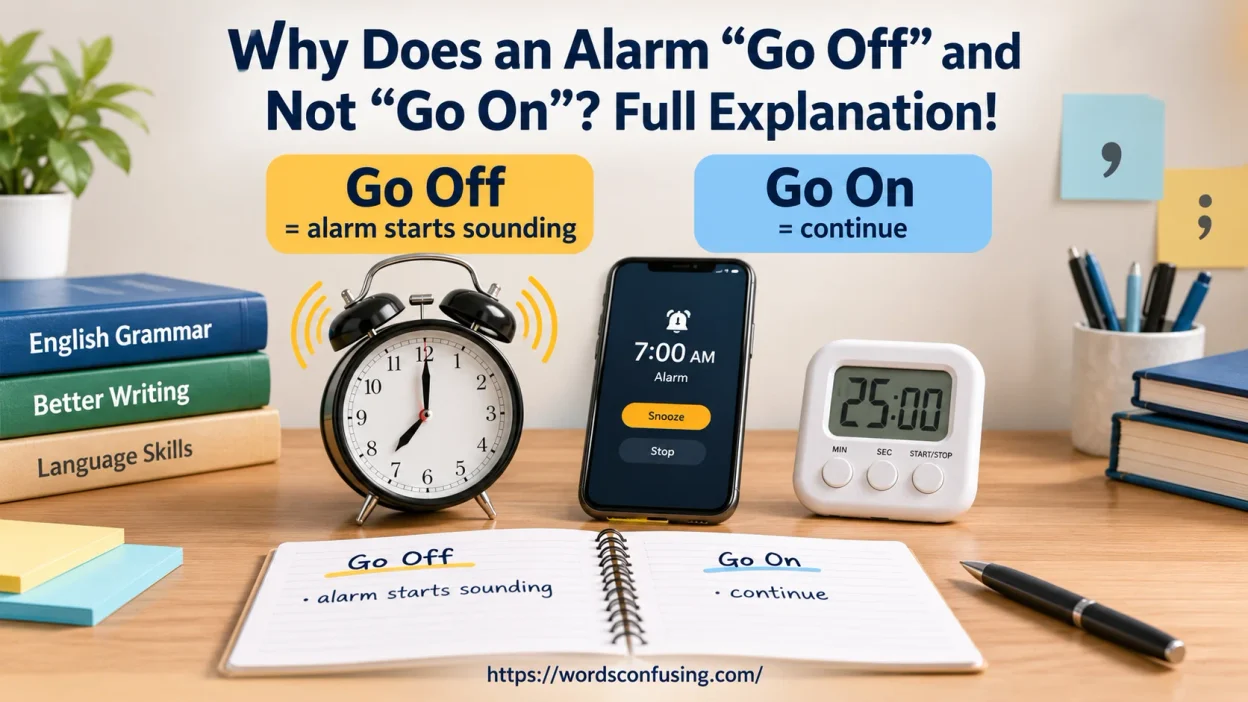
Why Does an Alarm “Go Off” and Not “Go On”? Full Explanation! English usage makes this phrase natural because “go off” is a phrasal verb linked with an alarm starting its sound or ring.
When an alarm clock, phone alarm, or alarm system becomes active, native speakers say it goes off, even when go on seems logical. This common expression developed through language use, language evolution, and accepted usage, rather than strict logic.
Its meaning depends on context, grammar, and familiar language patterns.The difference becomes clearer in scheduling, time management, calendar reminders, meetings, and task management. An alarm sends a notification or auditory signal when its activation occurs.
Therefore, alarm goes off describes the event naturally, while alarm goes on expresses another idea. This idiomatic usage appears in everyday English, professional communication, formal writing, business settings, and modern technology.
Understanding prepositions, grammatical usage, phrasal verbs, semantics, and contextual meaning explains why this expression remains widely accepted.
Quick Answer
An alarm goes off because go off is an established English phrasal verb meaning that an alarm or warning device starts making a sudden sound or signal.
For example:
My alarm went off at 6:30 this morning.
This means the alarm began ringing or beeping at 6:30.
By contrast, go on usually means to continue, happen, or proceed. For example:
The alarm went on ringing for another five minutes.
Here, went on doesn’t describe the moment the alarm started. It describes the fact that the ringing continued.
The distinction becomes clearer when you compare these sentences:
| Expression | Meaning | Example |
| go off | Start making an alarm sound | “My alarm went off at 7.” |
| go on | Continue or happen | “The alarm went on ringing.” |
| turn on | Activate something manually | “I turned on the alarm system.” |
| turn off | Stop or deactivate something | “I turned off the alarm.” |
| keep going | Continue operating or sounding | “The alarm kept going for five minutes.” |
The important point is simple: “go off” doesn’t mean an alarm stops. In this context, it means the alarm activates or sounds.
What Does “Go Off” Mean When We Talk About an Alarm?
When you use go off with an alarm, timer, bell, buzzer, or similar warning device, it means that the device starts making a sudden noise or alert.
Cambridge Dictionary defines this alarm-related use as a warning device beginning to ring loudly or make a loud noise. Oxford gives the same general meaning for alarms and similar devices.
Consider these examples:
- My alarm goes off at 6:00 every morning.
- The fire alarm went off during the drill.
- The timer went off after twenty minutes.
- Her car alarm went off in the parking lot.
- The security alarm suddenly went off.
- The oven timer will go off when the food is ready.
In every example, go off describes the moment when the warning device activates or produces its alert.
The phrase works with both simple and sophisticated alarm systems. A traditional alarm clock can go off. So can a modern phone alarm, smoke detector, security system, kitchen timer, or vehicle alarm.
Why “Go Off” Feels Confusing
The confusion comes from the ordinary meaning of off.
In everyday English, off often suggests that something isn’t operating.
For example:
- The television is off.
- The lights are off.
- The computer is off.
- Turn the fan off.
Naturally, you might assume that go off means “stop working.”
Sometimes it does.
However, phrasal verbs don’t always behave like simple mathematical formulas. You can’t assume that go + off will always equal “stop.”
English has developed many fixed combinations where the complete phrase carries its own meaning.
That’s why go off can mean different things depending on the noun and context.
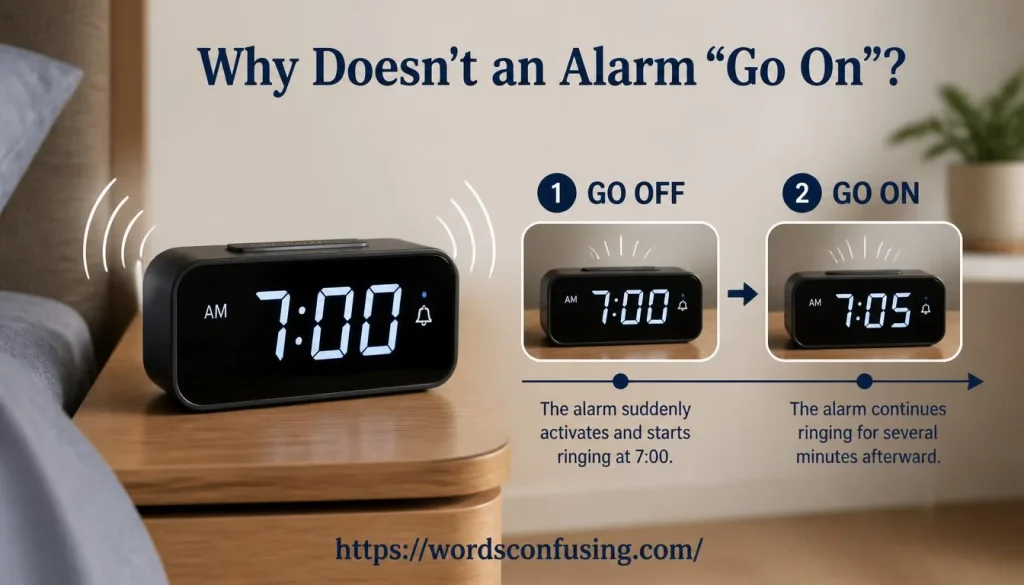
Why Doesn’t an Alarm “Go On”?
The phrase go on already has several established meanings in English. The most common ones involve continuation and happening.
For example:
The meeting went on for three hours.
Here, went on means continued.
You might also say:
What’s going on?
Here, going on means happening.
Cambridge and Oxford both list meanings of go on that include continuing, happening, and remaining in progress.
That’s why go on doesn’t normally describe the initial moment when an alarm begins sounding.
Compare these two sentences:
The alarm went off at 7:00.
The alarm went on ringing until 7:10.
The first sentence tells you when the alarm started sounding.
The second tells you how long the sound continued.
That difference is crucial.
“Go Off” Describes Activation
When an alarm goes off, something triggers its alert.
That trigger could be:
- A preset time
- Detected smoke
- Movement
- A security breach
- A timer reaching zero
- A door opening
- A vehicle disturbance
- A temperature threshold
For example:
The smoke alarm went off when the sensor detected smoke.
The phrase focuses on the alarm’s activation.
“Go On” Describes Continuation
When you use go on with an alarm, the phrase usually needs additional wording to make the intended meaning clear.
For example:
The alarm went on ringing for several minutes.
The alarm had already started. The phrase went on ringing tells you that the action continued.
You could also write:
The alarm continued to ring.
That’s often the clearest alternative.
“Go Off” Is a Phrasal Verb
The grammar behind this expression becomes easier once you understand phrasal verbs.
A phrasal verb combines a verb with another short word, often called a particle. The resulting expression can have a meaning that differs from the original verb.
For example:
- give up = stop trying
- find out = discover
- wake up = stop sleeping
- turn down = reduce or reject
- go on = continue or happen
- go off = activate, explode, leave, or change state depending on context
The word go doesn’t carry the entire meaning by itself.
The particle off changes the meaning.
That’s why translating every word separately can lead you astray.
If you translated go off literally as “move away from something,” you’d miss the alarm meaning entirely.
English learners encounter this problem frequently because phrasal verbs often resist word-for-word interpretation.
What Does “Off” Contribute to “Go Off”?
The word off has many uses in English.
It can describe separation:
The plane took off.
It can describe something not operating:
The television is off.
It can describe movement away:
She went off to college.
It can also appear in expressions connected with sudden events or activation.
With an alarm, go off became an established expression meaning that the device suddenly produces its warning sound.
Oxford lists several meanings of go off, including an alarm making a sudden loud noise, a bomb exploding, a person leaving, and a light or electrical system stopping.
So the meaning depends heavily on context.
That’s one reason English can feel quirky. The same two-word combination can behave like several different expressions.
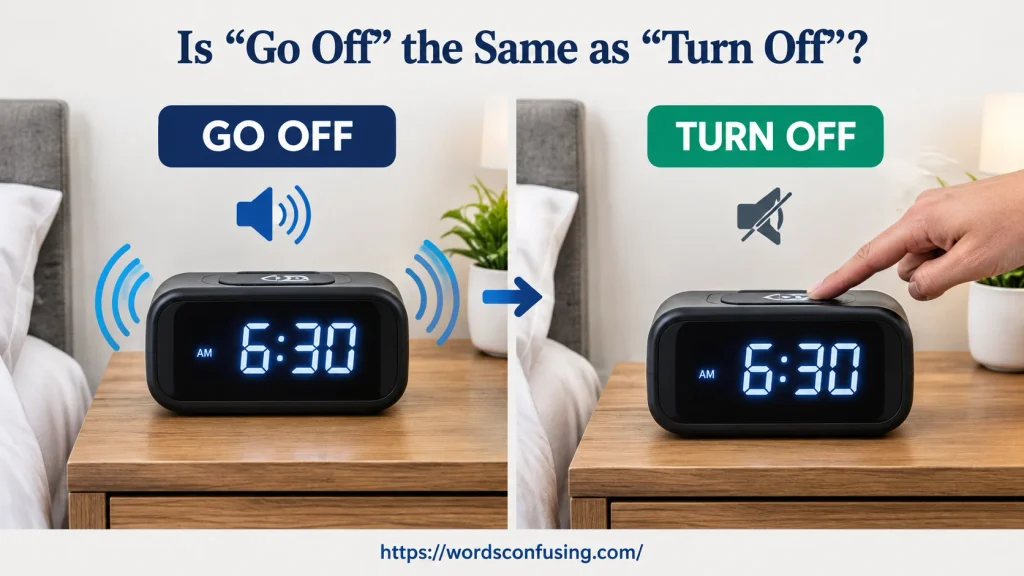
Is “Go Off” the Same as “Turn Off”?
No. These phrases describe different actions.
This distinction causes another common mistake.
“The Alarm Went Off”
The alarm went off at 6:30.
This means the alarm started sounding.
The alarm activated according to its setting or trigger.
“I Turned Off the Alarm”
I turned off the alarm at 6:35.
This means someone stopped or deactivated the alarm.
The two sentences can describe the same event from opposite points in time:
My alarm went off at 6:30, so I turned it off at 6:31.
First, the alarm activated.
Then, the person stopped it.
That’s why go off and turn off shouldn’t be treated as synonyms.
| Phrase | What happens? |
| The alarm went off. | The alarm started sounding. |
| I turned off the alarm. | Someone stopped the alarm. |
| The alarm is going off. | The alarm is sounding now. |
| The alarm keeps going off. | The alarm repeatedly activates. |
| The alarm went on ringing. | The alarm continued to ring. |
“Turn On” and “Go Off” Are Different Too
You might wonder why English doesn’t simply say:
The alarm went on at 7:00.
Interestingly, go on can describe something beginning to operate in some contexts.
For example:
The lights went on.
Oxford specifically recognizes go on as a way to describe lights or electricity beginning to work.
However, English uses go off for warning devices that suddenly begin making noise.
So these patterns developed differently:
- The light went on.
- The alarm went off.
- The television turned on.
- The alarm sounded.
Language doesn’t always create perfectly symmetrical pairs.
That’s an important lesson for English learners. Two words that appear to be opposites don’t necessarily produce opposite expressions in every situation.
Why English Doesn’t Follow Perfect Logic Here
English contains thousands of expressions that make sense only when you understand their conventional usage.
Consider these examples:
- The plane took off.
- The meeting broke up.
- The baby woke up.
- The alarm went off.
- The lights went on.
You can understand the individual words, but the complete expression carries a specific meaning.
This is especially common with phrasal verbs.
Trying to build every expression from literal meanings can create awkward sentences.
Instead, learn the phrase as a complete unit.
Think of go off as a vocabulary item when you’re talking about alarms.
You don’t need to mentally calculate its meaning every time.
Different Meanings of “Go Off”
One reason go off seems confusing is that English uses it in several unrelated situations.
Context tells you which meaning applies.
“Go Off” Can Mean an Alarm Sounds
This is the meaning discussed throughout this article.
The alarm went off at midnight.
The alarm started making its warning sound.
“Go Off” Can Mean Something Explodes
English also uses go off for bombs, guns, and fireworks.
The fireworks went off at midnight.
The gun went off unexpectedly.
The bomb went off before the area was evacuated.
Oxford and Cambridge both recognize this use for explosives and firearms.
Context makes the meaning obvious.
An alarm goes off by making a sound.
A bomb goes off by exploding.
The same phrasal verb works differently because the subject changes.
“Go Off” Can Mean Leave
You can also use go off to mean leaving a place.
She went off to college.
He went off to find his keys.
Here, off emphasizes movement away from the current location.
“Go Off” Can Mean Food Becomes Spoiled
In British English, go off can describe food that becomes bad or unsafe to eat.
The milk has gone off.
The cheese went off because nobody refrigerated it.
This meaning doesn’t normally appear in American everyday speech in the same way. American speakers often say that food went bad, spoiled, or spoiled quickly.
Cambridge and Oxford both identify the food-related meaning as British English usage.
“Go Off” Can Mean Become Angry
In informal North American English, go off on someone can mean suddenly becoming angry or speaking angrily.
He went off on his brother during the argument.
This is completely different from an alarm going off.
Again, context does the heavy lifting.
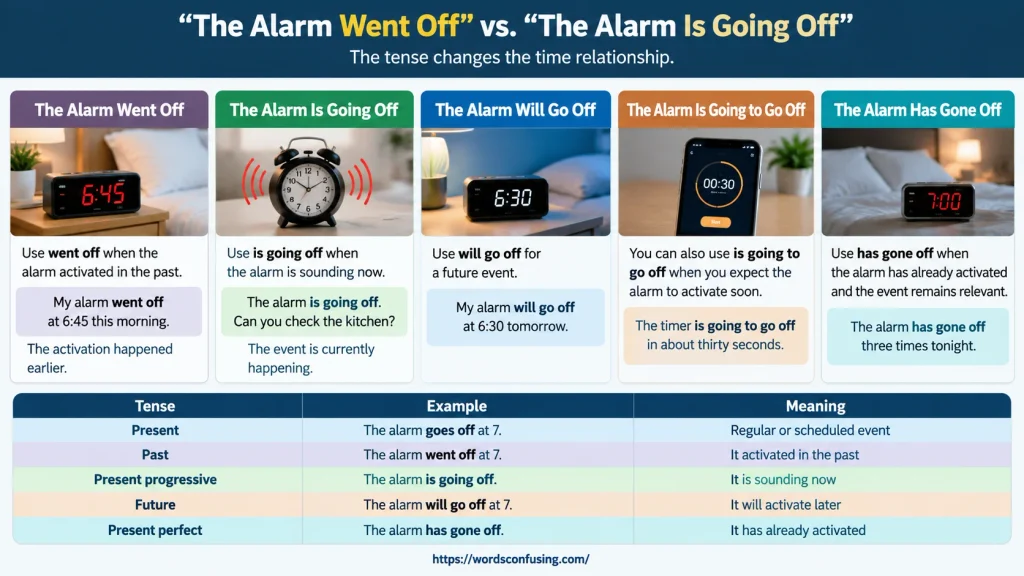
“The Alarm Went Off” vs. “The Alarm Is Going Off”
The tense changes the time relationship.
The Alarm Went Off
Use went off when the alarm activated in the past.
My alarm went off at 6:45 this morning.
The activation happened earlier.
The Alarm Is Going Off
Use is going off when the alarm is sounding now.
The alarm is going off. Can you check the kitchen?
The event is currently happening.
The Alarm Will Go Off
Use will go off for a future event.
My alarm will go off at 6:30 tomorrow.
The Alarm Is Going to Go Off
You can also use is going to go off when you expect the alarm to activate soon.
The timer is going to go off in about thirty seconds.
The Alarm Has Gone Off
Use has gone off when the alarm has already activated and the event remains relevant.
The alarm has gone off three times tonight.
These forms allow you to describe the same basic event across different time frames.
| Tense | Example | Meaning |
| Present | The alarm goes off at 7. | Regular or scheduled event |
| Past | The alarm went off at 7. | It activated in the past |
| Present progressive | The alarm is going off. | It is sounding now |
| Future | The alarm will go off at 7. | It will activate later |
| Present perfect | The alarm has gone off. | It has already activated |
Common Alarm Expressions You Should Know
English offers several natural expressions for talking about alarms.
Knowing the differences will help you sound more precise.
Set an Alarm
Set an alarm means program it for a particular time or condition.
I set my alarm for 6:30.
You don’t usually say make an alarm when you mean programming it.
An Alarm Goes Off
This describes activation.
My alarm goes off every weekday morning.
An Alarm Rings
Ring focuses on the sound.
My alarm rang at 6:30.
This works especially well with traditional alarm clocks.
An Alarm Sounds
Sound is more formal and works well in safety or technical contexts.
The emergency alarm sounded throughout the building.
An Alarm Beeps
Use beep when the device produces short electronic tones.
My phone beeped when the reminder activated.
An Alarm Keeps Going Off
This often means the alarm repeatedly activates.
The car alarm keeps going off whenever it rains.
Notice the important difference:
The alarm went off once.
The alarm keeps going off.
The first describes one activation.
The second suggests repeated activations.
Turn Off an Alarm
This describes stopping the alarm.
I turned off my alarm and went back to sleep.
Silence an Alarm
Silence is useful when you specifically mean stopping the audible sound.
Press the button to silence the alarm.
The system itself may remain armed even after you silence the sound.
Can You Say “The Alarm Went On”?
Usually, not if you mean the alarm started sounding.
That would sound unnatural to most English speakers.
However, went on can work when you describe continued activity.
For example:
The alarm went on ringing for ten minutes.
This sentence is grammatically fine because went on means continued.
You could also say:
The alarm went on sounding after everyone left the room.
Or:
The alarm kept ringing until someone reset it.
The problem isn’t that go on can never appear near the word alarm.
The problem occurs when someone uses go on to mean activate an alarm.
Go Off, Ring, Sound, Buzz, and Beep
These expressions overlap, but they aren’t identical.
| Expression | Main idea | Example |
| go off | An alarm activates | “The alarm went off.” |
| ring | A device produces a ringing sound | “The alarm rang loudly.” |
| sound | A warning device produces an alert | “The emergency alarm sounded.” |
| buzz | A device produces a buzzing noise | “The timer buzzed.” |
| beep | A device produces short electronic tones | “The oven beeped.” |
| go on ringing | The ringing continues | “The alarm went on ringing.” |
| keep going off | The alarm activates repeatedly | “The alarm keeps going off.” |
This vocabulary gives you more control over your writing.
If you’re simply describing activation, go off is usually the natural choice.
If you’re describing the actual noise, ring, buzz, or beep may be more specific.
A Simple Case Study: The Morning Alarm
Imagine that you set your phone alarm for 7:00 a.m.
At 7:00, the phone begins playing your alarm sound.
You could say:
My alarm went off at 7:00.
At 7:01, you press the stop button.
I turned off the alarm.
Now imagine that you don’t wake up immediately.
The alarm continues making noise.
The alarm went on ringing for another minute.
If the phone repeats the alarm later, you might say:
My alarm went off again.
This short situation demonstrates four different expressions without changing the basic event.
| Moment | Natural expression |
| 7:00 — alarm activates | The alarm went off. |
| Alarm is sounding | The alarm is going off. |
| Alarm continues sounding | The alarm went on ringing. |
| You stop it | I turned off the alarm. |
Once you see the sequence, the difference becomes much easier.
Common Mistakes With “Go Off” and “Go On”
Mistake: “My Alarm Went On at Seven”
If you mean that your alarm started ringing, use:
My alarm went off at seven.
Went on doesn’t carry that alarm-activation meaning.
Mistake: “I Went Off My Alarm”
This construction doesn’t normally mean that you stopped your alarm.
Instead, say:
I turned off my alarm.
Or:
I switched off my alarm.
Mistake: “The Alarm Went Off, So It Stopped”
This interpretation reverses the usual alarm meaning.
In this context, went off means the alarm started sounding.
If the alarm stopped, say:
The alarm stopped.
Or:
I turned off the alarm.
Mistake: Assuming “Off” Always Means “Not Working”
That’s true in some contexts.
It isn’t true in every phrasal verb.
For example:
The lights are off.
means the lights aren’t operating.
But:
The alarm went off.
means the alarm activated and began producing its warning.
The surrounding words determine the meaning.
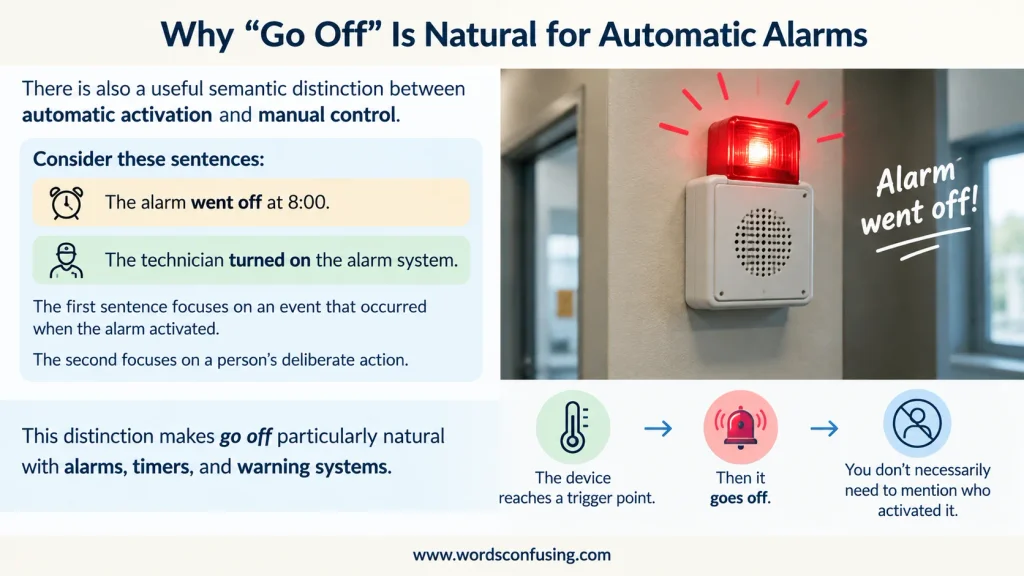
Why “Go Off” Is Natural for Automatic Alarms
There is also a useful semantic distinction between automatic activation and manual control.
Consider these sentences:
The alarm went off at 8:00.
The technician turned on the alarm system.
The first sentence focuses on an event that occurred when the alarm activated.
The second focuses on a person’s deliberate action.
This distinction makes go off particularly natural with alarms, timers, and warning systems.
The device reaches a trigger point.
Then it goes off.
You don’t necessarily need to mention who activated it.
“Go On” Has Its Own Useful Alarm Expressions
Although go on doesn’t normally mean an alarm activates, it remains useful in alarm-related sentences.
For example:
The alarm went on ringing for five minutes.
The alarm went on sounding after the first warning.
The noise went on until someone reset the system.
In each sentence, go on emphasizes duration.
The alarm had already started.
The action continued.
That distinction is worth remembering:
Go off = activation.
Go on = continuation.
It’s not a perfect rule for every use of these phrasal verbs. However, it works well when you’re talking about alarms.
A Quick Grammar Pattern for Alarm Sentences
You can use these structures to build natural sentences.
Regular Schedule
Subject + goes off + time
My alarm goes off at 6:30 every morning.
Past Event
Subject + went off + time
The alarm went off during the meeting.
Current Event
Subject + is going off
The fire alarm is going off.
Future Event
Subject + will go off + time
The timer will go off in ten minutes.
Repeated Activation
Subject + keeps going off
The smoke alarm keeps going off.
Continued Sound
Subject + went on + verb-ing
The alarm went on ringing for several minutes.
These patterns cover most everyday situations.
Read more: 15 Best Replies to “You’re Mine” Funny and Confident
Why “The Alarm Went Off” Sounds So Natural
Native English speakers recognize go off as a fixed expression when the subject is an alarm or warning device.
That’s why the sentence feels completely ordinary:
My alarm went off at 6:00.
Nobody interprets it as the alarm shutting down.
The surrounding context automatically supplies the intended meaning.
This is one of the defining features of natural language. Speakers don’t process every phrase as a literal mathematical equation. They recognize familiar combinations as complete units.
The same principle applies to many other English expressions.
For example:
- Wake up doesn’t mean “move upward while awake.”
- Give up doesn’t mean physically hand something upward.
- Find out doesn’t mean discover the outside.
- Go off doesn’t always mean move away from something.
Learning these combinations as units makes English much easier.
Read more: 27 Best Replies to “I Don’t Care” for Witty & Clever Responses
Go Off vs. Go On: The Key Difference
The simplest way to remember the distinction is to focus on what happens first and what happens afterward.
The alarm goes off when it starts.
The alarm can go on after it has started.
Think of it as a two-step sequence:
SET → GO OFF → CONTINUE → TURN OFF
For example:
I set my alarm for 6:30.
The alarm went off at 6:30.
It went on ringing for two minutes.
I turned it off at 6:32.
That sequence captures the difference perfectly.
FAQs
Why do we say an alarm “goes off”?
We say an alarm goes off because this is the established English expression for an alarm starting to make a sound or signal.
Why doesn’t an alarm “go on”?
Go on has different meanings in English. It can mean something continues or starts happening, but it isn’t the usual expression for an alarm sounding.
Is “the alarm went off” grammatically correct?
Yes. The alarm went off is standard and natural English. The phrase describes the moment the alarm begins ringing or producing its signal.
What does “go off” mean for an alarm?
In this context, go off means that an alarm activates and produces a sound, notification, or other warning signal.
Is “the alarm went on” ever correct?
It can be grammatically possible in a different context. For example, you might say an alarm went on to describe a continuing state or another action. It doesn’t normally replace went off when the alarm starts ringing.
Why does “go off” sound strange if the alarm is becoming active?
The phrase can seem confusing because off often suggests that something isn’t active. English idioms don’t always follow literal logic, though. Go off has developed a specific meaning when used with alarms.
Conclusion
At first, “go off” may sound like a strange choice for an alarm. Once you understand how English expressions develop, though, the phrase makes much more sense. An alarm goes off because that expression has become the standard way to describe its signal starting. “Go on” has other meanings and doesn’t normally describe an alarm beginning to ring.
English isn’t always built around literal logic. Many everyday expressions become natural because speakers use them repeatedly over time. So, when your alarm starts ringing tomorrow morning, you can confidently say, “My alarm went off.” It may sound unusual at first, but it’s perfectly natural English.

Shafiq Ur Rehman is a writer and content contributor at WordsConfusing.com. He enjoys exploring the English language, common word confusions, vocabulary, and practical writing tips. His goal is to make English easier to understand through clear, simple, and useful articles.