
If you search for Stole or Stolen: Grammar and Examples stole shows the simple past, while stolen works as a past participle in English.
Many people notice that these two words look similar but work differently, which can create confusion. Both come from the verb steal, but they are used in different ways. The main difference becomes much easier when you understand the verb tense rules.
For example, you can say “someone stole my bag” when describing a completed past action. However, “someone has stolen my bag” uses stolen as a past participle with the helping verb “has.” This grammar point is very common among students, writers, and native speakers because steal has two different forms that aren’t used the same way.
The quick answer is to use stole for a completed past tense action and stolen with helping verbs such as has, have, or had. This guide can help you choose the right word when you need to write better emails, speak more clearly, or avoid grammar mistakes at school or work. The spelling can seem tricky, but these English verbs become easier when you understand how they work.
From my experience, learning each word through easy examples works better than memorizing isolated grammar tips. This article will explore both forms and provide professional advice on how to use them correctly. That approach also makes verbs, verb forms, and past tense patterns easier to recognize.
Quick Answer
Stole is the simple past form of steal.
She stole my wallet yesterday.
Stolen is the past participle of steal.
Someone has stolen my wallet.
The simplest rule is:
- Steal → present/base form
- Stole → simple past
- Stolen → past participle
Here’s the difference at a glance:
| Word | Verb form | Example |
| Steal | Base form | Don’t steal anything. |
| Stole | Simple past | Someone stole my phone. |
| Stolen | Past participle | Someone has stolen my phone. |
Think of stole as a finished past action that stands on its own.
Think of stolen as a form that usually needs grammatical support, such as has, have, had, was, were, or another appropriate auxiliary verb.
Stole vs. Stolen: The Main Difference
The difference between stole and stolen comes down to verb form and sentence structure.
What Does “Stole” Mean?
Stole is the simple past tense of steal.
You use it when you’re describing an action that happened in the past. The action may have happened yesterday, last year, five minutes ago, or at another clearly understood past time.
For example:
- Someone stole my bicycle.
- Tom stole the cookies.
- She stole my seat.
- The thief stole several expensive watches.
- Someone stole the painting last night.
Notice how stole works directly as the main verb.
The basic structure is:
Subject + stole + object
For example:
The man stole the laptop.
Here, the man is the subject, stole is the past-tense verb, and the laptop is the object.
You don’t need has, have, or had before stole when you’re simply describing a completed past event.
What Does “Stolen” Mean?
Stolen is the past participle of steal.
Unlike stole, it generally doesn’t function as the simple past verb by itself.
Instead, it commonly appears with auxiliary verbs in perfect tenses or passive constructions.
Examples include:
- She has stolen my phone.
- They have stolen the documents.
- He had stolen the money.
- The car was stolen.
- The jewelry has been stolen.
The grammatical structure changes depending on the construction.
For perfect tenses:
Subject + has/have/had + stolen
For example:
They have stolen the documents.
For passive voice:
Subject + form of be + stolen
For example:
The documents were stolen.
That’s why He stolen my phone doesn’t work in standard English. The sentence lacks the auxiliary verb needed to support the past participle.

Steal, Stole, Stolen: The Three Main Forms
The verb steal is irregular. That means it doesn’t form its past tense simply by adding -ed.
You don’t say:
He stealed my phone.
You say:
He stole my phone.
The three principal forms are:
| Verb form | Word | Example |
| Base form | steal | They might steal the car. |
| Simple past | stole | They stole the car. |
| Past participle | stolen | They have stolen the car. |
This pattern is similar to other irregular verbs:
| Base | Simple Past | Past Participle |
| steal | stole | stolen |
| speak | spoke | spoken |
| break | broke | broken |
| write | wrote | written |
| drive | drove | driven |
| choose | chose | chosen |
The middle form describes a simple past action. The final form generally works with an auxiliary verb or in another participial construction.
When to Use “Stole”
Use “Stole” for a Completed Past Action
Use stole when the sentence describes something that happened in the past.
For example:
Someone stole my backpack yesterday.
The word yesterday places the action in a finished past period.
Other examples include:
- She stole my umbrella last night.
- Someone stole his car two weeks ago.
- The burglar stole several computers.
- They stole the painting in 2019.
- He stole a cookie from the kitchen.
Specific past-time expressions often make the choice especially obvious.
Common expressions include:
- yesterday
- last night
- last week
- last month
- last year
- two days ago
- three hours ago
- in 2020
- when I was younger
For example:
Someone stole my bike three days ago.
Because the sentence refers to a completed event in the past, stole fits naturally.
“Stole” in Questions
Questions involving did require the base form steal, not stole.
This is a common source of mistakes.
Correct:
Did he steal your phone?
Incorrect:
Did he stole your phone?
Why?
The auxiliary did already carries the past tense. The main verb therefore returns to its base form.
The pattern is:
Did + subject + base verb?
Examples:
- Did she steal the necklace?
- Did someone steal your bag?
- Who stole the money?
- Did they steal your keys?
Notice an important distinction:
Who stole the money?
Here, who functions as the subject. No did appears, so stole remains the correct form.
But:
Did someone steal the money?
Here, did carries the past tense, so the main verb becomes steal.
“Stole” in Negative Sentences
The same rule applies after didn’t.
Correct:
He didn’t steal the laptop.
Incorrect:
He didn’t stole the laptop.
The structure is:
Subject + did not/didn’t + base verb
Examples:
- She didn’t steal anything.
- They didn’t steal the money.
- I didn’t steal your book.
- He didn’t steal the car.
Again, didn’t already marks the sentence as past tense.
When to Use “Stolen”
Use “Stolen” With Has, Have, or Had
The past participle stolen appears in perfect constructions.
Use has stolen with a singular third-person subject:
She has stolen my notebook.
Use have stolen with I, you, we, and they:
They have stolen the documents.
Use had stolen when describing an earlier past action that happened before another past event:
He had stolen the money before the police arrived.
Examples:
- I have stolen nothing.
- You have stolen my idea.
- They have stolen several computers.
- She has stolen the keys.
- He had stolen the car before sunrise.
The auxiliary verb gives stolen its grammatical context.
Use “Stolen” in the Passive Voice
Stolen also appears frequently in passive constructions.
For example:
My car was stolen.
The sentence doesn’t focus on who committed the action. Instead, it focuses on the car and what happened to it.
Other examples include:
- The painting was stolen from the museum.
- Several laptops were stolen overnight.
- The jewelry was stolen during the robbery.
- My wallet has been stolen.
- The documents were stolen from the office.
The basic passive pattern is:
Subject + be + stolen
Depending on the tense, the form of be changes:
- was stolen
- were stolen
- is stolen
- has been stolen
- had been stolen
“Stolen” as an Adjective
Stolen can also function as an adjective.
In this use, it describes something that someone took illegally.
For example:
The police recovered the stolen car.
Here, stolen describes car.
More examples:
- The detective found the stolen jewelry.
- Police recovered the stolen artwork.
- The store returned the stolen merchandise.
- The owner reported the stolen bicycle.
This use can look similar to a passive construction. Context helps determine the role.
Compare these two sentences:
The car was stolen.
Here, stolen forms part of the passive verb phrase.
The stolen car was recovered.
Here, stolen modifies car as a participial adjective.
Stole vs. Stolen in Different Tenses
Understanding tense makes the difference much clearer.
| Tense or construction | Correct sentence | Why |
| Simple past | He stole the phone. | Stole is the past-tense verb. |
| Present perfect | He has stolen the phone. | Has + stolen forms the perfect construction. |
| Past perfect | He had stolen the phone. | Had + stolen places the action before another past event. |
| Past passive | The phone was stolen. | Was + stolen forms the passive. |
| Present perfect passive | The phone has been stolen. | Has been + stolen forms a perfect passive construction. |
| Question with did | Did he steal the phone? | Did takes the base form steal. |
The crucial point isn’t simply memorizing two words.
You need to recognize the grammar surrounding the verb.
If the sentence stands in the simple past, use stole.
If the grammar requires a past participle, use stolen.
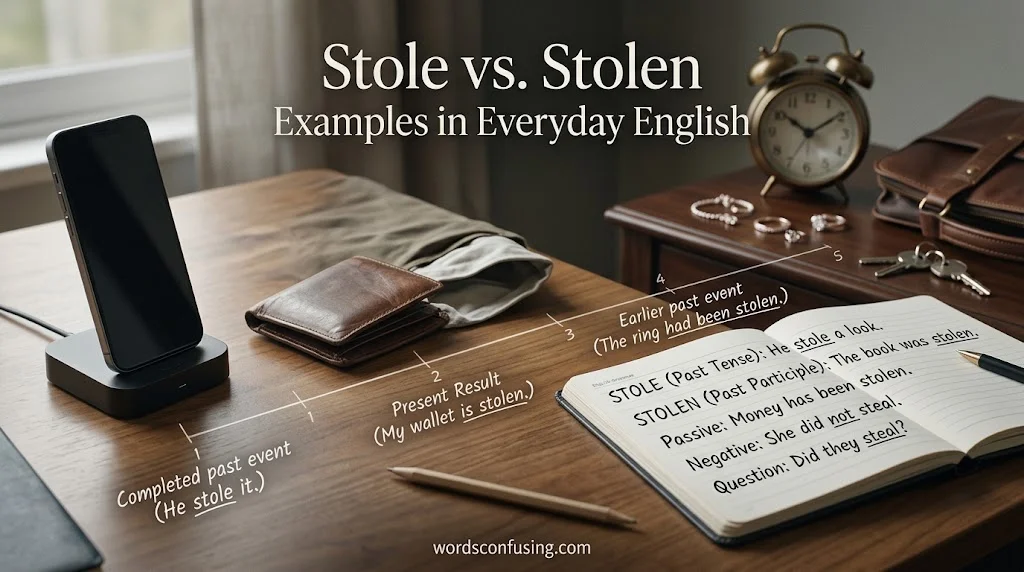
Stole vs. Stolen Examples in Everyday English
Real examples make this distinction easier to remember.
Example: Talking About Yesterday
Someone stole my phone yesterday.
The event happened at a finished time in the past.
Example: Talking About a Recent Result
Someone has stolen my phone.
The present perfect connects the past action with the current situation.
Perhaps the phone is missing right now. That’s why the speaker chooses has stolen.
Example: Describing a Earlier Past Event
The thief had stolen the jewelry before the alarm went off.
The theft happened first. The alarm happened afterward.
Example: Focusing on the Object
The jewelry was stolen.
The sentence focuses on the jewelry rather than the person who took it.
Example: Asking With “Did”
Did someone steal your wallet?
Because did carries the past tense, the main verb uses its base form.
Example: Making a Negative Statement
I didn’t steal your wallet.
Again, didn’t carries the past tense.
Common Mistakes With Stole and Stolen
Even experienced English learners sometimes mix up these forms. The mistakes usually happen because English uses several auxiliary verbs.
“He Has Stole My Phone”
Incorrect:
He has stole my phone.
Correct:
He has stolen my phone.
After has, the perfect tense requires the past participle.
The correct pattern is:
has + stolen
Not:
has + stole
“He Stolen My Phone”
Incorrect:
He stolen my phone.
Correct options:
He stole my phone.
or
He has stolen my phone.
The first sentence uses the simple past.
The second uses the present perfect.
The problem with He stolen my phone is that stolen lacks the auxiliary verb needed for this construction.
“Did He Stole It?”
Incorrect:
Did he stole it?
Correct:
Did he steal it?
After did, use the base form.
The same rule applies to many irregular verbs:
- Did she go? not Did she went?
- Did he write? not Did he wrote?
- Did they take it? not Did they took it?
- Did someone steal it? not Did someone stole it?
“He Didn’t Stole It”
Incorrect:
He didn’t stole it.
Correct:
He didn’t steal it.
The rule remains the same after didn’t.
Because didn’t already expresses the past, use steal.
“My Phone Was Stole”
Incorrect:
My phone was stole.
Correct:
My phone was stolen.
Passive constructions require the past participle.
The pattern is:
was + stolen
Compare:
He stole my phone.
with:
My phone was stolen.
The first sentence uses active voice.
The second uses passive voice.
The verb changes from stole to stolen because the sentence structure changes.
Read more: Forbade or Forbidden: Which Is the Past Tense of Forbid?
Why “Did” Changes the Verb Form
One of the easiest ways to understand stole vs. stolen is to look at did.
Consider:
He stole the wallet.
That’s a simple past sentence.
Now turn it into a question:
Did he steal the wallet?
The word did takes responsibility for the past tense. The main verb returns to its base form.
The same thing happens with negatives:
He didn’t steal the wallet.
Not:
He didn’t stole the wallet.
This pattern applies throughout English.
| Simple past | Question | Negative |
| She stole it. | Did she steal it? | She didn’t steal it. |
| He wrote it. | Did he write it? | He didn’t write it. |
| They drove away. | Did they drive away? | They didn’t drive away. |
| She chose it. | Did she choose it? | She didn’t choose it. |
Once you recognize this pattern, many irregular-verb problems disappear.
Why “Has,” “Have,” and “Had” Use “Stolen”
The opposite pattern appears with perfect tenses.
Consider:
She has stolen the necklace.
Here, has acts as the auxiliary verb. The main verb needs its past participle form: stolen.
The same pattern appears with have:
They have stolen the documents.
And with had:
The thief had stolen the money before anyone noticed.
The formula is:
has/have/had + past participle
Since stolen is the past participle of steal, it fits the construction.
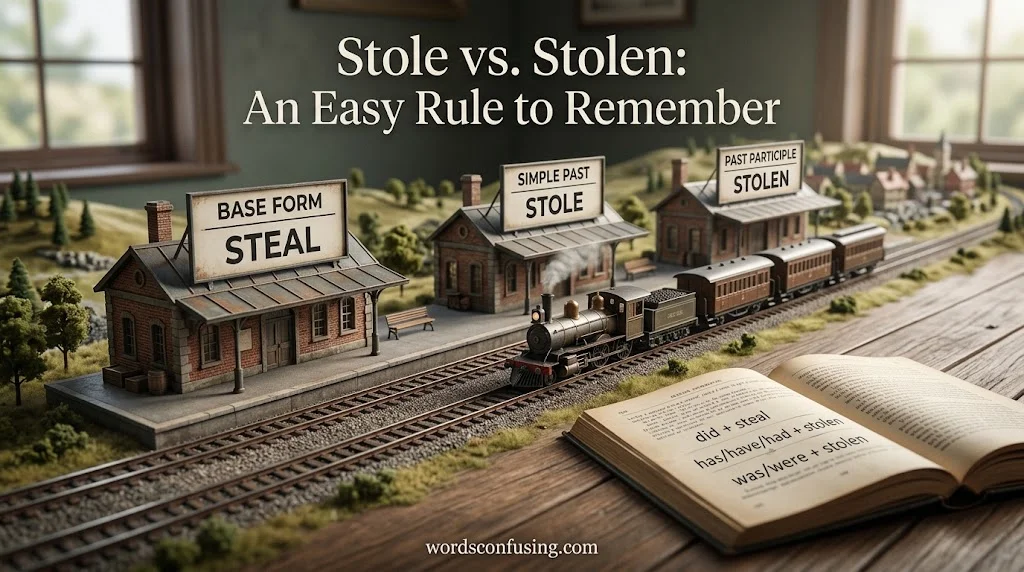
Stole vs. Stolen: An Easy Rule to Remember
Use this quick rule when you’re unsure:
Stole = simple past.
Stolen = past participle.
Then check the words around the verb.
1. If you see did or didn’t, use steal:
- Did he steal it?
- He didn’t steal it.
2. If you see has, have, or had, use stolen:
- He has stolen it.
- They have stolen it.
- She had stolen it.
3. If you use passive voice, use stolen:
- It was stolen.
- They were stolen.
- The car has been stolen.
A simple memory chain can help:
Steal → stole → stolen
Think of it like three stops on a grammar train. The first is the base form, the second marks simple past, and the third serves the participle role.
A Simple Decision Guide
When choosing between these forms, ask yourself three questions.
Did the action simply happen in the past?
Use stole.
Someone stole my laptop yesterday.
Does the sentence use has, have, or had?
Use stolen.
Someone has stolen my laptop.
Is the sentence passive?
Use stolen.
My laptop was stolen.
This quick check solves most stole or stolen questions in seconds.
Stole vs. Stolen in Formal and Casual English
The distinction doesn’t disappear in casual conversation.
Whether you’re writing an email, talking with friends, or completing a formal report, the basic grammar remains the same.
Formal:
The documents were stolen from the office.
Casual:
Someone stole my documents.
Both are grammatically correct. The difference comes from sentence structure and emphasis rather than formality.
In everyday speech, you’ll often hear stole in straightforward stories:
Someone stole my bike.
You’ll also hear stolen in situations where the speaker emphasizes the current result:
My bike has been stolen.
The first reports an event. The second highlights the present consequence.
Stole vs. Stolen: Active and Passive Voice
The distinction becomes especially clear when you compare active and passive sentences.
Active Voice
Someone stole the painting.
The subject performs the action.
Someone → performs the action
stole → action
the painting → receives the action
Passive Voice
The painting was stolen.
The sentence puts the object of the original action first.
The painting → subject of passive sentence
was → auxiliary verb
stolen → past participle
This is why you can’t simply swap stole and stolen whenever you like.
The surrounding grammar determines which form belongs there.
Stolen as a Descriptive Word
The word stolen can describe an object without emphasizing the action itself.
For example:
The detective examined the stolen vehicle.
The word stolen tells you what happened to the vehicle.
Other examples include:
- stolen property
- stolen money
- stolen artwork
- stolen documents
- stolen jewelry
- stolen vehicles
- stolen equipment
In these phrases, stolen works before a noun.
You wouldn’t say:
the stole vehicle
That construction is incorrect.
The correct phrase is:
the stolen vehicle
A Practical Comparison Table
| Sentence | Correct? | Explanation |
| She stole my book. | ✓ | Simple past |
| She stolen my book. | ✗ | Missing auxiliary verb |
| She has stolen my book. | ✓ | Present perfect |
| She has stole my book. | ✗ | Perfect tense needs the past participle |
| Did she steal my book? | ✓ | Base form follows did |
| Did she stole my book? | ✗ | Did already marks past tense |
| She didn’t steal my book. | ✓ | Base form follows didn’t |
| She didn’t stole my book. | ✗ | Incorrect verb form after didn’t |
| My book was stolen. | ✓ | Passive construction |
| My book was stole. | ✗ | Passive voice needs the past participle |
Related Forms of “Steal”
Learning all the forms together can make the distinction easier.
Steal
Steal is the base form.
Examples:
- Don’t steal.
- They might steal it.
- I don’t want to steal anything.
- She could steal the idea.
Steals
Steals is the third-person singular present form.
Examples:
- He steals food from the kitchen.
- She steals the spotlight during every performance.
Stole
Stole is the simple past form.
Examples:
- He stole the money.
- She stole my seat.
Stolen
Stolen is the past participle.
Examples:
- He has stolen the money.
- The money was stolen.
Stealing
Stealing is the present participle and gerund form.
Examples:
- He is stealing the car.
- Stealing isn’t acceptable.
Here’s the complete pattern:
| Form | Word | Example |
| Base | steal | They may steal it. |
| Present, third person | steals | He steals it. |
| Simple past | stole | He stole it. |
| Past participle | stolen | He has stolen it. |
| Present participle | stealing | He is stealing it. |
Stole vs. Stolen: Common Sentence Patterns
Memorizing useful patterns can be more effective than memorizing isolated rules.
Simple Past
Subject + stole + object
The thief stole the painting.
Present Perfect
Subject + has/have + stolen + object
The thief has stolen the painting.
Past Perfect
Subject + had + stolen + object
The thief had stolen the painting.
Simple Past Passive
Subject + was/were + stolen
The painting was stolen.
Question With Did
Did + subject + steal + object?
Did the thief steal the painting?
Negative With Didn’t
Subject + didn’t + steal + object
The thief didn’t steal the painting.
These patterns cover most everyday situations involving steal, stole, and stolen.
Read more: Forgot or Forgotten: Which Is Correct?
Case Study: One Event, Several Correct Forms
Imagine that a bicycle disappears from outside a house.
You could describe the same event in several grammatically correct ways.
Simple Past
Someone stole the bicycle last night.
This focuses on the completed event.
Present Perfect
Someone has stolen the bicycle.
This connects the theft with the current situation. The bicycle is missing now.
Past Perfect
Someone had stolen the bicycle before the owner returned.
This establishes the theft as an earlier event in a sequence of past events.
Passive Voice
The bicycle was stolen last night.
This focuses on the bicycle rather than the person who took it.
Question
Did someone steal the bicycle?
The question uses did, so the main verb returns to steal.
The event hasn’t changed. The grammatical perspective has.
That’s the real secret behind this distinction.
Stole or Stolen: Which One Should You Use?
Choose stole when you’re describing a completed past action without an auxiliary verb.
She stole the necklace.
Choose stolen when the sentence requires a past participle.
She has stolen the necklace.
The necklace was stolen.
Don’t choose based only on whether the event happened in the past. Both forms can refer to past actions. Instead, look at the sentence structure.
That’s a much more reliable test.
FAQs
Is “stole” the past tense of “steal”?
Yes. Stole is the simple past tense of steal. For example, “Someone stole my wallet yesterday.” The action happened and finished in the past.
Is “stolen” the past tense of “steal”?
No. Stolen is the past participle of steal. It usually appears with helping verbs such as has, have, or had. For example, “Someone has stolen my wallet.”
Should I say “my phone was stole” or “my phone was stolen”?
You should say “My phone was stolen.” After was in this passive construction, you need the past participle stolen, not the simple past stole.
Can I use “stole” and “stolen” in the same sentence?
Yes, when each word has the correct grammatical role. For example, “She stole the money after someone had stolen her bag.” The two forms describe different actions and tense structures.
How can I quickly remember the difference between stole and stolen?
Think of stole as a completed past action: “He stole my keys.” Think of stolen as a form that needs a helping verb: “He has stolen my keys.” This simple pattern can make the choice easier.
Which is correct: “Someone stole my bag” or “Someone has stolen my bag”?
Both are grammatically correct, but they use different tense structures. “Someone stole my bag” uses the simple past. “Someone has stolen my bag” uses the present perfect and connects the past action to the present situation.
Conclusion
Understanding stole and stolen becomes much simpler once you focus on how each form works in a sentence. Use stole when you’re talking about a completed action in the past, and use stolen when the sentence needs a past participle with a helping verb. A quick check of the verb tense can usually point you to the right choice.
With a little practice, you’ll start recognizing the difference naturally. Instead of memorizing complicated rules, pay attention to the words around stole or stolen. That small habit can help you write more accurately, speak with confidence, and avoid a common English grammar mistake.