
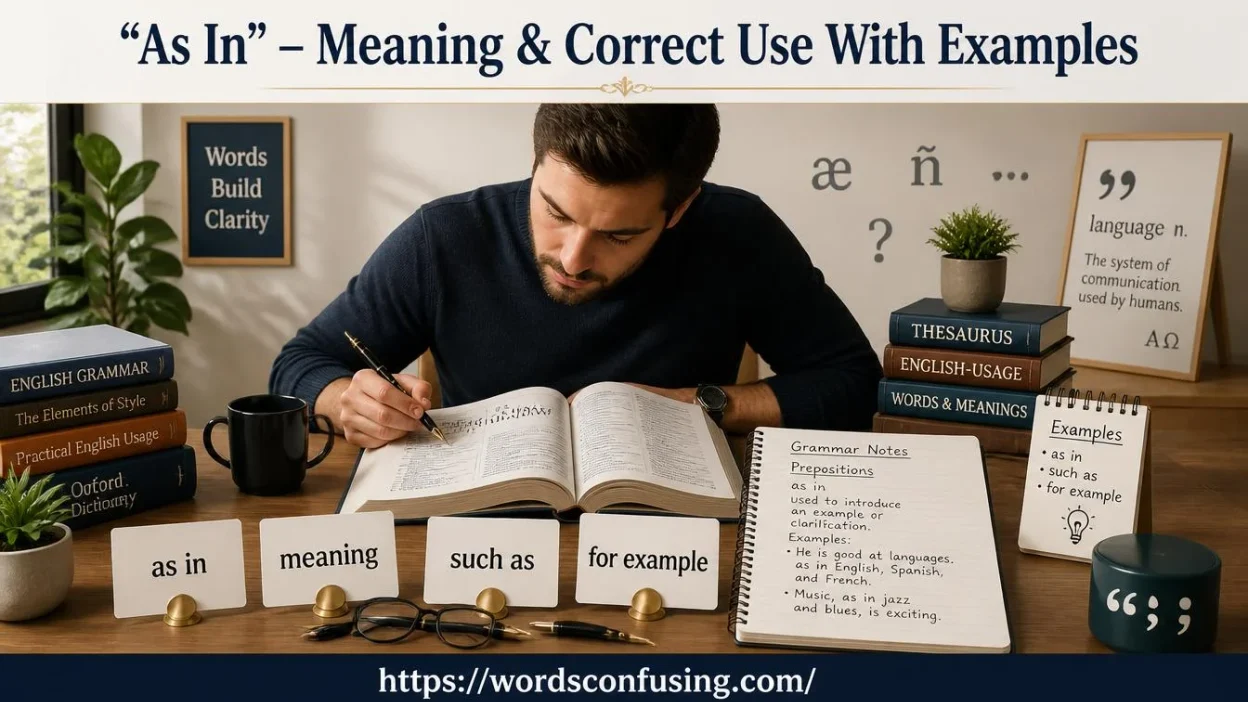
The phrase as in is a common expression in English that helps you clarify or specify a meaning, often to provide an example of a particular thing. The “As In” Meaning and Correct Use With Examples guide shows how it can point to one meaning when words have multiple meanings or more than one meaning.
In everyday conversations, emails, academic writing, and business communication, as in helps the reader or listener understand exactly what you mean. It closely links an idea to its context, especially when something was previously mentioned.
For example, “I mean spring, as in the season” makes the intended meaning clear and reduces confusion. With correct English usage, grammar skills, and regular practical examples, you can use the phrase naturally, clearly, confidently, and accurately in reading, writing, and workplace communication. It also works in casual conversations, meetings, reports, formal writing, and scheduling when you need clarification or specification.
A good guide should explain common mistakes, explain the function of the phrase, and help learners, readers, and listeners know how to use it when the context is familiar.
Quick Answer
“As in” means “meaning,” “specifically,” or “in the sense of.” You use it to clarify what you mean or make an idea more specific.
Example:
I mean “light,” as in not heavy.
In conversation, “As in?” usually means “What exactly do you mean?”
So, when you use “as in,” think of it as a small signpost that points your reader toward the exact meaning you intend.
What Does “As In” Mean?
The most useful definition of as in is “in the sense of,” “meaning,” or “specifically referring to.” It helps you clarify an idea by connecting it to a more precise meaning or example. Wiktionary lists “in the sense of” as a core idiomatic meaning of the expression.
Consider this example:
She wants a light jacket, as in one that isn’t heavy.
The word light can describe weight, brightness, color, or even a gentle amount. The phrase as in one that isn’t heavy removes that ambiguity.
That’s the central idea behind the expression: you start with something broad and then make its intended meaning clearer.
Basic “As In” Meaning
You can think of the construction this way:
General word or idea + as in + specific meaning or example
For example:
- I mean “bank,” as in the place where you keep money.
- He wants something casual, as in jeans and sneakers.
- She said it was expensive, as in more than $1,000.
- I mean “right,” as in the opposite of left.
In each sentence, the material after as in helps the reader or listener understand what came before it.
That makes as in especially useful when a word has multiple meanings or when a broad statement could leave room for different interpretations.
How “As In” Works in a Sentence
Although as in has a simple surface structure, its exact function depends on context. It doesn’t always translate neatly into one phrase such as for example.
In practical English, it commonly performs several related jobs.
“As In” to Clarify Meaning
One of the most common uses occurs when a word could mean more than one thing.
For example:
I mean “current,” as in happening now.
The word current can refer to something happening at the present time. It can also refer to the movement of water or electricity. The phrase after as in identifies the intended sense.
Here are more examples:
- I mean “sharp,” as in intelligent.
- She chose a light color, as in pale blue.
- He meant “cold,” as in emotionally distant.
- We’re talking about a mouse, as in the computer device.
This use is particularly valuable in explanations. Instead of giving a long definition, you can quickly identify the relevant meaning.
“As In” to Make a Broad Statement More Specific
Sometimes the first part of the sentence isn’t ambiguous in a dictionary sense. It’s simply too broad.
Consider:
The project was expensive, as in several thousand dollars.
The word expensive doesn’t have a single fixed price. What seems expensive to one person might seem reasonable to another. The second part gives the reader a concrete sense of the speaker’s meaning.
Another example:
The meeting was long, as in nearly four hours.
The phrase as in nearly four hours doesn’t necessarily define long. Instead, it tells you what long means in this particular situation.
This is why as in can make vague language more precise without requiring a formal definition.
“As In” to Give an Example
English speakers also use as in before a concrete example.
For instance:
We need outdoor shoes, as in hiking boots or trail shoes.
The phrase introduces examples that help visualize the broader category.
More examples include:
- Bring warm clothes, as in sweaters and jackets.
- Choose a soft fabric, as in cotton or fleece.
- We need a fruit, as in an apple or orange.
- Look for natural materials, as in wood or stone.
This use overlaps with such as and for example, but the expressions don’t always perform exactly the same job. Context matters.
“As In” to Specify a Particular Word Sense
The phrase becomes especially useful with words that have distinct meanings.
For example:
I mean “bow,” as in the weapon, not the front of a ship.
The clarification tells the reader which bow the sentence refers to.
Other examples:
- I mean “bat,” as in the animal, not the piece of sports equipment.
- He said “match,” as in a contest, not a small stick used to make fire.
- She meant “spring,” as in the season, not a metal coil.
This construction works almost like a verbal signpost. It tells the listener, “Take this word in this particular sense.”
What Does “As In?” Mean as a Question?
The expression becomes slightly different when someone says:
“As in?”
In conversation, this usually means “What exactly do you mean?”, “Do you mean…?”, or “Can you clarify that?”
For example:
Person A: “I’m moving.”
Person B: “As in moving to another city?”
Here, the second speaker isn’t defining the word moving. They’re asking for clarification.
Another example:
Person A: “The meeting is canceled.”
Person B: “As in today?”
The response asks whether canceled refers to today’s meeting specifically.
You might hear this structure frequently in casual speech:
- “As in tomorrow?”
- “As in permanently?”
- “As in you quit?”
- “As in the whole company?”
- “As in right now?”
The listener repeats or narrows the previous statement to confirm its meaning.
Why “As In?” Sounds Natural in Conversation
Conversation moves quickly. People don’t always give complete explanations the first time.
Imagine someone says:
“We’re changing the plan.”
That statement leaves many questions open.
You might respond:
“As in the entire plan?”
You could also say:
“What do you mean?”
or:
“Do you mean we’re changing everything?”
As in? simply offers a shorter conversational route to clarification.
In informal dialogue, it’s perfectly understandable. In a formal report, however, a complete question may communicate the idea more clearly.
“As In” for Spelling and Identifying Letters
Another familiar use appears when people identify letters verbally.
You may hear:
“That’s B as in boy.”
Here, as in means something close to “the B pronounced or represented by the word boy.” Wiktionary specifically records this use as “as pronounced in.”
This construction helps when letters sound similar, especially over the phone.
Examples include:
- A as in apple
- B as in boy
- C as in cat
- D as in dog
- M as in mother
- P as in Peter
- T as in tiger
The exact example word can vary. The purpose remains the same: the speaker gives a familiar word to make the intended letter unmistakable.
A Simple Example
Imagine someone gives you an email address over a poor phone connection.
“My last name starts with P as in Peter.”
That extra phrase reduces the chance of confusing P with B, T, or another letter that might be misheard.
It’s a tiny linguistic tool with a very practical purpose.
“As In” vs. “Such As”
One of the most common questions about as in meaning and correct use involves the expression such as.
These phrases sometimes appear in similar sentences, but they’re not interchangeable in every context.
| Expression | Main purpose | Example |
| as in | Clarifies a meaning or specific interpretation | I mean light, as in not heavy. |
| such as | Introduces examples from a category | I like fruits such as apples and mangoes. |
| for example | Introduces an illustrative example | Some fruits are tropical. For example, mangoes are. |
| meaning | Directly explains an intended sense | I mean light, meaning not heavy. |
| specifically | Narrows a broad statement | We need specifically lightweight materials. |
The difference becomes clearer when you compare the underlying ideas.
I mean “light,” as in not heavy.
Here, as in identifies the intended meaning.
Now compare:
I enjoy light foods such as salads and fruit.
Here, such as introduces examples belonging to the category.
The expressions can occasionally produce similar results, but they approach the information from different angles.
“As In” vs. “For Example”
As in and for example can both introduce an illustration. However, they don’t always carry the same emphasis.
Consider:
I want a classic car, for example, a 1960s Mustang.
The phrase for example presents the Mustang as one example of a classic car.
Now consider:
I mean classic, as in something from the 1960s.
Here, as in explains what the speaker means by classic.
That’s a subtle difference, but it’s important.
Compare These Sentences
For example:
We sell several types of fruit. For example, we sell apples, oranges, and pears.
As in:
I want something fresh, as in fruit picked recently.
The first sentence uses an example to illustrate a category. The second clarifies what fresh means in context.
A useful rule is:
Use “for example” when you’re illustrating an idea. Use “as in” when you’re clarifying what an idea means.
The distinction isn’t absolute because everyday English often allows some overlap. Still, this rule will keep most sentences clear.
“As In” vs. “Like”
Another expression that can cause confusion is like.
The word like commonly expresses similarity:
She sings like a professional.
The sentence says her singing resembles that of a professional.
Now compare:
I mean “professional,” as in someone who earns money from singing.
The phrase as in doesn’t express simple similarity. It identifies the intended interpretation of professional.
Consider another pair:
He runs like a professional athlete.
This compares his running with that of professional athletes.
I mean an athlete, as in someone who competes professionally.
This second sentence clarifies the meaning of athlete in context.
So, while like and as in can occasionally appear near similar ideas, their grammatical functions differ.
Is “As In” Grammatically Correct?
Yes. As in is a legitimate English expression.
Its established meaning includes “in the sense of.” It can also appear when identifying how a letter or word is represented in a particular example.
For instance:
I mean “bank,” as in a financial institution.
That’s a straightforward and grammatical use.
You can also find related constructions in established English usage. Cambridge Dictionary’s entries for as show that the word participates in several grammatical constructions involving comparison, similarity, and context.
The important point is that correctness depends on how you construct the sentence.
Compare:
Correct: I mean “light,” as in not heavy.
with:
Awkward: I need a light, as in.
The first construction provides the necessary clarification. The second leaves the phrase unfinished unless the context supplies the missing information.
A Quick Grammar Test
When you’re unsure, ask:
“Does the phrase after ‘as in’ explain, specify, or illustrate what came before it?”
If the answer is yes, the construction will usually make sense.
For example:
She wants something formal, as in a business suit.
The phrase a business suit clarifies formal.
That’s a strong construction.
Is “As In” Formal or Informal?
The phrase itself isn’t automatically informal.
It can work perfectly well in explanatory, professional, and academic contexts when it clearly identifies a particular meaning.
For example:
The term “culture,” as in the shared practices of a group, has a broad meaning.
That construction is explanatory rather than casual.
However, some conversational uses sound much more informal:
“As in, you actually quit?”
This style is common in spoken English. It resembles “You mean you actually quit?”
The difference isn’t necessarily about grammatical correctness. It’s about register.
Neutral Use
The word “bank,” as in a financial institution, differs in meaning from “bank” as a riverbank.
Casual Use
As in, you really did that?
The first sounds suitable for an explanation. The second sounds like ordinary conversation.
When you’re writing formally, alternatives such as specifically, meaning, namely, or in the sense of may sometimes produce a more polished sentence.
Read more: Shown vs. Showed: What’s the Difference?
Does “As In” Need a Comma?
There isn’t one universal comma rule for every sentence containing as in.
Punctuation depends on the structure and the role of the clarification.
Consider:
I mean light as in not heavy.
The phrase as in not heavy closely connects to light, so no comma may be necessary.
Now consider:
The trip was expensive, as in several thousand dollars.
The comma can signal that the following phrase provides an additional clarification.
You may also encounter constructions where the clarification appears parenthetically:
She wanted something casual, as in jeans and sneakers, rather than a formal dress.
The commas help mark the inserted clarification.
Don’t Add Commas Automatically
A common mistake is assuming that every as in phrase needs commas.
That’s not a reliable rule.
Instead, look at the sentence as a whole.
Ask:
- Does the phrase closely complete the preceding idea?
- Does it function like a parenthetical clarification?
- Would removing it leave a grammatically complete sentence?
- Does the punctuation improve readability?
The answer will guide your choice better than memorizing a one-size-fits-all rule.
Common Mistakes With “As In”
Even though the expression is straightforward, several mistakes appear regularly.
Treating “As In” as a Universal Replacement for “Such As”
These expressions overlap, but they aren’t identical.
Natural: Bring clothes such as jackets and sweaters.
Natural: I mean warm clothes, as in jackets and sweaters.
The first sentence presents examples within a category. The second clarifies what the speaker means by warm clothes.
Using “As In” Without Clarification
The phrase needs a useful connection to the preceding idea.
Weak: I like that, as in.
There’s nothing after the expression to clarify what that means.
Instead:
Better: I like that, as in the way you organized the information.
Now the relationship becomes clear.
Adding Commas Automatically
Not every as in phrase requires commas.
Punctuation should reflect the sentence’s structure rather than a memorized formula.
Confusing “As In” With “Like”
Remember the core distinction:
- like often expresses similarity
- as in usually identifies a meaning, interpretation, or example
For instance:
He looks like his father.
This means he resembles his father.
I mean father, as in the biological parent.
This clarifies the intended sense of father.
Using Conversational “As In?” in Formal Writing
A phrase such as:
As in, what exactly?
works naturally in casual conversation.
In a formal report, you might write:
Could you clarify what you mean?
The second version better matches the expected register.
Assuming “As In” Always Means “For Example”
This is perhaps the most important mistake to avoid.
As in can introduce an example, but its deeper function often involves specification or clarification.
Wiktionary lists “in the sense of” as a core meaning and separately records the informal sense “by which I mean; that is to say.”
That distinction explains why as in can work with abstract words, specific meanings, and conversational clarifications.
“As In” Sentence Examples
Seeing the expression in different situations makes its meaning much easier to recognize.
Everyday Conversation
- “You said you’re leaving, as in today?”
- “Do you mean expensive, as in over $500?”
- “As in you actually met her?”
- “You want something sweet, as in dessert?”
These examples use as in to confirm or narrow another person’s statement.
Workplace Communication
- We need a faster solution, as in something we can implement this week.
- Do you mean the entire project, as in every department?
- The deadline is tight, as in we have only three days.
- We’re looking for someone experienced, as in someone with five years in the field.
These examples make broad workplace language more concrete.
Academic or Explanatory Writing
- The term “bias,” as in a systematic preference, can have several applications.
- The study examines social behavior, as in how people interact within groups.
- The word “theory,” as in a well-supported explanation, has a specific meaning in science.
In explanatory writing, as in can help identify the exact sense of a term.
Spelling and Pronunciation
- That’s P as in Peter.
- The first letter is M as in mother.
- The name begins with C as in cat.
These constructions help speakers distinguish letters during verbal communication.
Clarifying Ambiguous Words
- I mean “right,” as in the opposite of left.
- She meant “spring,” as in the season.
- He said “bat,” as in the animal.
- We’re talking about “current,” as in happening now.
This is one of the clearest and most useful applications of the phrase.
“As In” Examples With Different Meanings
The following table brings the major uses together.
| Sentence | Function of “As In” |
| I mean light, as in not heavy. | Clarifies meaning |
| We need casual clothes, as in jeans and sneakers. | Gives specific examples |
| As in tomorrow? | Requests confirmation |
| B as in boy. | Identifies a letter |
| Bow, as in the weapon. | Specifies word sense |
| The project was huge, as in months of work. | Makes a broad statement concrete |
| I mean current, as in happening now. | Removes ambiguity |
| She’s successful, as in she owns several companies. | Explains an interpretation |
Notice the common thread. In every case, the material after as in gives the reader or listener a more precise target.
“As In” in Real-World Communication
The phrase becomes especially useful when people need to avoid misunderstandings.
Case Study: A Travel Conversation
Imagine someone says:
“I want to visit the coast.”
That statement could mean several things. They might want a beach vacation, a coastal city, or a quiet seaside town.
A natural clarification would be:
“As in a beach vacation?”
The response immediately narrows the meaning.
Case Study: A Workplace Discussion
Suppose a manager says:
“We need to cut costs.”
An employee might ask:
“As in reducing staff?”
The question doesn’t assume that staff reductions are definitely part of the plan. It asks whether that specific interpretation is intended.
That distinction matters.
Case Study: Clarifying a Word
Suppose someone says:
“I saw a bat outside.”
You could ask:
“As in the animal?”
If they answer yes, the ambiguity disappears.
These examples show why as in works so well in conversation. It allows you to narrow meaning without forcing the other person into a lengthy explanation.
Better Alternatives to “As In”
Sometimes another expression will fit your sentence better.
“Meaning”
Use meaning when you want a direct explanation.
I mean “light,” meaning not heavy.
This is especially clear in definitions.
“Specifically”
Use specifically when narrowing a broad idea.
We need specifically lightweight materials.
It focuses attention on the exact requirement.
“In the Sense Of”
Use in the sense of when you want to make the interpretation unmistakable.
The word “strong” is being used in the sense of emotionally resilient.
This can work particularly well in formal explanations.
“Such As”
Use such as when introducing examples.
We sell outdoor equipment such as tents, sleeping bags, and hiking poles.
The examples belong to the broader category.
“For Example”
Use for example when illustrating a general point.
Many outdoor activities require preparation. For example, hiking often requires suitable footwear and water.
“Namely”
Use namely when identifying exactly what you mean.
Three people attended, namely Sarah, Daniel, and Marcus.
The word has a more formal flavor than as in.
When Should You Use “As In”?
Use as in when your reader or listener could reasonably misunderstand the intended meaning.
It’s particularly useful when you want to:
- clarify an ambiguous word
- identify a specific interpretation
- narrow a broad statement
- provide a representative example
- confirm another person’s meaning
- identify a letter verbally
- explain how a word is being used
- make an abstract idea more concrete
Think of as in as a linguistic flashlight. It shines directly on the part of a statement you want someone to notice.
For example:
The movie was dark, as in emotionally depressing.
Without the clarification, dark could refer to lighting, subject matter, humor, mood, or even color.
The phrase tells the reader where to look.
When Should You Avoid “As In”?
Despite its usefulness, you don’t need it everywhere.
Avoid or replace as in when:
- such as introduces examples more naturally
- for example better introduces an illustration
- a direct definition would be clearer
- the phrase doesn’t add meaningful information
- you’re writing formal material where a more precise expression fits better
- the sentence becomes unnecessarily conversational
Compare:
Awkward: There are many options, as in apples and oranges.
Better: There are many options, such as apples and oranges.
Now compare:
Natural: I mean “fresh,” as in recently picked.
Here, as in makes sense because the phrase explains the intended meaning of fresh.
The best choice depends on the relationship between the first idea and the explanation that follows.
A Quick Guide to “As In” Meaning and Correct Use
| Question | Answer |
| What does “as in” mean? | Usually “in the sense of,” “meaning,” or “specifically referring to.” |
| Is “as in” grammatically correct? | Yes. |
| Can “as in” introduce examples? | Yes, when the examples clarify or illustrate the preceding idea. |
| Can “as in” clarify meaning? | Yes. This is one of its main uses. |
| What does “as in?” mean? | Usually “What exactly do you mean?” |
| Is “as in” the same as “such as”? | No. They can overlap, but their functions differ. |
| Is “as in” the same as “for example”? | Not always. “As in” often clarifies meaning or interpretation. |
| Does “as in” always need commas? | No. Punctuation depends on sentence structure. |
| Can you use “as in” formally? | Yes, although some conversational constructions are better suited to informal speech. |
| What does “B as in boy” mean? | It identifies the letter B using boy as the representative word. |
FAQs
1. What does “as in” mean?
“As in” is used to clarify or specify what you mean. It often introduces an example or points to a particular meaning of a word or idea.
2. When should I use “as in” in a sentence?
Use “as in” when something could have more than one meaning and you want to make your intended meaning clear. For example, “I mean spring, as in the season.”
3. Is “as in” used only in casual conversations?
No. “As in” can appear in everyday conversations, emails, workplace communication, academic writing, meetings, reports, and other forms of English usage.
4. Does “as in” mean “for example”?
Yes. In many contexts, “as in” can introduce an example that makes a previous idea more specific or easier to understand.
5. Can “as in” help avoid confusion?
Yes. Using “as in” can provide clarification when a word or expression has multiple meanings. It helps the reader or listener understand exactly what you mean.
6. Is “as in” grammatically correct?
Yes. “As in” is a grammatically correct expression when it’s used appropriately to clarify, specify, or give an example within the context of a sentence.
Conclusion
Understanding “as in” is easier once you see its simple purpose: it adds clarity when you want to explain exactly what you mean. Whether you’re talking with someone, writing an email, or working on formal writing, this small phrase can make your message more precise and easier to follow. When you use it naturally, you can avoid confusion and help your reader or listener connect your words with the right context.
The best way to become comfortable with “as in” is to notice how people use it in real sentences and practice creating your own examples. Once the pattern becomes familiar, you’ll find it much easier to use the phrase confidently and correctly in everyday English.