
Can You Start a Sentence With “Otherwise”? Otherwise can start a sentence and still follow English grammar and normal writing rules.
Otherwise can begin sentences while clearly helping you signal contrast or a possible result. There are no English rules that teach that certain words cannot begin a sentence. Such language myths often fail when challenged, especially when context, sentence structure, and correct usage receive proper attention.
Otherwise can offer a different approach by showing a change in direction, giving a hint about consequences, or introducing alternatives. When used thoughtfully, it creates a natural flow and keeps the message easy to understand.
Starting with otherwise may feel tricky, but the pattern becomes simple when you understand its role. It adds a curious, dynamic tone while clearly conveying your message. Language evolves constantly, which gives writers room to break minor patterns for a fresh, thoughtful reason.
This creates room for expression, helping you stand out, express perspective, and show shifts in meaning without sounding forced or awkward. The key part involves balancing grammar rules with writing style, clarity, and sentence formation.
Through exercises, reading, and other tasks, this approach can make your writing strong, engaging, and natural. It also shows how otherwise works and how you can make the most of it while blending tradition with creativity.
Quick Answer
Yes, you can start a sentence with “otherwise.”
When otherwise begins a sentence, it often introduces a consequence that depends on the previous statement.
For example:
- Leave now. Otherwise, you’ll miss the bus.
- Save your document. Otherwise, you could lose your work.
- Wear a jacket. Otherwise, you’ll be cold.
- Submit the form today. Otherwise, your application may be delayed.
In these examples, otherwise essentially means “if you don’t do that” or “if that doesn’t happen.”
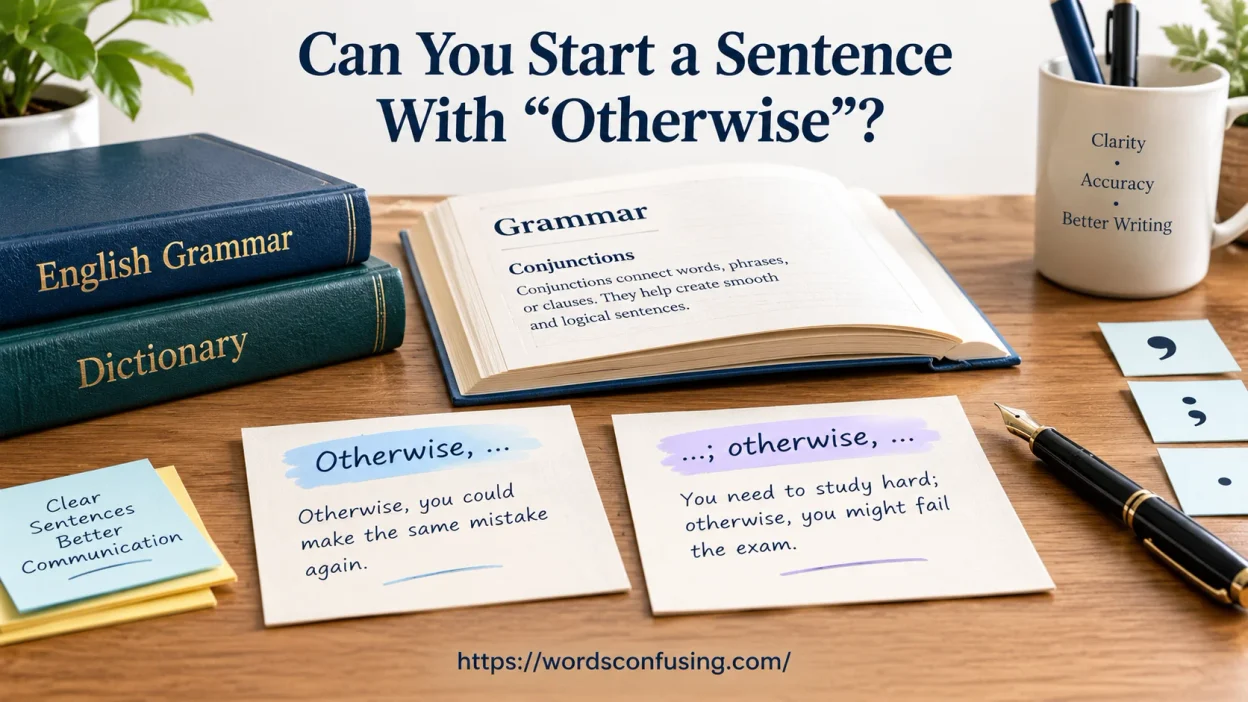
The usual punctuation pattern is simple:
Previous sentence. Otherwise, + main clause.
You can also connect two independent clauses with a semicolon:
Previous clause; otherwise, + main clause.
For example:
Check the address carefully; otherwise, the package could go to the wrong location.
Both constructions are grammatically sound.
The Main Rule
Don’t worry about placing otherwise at the beginning. Instead, make sure the word creates a clear logical connection.
If the reader can easily understand what otherwise refers to, the construction usually works well.
What Does “Otherwise” Mean?
The word otherwise has several meanings. That versatility explains why you see it in many different sentence structures.
Understanding these meanings makes its grammar much easier.
“Otherwise” Means “If Not”
This is probably the most common meaning when otherwise starts a sentence.
In this use, otherwise introduces the result of failing to meet a condition.
For example:
Hurry up. Otherwise, we’ll miss the train.
The hidden meaning is:
If you don’t hurry up, we’ll miss the train.
Another example:
Back up your files. Otherwise, you could lose important information.
The implied condition is:
If you don’t back up your files, you could lose important information.
This construction works especially well for warnings, instructions, reminders, and consequences.
“Otherwise” Means “Or Else”
Sometimes otherwise has almost the same meaning as “or else.”
Compare these sentences:
Put the food in the refrigerator. Otherwise, it may spoil.
Put the food in the refrigerator, or else it may spoil.
The meaning remains essentially the same. However, otherwise often sounds smoother and less forceful.
That makes it useful in professional instructions.
For example:
Please submit the report by Friday. Otherwise, the review process may be delayed.
The sentence communicates a consequence without sounding unnecessarily harsh.
“Otherwise” Means “Differently”
The word can also mean “in a different way” or “differently.”
Consider:
The facts suggest otherwise.
Here, otherwise doesn’t mean “if not.”
Instead, it means something like:
The facts suggest a different conclusion.
You can see the same meaning in:
She thought otherwise.
This means:
She thought differently.
Another example is:
The results indicate otherwise.
That means:
The results indicate something different from what was previously believed or stated.
This meaning frequently appears in academic, professional, legal, and analytical writing.
“Otherwise” Means “Under Different Circumstances”
In some sentences, otherwise refers to a different situation or condition.
For example:
Otherwise, I might have accepted the invitation.
The exact condition comes from the surrounding context.
Perhaps the previous sentence says:
I had already made other plans.
Then:
Otherwise, I might have accepted the invitation.
The meaning becomes clear:
If I hadn’t already made other plans, I might have accepted.
This use can appear at the beginning of a sentence without any problem.
How “Otherwise” Works at the Beginning of a Sentence
Sentence-initial otherwise usually connects the current sentence with something that came before it.
Think of it as a small bridge between two ideas.
The first statement establishes an action, condition, or expectation. The second statement explains what happens if that condition isn’t met.
The basic structure looks like this:
Action or condition → Otherwise → consequence
For example:
Take an umbrella. Otherwise, you may get soaked.
The first sentence gives advice.
The second sentence presents the possible consequence.
Another example:
Read the instructions carefully. Otherwise, you may make a mistake.
Again, the relationship is straightforward.
The reader doesn’t have to stop and figure out what otherwise refers to.
Why Context Matters
Although otherwise can begin a sentence, it shouldn’t appear without a meaningful connection.
Consider:
Otherwise, the project could fail.
This sentence isn’t necessarily wrong. However, without context, the reader may wonder:
Otherwise than what?
Now compare it with:
The team needs to meet the deadline. Otherwise, the project could fail.
The connection becomes obvious.
The previous sentence supplies the condition.
That distinction matters because good grammar isn’t only about individual words. Clarity depends on how those words interact.
“Otherwise” as “If Not” or “Or Else”
When you’re unsure whether sentence-initial otherwise works, try replacing it with “if not.”
If the sentence still makes sense, you’re probably using otherwise correctly in its conditional sense.
For example:
Leave before six. Otherwise, you’ll encounter heavy traffic.
Replace otherwise:
Leave before six. If not, you’ll encounter heavy traffic.
The meaning remains clear.
Try another:
Save the changes. Otherwise, you may lose your work.
Becomes:
Save the changes. If not, you may lose your work.
Again, the meaning works.
This simple substitution can help you identify the intended relationship.
Examples of Conditional “Otherwise”
Deadlines
Submit your application today. Otherwise, you may miss the deadline.
Instructions
Follow each step carefully. Otherwise, the device may not operate correctly.
Safety
Wear the required protective gear. Otherwise, you could put yourself at risk.
Travel
Leave early. Otherwise, you may get stuck in traffic.
Schoolwork
Review the chapter tonight. Otherwise, tomorrow’s quiz may feel difficult.
Technology
Install the latest update. Otherwise, some features may not work properly.
Each sentence uses otherwise to introduce a consequence.
Read more: 4 Words to Describe the Sound of Coughing
“Otherwise” as “In Another Way”
Not every sentence with otherwise expresses a condition.
Sometimes the word simply means “differently.”
For example:
I wouldn’t have acted otherwise.
This means:
I wouldn’t have acted differently.
Similarly:
The evidence suggests otherwise.
The writer means:
The evidence suggests a different conclusion.
Another common construction is:
She believed otherwise.
This means:
She believed something different.
These sentences don’t need a warning or instruction before otherwise.
That’s an important distinction.
Examples of This Meaning
- The facts suggest otherwise.
- The evidence indicates otherwise.
- He believed otherwise.
- She had expected otherwise.
- The results turned out otherwise.
- Nothing could convince them otherwise.
In each example, otherwise refers to a different belief, expectation, interpretation, or outcome.
“Otherwise” as “Under Different Circumstances”
Another useful meaning appears when otherwise describes an alternative situation.
For example:
Otherwise, I would’ve stayed longer.
This suggests that something prevented the speaker from staying.
The surrounding context might explain that condition:
I had an early appointment the next morning. Otherwise, I would’ve stayed longer.
The second sentence effectively means:
If I hadn’t had an early appointment, I would’ve stayed longer.
This construction appears frequently in natural conversation.
You might hear:
Otherwise, we would’ve gone with you.
Or:
Otherwise, the meeting would’ve lasted much longer.
The reader or listener uses the surrounding context to understand the missing condition.
Can You Start a Sentence With “Otherwise” in Formal Writing?
Yes.
Sentence-initial otherwise works perfectly well in formal writing when you use it clearly.
You can find this construction in professional instructions, academic discussions, technical explanations, and business communication.
The important issue isn’t whether otherwise begins the sentence. The important issue is whether the sentence communicates its relationship clearly.
Academic Writing
For example:
The variables must remain constant. Otherwise, the results may become unreliable.
Another example:
Researchers must define the terms precisely. Otherwise, readers may interpret the findings differently.
These sentences use otherwise to establish a logical consequence.
Business Writing
Consider:
Please review the attached document before the meeting. Otherwise, important details may be overlooked.
Or:
The payment must arrive by Friday. Otherwise, the order may be delayed.
The construction sounds professional because it communicates the consequence directly.
Technical Writing
Technical instructions often benefit from otherwise because procedures frequently depend on specific conditions.
For example:
Disconnect the device before opening the case. Otherwise, you could damage the internal components.
The word creates a clear relationship between the instruction and its consequence.
Punctuation With “Otherwise” at the Beginning
Punctuation becomes important when otherwise connects ideas.
Fortunately, the main patterns aren’t complicated.
Use a Comma After Sentence-Initial “Otherwise”
When otherwise begins a sentence, a comma commonly follows it.
For example:
Otherwise, you may miss the deadline.
Otherwise, the results could become inaccurate.
Otherwise, we may need to cancel the event.
The comma signals a brief pause before the main clause.
This construction is especially common when otherwise means “if not” or “under different circumstances.”
Use a Period Before “Otherwise”
One of the cleanest constructions uses two separate sentences.
For example:
Finish the report today. Otherwise, the team can’t submit it tomorrow.
Here, the first sentence is complete.
The second sentence begins with otherwise and explains the consequence.
This approach works especially well when you want the consequence to stand out.
Short sentences can add punch, too.
Check the address twice. Otherwise, the package may go somewhere else.
The period creates a natural pause before the warning.
Use a Semicolon Before “Otherwise”
You can also connect two closely related independent clauses with a semicolon.
For example:
Finish the report today; otherwise, the team can’t submit it tomorrow.
This construction keeps both ideas in one sentence.
The general pattern is:
Independent clause; otherwise, independent clause.
Another example:
Take the earlier train; otherwise, you may arrive late.
Both sides can function as complete clauses.
That’s why the semicolon works.
Avoid the Comma Splice
A common mistake looks like this:
Finish the report today, otherwise, the team can’t submit it tomorrow.
Some informal writing may use this punctuation. However, in standard formal writing, a comma alone shouldn’t join two independent clauses.
Better options include:
Finish the report today. Otherwise, the team can’t submit it tomorrow.
Or:
Finish the report today; otherwise, the team can’t submit it tomorrow.
Both versions provide a cleaner grammatical structure.
“Otherwise” at the Beginning vs. Middle of a Sentence
Where you place otherwise affects the rhythm and emphasis of your sentence.
| Position | Example | Effect |
| Beginning | Otherwise, you’ll miss the deadline. | Emphasizes the consequence |
| Middle | You’ll miss the deadline otherwise. | Sounds more compact |
| After semicolon | Leave now; otherwise, you’ll be late. | Connects two related clauses |
| After a comma in some constructions | You should leave now, otherwise you’ll be late. | Often avoided in formal writing because of the comma splice issue |
Sentence-initial placement often gives otherwise more emphasis.
Compare these:
You’ll miss the bus otherwise.
Otherwise, you’ll miss the bus.
The first sounds more compact.
The second puts stronger attention on the consequence.
For instructions and warnings, the second version often feels more direct.
Examples of Starting Sentences With “Otherwise”
Seeing many examples can make the pattern easier to recognize.
Warnings
Keep the door locked. Otherwise, someone could enter.
Stay behind the marked line. Otherwise, you could create a safety hazard.
Don’t touch the equipment while it’s running. Otherwise, you could damage it.
Instructions
Read the instructions first. Otherwise, you may miss an important step.
Check the settings carefully. Otherwise, the software may behave unexpectedly.
Save your work regularly. Otherwise, you could lose recent changes.
Deadlines
Send the documents by Friday. Otherwise, the application may be delayed.
Confirm your appointment today. Otherwise, the available time may disappear.
Pay the invoice on time. Otherwise, additional charges may apply.
Everyday Conversation
We should leave soon. Otherwise, we’ll miss the movie.
Bring a jacket. Otherwise, you’ll be cold tonight.
Let’s take the highway. Otherwise, we’ll probably hit heavy traffic.
Academic Writing
Define the term before discussing it. Otherwise, readers may misunderstand the argument.
Use consistent measurements. Otherwise, the comparison may become misleading.
Consider the surrounding evidence. Otherwise, the conclusion may appear unsupported.
Common Mistakes With “Otherwise”
Although otherwise is easy to use, several mistakes appear repeatedly.
Using “Otherwise” Without Clear Context
The biggest problem isn’t usually grammar.
It’s unclear meaning.
Consider:
Otherwise, the results could change.
A reader may ask, “Otherwise than what?”
Give the reader the condition first:
Keep the testing conditions consistent. Otherwise, the results could change.
Now the relationship is obvious.
Confusing “Otherwise” With “However”
Otherwise and however don’t perform the same grammatical job.
However generally introduces a contrast.
Otherwise often introduces an alternative, consequence, or different result.
Compare:
The exam was difficult. However, she passed.
The second sentence contrasts with the first.
Now compare:
She needed to study. Otherwise, she might have failed.
The second sentence gives a possible consequence.
A useful shortcut is:
- However = in contrast
- Otherwise = if not / differently
They’re not interchangeable.
Confusing “Otherwise” With “Alternatively”
Alternatively usually introduces another available choice.
For example:
You can drive to the airport. Alternatively, you can take the train.
Here, the writer presents two options.
Now consider:
Leave now. Otherwise, you’ll miss the train.
This doesn’t offer a second choice.
Instead, it explains what happens if the first action isn’t taken.
That’s a significant difference.
Overusing “Otherwise”
Even a grammatically correct word can become irritating through repetition.
For example:
Check the settings. Otherwise, the program may fail. Otherwise, you may need to restart it. Otherwise, the process could become complicated.
The repeated otherwise makes the paragraph feel mechanical.
Instead, vary your transitions and sentence structures.
For example:
Check the settings first. If something looks wrong, correct it before continuing. The program may fail if you skip this step.
Good writing isn’t only grammatically correct. It also has rhythm.
Misplacing Punctuation
Watch for constructions such as:
Save the file, otherwise, you may lose your work.
In formal writing, a period or semicolon usually provides a cleaner solution:
Save the file. Otherwise, you may lose your work.
Or:
Save the file; otherwise, you may lose your work.
“Otherwise” vs. Similar Words and Phrases
These words can appear in similar contexts, but their meanings aren’t identical.
| Word or phrase | Main meaning | Example |
| Otherwise | If not; differently | Hurry. Otherwise, you’ll be late. |
| If not | If the condition isn’t met | Hurry. If not, you’ll be late. |
| Or else | If not, another consequence follows | Hurry, or else you’ll be late. |
| Alternatively | Another option | Alternatively, take the train. |
| However | In contrast | The route is longer. However, it’s safer. |
| Instead | In place of something else | Take the train instead. |
The subtle differences matter.
For example, alternatively suggests choice.
Otherwise often suggests consequence.
However signals contrast.
Instead indicates replacement.
Choosing the right transition makes your writing much sharper.
When Should You Use “Otherwise” at the Start of a Sentence?
Sentence-initial otherwise works particularly well when you need to highlight a consequence.
Use it when:
- The previous sentence establishes a clear condition.
- The second sentence explains what happens if that condition fails.
- You want to emphasize a warning or consequence.
- “If not” fits the intended meaning.
- The surrounding context makes the reference obvious.
- A new sentence creates better readability.
For example:
Check the expiration date. Otherwise, the product may not be safe to use.
The first sentence establishes the action.
The second sentence highlights the consequence.
That relationship is easy to follow.
When Is It Better to Keep “Otherwise” in the Same Sentence?
Sometimes a semicolon produces a smoother sentence.
Compare:
Check the expiration date. Otherwise, the product may not be safe to use.
With:
Check the expiration date; otherwise, the product may not be safe to use.
Both versions communicate the same basic idea.
The choice depends on rhythm, emphasis, and context.
Use two sentences when you want the consequence to stand out.
Use a semicolon when the two clauses feel tightly connected.
Neither option is inherently better in every situation.
Can You Start a Sentence With “Otherwise” in Academic Writing?
Absolutely.
Academic writing often uses otherwise to explain consequences, alternative interpretations, or different conclusions.
For example:
The sample must remain uncontaminated. Otherwise, the results may become unreliable.
Another example:
The term should be defined before analysis begins. Otherwise, readers may interpret it inconsistently.
The word can also express a different interpretation:
The available evidence suggests otherwise.
Here, otherwise means that the evidence points toward a different conclusion.
Why Clarity Matters More Than Position
Some writers worry that beginning a sentence with a conjunction-like word sounds informal.
That concern doesn’t apply here.
English allows many words and phrases to begin sentences naturally. Otherwise is one of them.
Instead of asking:
“Can I start a sentence with otherwise?”
Ask:
“Does otherwise clearly express the relationship I mean?”
That’s the more useful grammar question.
Can You Start a Sentence With “Otherwise” in Professional Emails?
Yes.
In professional communication, otherwise can make consequences clear without unnecessary wording.
For example:
Please review the document before Friday. Otherwise, the team may not have enough time to make revisions.
Or:
Please confirm your attendance by noon. Otherwise, the meeting arrangements may need to change.
This style works because the reader immediately understands the expected action and its possible consequence.
However, keep the tone reasonable.
A long email filled with warnings can sound unnecessarily severe. Use otherwise when the consequence genuinely matters.
Can “Otherwise” Follow a Period?
Yes.
This is one of the most common and useful constructions.
For example:
Bring your identification. Otherwise, you may not be allowed to enter.
The first sentence stands independently.
The second sentence begins with otherwise and refers back to the first sentence.
There’s no grammatical problem with this structure.
In fact, splitting the ideas into two sentences can improve readability.
Compare:
Bring your identification; otherwise, you may not be allowed to enter.
and:
Bring your identification. Otherwise, you may not be allowed to enter.
Both are clear.
The second version gives the warning slightly more emphasis.
Should You Use a Comma or Semicolon Before “Otherwise”?
The answer depends on the sentence structure.
Use a period when you want two separate sentences:
Check the details. Otherwise, mistakes may occur.
Use a semicolon when you want two independent clauses in one sentence:
Check the details; otherwise, mistakes may occur.
Avoid relying on a comma alone to join two independent clauses in formal writing:
Check the details, otherwise, mistakes may occur.
The semicolon provides a stronger grammatical connection.
A Simple Punctuation Formula
Remember this:
Sentence. Otherwise, sentence.
Or:
Independent clause; otherwise, independent clause.
Those two patterns will handle most situations.
Correct and Incorrect Examples
A quick comparison can make the rules easier to remember.
| Construction | Evaluation | Example |
| Period + Otherwise | Correct | Leave now. Otherwise, you’ll be late. |
| Semicolon + otherwise | Correct | Leave now; otherwise, you’ll be late. |
| Comma splice | Avoid in formal writing | Leave now, otherwise, you’ll be late. |
| Sentence-initial otherwise with clear context | Correct | Check the file. Otherwise, errors may occur. |
| Otherwise meaning “differently” | Correct | The evidence suggests otherwise. |
| Otherwise with unclear reference | Potentially unclear | Otherwise, things may change. |
The most important distinction involves context.
A sentence isn’t automatically wrong because otherwise starts it. The surrounding information determines whether the meaning is clear.
A Simple Test for Using “Otherwise” Correctly
When you’re unsure about a sentence, use this three-step test.
Check the Meaning
Ask whether otherwise means:
- If not
- Or else
- Differently
- Under different circumstances
If you can’t identify the intended meaning, rewrite the sentence.
Check the Connection
Ask:
What does “otherwise” refer to?
If the answer comes from the previous sentence, the connection should be obvious.
For example:
Submit the form today. Otherwise, your request may be delayed.
The reference is clear.
Check the Punctuation
If otherwise begins a new sentence, use the normal sentence structure:
Otherwise, your request may be delayed.
If it connects two independent clauses, a semicolon works:
Submit the form today; otherwise, your request may be delayed.
This quick check prevents most common errors.
Key Facts About Starting a Sentence With “Otherwise”
Here are the essential points to remember:
- Yes, you can start a sentence with otherwise.
- Sentence-initial otherwise is grammatically acceptable.
- It often means “if not” or “or else.”
- It can also mean “differently.”
- It may describe an alternative set of circumstances.
- A comma commonly follows sentence-initial otherwise.
- A period can separate the preceding sentence from otherwise.
- A semicolon can connect two closely related independent clauses.
- Avoid comma splices in formal writing.
- Don’t confuse otherwise with however.
- Don’t confuse otherwise with alternatively.
- Make sure the reader can understand what otherwise refers to.
- Use it when it improves clarity rather than simply adding a transition.
FAQs
Can you start a sentence with “otherwise”?
Yes, you can start a sentence with “otherwise.” It can introduce a contrasting idea, alternative, or possible consequence. The key is using it naturally within the sentence and surrounding context.
Is it grammatically correct to begin a sentence with “otherwise”?
Yes. Beginning a sentence with “otherwise” is grammatically correct. English has no general rule that prevents you from using this word at the beginning of a sentence.
What does “otherwise” mean at the beginning of a sentence?
At the beginning, “otherwise” often means “if not” or introduces a different outcome. For example, “Finish your work. Otherwise, you may miss the deadline.”
Should “otherwise” be followed by a comma?
Usually, yes, when “otherwise” works as a sentence-opening transition. A comma can make the meaning and pause clearer, especially when it introduces a contrasting result.
Can “otherwise” make writing sound more natural?
It can. When used correctly, “otherwise” creates a smooth transition between ideas. It can also help you show contrast without repeating longer phrases.
Is starting with “otherwise” considered informal?
Not necessarily. “Otherwise” works in both formal and informal writing. Your overall sentence structure and context determine whether the writing sounds polished and appropriate.
Conclusion
Starting a sentence with “otherwise” is completely acceptable in English. What matters most is how naturally it fits the meaning and flow of your sentence. At the beginning, otherwise can create a clear contrast, introduce a possible consequence, or guide the reader toward another option. It can also give your writing a smoother transition when one idea needs to shift into another. So, don’t let outdated grammar myths make you second-guess a perfectly valid sentence.
Once you understand its purpose, “otherwise” becomes much easier to use with confidence. Good writing isn’t about following imaginary restrictions. It’s about choosing words that communicate your ideas clearly and naturally. Whether you’re writing an essay, an email, or everyday sentences, otherwise can add variety and precision when used thoughtfully. In short, if the sentence makes sense and the word fits the context, there’s no reason to avoid starting with “otherwise.”

Shafiq Ur Rehman is a writer and content contributor at WordsConfusing.com. He enjoys exploring the English language, common word confusions, vocabulary, and practical writing tips. His goal is to make English easier to understand through clear, simple, and useful articles.