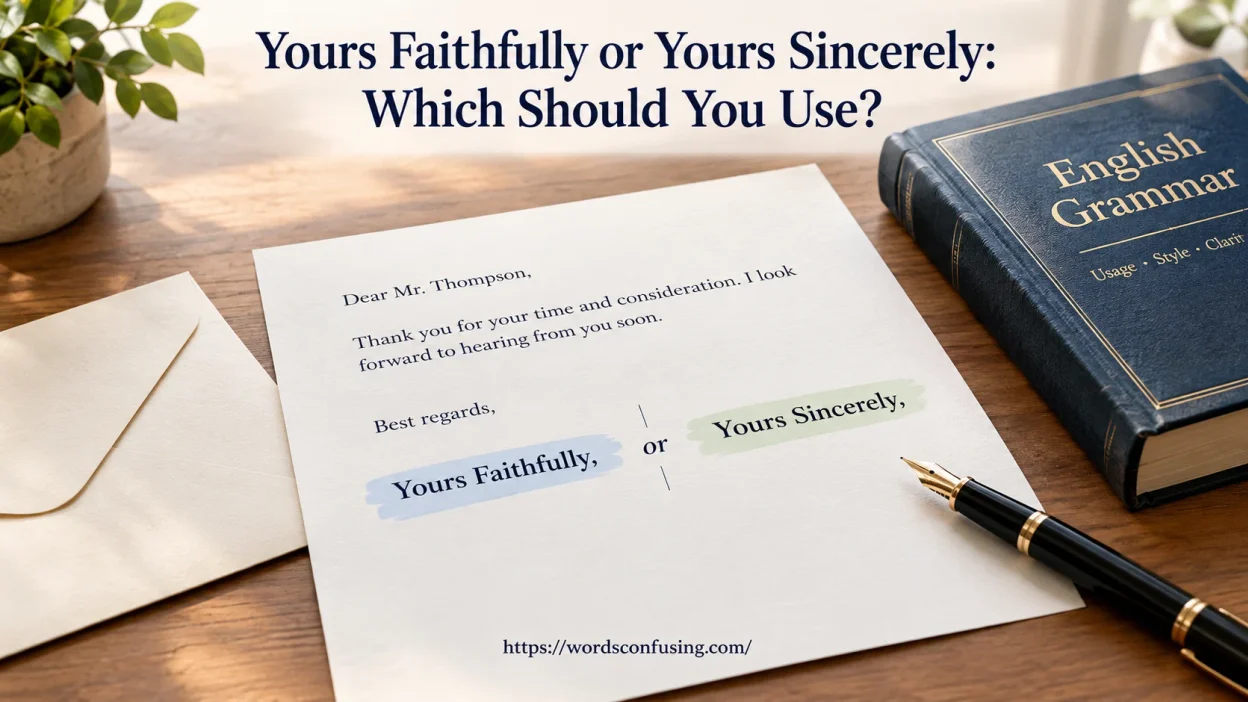
Yours Faithfully or Yours Sincerely: Which Should You Use? helps you choose the right closing for formal writing and business correspondence.
Writers can feel confused when deciding how to end a letter, especially when the ending, sign-off, or complimentary close needs to fit the salutation and purpose of the correspondence.
In a formal letter or business letter, Yours sincerely and Yours faithfully are common options for the closing, closing phrase, and letter closing. British English and American English follow different conventions, although the variation is often straightforward once you understand the basic rules and letter-writing conventions.
The appropriate usage depends largely on whether you know the recipient’s name or use a general salutation. Before signing, check the opening first. That simple step helps you choose the best choice and keeps the closing options, letter ending, and sign-off rules consistent. British, American, formal correspondence, written communication, writing rules, usage, grammar, and punctuation all shape accepted formal writing and professional writing.
In my experience reviewing business correspondence, Yours sincerely usually follows a known recipient, while Yours faithfully traditionally follows a general salutation. Sincerely and faithfully each have a specific role, and using them correctly gives your letter writing a more polished and professional tone. These closing conventions, writing conventions, grammatical rules, and letter-ending rules make the choice much easier.
Quick Answer
Use “Yours faithfully” when you don’t know the recipient’s name, especially in traditional British English. Use “Yours sincerely” when you address the recipient by name.
- Dear Sir or Madam → Yours faithfully
- Dear Mr. Smith → Yours sincerely
- American English → “Sincerely” works in either situation.
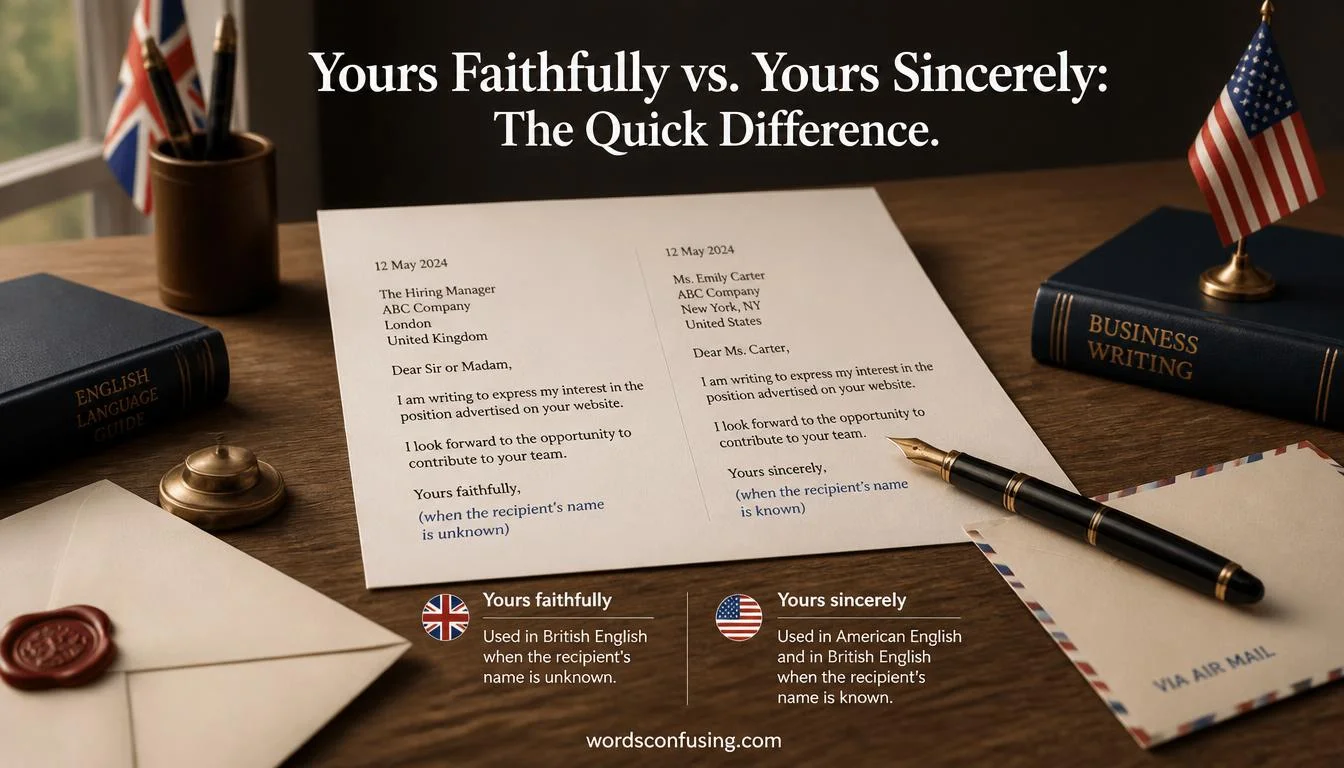
Yours Faithfully vs. Yours Sincerely: The Quick Difference
The fastest way to remember the traditional distinction is to look at the salutation at the beginning of your letter.
| Salutation | Traditional British closing | Common American closing |
| Dear Sir or Madam | Yours faithfully | Sincerely |
| Dear Sir | Yours faithfully | Sincerely |
| Dear Madam | Yours faithfully | Sincerely |
| Dear Mr. Smith | Yours sincerely | Sincerely |
| Dear Ms. Smith | Yours sincerely | Sincerely |
| Dear Dr. Brown | Yours sincerely | Sincerely |
| Dear Professor Jones | Yours sincerely | Sincerely |
The traditional British convention connects the level of personal knowledge to the closing.
If you don’t know the recipient’s name, you use “Yours faithfully.”
If you know the recipient’s name, you use “Yours sincerely.”
For example:
Dear Sir or Madam,
I am writing to inquire about the position advertised on your website.
Yours faithfully,
James Wilson
Now compare it with a named recipient:
Dear Ms. Taylor,
I am writing to inquire about the position advertised on your website.
Yours sincerely,
James Wilson
The body barely changes. The salutation changes, and the closing changes with it.
What Does “Yours Faithfully” Mean?
“Yours faithfully” is a formal complimentary close traditionally used when you don’t know the name of the person receiving your letter.
The word “faithfully” doesn’t mean that you’re declaring personal loyalty or affection. In this context, it’s part of a long-established formal correspondence formula.
Think of it as a conventional sign-off rather than a literal statement.
The expression became associated with formal British correspondence where writers addressed organizations, offices, or unknown individuals. Instead of guessing the recipient’s name, the writer could use a general salutation such as “Dear Sir or Madam.”
The closing then matched that impersonal opening.
When Should You Use “Yours Faithfully”?
Use “Yours faithfully” when the traditional British convention applies and you haven’t identified the recipient by name.
Typical situations include:
- Formal letters addressed to Dear Sir or Madam
- Formal inquiries sent to an organization
- Complaints addressed to an unknown representative
- Certain traditional business letters
- Formal requests where the individual recipient isn’t identified
For example:
Dear Sir or Madam,
I am writing to request further information about your graduate program. Please send details about the application deadline and required documents.
Yours faithfully,
Daniel Carter
Here, the writer doesn’t know who will read the letter. “Yours faithfully” therefore fits the traditional British pattern.
“Yours Faithfully” Doesn’t Mean “More Respectful”
A common misconception is that “Yours faithfully” automatically sounds more respectful than “Yours sincerely.”
That’s not quite right.
The distinction primarily concerns the relationship between the salutation and the closing, especially in traditional British letter writing.
Both expressions can sound highly formal. Neither one automatically makes a letter more polite.
Your word choice throughout the message matters far more. A letter with “Yours faithfully” can still sound rude if the body attacks the recipient.
What Does “Yours Sincerely” Mean?
“Yours sincerely” is a formal closing traditionally used when you know the recipient’s name.
The word “sincerely” emphasizes genuine or earnest communication. In formal correspondence, however, it functions mainly as a conventional closing.
For example:
Dear Mr. Anderson,
Thank you for considering my application. I would welcome the opportunity to discuss the position further.
Yours sincerely,
Michael Brown
Because the writer addresses Mr. Anderson by name, “Yours sincerely” follows the traditional British convention.
When Should You Use “Yours Sincerely”?
Use “Yours sincerely” when you address the recipient personally by name in traditional British correspondence.
That can include:
- Dear Mr. Williams
- Dear Ms. Parker
- Dear Dr. Lewis
- Dear Professor Adams
- Dear Jordan Smith
The recipient doesn’t have to be someone you know personally.
That’s an important distinction.
You might never have met Ms. Parker. If you know her name and address the letter to her specifically, the traditional British convention still favors “Yours sincerely.”
Example of “Yours Sincerely”
Dear Ms. Wilson,
Thank you for your response regarding my application. I appreciate the additional information and would be pleased to provide any further documents you require.
Yours sincerely,
Robert Davis
The tone remains formal without sounding excessively ceremonial.
The Main Rule: Look at the Salutation
If you remember only one thing from this article, remember this:
In traditional British English, the salutation usually determines the closing.
The pattern looks like this:
Unknown name → Dear Sir/Madam → Yours faithfully
Known name → Dear Mr./Ms. Name → Yours sincerely
This convention creates a neat correspondence between the beginning and end of the letter.
“Dear Sir or Madam” → “Yours Faithfully”
Suppose you’re contacting a company but can’t find the name of the appropriate manager.
You might write:
Dear Sir or Madam,
Because you’ve used a general salutation, the traditional British closing is:
Yours faithfully,
The complete ending could look like this:
Dear Sir or Madam,
I am writing to request information about your internship program. Could you please provide details about the application process and closing date?
Yours faithfully,
Sarah Miller
“Dear Mr. Smith” → “Yours Sincerely”
Now suppose you find the hiring manager’s name.
Your opening becomes:
Dear Mr. Smith,
Your traditional British closing then becomes:
Yours sincerely,
For example:
Dear Mr. Smith,
I am writing to apply for the marketing assistant position advertised recently. My experience in digital marketing and content creation closely matches the requirements listed in the advertisement.
Yours sincerely,
Sarah Miller
“Dear Ms. Johnson” → “Yours Sincerely”
The same principle applies to other titles:
Dear Ms. Johnson,
followed by:
Yours sincerely,
The important point isn’t whether you’ve met Ms. Johnson. The key issue is whether you’ve identified her by name.
Why Does the Name Matter?
The traditional rule developed around the relationship between the writer and recipient.
A general salutation such as “Dear Sir or Madam” doesn’t identify an individual. The closing therefore uses “faithfully.”
A named salutation establishes a more direct correspondence with a specific person. The traditional closing then uses “sincerely.”
You can think of the two expressions as matching bookends.
| Beginning | Traditional ending |
| Dear Sir or Madam | Yours faithfully |
| Dear Sir | Yours faithfully |
| Dear Madam | Yours faithfully |
| Dear Mr. Jones | Yours sincerely |
| Dear Ms. Jones | Yours sincerely |
| Dear Dr. Jones | Yours sincerely |
This rule isn’t a universal law of English grammar. It’s a convention of formal correspondence, particularly associated with British English.
That’s why regional style matters.
Yours Faithfully vs. Yours Sincerely in British English
British English traditionally makes a stronger distinction between these two closings.
If you don’t know the recipient’s name, “Yours faithfully” is the conventional choice.
If you know the recipient’s name, “Yours sincerely” is the conventional choice.
For example:
Unknown recipient:
Dear Sir or Madam,
Yours faithfully,
Known recipient:
Dear Ms. Roberts,
Yours sincerely,
This distinction often appears in traditional British business letters, formal applications, complaints, and official correspondence.
However, modern British business writing isn’t frozen in the past. Email has changed professional communication dramatically. Many workplaces now favor shorter closings such as “Kind regards” or “Best regards.”
Even so, “Yours faithfully” and “Yours sincerely” remain recognizable and grammatically established formal closings.
Is “Yours Faithfully” Still Correct?
Yes.
“Yours faithfully” is still correct. It may sound more traditional than some modern alternatives, but traditional doesn’t mean incorrect.
You’ll especially see it in formal British-style correspondence when the recipient’s name isn’t known.
For example:
Dear Sir or Madam,
I am writing to request a copy of your current membership information.
Yours faithfully,
Thomas Reed
The phrase works perfectly in this context.
Yours Faithfully vs. Yours Sincerely in American English
American English generally makes the choice easier.
In American business correspondence, “Sincerely” is a standard formal closing for both named and unnamed recipients.
For example:
Dear Hiring Manager,
Thank you for considering my application.
Sincerely,
Emily Carter
Or:
Dear Ms. Johnson,
Thank you for your time and consideration.
Sincerely,
Emily Carter
American English doesn’t generally require the strict “Dear Sir or Madam → Yours faithfully” pairing used in traditional British correspondence.
What About “Yours Sincerely” in American English?
Americans may understand “Yours sincerely”, but it isn’t the default professional closing in contemporary American business writing.
The more natural American choices include:
- Sincerely
- Sincerely yours
- Best regards
- Kind regards
- Regards
If you’re writing for an American audience, “Sincerely” is usually the safest formal option.
Yours Faithfully or Yours Sincerely for a Cover Letter?
Cover letters create one of the most common situations where this distinction matters.
First, identify the recipient.
If you know the hiring manager’s name, traditional British English favors:
Dear Ms. Thompson,
…
Yours sincerely,
Alex Morgan
If you don’t know the person’s name and use:
Dear Sir or Madam,
then traditional British usage favors:
Yours faithfully,
For American applications, “Sincerely” works in either situation.
A Better Cover Letter Strategy
Whenever possible, identify the actual hiring manager.
Compare these two openings:
Dear Sir or Madam,
and:
Dear Ms. Garcia,
The second feels more direct because you’ve identified the person who will receive the letter.
That doesn’t mean you should guess a name. Never invent a recipient’s name just to satisfy a formatting rule.
If the name isn’t available, use an appropriate general salutation instead.
Yours Faithfully or Yours Sincerely for a Complaint Letter?
Formal complaints often use either closing depending on the salutation and regional convention.
Suppose you’re writing to an organization without knowing the responsible employee’s name:
Dear Sir or Madam,
I am writing to complain about a delayed delivery associated with my recent order. The package arrived eight days after the promised delivery date.
Yours faithfully,
Daniel Harris
Now imagine you know the customer-service manager’s name:
Dear Ms. Brown,
I am writing to complain about a delayed delivery associated with my recent order. The package arrived eight days after the promised delivery date.
Yours sincerely,
Daniel Harris
The complaint itself determines the substance. The salutation determines the traditional closing.
Can You Use “Yours Faithfully” in an Email?
Yes, but context matters.
Email has made traditional letter-writing conventions more flexible. A highly formal email can still end with “Yours faithfully,” particularly when the message follows a formal British correspondence style.
However, the phrase can feel somewhat old-fashioned in everyday workplace communication.
For example, this email may sound unnecessarily formal:
Dear Sir or Madam,
I wish to request clarification regarding tomorrow’s meeting.
Yours faithfully,
Daniel
A modern professional email might sound more natural as:
Dear Sir or Madam,
Could you please confirm the time of tomorrow’s meeting?
Kind regards,
Daniel
The second version remains professional while sounding less ceremonial.
When “Yours Faithfully” Works Well in Email
It can make sense when:
- You’re writing an official complaint.
- You’re contacting an organization formally.
- You’re following a traditional British correspondence style.
- The situation calls for a highly formal tone.
- The recipient is unknown.
For ordinary workplace emails, Kind regards or Best regards may feel more natural.
Read more: 6 More Formal Ways to Say “Please Provide”
Can You Use “Yours Sincerely” in an Email?
Absolutely.
“Yours sincerely” can work well in a formal email when you know the recipient’s name, particularly in British English.
For example:
Dear Professor Wilson,
Thank you for reviewing my application. I appreciate your time and consideration.
Yours sincerely,
Daniel Harris
Still, modern email communication often favors shorter closings.
You might instead write:
Kind regards,
Daniel Harris
The choice depends on the relationship, purpose, and level of formality.
Yours Faithfully or Yours Sincerely for Business Letters?
Business letters often require a little more judgment than a simple memorized rule suggests.
Traditional British correspondence follows the name-based distinction. Modern businesses may use different house styles.
| Situation | Traditional British choice | Modern common alternative |
| Unknown recipient | Yours faithfully | Kind regards |
| Named recipient | Yours sincerely | Kind regards |
| Formal American letter | Sincerely | Best regards |
| Formal American email | Sincerely | Best regards |
| Less formal workplace email | Kind regards | Best regards |
The safest approach is to consider audience, region, relationship, and purpose together.
A legal notice doesn’t necessarily need the same closing as a quick internal email.
Formal Alternatives to “Yours Faithfully” and “Yours Sincerely”
Sometimes neither phrase fits the tone you want.
Modern professional communication offers several alternatives.
Sincerely
Sincerely is especially common in American English.
Example:
Dear Mr. Brown,
Thank you for your assistance.
Sincerely,
James Wilson
It’s formal, familiar, and versatile.
Sincerely Yours
Sincerely yours is another established formal closing, particularly in American English.
Example:
Dear Ms. Carter,
I appreciate your consideration.
Sincerely yours,
James Wilson
It sounds formal without being overly elaborate.
Kind Regards
Kind regards works especially well in modern professional emails.
Example:
Dear Dr. Evans,
Thank you for the information.
Kind regards,
James Wilson
It’s courteous without sounding stiff.
Best Regards
Best regards is widely used in professional correspondence.
It suits business emails, workplace communication, networking messages, and many other situations.
Regards
Regards is concise and neutral.
It works when you want to remain professional without adding extra warmth.
Respectfully
Respectfully carries a more formal or deferential tone.
It’s more appropriate for certain official, institutional, or sensitive communications than for casual workplace emails.
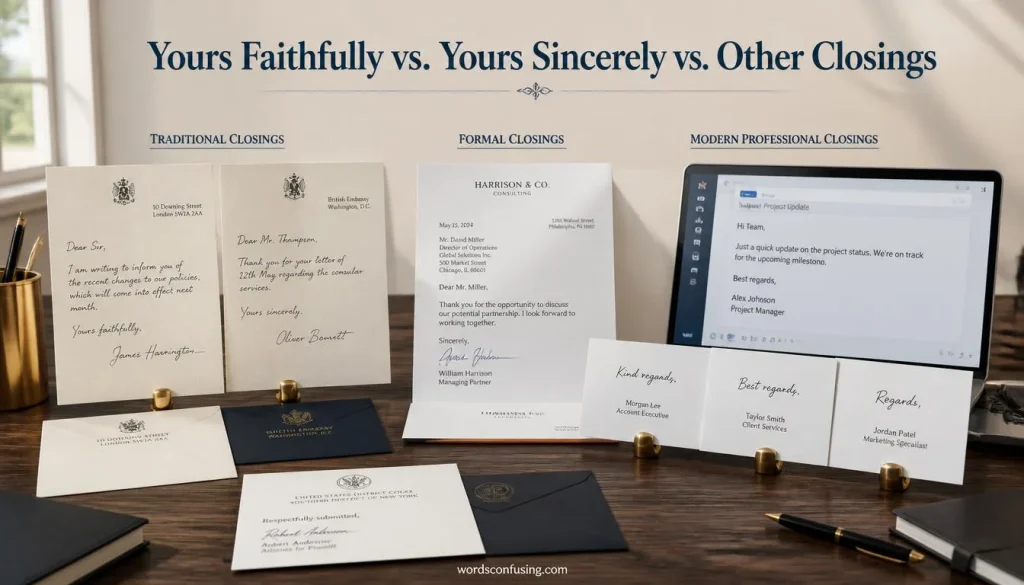
Yours Faithfully vs. Yours Sincerely vs. Other Closings
| Closing | Formality | Typical use |
| Yours faithfully | High | Traditional British letters to unnamed recipients |
| Yours sincerely | High | Traditional British letters to named recipients |
| Sincerely | High | American formal correspondence |
| Sincerely yours | High | American formal correspondence |
| Kind regards | Professional | Modern business emails |
| Best regards | Professional | General workplace communication |
| Regards | Neutral-professional | Short business messages |
| Respectfully | Very formal | Official or sensitive correspondence |
No closing works perfectly everywhere.
For instance, “Respectfully” may sound overly solemn in a routine scheduling email. Likewise, “Yours faithfully” may sound unusually traditional in a casual exchange with a colleague.
Good writing isn’t only about grammatical correctness. Tone has to fit the room.
Yours Faithfully or Yours Sincerely: Common Mistakes
Even experienced writers sometimes mix these expressions.
Using “Yours Faithfully” After a Person’s Name
Traditional British usage normally pairs a named salutation with “Yours sincerely.”
For example:
Dear Mr. Davis,
…
Yours faithfully,
This doesn’t follow the traditional pairing.
The expected form is:
Dear Mr. Davis,
…
Yours sincerely,
Using “Yours Sincerely” After “Dear Sir or Madam”
The reverse mistake happens too.
Traditional British correspondence normally uses:
Dear Sir or Madam,
…
Yours faithfully,
Not:
Dear Sir or Madam,
…
Yours sincerely,
American English handles this differently because “Sincerely” works broadly.
Writing “Your’s Sincerely”
This is incorrect.
The possessive pronoun “yours” never takes an apostrophe.
Correct:
Yours sincerely
Incorrect:
Your’s sincerely
The same principle applies to:
- yours
- ours
- theirs
- its
These possessive forms don’t need apostrophes.
Capitalizing Every Word
The standard forms are:
Yours faithfully
and:
Yours sincerely
You don’t normally need to capitalize the second word.
A common error is:
Yours Faithfully
This capitalization isn’t necessary in ordinary correspondence.
Treating the Rule as Universal
The biggest mistake is assuming that every English-speaking country follows exactly the same convention.
British and American English differ here.
Traditional British usage makes a distinction between named and unnamed recipients. American business writing generally doesn’t require that distinction.
Regional conventions matter.
Correct Formatting for “Yours Faithfully” and “Yours Sincerely”
The closing normally appears after the final paragraph of the letter.
A traditional format looks like this:
Dear Sir or Madam,
I am writing to request further information about your scholarship program. Please send details about the eligibility requirements and application deadline.
Yours faithfully,
Olivia Carter
For a named recipient:
Dear Dr. Wilson,
Thank you for taking the time to review my application. I appreciate your consideration and look forward to hearing from you.
Yours sincerely,
Olivia Carter
Should You Add a Comma?
You may see different punctuation styles in professional correspondence.
Traditional British formatting commonly uses:
Yours sincerely,
American business letters also commonly use a comma after the complimentary close:
Sincerely,
However, punctuation conventions can vary by organizational style. The important thing is consistency.
Where Does Your Name Go?
Leave enough space between the closing and your typed name if you’re printing and signing the letter.
For example:
Yours sincerely,
[Signature]
Olivia Carter
In an email, you normally don’t need a handwritten signature.
Case Study: Choosing the Right Closing
Consider three writers applying for jobs.
Case One: Unknown Hiring Manager
A job advertisement provides only:
Recruitment Department
The applicant writes:
Dear Sir or Madam,
Under traditional British conventions, the corresponding closing is:
Yours faithfully,
Case Two: Named Hiring Manager
The same company later identifies the hiring manager as Sarah Bennett.
The applicant writes:
Dear Ms. Bennett,
The traditional British closing becomes:
Yours sincerely,
Case Three: American Employer
The applicant applies to an American company and addresses the hiring manager:
Dear Ms. Bennett,
The natural formal closing is:
Sincerely,
Notice what changed. The applicant didn’t suddenly become more or less respectful. The regional convention changed.
That’s why memorizing only one formula can create problems.
A Simple Decision Guide
When you’re unsure, ask two questions.
First: Which variety of English are you using?
If you’re writing traditional British English, use the name-based distinction.
If you’re writing American English, Sincerely works in most formal situations.
Second: Do you know the recipient’s name?
For traditional British correspondence:
No name → Yours faithfully
Name known → Yours sincerely
Here’s the complete decision tree:
Do you know the recipient’s name?
→ No → “Dear Sir or Madam” → Yours faithfully
→ Yes → “Dear Mr./Ms./Dr. [Name]” → Yours sincerely
For American English:
→ Either situation → Sincerely is generally appropriate.
Read more: Nicholas’ or Nicholas’s: Which Is Correct?
Is “Yours Faithfully” More Formal Than “Yours Sincerely”?
Not necessarily.
Both are formal closings. The traditional distinction isn’t mainly about ranking one phrase above the other.
Instead, the distinction concerns whether the recipient’s name appears in the salutation.
That means this isn’t really a question of:
Which phrase sounds more professional?
It’s more accurately a question of:
Which phrase matches my salutation and regional writing convention?
That shift makes the choice much easier.
Is “Yours Sincerely” More Personal?
It can feel slightly more personal because it traditionally follows a named salutation.
Still, don’t read too much emotion into the word “sincerely.”
In formal correspondence, it’s largely a conventional formula. A letter to someone you’ve never met can appropriately end with “Yours sincerely” if you address that person by name.
For example:
Dear Mr. Harrison,
You don’t need to know Mr. Harrison personally.
If you’re following traditional British usage, the closing can still be:
Yours sincerely,
Can You Start a Letter With “Dear Sir or Madam”?
Yes.
“Dear Sir or Madam” remains a recognized formal salutation when you genuinely don’t know the recipient’s name.
However, if you can identify the appropriate person, using their name usually creates a more direct and specific letter.
For example:
Dear Hiring Manager,
may be preferable to:
Dear Sir or Madam,
when you’re writing about a job and no individual name is available.
Similarly, an organizational role can sometimes provide a useful alternative:
Dear Customer Service Manager,
The best salutation depends on the situation.
Should You Use “Dear Sir or Madam” in Every Formal Letter?
No.
Formal doesn’t automatically mean old-fashioned.
1. If you know the recipient’s name, use it.
2. If you don’t know the name but know the role, you may use the role.
3. If the organization provides a specific contact name, follow that information.
For example:
Dear Admissions Officer,
can be more specific than:
Dear Sir or Madam,
Specificity often makes professional writing feel more deliberate.

Yours Faithfully or Yours Sincerely: Which One Should You Choose?
The answer depends mainly on English variety and recipient information.
For traditional British English:
| If your letter begins with… | Use… |
| Dear Sir or Madam | Yours faithfully |
| Dear Sir | Yours faithfully |
| Dear Madam | Yours faithfully |
| Dear Mr. Smith | Yours sincerely |
| Dear Ms. Smith | Yours sincerely |
| Dear Dr. Smith | Yours sincerely |
For American English, Sincerely is the straightforward formal choice.
Modern professional emails allow even more flexibility. Kind regards and Best regards often sound more natural when the message doesn’t require a highly formal tone.
FAQs
Is “Yours faithfully” more formal than “Yours sincerely”?
Both are formal letter closings. The main difference is how you address the recipient. “Yours faithfully” traditionally follows a general salutation, while “Yours sincerely” usually follows a named recipient.
When should I use “Yours sincerely”?
Use “Yours sincerely” when you know the recipient’s name. For example, if your letter begins with “Dear Mr. Smith,” you can normally close it with “Yours sincerely.”
When should I use “Yours faithfully”?
Use “Yours faithfully” when you don’t know the recipient’s name. A traditional example is a letter beginning with “Dear Sir or Madam.”
Do Americans use “Yours faithfully”?
It can be understood in American English, but it isn’t as common as it is in British English. American business letters often use closings such as “Sincerely” or “Sincerely yours.”
Is “Yours sincerely” correct in British English?
Yes. In British English, “Yours sincerely” is standard when you address the recipient by name. It is a common choice for formal and professional correspondence.
Can I use “Yours sincerely” and “Yours faithfully” interchangeably?
Not traditionally. Your choice should match the salutation and the convention you’re following. If you know the recipient’s name, “Yours sincerely” is generally appropriate. If you use a general salutation, “Yours faithfully” is traditionally preferred.
Conclusion
Choosing between Yours sincerely and Yours faithfully becomes much easier when you look at how you started the letter. If you address someone by name, Yours sincerely is generally the natural choice in British formal writing. If you use a general salutation such as “Dear Sir or Madam,” Yours faithfully traditionally fits better.
American English often favors Sincerely in both situations, so your audience and regional conventions matter. When in doubt, check the salutation, keep the closing consistent, and avoid mixing different letter-writing conventions. A small detail like this can make your formal correspondence feel polished rather than awkward.

Shafiq Ur Rehman is a writer and content contributor at WordsConfusing.com. He enjoys exploring the English language, common word confusions, vocabulary, and practical writing tips. His goal is to make English easier to understand through clear, simple, and useful articles.