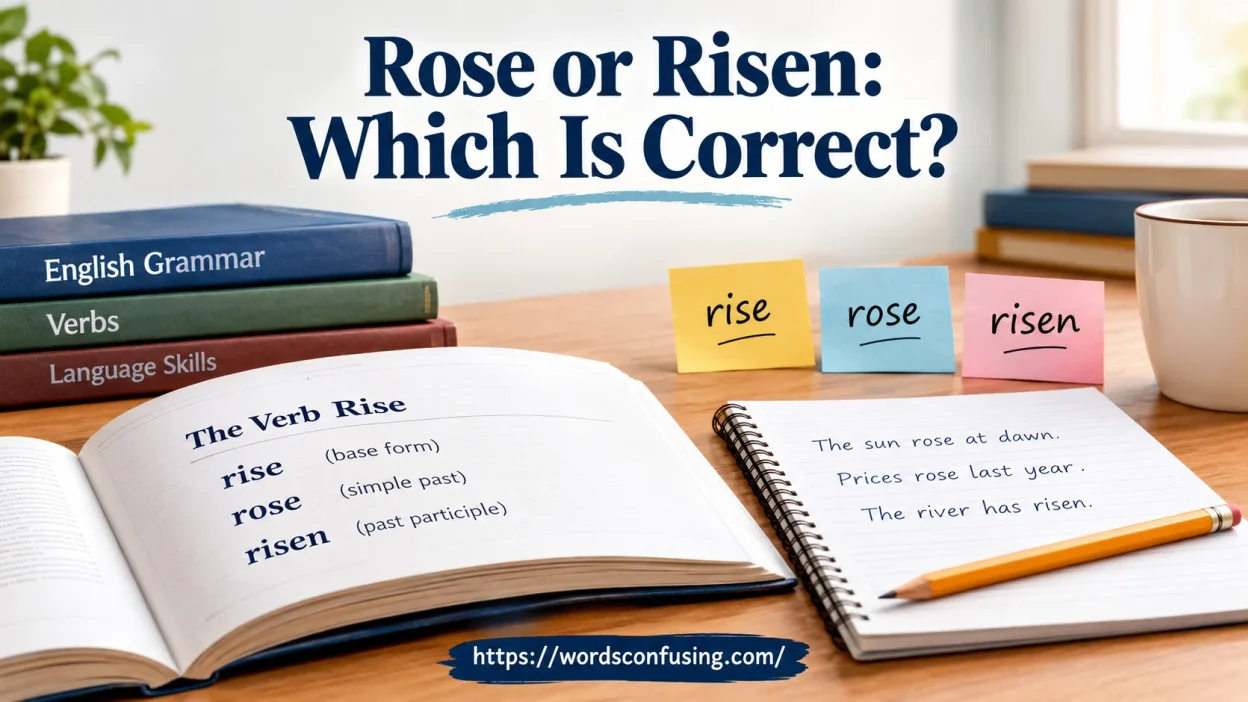
Understanding Rose or Risen: Which Is Correct? starts with knowing how each verb form works in everyday English and formal writing.
The words rose and risen are forms of the verb to rise, but they are used in different ways. The main difference is their verb tense: rose is the simple past tense, while risen is the past participle. The helping verb has, have, or had normally appears with risen.
This basic grammar rule helps with choosing the correct word and understanding their grammatical roles, meanings, pronunciation, and correct usage. It also reduces confusion and common English mistakes in everyday communication and formal writing.
The simple past tense rose describes actions that were completed in the past, including something that moved upward or someone who got up. For example, “The sun rose early.” In contrast, risen works with an auxiliary verb to create perfect tenses, as in “Prices have risen this year.”
These practical examples show that the two verb forms cannot always replace each other. Their definition and sentence structures depend on the context, whether you describe upward movement, an increase, prices last year, or this year.
Learning the correct verb forms, sentence patterns, and usage helps you communicate your ideas clearly. These useful examples also make rose vs. risen easier to remember in spoken English and written English, while preventing common mistakes.
Quick Answer
The quick answer is simple: rose is the simple past tense of rise, while risen is the past participle of rise.
| Word | Verb form | Typical use | Example |
| Rise | Base form | Present tense and infinitives | Prices rise every year. |
| Rose | Simple past | A completed past action | Prices rose last year. |
| Risen | Past participle | Perfect tenses | Prices have risen this year. |
| Rising | Present participle | Continuous forms | Prices are rising quickly. |
Think of rose as the form that tells you something happened in the past.
Risen, on the other hand, normally works with a helping verb such as has, have, or had.
For example:
- The temperature rose yesterday.
- The temperature has risen today.
- The temperature had risen before noon.
The meaning involves upward movement in all three sentences. The grammar changes because the verb form changes.

What Does “Rose” Mean?
Rose is the simple past form of rise. It describes something that moved upward, increased, got up, or appeared at a particular point in the past.
The verb rise has several meanings. It doesn’t always describe physical movement. You can use it for prices, temperatures, water levels, salaries, emotions, expectations, and even the sun.
Consider these examples:
- The sun rose at 6:15 a.m.
- She rose from her chair.
- The river rose after heavy rain.
- Food prices rose sharply last year.
- The temperature rose five degrees.
- His confidence rose after the victory.
In every example, rose describes a past action or change.
When to Use Rose
Use rose when you need the simple past form of rise.
The sentence can contain a specific past-time expression:
The water rose three feet overnight.
The word overnight places the event in a completed past period.
You can also use rose without stating exactly when the action happened:
The crowd rose when the speaker entered.
The important point is that rose itself carries the simple past form. It doesn’t need has, have, or had before it.
Rose Examples in Different Contexts
Physical movement
The child rose from the floor.
Natural movement
The sun rose above the horizon.
Increase
The price of gasoline rose again.
Water level
The river rose several inches after the storm.
Abstract change
Her confidence rose after receiving the good news.
These sentences demonstrate one useful rule: rose can function as the main verb in a simple past sentence.
What Does “Risen” Mean?
Risen is the past participle of rise. It isn’t the simple past form.
This distinction matters because past participles usually work with auxiliary or helping verbs. The most common combinations are has risen, have risen, and had risen.
For example:
- The sun has risen.
- Prices have risen.
- The river had risen overnight.
- The water level has risen considerably.
- Expectations have risen since the announcement.
Notice the pattern:
has/have/had + risen
That’s the easiest way to recognize the past participle in everyday sentences.
Why “Risen” Usually Needs a Helping Verb
A past participle doesn’t normally express the simple past by itself.
You wouldn’t normally say:
The temperature risen yesterday.
That construction is incorrect because risen cannot replace rose in the simple past.
Instead, say:
The temperature rose yesterday.
Or, if you want a perfect construction:
The temperature has risen since yesterday.
The helping verb gives risen the grammatical support it needs.
Rose vs. Risen: The Main Grammar Difference
The most important distinction between rose and risen is their grammatical function.
“Rose” Is the Simple Past Form
The simple past describes an action or event that happened in the past.
The basic structure is:
Subject + rose + additional information
Examples:
- The balloon rose into the air.
- The sun rose early.
- The temperature rose overnight.
- The crowd rose to its feet.
No auxiliary verb is necessary.
That’s why “The sun rose” is complete and grammatical.
“Risen” Is the Past Participle
The past participle appears in perfect constructions.
A common structure looks like this:
Subject + has/have/had + risen
Examples:
- The sun has risen.
- Prices have risen.
- The river had risen before dawn.
- Demand has risen considerably.
The tense comes from the auxiliary verb. Risen remains the participle.
This is similar to other irregular verbs:
| Base | Simple Past | Past Participle |
| Rise | Rose | Risen |
| Write | Wrote | Written |
| Speak | Spoke | Spoken |
| Break | Broke | Broken |
| Choose | Chose | Chosen |
| Drive | Drove | Driven |
The pattern isn’t unusual. English contains many irregular verbs with different past and past-participle forms.
Rise, Rose, Risen: Complete Verb Forms
Learning all the forms together makes the distinction much easier.
| Verb form | Word | Example |
| Base form | rise | Prices rise every year. |
| Simple past | rose | Prices rose last year. |
| Past participle | risen | Prices have risen this year. |
| Present participle | rising | Prices are rising now. |
You can think of these forms as four different tools.
Rise handles the base form.
Rose handles the simple past.
Risen works as the past participle.
Rising appears in continuous constructions.
For example:
1. Prices rise when demand increases.
2. Prices rose last year.
3. Prices have risen since January.
4. Prices are rising again.
The basic meaning stays connected to upward movement. The grammatical form changes with the sentence.
Rose or Risen in a Sentence?
Choosing between rose and risen becomes easier when you look at the sentence structure.
Use “Rose” for a Completed Past Action
Use rose when you’re describing something that happened in the past using the simple past tense.
For example:
The temperature rose sharply yesterday.
Here, rose describes a completed event.
Other examples include:
- The sun rose behind the mountains.
- The water rose during the storm.
- The company’s revenue rose last quarter.
- She rose from her seat.
- The number of visitors rose in June.
Each sentence presents the increase or upward movement as a past event.
Use “Risen” With Has, Have, or Had
Use risen when the sentence requires the past participle.
For example:
The temperature has risen sharply.
The sentence doesn’t simply report a completed event at a particular past moment. It connects the earlier increase with the present.
Compare:
The temperature rose yesterday.
The temperature has risen since yesterday.
The first sentence focuses on a past event. The second emphasizes a change that extends or remains relevant up to the present.
“Rose” vs. “Has Risen”
This contrast is especially useful.
The price rose last week.
This sentence points to a completed past period.
The price has risen since last week.
This sentence connects the earlier change with the present situation.
Both sentences are grammatical. Neither form is automatically better.
The surrounding context determines which one you need.
Read more: Some Is vs. Some Are: Learn If “Some” Is Singular or Plural
Rose or Risen for “Get Up”?
The verb rise can mean to move from a lower position to a higher position, including getting up from a bed, chair, or floor.
Both rose and risen can describe this action. However, they require different grammatical structures.
Simple Past
She rose from her chair.
Here, rose is the simple past form.
Present Perfect
She has risen from her chair.
Here, has risen forms the present perfect.
The incorrect version would be:
She has rose from her chair.
The problem is has rose. After has, you need the past participle risen.
So remember:
She rose.
She has risen.
Not:
She has rose.
Rose or Risen for Prices?
Economic writing provides some of the clearest examples of this distinction.
You might read:
Housing prices rose by 6% last year.
The simple past works because the sentence refers to a completed period.
Now compare:
Housing prices have risen by 6% since last year.
Here, have risen connects the change to the present.
The same principle works with many measurable quantities:
- Interest rates
- Wages
- Food prices
- Rent
- Stock values
- Production
- Demand
- Sales
- Unemployment
- Energy costs
For example:
| Simple past | Perfect construction |
| Demand rose in May. | Demand has risen since May. |
| Sales rose last quarter. | Sales have risen this year. |
| Prices rose yesterday. | Prices have risen recently. |
| Costs rose in 2025. | Costs have risen since 2025. |
The choice depends on the tense and time relationship.
Rose or Risen for Temperatures?
Temperature provides another useful comparison.
The temperature rose to 90°F yesterday.
This sentence describes a past event.
Now consider:
The temperature has risen to 90°F.
This construction connects the rise with the current situation.
You can also use had risen when one past event happened before another:
The temperature had risen significantly before the storm arrived.
Here, had risen establishes an earlier past event.
This gives you a useful three-way comparison:
- rose — simple past
- has risen — present perfect
- had risen — past perfect
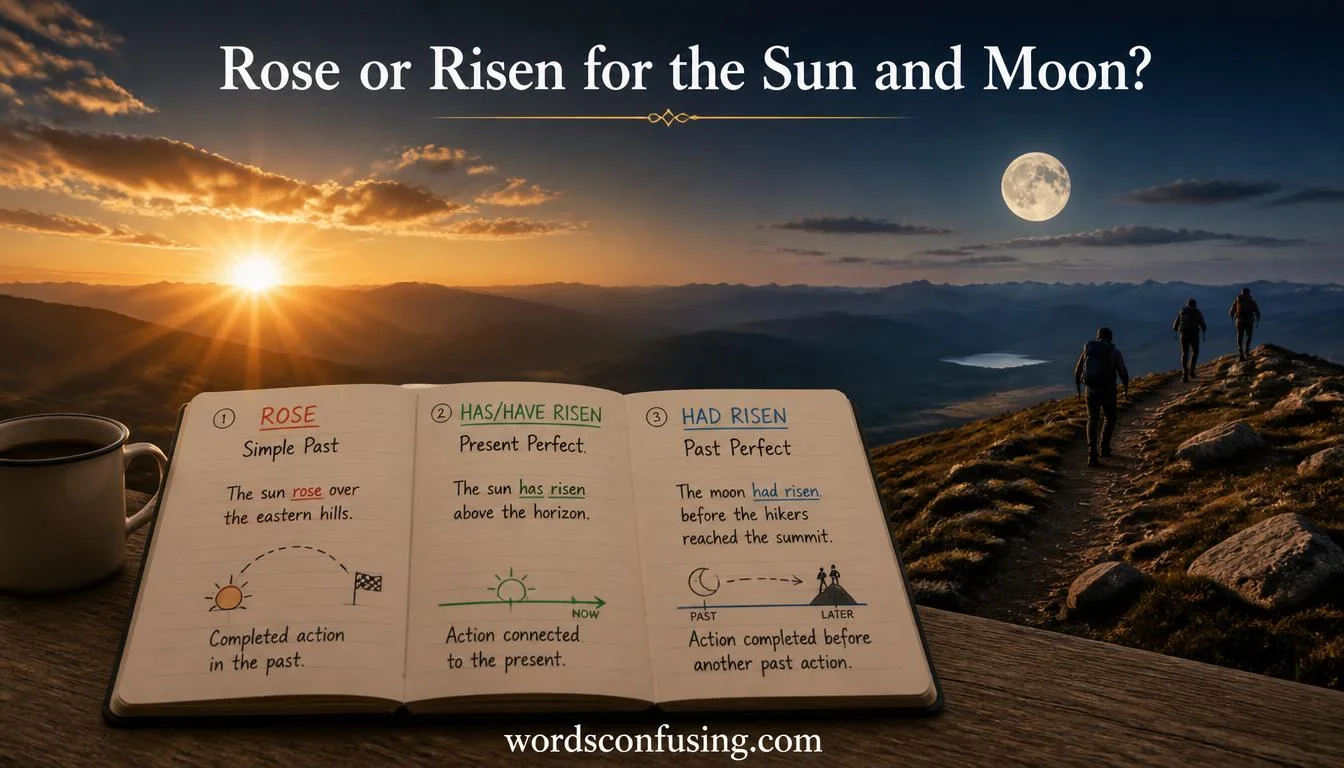
Rose or Risen for the Sun and Moon?
The sun and moon frequently appear with rise because they appear to move upward above the horizon.
For a simple past event, use rose:
The sun rose over the eastern hills.
For a perfect construction, use risen:
The sun has risen above the horizon.
You can also use had risen:
The moon had risen before the hikers reached the summit.
Again, the choice isn’t about the sun or moon. It’s about verb tense.
That’s an important point. You don’t choose rose because something is physical or risen because something is natural. You choose the form based on the grammatical construction.
Rose or Risen for Water Levels?
Water levels make the difference especially clear.
The river rose after heavy rain.
This sentence uses the simple past.
Now compare:
The river has risen several feet.
The second sentence uses the present perfect.
You can also place the rise earlier in the past:
The river had risen before emergency crews arrived.
These examples show how the same event can use different forms depending on the timeline.
A Simple Timeline
Past event:
River rose → Heavy rain ended
Past event connected to now:
Rain → River has risen → Current level
Earlier past event:
River had risen → Crews arrived
The timeline helps you see why rose and risen aren’t interchangeable.
Common Mistakes With Rose and Risen
Many errors happen because English speakers know that rose and risen both come from rise. The tricky part is knowing which grammatical form belongs after a helping verb.
“I Have Rose” Is Incorrect
A common mistake is:
I have rose early.
The correct sentence is:
I have risen early.
Why?
Because have requires the past participle in this perfect construction.
The pattern is:
have + risen
Not:
have + rose
“He Has Rose” Is Incorrect
You might hear:
He has rose from his seat.
Standard English requires:
He has risen from his seat.
But if you remove has, you can use rose:
He rose from his seat.
The grammatical structure determines the form.
“He Risen Early” Is Incorrect
Another common error is:
He risen early.
This doesn’t work as a standard simple-past sentence.
Use:
He rose early.
Or:
He has risen early.
The missing auxiliary is the problem in the second version.
Rose or Risen: What About “Had”?
The word had often creates confusion because it can make either form seem possible.
When had functions as an auxiliary in the past perfect, use risen:
The water had risen before dawn.
Don’t write:
The water had rose before dawn.
The correct pattern is:
had + risen
However, had can also appear as the main verb in unrelated constructions:
She had a meeting.
That doesn’t affect the rise → rose → risen pattern.
Rose or Risen: What About “Was”?
The verb rise also appears in passive-looking or continuous structures where rising may be the correct form.
For example:
The water was rising quickly.
Here, rising is the present participle used in a progressive construction.
You wouldn’t normally replace it with risen:
The water was risen quickly.
That sentence doesn’t express the intended meaning.
Compare these forms:
- The water rose quickly.
- The water has risen quickly.
- The water was rising quickly.
Each sentence uses a different grammatical construction.
Rose vs. Risen and the Difference Between Rise and Raise
Another useful distinction involves rise and raise.
These verbs often appear together in grammar discussions because both involve upward movement. However, they don’t mean exactly the same thing.
Rise is generally intransitive. The subject moves upward or increases.
Prices rose.
Raise is transitive. Someone or something causes another object or amount to move upward.
The company raised prices.
Compare:
| Rise | Raise |
| The sun rose. | She raised her hand. |
| Prices rose. | The store raised its prices. |
| The water rose. | Workers raised the platform. |
| He rose from his chair. | He raised the chair. |
This distinction matters because rise doesn’t normally take a direct object in the same way raise does.

Rose, Risen, and Real-World Examples
Example: Weather
The temperature rose above 100°F yesterday.
This uses simple past because the sentence refers to a completed past event.
The temperature has risen above 100°F today.
This uses present perfect because the increase remains relevant to the current situation.
Example: Business
Company revenue rose during the final quarter.
The increase occurred during a completed reporting period.
Company revenue has risen steadily this year.
The sentence connects the increase with the present.
Example: Water
The river rose after the storm.
Simple past.
The river has risen several feet.
Present perfect.
Example: Human movement
The audience rose when the judge entered.
Simple past.
Several people have risen from their seats.
Present perfect.
A Practical Test for Rose or Risen
When you’re unsure, ask one simple question:
Does the sentence need the simple past or the past participle?
If you need the simple past, choose rose.
The sun rose at dawn.
If you need the past participle, choose risen.
The sun has risen.
A second test can make the decision even faster.
Look at the word immediately before the verb.
If you see:
- has
- have
- had
you’ll usually need risen in a perfect construction.
For example:
- has risen
- have risen
- had risen
If the sentence simply needs the past form without an auxiliary, use rose.
The sun rose.
Read more: 5 Ways to Describe the Sound of Rain
Rose or Risen: A Quick Memory Trick
The easiest memory trick is:
Yesterday → rose.
Has, have, or had → risen.
For example:
Yesterday, the temperature rose.
The temperature has risen.
The temperature had risen.
This isn’t a complete explanation of every possible grammatical construction. However, it’s a highly useful shortcut for ordinary writing.
Another way to remember the sequence is:
Rise → Rose → Risen
Think of it like:
Today → Yesterday → Perfect
- Today: rise
- Yesterday: rose
- Perfect: risen
Once this sequence becomes familiar, the forms stop looking like three unrelated words.
Rose vs. Risen Comparison Table
| Feature | Rose | Risen |
| Related verb | Rise | Rise |
| Verb form | Simple past | Past participle |
| Main function | Describes a past action | Works in perfect constructions |
| Auxiliary required? | No | Usually yes |
| Common helpers | — | Has, have, had |
| Example | The river rose. | The river has risen. |
| Example with time | Prices rose last year. | Prices have risen since last year. |
| Correct after “has” | No | Yes |
| Correct after “have” | No | Yes |
| Correct after “had” | No | Yes |
The table reveals the core rule at a glance: rose carries the simple past, while risen carries the past participle.
FAQs
Is “rose” the past tense of “rise”?
Yes. Rose is the simple past tense of rise. Use it for an action that happened and ended in the past. For example, “The sun rose at 6 a.m.”
Is “risen” the past tense of “rise”?
No. Risen is the past participle of rise. It usually needs a helping verb such as has, have, or had. For example, “The temperature has risen.”
Can I use “rose” and “risen” interchangeably?
No. They have different grammatical roles. Rose works as a simple past verb, while risen forms perfect tenses with a helping verb.
Which is correct: “Prices rose” or “Prices have risen”?
Both are correct, but they describe different time structures. “Prices rose last year” uses the simple past, while “Prices have risen this year” uses the present perfect.
What is an easy way to remember rose vs. risen?
Think of rose as the completed past action. Think of risen as the form that usually needs has, have, or had nearby. This quick pattern helps prevent mistakes.
Is “The sun has rose” grammatically correct?
No. The correct sentence is “The sun has risen.” After has, you need the past participle risen, not the simple past form rose.
Conclusion
Choosing between rose and risen becomes much easier once you remember what role each word plays. Rose stands alone as the simple past tense of rise, while risen is the past participle and usually needs has, have, or had before it. A quick check of the sentence can often tell you which form belongs there. If you’re talking about something that happened and finished in the past, rose is usually the right choice. If the sentence uses a helping verb to create a perfect tense, risen is the better fit.
This distinction may seem small, but it makes your spoken English and written English much clearer. I find that remembering a few everyday examples works better than memorizing a complicated grammar rule. Think of “The sun rose” for a completed past action, but “The sun has risen” for a perfect tense. Once this pattern becomes familiar, the confusion fades quickly. With a little practice, you’ll be able to choose between rose and risen naturally and use both forms with confidence.

Shafiq Ur Rehman is a writer and content contributor at WordsConfusing.com. He enjoys exploring the English language, common word confusions, vocabulary, and practical writing tips. His goal is to make English easier to understand through clear, simple, and useful articles.