
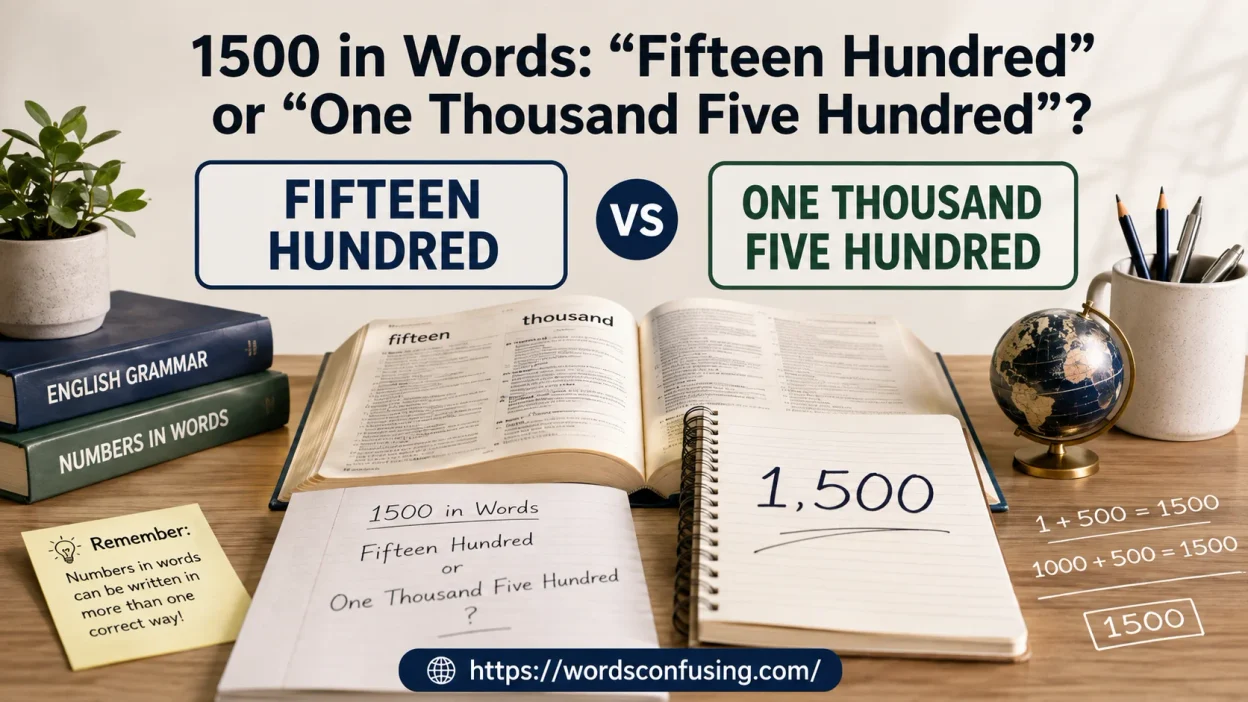
When writing 1,500, the number wording you choose depends on the context, audience, and writing purpose. For 1500 in Words: “Fifteen Hundred” or “One Thousand Five Hundred”, both fifteen hundred and one thousand five hundred are correct and grammatically correct in English.
In everyday English and everyday conversation, fifteen hundred sounds more natural, concise, and conversational. In formal English, formal writing, academic documents, and official records, one thousand five hundred often provides better clarity, precision, and readability. The right expression depends on the level of formality, audience expectations, and writing purpose, while using the correct version consistently improves communication and confidence.
The same number wording matters in a document, form, check, or documentation, where accurate wording, number formatting, and accuracy support clear information exchange. This applies to business communication, project management, scheduling, calendar planning, time management, online booking, broadcasting, and meetings.
Understanding these two forms helps you recognize common usage patterns in modern English and choose the most appropriate choice for specific situations.
The article also explores how clear wording can help when you know somebody who finds faults in everything and you work really hard to impress people with critical, judgmental, picky, demanding, difficult, disapproving, negative, perfectionist, exacting, nitpicky, hypercritical, or censorious attitude.
Quick Answer
If a worksheet asks, “Write 1500 in words,” the safest answer is:
One thousand five hundred
If you’re speaking naturally, especially in American English, you can comfortably say:
Fifteen hundred
Both communicate the same numerical value.
What Is 1500 in Words?
The standard place-value spelling of 1500 is:
1,500 = one thousand five hundred
Another accepted expression is:
1,500 = fifteen hundred
Both equal exactly 1,500.
To understand why, break the number into its place values:
| Digit | Place | Value |
| 1 | Thousands | 1,000 |
| 5 | Hundreds | 500 |
| 0 | Tens | 0 |
| 0 | Ones | 0 |
Now add the values:
1,000 + 500 = 1,500
That gives you one thousand five hundred.
There’s another way to look at the same number:
15 × 100 = 1,500
That produces fifteen hundred.
The difference is therefore not mathematical. It’s simply a difference in how English packages the same quantity into words.
Is “Fifteen Hundred” Correct?
Yes. “Fifteen hundred” is grammatically correct English.
English speakers regularly use this construction for numbers between 1,000 and 9,900 when the number can be expressed as a multiple of 100.
Consider this sequence:
- 1,100 → eleven hundred
- 1,200 → twelve hundred
- 1,300 → thirteen hundred
- 1,400 → fourteen hundred
- 1,500 → fifteen hundred
- 1,600 → sixteen hundred
- 1,700 → seventeen hundred
- 1,800 → eighteen hundred
- 1,900 → nineteen hundred
The construction works because “fifteen hundred” means fifteen groups of one hundred.
Merriam-Webster defines hundred as a number equal to ten times ten. The word can also function in expressions referring to quantities or groups.
Why “Fifteen Hundred” Sounds Natural
Imagine someone tells you that a concert attracted 1,500 people.
In conversation, you might naturally hear:
“About fifteen hundred people showed up.”
That phrasing feels compact. It rolls off the tongue without forcing the speaker to build the number piece by piece.
Compare it with:
“About one thousand five hundred people showed up.”
That version isn’t wrong. It simply sounds more deliberate.
This distinction matters because spoken English often favors economical expressions. When a number consists of an exact number of hundreds, “fifteen hundred” provides a neat shortcut.
Is “One Thousand Five Hundred” Correct?
Yes. “One thousand five hundred” is also completely correct.
This version follows the number’s place-value structure directly:
- one thousand = 1,000
- five hundred = 500
- Together = 1,500
For students learning English numbers, this form can feel easier to understand because every part of the number has an obvious place-value role.
For example:
The company received one thousand five hundred applications.
The same sentence could say:
The company received fifteen hundred applications.
The meaning doesn’t change.
The first version spells out the number according to its thousands-and-hundreds structure. The second compresses the same quantity into fifteen hundreds.
“Fifteen Hundred” vs. “One Thousand Five Hundred”
Here’s the practical difference at a glance:
| Expression | Correct? | Best fit | Example |
| fifteen hundred | Yes | Conversation and natural speech | “It costs fifteen hundred dollars.” |
| one thousand five hundred | Yes | Number exercises and explicit place-value wording | “The total is one thousand five hundred.” |
| fifteen hundreds | No | Avoid | Incorrect construction |
| one thousand five hundreds | No | Avoid | Incorrect construction |
| one thousand five hundred | Yes | Standard full form | “There are one thousand five hundred seats.” |
One important point deserves emphasis: “one thousand five hundred” isn’t grammatically wrong just because “fifteen hundred” may sound more natural in certain situations.
Likewise, “fifteen hundred” isn’t informal nonsense that should disappear from formal English.
The appropriate choice depends on the writing system, context, audience, and style guide.
The Chicago Manual of Style provides a particularly useful example. Its guidance says that whole numbers from one through one hundred followed by hundred, thousand, or similar terms are generally spelled out. For 1,500, its Q&A specifically gives “fifteen hundred” as the spelled-out form.
That detail is worth remembering because it challenges a common assumption: longer doesn’t automatically mean more formal or more correct.
Which Is More Formal: “Fifteen Hundred” or “One Thousand Five Hundred”?
Neither expression is automatically more formal in every situation.
That’s the important distinction.
Many writers assume that “one thousand five hundred” must be the formal version because it looks more complete. Yet style guides don’t always support that assumption.
For example, Chicago’s guidance specifically favors “fifteen hundred” when spelling out 1,500 under its number rules.
However, “one thousand five hundred” can be useful when you’re teaching place value or explaining exactly how a number is constructed.
Consider these two situations.
Conversation:
“The new sofa cost fifteen hundred dollars.”
Math lesson:
“1,500 consists of one thousand plus five hundred.”
Both sentences work beautifully because the wording serves the purpose.
The Better Rule
Instead of asking, “Which version is more formal?”, ask:
“Which version makes the number clearest in this context?”
That’s a much more useful writing rule.
How to Say 1500 in Everyday American English
In everyday American speech, “fifteen hundred” is extremely natural.
You could hear it when someone talks about:
- money
- attendance
- distance
- population
- quantities
- measurements
- years
For example:
“The apartment costs fifteen hundred a month.”
“Around fifteen hundred people attended.”
“The destination is fifteen hundred miles away.”
“We ordered fifteen hundred units.”
These sentences don’t sound strange or incomplete to an American English speaker.
In fact, the shorter structure can feel more conversational because it treats 1,500 as a simple block of fifteen hundreds.
A Useful Speaking Tip
When you see 1,500 during a conversation, don’t feel obligated to mentally construct:
one → thousand → five → hundred
You can simply recognize:
15 × 100 = fifteen hundred
That mental shortcut makes speaking numbers much faster.
How to Write 1500 in Formal English
Formal writing requires more than choosing the longest possible wording.
A professional document might use 1,500 instead of spelling the number out entirely. The decision depends on the document’s style rules.
For example:
The survey received 1,500 responses.
That sentence may be cleaner than:
The survey received one thousand five hundred responses.
If the document contains many statistics, numerals usually make scanning easier.
Chicago also notes that numerals are useful in many contexts involving precise measurements and statistical information. Its guidance recognizes that number style depends heavily on context rather than one universal spelling rule.
Formal Writing Does Not Mean “Use More Words”
This is an important writing lesson.
Compare:
The organization served 1,500 customers.
The organization served one thousand five hundred customers.
The second sentence isn’t automatically more professional. In a statistical report, the first version may actually be easier to read.
Good formal writing values clarity, consistency, and purpose.
How to Write $1,500 in Words
If you’re writing $1,500 in words, the most straightforward form is:
one thousand five hundred dollars
You can also say:
fifteen hundred dollars
Both expressions describe the same amount.
Examples
The laptop costs fifteen hundred dollars.
The repair estimate is one thousand five hundred dollars.
She saved $1,500 for the trip.
The total payment came to one thousand five hundred dollars.
In everyday conversation, “fifteen hundred dollars” often sounds more natural.
On a formal financial document, however, follow the instructions or formatting requirements provided by the institution. There isn’t a universal rule that every check, contract, invoice, or financial form must use one specific wording.
$1,500 at a Glance
| Numerical form | Written form |
| $1,500 | one thousand five hundred dollars |
| $1,500 | fifteen hundred dollars |
| 1500 dollars | one thousand five hundred dollars |
| 1500 dollars | fifteen hundred dollars |
The key is consistency.
If a document requires both numerals and words, use the exact format requested by that document’s rules.
1500 in Words for Different Contexts
The best form changes slightly depending on where you use the number.
| Context | Recommended form |
| Everyday conversation | fifteen hundred |
| Talking about money | fifteen hundred dollars |
| Basic number-to-word exercise | one thousand five hundred |
| Place-value lesson | one thousand five hundred |
| General prose | fifteen hundred or one thousand five hundred |
| Statistical report | 1,500 is often clearer |
| Financial document | Follow the document’s required style |
| Year 1500 | fifteen hundred is natural |
This table highlights something easy to miss: the number itself doesn’t dictate the wording in every situation.
The surrounding text matters.
Common Mistakes When Writing 1500
Most errors involving 1500 aren’t caused by difficult mathematics. They’re caused by treating hundred like an ordinary plural noun.
“One Thousand Five Hundreds”
This is incorrect:
❌ one thousand five hundreds
The correct form is:
✅ one thousand five hundred
When a specific number comes immediately before hundred, the word hundred stays singular.
The same rule applies to other numbers:
- two hundred
- three hundred
- five hundred
- fifteen hundred
- twenty hundred
You don’t say:
❌ three hundreds people
You say:
✅ three hundred people
The plural hundreds appears in constructions such as “hundreds of people,” where the exact number isn’t specified.
“Fifteen Hundreds”
This is another common mistake:
❌ fifteen hundreds
For the exact number 1,500, use:
✅ fifteen hundred
The plural form changes the construction.
Compare:
Fifteen hundred students attended.
with:
Hundreds of students attended.
The first gives an exact quantity. The second gives an approximate large quantity.
“One Thousand and Five Hundred”
You may encounter:
one thousand and five hundred
This form can occur in varieties of English outside the United States, especially where and is commonly used within larger numbers.
For standard US English writing, however, one thousand five hundred is the cleaner choice.
That distinction matters because English number conventions vary across regions. A form that sounds normal in one English-speaking country may sound unusual in another.
“Fifteen Hundredth”
This mistake happens when cardinal and ordinal numbers get mixed together.
1,500 is a cardinal number.
So:
fifteen hundred
is correct.
But 1,500th is an ordinal number.
That can be written as:
fifteen hundredth
or:
one thousand five hundredth
The word hundredth has a different meaning. Merriam-Webster defines hundredth as something occupying position 100 in a series or one of 100 equal parts.
Cardinal vs. Ordinal
| Number | Type | Written form |
| 1,500 | Cardinal | fifteen hundred |
| 1,500 | Cardinal | one thousand five hundred |
| 1,500th | Ordinal | fifteen hundredth |
| 1,500th | Ordinal | one thousand five hundredth |
That tiny -th changes the grammatical function of the number.
1500 in Words: Sentence Examples
Seeing the number inside real sentences makes the distinction much easier.
Examples With “Fifteen Hundred”
The restaurant can accommodate fifteen hundred guests.
The car needs about fifteen hundred dollars in repairs.
More than fifteen hundred runners joined the race.
The warehouse received fifteen hundred packages.
The village sits nearly fifteen hundred feet above sea level.
The company expects to sell fifteen hundred units this quarter.
Notice how naturally the expression fits ordinary conversation.
Examples With “One Thousand Five Hundred”
The survey collected one thousand five hundred responses.
The library added one thousand five hundred books to its collection.
The manufacturer shipped one thousand five hundred units.
The course requires one thousand five hundred words for the final assignment.
The database currently contains one thousand five hundred records.
This version can feel especially useful when the writer wants the reader to see the number’s structure clearly.
Case Study: Writing 1,500 Words in an Assignment
Here’s a situation many students encounter.
An instructor says:
“Write a 1,500-word essay.”
How should that be expressed in words?
A natural version is:
a one-thousand-five-hundred-word essay
Notice the hyphens.
Why?
Because the entire number works as a compound modifier before the noun essay.
Compare:
The essay contains one thousand five hundred words.
with:
It is a one-thousand-five-hundred-word essay.
The grammatical structure changes.
In the first sentence, the number simply identifies a quantity.
In the second sentence, the entire phrase modifies essay. Hyphenation helps readers understand that the words function together as one compound modifier.
Chicago’s guidance similarly distinguishes ordinary spelled-out numbers from number-plus-noun compound modifiers. It notes that number compounds can require hyphenation when they function adjectivally.
More Examples
She submitted a one-thousand-five-hundred-word report.
The company launched a one-thousand-five-hundred-unit project.
They planned a one-thousand-five-hundred-mile journey.
But when the number isn’t functioning as a compound modifier:
The report contains one thousand five hundred words.
No hyphens are needed.
That’s a small detail with a surprisingly big impact on polished writing.
1500 as a Year: Is It “Fifteen Hundred”?
Yes. When 1500 refers to a year, “fifteen hundred” is a natural way to say it.
For example:
The building dates to 1500.
In speech:
“The building dates to fifteen hundred.”
You can also use the fuller form:
“The building dates to one thousand five hundred.”
However, fifteen hundred is much more natural in historical conversation.
The same pattern appears with many other years:
- 1200 → twelve hundred
- 1300 → thirteen hundred
- 1400 → fourteen hundred
- 1500 → fifteen hundred
- 1600 → sixteen hundred
- 1700 → seventeen hundred
- 1800 → eighteen hundred
- 1900 → nineteen hundred
This is one reason the expression “fifteen hundred” feels so familiar to English speakers.
Read more: Universities or University’s or Universities’? Which Is Correct?
1500 in American English vs. British English
Both American and British English recognize “fifteen hundred” and “one thousand five hundred.”
The main difference isn’t whether one form is grammatical. Regional preferences can influence how frequently speakers choose particular constructions.
For US English, fifteen hundred is especially natural in everyday speech.
You might hear:
“The house costs fifteen hundred a month.”
“There were fifteen hundred people there.”
“It’s about fifteen hundred miles away.”
British English speakers can use the same structure. However, British number conventions also commonly use and in constructions such as one hundred and five.
For US-focused writing, keeping the form one thousand five hundred without and is generally the cleanest approach.
The important lesson is simple:
Don’t confuse regional preference with grammatical correctness.
English has several legitimate ways of expressing numbers. Good writing chooses the form that matches its audience.
Why Does English Say “Fifteen Hundred”?
At first glance, “fifteen hundred” might seem unusual.
After all, 1,500 contains the digit 1 in the thousands position and 5 in the hundreds position.
So why not always say one thousand five hundred?
The answer lies in how English groups quantities.
When you say fifteen hundred, you’re treating the number as:
15 groups × 100
That is:
15 × 100 = 1,500
English uses this pattern naturally with many round hundreds.
For example:
18 × 100 = 1,800
So:
eighteen hundred
Likewise:
24 × 100 = 2,400
So:
twenty-four hundred
The pattern is efficient because the listener already understands that hundred supplies the unit.
A Simple Trick to Remember 1500 in Words
If you often forget how to spell 1500 in words, use two steps.
Step One: Break It Apart
1,500 = 1,000 + 500
Then convert each part:
1,000 = one thousand
500 = five hundred
Therefore:
1,500 = one thousand five hundred
Step Two: Use the Hundred Shortcut
Take the first two digits:
15
Then attach hundred:
fifteen hundred
So:
1,500 = one thousand five hundred = fifteen hundred
Think of it like folding a large number into smaller pieces. One method shows the place values. The other shows the number of hundreds.
Numbers Related to 1500 in Words
Understanding nearby numbers can make the pattern easier to remember.
| Number | Number in words |
| 1,000 | one thousand |
| 1,100 | one thousand one hundred / eleven hundred |
| 1,200 | one thousand two hundred / twelve hundred |
| 1,300 | one thousand three hundred / thirteen hundred |
| 1,400 | one thousand four hundred / fourteen hundred |
| 1,500 | one thousand five hundred / fifteen hundred |
| 1,600 | one thousand six hundred / sixteen hundred |
| 1,700 | one thousand seven hundred / seventeen hundred |
| 1,800 | one thousand eight hundred / eighteen hundred |
| 1,900 | one thousand nine hundred / nineteen hundred |
| 2,000 | two thousand |
This pattern also reveals an important limitation.
You can naturally say fifteen hundred because 1,500 divides evenly into hundreds.
However, 1,543 isn’t normally expressed as fifteen hundred forty-three in every context simply because the number contains additional digits. Standard number naming follows the full value:
one thousand five hundred forty-three
In US English, the and is generally omitted in whole-number constructions of this type.
When Should You Use 1,500 Instead of Words?
Sometimes the best answer isn’t either fifteen hundred or one thousand five hundred.
Sometimes it’s simply:
1,500
Numerals are often more efficient when a document contains many figures.
For example, a business report might say:
The company received 1,500 applications, interviewed 340 candidates, and hired 42 employees.
Spelling out every number would make the sentence heavier:
The company received one thousand five hundred applications, interviewed three hundred forty candidates, and hired forty-two employees.
The first version is much easier to scan.
Chicago’s guidance recognizes this principle. Its number rules allow numerals in contexts where precision, consistency, measurements, statistics, or dense numerical information make them more useful.
Use Numerals When:
- The document contains many statistics.
- You are presenting measurements.
- You are comparing several numerical values.
- The number belongs to a table or data set.
- A style guide requires numerals.
- Visual scanning matters.
Spell Out the Number When:
- You’re following a style guide that calls for it.
- The number appears in ordinary prose where words read naturally.
- You’re teaching number names.
- You’re answering a number-to-word question.
- The number begins a sentence and your style requires spelling it out.
The right choice depends on the writing environment.
What Does “Hundreds” Mean?
Understanding hundred versus hundreds helps prevent many mistakes.
Hundred follows a specific number:
five hundred
fifteen hundred
two thousand five hundred
- Hundreds of people attended the event.
2. Hundreds of dollars were spent on the project.
3. Hundreds of books filled the library.
Compare:
Fifteen hundred people attended.
This gives an exact number.
Now compare:
Hundreds of people attended.
This gives an approximate quantity.
The distinction is small in spelling but substantial in meaning.
Merriam-Webster recognizes hundreds as the plural form used for numbers from 100 through 999 or for a large unspecified number.
Key Takeaways
- 1500 in words is one thousand five hundred.
- Fifteen hundred is also a correct expression for 1,500.
- Fifteen hundred is especially natural in everyday American speech.
- One thousand five hundred clearly reflects the number’s place-value structure.
- Don’t write “fifteen hundreds” for the exact number 1,500.
- Don’t write “one thousand five hundreds.”
- In US English, “one thousand five hundred” normally doesn’t need and.
- For $1,500, both fifteen hundred dollars and one thousand five hundred dollars can work in ordinary language.
- 1,500th is an ordinal and differs from the cardinal 1,500.
- In data-heavy writing, 1,500 may be easier to read than either spelled-out form.
- Always follow a specific publication, academic, business, or institutional style guide when one applies.
FAQs
How do you write 1500 in words?
You can write 1500 as fifteen hundred or one thousand five hundred. Both forms are correct in English.
Is “fifteen hundred” grammatically correct?
Yes. Fifteen hundred is grammatically correct and very common in everyday English, especially in conversational settings.
Is “one thousand five hundred” better than “fifteen hundred”?
Not always. One thousand five hundred sounds more formal and can be clearer in official documents, academic writing, and professional contexts.
Should I write 1500 as words on a check?
For a check, one thousand five hundred is often a practical choice because it clearly spells out the exact amount and reduces confusion.
Which is more natural: fifteen hundred or one thousand five hundred?
Fifteen hundred usually sounds more natural in casual conversation. One thousand five hundred is more common when you want a formal or precise tone.
Can I use both forms in formal writing?
Yes, both are correct. However, it’s best to choose one style based on your document and maintain consistency throughout your writing.
Conclusion
Writing 1500 in words doesn’t have to be confusing. Fifteen hundred feels smooth and natural in everyday conversations, while one thousand five hundred works especially well when your writing needs a more formal or precise tone. Both expressions are correct, so the best choice depends on where and how you’re using the number.
A simple rule is to think about your reader first. If you’re having a casual conversation, fifteen hundred is usually the easier choice. For forms, official documents, academic work, or other situations where clarity matters, one thousand five hundred may be the safer option. Once you get used to this small difference, choosing the right wording becomes quick and effortless.