Hers or Her’s or Hers’: Which Is Correct? becomes much clearer when you understand how possessive pronouns work in modern English writing today.
For English learners, students, and writers, hers and her’s can cause confusion because spelling and apostrophes may seem challenging. The correct spelling is hers, while her’s is incorrect usage in modern English. The possessive pronoun hers already expresses ownership or possession, so adding an apostrophe creates a common spelling mistake.
This common grammar question often seems logical because people learn that an apostrophe can show possession. However, the same rule applies to theirs. Once you understand this special rule, you can avoid common grammar mistakes and write with greater confidence.
Usual noun forms often follow expected rules, but a possessive pronoun works differently. Apostrophes can represent missing letters in contractions such as they’re and shouldn’t, or show possession through –‘s in titles such as The Time Traveler’s Wife. However, hers does not need an apostrophe.
Using the correct form in emails, essays, school assignments, social media posts, and professional writing keeps your language polished and grammatically correct in both British English and American English. Practical examples, sample sentences, and real-life examples can make the rule easier to remember.
This guide also supports better writing skills by covering correct spelling, grammar, spelling rules, common mistakes, tips, the wrong form “her’s or hers”, and how the pronoun her takes the possessive form hers.
Quick Answer
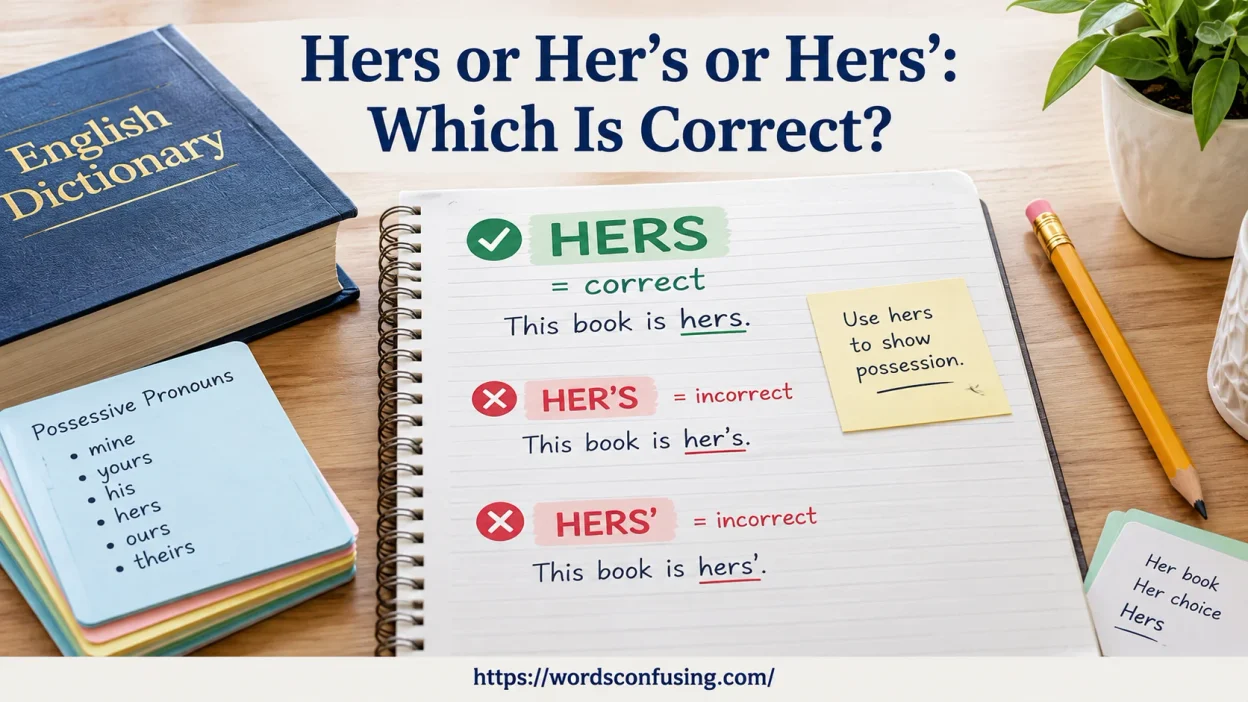
Hers is correct. Her’s and hers’ are incorrect in standard English.
Use her before a noun:
her book
Use hers when the possessive expression stands alone:
The book is hers.
The apostrophe rule is the part worth remembering. Although English often uses apostrophes for possessive nouns, possessive pronouns such as hers, mine, yours, ours, and theirs don’t need apostrophes.
Hers or Her’s or Hers’: Which One Is Correct?
The correct spelling is hers.
Here’s the complete comparison:
| Form | Correct? | Grammatical use | Example |
| hers | ✅ Correct | Possessive pronoun | The blue jacket is hers. |
| her’s | ❌ Incorrect | Nonstandard spelling | The blue jacket is her’s. |
| hers’ | ❌ Incorrect | Incorrect possessive form | The blue jacket is hers’. |
Hers Is the Correct Form
Hers is a possessive pronoun. It refers to something that belongs to or is associated with a female person, girl, or female animal already identified or understood from context. Cambridge Dictionary defines hers as a pronoun referring to something belonging to or connected with such a person or animal.
Consider these examples:
- This notebook is hers.
- That car is hers.
- The red umbrella is hers.
- The final decision was hers.
- That seat isn’t hers.
- Which jacket is hers?
Notice what happens in each sentence. Hers stands independently. You don’t place a noun immediately after it.
You wouldn’t normally write:
- ❌ hers notebook
- ❌ hers car
- ❌ hers jacket
Instead, use her before the noun:
- ✅ her notebook
- ✅ her car
- ✅ her jacket
That difference is the key to understanding the entire issue.
Her’s Is Incorrect
Her’s looks tempting because English frequently uses ’s to express possession.
For example:
- Maria’s phone
- Daniel’s laptop
- the teacher’s desk
- the dog’s collar
However, hers doesn’t follow that pattern. It’s already a possessive pronoun.
Therefore:
- ❌ The phone is her’s.
- ✅ The phone is hers.
The apostrophe isn’t missing. It simply doesn’t belong there.
Hers’ Is Also Incorrect
Hers’ creates a second apostrophe mistake.
Some writers see the s in hers and assume they need to place an apostrophe after it. That pattern does exist with certain plural possessive nouns. For example:
- the students’ books
- the teachers’ lounge
- the players’ uniforms
But hers isn’t a plural noun. It’s a possessive pronoun.
So this is incorrect:
❌ That laptop is hers’.
The correct version is:
✅ That laptop is hers.
Cambridge’s grammar guidance explicitly states that possessive pronouns don’t take ’s and gives examples such as hers rather than her’s.
Why Does “Hers” Have No Apostrophe?
The answer becomes clearer when you separate possessive nouns from possessive pronouns.
English has several ways to express ownership or belonging. Apostrophes are one tool, but they aren’t required in every possessive construction.
Possessive Nouns Can Use Apostrophes
A noun can take an apostrophe to indicate possession.
For example:
- Emma’s phone
- the teacher’s desk
- the dog’s leash
- James’s notebook
In these examples, the apostrophe helps form a possessive noun phrase.
Compare:
This is Sarah’s book.
Here, Sarah’s identifies the owner while book identifies the thing owned.
Possessive Pronouns Work Differently
A possessive pronoun can replace the noun phrase that would otherwise follow the possessive form.
Compare:
This is Sarah’s book.
with:
This book is hers.
The second sentence doesn’t need to repeat Sarah or book. Hers carries the possessive meaning and stands in for the relevant noun phrase.
That distinction explains why adding an apostrophe to hers is unnecessary.
Cambridge Grammar separates possessive determiners from possessive pronouns. Possessive determiners appear before nouns, while possessive pronouns stand in place of noun phrases.
Hers vs. Her: What’s the Difference?
The most useful comparison isn’t actually hers vs. her’s.
It’s her vs. hers.
These two words perform different grammatical jobs.
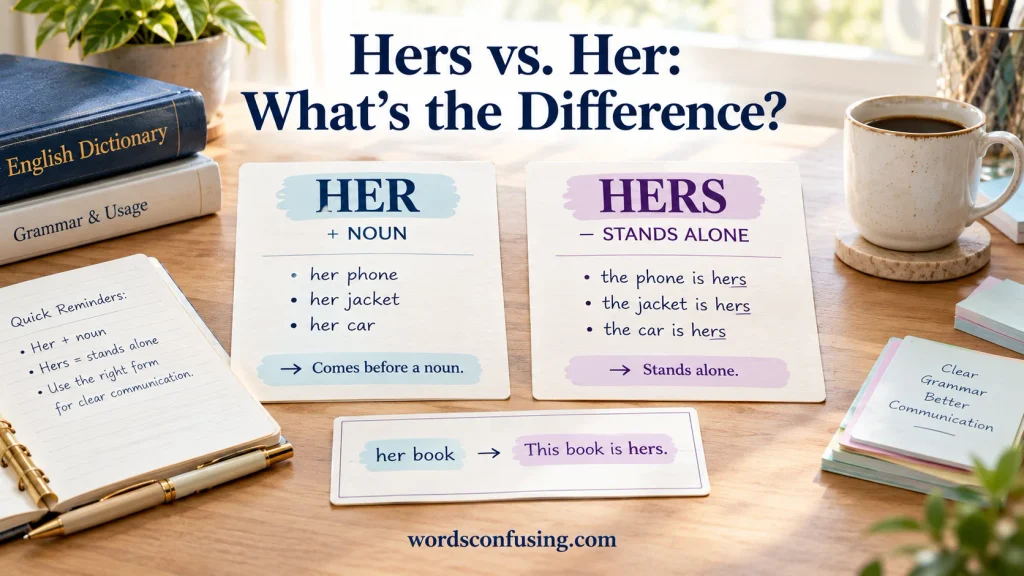
Her Comes Before a Noun
Use her as a possessive determiner when a noun follows it.
Examples:
- Her phone is ringing.
- I found her keys.
- Her brother lives nearby.
- We visited her apartment.
- I borrowed her notebook.
Here, her doesn’t stand alone as the possessive expression. It introduces the noun that follows.
Hers Stands Alone
Use hers when the noun doesn’t follow it.
Examples:
- The phone is hers.
- Those keys are hers.
- The apartment is hers.
- The notebook is hers.
- That decision was hers.
A simple comparison makes the pattern obvious:
| With a noun | Without the noun |
| her phone | the phone is hers |
| her jacket | the jacket is hers |
| her car | the car is hers |
| her idea | the idea is hers |
| her desk | the desk is hers |
Cambridge describes her as the possessive form of she when it comes before a noun.
A Simple Memory Trick
Think of her and hers as two pieces of the same grammatical puzzle:
Her needs a noun. Hers doesn’t.
For example:
This is her book.
But:
This book is hers.
If you remember that contrast, you’ll avoid most her vs. hers mistakes.
Hers and the Other Possessive Pronouns
Hers belongs to a larger family of possessive pronouns.
Here are the standard forms:
| Personal pronoun | Possessive determiner | Possessive pronoun |
| I | my | mine |
| you | your | yours |
| he | his | his |
| she | her | hers |
| we | our | ours |
| they | their | theirs |
This table reveals an important pattern.
Possessive pronouns such as mine, yours, hers, ours, and theirs don’t need apostrophes. Cambridge lists these forms as possessive pronouns and specifically distinguishes them from possessive determiners such as my, your, her, our, and their.
Look at the parallel structures:
- This book is mine.
- That book is yours.
- The red notebook is hers.
- The house is ours.
- The seats are theirs.
You wouldn’t write:
- ❌ mine’s
- ❌ your’s
- ❌ her’s
- ❌ our’s
- ❌ their’s
The same principle applies to hers.
How to Use “Hers” Correctly
Once you know its grammatical role, hers becomes easy to use naturally.
“This Is Hers”
This is one of the simplest structures.
Examples:
- This backpack is hers.
- This seat is hers.
- This notebook is hers.
- This umbrella is hers.
The word hers identifies the owner without repeating the noun.
“That Is Hers”
You can also use hers with that.
Examples:
- That blue car is hers.
- That desk is hers.
- That jacket is hers.
- That apartment is hers.
Again, the noun comes before the possessive pronoun in the sentence.
“It Is Hers”
The pattern works naturally with it.
Examples:
- It is hers.
- The phone? It is hers.
- The responsibility is hers.
- The choice is hers.
The pronoun hers answers the underlying question of ownership or association.
“The ___ Is Hers”
This structure appears frequently in everyday English.
Examples:
- The red bicycle is hers.
- The black suitcase is hers.
- The office near the window is hers.
- The final copy is hers.
- The blue folder is hers.
The construction is straightforward:
noun + linking verb + hers
For example:
The laptop + is + hers.
Read more: Froze or Frozen? Past Tense of “Freeze” Helpful Examples
Hers in Comparisons
Hers can also appear in comparisons.
Consider:
My car is newer than hers.
The sentence doesn’t need to say:
My car is newer than her car.
The possessive pronoun hers allows English to avoid repeating information.
Other examples include:
- My answer is different from hers.
- Your room is larger than hers.
- His score was higher than hers.
- Their house is closer than hers.
- My approach differs from hers.
This isn’t merely a stylistic trick. Possessive pronouns make sentences more economical by allowing the reader to recover the omitted noun from context.
Why “Hers” Works Here
In:
My car is newer than hers.
Hers refers to her car.
The noun car doesn’t need to appear again because the context supplies it.
That same principle works across many sentences:
My jacket is warmer than hers.
Here, hers means her jacket.
My score was higher than hers.
Here, hers means her score.
The surrounding context determines what hers represents.
Hers vs. Possessive Nouns
Another useful distinction involves possessive nouns.
Compare these sentences:
Maria’s laptop is expensive.
The laptop is hers.
Both sentences communicate ownership. However, they use different grammatical structures.
| Sentence | Possessive form | Role |
| Maria’s laptop is expensive. | Maria’s | Possessive noun |
| The laptop is hers. | hers | Possessive pronoun |
The apostrophe belongs in Maria’s because Maria is a noun being marked as possessive.
The apostrophe doesn’t belong in hers because hers is already a possessive pronoun.
Cambridge explains that ’s is used after singular nouns to create possessive forms. It also distinguishes that construction from possessive pronouns such as hers.
Why “Her’s” Looks Correct to Many Writers
The mistake has a logical explanation.
English often teaches writers that an apostrophe can signal possession. That rule works in many familiar examples:
- the girl’s coat
- the teacher’s desk
- Michael’s phone
- the dog’s bowl
So it’s natural to think:
her + ’s = her’s
Unfortunately, that shortcut doesn’t work.
English possessive pronouns aren’t formed by simply adding ’s to the corresponding pronoun.
For example:
- my → mine
- your → yours
- her → hers
- our → ours
- their → theirs
The forms have their own grammatical histories and functions.
That’s why her’s isn’t an alternative spelling of hers.
It’s simply incorrect in standard English.
Hers or Her’s: Common Mistakes
Incorrect: “That Bag Is Her’s”
The correct sentence is:
That bag is hers.
Don’t add an apostrophe.
Incorrect: “The Car Is Hers’”
The correct version is:
The car is hers.
The extra apostrophe doesn’t show anything useful.
Incorrect: “Hers Book Is on the Table”
The correct sentence is:
Her book is on the table.
Why?
Because her appears directly before the noun book.
Correct: “The Book Is Hers”
Now hers works perfectly:
The book is hers.
The noun book isn’t immediately after hers, so the possessive pronoun can stand independently.
Hers or Her’s or Hers’: A Practical Sentence Test
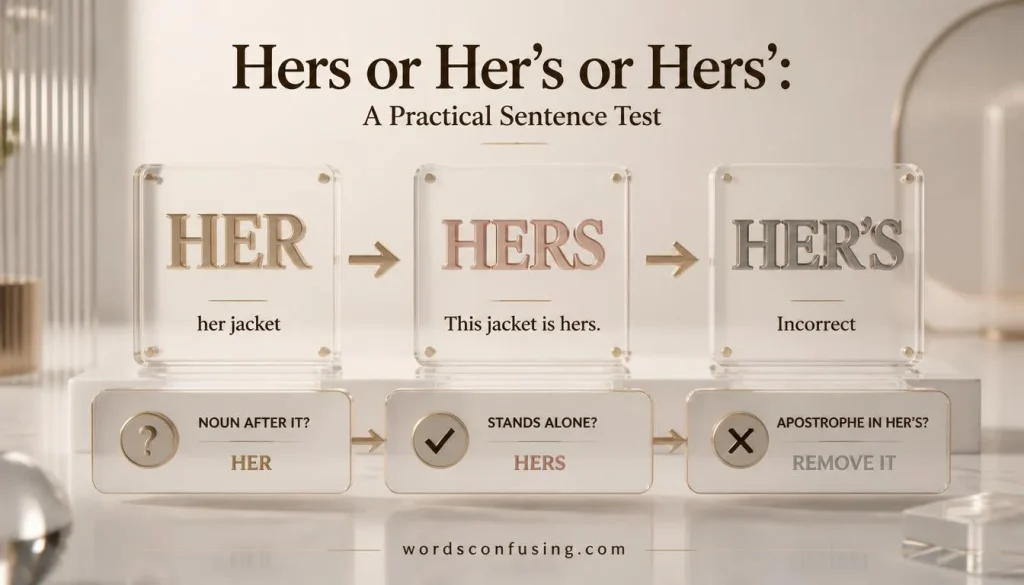
When you’re unsure which form to use, try this quick test.
Step One: Look for a Noun
Ask whether a noun immediately follows the possessive word.
___ jacket
Because jacket follows the word, use her:
her jacket
Don’t use hers jacket.
Step Two: Check Whether the Word Stands Alone
If the possessive expression stands alone, hers may be correct.
This jacket is hers.
Here, hers doesn’t modify a noun.
Step Three: Remove the Apostrophe
If you’re tempted to write her’s, stop and check the sentence.
Replace it with hers.
In standard English, that’s the correct possessive pronoun.
Step Four: Check the Meaning
Ask:
Does this word mean “belonging to her”?
If yes, hers may fit when it stands independently.
For example:
Whose phone is this?
It’s hers.
That answer is short, natural, and grammatically correct.
Hers in Questions
Possessive pronouns frequently appear in questions about ownership.
“Whose Is This?”
The question whose is this? asks who owns something.
Possible answers include:
- It’s mine.
- It’s yours.
- It’s hers.
- It’s his.
- It’s ours.
- It’s theirs.
For example:
“Whose jacket is this?”
“It’s hers.”
The word hers provides the ownership information without repeating her jacket.
“Is This Hers?”
You can also place hers at the end of a yes-or-no question.
Examples:
- Is this notebook hers?
- Is that car hers?
- Was this seat hers?
- Are these keys hers?
Possible answers include:
Yes, they’re hers.
or:
No, they’re not hers.
Hers in Negative Sentences
The possessive pronoun doesn’t change in negative sentences.
Examples:
- This phone isn’t hers.
- That bag wasn’t hers.
- The apartment isn’t hers.
- Those keys weren’t hers.
- The decision wasn’t hers.
The word remains hers regardless of whether the sentence is positive or negative.
Compare:
The jacket is hers.
The jacket isn’t hers.
Only the verb structure changes.
The possessive pronoun stays exactly the same.
Hers in Formal and Informal English
Hers works in both everyday conversation and formal writing.
You can use it in a text message:
I think this bag is hers.
You can use it in workplace communication:
The desk near the window is hers.
You can use it in academic writing:
The interpretation differs from hers.
You can also use it in fiction, journalism, essays, reports, and ordinary conversation.
There isn’t a more formal spelling such as her’s. In fact, using her’s in formal writing would introduce an unnecessary grammatical error.
Hers vs. Her’s vs. Hers’: Quick Comparison
The difference can be reduced to three lines:
| Form | Status | Explanation |
| hers | ✅ Correct | Standard possessive pronoun |
| her’s | ❌ Incorrect | Apostrophe doesn’t belong |
| hers’ | ❌ Incorrect | Extra apostrophe doesn’t belong |
A useful memory phrase is:
Hers is hers — no apostrophe needed.
It sounds almost too simple. That’s exactly why it’s easy to remember.
Does “Hers” Ever Need an Apostrophe?
In standard English, hers doesn’t take an apostrophe.
This remains true when the word appears:
- at the end of a sentence
- in a question
- in a comparison
- after is
- after was
- in a negative sentence
- after a preposition
- in formal writing
- in informal writing
Examples:
- The coat is hers.
- Was that notebook hers?
- My answer differs from hers.
- The responsibility wasn’t hers.
- A friend of hers called yesterday.
The last example deserves special attention.
“A Friend of Hers”
English commonly uses the construction:
a friend of hers
This means a friend belonging to her social circle or a person who is her friend.
Examples:
- A friend of hers recommended the restaurant.
- I met a colleague of hers yesterday.
- An old classmate of hers moved nearby.
Notice that hers still has no apostrophe.
The structure of + possessive pronoun is a standard English construction. Cambridge Grammar provides examples such as a friend of mine and a close friend of yours as part of this possessive pattern.
Hers vs. She’s
Another common confusion involves hers and she’s.
They look and sound somewhat similar in rapid speech. Grammatically, however, they have completely different jobs.
Hers Shows Possession
The backpack is hers.
Here, hers means that the backpack belongs to her.
She’s Is a Contraction
She’s usually represents:
- she is
- she has
Examples:
She’s at home.
This means:
She is at home.
Another example:
She’s finished her work.
This means:
She has finished her work.
So compare:
She’s carrying her bag.
with:
The bag is hers.
The first sentence contains a contraction. The second contains a possessive pronoun.
An apostrophe in she’s marks omitted letters in a contraction. It doesn’t indicate possession. Cambridge explains that apostrophes can mark omitted letters in contractions such as she’s, don’t, and isn’t.
Read more: 7 Best Ways to Politely Ask Someone to Be Patient
Hers vs. Herself
Hers and herself can also be confused because both relate to the third-person feminine pronoun she.
However, they serve completely different grammatical purposes.
Hers Shows Possession
The decision was hers.
The sentence identifies who owns or controls the decision.
Herself Is Reflexive
She completed the project herself.
Here, herself emphasizes that she personally completed the action.
Compare:
| Word | Function | Example |
| hers | Possessive pronoun | The choice was hers. |
| herself | Reflexive pronoun | She made the choice herself. |
One shows possession. The other refers back to she.
Common Examples of Correct “Hers” Usage
Here are several natural examples you can use as models:
- The blue sweater is hers.
- That notebook is hers.
- This isn’t hers.
- The decision was hers.
- The seat near the door is hers.
- My answer was different from hers.
- A friend of hers called this morning.
- Is that umbrella hers?
- Which bag is hers?
- Her apartment is larger than hers.
- The responsibility wasn’t hers.
- That idea sounds similar to hers.
These examples demonstrate an important point: hers can appear in several sentence structures while retaining the same basic possessive function.
Incorrect and Correct Examples
A side-by-side comparison can make the rule stick.
| Incorrect | Correct |
| The bag is her’s. | The bag is hers. |
| The car is hers’. | The car is hers. |
| Hers jacket is blue. | Her jacket is blue. |
| Is this her’s? | Is this hers? |
| That notebook belongs to her’s. | That notebook belongs to her. |
| The red one is her’s. | The red one is hers. |
The fifth example highlights another useful distinction.
After the preposition to, English uses the object pronoun her, not hers, when the meaning is “belongs to her”:
The notebook belongs to her.
But:
The notebook is hers.
Both sentences express ownership, but their grammatical structures differ.
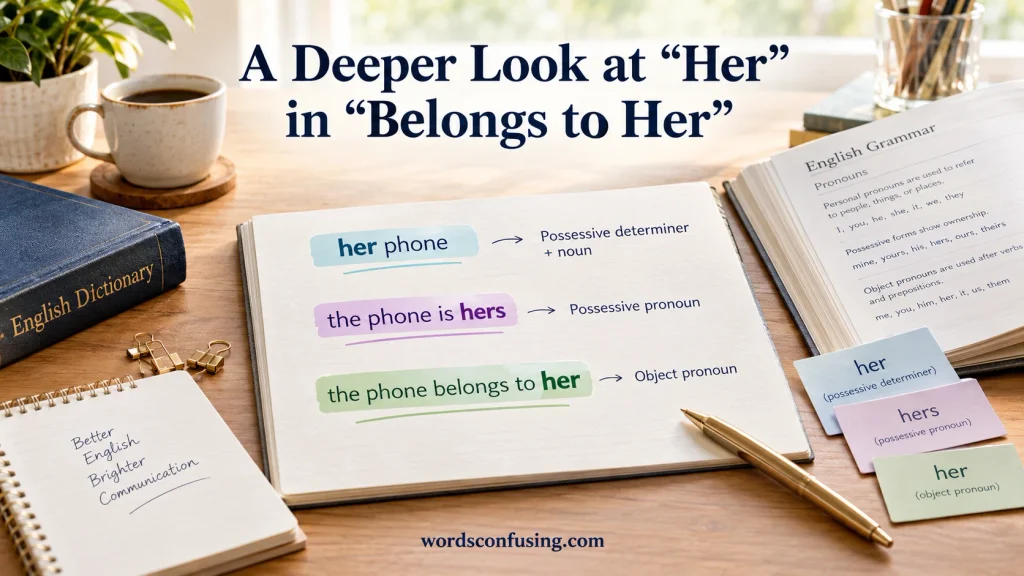
A Deeper Look at “Her” in “Belongs to Her”
This distinction helps prevent another subtle mistake.
Consider:
This phone belongs to her.
Here, her follows the preposition to. It functions as an object pronoun.
Now compare:
This phone is hers.
Here, hers functions as a possessive pronoun.
So English can express the same basic ownership relationship in different grammatical ways:
| Structure | Example |
| possessive determiner + noun | her phone |
| possessive pronoun | the phone is hers |
| verb + object pronoun | the phone belongs to her |
This is why simply thinking “anything related to possession needs hers” can cause mistakes.
Grammar depends on the sentence structure.
A Useful Mini Case Study
Imagine three backpacks sitting on a classroom table.
One belongs to Maya. One belongs to Jordan. The third belongs to the teacher.
You could write:
This is Maya’s backpack.
Now remove the repeated noun:
This backpack is hers.
If you point directly to the backpack, you could also say:
This is hers.
But if you put the noun after the possessive form, use her:
This is her backpack.
The three structures are different:
| Structure | Example |
| Possessive noun | Maya’s backpack |
| Possessive determiner | her backpack |
| Possessive pronoun | the backpack is hers |
This simple scenario captures the core rule better than memorizing isolated spellings.
How to Remember Hers Without an Apostrophe
A quick mnemonic can help:
Her before a noun. Hers alone.
For example:
Her + noun
her phone
her car
her idea
her jacket
Hers alone
The phone is hers.
The car is hers.
The idea is hers.
The jacket is hers.
And one more rule:
Never turn hers into her’s.
The apostrophe is unnecessary.
The “Mine” Test
Another useful trick is to replace hers with mine.
If the sentence works with mine, hers may fit the same grammatical position.
For example:
This book is mine.
Therefore:
This book is hers.
But you wouldn’t normally say:
❌ mine book
So you wouldn’t say:
❌ hers book
Instead:
my book
and:
her book
This substitution test is especially useful when you’re proofreading quickly.
FAQs
Is “hers” or “her’s” correct?
Hers is correct. Her’s is not standard English because hers is already a possessive pronoun and does not need an apostrophe.
Why doesn’t “hers” need an apostrophe?
Possessive pronouns such as hers, theirs, yours, and ours generally do not use apostrophes. The word already shows possession on its own.
Can “her’s” ever be correct?
In standard modern English, her’s is considered incorrect. You should use hers when you want to show that something belongs to a female person or is associated with her.
What is the difference between “her” and “hers”?
Her can work as a possessive determiner before a noun, as in “her book.” Hers stands alone, as in “The book is hers.”
Is “hers” the same in British and American English?
Yes. Hers is the standard possessive pronoun in both British English and American English. The spelling does not change between the two varieties.
What is the easiest way to remember “hers”?
Think of hers as a complete possessive pronoun. If you are tempted to add an apostrophe, remember that the word already expresses possession without one.
Conclusion
Choosing between hers and her’s becomes much easier once you remember one simple point: hers is the correct possessive pronoun. It already shows ownership, so it does not need an apostrophe. Although her’s may look natural at first, especially if you are used to possessive nouns with apostrophes, it is not standard English.
A quick habit can help you remember the difference. When you mean that something belongs to her, use hers. Whether you are writing an email, completing an assignment, or polishing professional content, this small spelling choice keeps your writing clear, correct, and confident.

Shafiq Ur Rehman is a writer and content contributor at WordsConfusing.com. He enjoys exploring the English language, common word confusions, vocabulary, and practical writing tips. His goal is to make English easier to understand through clear, simple, and useful articles.