

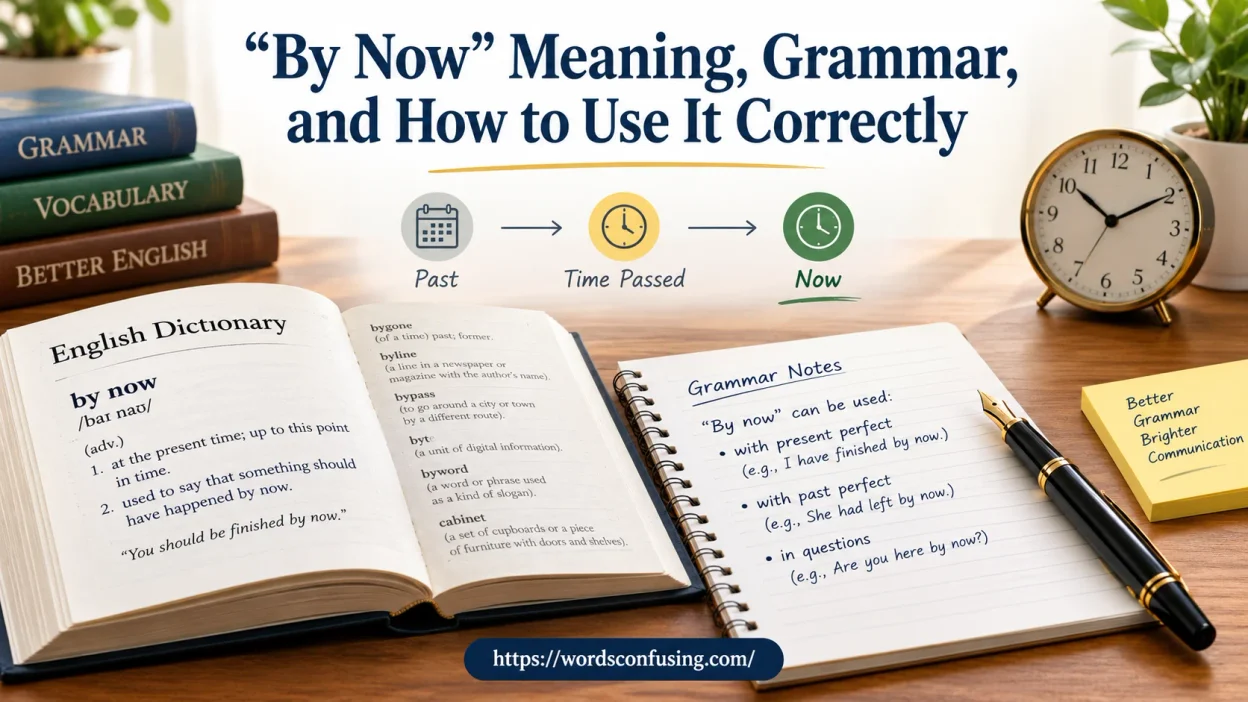
The “By Now” Meaning and Grammar guide explains how this common phrase connects past actions with the present time in clear English usage today.
By Now is a useful time expression that refers to a point in time reaching the present. By works as a preposition for a particular time, while Now means the present. Combining these two words gives us a way of saying that something might be completed, should be happening, or may come to an end.
The best way to understand how it works is to look at its sentence structure and see where to put it in a sentence.
In grammar, the phrase commonly appears with tasks, decisions, and information that should have reached a certain point.
You can use it for scheduling, time management, business communication, meetings, and project management, as well as formal writing, everyday speech, calendar planning, online booking, broadcasting, workplace communication, and academic writing.
In professional writing, emails, reports, and discussions, precise placement keeps communication clearer.
Similar expressions may cause confusion, so these Helpful Examples in this Usage Guide show the best place to use the phrase naturally and confidently in everyday conversations without changing the intended meaning.
The examples also show how to talk about what is happening and past actions clearly.
Quick Answer
“By now” means at or before the present time. It usually suggests that enough time has passed for something to happen or for you to expect it to have happened already. For example, “She should be home by now” means you expect her to be home because sufficient time has passed.
| Phrase | Meaning | Example |
| By now | At or before this point | She should be home by now. |
| Now | At the present moment | She is home now. |
| Already | Something happened before now | She has already arrived. |
| By then | At or before another time | She should arrive by then. |
In short: By now = at this point, after the time that has passed.
What Does “By Now” Mean?
“By now” means at or before the present point in time. It usually suggests that enough time has passed for something to happen or become true.
The phrase often carries an idea of expectation, assumption, or deduction.
Consider this sentence:
The train should have arrived by now.
The speaker isn’t necessarily saying the train has arrived. Instead, the speaker believes that the train should have arrived already, based on the amount of time that has passed.
Here’s another example:
You should understand the rule by now.
The speaker believes you’ve had enough time or experience to understand the rule.
So, by now often answers an implied question:
“After all this time, what should be true at this point?”
Simple Definition of “By Now”
You can think of by now as meaning:
- at this point
- by this time
- already, at the present point
- before or at the present time
- after the amount of time that has passed
The exact meaning depends on context.
Examples of “By Now”
- He should be here by now.
- You probably know the answer by now.
- They must have heard the news by now.
- By now, everyone has received the email.
- She should have finished the assignment by now.
In each example, the speaker connects an earlier period with the present.
“By Now” Meaning in Simple English
If grammar terminology makes your eyes glaze over, here’s the easy version:
“By now” means that enough time has passed to reach the present point.
Imagine a timeline:
Past → Time passes → Present
The phrase by now points toward the present while considering everything that happened before it.
For example:
He should have arrived by now.
Perhaps you expected him twenty minutes ago. It’s now 8:00 p.m., and he still hasn’t arrived.
The phrase by now expresses your expectation based on the time that has passed.
Another example:
You should know better by now.
This means you’ve had enough experience to understand what you shouldn’t do.
A Useful Way to Remember “By Now”
Think of by now as a time checkpoint.
You aren’t merely saying what’s happening at this moment. You’re asking what should have happened before reaching this moment.
That’s why these sentences have different meanings:
- She is here now. → She is here at present.
- She should be here by now. → Enough time has passed that she is expected to be here.
- She has already arrived. → Her arrival happened before now.
The differences are small but important.
Is “By Now” Correct Grammar?
Yes. “By now” is completely correct and standard English.
It functions as a time expression and commonly appears with verbs, modal verbs, and perfect constructions.
You can place it in different parts of a sentence.
For example:
By now, he should understand the problem.
He should understand the problem by now.
Both sentences are grammatical. The second version often sounds more natural in casual conversation.
The phrase itself doesn’t require one particular tense. Instead, the surrounding sentence determines which verb form makes sense.
That’s an important point because some learners assume that by now always requires the present perfect. It doesn’t.
Compare:
- She should be here by now.
- She should have arrived by now.
- She must know by now.
- She has probably arrived by now.
- By now, everyone knows the truth.
All of these structures are correct.
How to Use “By Now” in a Sentence
You can use by now in several positions. Its placement can slightly change emphasis without changing the basic meaning.
“By Now” at the Beginning of a Sentence
Starting with by now places emphasis on the time that has passed.
For example:
By now, you should understand the difference.
At this point, the team should have completed the project.
Everyone has likely heard the announcement by now.
When by now begins a sentence as an introductory expression, a comma commonly follows it.
This structure works especially well when you want to highlight the present stage of a process.
“By Now” at the End of a Sentence
End position is extremely common in everyday English.
Examples include:
You should know that by now.
They should have arrived by now.
She must be tired by now.
He probably knows about it by now.
This position often sounds relaxed and conversational.
If you’re speaking naturally, you’ll frequently hear by now at the end of a sentence.
“By Now” in the Middle of a Sentence
You can also place by now inside a sentence.
For example:
They have by now completed the first stage.
The company should by now have enough information to decide.
This placement is grammatical, but it can sound more formal or deliberate.
In everyday conversation, speakers often prefer:
They have completed the first stage by now.
The meaning remains essentially the same.
What Tense Is Used With “By Now”?
There isn’t one mandatory tense after by now.
The correct tense depends on what you’re trying to communicate. This makes by now more flexible than many learners realize.
Present Perfect With “By Now”
The present perfect works naturally when you want to connect a past action with the present.
Examples:
She has arrived by now.
They have probably finished by now.
You have heard the news by now.
The package has reached the office by now.
The present perfect highlights a connection between an earlier event and the current situation.
However, native speakers often use modal verbs with the perfect form when they aren’t completely certain.
For example:
She should have arrived by now.
This expresses an expectation rather than definite knowledge.
“Should” With “By Now”
Should is one of the most common words used with by now.
He should be here by now.
You should know the answer by now.
They should have finished by now.
The meaning depends on the verb structure.
Should + base verb can describe an expected current state:
He should be home by now.
Should have + past participle usually refers to an action that was expected to happen before the present:
He should have arrived by now.
That distinction matters.
“Must” With “By Now”
Must can express a strong conclusion or deduction.
She must know by now.
They must be home by now.
He must have heard about the change by now.
The speaker isn’t necessarily stating a verified fact. Instead, the speaker makes a strong inference from the available circumstances.
“May” and “Might” With “By Now”
When you’re less certain, may or might can soften the statement.
She might have arrived by now.
They may know about the problem by now.
He might be home by now.
These expressions indicate possibility rather than strong expectation.
Past Perfect and “By Now”
The past perfect can appear with by now when the sentence has a particular time relationship or hypothetical context.
For example:
If we had left earlier, we would have been home by now.
Here, by now refers to the present while the past perfect describes the earlier condition.
The sentence essentially means that leaving earlier would have produced a different situation at the present time.
“Would” With “By Now”
This structure frequently appears in hypothetical statements.
Without the delay, the project would be finished by now.
If she had taken the earlier flight, she’d be here by now.
The phrase by now marks the point the hypothetical situation has reached.
Read more: 4 Words for When Someone Accuses You of What They’re Guilty Of
“By Now” vs. “Now”
The difference between by now and now looks tiny on paper. The meaning, however, can change significantly.
“Now”
Now simply refers to the present.
She is at home now.
This sentence tells you about her current location.
“By Now”
By now considers the time that has passed before reaching the present.
She should be at home by now.
This sentence expresses an expectation based on elapsed time.
| Phrase | Main meaning | Example |
| now | At the present moment | She is home now. |
| by now | At or before the present point | She should be home by now. |
Think of now as a photograph.
By now is more like a timeline.
One tells you where things stand. The other often suggests how they got there and what should have happened along the way.
“By Now” vs. “Until Now”
These two expressions frequently confuse English learners.
They aren’t interchangeable.
By now usually points toward the present as a point by which something is expected, assumed, or likely to have happened.
Until now describes something that continued or remained true up to the present.
Compare:
She should have arrived by now.
This means the speaker expects her arrival at or before the present.
Now consider:
She hasn’t spoken to me until now.
This means the situation continued up to the present point.
| Phrase | Focus | Example |
| by now | What should or may have happened | He should have arrived by now. |
| until now | What continued up to the present | He hadn’t contacted us until now. |
A simple memory trick helps:
By now = reaching a point.
Until now = continuing up to a point.
“By Now” vs. “So Far”
So far and by now can both refer to the period leading up to the present. They don’t emphasize the same idea.
So far usually reports what has happened up to this point.
We have completed five chapters so far.
The sentence gives you information about progress.
By now often focuses on what should already be true.
We should have completed five chapters by now.
The second sentence contains an expectation.
Here’s the difference:
| Phrase | Main focus | Example |
| so far | Actual progress up to the present | We have completed five chapters so far. |
| by now | Expected or inferred state at the present | We should have completed five chapters by now. |
Of course, context can make the distinction less sharp. Still, this is a useful rule for everyday writing.
“By Now” vs. “Already”
Already and by now sometimes overlap.
However, already often emphasizes that something happened earlier than expected or before the current point.
She has already arrived.
This sounds like a statement about a completed event.
Now compare:
She should have arrived by now.
This expresses an expectation. The speaker may not know whether she actually arrived.
That’s a crucial difference.
| Phrase | Typical emphasis | Example |
| already | Completion before now | She has already arrived. |
| by now | Expected or inferred state at the present | She should have arrived by now. |
Compare These Two Sentences
“He has already finished.”
This generally presents completion as fact.
“He should have finished by now.”
This presents completion as an expectation.
The second speaker may still need confirmation.
“By Now” vs. “By Then”
The easiest way to distinguish these expressions is to focus on their reference points.
By now refers to the present.
By then refers to another time, usually one mentioned or understood from context.
Compare:
You should know the answer by now.
Here, the reference point is the present.
Now:
You should know the answer by then.
Here, then refers to a different point in time.
For example:
The meeting starts at three. You should know the results by then.
The word then refers to three o’clock.
| Phrase | Reference point | Example |
| by now | Present | They should be here by now. |
| by then | Another time | They should be here by then. |
“By Now” vs. “By This Time”
By this time can often replace by now, especially when referring to the present.
For example:
She should be here by now.
and:
She should be here by this time.
The first sounds more natural in ordinary conversation.
However, by this time can also introduce a specific future or past reference point:
By this time next year, the project should be complete.
You can’t simply replace by now with by this time in every sentence.
Context matters.
20+ “By Now” Examples in Sentences
The best way to understand a time expression is to see it in real situations.
Everyday Conversation
- You should be hungry by now.
- He should be home by now.
- You know better by now.
- She must be tired by now.
- They’ve probably left by now.
Work and Business
- The manager should have received the report by now.
- The client should know about the change by now.
- The team must have completed the first stage by now.
- The company should have enough data by now.
- The documents should have reached the office by now.
School and Learning
- You should understand the formula by now.
- The students should have finished the assignment by now.
- She must know the basic rules by now.
- They’ve probably learned the material by now.
Travel
- The train should have arrived by now.
- They should be at the airport by now.
- He must have reached the hotel by now.
- The flight should have landed by now.
Technology and Communication
- You should have received the email by now.
- The update should be available by now.
- They must have seen the notification by now.
- The website should be working by now.
Formal Contexts
- By now, the committee should have reached a decision.
- The requested documents should have arrived by now.
- By now, the available evidence should provide a clearer picture.
Common Sentence Patterns With “By Now”
Learning reusable patterns can make the phrase much easier to use.
Subject + Should + Verb + By Now
She should know by now.
This pattern describes an expected current state.
Subject + Should Have + Past Participle + By Now
She should have arrived by now.
This pattern describes an action that was expected to happen before the present.
Subject + Must + Verb + By Now
They must be home by now.
This pattern expresses a strong deduction.
Subject + Must Have + Past Participle + By Now
They must have arrived by now.
This pattern makes a strong inference about a completed action.
Subject + Might Have + Past Participle + By Now
They might have left by now.
This expresses a possibility.
By Now + Subject + Verb
By now, everyone knows the truth.
This structure emphasizes the present point reached after time has passed.
Common Mistakes With “By Now”
Although by now is straightforward once you understand its meaning, several mistakes appear frequently.
Confusing “By Now” With “Until Now”
Incorrect usage often happens when someone wants to describe something that continued up to the present.
Remember:
By now focuses on what has happened or should have happened.
Until now focuses on continuation up to the present.
Using “By Now” When You Mean “Now”
These sentences aren’t identical:
He is at home now.
He should be at home by now.
The first sentence states a current fact.
The second expresses an expectation.
Using by now adds a time-based inference.
Assuming “By Now” Confirms Something Happened
Consider:
She should have arrived by now.
This doesn’t prove that she arrived.
The speaker expects her arrival based on the elapsed time.
Perhaps the train was delayed. Maybe she stopped somewhere. The phrase itself doesn’t guarantee completion.
Using the Wrong Verb Form
Compare:
He should be here by now.
with:
He should have arrived by now.
The first focuses on his expected current location.
The second focuses on the expected completion of his arrival.
Both can be correct. They simply highlight different aspects of the situation.
Treating “By Now” as a Strict Deadline
A deadline usually tells you when something must happen.
For example:
Submit the form by Friday.
This gives a specific deadline.
By contrast:
You should have submitted the form by now.
This sentence refers to the present and expresses an expectation that the submission should already have happened.
The two constructions may look similar because both involve by, but their functions differ.
Is “By Now” Formal or Informal?
“By now” works in both formal and informal English.
It’s completely natural in conversation:
You should know that by now.
It’s also appropriate in professional writing:
The department should have received the documents by now.
And it can appear in academic or analytical writing:
By now, the available evidence should support a more detailed assessment.
The phrase itself doesn’t make writing informal. The surrounding language determines the overall tone.
Can You Start a Sentence With “By Now”?
Yes. Starting a sentence with by now is perfectly grammatical.
For example:
By now, you should understand the basic distinction.
At this point, the results should be available.
Everyone should have received the announcement by now.
This structure puts greater emphasis on the time that has passed.
When by now functions as an introductory phrase, a comma commonly follows it.
Can “By Now” Go at the End of a Sentence?
Yes. In fact, end position is extremely common.
Examples include:
They should have arrived by now.
You should understand the process by now.
She must know about the change by now.
He should be feeling better by now.
This placement often sounds particularly natural in conversation.
If you’re unsure where to put by now, placing it at the end will usually produce a clear and natural sentence.
Is “By Now” One Word or Two?
“By now” is written as two separate words.
The correct form is:
by now
Not:
bynow
You should also avoid treating the standard phrase as one compound word.
Examples:
- Correct: You should know by now.
- Correct: By now, everyone understands.
- Incorrect: You should know bynow.
The words by and now retain their separate grammatical identities.
Synonyms and Alternatives for “By Now”
Several expressions can sometimes replace by now, but they aren’t perfect substitutes in every situation.
| Alternative | General meaning | Example |
| already | Before or earlier than expected | She has already arrived. |
| at this point | At the current stage | At this point, we need more information. |
| by this time | At or before a particular time | She should be here by this time. |
| by this point | At the current stage of progress | By this point, they should understand the process. |
| at this stage | At the current stage | At this stage, another review is necessary. |
| as of now | According to the present situation | As of now, no decision has been made. |
These alternatives carry different shades of meaning.
For example, as of now usually reports the current status. It doesn’t necessarily carry the expectation that by now often expresses.
“By Now” in Questions
You can naturally use by now in questions.
For example:
Shouldn’t he be here by now?
This question expresses an expectation that he should already have arrived.
Another example:
Wouldn’t they know by now?
This suggests that enough time has passed for them to know something.
You can also ask:
Has she arrived by now?
However, depending on the context, yet or already may sound more natural:
Has she arrived yet?
Has she already arrived?
The choice depends on whether you’re asking about completion, expectation, or elapsed time.
“By Now” in Negative Sentences
Negative constructions with by now require some care.
For example:
You shouldn’t still be waiting by now.
Here, the speaker believes the waiting should have ended.
Another example:
They haven’t finished by now.
This construction can sound unnatural in many contexts because yet often works better when simply asking whether an expected action has happened:
They haven’t finished yet.
However, by now can work naturally when the sentence expresses an expectation or contrast:
They should have finished by now, but they’re still working.
That sentence makes the intended meaning much clearer.
“By Now” in Everyday English vs. Formal Writing
The expression fits almost anywhere.
Casual English
You should know that by now.
Professional English
The client should have received the documents by now.
Academic English
By now, the available evidence should provide a clearer basis for comparison.
Narrative Writing
By now, the streets were almost empty.
The phrase doesn’t belong exclusively to casual conversation. Its versatility makes it useful across different forms of writing.
A Practical Case Study: Understanding “By Now”
Imagine that Sarah leaves work at 5:00 p.m. Her house sits twenty minutes away.
At 5:45 p.m., her friend says:
Sarah should be home by now.
What does the sentence communicate?
It doesn’t prove that Sarah is home.
Instead, the speaker reasons from the timeline:
5:00 p.m. → Sarah leaves work
5:20 p.m. → Expected arrival
5:45 p.m. → Present
Because fifteen extra minutes have passed, the speaker expects Sarah to be home.
Now change the sentence:
Sarah is home now.
This simply states her present location.
Change it again:
Sarah has already arrived.
This emphasizes the completed arrival.
The three sentences overlap, but each one carries a different perspective.
Another Case Study: “By Now” at Work
Suppose a manager asked an employee to prepare a report before lunch.
At 2:00 p.m., the manager says:
The report should be finished by now.
The phrase expresses an expectation based on the amount of time available.
If the manager says:
The report is finished now.
That’s a straightforward statement about the current status.
If the manager says:
The report has already been finished.
The focus shifts toward completion before the expected or current point.
This small comparison shows why by now can add a layer of meaning that now doesn’t provide.
Quick Test: Should You Use “By Now”?
Before using by now, ask yourself three questions:
- Am I referring to the present point?
- Has some amount of time passed?
- Am I suggesting that something has happened, should have happened, or is probably true?
If the answer is yes, by now may be exactly what you need.
Use “By Now” When:
- You want to express an expectation.
- You want to make a deduction.
- You want to show that enough time has passed.
- You want to connect an earlier period with the present.
- You want to describe an expected current state.
Consider Another Expression When:
- You simply mean the present moment → now
- You want to emphasize completed action → already
- You want to describe progress up to the present → so far
- You want to describe continuation up to the present → until now
- You mean a different reference time → by then
FAQs About “By Now”
1. What does “by now” mean?
“By now” means that something is expected to have happened or been completed at the present time.
2. Is “by now” grammatically correct?
Yes. “By now” is a standard English time expression and commonly works as an adverbial phrase.
3. Where should I put “by now” in a sentence?
You can place “by now” at the beginning or end of a sentence. The position depends on emphasis and sentence flow.
4. Can I use “by now” in formal writing?
Yes. “By now” works well in professional emails, reports, academic writing, and other formal contexts.
5. What is the difference between “by now” and “now”?
“Now” refers simply to the present moment. “By now” suggests that something should already have happened by this point.
6. Can “by now” describe something that is still happening?
Yes. You can use “by now” when an ongoing action was expected to have started, progressed, or reached a certain stage.
Conclusion
“By now” may look like a small phrase, but it plays an important role in clear English. It helps you show that something was expected to happen before the present time or should already have happened. Once you understand its meaning and grammar, using it becomes much easier in everyday conversations, emails, reports, and professional writing.
Think of “by now” as a bridge between what was expected and where things stand today. The more you notice it in real sentences, the more naturally it will become part of your English. So, keep practicing, pay attention to context, and you’ll soon be using “by now” with confidence and precision.

Shafiq Ur Rehman is a writer and content contributor at WordsConfusing.com. He enjoys exploring the English language, common word confusions, vocabulary, and practical writing tips. His goal is to make English easier to understand through clear, simple, and useful articles.