
Secretaries or Secretary’s or Secretaries’ becomes easier when you know whether the word is singular, plural, or possessive in your writing.
When you understand the meaning of secretary, the different forms become easier to get it right. The singular form is secretary, while secretaries is the plural form for multiple people. Secretary’s is the singular possessive form, showing ownership when one secretary own or possess something.
Secretaries’ is the plural possessive for multiple secretaries or two or more secretaries, so the correct possessive form depends on the number of people involved and the object.
The best ways to check the correct spelling are to make a quick comparison and explain the difference between each form. For example, a secretary’s degree may involve a degree in politics, while a secretaries’ role in a company or organization can be vital.
If an organization hired four new secretaries, the word remains plural, not possessive. A chart, overview, or examples can help you refer to the right word and talk about something one person possesses or what several people own.
Secretaries’ to refer to shared ownership is less common, but it can be correct when people are owning something at once.
Quick Answer
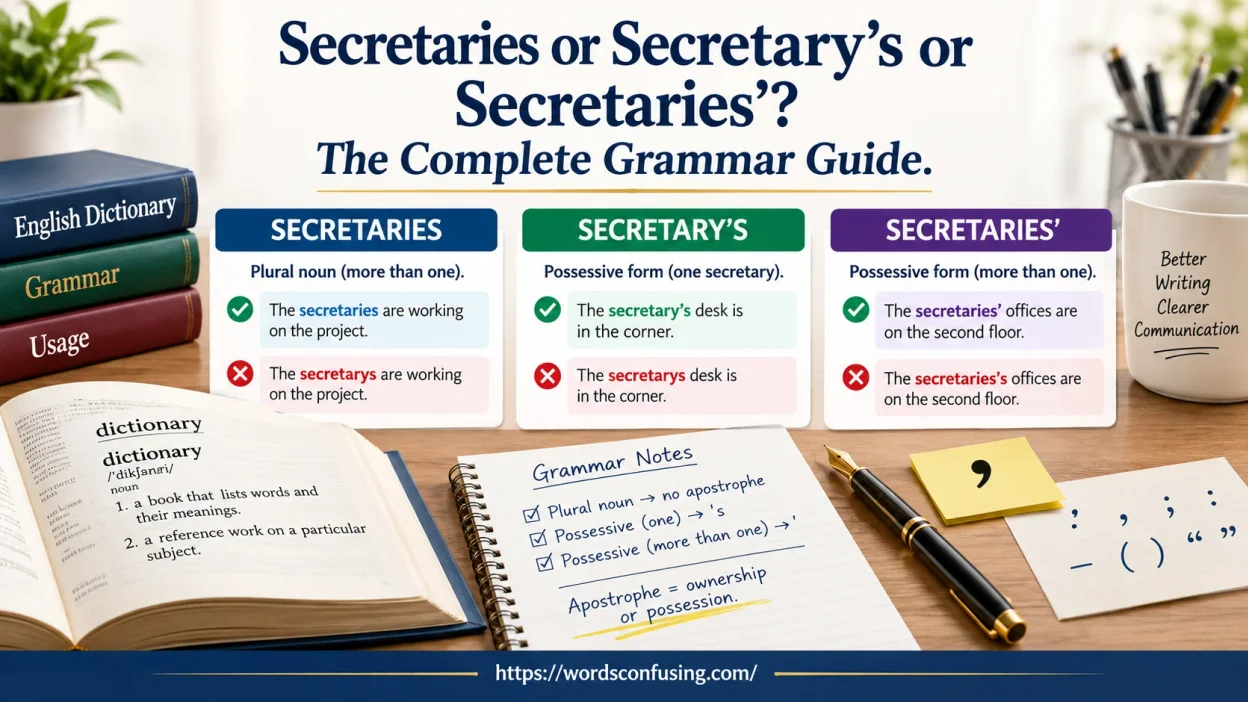
Although secretaries, secretary’s, and secretaries’ look similar, each serves a different purpose. Secretaries is simply the plural form of secretary. When something belongs to one secretary, use secretary’s. For ownership involving two or more secretaries, the correct form is secretaries’.
- Secretaries → more than one secretary
- Secretary’s → belonging to one secretary
- Secretaries’ → belonging to multiple secretaries
For example, “The secretaries attended the meeting” uses the plural. “The secretary’s desk is clean” refers to one secretary’s desk. “The secretaries’ desks are clean” refers to desks belonging to several secretaries.
The easiest trick: first count the secretaries, then decide whether you need to show possession.
Secretaries or Secretary’s or Secretaries’: What’s the Difference?
The easiest way to understand these forms is to separate plural nouns from possessive nouns.
| Form | What it means | Grammar role | Example |
| secretary | One secretary | Singular noun | The secretary called me. |
| secretaries | Two or more secretaries | Plural noun | The secretaries attended the meeting. |
| secretary’s | Something belonging to one secretary | Singular possessive | The secretary’s desk is clean. |
| secretaries’ | Something belonging to multiple secretaries | Plural possessive | The secretaries’ desks are clean. |
There’s another use worth remembering:
Secretary’s can also mean secretary is or secretary has when the context allows the contraction.
For example:
- The secretary’s available. = The secretary is available.
- The secretary’s finished the report. = The secretary has finished the report.
So, before adding an apostrophe, ask two questions:
- How many secretaries are you talking about?
- Are you showing possession or simply making the noun plural?
Those two questions solve most cases.
When to Use “Secretaries”
Secretaries is the standard plural form of secretary.
Use it when you’re talking about more than one secretary and aren’t showing possession.
For example:
The company hired three secretaries.
Here, secretaries simply tells the reader that the company hired more than one person. Nothing belongs to the secretaries in this sentence.
Why Does Secretary Become Secretaries?
The plural spelling follows a common English spelling pattern.
When a noun ends in a consonant followed by y, English usually changes the y to i and adds -es.
For example:
- secretary → secretaries
- library → libraries
- dictionary → dictionaries
- university → universities
- company → companies
However, this pattern doesn’t apply when a word ends in a vowel + y.
For example:
- boy → boys
- day → days
- key → keys
That’s why secretaries isn’t spelled secretarys.
Examples of “Secretaries” in a Sentence
Here are some natural examples:
- Several secretaries attended the training session.
- The office employs five secretaries.
- The secretaries prepared the documents.
- Two secretaries answered the phones.
- The department’s secretaries work closely with the managers.
- Several school secretaries helped organize the event.
Notice something important in the last example.
Secretaries doesn’t need an apostrophe simply because the noun refers to people. Apostrophes don’t automatically indicate people or plural nouns. They primarily indicate possession or certain contractions.
Why “Secretary’s” Isn’t the Regular Plural
A very common mistake looks like this:
❌ The company has three secretary’s.
That’s incorrect if the writer means three people.
The correct version is:
✅ The company has three secretaries.
Why? Because ’s doesn’t make a regular noun plural.
Compare these:
- one secretary → secretary
- two secretaries → secretaries
- one secretary’s desk → secretary’s desk
- two secretaries’ desks → secretaries’ desks
The apostrophe carries grammatical information. It isn’t decoration.
When to Use “Secretary’s”
Secretary’s normally shows possession by one secretary.
The basic pattern is:
Singular noun + ’s = singular possessive
So:
secretary + ’s = secretary’s
For example:
The secretary’s desk is beside the window.
The desk belongs to one secretary or is associated with one secretary.
Examples of “Secretary’s” as a Singular Possessive
Consider these examples:
- The secretary’s desk needs repair.
- I checked the secretary’s schedule.
- The secretary’s office is on the second floor.
- We need the secretary’s approval.
- The secretary’s computer stopped working.
- The secretary’s report contains several recommendations.
- The manager reviewed the secretary’s notes.
In each sentence, secretary’s connects one secretary with something associated with that person.
The relationship doesn’t always mean literal ownership.
For instance:
The secretary’s responsibilities have changed.
The responsibilities aren’t physical objects owned by the secretary. Instead, they are responsibilities assigned to or associated with that secretary.
That’s an important point about possessives. English uses possessive structures for many relationships beyond physical ownership.
“Secretary’s” Can Mean More Than Ownership
The possessive form can express:
- ownership
- responsibility
- association
- authorship
- control
- connection
- involvement
For example:
The secretary’s decision surprised everyone.
The decision doesn’t necessarily belong to the secretary like a laptop does. It means the secretary made the decision.
Similarly:
The secretary’s signature appears at the bottom.
The signature belongs to or was produced by one secretary.
“Secretary’s” as a Contraction
Here’s where things get slightly more interesting.
Secretary’s can also represent a contraction of:
- secretary is
- secretary has
Context tells you which meaning applies.
“Secretary’s” = “Secretary Is”
For example:
The secretary’s available now.
Expand the contraction:
The secretary is available now.
Another example:
The secretary’s in the conference room.
This means:
The secretary is in the conference room.
In these sentences, ’s isn’t possessive. It’s a shortened form of is.
“Secretary’s” = “Secretary Has”
The same spelling can sometimes represent secretary has.
For example:
The secretary’s finished the report.
Expanded:
The secretary has finished the report.
Another example:
The secretary’s already sent the email.
Expanded:
The secretary has already sent the email.
This distinction matters because secretary’s doesn’t automatically mean possession.
A useful trick is to replace ’s with is or has. If the sentence still makes grammatical sense, you’re probably looking at a contraction.
When to Use “Secretaries’”
Now we reach the form that causes the most apostrophe confusion.
Secretaries’ is the plural possessive form of secretary.
It means that something belongs to, relates to, or is associated with multiple secretaries.
The construction works like this:
plural noun ending in s + apostrophe
So:
secretaries + ’ = secretaries’
For example:
The secretaries’ offices are on the second floor.
Here, multiple secretaries have offices.
Examples of “Secretaries’”
- The secretaries’ meeting begins at noon.
- The secretaries’ desks are near the reception area.
- The manager reviewed the secretaries’ schedules.
- The secretaries’ responsibilities vary by department.
- We collected the secretaries’ recommendations.
- The secretaries’ offices were renovated last year.
The apostrophe comes after the s because secretaries is already plural.
That’s the key.
Why the Apostrophe Comes After the “S”
Look at the progression:
One secretary:
secretary
One secretary’s belongings:
secretary’s belongings
Several secretaries:
secretaries
Several secretaries’ belongings:
secretaries’ belongings
The final s tells you the noun is plural. The apostrophe after that s signals possession.
Think of it as stacking two pieces of information:
secretaries = multiple people
secretaries’ = something associated with those multiple people
Secretary’s vs. Secretaries’: What’s the Difference?
This is the comparison that matters most.
| Meaning | Correct form | Example |
| One secretary | secretary | The secretary arrived. |
| Multiple secretaries | secretaries | The secretaries arrived. |
| Something associated with one secretary | secretary’s | The secretary’s desk is clean. |
| Something associated with multiple secretaries | secretaries’ | The secretaries’ desks are clean. |
Compare these two sentences:
The secretary’s office is locked.
This refers to one secretary.
Now change the number:
The secretaries’ offices are locked.
This refers to multiple secretaries.
The apostrophe moves because the number changes.
That’s the whole trick.
Secretary vs. Secretaries vs. Secretary’s vs. Secretaries’
When all four forms appear together, the pattern becomes much clearer.
| Form | Number | Possessive? | Example |
| secretary | One | No | The secretary arrived. |
| secretaries | More than one | No | The secretaries arrived. |
| secretary’s | One | Yes | The secretary’s chair broke. |
| secretaries’ | More than one | Yes | The secretaries’ chairs broke. |
Here’s another useful set:
- The secretary called. → one person
- The secretaries called. → multiple people
- The secretary’s phone rang. → one person’s phone
- The secretaries’ phones rang. → multiple people’s phones
Once you identify the number of people involved, the correct form becomes much easier to spot.
Common Mistakes With Secretaries and Apostrophes
Apostrophe errors often happen because writers confuse plural with possessive.
Mistake: Using “Secretary’s” as a Plural
Incorrect:
❌ There are four secretary’s in the office.
Correct:
✅ There are four secretaries in the office.
The sentence needs a plural noun, not a possessive noun.
Mistake: Forgetting the Apostrophe in “Secretaries’”
Incorrect:
❌ The secretaries desks are organized.
Correct:
✅ The secretaries’ desks are organized.
Without the apostrophe, secretaries simply functions as a plural noun.
With the apostrophe, it shows that the desks belong to or are associated with multiple secretaries.
Mistake: Putting the Apostrophe Before the “S”
Incorrect:
❌ The secretaries’s office
Correct:
✅ The secretaries’ office
Because secretaries already ends in s, the plural possessive normally takes only an apostrophe.
Mistake: Adding an Apostrophe to Every Plural
Some writers assume that nouns referring to people need apostrophes.
That’s not how English works.
Compare:
Five secretaries work here.
No possession exists.
Now:
The five secretaries’ offices are upstairs.
Here, possession or association exists.
The difference isn’t whether the noun refers to people. The difference is whether you’re expressing a possessive relationship.
Is “Secretaries’” Always About Ownership?
No.
Possessive constructions can describe many kinds of relationships.
For example:
The secretaries’ responsibilities have increased.
The responsibilities aren’t objects that the secretaries physically own.
Instead, the phrase means:
the responsibilities of the secretaries
The same idea appears in phrases such as:
- the secretaries’ duties
- the secretaries’ decisions
- the secretaries’ recommendations
- the secretaries’ schedules
- the secretaries’ training
- the secretaries’ concerns
A useful substitution test is to replace the possessive with of.
the secretaries’ responsibilities
becomes:
the responsibilities of the secretaries
If that relationship makes sense, the possessive structure may be appropriate.
Real-World Examples of Each Form
Understanding grammar becomes easier when you see how these forms behave in everyday writing.
Workplace Examples
The secretary scheduled the meeting.
One secretary is involved.
The secretaries scheduled the meetings.
Multiple secretaries are involved.
The secretary’s calendar is full.
One secretary has the calendar.
The secretaries’ calendars are full.
Multiple secretaries have calendars.
School and University Examples
The school secretary answered the phone.
One person holds the role.
The school secretaries attended the training.
More than one person attended.
The school secretary’s office is beside the main entrance.
One secretary’s office is being identified.
The school secretaries’ offices are beside the main entrance.
Multiple offices are associated with multiple secretaries.
Government and Organizational Examples
The same grammar applies to professional titles and organizational roles.
For example:
The secretary’s statement was released this morning.
One secretary is associated with the statement.
In a plural context:
The secretaries’ statements addressed different issues.
Several secretaries are associated with their respective statements.
The grammatical rule doesn’t change because secretary appears as part of a formal job title.
What About “Executive Secretary”?
Compound job titles follow the same possessive logic.
Consider:
The executive secretary’s office is nearby.
That’s singular possessive.
For multiple people:
The executive secretaries’ offices are nearby.
That’s plural possessive.
And without possession:
Several executive secretaries attended the conference.
The same principle applies to other phrases:
- administrative secretary
- legal secretary
- school secretary
- department secretary
- personal secretary
- executive secretary
The word secretary still determines the plural and possessive pattern.
Read more: Yours or Your’s or Yours’? Which Is Correct?
A Closer Look at “Secretary’s” vs. “Secretaries’” With Compound Phrases
Compound phrases can make apostrophe placement look intimidating. Don’t let them.
Take this sentence:
The executive secretary’s report was submitted.
Only one executive secretary is involved.
Now make the noun plural:
The executive secretaries’ reports were submitted.
Now several executive secretaries are involved.
Notice how secretaries changes before the apostrophe.
That’s because the noun has two jobs:
- -ies shows the plural.
- The apostrophe shows possession.
The same pattern works with:
school secretaries’ offices
and:
department secretaries’ schedules
You don’t need an extra s after the apostrophe.
A Quick Case Study: The Office Memo
Imagine an office manager wants to write this sentence:
The secretaries desks need to be replaced.
At first glance, the meaning seems obvious. Several desks need replacement.
However, the grammar needs one small adjustment:
The secretaries’ desks need to be replaced.
Why?
There are multiple secretaries. The desks are associated with them. Therefore, secretaries is plural and ’ marks the possessive.
Now imagine only one secretary:
The secretary’s desk needs to be replaced.
One person means secretary’s.
This tiny change demonstrates why apostrophe placement matters in professional writing. A single mark can tell readers whether the sentence refers to one person or several.
Another Case Study: A Meeting Invitation
Suppose an office has several administrative staff members.
You could write:
The secretaries’ meeting starts at 10 a.m.
That means the meeting is associated with multiple secretaries.
If one secretary has a private meeting:
The secretary’s meeting starts at 10 a.m.
The grammar now points to one secretary.
However, context can affect interpretation. If an organization has a named meeting called the “Secretaries’ Meeting,” capitalization may also reflect the official name rather than ordinary possession.
Grammar and context work together.
“Secretaries” or “Secretary’s” or “Secretaries’”: A Practical Cheat Sheet
Save this quick reference if apostrophes regularly trip you up.
| If you mean… | Use this |
| One secretary | secretary |
| More than one secretary | secretaries |
| Something belonging to one secretary | secretary’s |
| Something belonging to several secretaries | secretaries’ |
| “Secretary is” | secretary’s |
| “Secretary has” | secretary’s |
The Fastest Memory Trick
Remember three patterns:
secretaries = plural
secretary’s = one secretary’s possession
secretaries’ = several secretaries’ possession
Or use this shortcut:
One owner → ’s
Multiple owners ending in s → s’
Simple plural → no apostrophe
That’s the rule in a nutshell.
Secretaries or Secretary’s or Secretaries’: Quick Grammar Test
Ready to test yourself?
Choose the correct form in each sentence.
Which form belongs in each blank?
The company hired three ______ last month.
- A. secretary’s
- B. secretaries
- C. secretaries’
Answer: B. secretaries
There are three people. No possession appears.
The ______ desk is near the entrance.
- A. secretary’s
- B. secretaries
- C. secretaries’
Answer: A. secretary’s
The sentence refers to one secretary’s desk.
The ______ offices are on the second floor.
- A. secretary’s
- B. secretaries
- C. secretaries’
Answer: C. secretaries’
Multiple secretaries have offices.
Several ______ attended the conference.
- A. secretary’s
- B. secretaries
- C. secretaries’
Answer: B. secretaries
The noun is simply plural.
We reviewed the ______ schedules.
- A. secretary’s
- B. secretaries
- C. secretaries’
Answer: C. secretaries’
Multiple secretaries have schedule
The ______ available now.
- A. secretary’s
- B. secretaries
- C. secretaries’
Answer: A. secretary’s
Here, secretary’s means secretary is.
What the Test Reveals
If you consistently identify number first, most apostrophe questions become straightforward.
Don’t start by staring at the apostrophe.
Start with the meaning.
FAQs
Is “secretaries” plural or possessive?
Secretaries is the plural form of secretary. It refers to more than one person and does not show ownership by itself.
When should I use “secretary’s”?
Use secretary’s when one secretary owns or is connected to something. For example, “The secretary’s desk is near the entrance.”
What does “secretaries’” mean?
Secretaries’ is the plural possessive form. Use it when something belongs to or is associated with multiple secretaries.
Is “secretary’s” or “secretaries’” correct?
Both can be correct, but they have different meanings. Secretary’s shows possession by one secretary, while secretaries’ shows possession by two or more secretaries.
What is the easiest way to remember these forms?
Think about the number of people first. One secretary uses secretary’s, while multiple secretaries use secretaries’. If there’s no ownership, use secretaries.
Is “Secretaries or Secretary’s or Secretaries’” a common grammar question?
Yes. These forms can look similar, but the apostrophe changes the meaning. Once you identify whether the word is plural or possessive, choosing the correct form becomes much easier.
Conclusion
Choosing between secretaries, secretary’s, and secretaries’ really comes down to two simple questions: how many secretaries are you talking about, and are you showing ownership? Use secretary’s when one secretary owns something, secretaries’ when several secretaries share ownership, and secretaries when you simply mean more than one secretary. Once you look at the number of people involved, the correct form usually becomes clear.
The easiest way to remember the difference is to focus on the apostrophe. One secretary becomes secretary’s, while multiple secretaries become secretaries’. If there’s no ownership involved, just use secretaries. This small distinction can make your writing much clearer and help you avoid common possessive mistakes.