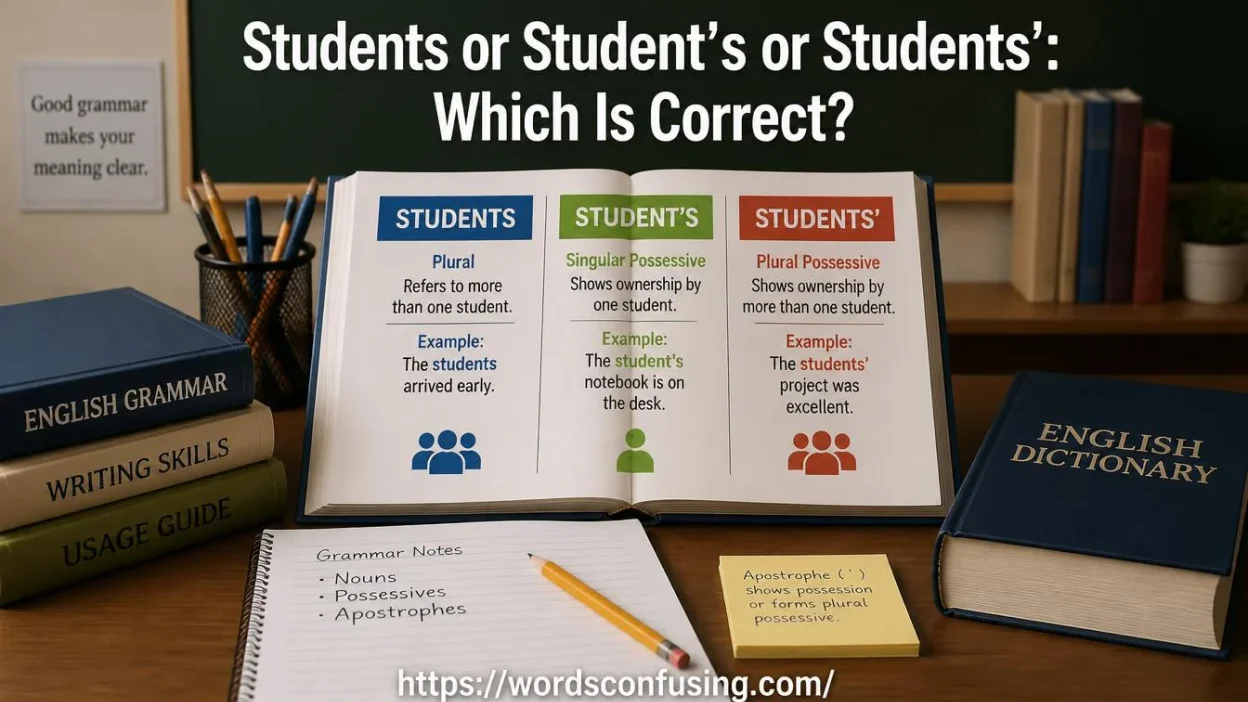
Students or Student’s or Students’: Which Is Correct? becomes easier when you check whether one student or many students own something in a sentence. When writing about students, the possessive form can create a mix-up because Student’s and students’ look the same at first.
However, they can change the entire meaning of a sentence. The good news is that the rule is simple: check who owns the thing. For one student, use the singular possessive student’s; for many students, use the plural possessive students’.
From my experience with grammar, this trick helps writers avoid wrong apostrophe use within a couple of minutes. The article can teach you the possessive form of student and how to use it in a natural sentence structure. The form becomes easy once you understand ownership, singular, and plural patterns.
Sometimes, students or student require an apostrophe, depending on what the sentence means. This basic idea and these rules make the different forms easier to recognize, reducing confusion for almost every writer.
Quick Answer
Students is the plural form for two or more learners. Student’s shows that something belongs to or relates to one student. Students’ shows possession or association involving multiple students. The easiest trick is to count the students first, then check whether you need to show possession.
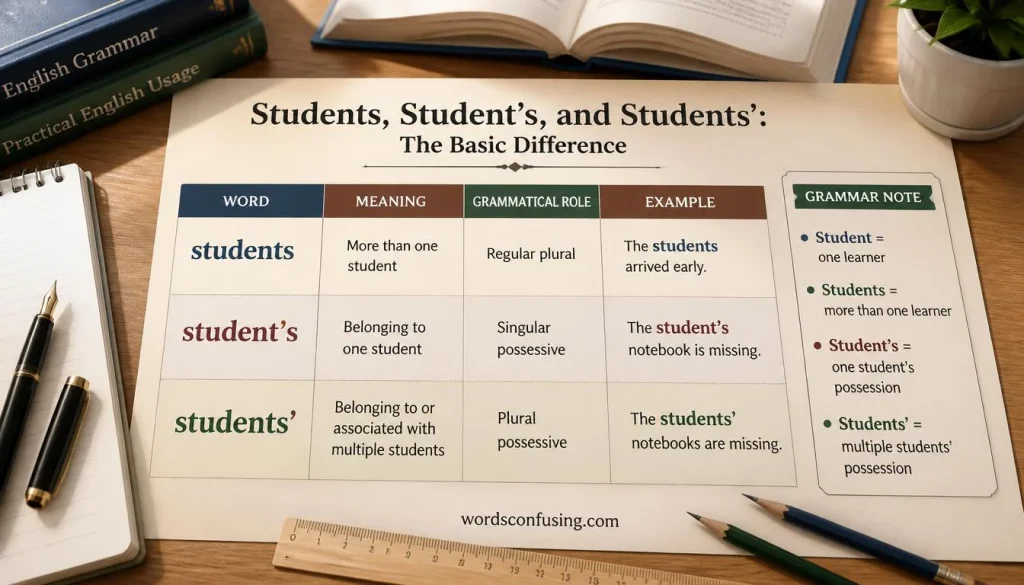
Students, Student’s, and Students’: The Basic Difference
The three forms serve different grammatical purposes.
| Form | Meaning | Grammatical use | Example |
| students | More than one student | Regular plural | The students arrived early. |
| student’s | Belonging to one student | Singular possessive | The student’s notebook is missing. |
| students’ | Belonging to or associated with multiple students | Plural possessive | The students’ notebooks are missing. |
Notice what happens when the apostrophe moves.
Student means one learner.
Students means more than one learner.
Student’s means something belongs to one student.
Students’ means something belongs to, concerns, or is associated with multiple students.
That distinction matters in everyday writing. It also matters in academic work, school notices, reports, emails, websites, and professional communication.
Students: The Regular Plural Form
Students is the standard plural of student.
Use it when you simply mean two or more students. You don’t need an apostrophe because you’re not showing possession.
For example:
- The students entered the classroom.
- Several students joined the discussion.
- The students completed their assignments.
- Five students volunteered for the project.
- The teacher asked the students to remain seated.
In each sentence, students simply identifies more than one person.
There is no ownership relationship that requires an apostrophe.
Why “Students” Doesn’t Need an Apostrophe
Apostrophes don’t normally make regular nouns plural.
That’s one of the most common apostrophe mistakes in English.
You add -s to many singular nouns to create their regular plural forms:
- student → students
- teacher → teachers
- book → books
- classroom → classrooms
- assignment → assignments
You don’t write:
- student’s ❌
- book’s ❌
- teacher’s ❌
when you simply mean more than one.
For example:
The students discussed the assignment.
Here, students means a group of learners. Nothing belongs to them in the word students itself.
“Students” in a Sentence
Consider this example:
The students are waiting outside the classroom.
The word students tells you that more than one student is waiting.
Now compare it with:
The student’s backpack is outside the classroom.
The meaning changes completely. The second sentence refers to one student’s backpack.
That tiny apostrophe carries grammatical information.
Student’s: The Singular Possessive Form
Student’s is the singular possessive form of student.
Use it when one student owns, has, creates, controls, or is associated with something.
The standard pattern is:
singular noun + ’s
So:
student + ’s = student’s
For example:
- The student’s book is on the desk.
- The student’s answer was correct.
- The student’s grade improved.
- The student’s backpack is under the chair.
- The student’s question surprised the teacher.
In each case, the sentence focuses on one student.
What Does “Student’s” Actually Show?
Possession doesn’t always mean literal ownership.
In grammar, a possessive construction can show several kinds of relationships.
For example:
The student’s essay received detailed feedback.
The student may not physically own the essay forever. The phrase simply connects the essay with that particular student.
Similarly:
- student’s grade
- student’s opinion
- student’s responsibility
- student’s schedule
- student’s performance
- student’s decision
- student’s question
These expressions show a relationship between one student and another noun.
That’s why student’s can be better understood as a possessive or associative form, rather than merely an ownership marker.
Students’: The Plural Possessive Form
Students’ is the plural possessive form.
Use it when multiple students have a possessive or associative relationship with something.
The standard pattern is:
regular plural noun ending in -s + apostrophe
So:
students + ’ = students’
For example:
- The students’ books were on the table.
- The students’ projects looked impressive.
- The teacher reviewed the students’ assignments.
- The students’ opinions differed.
- The students’ classroom was recently renovated.
Here, students already functions as a plural noun. Because it ends in s, you normally place the apostrophe after the s.
Why “Students’” Has the Apostrophe After the S
This is where many writers hesitate.
They see students and know that the word refers to multiple people. Then they wonder whether they should write student’s, students’, or students’s.
The standard form is:
students’
The plural s remains intact. The apostrophe comes afterward.
Think of the structure this way:
student → one student
students → several students
student’s → one student’s
students’ → several students’
That pattern works for many regular plural nouns.
Compare:
- teacher → teacher’s → teachers’
- player → player’s → players’
- customer → customer’s → customers’
- employee → employee’s → employees’
- student → student’s → students’
The apostrophe placement follows the number of people involved.
Students vs. Student’s: Plural or Singular Possessive?
The difference between students and student’s becomes clear when you focus on meaning.
Compare these sentences:
The students are preparing for the exam.
This means multiple students are preparing.
Now:
The student’s exam begins tomorrow.
This refers to an exam associated with one student.
The first word answers who?
The second answers something closer to whose?
That distinction provides a useful test.
Compare These Examples
| Sentence | Meaning |
| The students are studying. | More than one student is studying. |
| The student’s notes are organized. | The notes belong to or concern one student. |
| The students submitted essays. | Multiple students submitted essays. |
| The student’s essay won an award. | One student’s essay won an award. |
The apostrophe isn’t decorative. It changes the grammatical relationship.
Students vs. Students’: Plural or Plural Possessive?
The difference between students and students’ can seem even smaller.
Compare:
The students finished their projects.
Here, students is simply the subject of the sentence.
Now look at:
The students’ projects were displayed.
Here, students’ describes the projects.
The first sentence tells you who finished something.
The second tells you which projects you’re talking about.
A Simple Comparison
Students:
The students completed the test.
Students’:
The teacher collected the students’ tests.
In the first sentence, the students perform an action.
In the second sentence, the tests relate to the students.
That difference is often enough to identify the correct form.
Student’s vs. Students’: One Student or Several?
This is the most important distinction between the two possessive forms.
Student’s = one student.
Students’ = multiple students.
Compare:
The student’s desk is near the window.
This refers to one student’s desk.
Now:
The students’ desks are near the window.
This refers to desks associated with several students.
The nouns don’t necessarily have to be jointly owned. Each student could have a separate desk.
That’s an important point.
“Students’” Doesn’t Always Mean Shared Ownership
Plural possession can describe a group relationship without suggesting that everyone jointly owns one thing.
For example:
The students’ grades were posted online.
Each student may have an individual grade. The plural possessive simply connects those grades with the group.
Likewise:
The students’ schedules were updated.
Each student might have a different schedule.
The phrase students’ schedules still works because the schedules belong to or concern the students collectively as a group.
This broader sense of association appears frequently in academic and professional writing.
Students’ Rights, Students’ Opinions, and Students’ Responsibilities
You’ll often see students’ before abstract nouns.
Examples include:
- students’ rights
- students’ opinions
- students’ responsibilities
- students’ experiences
- students’ achievements
- students’ expectations
- students’ concerns
- students’ needs
These phrases don’t describe physical ownership.
Instead, they show that something relates to or concerns students.
For example:
The policy addresses students’ concerns about course scheduling.
The students don’t “own” their concerns in a physical sense. The possessive form connects the concerns to the students.
This is perfectly normal English usage.
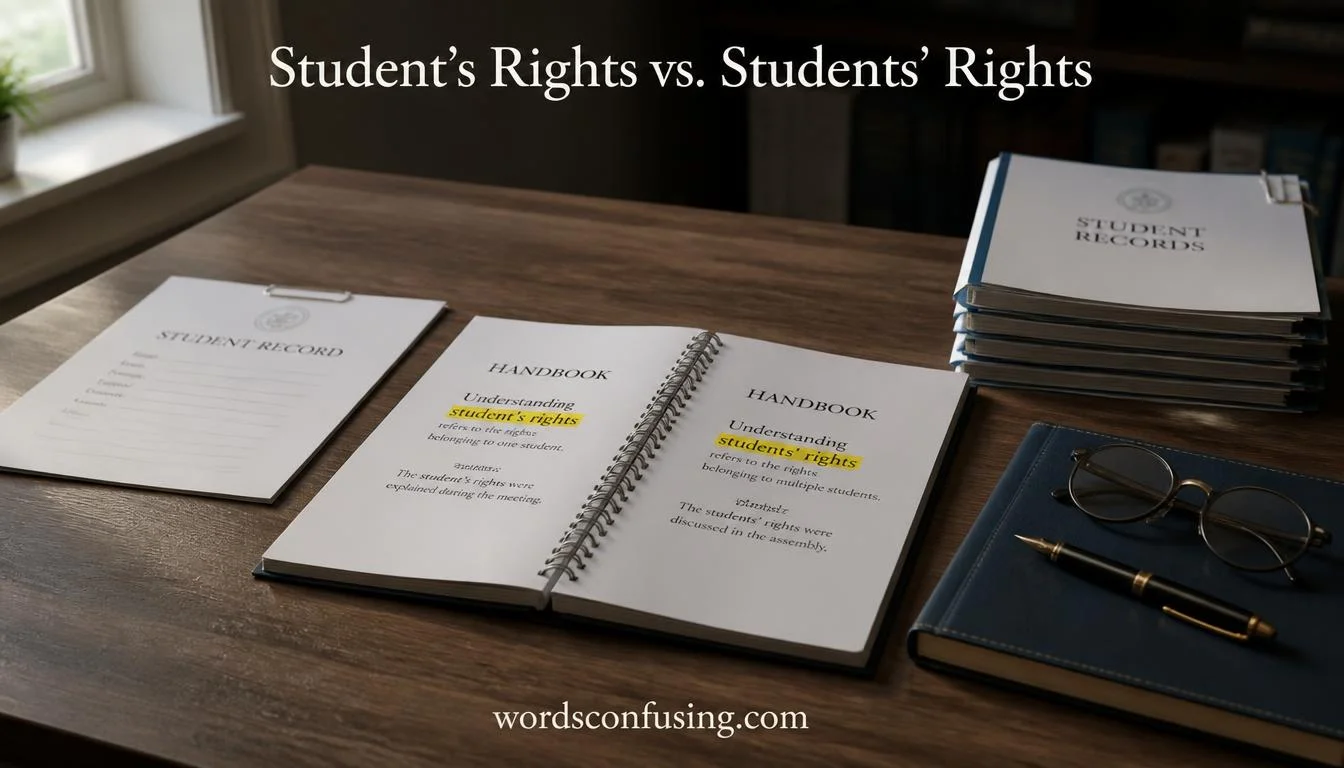
Student’s Rights vs. Students’ Rights
Both student’s rights and students’ rights can be grammatically correct.
The difference depends on the number of students.
One Student
The counselor explained the student’s rights.
The sentence focuses on one student.
Multiple Students
The counselor explained the students’ rights.
The sentence refers to rights belonging to or concerning multiple students.
The surrounding context usually tells you which meaning makes sense.
Common Mistakes With Students, Student’s, and Students’
Apostrophe errors often happen because writers treat the apostrophe as a simple plural marker.
It isn’t.
Mistake: Using “Student’s” as the Plural
Incorrect:
Twenty student’s attended the workshop.
Correct:
Twenty students attended the workshop.
The sentence needs an ordinary plural noun. No possession appears.
Mistake: Using “Students” for Possession
Incorrect:
The students books were on the desks.
Correct:
The students’ books were on the desks.
The books relate to multiple students, so the plural possessive form needs an apostrophe.
Mistake: Writing “Students’s”
Incorrect:
The students’s assignments were collected.
Correct:
The students’ assignments were collected.
The word students already ends in s. For a regular plural possessive, add the apostrophe after that existing s.
Mistake: Confusing “Student’s” With “Students’”
Incorrect when several students are involved:
The student’s projects were displayed.
If the projects belong to several students, use:
The students’ projects were displayed.
However, context can change the intended meaning. If one student created multiple projects, student’s projects is correct.
A Quick Test for Students, Student’s, and Students’
When you’re unsure which form to use, don’t guess.
Use this three-step test.
Step One: Count the Students
Ask whether you’re talking about one student or several.
One student:
student
More than one student:
students
That’s the foundation.
Step Two: Look for Possession or Association
Now ask whether the sentence connects the student or students with another noun.
For example:
The students arrived.
No possessive relationship appears.
Use students.
But:
The students’ assignments arrived.
The assignments relate to the students.
Use students’.
Step Three: Place the Apostrophe
If one student possesses or relates to something:
student’s
If several students possess or relate to something:
students’
The entire decision becomes:
One + possession = student’s
Many + possession = students’
Many + no possession = students
A Practical Sentence Test
Suppose you want to write:
The ___ project was excellent.
Ask yourself how many students worked on it.
If one student worked on the project:
The student’s project was excellent.
If several students worked on the project:
The students’ project was excellent.
Now remove the possessive relationship:
The students presented the project.
The form changes because the grammatical job changes.
This simple substitution test works surprisingly well.
Read more: 27 Best Replies to “I Don’t Care” for Witty & Clever Responses
Students, Student’s, and Students’ in Academic Writing
Academic writing frequently uses all three forms.
For example:
The students completed a survey about their study habits.
Here, students is plural.
Now:
Each student’s response was recorded separately.
Here, student’s refers to one student at a time.
Then:
The researchers compared the students’ responses.
Here, students’ connects the responses with multiple students.
Notice how all three forms can appear naturally within the same discussion.
Why Context Matters
English grammar doesn’t operate through isolated words alone.
The surrounding sentence provides clues.
Consider:
The student’s results were compared with the class average.
One student is the focus.
Now:
The students’ results were compared with the class average.
Multiple students are the focus.
The only visible difference is the apostrophe placement. The meaning changes nonetheless.
Case Study: A Classroom Notice
Imagine a school notice that says:
Students must bring their notebooks tomorrow.
Here, students is correct because the notice addresses multiple learners.
Now consider:
Each student’s notebook must include a name.
The phrase refers to each individual learner’s notebook. Student’s works because the possessive noun is singular.
Finally:
The students’ notebooks will be checked before class.
Now the sentence refers to notebooks associated with multiple students.
These three sentences demonstrate the complete pattern:
- Students = multiple learners
- Student’s = one learner’s
- Students’ = multiple learners’
Case Study: Assignments
Assignments provide another useful example.
The students completed their assignments.
No possessive apostrophe appears in students.
Now:
The student’s assignment was incomplete.
One student has an incomplete assignment.
Finally:
The students’ assignments were collected.
Multiple students submitted assignments.
The meaning becomes especially clear when you compare the noun that follows the possessive form.
Case Study: Classroom and Campus Language
Educational writing often uses phrases such as:
- student’s academic progress
- students’ academic progress
- student’s attendance
- students’ attendance
- student’s academic record
- students’ academic records
- student’s perspective
- students’ perspectives
The singular and plural forms aren’t interchangeable.
For example:
The counselor reviewed the student’s academic progress.
This suggests one student’s progress.
The report examined students’ academic progress.
This refers to academic progress across multiple students.
The choice depends on the intended scope.
Students or Student’s or Students’: More Examples
Here are several examples that show how the forms behave in different contexts.
1. Correct Uses of “Students”
- Students gathered in the auditorium.
- The students discussed the reading.
- Several students asked questions.
- The students completed the experiment.
- New students arrived this semester.
2. Correct Uses of “Student’s”
- The student’s answer was accurate.
- I found the student’s notebook.
- The student’s grade improved.
- The student’s schedule changed.
- The teacher praised the student’s effort.
3. Correct Uses of “Students’”
- The students’ answers were accurate.
- I found the students’ notebooks.
- The students’ grades improved.
- The students’ schedules changed.
- The teacher praised the students’ efforts.
Notice the parallel structure. Changing the number of students changes the possessive form.

What Happens When “Students’” Comes Before a Singular Noun?
A plural possessive doesn’t always need a plural noun afterward.
For example:
The students’ classroom was renovated.
The noun classroom is singular.
That doesn’t make students’ incorrect.
The phrase means a classroom associated with multiple students.
Similarly:
- students’ union
- students’ council
- students’ section
- students’ committee
- students’ entrance
- students’ lounge
The noun after the possessive can be singular or plural. What matters is the relationship between the possessive noun and the following noun.
What If Each Student Has a Separate Item?
You can still use students’ when referring collectively to items associated with individual students.
For example:
The teacher checked the students’ notebooks.
This doesn’t necessarily mean the students share notebooks.
Instead, it can mean that each student’s notebook was checked.
The plural possessive construction connects the collection of notebooks with the group of students.
This distinction becomes useful in formal writing because English often uses group-level possessives to describe individual items collectively.
A Table of Common Expressions
| Singular possessive | Plural possessive |
| student’s answer | students’ answers |
| student’s grade | students’ grades |
| student’s project | students’ projects |
| student’s opinion | students’ opinions |
| student’s responsibility | students’ responsibilities |
| student’s experience | students’ experiences |
| student’s record | students’ records |
| student’s concern | students’ concerns |
| student’s schedule | students’ schedules |
| student’s achievement | students’ achievements |
The pattern is consistent.
One student → student’s
Multiple students → students’
Why Apostrophes Matter
An apostrophe can look tiny on the page, yet it carries useful information.
Compare:
The students projects were impressive.
This version lacks the apostrophe needed to show the relationship between students and projects.
Now:
The students’ projects were impressive.
The relationship becomes grammatically clear.
Similarly:
The student’s projects were impressive.
Now the sentence points to one student’s projects.
Punctuation doesn’t merely decorate writing. In cases like these, it helps readers understand structure and meaning.
Read more: Campuses or Campus’s or Campus’: Which Is Correct?
Students or Student’s or Students’: Quick Reference
Keep this rule nearby if you frequently write about education.
Students
Use it for more than one student when no possessive relationship needs marking.
The students are ready.
Student’s
Use it when one student possesses or relates to something.
The student’s book is open.
Students’
Use it when multiple students possess or relate to something.
The students’ books are open.
The Three-Question Shortcut
When you’re stuck, ask:
Are there several students?
If yes, start with students.
Does something belong to or relate to one student?
Use student’s.
Does something belong to or relate to several students?
Use students’.
That’s the entire framework.
FAQs
1. Is student’s singular or plural?
Student’s is the singular possessive form. It shows that something belongs to one student. For example, “The student’s notebook is on the desk.”
2. When should I use students’?
Use students’ when something belongs to two or more students. For example, “The students’ projects were displayed in the classroom.”
3. Is students’s ever correct?
No. Students’s is not the standard possessive form. Since students is already plural and ends in s, add only an apostrophe to make students’.
4. What is the difference between student and student’s?
Student is a singular noun, while student’s shows possession. Compare “The student arrived early” with “The student’s bag was missing.”
5. How can I quickly choose between student’s and students’?
Ask yourself who owns something. If one student owns it, choose student’s. If many students own it, choose students’.
6. Why do writers often confuse student’s and students’?
The two forms differ by only one letter and an apostrophe position. That small difference can easily cause mistakes, especially when writing quickly.
Conclusion
Choosing between student’s and students’ becomes much easier when you focus on ownership rather than the apostrophe itself. If one student owns something, use student’s. If many students own something, use students’. That small distinction can prevent a surprisingly large number of grammar mistakes.
When you’re writing, don’t rush past the apostrophe. Pause for a second and ask, “Who owns this?” That quick question usually gives you the answer. With a little practice, the difference between student, student’s, and students’ will start to feel natural, and you won’t need to second-guess your sentence every time.