Seen vs. Saw: When Should You Use Each? helps you understand why saw and seen have similar meanings but different uses in English grammar.
Both come from the verb see and relate to sight, but they are not interchangeable. Saw is the simple past tense, while seen needs a helping verb such as has, have, or had. This simple rule makes the difference clear for English learners.
The same common mistake appears in speaking, informal writing, emails, school work, social media posts, and business writing. If you ask, “I seen or I saw?” remember that saw can stand alone for a completed past action, while seen usually appears in perfect verb forms.
These easy examples can help you use both forms correctly every time. I personally struggled with this confusing grammar for a long time, but understanding the rule made the distinction much easier to remember.
This approach improves word choice and helps avoid sentences in everyday and casual writing.
Quick answer
Saw is the simple past tense of see, while seen is the past participle. Use saw for a completed past action: “I saw him yesterday.” Use seen with a helping verb such as have, has, or had: “I have seen him before.” After did, use see, not saw or seen: “Did you see the movie?”
Seen vs. Saw: What’s the Difference?
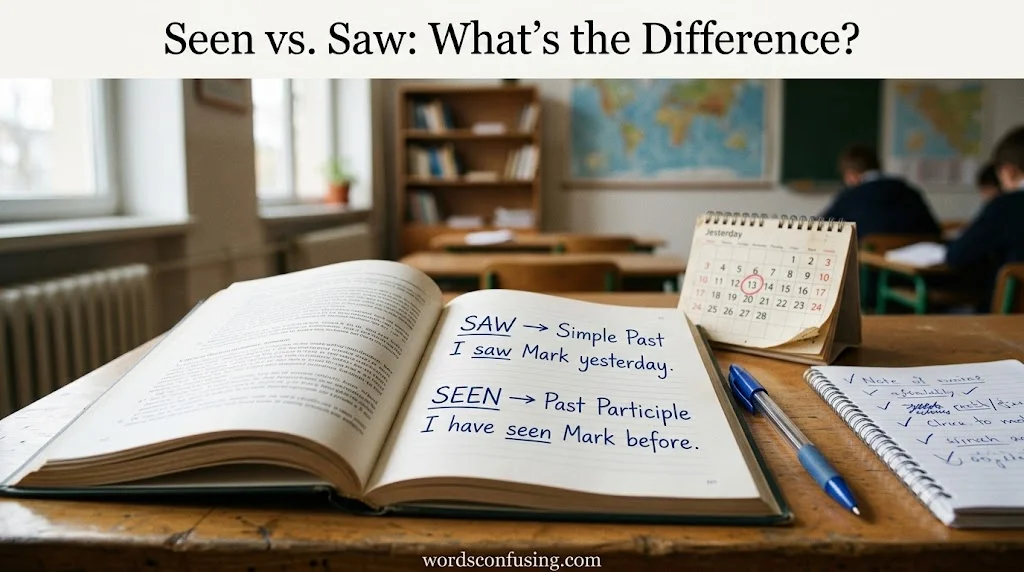
The key difference between seen vs. saw comes down to verb form and tense.
Saw is the simple past tense of see. It describes something that happened at a completed point in the past.
I saw Mark at the store yesterday.
Seen is the past participle of see. It normally works with an auxiliary or helping verb.
I have seen Mark at the store before.
Both sentences describe a past experience. The grammar differs because the verbs perform different jobs.
| Word | Verb form | Typical use | Example |
| see | Base form | Present, infinitive, after auxiliaries | I want to see it. |
| saw | Simple past | Completed past action | I saw it yesterday. |
| seen | Past participle | Perfect or passive constructions | I have seen it before. |
| seeing | Present participle | Continuous constructions | I am seeing it now. |
Think of these forms as different tools in a toolbox. They all belong to the same verb, but you wouldn’t use a screwdriver when you need a wrench.
Saw Is the Simple Past Tense of See
Saw tells you that an action happened in the past.
You don’t normally need another helping verb to use it.
For example:
- I saw your message yesterday.
- She saw a dog in the yard.
- We saw the new restaurant last night.
- They saw each other at school.
- He saw the accident from his window.
Notice the time relationship. Each sentence presents the act of seeing as a completed event.
You can also use saw without mentioning an exact time.
I saw him earlier.
The word “earlier” still places the event in the past.
Seen Is the Past Participle of See
Seen is not the ordinary past-tense form of see. It is the past participle.
That distinction matters because English uses past participles in several grammatical constructions.
Most commonly, you will see seen after forms of have:
- I have seen it.
- She has seen the movie.
- We had seen the building before.
- They will have seen the results.
The auxiliary verb carries the tense while seen completes the verb phrase.
That’s why “I have saw” is incorrect. The word have requires the past participle here, which is seen.
Saw vs. Seen at a Glance
If you’re unsure which word to choose, this quick comparison can help.
| Situation | Correct form | Example |
| Completed past action | saw | I saw him yesterday. |
| Present perfect | seen | I have seen him before. |
| Past perfect | seen | I had seen him earlier. |
| Future perfect | seen | I will have seen it by Friday. |
| After “did” | see | Did you see her? |
| Passive construction | seen | He was seen leaving. |
The biggest trap is assuming that every past reference requires saw. English doesn’t work that way. The surrounding verb structure determines the correct form.
When to Use “Saw” in a Sentence
Use saw when you need the simple past form of see.
This construction works especially well when the event has a clear beginning and ending in the past.
Use “Saw” for a Completed Past Action
Suppose you went to a concert last Saturday.
You could say:
I saw the band perform last Saturday.
The seeing happened during a finished event. Therefore, saw fits naturally.
Here are more examples:
- I saw your brother at lunch.
- She saw an unusual bird yesterday.
- We saw the game on television.
- He saw the doctor last Tuesday.
- They saw the fireworks downtown.
The simple past doesn’t necessarily mean the action lasted only a moment. It simply presents the event as completed.
For instance:
I saw her every day during my vacation.
The seeing happened repeatedly. Yet saw remains correct because the sentence describes a finished period in the past.
Use “Saw” With Specific Past-Time Expressions
Certain time expressions strongly support the simple past.
Common examples include:
- yesterday
- last night
- last week
- last month
- two days ago
- three years ago
- in 2020
- when I was younger
- earlier this morning, when that period has ended
Consider these examples:
I saw him yesterday.
We saw that movie last Friday.
She saw the doctor two weeks ago.
The finished time period gives the reader a clear past reference.
Compare that with:
I have seen that movie before.
Here, the speaker doesn’t identify a particular completed time. The focus falls on past experience rather than one specific event.
“Saw” in Questions and Negative Sentences
One of the most common mistakes appears after did.
You should say:
Did you see the movie?
Not:
Did you saw the movie?
Why? Because did already carries the past tense. The main verb returns to its base form, see.
The same principle applies to negative sentences.
Correct:
I didn’t see him yesterday.
Incorrect:
I didn’t saw him yesterday.
A useful pattern is:
1. Did + subject + base verb
Did you see?
2. Did not + subject + base verb
I did not see.
Once you recognize that pattern, this particular mistake becomes much easier to avoid.
When to Use “Seen” in a Sentence
Use seen when the grammar requires the past participle of see.
The most common pattern involves have, has, or had.
Use “Seen” With Have, Has, or Had
The perfect tenses require a past participle.
For the verb see, that participle is seen.
Examples:
I have seen that movie.
She has seen the report.
We had seen the warning before the accident.
They have seen this problem many times.
Here, have, has, or had establishes the grammatical structure. Seen supplies the past participle.
This is why these forms work:
- have seen
- has seen
- had seen
- will have seen
But these forms don’t work in Standard American English:
- have saw
- has saw
- had saw
The rule is straightforward: perfect constructions use seen, not saw.
Use “Seen” With Forms of “Be”
You can also find seen in passive constructions.
For example:
He was seen leaving the building.
The suspect was seen near the entrance.
The comet has been seen from several locations.
Here, seen isn’t functioning as an ordinary simple past verb. It forms part of a passive construction.
Consider this sentence:
Someone saw him leaving.
That’s active voice.
Now compare:
He was seen leaving.
That’s passive voice.
The meaning remains closely related, but the sentence structure changes.
Use “Seen” When Talking About Experience
Seen frequently appears when you discuss experiences without naming a specific time.
For example:
I have seen this before.
Have you ever seen snow?
She has never seen the ocean.
We’ve seen several changes over the years.
The present perfect connects a past experience with the present.
You aren’t necessarily saying exactly when the event occurred. You’re saying that the experience exists within your past experience.
That’s an important distinction between:
I saw that movie last Friday.
and:
I have seen that movie before.
The first identifies a completed past event. The second emphasizes experience.
Saw vs. Seen in Different Verb Tenses
Understanding the larger tense system makes seen vs. saw much easier.
| Tense or construction | Correct form | Example |
| Simple present | see | I see the problem. |
| Simple past | saw | I saw the problem. |
| Present perfect | have/has seen | I have seen the problem. |
| Past perfect | had seen | I had seen the problem. |
| Future perfect | will have seen | I will have seen the problem. |
| Present continuous | am/is/are seeing | I am seeing the doctor. |
| Passive | was/were seen | He was seen outside. |
The important pattern is easy to spot:
see → saw → seen
That’s the basic irregular verb sequence.
English has many irregular verbs that don’t follow the regular -ed pattern. See belongs to that group.
You don’t say:
I seed it.
Instead, you say:
I saw it.
And you don’t say:
I have saw it.
You say:
I have seen it.
Common Mistakes With “Saw” and “Seen”
The most useful way to master seen vs. saw is to understand the errors people commonly make.
“I Have Saw” vs. “I Have Seen”
This mistake happens because speakers recognize that saw refers to the past.
However, have changes the grammatical structure.
Incorrect:
I have saw that movie.
Correct:
I have seen that movie.
The formula is:
have/has + past participle
Since seen is the past participle, it belongs after have or has.
“I Seen It” vs. “I Saw It”
In Standard American English, “I seen it” is not the standard simple past construction.
If you’re describing a completed past event, use saw:
I saw it yesterday.
If you’re using the present perfect, use have seen:
I have seen it before.
Therefore, the choice isn’t simply between saw and seen. Sometimes the correct answer requires see or have seen depending on the sentence.
“Did You Saw?” vs. “Did You See?”
This mistake is extremely common.
Incorrect:
Did you saw the game?
Correct:
Did you see the game?
The reason is simple: did already marks the past.
Compare:
You saw the game.
with:
Did you see the game?
The statement uses saw. The question uses did + see.
“I Had Saw” vs. “I Had Seen”
The past perfect requires had + past participle.
Therefore:
I had seen the message before you called.
Not:
I had saw the message before you called.
The word had already establishes the past-perfect structure. The correct participle is seen.
“I Seen Him Yesterday” vs. “I Saw Him Yesterday”
The word yesterday points toward a completed past time.
Therefore:
I saw him yesterday.
is the standard choice.
The sentence:
I seen him yesterday.
doesn’t follow Standard American English grammar.
The correction becomes especially easy when you ask one question: Is there a helping verb before the participle?
If there isn’t, you probably need saw for a simple past statement.
“I Saw” vs. “I Have Seen”: What’s the Difference?
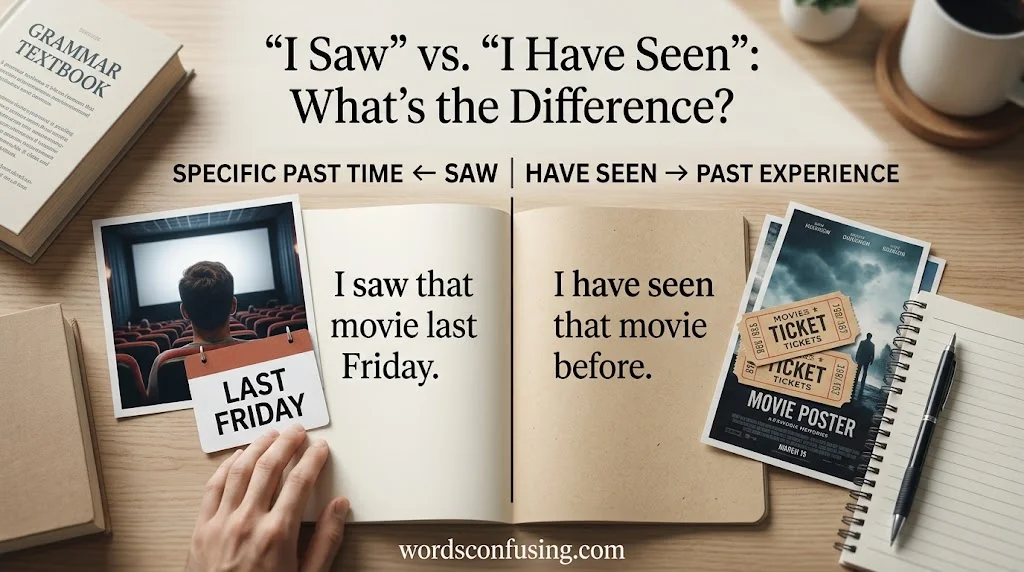
The difference between “I saw” and “I have seen” deserves special attention because both sentences can describe past experiences.
Consider:
I saw that movie last Friday.
The speaker identifies a specific completed time.
Now consider:
I have seen that movie before.
The speaker focuses on experience. The exact time isn’t important.
This distinction often appears in everyday conversation.
| Sentence | Main focus |
| I saw him yesterday. | A specific past event |
| I have seen him before. | Previous experience |
| She saw the doctor Monday. | Specific completed time |
| She has seen the doctor several times. | Experience or repeated action |
| We saw the building in 2023. | Specific past time |
| We have seen the building before. | Past experience |
A simple rule helps:
Finished past time → usually saw.
Past experience connected to the present → often have seen.
This isn’t merely about whether something happened in the past. Both constructions refer to the past. The difference lies in how the speaker frames that past event.
“I Saw It” vs. “I’ve Seen It”
These two expressions sound similar, yet they can communicate different ideas.
“I saw it.”
This usually reports a particular event.
I saw it on television last night.
The speaker tells you when the event occurred.
“I’ve seen it.”
This usually means the speaker has experienced it previously.
I’ve seen it before.
The exact date isn’t relevant.
Imagine a friend recommending a movie.
Friend: “Have you seen that movie?”
Response: “Yes, I’ve seen it.”
The response emphasizes previous experience.
If someone asks:
When did you see it?
You might answer:
I saw it last Saturday.
The tense changes because the question now asks about a specific past event.
Can “Seen” Ever Be Used Without a Helping Verb?
This question causes considerable confusion.
In Standard American English, seen does not normally replace saw as the simple past form.
You wouldn’t normally write:
I seen him yesterday.
Instead:
I saw him yesterday.
However, seen can appear in larger grammatical structures where another word supplies the necessary support.
For example:
Seen from above, the city looks completely different.
Here, seen from above works as a participial phrase.
Another example is:
The movie is seen as a modern classic.
The word seen forms part of a passive construction.
So the better rule isn’t simply “seen always needs have.” The more accurate rule is:
Seen is a past participle that usually appears within a larger verb or participial construction.
That explanation covers more situations without creating a misleading shortcut.
Read more: 4 Ways to Spell the Sound of Spitting and Spit Onomatopoeia
Saw vs. Seen in Questions
Questions provide an excellent way to distinguish the two forms.
Correct Questions With “Saw”
In ordinary questions, saw usually appears only when another structure allows it. Most questions about a completed past event use did + see.
Correct:
Did you see Sarah?
When did you see the accident?
Where did you see him?
Incorrect:
Did you saw Sarah?
When did you saw the accident?
The helping verb did takes the past tense, so the main verb remains see.
Correct Questions With “Seen”
Perfect-tense questions use seen.
Examples include:
Have you seen Sarah?
Has he seen the report?
Had they seen the warning?
Have you ever seen a whale?
Here, have, has, or had creates the perfect construction.
Common Question Mistakes
| Incorrect | Correct |
| Did you saw it? | Did you see it? |
| Did you seen it? | Did you see it? |
| Have you saw it? | Have you seen it? |
| Has she saw him? | Has she seen him? |
| Had they saw the message? | Had they seen the message? |
The pattern becomes almost mechanical once you identify the helping verb.
Saw vs. Seen in American English
In Standard American English, the distinction between saw and seen follows the same core grammatical rules described above.
You may hear forms such as “I seen” in some dialects and informal speech. Language varies across communities, regions, and social settings. However, that doesn’t make “I seen” the standard form for formal American English writing.
For school assignments, professional emails, articles, reports, and other formal contexts, use:
I saw him yesterday.
or:
I have seen him before.
rather than:
I seen him yesterday.
This distinction matters because effective writing depends on audience and context. Informal speech can bend grammatical conventions that formal writing normally follows.
Saw vs. Seen vs. See: The Complete Verb Forms
The three forms are easiest to understand together.
| Verb form | Word | Example |
| Base form | see | I want to see the movie. |
| Simple past | saw | I saw the movie yesterday. |
| Past participle | seen | I have seen the movie before. |
| Present participle | seeing | I am seeing the movie tonight. |
Each form has a specific grammatical role.
See
Use see as the base form.
I want to see the results.
It also follows auxiliary verbs such as do, does, and did.
Did you see that?
Saw
Use saw as the simple past.
I saw that yesterday.
Seen
Use seen as the past participle.
I have seen that before.
Seeing
Use seeing in continuous constructions or other participial structures.
I am seeing a doctor tomorrow.
The complete sequence is therefore:
see → saw → seen → seeing
Memorizing this sequence can eliminate many common errors.
Easy Ways to Remember Saw vs. Seen
A few simple tests can help you choose correctly.
Use the Helping-Verb Test
Look immediately before the verb.
If you see have, has, or had, use seen.
I have seen it.
She had seen him.
If you see did, use see.
Did you see it?
This test catches several mistakes instantly.
Use the Specific-Time Test
If you’re describing a completed event at a definite past time, saw often fits.
I saw her yesterday.
We saw the show last week.
He saw the accident in 2022.
The time expression provides a strong clue.
Remember the Three-Part Pattern
Keep this sequence in mind:
See — saw — seen
Then attach a simple example to each form:
- See: I want to see it.
- Saw: I saw it yesterday.
- Seen: I have seen it before.
That tiny pattern is more useful than memorizing a long grammar definition.
Saw vs. Seen Examples in Everyday Sentences
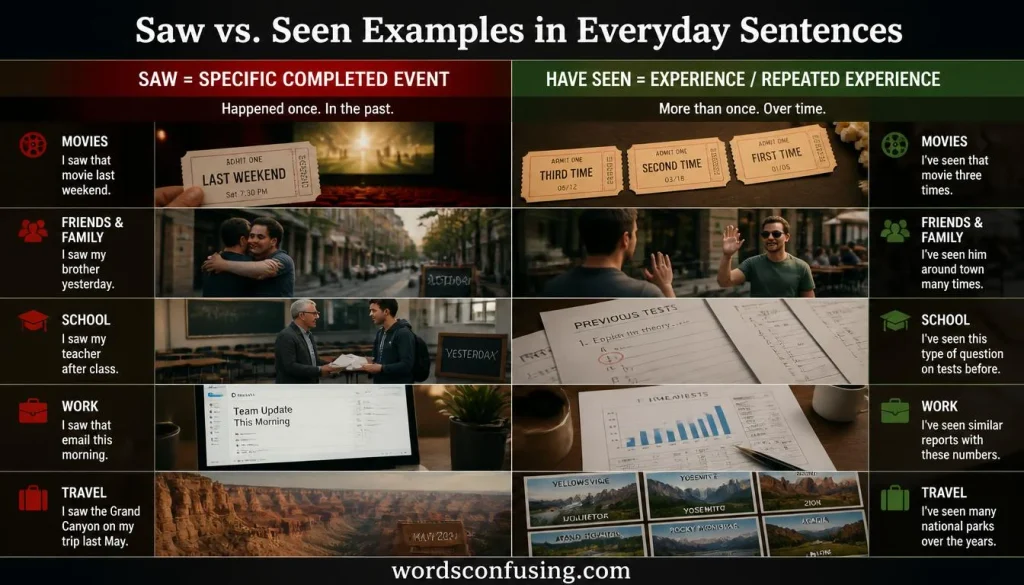
Real-life examples make the distinction easier to recognize.
Movies and Television
I saw that movie last weekend.
I’ve seen that movie three times.
Did you see the latest episode?
Have you seen this show before?
The tense changes according to the speaker’s purpose.
Friends and Family
I saw your brother yesterday.
I’ve seen your brother around town.
Did you see Sarah at lunch?
Have you seen Sarah today?
Again, saw reports a past event while have seen often emphasizes experience or a period connected to now.
School
I saw the teacher after class.
I’ve seen that question on previous tests.
Did you see the assignment?
Have you seen the revised schedule?
Work
I saw your email this morning.
I’ve seen similar reports before.
Did you see the updated figures?
Have you seen the latest version?
Travel
We saw the Grand Canyon during our trip.
We’ve seen several national parks.
Did you see the mountains?
Have you ever seen the ocean from that viewpoint?
These examples show why context matters more than simply memorizing one word.
Saw vs. Seen: Incorrect and Correct Examples
The following table summarizes the mistakes most likely to appear in everyday writing.
| Incorrect | Correct | Why |
| I seen him yesterday. | I saw him yesterday. | Simple past requires saw. |
| I have saw it. | I have seen it. | Perfect tense requires seen. |
| Did you saw her? | Did you see her? | Did takes the base verb. |
| I had saw that movie. | I had seen that movie. | Past perfect requires seen. |
| She has saw the report. | She has seen the report. | Has requires the past participle. |
| Did you seen that? | Did you see that? | Did takes the base form. |
| He saw it before. | He has seen it before. | Present perfect better expresses previous experience when no finished time is given. |
The last example needs context. “He saw it before” can be grammatical in the right context. However, “He has seen it before” commonly expresses an experience that remains relevant to the present.
A Practical Case Study: Choosing the Right Form
Imagine three friends discussing a movie.
Question: “Did you watch the new science-fiction movie?”
Alex says:
I saw it Friday.
That’s correct because Alex identifies a completed past time.
Another friend says:
I’ve seen it already.
That’s also correct. This response focuses on previous experience rather than a particular time.
A third friend asks:
Have you seen it yet?
Again, seen works because the question uses the present perfect.
Now suppose someone asks:
When did you see it?
The answer becomes:
I saw it Friday.
The conversation demonstrates how grammar changes with the information being requested.
The words aren’t interchangeable. The surrounding structure controls the choice.
Read more: 7 Good Words for the Sound of Thunder and Onomatopoeia
Saw vs. Seen Quick Grammar Test
Choose see, saw, or seen for each sentence.
Questions
- I ___ that movie last night.
- Have you ___ this documentary?
- Did you ___ my message?
- She has ___ the results.
- We ___ him yesterday.
- They had ___ the building before.
- I want to ___ the new exhibit.
- Did you ___ what happened?
- He ___ the doctor last week.
- I’ve ___ that problem before.
Answers
- saw
- seen
- see
- seen
- saw
- seen
- see
- see
- saw
- seen
The pattern is consistent.
Specific completed past events generally use saw. Perfect constructions use seen. After did, use see.
FAQs
Is “saw” the past tense of “see”?
Yes. Saw is the simple past tense of see. Use it when you describe something that happened at a specific time in the past. For example, “I saw your message yesterday.”
Is “seen” a past tense word?
Seen is a past participle, not the simple past form. It normally needs a helping verb such as have, has, or had. For example, “I have seen that movie before.”
Can I say “I seen it”?
In standard English, “I seen it” is incorrect. Say “I saw it” for a simple past action. You can also say “I have seen it” when using the present perfect tense.
When should I use “saw” instead of “seen”?
Use saw when the sentence describes a completed past action without a helping verb. For example, “She saw him at the store.” If the sentence uses has, have, or had, seen is usually the correct form.
Why do people confuse “saw” and “seen”?
The confusion happens because both words come from see and describe past experiences. Informal speech can also make incorrect forms sound familiar, especially when people hear them frequently.
What is an easy way to remember “saw” vs. “seen”?
Remember this quick pattern: saw can stand alone, but seen needs a helper. Think “I saw it” versus “I have seen it.” This simple memory trick works well when you’re writing or speaking quickly.
Conclusion
Understanding seen vs. saw becomes much easier when you remember one key difference: saw works as the simple past form of see, while seen normally needs a helping verb. Once this pattern becomes familiar, questions like “I saw or I seen?” stop being confusing. Instead of memorizing endless grammar rules, focus on how each word functions within the sentence.
With a little practice, you’ll start noticing the difference naturally in conversations, emails, school work, and everyday writing. When you saw something yesterday, use saw. When you have seen something before, use seen. That small distinction can save you from a very common grammar mistake and make your writing sound much more polished.