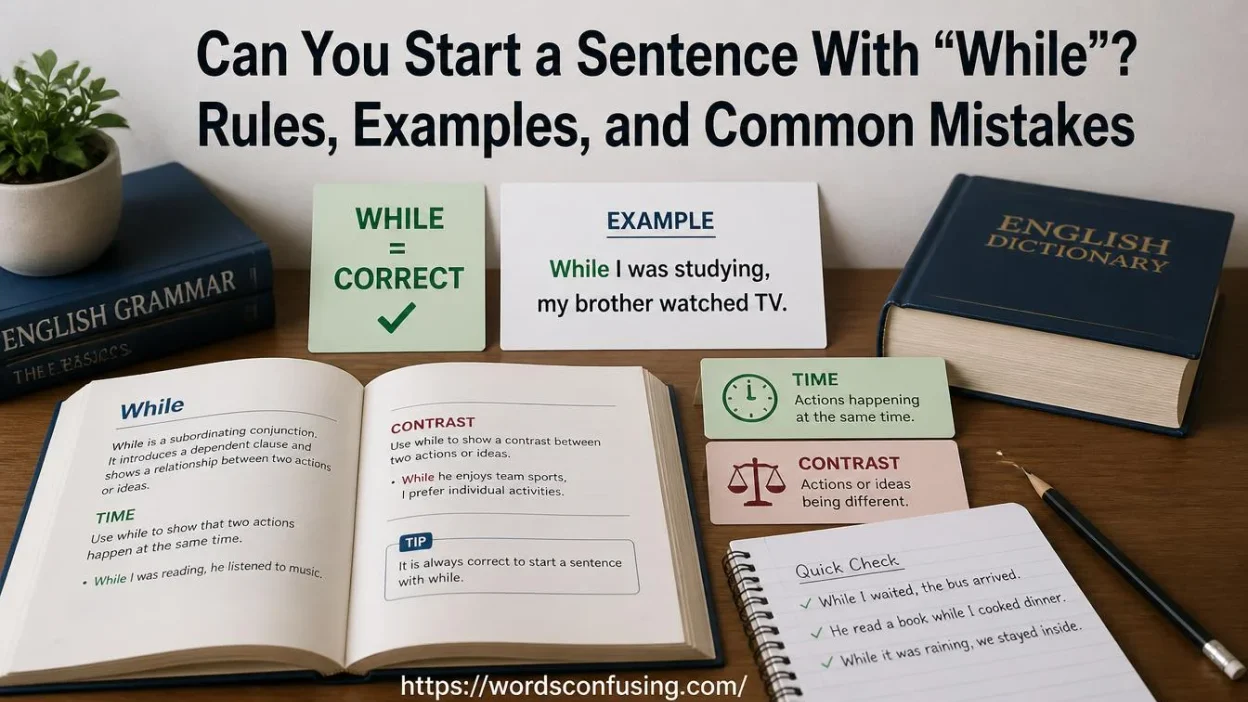
Can You Start a Sentence With “While”? Common Mistakes explains why English allows you to start a sentence with while when the context and sentence structure are correct and clear.
There is no grammatical rule that bans particular words from sentence beginnings. In English grammar, while can act as an introductory word and subordinating conjunction, introducing a dependent clause before an independent clause.
For example, “While I was at work, I checked the report” uses natural sentence construction and proper usage. As a writer, I find this structure useful because it connects related ideas smoothly.
The right context, correct punctuation, and clear writing matter more than avoiding while because of a common myth taught in some schools. This is especially helpful in formal work, school, and casual contexts, where Writers may need flexible sentence beginnings.
A separate common mistake occurs when writers split meanwhile into two words and write mean while. That form is incorrect because meanwhile is a single adverb meaning at the same time or in the meantime.
Compare the wrong sentence, “Mean while, I waited,” with the right sentence, “Meanwhile, I waited.” These sentence pairs offer short rules for remembering correct usage. Proper word spacing also makes the error easier to spot during proofreading.
When you find it, use quick rewrites and proofreading tricks to fix the mistake immediately, while checking punctuation and intended meaning.
Quick Answer
Yes, you can start a sentence with “while.”
The construction is grammatically correct when while introduces a dependent clause followed by a complete main clause.
For example:
While I was preparing dinner, my guests arrived.
Here, while I was preparing dinner establishes the time. My guests arrived provides the complete main idea.
You can also use while to introduce contrast:
While the first option is cheaper, the second is more reliable.
The most important thing is understanding what while means in your sentence.
If it describes two events occurring during the same period, it has a time-related meaning. If it compares two ideas, it has a contrastive meaning.
When the introductory clause comes first, a comma normally follows it.
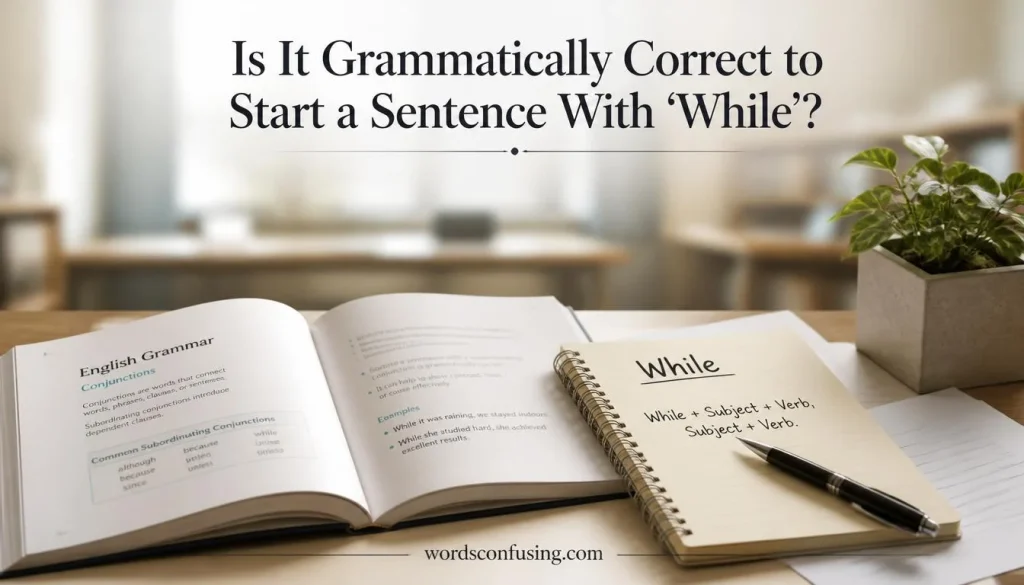
Is It Grammatically Correct to Start a Sentence With “While”?
Yes. Starting a sentence with “while” is grammatically correct.
In this construction, while commonly acts as a subordinating conjunction. It introduces a dependent clause that needs a main clause to complete the thought.
Consider this example:
While the students were taking the test, the teacher walked around the classroom.
The opening portion, while the students were taking the test, can’t normally stand alone as a complete sentence. It tells you when something happened, but it doesn’t finish the thought.
The second portion does:
The teacher walked around the classroom.
Together, the clauses create a complete sentence.
This structure is not unusual or informal. English regularly places subordinate clauses before main clauses. Grammar references also describe while as a conjunction used to connect events occurring during the same period or ideas that contrast.
The Basic Pattern
The most useful pattern is:
While + subject + verb, independent clause.
For example:
- While I was cooking, my sister cleaned the kitchen.
- While the children played outside, their parents prepared dinner.
- While the meeting continued, employees took notes.
- While the store was closing, several customers entered.
You can also reverse the order:
My sister cleaned the kitchen while I was cooking.
Both versions are grammatical. The difference is mainly one of emphasis and sentence flow.
When you put the while clause first, you establish the background before presenting the main action. That can make the relationship between the two events especially clear.
What Does “While” Mean at the Beginning of a Sentence?
The meaning of while depends on the context.
Most beginning-of-sentence examples fall into two broad categories:
- Time: two actions happen during the same period.
- Contrast: two facts, opinions, or situations differ.
Cambridge Grammar describes these two major uses as meaning roughly “during the time that” and “in contrast with something else.”
“While” for Two Actions Happening at the Same Time
The first use connects events that overlap in time.
For example:
While I was driving, my phone rang.
The driving happened when the phone rang. The two events overlap.
More examples include:
- While Maria studied, her brother played video games.
- While we were eating dinner, the lights went out.
- While the manager spoke, everyone listened carefully.
- While I was walking home, I saw an old friend.
- While the machine was running, the technician checked the controls.
This use often appears with continuous verb forms such as was studying, were eating, or was walking. However, continuous forms aren’t mandatory.
For example:
While I live here, I follow the local rules.
The important point is the relationship between the actions, not a particular verb tense.
“While” to Show Contrast
The second major use has nothing to do with simultaneous actions.
Here, while introduces a contrasting fact.
While the first option is cheaper, the second is more reliable.
Nobody needs to perform both actions at the same time. Instead, the sentence compares two characteristics.
Other examples include:
- While I understand your concern, I disagree with the conclusion.
- While the apartment is small, its location is excellent.
- While Sarah prefers coffee, Mark prefers tea.
- While the old system was slower, it was easier to use.
- While one plan saves money, the other saves time.
In these sentences, while can often be replaced by although or whereas, depending on the exact meaning.
That creates one of the biggest challenges with this word: readers sometimes need a moment to determine which meaning you intend.
How to Use “While” at the Beginning of a Sentence
Using while correctly isn’t difficult. You mainly need to pay attention to clause structure, punctuation, and meaning.
Use “While” + Subject + Verb
A normal construction looks like this:
While + subject + verb, main clause.
For example:
While John prepared dinner, Maria set the table.
The opening clause contains:
- While — subordinating conjunction
- John — subject
- prepared — verb
- dinner — object
The main clause contains:
- Maria — subject
- set — verb
- the table — object
The two clauses work together as one complete sentence.
Here’s another example:
While the team worked, the manager reviewed the results.
The opening clause establishes the situation. The main clause delivers the primary action.
Put a Comma After an Introductory “While” Clause
When a while clause comes before the main clause, a comma normally separates the two.
Correct:
While I was waiting, I checked my email.
Correct:
While the rain continued, the game went on.
Correct:
While she prepared the report, her colleague gathered the data.
Traditional American grammar guidance treats an introductory dependent clause as an element that should generally be followed by a comma. Purdue OWL specifically includes while among common introductory clause starters.
When the order reverses, you normally don’t need that comma:
I checked my email while I was waiting.
The game went on while the rain continued.
Her colleague gathered the data while she prepared the report.
This distinction makes punctuation easier to remember:
Dependent clause first → comma.
Dependent clause second → usually no comma.
Make Sure the “While” Clause Connects to a Complete Main Clause
One common mistake occurs when writers stop after the while clause.
Incorrect:
While I was waiting.
That isn’t a complete standard sentence. The reader naturally expects more information.
Correct:
While I was waiting, the bus finally arrived.
Another incorrect example:
While the meeting was happening.
Correct:
While the meeting was happening, employees answered questions.
The opening while clause depends on the main clause to complete the sentence.
A sentence fragment can occur when a dependent clause becomes separated from the main clause. Purdue OWL identifies dependent clauses that cannot stand alone as a common source of fragments.
Can You Start a Sentence With “While” in Formal Writing?
Absolutely.
You can use while at the beginning of sentences in:
- Academic writing
- Business writing
- Professional emails
- Reports
- Essays
- Articles
- Everyday communication
- Explanatory writing
The construction itself isn’t informal.
For example:
While the evidence supports the first explanation, several questions remain.
That sentence could easily appear in an academic discussion.
Another example:
While the new procedure reduces processing time, employees still need additional training.
This works well in a workplace report because the sentence establishes a clear relationship between two ideas.
The real concern isn’t whether while appears at the beginning. The concern is whether the sentence communicates the intended relationship clearly.
That’s an important distinction.
Some writers learn rules such as “never begin a sentence with a conjunction.” Those blanket rules can cause unnecessary problems because they confuse different types of conjunctions and sentence structures.
In this case, while can correctly introduce a subordinate clause at the beginning of a sentence.
Examples of Sentences Starting With “While”
The following examples show how flexible this construction can be.
| Sentence | Meaning of “while” |
| While I was working, my phone rang. | Two events overlap |
| While Sarah cooked, Tom washed the dishes. | Simultaneous actions |
| While the rain continued, we stayed inside. | Simultaneous events |
| While the product costs more, it lasts longer. | Contrast |
| While I appreciate your help, I need to finish this myself. | Contrast |
| While one option is faster, the other is cheaper. | Comparison |
| While the meeting continued, employees took notes. | Simultaneous actions |
| While the apartment is small, it has plenty of storage. | Contrast |
| While the children slept, their parents cleaned the house. | Simultaneous actions |
| While I understand the policy, I think this situation is different. | Contrast |
Notice the difference between the meanings.
In “While I was working, my phone rang,” the word refers to time.
In “While the product costs more, it lasts longer,” the word signals contrast.
The surrounding information tells you which interpretation makes sense.
“While” vs. “Although” at the Beginning of a Sentence
While and although can both introduce contrasting ideas.
Compare these sentences:
While the task was difficult, we completed it.
Although the task was difficult, we completed it.
Both sentences present difficulty as a fact that contrasts with the successful outcome.
However, while carries an additional meaning that although doesn’t normally carry: time.
That makes although useful when you want the contrast to be unmistakable.
For example:
Although the road was narrow, the driver continued carefully.
There’s no reasonable time-based interpretation. The sentence clearly expresses contrast.
By comparison:
While the road was narrow, the driver continued carefully.
This can still express contrast. Yet the word while technically has its time-related meaning available as another interpretation.
When “Although” Is Clearer
Use although when your only purpose is to express concession or contrast.
For example:
Although the software is expensive, many businesses use it.
This is straightforward.
You don’t need the reader to consider whether two events happened simultaneously.
That said, while remains completely acceptable when the intended contrast is obvious from context.
Read more: 25 Best Replies to “You’re Welcome” Formal and Friendly
“While” vs. “Whereas” at the Beginning of a Sentence
Whereas focuses specifically on contrast.
For example:
Whereas Anna prefers tea, Mark prefers coffee.
This sentence directly compares two preferences.
You can also write:
While Anna prefers tea, Mark prefers coffee.
In a contrastive sentence, while and whereas can have similar meanings. Cambridge specifically notes that whereas indicates contrast and can correspond to while when while expresses contrast rather than time.
The key difference is that whereas doesn’t carry the same time meaning.
Consider:
While I was at work, Sarah called me.
You can’t replace while with whereas:
Whereas I was at work, Sarah called me.
That changes the sentence into an unnatural construction because the original sentence describes time rather than contrast.
A useful rule is:
- while → time or contrast
- whereas → contrast
- although → concession or contrast
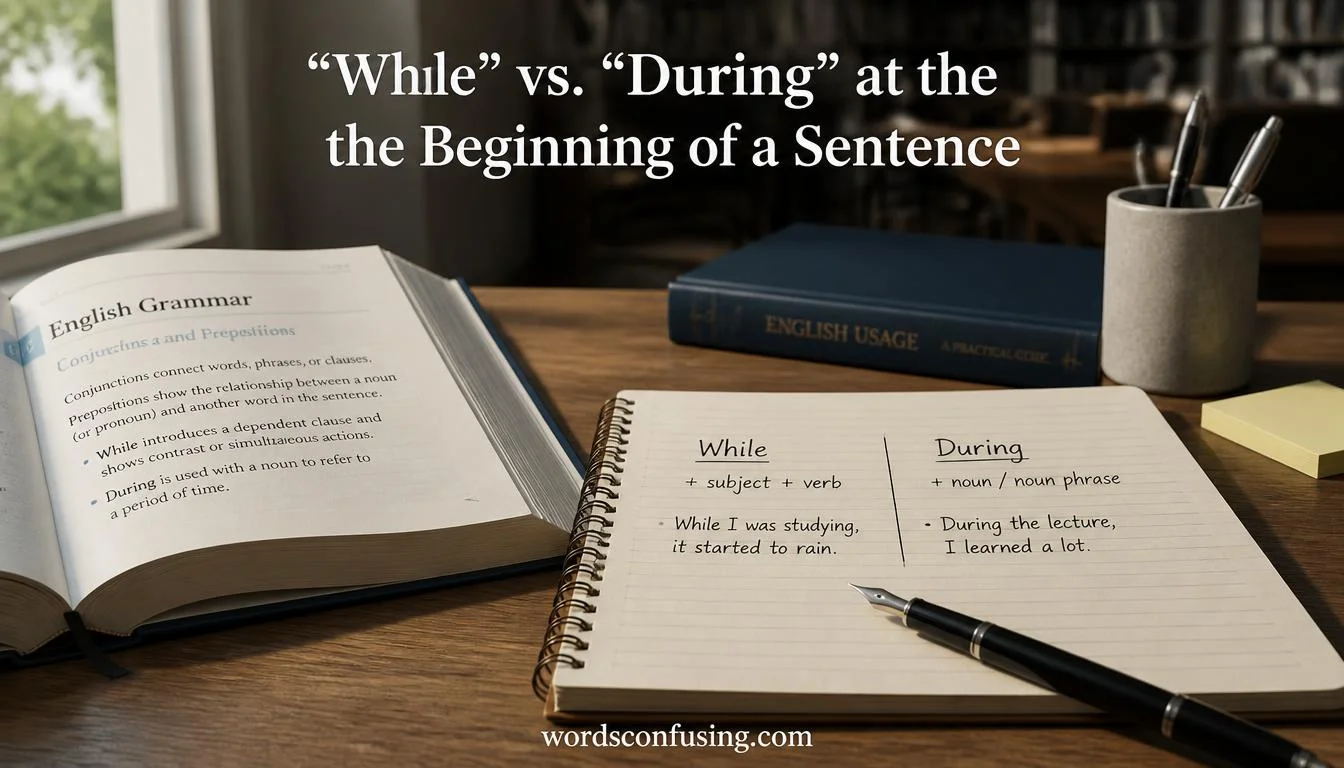
“While” vs. “During” at the Beginning of a Sentence
These two words often confuse learners because they can express similar ideas.
However, they don’t perform the same grammatical job.
While can introduce a clause:
While I was in class, I took notes.
During normally functions as a preposition and takes a noun or noun phrase:
During class, I took notes.
You can’t normally write:
During I was in class, I took notes.
That’s incorrect because during doesn’t introduce a finite clause in the same way while does.
Compare the structures:
| Word | Typical structure | Example |
| while | while + subject + verb | While I was studying, she called. |
| during | during + noun/noun phrase | During the class, she called. |
| whereas | whereas + clause | Whereas I prefer tea, he prefers coffee. |
| although | although + clause | Although I was tired, I continued. |
Cambridge’s grammar guidance makes the same distinction between while as a conjunction and during as a preposition.
Common Mistakes When Starting a Sentence With “While”
Starting with while is correct. Still, several mistakes can make the sentence awkward or grammatically incomplete.
Sentence Fragment
The most obvious problem is stopping after the dependent clause.
Incorrect:
While I was studying.
Correct:
While I was studying, my friend called.
The first version gives the reader a setup without the payoff.
Think of the opening while clause like the first half of a bridge. It needs the main clause to reach the other side.
Missing Comma After the Introductory Clause
When a dependent while clause comes first, add the comma in standard usage:
While I was driving, my friend called.
Not:
While I was driving my friend called.
The second version can momentarily make the sentence harder to parse.
Punctuation gives the reader a small visual signal: the introductory information has ended and the main clause begins.
Using “While” When “During” Is Needed
Incorrect:
During I was studying, my brother watched television.
Correct:
While I was studying, my brother watched television.
Or:
During my study session, my brother watched television.
The choice depends on what follows the word.
Ambiguous Meaning
Sometimes while can create two possible interpretations.
Consider:
While the manager was reviewing the report, the assistant prepared the presentation.
The meaning is clear because both actions can happen at the same time.
Now consider:
While the first proposal is cheaper, the second is more practical.
Here, while clearly signals contrast.
In a sentence where both interpretations seem plausible, consider replacing while with a more specific conjunction.
Use although when you mean concession.
Use whereas when you mean direct comparison.
Use while when you mean simultaneous timing.
That small adjustment can make a sentence much sharper.
Unclear Relationship Between the Clauses
The two clauses should have a sensible connection.
Awkward:
While the restaurant was crowded, I bought a new laptop.
The grammar isn’t necessarily broken, but the relationship feels unexplained. Is while describing the time of the purchase? Is the crowded restaurant relevant to the laptop?
A clearer sentence would be:
While the restaurant was crowded, the staff continued serving customers efficiently.
Now the two ideas belong together.
Good grammar isn’t only about avoiding errors. It also helps readers see relationships between ideas.
Can You Start a Sentence With “While” in Academic Writing?
Yes. Academic writing often uses introductory dependent clauses to establish relationships between ideas.
For example:
While previous studies focused on short-term effects, this analysis examines long-term outcomes.
This structure works particularly well when introducing a distinction between an established idea and a new point.
Another example:
While the initial results appear promising, additional evidence is needed.
The sentence acknowledges one fact before introducing a qualification.
This pattern can make analytical writing more nuanced because it avoids abrupt transitions.
However, repetition can become noticeable.
For example:
While the first study found a difference, the second found no difference.
While the sample was small, the results were significant.
While the method was efficient, it lacked flexibility.
Three consecutive while openings may sound mechanical.
A better approach is to vary your sentence structures:
The first study found a difference, whereas the second found none.
Although the sample was small, the results were significant.
The method was efficient but lacked flexibility.
Variety improves rhythm without sacrificing precision.
Can You Start a Sentence With “While” in an Email?
Yes. While can work especially well in professional emails when you need to acknowledge something before expressing a concern.
For example:
While I understand the deadline, I need additional time to complete the report accurately.
Or:
While we appreciate your feedback, we’d like to clarify one point.
Or:
While we can complete the request today, the additional changes may delay delivery.
These sentences soften the transition between acknowledgment and disagreement.
Compare:
I understand your concern. I disagree with your conclusion.
With:
While I understand your concern, I disagree with your conclusion.
The second version connects the two ideas more smoothly.
That doesn’t mean while automatically makes every disagreement polite. The main clause still determines much of the tone.
For example:
While I understand your concern, your request is unreasonable.
Grammatically correct? Yes.
Friendly? Not particularly.
A softer alternative might be:
While I understand your concern, could we look at another option?
The grammar remains similar, but the tone changes considerably.
When Should You Avoid Starting a Sentence With “While”?
There isn’t a general rule saying you should avoid sentence-initial while.
Instead, consider avoiding it when it creates a specific writing problem.
Avoid It When the Meaning Is Ambiguous
If readers can’t tell whether while means time or contrast, choose a more precise word.
Instead of:
While the system is expensive, we need to replace it.
You could write:
Although the system is expensive, we need to replace it.
The second sentence clearly signals concession.
Avoid Repeating the Same Opening
A paragraph becomes monotonous when every sentence begins with while.
Mix your structures.
Use:
- Although
- Whereas
- During
- At the same time
- A main-clause-first construction
- A different sentence pattern entirely
Variety keeps the prose moving.
Avoid Overly Long Introductory Clauses
A short opening clause is easy to follow:
While the team worked, the manager reviewed the data.
A very long opening can delay the main point:
While the team that had recently joined the project was reviewing the large collection of documents that the previous department had prepared over several months, the manager…
At some point, the reader is waiting for the sentence to arrive.
Move the main idea forward when necessary.
For example:
The manager reviewed the data while the newly formed team examined the documents.
Same basic relationship. Cleaner delivery.
How to Improve Sentences That Start With “While”
You don’t always need to rewrite a sentence that begins with while. Sometimes the construction is already the clearest choice.
When it isn’t, try one of these revisions.
Move the “While” Clause to the End
Original:
While I was waiting for the bus, I checked my messages.
Alternative:
I checked my messages while I was waiting for the bus.
This can work better when the main action deserves more emphasis.
Replace “While” With “Although”
Original:
While the task was difficult, we finished it on time.
Alternative:
Although the task was difficult, we finished it on time.
Use this option when you mean concession rather than simultaneous time.
Replace “While” With “Whereas”
Original:
While the first model is cheaper, the second model is more durable.
Alternative:
Whereas the first model is cheaper, the second model is more durable.
This version emphasizes a direct comparison.
Remove the Introductory Clause
Sometimes the extra clause isn’t necessary.
Original:
While it is important to check every detail, you should also consider the overall result.
Simpler:
You should check every detail while considering the overall result.
Or:
Check every detail, but consider the overall result too.
The best revision depends on the intended emphasis.
Read more: 27 Best Replies to “HAHAHA,” “LOL,” or “LMAO” Cute and Friendly
A Simple Test for Sentences Starting With “While”
When you’re unsure about your sentence, use this quick test.
Check the Word After “While”
Ask:
Does “while” introduce a subject and verb?
Correct:
While I was working…
Correct:
While the students studied…
Correct:
While the machine was running…
Check for a Complete Main Clause
Ask:
Does the sentence contain a complete thought after the comma?
Correct:
While I was working, my manager called.
The main clause is my manager called.
Check the Meaning
Ask:
Does “while” mean time or contrast?
If it means time:
While I was cooking, the phone rang.
If it means contrast:
While the apartment is small, it has a great location.
Check the Punctuation
If the while clause comes first, use a comma:
While the rain fell, we stayed inside.
If the while clause follows the main clause, you normally don’t need a comma:
We stayed inside while the rain fell.
This aligns with standard guidance for introductory dependent clauses.
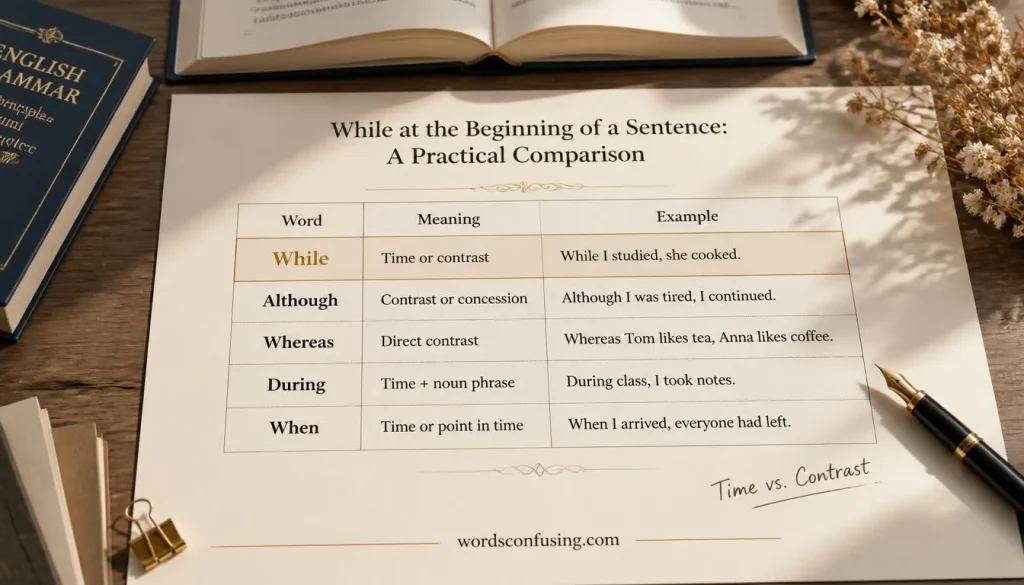
While at the Beginning of a Sentence: A Practical Comparison
The following table shows how related words behave differently.
| Word | Main function | Example |
| while | Time or contrast | While I studied, she cooked. |
| although | Contrast or concession | Although I was tired, I continued. |
| whereas | Direct contrast | Whereas Tom likes tea, Anna likes coffee. |
| during | Time + noun phrase | During class, I took notes. |
| when | Time or point in time | When I arrived, everyone had left. |
The differences may seem small, but they matter.
While can introduce an actual clause describing an overlapping period. During cannot perform the same grammatical function because it normally needs a noun or noun phrase after it.
Meanwhile, whereas specializes in contrast rather than time. Cambridge also notes that whereas and contrastive while can be interchangeable in some sentences, but not when while expresses time.
What About “Whilst”?
You may also encounter whilst, particularly in British English.
While and whilst can have the same conjunction meanings. Cambridge notes that while is much more common, while whilst can sound more formal.
For US English, while is the natural everyday choice.
For example:
While I was studying, my brother watched television.
There’s usually no reason to replace while with whilst in ordinary American writing.
Case Study: Fixing a “While” Sentence
Consider this sentence:
While the company was facing higher costs the manager decided to delay the expansion.
The basic idea works, but the punctuation needs attention.
A clearer version is:
While the company was facing higher costs, the manager decided to delay the expansion.
The comma separates the introductory dependent clause from the main clause.
Now consider a different issue:
While the company was facing higher costs, the office moved to a new building.
The grammar is acceptable, but the relationship feels weak. Why does the company’s financial situation relate to moving offices?
A stronger version might be:
While the company was facing higher costs, management postponed the office move.
Now the ideas connect logically.
This illustrates an important principle: correct grammar doesn’t automatically create clear writing.
The clauses should make sense together.
Quick Rules for Starting a Sentence With “While”
Keep these rules handy:
- Yes, you can start a sentence with “while.”
- Use while to introduce a dependent clause.
- Put a comma after an introductory while clause.
- Follow the dependent clause with a complete main clause.
- Use while for overlapping actions when you mean time.
- Use while for contrast when the context makes the comparison clear.
- Consider although when you mean concession.
- Consider whereas when you mean direct comparison.
- Don’t use during in place of while before a full clause.
- Avoid repetitive while openings across several sentences.
- Rewrite the sentence when while creates ambiguity.
- Don’t treat the sentence-initial position as a grammatical error.
FAQs
Can you start a sentence with “while”?
Yes. You can start a sentence with while when it introduces a dependent clause. For example, “While the meeting continued, I finished my notes.” This is standard English usage.
Is starting a sentence with “while” too informal?
No. Starting with while can work in both formal and informal writing. The important thing is to build the sentence clearly and use the correct punctuation.
What does “while” mean at the beginning of a sentence?
At the beginning of a sentence, while often shows that two actions happen at the same time. It can also introduce a contrast. The exact meaning depends on the surrounding context.
Should you put a comma after a sentence starting with “while”?
Usually, yes, when the while clause comes first. For example, “While I waited, I checked my email.” The comma separates the introductory dependent clause from the main clause.
Is “mean while” correct English?
No. Mean while is an incorrect spelling when you mean the adverb. The correct form is meanwhile, which means “at the same time” or “in the meantime.”
How can you quickly check a sentence beginning with “while”?
Read the sentence and identify the clause beginning with while. Make sure it connects naturally to an independent clause, then check the comma and overall meaning.
Conclusion
Starting a sentence with while isn’t a grammar mistake. What matters is how you connect the dependent clause to the main idea and whether the punctuation makes the relationship clear. Once you understand that pattern, there’s no need to avoid while simply because of an old classroom rule.
Also, keep an eye on meanwhile. It’s one word, not mean while. A quick proofreading check can catch that small error before it slips into your final draft. Good writing isn’t about avoiding ordinary words. It’s about using them clearly, naturally, and in the right context.

Franklin Hayes is a writer and editor at WordsConfusing.com, focused on making English vocabulary, grammar, and commonly confused words easy to understand. He writes clear, practical articles with simple explanations and useful examples to help readers improve their English with confidence.
His goal is simple: Making Confusing Words Simple.