For a clear guide to Wore or Worn: Meaning, Rules and Examples, learn how each verb form works in everyday English with simple, clear examples.
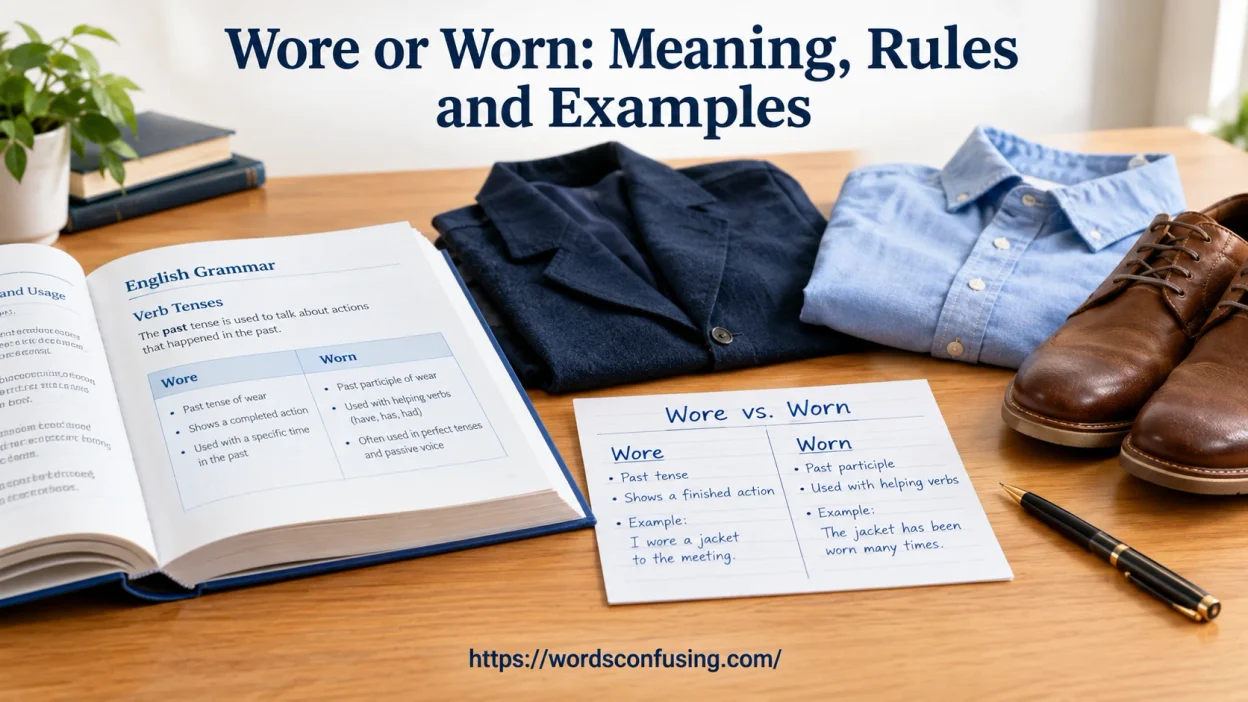
The verb wear has two important verb forms that often cause confusion: wore and worn. They come from the same verb, but each form has a different purpose. Wore is the simple past and simple past tense form, while worn is the past participle. The difference is easier to understand when you compare these two forms in real sentences.
For example, “I wore my coat yesterday” shows the past tense, while “I have worn this coat before” uses a helping verb. Common helping verbs include have, has, had, and be. This grammatical difference matters because choosing the wrong form can create an incorrect sentence, even when the meaning remains clear.
The word wear relates to putting something on your body, such as putting clothes, putting shoes, or putting glasses on. In everyday writing, these examples can help you remember this commonly misused irregular verb. The two words may look and sound similar, but they serve completely different purposes.
This guide helps explain the basic rule through easy examples, making a confusing choice easier when looking at the available forms. Once you know when to use each form, choosing between wore and worn becomes easier, and you can use both correctly. The rest of this article focuses on how each form works.
Quick Answer
If you’re deciding between wore or worn, look at the structure of the sentence first.
| Word | Verb Form | Main Use | Example |
| Wear | Base form | Present tense and infinitive structures | I wear glasses every day. |
| Wore | Simple past | A completed action in the past | I wore glasses yesterday. |
| Worn | Past participle | Perfect tenses and some passive constructions | I have worn glasses for years. |
| Wearing | Present participle | Continuous tenses and gerunds | I am wearing glasses now. |
Here’s the shortcut worth remembering:
Wore = simple past. Worn = past participle.
So, if you say “yesterday,” “last night,” “last week,” or another finished past time, wore will often be the right choice.
If you use has, have, or had, you generally need worn.
Quick Examples
Wore:
- She wore a red coat yesterday.
- We wore uniforms at school.
- He wore his favorite shoes to the party.
Worn:
- She has worn that coat before.
- We have worn these uniforms for years.
- He had worn those shoes many times.
The difference isn’t about meaning alone. It comes down to verb form and sentence structure.
What Does “Wore” Mean?
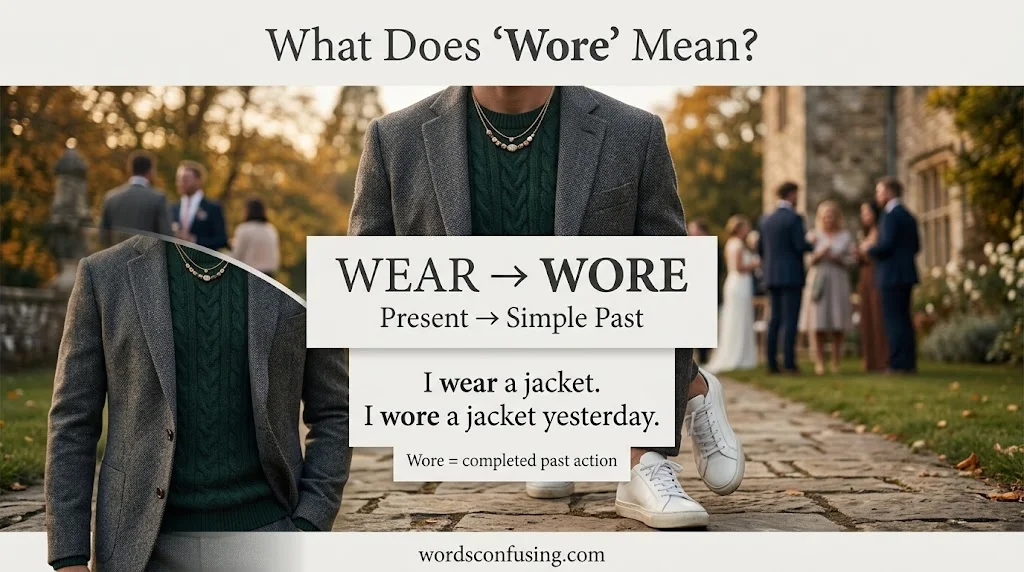
Wore is the simple past form of wear.
The verb wear describes having clothing, jewelry, accessories, or something similar on your body. It can also describe using something regularly until it becomes damaged or less effective.
When you move that action into the simple past, wear changes to wore.
Wore as the Simple Past of Wear
Consider these examples:
- I wear a jacket when it’s cold.
- I wore a jacket yesterday.
The present-tense sentence uses wear. The completed past action uses wore.
Here are more examples:
- Maria wore a black sweater to work.
- Daniel wore his new sneakers on Saturday.
- The students wore formal clothes for the ceremony.
- We wore matching shirts during the trip.
Each action happened in the past and is presented as a completed event.
When Should You Use “Wore”?
Use wore when you’re describing a finished action in the past.
Common time expressions include:
- yesterday
- last night
- last week
- last month
- last year
- two days ago
- during the ceremony
- at the party
- when I was younger
- on Monday
For example:
She wore a green dress to the wedding last Saturday.
The sentence clearly places the action in a completed past period.
Wore Doesn’t Need “Have,” “Has,” or “Had”
One useful clue separates wore from worn.
You can use wore directly after the subject:
- I wore a coat.
- She wore a necklace.
- They wore uniforms.
You don’t need an auxiliary verb.
That’s because wore already carries the simple past tense.
What Does “Worn” Mean?
Worn is the past participle of wear.
Unlike wore, you generally can’t use worn by itself to express a simple past action.
For example:
- ❌ I worn my new jacket yesterday.
- ✅ I wore my new jacket yesterday.
The second sentence works because wore is the simple past form.
The past participle worn usually appears with an auxiliary verb.
Worn With Have or Has
Use worn with have or has to form the present perfect.
Examples:
- I have worn these shoes before.
- She has worn that dress several times.
- He has worn glasses since childhood.
- They have worn matching uniforms this season.
The structure is:
Subject + have/has + worn
This structure often connects a past action with the present.
For instance:
I have worn this jacket many times.
The sentence doesn’t simply tell you about one finished event. It emphasizes experience or repetition up to the present.
Worn With Had
You also use worn with had to form the past perfect.
Examples:
- I had worn the shoes before the trip.
- She had worn the dress once before.
- They had worn their uniforms before the ceremony started.
The structure is:
Subject + had + worn
The past perfect helps show that one past action happened before another past event.
Consider this sentence:
She had worn the dress before she decided to buy it.
First, she wore the dress. Later, she decided to buy it.
The word had establishes that earlier timeline.
Wore vs. Worn: The Main Grammar Difference
The most important distinction is grammatical rather than semantic.
Both words come from wear, and both relate to clothing or having something on your body. However, they occupy different positions in English verb patterns.
The Four Main Forms of Wear
| Form | Verb | Example |
| Base form | wear | I wear glasses. |
| Simple past | wore | I wore glasses yesterday. |
| Past participle | worn | I have worn glasses for years. |
| Present participle | wearing | I am wearing glasses now. |
English learners often struggle with wore and worn because wear is an irregular verb.
Regular verbs usually form the past tense and past participle with -ed. For example:
- walk → walked → walked
- work → worked → worked
- clean → cleaned → cleaned
But wear doesn’t follow that pattern:
- wear → wore → worn
That’s why memorizing its three principal forms helps.
When to Use Wore Instead of Worn
Use Wore for a Completed Past Action
When an action happened and finished in the past, wore is usually appropriate.
Examples:
- I wore a suit to the interview.
- She wore boots during the hike.
- He wore a hat yesterday.
- We wore formal clothes to dinner.
You can often add a finished time expression without changing the structure:
I wore my new shoes last Friday.
The word last Friday makes the completed past time especially clear.
Use Wore After a Subject in Simple Past Sentences
A common pattern is:
Subject + wore + object
Examples:
- Sarah wore a jacket.
- The actor wore a costume.
- The children wore matching shirts.
- My brother wore his school uniform.
Here, wore directly carries the past-tense meaning.
Important Point: Questions Use “Wear” After Did
Here’s a mistake that catches many learners:
- ❌ Did you wore that shirt?
- ✅ Did you wear that shirt?
Why?
The auxiliary did already marks the sentence as past tense. Therefore, the main verb returns to its base form.
The pattern is:
Did + subject + wear…?
Examples:
- Did you wear your new shoes?
- Did she wear a jacket?
- Did they wear uniforms?
The same rule applies to negative sentences:
- I didn’t wear a coat.
- She didn’t wear makeup.
- They didn’t wear formal clothes.
Not:
- ❌ I didn’t wore a coat.
When to Use Worn Instead of Wore
Use Worn With Have or Has
The present perfect uses have/has + past participle.
Since worn is the past participle of wear, these sentences are correct:
- I have worn this shirt before.
- She has worn that necklace several times.
- He has worn the same style for years.
- We have worn these shoes on many occasions.
The key isn’t the clothing item. It’s the auxiliary verb.
Use Worn With Had
The past perfect uses had + past participle.
Therefore:
- I had worn the jacket before.
- She had worn the shoes earlier.
- They had worn their uniforms before the match.
A useful formula is:
had + worn
Never:
had + wore
So:
- ❌ I had wore the jacket.
- ✅ I had worn the jacket.
Worn in Passive Constructions
Worn can also appear in passive constructions.
For example:
The costume was worn by the lead actor.
Here, the subject receives the action rather than performing it.
More examples include:
- The medals were worn during the ceremony.
- The traditional clothing was worn by the performers.
- The uniform was worn by every student.
The structure can be:
Subject + was/were + worn
This is different from the perfect-tense structure:
Subject + has/have/had + worn
Both structures use worn, but they perform different grammatical jobs.
Wore vs. Worn in Different Tenses
Understanding the entire verb family makes the distinction much easier.
| Tense or Structure | Correct Form | Example |
| Simple present | wear | I wear glasses daily. |
| Simple past | wore | I wore glasses yesterday. |
| Present perfect | have/has worn | I have worn glasses for years. |
| Past perfect | had worn | I had worn them before. |
| Present continuous | am/is/are wearing | She is wearing glasses. |
| Past continuous | was/were wearing | She was wearing glasses. |
| Future | will wear | She will wear glasses tomorrow. |
| Infinitive | to wear | I want to wear this jacket. |
This table reveals an important pattern.
Wore belongs specifically to the simple past. Worn functions as a past participle. Meanwhile, wear appears in several other structures.
Read more: “First Pass” Meaning and Usage with Real Examples
Common Mistakes With Wore and Worn
Even fluent speakers sometimes make mistakes when they move quickly between verb forms. These errors become easier to avoid once you identify the auxiliary verb.
“I Have Wore” vs. “I Have Worn”
Incorrect:
I have wore this shirt before.
Correct:
I have worn this shirt before.
Why? Have requires the past participle.
The correct sequence is:
have + worn
Not:
have + wore
“I Worn It Yesterday” vs. “I Wore It Yesterday”
Incorrect:
I worn it yesterday.
Correct:
I wore it yesterday.
The phrase yesterday describes a completed past event. No auxiliary verb appears before the main verb, so you need the simple past wore.
“She Has Wore” vs. “She Has Worn”
Incorrect:
She has wore that dress several times.
Correct:
She has worn that dress several times.
Again, has requires the past participle worn.
“They Had Wore” vs. “They Had Worn”
Incorrect:
They had wore their uniforms before the game.
Correct:
They had worn their uniforms before the game.
The auxiliary had signals the past perfect. Therefore, use the past participle worn.
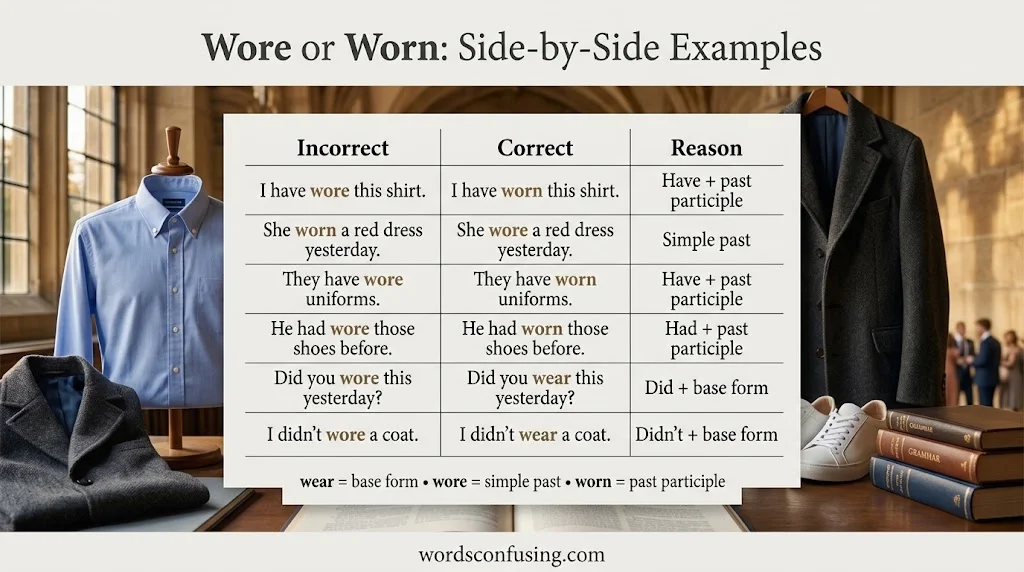
Wore or Worn: Side-by-Side Examples
A comparison table can make the distinction almost automatic.
| Incorrect | Correct | Reason |
| I have wore this shirt. | I have worn this shirt. | “Have” takes the past participle. |
| She worn a red dress yesterday. | She wore a red dress yesterday. | Simple past requires “wore.” |
| They have wore uniforms. | They have worn uniforms. | “Have” takes “worn.” |
| He had wore those shoes before. | He had worn those shoes before. | “Had” takes the past participle. |
| Did you wore this yesterday? | Did you wear this yesterday? | “Did” takes the base form. |
| I didn’t wore a coat. | I didn’t wear a coat. | “Didn’t” takes the base form. |
The last two examples introduce an important third form: wear.
That’s why learning only wore vs. worn isn’t enough. You also need to understand how wear behaves after auxiliaries such as did and will.
Wore or Worn in Questions
Questions often expose mistakes because English uses auxiliary verbs heavily.
Questions With Wore
A direct simple-past question usually uses did + wear, not did + wore.
Correct:
- Did you wear the jacket?
- Did she wear the dress?
- Did they wear uniforms?
- When did he wear that suit?
Incorrect:
- ❌ Did you wore the jacket?
- ❌ Did she wore the dress?
The reason is straightforward. Did carries the past tense.
Questions With Worn
When a question uses have, has, or had, use worn.
Examples:
- Have you worn this before?
- Has she worn that dress?
- Have they worn uniforms before?
- Had he worn the shoes previously?
The structure tells you which form belongs there.
Wore or Worn in Negative Sentences
Negative sentences follow the same auxiliary rules.
1. For simple past negatives, use didn’t + wear:
- I didn’t wear a jacket.
- She didn’t wear makeup.
- We didn’t wear uniforms.
- They didn’t wear formal clothes.
2. For present perfect negatives, use haven’t/hasn’t + worn:
- I haven’t worn those shoes.
- She hasn’t worn the dress yet.
- They haven’t worn their new uniforms.
3. For past perfect negatives, use hadn’t + worn:
- I hadn’t worn the shoes before.
- She hadn’t worn that style previously.
- They hadn’t worn uniforms before the event.
The auxiliary determines the grammatical form.
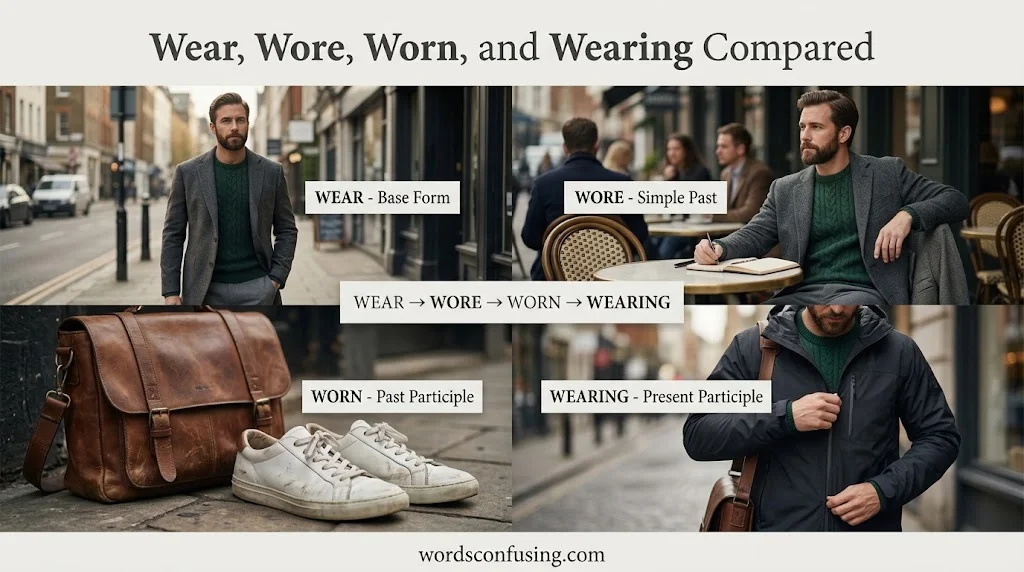
Wear, Wore, Worn, and Wearing Compared
Learning the complete set makes English verb patterns far less confusing.
Wear
Wear is the base form.
Examples:
- I wear glasses every day.
- They wear uniforms at school.
- You should wear comfortable shoes.
It also follows modal verbs and auxiliary did:
- You should wear a coat.
- Did she wear the necklace?
- I didn’t wear a hat.
Wore
Wore is the simple past.
Examples:
- I wore a coat yesterday.
- She wore a blue dress.
- They wore matching shirts.
Worn
Worn is the past participle.
Examples:
- I have worn this jacket before.
- She has worn that necklace many times.
- They had worn their uniforms earlier.
Wearing
Wearing is the present participle and gerund form.
Examples:
- I am wearing a jacket.
- She was wearing a red dress.
- Wearing comfortable shoes can make a long walk easier.
A Simple Memory Trick for Wore vs. Worn
If you need a quick rule, remember this:
Wore = did it. Worn = has, have, or had done it.
For example:
- I wore it yesterday.
- I have worn it before.
- I had worn it before the event.
There’s another useful trick.
Look for the Auxiliary Verb
If you see:
- has
- have
- had
then worn is usually the form you need.
If the sentence simply describes a completed past action, wore may be correct.
If you see did, however, use wear, not wore.
This gives you a three-part shortcut:
| Signal | Correct Verb |
| Simple past | wore |
| Has/have/had | worn |
| Did/didn’t | wear |
It’s not a substitute for understanding grammar, but it’s a handy editing test.
Wore or Worn in Everyday English
These verbs appear constantly in ordinary conversation.
Clothing
- I wore a sweater yesterday.
- I have worn this sweater before.
Shoes
- She wore new boots to work.
- She has worn those boots all winter.
Accessories
- He wore a watch to the meeting.
- He has worn that watch for years.
Uniforms
- The students wore uniforms yesterday.
- The students have worn uniforms throughout the semester.
Costumes
- The actor wore a historical costume.
- The actor had worn the costume during rehearsals.
Protective Equipment
The verb wear isn’t limited to fashion. It also applies to protective items.
- He wore a helmet during the ride.
- She has worn protective gloves at work.
- They wore safety equipment during the experiment.
The grammar stays exactly the same.
Wore Can Also Describe Damage From Use
The verb wear has another important meaning: gradual deterioration caused by continued use.
For example:
The constant friction wore down the fabric.
Here, wore doesn’t mean that someone put clothing on their body. It means something gradually caused deterioration.
The same verb can appear in several expressions:
- wear out = become unusable through continued use
- wear down = gradually weaken
- wear away = gradually remove or erode
- wear off = gradually disappear
Examples:
- The soles wore out after years of use.
- Repeated stress wore him down.
- Water wore away the stone.
- The effect eventually wore off.
The past participle remains worn:
- The shoes are worn out.
- The fabric has worn away.
- The surface had worn down over time.
This broader meaning explains why wear, wore, and worn appear in many contexts beyond clothing.
Read more: Stole or Stolen: Grammar and Examples
A Practical Case Study: Choosing Wore or Worn
Imagine you’re describing a weekend trip.
You might say:
I wore a gray jacket on Saturday.
That’s simple past because you’re describing one completed event.
Now suppose you want to discuss your experience with the jacket:
I have worn that jacket on several trips.
That’s present perfect because you’re connecting past experience to the present.
Then you mention something that happened before another past event:
I had worn the jacket several times before the trip.
That’s past perfect.
The clothing hasn’t changed. The time relationship and sentence structure have changed.
That’s the heart of the distinction.
Practice: Wore or Worn?
Choose the correct form in each sentence.
- I ___ my new shoes yesterday.
- She has ___ that dress before.
- They had ___ their uniforms before the ceremony.
- He ___ a blue shirt last Friday.
- Have you ever ___ a tuxedo?
- We ___ matching jackets at the event.
- I haven’t ___ those boots yet.
- Did she ___ the red coat?
- He didn’t ___ his glasses yesterday.
- She had ___ the necklace several times before.
Answer Key
- wore
- worn
- worn
- wore
- worn
- wore
- worn
- wear
- wear
- worn
Why These Answers Work
The first, fourth, and sixth sentences describe completed past actions without a perfect-tense auxiliary. Therefore, they use wore.
Sentences containing has, have, or had use worn because those auxiliaries form perfect constructions.
The questions with did use the base form wear. That’s an especially common point of confusion.
FAQs
What is the difference between wore and worn?
Wore is the simple past form of wear. Worn is the past participle and usually appears with a helping verb such as has, have, or had. For example, “She wore a blue dress yesterday,” but “She has worn that dress before.”
Is wore the past tense of wear?
Yes. Wore is the simple past tense of wear. You use it when talking about something that happened in the past. For example, “I wore my favorite shoes to the party.”
Is worn a past tense word?
Worn is not the simple past form. It is the past participle of wear. It normally works with helping verbs, as in “He has worn this jacket many times.”
Can I say “I have wore”?
No. The correct form is “I have worn.” After have, has, or had, you need the past participle worn, not the simple past wore.
What is an easy way to remember wore and worn?
Think of wore as a completed past action: “I wore it yesterday.” Think of worn as a form that needs help: “I have worn it before.” This simple pattern makes the difference easier to remember.
Which is correct: “She wore a dress” or “She worn a dress”?
“She wore a dress” is correct when describing a completed past action. You can use worn with a helping verb instead: “She has worn a dress like that before.”
Conclusion
Choosing between wore and worn gets much easier once you stop treating them as interchangeable. Remember one simple rule: wore describes something that happened in the past, while worn usually works with a helping verb such as have, has, or had. If you’re talking about what you put on yesterday, use wore.
If you’re describing something you have experienced or completed, worn is usually the right choice. A few everyday examples will make this irregular verb feel natural, and before long, you’ll choose the correct form without having to think twice.