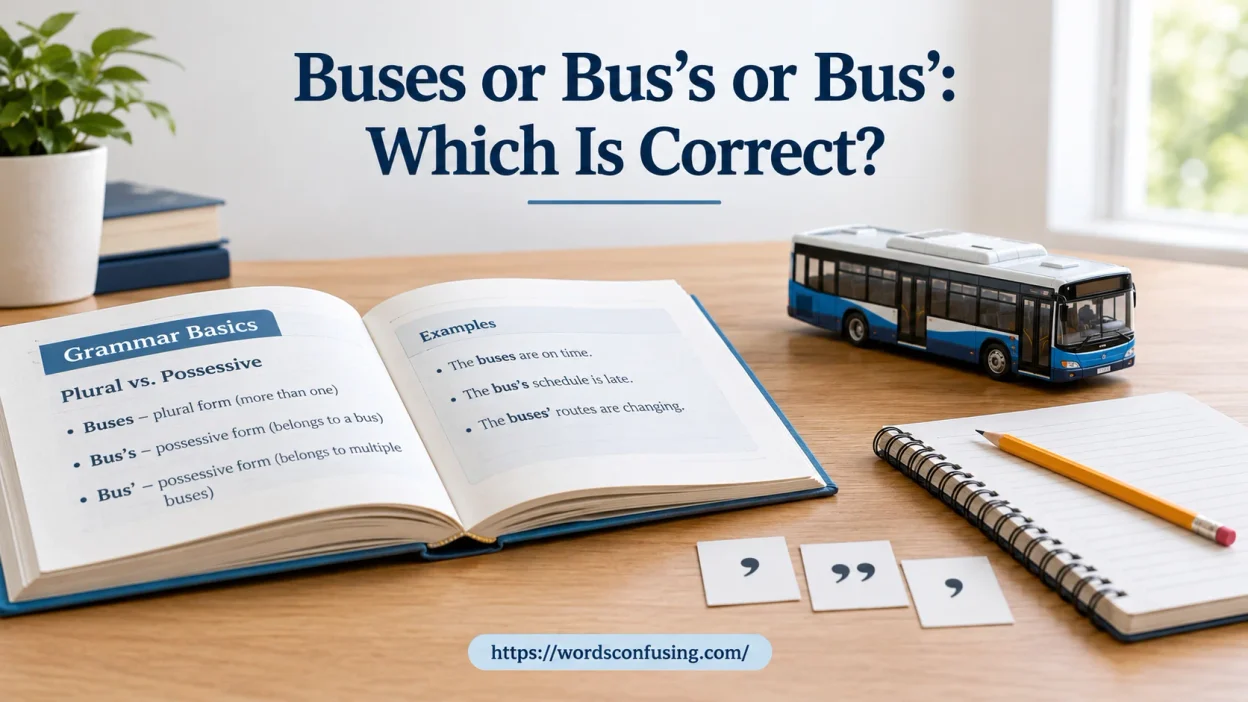
If you’re asking Buses or Bus’s or Bus’: Which Is Correct?, the key is knowing the difference between busses and buses in modern English spelling and usage.
Buses is the correct plural of bus, while busses has a different meaning as a less common verb form. These words can look almost the same and confuse both English learners and native speakers, making this grammar question especially tricky when typing.
Learning the spelling rules, irregular forms, word forms, and meanings helps you remember the right word and confidently choose the correct spelling for each situation.
In formal writing, professional emails, academic work, and business communication, accuracy, consistency, clear writing, and readability become important. Buses, Bus’s, Bus’, and busses are not interchangeable because each form serves a different purpose.
Buses works as the plural, while Bus’s and Bus’ concern possessive form, possessive nouns, and possessive forms. A bus company’s scheduling system, calendar, or online booking details may need a possessive form.
Meanwhile, reports, project management documents, presentations, everyday correspondence, meetings, broadcasting, time management, and workplace communication all benefit from accurate punctuation.
This guide uses practical examples, relevant grammar rules, and modern style preferences to explain the correct form, proper punctuation, and intended usage in real-world contexts.
From my experience, checking the intended meaning first makes the choice much easier, while Midoo AI can help clarify when to use each form and how to remember the distinction.
Quick Answer
Buses is the plural of bus. Use it when you mean two or more buses.
Bus’s is the singular possessive form. Use it when something belongs to one bus.
Buses’ is the plural possessive form. Use it when something belongs to multiple buses.
Bus’ is generally not the preferred form in standard American English. For singular possession, bus’s is the clearer choice.
Examples:
- Buses: Three buses arrived late.
- Bus’s: The bus’s engine broke down.
- Buses’: The buses’ engines were inspected.
Easy rule:
buses = plural | bus’s = one bus’s possession | buses’ = multiple buses’ possession
Buses: The Correct Plural Form of Bus
Buses is the standard plural form of bus. Use it whenever you mean two or more buses without expressing possession.
For example:
- One bus is waiting outside.
- Two buses are waiting outside.
- The school operates five buses.
- Several buses arrived at the station.
- The city added more buses to the route.
Notice that none of these sentences expresses ownership. They simply identify multiple vehicles.
That’s why an apostrophe doesn’t belong in buses.
Why Is the Plural of Bus “Buses”?
The word bus ends in s, so its plural normally takes -es rather than simply adding another s.
The basic pattern looks like this:
bus → buses
This follows a familiar English spelling pattern. Many nouns ending in certain sibilant sounds form their plurals with -es.
Consider these examples:
| Singular | Plural |
| bus | buses |
| class | classes |
| glass | glasses |
| dress | dresses |
| box | boxes |
| dish | dishes |
| church | churches |
The extra e helps form the conventional plural spelling and pronunciation.
Therefore, writing bus’s when you mean several buses creates a grammatical error. The apostrophe doesn’t create a plural noun in ordinary English.
“Buses” Does Not Need an Apostrophe
Apostrophes have specific jobs. One major job involves showing possession.
They don’t normally indicate that a noun is plural.
For example:
Correct: The buses are late.
Incorrect: The bus’s are late.
The second version suggests a possessive construction rather than a simple plural. It also leaves the reader wondering what the bus possesses.
A useful test is simple: Can you replace the word with “more than one bus”?
If yes, use buses.
Three buses stopped outside the school.
Here, buses simply means three individual vehicles. Nothing belongs to them in the sentence.

Bus’s: The Singular Possessive Form
Bus’s is the standard singular possessive form in American English.
Use it when one bus possesses, contains, has, or is associated with something.
For example:
- The bus’s engine needs repair.
- The bus’s driver checked the mirrors.
- The bus’s door wouldn’t close.
- The bus’s route changed this morning.
- The bus’s tires need replacement.
In each sentence, the sentence discusses one particular bus.
The apostrophe followed by s signals possession.
How “Bus’s” Shows Possession
Consider this sentence:
The bus’s engine stopped suddenly.
The phrase bus’s engine means the engine of the bus.
You can use this substitution test whenever you’re unsure:
the bus’s engine = the engine of the bus
The same principle works in other examples:
- the bus’s door = the door of the bus
- the bus’s route = the route of the bus
- the bus’s driver = the driver assigned to the bus
- the bus’s schedule = the schedule associated with the bus
This makes the grammatical function much easier to see.
Why “Bus’s” Has Two S’s
Some writers hesitate over bus’s because the word already ends in s.
However, that spelling follows the common American English rule for singular possessives. A singular noun generally forms its possessive with ’s, even when the noun already ends in s.
So:
bus + ’s = bus’s
This pattern isn’t limited to the word bus.
Examples include:
- class’s schedule
- glass’s edge
- dress’s color
- boss’s office
- address’s location
The result may look visually crowded, but the grammar remains straightforward.
When to Use Bus’s
Use bus’s when a single bus is the source of the possession or relationship.
For instance:
The bus’s brakes need inspection.
The sentence refers to one bus and its brakes.
Now compare it with:
The buses’ brakes need inspection.
That sentence refers to multiple buses and their brakes.
The difference is only one apostrophe position, yet the meaning changes significantly.
More Examples of “Bus’s”
Here are several practical examples:
- The bus’s headlights were still on.
- The bus’s windows were covered with advertisements.
- The bus’s interior looked newly renovated.
- The bus’s battery had lost its charge.
- The bus’s destination sign wasn’t working.
- The bus’s emergency door remained locked.
- The bus’s route passes through downtown.
- The bus’s maintenance record was updated.
In every example, bus’s refers to one bus.
Buses’: The Plural Possessive Form
When multiple buses possess something, use buses’.
This form can look confusing because the word already ends in s. Yet the formation follows a predictable sequence:
bus → buses → buses’
First, make the noun plural.
Then, add the apostrophe to show possession.
For example:
The buses’ engines were inspected.
The phrase means:
The engines of the buses were inspected.
Because the sentence refers to multiple buses, the possessive apostrophe comes after the plural s.
Examples of “Buses’”
Consider these sentences:
- The buses’ engines require regular maintenance.
- The buses’ routes changed after construction began.
- The buses’ doors were locked overnight.
- The buses’ drivers attended a safety meeting.
- The buses’ schedules were posted online.
- The buses’ tires were replaced last week.
- The buses’ interiors need cleaning.
- The buses’ headlights were inspected.
Each example discusses something associated with more than one bus.
The Formation Is Easy to Remember
Think of the process as three steps:
One bus: bus
Several buses: buses
Something belonging to several buses: buses’
That simple progression prevents most mistakes.
Buses vs. Bus’s vs. Buses’: The Main Difference
The easiest way to understand buses or bus’s or bus’ is to ask two questions.
First: Are you talking about one bus or multiple buses?
Second: Are you showing possession?
Those two questions determine the correct form.
| What you mean | Correct form | Example |
| One bus | bus | The bus arrived. |
| Multiple buses | buses | The buses arrived. |
| One bus + possession | bus’s | The bus’s engine failed. |
| Multiple buses + possession | buses’ | The buses’ engines failed. |
This approach is more reliable than trying to memorize isolated examples.
Bus’: Is “Bus’” Correct?
Bus’ is where many grammar discussions become complicated.
In standard American English, bus’s is generally the clearest and preferred form when one bus possesses something.
For example:
The bus’s engine needs repair.
This construction follows the regular singular possessive pattern.
You may occasionally encounter bus’ in published material, especially under particular editorial or style conventions. Some style systems make different choices about singular nouns ending in s. However, that variation doesn’t make bus’ the safest default for general American English writing.
For everyday writing, academic work, websites, business communication, and most general-purpose content, bus’s is the clearer choice for singular possession.
Why “Bus’” Causes Confusion
The problem with bus’ is that it visually resembles the plural possessive pattern.
Compare:
- bus’s = possession by one bus
- buses’ = possession by multiple buses
- bus’ = less common singular possessive variant
The first two forms create a clear grammatical distinction.
That’s why bus’s usually works better when you want readers to understand the meaning immediately.
Read more: Starting a Sentence With “During” Comma Rules Explained
Common Mistakes With Buses, Bus’s, and Buses’
Apostrophes create small marks with surprisingly large consequences. A misplaced apostrophe can change the grammatical meaning of an entire phrase.
Mistake: Using “Bus’s” as a Plural
Incorrect:
Five bus’s arrived at the station.
Correct:
Five buses arrived at the station.
The sentence simply refers to five vehicles. No possession exists.
Mistake: Writing “Buses” for Possession
Incorrect:
The buses engine was damaged.
Correct:
The bus’s engine was damaged.
The corrected sentence refers to the engine belonging to one bus.
Mistake: Using “Bus’” for Standard Singular Possession
Less preferred:
The bus’ driver opened the door.
Standard American English:
The bus’s driver opened the door.
The second version makes the singular possessive relationship explicit.
Mistake: Confusing “Buses’” With “Buses”
Compare these sentences:
The buses arrived early.
The buses’ drivers arrived early.
The first sentence simply identifies multiple buses.
The second sentence identifies the drivers associated with those buses.
That apostrophe changes the grammatical role of the word.
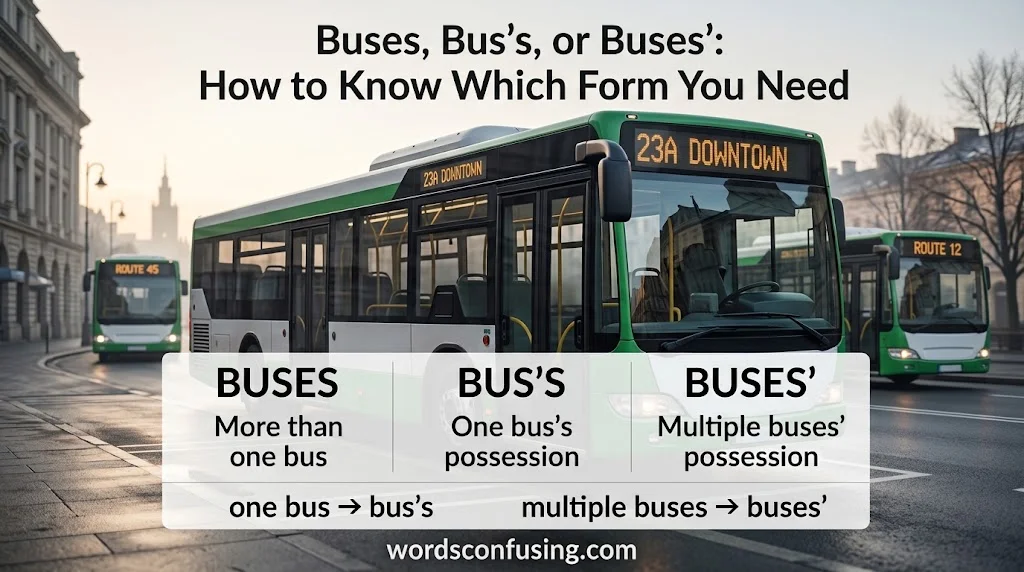
How to Know Which Form You Need
When you’re stuck between buses, bus’s, and buses’, don’t stare at the apostrophe. Start with the meaning.
Use “Buses” for More Than One Bus
Choose buses when you’re simply talking about multiple vehicles.
Examples:
- The buses arrived.
- Several buses were parked outside.
- The company purchased three buses.
- School buses leave at 3 p.m.
There is no possessive relationship.
Use “Bus’s” for One Bus’s Possession
Choose bus’s when one bus has or is associated with something.
Examples:
- The bus’s engine is loud.
- The bus’s route changed.
- The bus’s driver is waiting.
- The bus’s windshield cracked.
One bus. One possessive relationship.
Use “Buses’” for Multiple Buses’ Possession
Choose buses’ when several buses possess or are associated with something.
Examples:
- The buses’ engines were inspected.
- The buses’ routes overlap.
- The buses’ drivers attended training.
- The buses’ doors were repaired.
Multiple buses. Possessive relationship.
A Simple Decision Tree for Buses or Bus’s or Bus’
You can reduce the entire issue to a short decision process:
Are you talking about more than one bus?
- Yes. Use buses if there’s no possession.
- Yes. Use buses’ if you’re showing possession.
Are you talking about one bus?
- Yes. Use bus if there’s no possession.
- Yes. Use bus’s if you’re showing possession.
This produces four basic forms:
| Number | Possession? | Form |
| One | No | bus |
| More than one | No | buses |
| One | Yes | bus’s |
| More than one | Yes | buses’ |
That’s the entire grammatical system in one table.
Buses or Bus’s in Real-World Sentences
Context often makes the difference easier to see.
Imagine a school has three buses.
You could write:
Three buses are waiting outside.
Here, buses simply means three vehicles.
Now suppose you’re discussing one vehicle:
The bus’s engine is overheating.
The possessive form identifies the engine belonging to that particular bus.
Now consider all three vehicles:
The buses’ engines need inspection.
The possessive form now applies to multiple buses.
A School Transportation Example
Imagine a school operates ten buses.
The principal might say:
The buses leave at 3:15 p.m.
This sentence describes the vehicles.
A mechanic might say:
The bus’s engine needs a new belt.
This sentence describes one specific vehicle.
A fleet manager might say:
The buses’ maintenance records are up to date.
This sentence describes records associated with several vehicles.
The grammatical difference follows the meaning naturally.
Buses or Bus’s in Public Transportation
The same distinction appears in public transit writing.
Consider:
Several buses stopped at the station.
Nothing belongs to the buses in that sentence.
Now:
The bus’s destination display was broken.
Only one bus has the defective display.
Finally:
The buses’ destination displays were updated.
Multiple buses have displays that were updated.
The pattern remains consistent regardless of the subject.
Buses or Bus’s in Workplace Writing
Professional writing benefits from precise apostrophe use because small errors can distract readers.
For example:
The bus’s maintenance report was filed.
This means one bus has a maintenance report.
However:
The buses’ maintenance reports were filed.
This refers to multiple buses and multiple reports.
The difference becomes especially important in fleet management, transportation reports, maintenance records, invoices, and operational documents.
A single apostrophe can tell readers whether you’re discussing one asset or an entire fleet.
Buses or Bus’s in Academic Writing
Academic writing should favor the standard grammatical form that readers can understand quickly.
Use buses for the plural:
The study examined passenger behavior on urban buses.
Use bus’s for singular possession:
The bus’s capacity affected passenger flow.
Use buses’ for plural possession:
The buses’ capacities varied by model.
This distinction keeps technical writing precise without making the prose unnecessarily complicated.
Read more: 8 Words for Someone Who Follows the Rules
Why Apostrophes Matter
An apostrophe isn’t decorative punctuation. It often signals a grammatical relationship.
Compare:
The buses stopped.
and:
The buses’ stops were recorded.
In the first sentence, buses is simply plural.
In the second sentence, buses’ functions as a plural possessive modifier.
Now compare:
The bus stopped.
with:
The bus’s stop was crowded.
Again, the apostrophe changes the grammatical function.
This is why apostrophes deserve attention even when the difference looks tiny.
Singular and Plural Possessives With Similar Words
The same pattern appears with other nouns ending in s.
Consider class:
- one class → class
- multiple classes → classes
- one class possessing something → class’s
- multiple classes possessing something → classes’
For example:
The class’s teacher arrived early.
The classes’ teachers attended the meeting.
The same structure applies to bus.
More Examples
| Singular | Plural | Singular possessive | Plural possessive |
| bus | buses | bus’s | buses’ |
| class | classes | class’s | classes’ |
| dress | dresses | dress’s | dresses’ |
| glass | glasses | glass’s | glasses’ |
| boss | bosses | boss’s | bosses’ |
The exact pronunciation can vary across words. The grammatical pattern remains useful.
A Quick Comparison: Bus’s vs. Buses’
These two forms cause more confusion than buses itself.
Remember this shortcut:
bus’s = one
buses’ = more than one
Compare:
The bus’s driver opened the door.
One bus has one driver in the sentence.
The buses’ drivers opened the doors.
Multiple buses have multiple drivers in the sentence.
Another example:
The bus’s windows were dirty.
One bus has dirty windows.
The buses’ windows were dirty.
Multiple buses have dirty windows.
The location of the apostrophe tells you whether the noun is singular or plural.
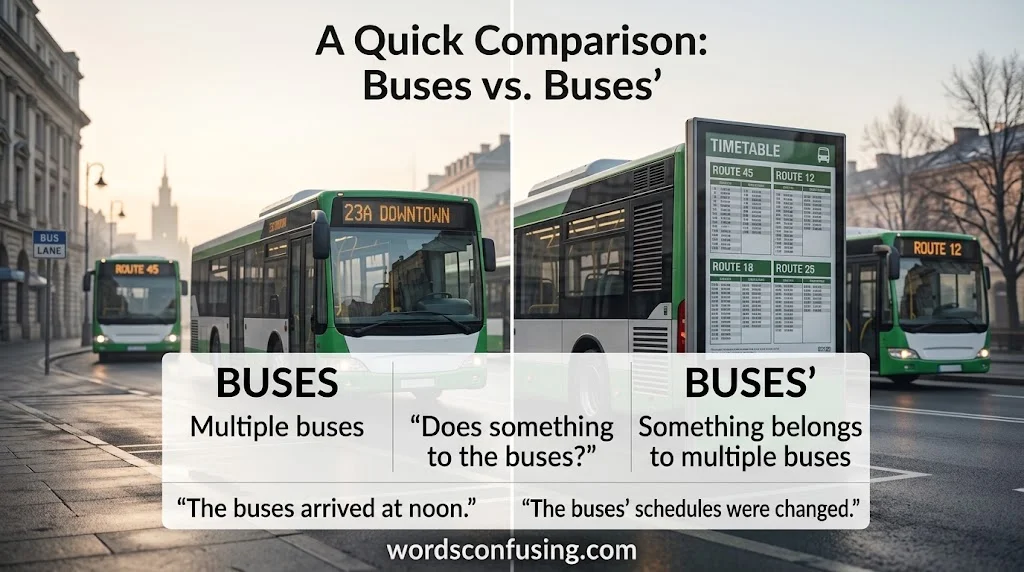
A Quick Comparison: Buses vs. Buses’
These forms look almost identical, but the apostrophe changes the function.
Buses means multiple buses.
Buses’ means something belongs to multiple buses.
Compare:
The buses arrived at noon.
The buses’ schedules were changed.
In the first sentence, buses acts as a noun.
In the second, buses’ modifies schedules and shows possession.
A useful question is:
“Does something belong to the buses?”
If the answer is yes, you may need buses’.
FAQs
Is “buses” the correct plural of “bus”?
Yes. Buses is the standard plural form of bus. For example, you could write, “Several buses stopped outside the school.” The spelling busses exists, but it’s much less common and usually has a different grammatical use.
Is “bus’s” grammatically correct?
Yes. Bus’s can show possession when something belongs to or relates to one bus. For example, “The bus’s door was damaged.” It follows the common rule of adding ’s to a singular noun.
Is “bus’” ever correct?
Yes, but it’s uncommon in standard modern usage. Some style guides allow a singular proper noun or certain names ending in s to take only an apostrophe, but bus’s is generally clearer for the singular noun bus.
What is the difference between “buses” and “busses”?
Buses usually means more than one bus. Busses can be the third-person singular form of the verb bus, meaning to transport someone by bus, though this form is relatively uncommon. Choosing the right spelling depends on what you mean.
Why does “buses” have only one “s” after the “u”?
The standard plural spelling adds -es to bus, producing buses. This keeps the pronunciation and spelling clear. Writing busses can suggest a different word or verb form.
How can I remember whether to use “buses” or “busses”?
A simple trick is to remember that buses means multiple vehicles. If you’re talking about two, three, or twenty buses, use buses. Think of busses as a less common verb form rather than the normal plural.
Conclusion
Choosing between buses, bus’s, bus’, and busses becomes much easier once you focus on meaning instead of appearance. Use buses when you mean more than one vehicle, while bus’s generally shows that something belongs to one bus. Bus’ may appear under certain style preferences, but it isn’t the usual choice for the singular noun bus. Busses has a separate, less common use and shouldn’t replace the standard plural buses.
The best habit is simple: pause for a second and ask what you’re trying to say. That small check can prevent awkward spelling and punctuation mistakes, especially in professional emails, academic work, reports, and other formal writing. Once the distinction becomes familiar, choosing the right form feels almost automatic.

Franklin Hayes is a writer and editor at WordsConfusing.com, focused on making English vocabulary, grammar, and commonly confused words easy to understand. He writes clear, practical articles with simple explanations and useful examples to help readers improve their English with confidence.
His goal is simple: Making Confusing Words Simple.