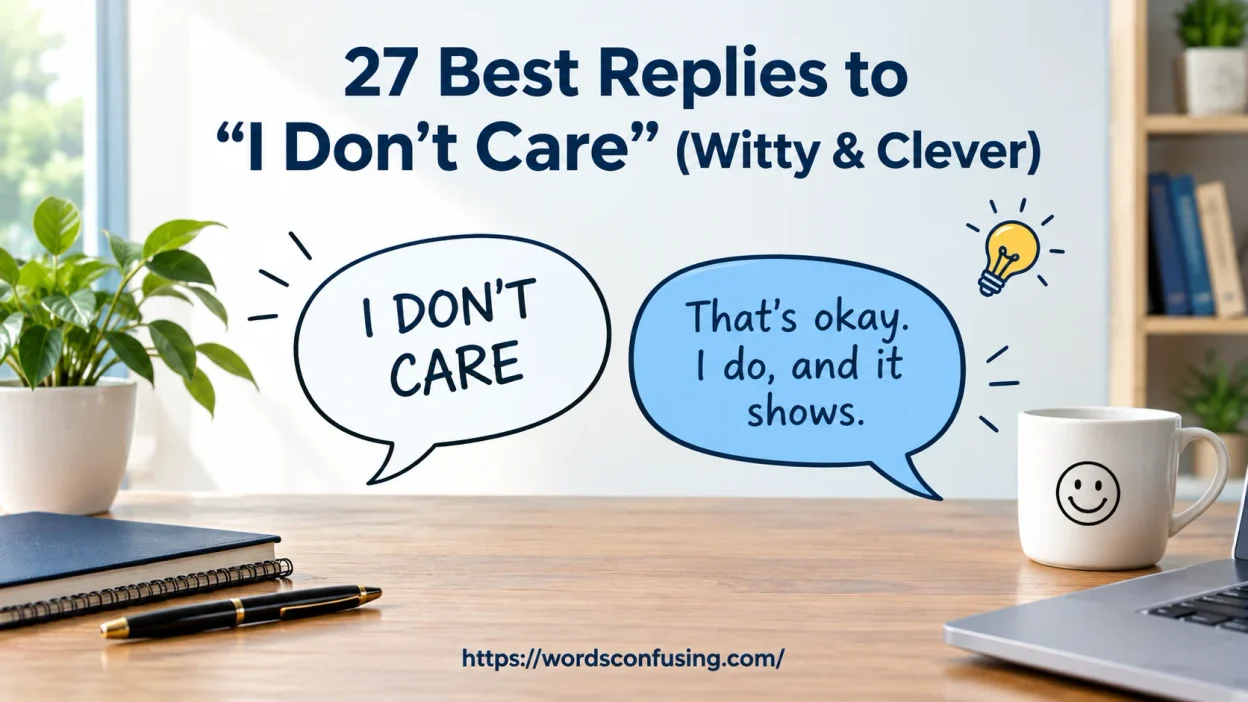
When choosing 27 Best Replies to “I Don’t Care” for Witty & Clever Responses, use a response that protects your confidence, matches the situation, and keeps you calm.
Hearing “I don’t care” during an argument can feel frustrating, but the best response doesn’t need to be harsh. You can avoid a fight, hide your real emotions, and respond with emotional maturity. Understanding the reason behind the phrase helps you recognize what it really means.
A funny comeback may suit friends, while a calm, polite, or respectful reply works better with family or coworkers. Your goal isn’t always to win the conversation. Instead, focus on communication, respect, and choosing a reply that can turn the conversation around.
The right response also depends on the context, tone, relationship, and personality involved. Sometimes, people say they don’t care about something because they struggle to express themselves.
In texting, apps, and social media, witty, clever, charming, or funny replies can create a better reaction. A playful reply may help you flirt back, play it cool, or remain mysterious.
Whether you need humor, a joke, a roast, reassurance, or a professional response, knowing what to say when someone tells you they don’t care can help you handle the entire conversation and change its direction.
Quick Answer
The best reply to “I don’t care” depends on the mood and situation. For a playful comeback, try “And yet, here we are talking about it.” If you want something witty, say “That’s quite the passionate way to say you don’t care.” During a serious conversation, keep things calm with “That’s fine. You don’t have to care.” The goal isn’t to have the last word. Choose a response that fits the moment without turning a simple comment into a bigger argument.
What Does “I Don’t Care” Mean?
“I don’t care” literally expresses indifference. The speaker is saying that something doesn’t matter to them or doesn’t deserve their attention.
However, everyday conversation isn’t always that straightforward.
The same three words can carry completely different meanings depending on someone’s tone, facial expression, relationship with you, and the situation.
For example, imagine a friend says:
“I don’t care which restaurant we choose.”
That probably means they genuinely have no preference.
Now imagine someone says:
“I don’t care what you think.”
That version sounds much more dismissive. The speaker may be annoyed or trying to end the conversation.
Here are some common meanings behind the phrase:
| What they may mean | What it sounds like |
| Genuine indifference | “Either option works for me.” |
| Annoyance | “I’m tired of discussing this.” |
| Sarcasm | “I actually care more than I’m admitting.” |
| Defensiveness | “I don’t want to discuss my feelings.” |
| Dismissal | “Your opinion doesn’t matter to me.” |
| Conversation-ending | “Let’s stop talking about this.” |
| Playful teasing | “I’m pretending not to care.” |
Context is everything.
Before firing back with a clever comeback, listen to the tone. A playful “I don’t care” deserves a different response than one delivered during a serious argument.
27 Best Replies to “I Don’t Care”
The best response doesn’t always have to be the harshest one. Sometimes a tiny dose of humor lands better than a verbal sledgehammer.
Below are 27 replies to “I don’t care” organized by tone. Pick one that matches the moment instead of forcing a joke into a serious conversation.
Witty Replies to “I Don’t Care”
Witty responses work especially well when the conversation has a playful tone. They let you acknowledge the comment without taking it too seriously.
“That’s okay. I wasn’t asking for a permission slip.”
This response works because it turns the dismissal into something humorous.
You’re basically saying that their approval wasn’t necessary in the first place. It sounds confident without becoming openly hostile.
Use it when someone acts as though you needed their permission.
“Good to know. I’ll file that under ‘things nobody asked.’”
This one adds a playful twist.
It works best with friends or people who already understand your sense of humor. With someone who’s genuinely angry, however, it could make the situation worse.
“And yet, here we are talking about it.”
This is one of the sharper witty replies.
If someone insists they don’t care while continuing to discuss the subject, the contradiction becomes the joke.
It’s short. It’s confident. Most importantly, it doesn’t require a long explanation.
“Your indifference has been officially noted.”
This response gives “I don’t care” an almost bureaucratic treatment.
Instead of arguing, you pretend to record their statement like an important administrative decision.
That absurdity creates the humor.
“Don’t worry. Your care wasn’t required.”
This comeback keeps the spotlight off you.
Rather than trying to convince the person to care, you make it clear that their emotional investment wasn’t necessary.
It works particularly well when someone says “I don’t care” simply to dismiss your opinion.
“That’s quite the passionate way to say you don’t care.”
This response points out the irony.
Someone who dramatically announces their lack of interest may actually sound surprisingly invested. The contradiction makes the line effective.
“Cool. We’ve reached the caring-free zone.”
This is a lighter option.
It works nicely in casual conversations where nobody is genuinely upset. Think friendly banter rather than conflict.
“I’ll try to survive this devastating news.”
Here, exaggeration creates the joke.
Obviously, you aren’t devastated by their indifference. Pretending otherwise makes the response playful.
It can be especially funny when someone delivers “I don’t care” with unnecessary drama.
Clever Replies to “I Don’t Care”
Clever responses are slightly different from sarcastic ones. They don’t necessarily mock the other person. Instead, they use logic, confidence, or an unexpected angle.
“Then we agree on one thing.”
This is a surprisingly effective response.
Instead of fighting their statement, you accept it. That immediately removes some of the tension.
It can also leave the other person wondering what exactly you mean.
“Fair enough. Not everything deserves your attention.”
This response takes their statement at face value.
It doesn’t challenge them. It doesn’t insult them. You simply acknowledge that people have different priorities.
That’s useful when you want to remain composed.
“That’s your choice. I’ll respect it.”
Sometimes confidence means refusing to play the argument game.
This reply communicates that you’re not desperate for their approval. You can accept their position and move forward.
“No problem. We can leave it there.”
This is one of the safest responses when the conversation feels tense.
Instead of escalating, you close the subject. It shows emotional restraint without sounding weak.
“Understood. Message received.”
Short responses can carry surprising weight.
This one tells the speaker that you heard them. It also signals that you don’t intend to keep pushing.
If they wanted the conversation to end, you’ve given them exactly that.
“That saves us both a lot of unnecessary discussion.”
This response works when a conversation has started going in circles.
You acknowledge their indifference and remove yourself from the debate.
Sometimes the cleverest comeback is simply knowing when to stop.
Funny Replies to “I Don’t Care”
Funny replies work best when the relationship already has some warmth.
If you know the other person enjoys sarcasm and banter, humor can defuse the moment.
“Should I call the care department and cancel your subscription?”
This turns “I don’t care” into a fictional customer-service problem.
The absurd image makes the comeback playful rather than confrontational.
“Noted. Your care level is currently at zero.”
Treating someone’s feelings like a measurement creates a silly contrast.
You can even deliver it dramatically for extra comedic effect.
“Breaking news: someone doesn’t care.”
This works because you exaggerate an ordinary statement into a major news event.
It’s deliberately ridiculous.
Use it with someone who understands playful sarcasm.
“Thanks for the update. I’ll alert absolutely nobody.”
This is a classic dismissive-style joke.
It mirrors their indifference while keeping the response humorous.
Be careful with the tone, though. With the wrong person, it can sound more insulting than funny.
“Your caring credentials have officially expired.”
This comeback imagines caring as though it were a professional certification.
The unusual comparison makes the response memorable.
“I’ll be sure to lose exactly zero sleep over that.”
This one works when someone expects their lack of concern to bother you.
You’re communicating that their opinion doesn’t control your emotions.
Sarcastic Replies to “I Don’t Care”
Sarcasm can be funny, but it has sharper edges.
A sarcastic reply may entertain your friends while irritating someone who’s already angry. Use these responses when the conversation can handle a little verbal sparring.
“You seem to care enough to mention it.”
This is one of the most direct sarcastic replies.
The logic is simple: if someone genuinely didn’t care, they might not have bothered announcing it.
That doesn’t always mean the person secretly cares. It simply highlights the tension between their words and behavior.
“That’s a lot of words for someone who doesn’t care.”
This response works when the person has delivered a long speech about their supposed indifference.
The irony does the heavy lifting.
“Clearly. Your enthusiasm is overwhelming.”
The humor comes from saying the exact opposite of what you mean.
Their lack of enthusiasm becomes “overwhelming enthusiasm.”
“I can tell. The excitement is practically contagious.”
This is another exaggerated response.
It works especially well when someone says “I don’t care” dramatically or with obvious irritation.
“Congratulations on caring so little. Truly inspiring.”
This is intentionally over-the-top.
It treats indifference like an impressive achievement. That exaggeration creates the sarcastic effect.
Still, this one belongs in playful situations rather than serious disagreements.
Calm and Confident Replies to “I Don’t Care”
Not every situation needs a clever comeback.
Sometimes the strongest response is calm, direct, and completely unbothered.
“That’s fine. You don’t have to care.”
This response removes the conflict.
You’re not trying to force someone to share your feelings. You acknowledge their position and move forward.
“No worries. I’ll respect your feelings and move on.”
This works particularly well during disagreements.
It shows that you can hear an unpleasant response without turning the exchange into a battle.
“Fair enough. We see it differently.”
When two people clearly disagree, this line creates a clean stopping point.
You don’t need to convince everyone.
“Okay. I understand where you stand.”
This response is useful when the other person wants to make their position clear.
You acknowledge it without surrendering your own perspective.
“That’s your opinion, and that’s okay.”
This is another composed option.
It separates disagreement from disrespect. People can have different views without turning every conversation into a contest.
How to Choose the Right Reply to “I Don’t Care”
The perfect comeback depends less on the words themselves and more on the situation surrounding them.
Before responding, consider these factors.
Consider Who Said It
A close friend may appreciate a ridiculous joke.
A coworker may respond better to something neutral.
A stranger probably doesn’t need an elaborate comeback at all.
Your relationship changes the meaning of humor.
Listen to Their Tone
Tone often reveals more than the words.
Compare these two versions:
“I don’t care, haha. You choose.”
and:
“I don’t care. Do whatever you want.”
The first sounds casual. The second may signal frustration or emotional fatigue.
Your response should account for that difference.
Decide Whether the Situation Is Serious
If someone is upset about a personal issue, sarcasm may pour gasoline on the fire.
In those moments, try something simple:
“Okay. I understand.”
You can always return to the subject later when emotions settle.
Match Their Energy Without Matching Their Hostility
This is an important distinction.
You can be playful without becoming cruel. You can be confident without becoming insulting.
A good comeback protects your dignity instead of attacking someone else’s.
Know When to Stop
Sometimes the best reply to “I don’t care” is no reply at all.
If someone clearly wants to end the discussion, continuing to argue rarely improves anything.
Silence can be more effective than the perfect comeback.
Best Replies to “I Don’t Care” in Different Situations
A response that works with your best friend might sound strange coming from a romantic partner or coworker.
Context changes everything.
When a Friend Says “I Don’t Care”
Friends often use “I don’t care” casually.
They might be joking, teasing, or simply refusing to choose between two options.
Good replies include:
- “Perfect. That makes two of us.”
- “Great. I’ll make the executive decision.”
- “Your enthusiasm is inspiring.”
- “Noted and spectacularly ignored.”
- “Cool. Moving right along.”
- “Then I’ll choose for both of us.”
The goal here is usually playful banter, not winning an argument.
When Your Crush Says “I Don’t Care”
A crush can make every sentence feel like a puzzle.
If they say “I don’t care” playfully, avoid responding with something overly aggressive. A light response keeps the conversation comfortable.
Try:
- “You say that like you’re trying very hard not to care.”
- “Sure. I’ll pretend I believe you.”
- “Fair enough. I’ll let you keep your mysterious ways.”
- “Okay, tough one. I get it.”
Flirty humor works best when it feels natural rather than forced.
Don’t turn a casual exchange into an emotional interrogation.
When Your Partner Says “I Don’t Care”
This situation deserves more caution.
If your partner says “I don’t care” during a disagreement, the phrase may express frustration rather than genuine indifference.
Instead of immediately reaching for sarcasm, try:
“Okay. Do you want some space, or do you want to talk about it later?”
That response creates room for the conversation to cool down.
If the phrase becomes a recurring pattern during disagreements, the underlying communication issue matters more than any comeback.
A clever sentence won’t fix a communication breakdown.
When Someone Is Angry
Anger changes the rules.
A sarcastic response might feel satisfying for five seconds. It can also turn a small disagreement into a much bigger one.
Calmer options include:
- “Okay. I hear you.”
- “Let’s talk when we’re both calmer.”
- “I don’t want this to become an argument.”
- “We can leave this conversation here.”
- “I understand that you’re upset.”
These responses don’t mean you agree with everything the other person says.
They simply prevent unnecessary escalation.
When Someone Says It Sarcastically
If the person is clearly joking, you can play along.
Try:
- “Your acting career is going great.”
- “That sounded incredibly convincing.”
- “Sure. Absolutely believable.”
- “I can practically feel the indifference.”
- “Oscar-worthy performance.”
The humor works because you recognize the sarcasm instead of pretending it isn’t there.
Read more: Answer To, For, or Of the Question? Correct Version Explained
When Someone Is Clearly Trying to Dismiss You
A dismissive “I don’t care” can feel rude.
You don’t have to respond with another insult.
Try something confident:
“That’s fine. You don’t have to agree with me.”
Or:
“I understand. I’ll leave it there.”
These responses protect your boundaries without creating another argument.
Confidence doesn’t require the last word.
Short Replies to “I Don’t Care”
Sometimes you don’t need a paragraph. A short response can end the exchange cleanly.
| Short reply | Best use |
| “Fair enough.” | Neutral disagreement |
| “Noted.” | Brief acknowledgment |
| “Okay.” | Simple closure |
| “Your choice.” | Giving them control |
| “No worries.” | Keeping things relaxed |
| “Got it.” | Acknowledging their position |
| “That’s fine.” | Calm disagreement |
| “Understood.” | More formal situations |
| “Suit yourself.” | Mildly sarcastic situations |
| “Moving on.” | Ending the subject |
Short responses can be surprisingly powerful because they don’t give the argument additional fuel.
What Not to Say When Someone Says “I Don’t Care”
A comeback can be clever without becoming cruel.
Avoid responses that deliberately attack someone’s identity, appearance, intelligence, family, or personal vulnerabilities. Those comments don’t create witty banter. They usually create resentment.
It’s also smart to avoid escalating the situation when someone is visibly upset.
Don’t Demand That They Care
You can’t force emotional investment.
If someone genuinely doesn’t care about a particular topic, arguing about their feelings won’t help.
Don’t Insult Them Immediately
Calling someone inconsiderate or pathetic might feel like a comeback, but it usually shifts the conversation from the original issue to a personal attack.
Don’t Keep Repeating Yourself
If you’ve explained your point clearly and the other person says they don’t care, repeating the same argument rarely changes anything.
Don’t Use Sarcasm During Serious Emotional Moments
Timing matters.
A joke that works at lunch could land terribly during an emotional disagreement.
Don’t Confuse Silence With Weakness
Walking away from an unproductive argument isn’t losing.
Sometimes it means you’ve decided the conversation isn’t worth your energy.
When “I Don’t Care” Actually Means Something Else
People don’t always communicate emotions directly.
Someone may say “I don’t care” when they actually mean:
- “I’m upset.”
- “I don’t want to talk about this.”
- “I feel misunderstood.”
- “I’m tired of arguing.”
- “I don’t know how to respond.”
- “I need some space.”
- “I don’t want to show that this bothers me.”
Of course, you shouldn’t automatically assume hidden emotions.
The phrase may genuinely mean exactly what it says.
Still, context can reveal a deeper message.
For instance, someone who says “I don’t care” and immediately changes the subject may simply want to end the discussion. Someone who says it while continuing to argue may be communicating frustration instead.
The important point is simple: don’t diagnose the person based on one sentence. Look at the entire interaction.
A Quick Guide to Choosing Your Response
If you’re unsure which reply fits, use this simple guide.
| Situation | Best response style |
| Friend joking around | Funny or witty |
| Light teasing | Clever or sarcastic |
| Crush being playful | Light and flirty |
| Partner during an argument | Calm and direct |
| Angry person | Respectful and brief |
| Stranger being dismissive | Neutral and confident |
| Coworker | Professional and restrained |
| Person clearly ending conversation | Short acknowledgment |
| Someone repeatedly provoking you | Firm boundary |
| Serious emotional discussion | Avoid sarcasm |
This approach keeps your response proportional to the situation.
Case Study: When a Funny Reply Works
Imagine two friends deciding where to eat.
One asks:
“Pizza or burgers?”
The other shrugs.
“I don’t care.”
A playful answer such as “Perfect. I’ll make the executive decision.” fits naturally.
Nobody feels attacked. The conversation keeps moving.
Now change the situation.
One friend is explaining why something hurt their feelings. The other responds:
“I don’t care.”
A sarcastic comeback probably won’t solve anything.
The better response might be:
“Okay. I don’t want to force this conversation. We can talk later.”
The words “I don’t care” stayed the same. The context changed everything.
Case Study: When Confidence Beats Sarcasm
Suppose someone dismisses your opinion during a disagreement.
You could respond:
“That’s a lot of words for someone who doesn’t care.”
It’s clever. It might also prolong the argument.
A calmer response would be:
“That’s okay. We don’t have to agree.”
The second response doesn’t give the other person much to fight against.
That can be more effective when your real goal is to end the conflict rather than win the exchange.
Why Short Comebacks Often Work Better
Long comebacks can become explanations.
Once you start explaining a joke, the joke has usually lost its punch.
A strong comeback often takes only one sentence.
Consider:
“Noted.”
That’s it.
The speaker knows you heard them. You haven’t accepted their opinion. You haven’t started another argument. You’ve simply acknowledged the statement.
Short responses also give you more control over the conversation.
You don’t have to fill every silence.
The Difference Between Being Witty and Being Rude
Wit usually plays with ideas, timing, irony, and exaggeration.
Rudeness attacks the person.
Compare these responses:
Witty:
“That’s quite the passionate way to say you don’t care.”
Rude:
“Nobody cares what you think either.”
The first challenges the situation.
The second attacks the person.
That distinction matters.
If you want your comeback to sound clever rather than childish, aim your humor at the moment, not someone’s personal weaknesses.
Can Ignoring “I Don’t Care” Be the Best Response?
Absolutely.
Not every comment deserves a comeback.
If someone says “I don’t care” because they want attention, giving them a dramatic response may reward the behavior.
A simple “Okay” can end the cycle.
Ignoring the statement can work particularly well when:
- The person is intentionally provoking you.
- The discussion has become repetitive.
- You don’t need their approval.
- The topic doesn’t matter enough to argue over.
- The person clearly wants to end the conversation.
There’s a difference between having a comeback and needing one.
The strongest response sometimes comes from recognizing that you don’t have to respond at all.
FAQs
How should I respond when someone says “I don’t care”?
Stay calm and choose a reply that fits the situation. A witty response can work with friends, while a respectful answer is better for serious conversations.
How can I reply to “I don’t care” without sounding rude?
Try something confident but composed, such as, “That’s okay, but it matters to me.” This keeps your dignity without turning the conversation into another argument.
How can I give a funny reply to “I don’t care”?
You can use light humor, such as, “Good thing I wasn’t asking you to care.” Keep the joke playful rather than turning it into a personal attack.
How Can I Respond to “I Don’t Care” Without Using a Harsh Comeback?
Choose a calm or clever response instead of escalating the situation. A thoughtful reply can show confidence without creating another argument.
How can I reply when someone I like says “I don’t care”?
Consider their tone before answering. A playful line can keep things flirty, while a straightforward response may work better if their words genuinely hurt your feelings.
How can I understand what “I don’t care” really means?
Look at the context, tone, and relationship. The phrase might show genuine indifference, annoyance, emotional avoidance, or a desire to end the conversation.
Conclusion
“I don’t care” can sound dismissive, but your response doesn’t have to match that energy. Sometimes a clever comeback gets a laugh, while other moments call for calm confidence and a little emotional maturity. The key is reading the tone, relationship, and situation before choosing your words. You don’t need the sharpest reply to prove a point.
A thoughtful response can say more than a sharp one ever could. Whether you’re replying to a friend, coworker, family member, or someone you like, choose words that protect your confidence without creating unnecessary drama. After all, the strongest comeback isn’t always the funniest or most cutting. Sometimes, it’s simply knowing when to speak, when to joke, and when to walk away.

Franklin Hayes is a writer and editor at WordsConfusing.com, focused on making English vocabulary, grammar, and commonly confused words easy to understand. He writes clear, practical articles with simple explanations and useful examples to help readers improve their English with confidence.
His goal is simple: Making Confusing Words Simple.