
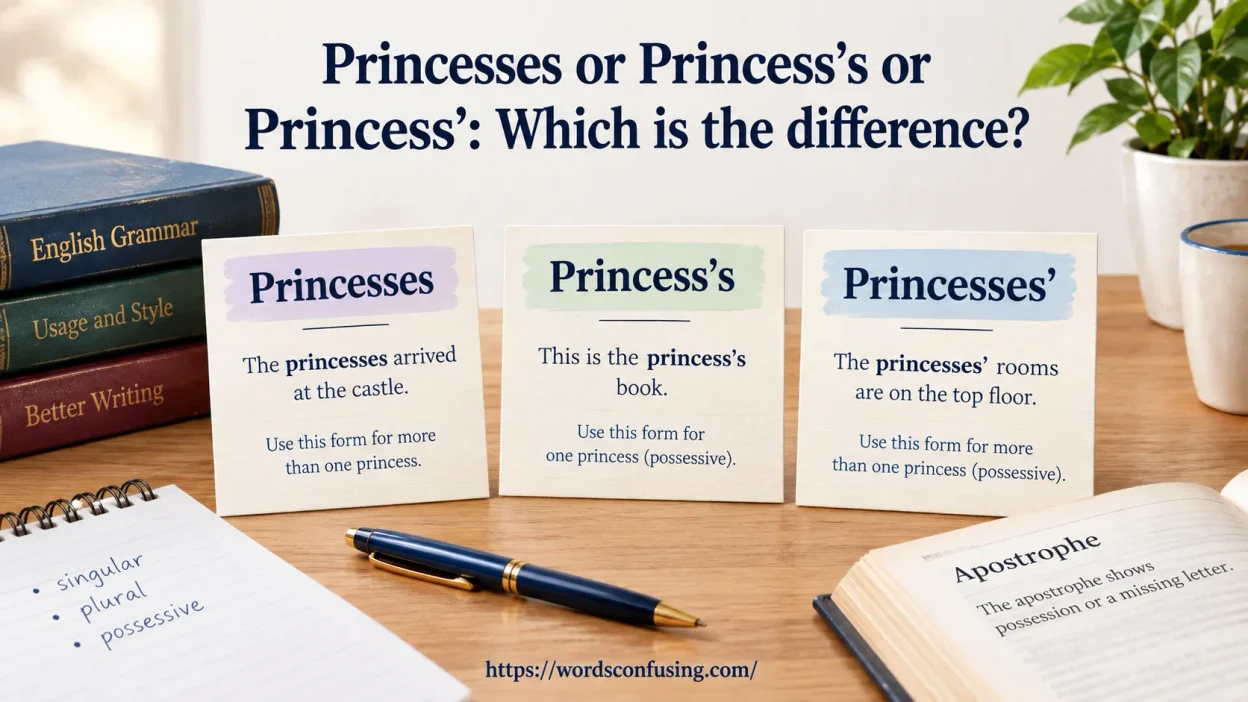
The phrase Princesses or Princess’s or Princess’: Which is the Difference? becomes easier when you understand plural and possessive forms.
Princesses is the plural form of the noun princess, meaning more than one princess. Princess’s shows ownership or that something belongs to a princess. The apostrophe often creates grammar confusion because this tiny mark changes the meanings of words.
In English grammar, plural nouns and possessive forms follow different grammar rules. Understanding these differences helps English learners, students, and native speakers maintain clear communication, correct grammar, and professional writing.
In my experience, checking the number first makes these forms much easier to use confidently. I look at whether I mean one princess, several Princesses, or something showing ownership.
English possessives use possessive apostrophes, while style guides may differ about princess’s and princess’. This simple approach helps with professional writing, emails, essays, online content, blog posts, and editing without making the rules feel complicated.
Quick Answer
Princesses is the plural form of princess, while princess’s shows possession by one princess. Princesses’ shows possession by two or more princesses. You may also see princess’ in some style guides, but princess’s is the standard choice for most modern writing.
- Princesses = more than one princess
The princesses entered the palace. - Princess’s = something belonging to one princess
The princess’s crown was sparkling. - Princesses’ = something belonging to multiple princesses
The princesses’ crowns were sparkling. - Princess’ = an alternative singular possessive form used by some style conventions
The princess’ crown was sparkling.
The easiest trick is to ask yourself two questions: How many princesses are there? And does the sentence show possession? Once you answer those, the correct form usually falls into place.
Princesses: The Correct Plural Form of Princess
Princesses is the plural form of princess. Use it when you’re talking about two or more princesses.
Unlike a possessive noun, the word princesses doesn’t contain an apostrophe. The ending -es creates the plural because princess already ends in s.
For example:
- One princess arrived at the palace.
- Two princesses arrived at the palace.
- Several princesses attended the celebration.
- The story features three princesses.
- The young princesses explored the garden.
In each sentence, princesses simply identifies multiple people. Nothing belongs to them in the grammatical structure.
Why Is the Plural “Princesses”?
English usually forms regular plurals by adding -s. However, nouns ending in sounds such as s, sh, ch, x, and z often take -es.
The singular noun is:
princess
The plural becomes:
princesses
This gives the word a natural plural pronunciation and spelling.
Consider these similar examples:
- class → classes
- glass → glasses
- dress → dresses
- church → churches
- box → boxes
- princess → princesses
The same basic plural pattern applies.
Examples of Princesses in Sentences
Here are several examples that show how princesses works:
The princesses walked through the royal garden.
The word princesses refers to more than one princess. It doesn’t indicate ownership.
Three princesses competed in the tournament.
Again, princesses is simply plural.
The book tells the stories of several princesses.
The noun identifies multiple characters without showing possession.
The princesses traveled together.
There is no apostrophe because the sentence doesn’t describe anything belonging to the princesses.
A Common Mistake With Princesses
One of the most common errors involves adding an apostrophe simply because the word ends in s.
Incorrect:
The princess’s attended the ceremony.
Correct:
The princesses attended the ceremony.
The apostrophe in princess’s doesn’t make a noun plural. It normally signals possession.
That’s an important rule to remember:
Apostrophes don’t normally create ordinary plurals.
So, when you mean multiple princesses, write princesses, not princess’s.
Princess’s: The Singular Possessive Form
Princess’s is the standard singular possessive form of princess.
Use it when one princess owns, possesses, controls, or is associated with something.
For example:
- the princess’s crown
- the princess’s dress
- the princess’s horse
- the princess’s room
- the princess’s decision
- the princess’s family
- the princess’s palace
The basic construction is:
princess + ’s = princess’s
The extra s after the apostrophe doesn’t make the noun plural. Instead, it forms the singular possessive.
What Does Princess’s Mean?
Consider this sentence:
The princess’s crown sparkled under the lights.
The crown belongs to or is associated with one princess.
Compare that with:
The princesses’ crowns sparkled under the lights.
Now the crowns belong to multiple princesses.
That tiny difference between princess’s and princesses’ carries a significant grammatical distinction.
Examples of Princess’s
The princess’s dress was covered with silver embroidery.
One princess has the dress.
Everyone admired the princess’s courage.
The courage is associated with one princess.
The princess’s horse waited outside the castle.
One princess has the horse.
The king praised the princess’s decision.
The decision came from one princess.
The princess’s family gathered for dinner.
The family is associated with one princess.
These examples demonstrate why context matters. The apostrophe tells readers that the noun represents a singular possessive relationship.
Is Princess’s Grammatically Correct?
Yes. Princess’s is grammatically correct as the standard singular possessive form.
A common misconception says that nouns ending in s should always receive only an apostrophe. That’s not the general rule for singular nouns in modern English.
For most singular nouns, including singular nouns ending in s, the possessive form uses ’s.
For example:
- boss → boss’s
- class → class’s
- dress → dress’s
- glass → glass’s
- princess → princess’s
Therefore:
princess’s crown
is a standard singular possessive construction.
Does Princess’s Mean More Than One Princess?
No.
Princess’s refers to one princess in a possessive construction.
For example:
The princess’s necklace was expensive.
The necklace belongs to one princess.
The plural possessive would be:
The princesses’ necklaces were expensive.
Now the necklaces belong to multiple princesses.
That distinction becomes much clearer when you compare the forms side by side.
| Meaning | Correct form | Example |
| One princess | princess | The princess smiled. |
| More than one | princesses | The princesses smiled. |
| One princess’s possession | princess’s | The princess’s crown gleamed. |
| Multiple princesses’ possession | princesses’ | The princesses’ crowns gleamed. |
Princesses’: The Plural Possessive Form
Princesses’ is the plural possessive form of princess.
Use it when two or more princesses collectively own, possess, control, or relate to something.
The construction works like this:
princess → princesses → princesses’
First, make the noun plural:
princesses
Then add the apostrophe:
princesses’
For example:
- the princesses’ crowns
- the princesses’ dresses
- the princesses’ rooms
- the princesses’ horses
- the princesses’ decisions
- the princesses’ families
Why Does the Apostrophe Come After the S?
The word princesses already ends in s because it is plural.
To make that plural noun possessive, add an apostrophe after the existing s.
So:
princesses + ’ = princesses’
You don’t add another s after the apostrophe.
That’s the same pattern used with many regular plural nouns:
- students → students’
- teachers → teachers’
- players → players’
- princesses → princesses’
Examples of Princesses’
The princesses’ crowns were placed on a velvet table.
The crowns belong to multiple princesses.
The princesses’ dresses were designed by the same tailor.
Multiple princesses have dresses.
The princesses’ rooms were located on the upper floor.
The rooms belong to several princesses.
The princesses’ parents attended the ceremony.
The parents are associated with multiple princesses.
The princesses’ decisions affected the entire kingdom.
The decisions came from multiple princesses.
Princess’s vs. Princesses’
This distinction deserves special attention because it’s one of the easiest places to make an error.
Compare:
The princess’s crown was made of gold.
One princess has one crown.
Now compare:
The princesses’ crowns were made of gold.
Multiple princesses have crowns.
The spelling changes from princess’s to princesses’ because the number of owners changes.
Princess’: Is This Form Correct?
Princess’ can appear in English, but it requires more explanation.
When princess functions as a singular possessive noun, the standard modern form is generally princess’s.
Therefore, in ordinary writing, these are common:
The princess’s crown was beautiful.
The princess’s carriage arrived at noon.
However, some style systems allow or prefer an apostrophe alone for certain singular proper or common nouns ending in s. Under such conventions, you may encounter:
The princess’ crown was beautiful.
This doesn’t mean every style guide treats the forms identically.
Why Do Some Writers Use Princess’?
English style conventions aren’t completely uniform.
Some editorial systems simplify singular possessives ending in s by adding only an apostrophe. Other style systems retain ’s.
As a result, both of these forms may appear in published material:
- the princess’s crown
- the princess’ crown
The important point is that princess’ should not automatically be treated as the standard answer in every context.
For general modern English writing, princess’s is the safer standard choice when one princess possesses something.
When Might You See Princess’?
You may encounter princess’ in:
- Older publications
- Certain newspapers
- House styles
- Editorial systems that simplify possessives
- Writing influenced by a particular style guide
The choice can therefore depend on the style convention being followed.
If you’re writing an essay, article, website page, or general piece of modern English prose, princess’s is typically the clearest choice for singular possession.
Princesses or Princess’s or Princess’: The Main Difference
The easiest way to understand all four forms is to focus on number and possession.
Ask yourself two questions:
How many princesses are you talking about?
Are you showing possession?
Your answers will lead you to the correct form.
If You Mean One Princess
Use:
princess
Example:
The princess entered the ballroom.
No possession appears here.
If You Mean More Than One Princess
Use:
princesses
Example:
The princesses entered the ballroom.
The noun is simply plural.
If One Princess Owns Something
Use:
princess’s
Example:
The princess’s necklace caught the light.
One princess possesses or is associated with the necklace.
If Multiple Princesses Own Something
Use:
princesses’
Example:
The princesses’ necklaces caught the light.
Multiple princesses possess the necklaces.
Where Does Princess’ Fit?
Princess’ can function as a singular possessive under certain style conventions.
Example:
The princess’ necklace caught the light.
For standard general-purpose writing, however, princess’s is usually the clearer choice.
Princesses vs. Princess’s vs. Princesses’ vs. Princess’
Here’s the complete comparison at a glance:
| Form | Number | Possessive? | Main use |
| princess | Singular | No | One princess |
| princesses | Plural | No | Two or more princesses |
| princess’s | Singular | Yes | Something belonging to one princess |
| princesses’ | Plural | Yes | Something belonging to multiple princesses |
| princess’ | Singular | Sometimes | Style-dependent singular possessive |
This table captures the central rule.
The apostrophe marks possession. The spelling of the noun tells you whether the noun is singular or plural.
How to Form the Possessive of Princess
Forming the possessive becomes easy when you follow a simple sequence.
One Princess: Add ’s
Start with:
princess
Add ’s:
princess’s
Example:
The princess’s crown was stolen.
The crown belongs to one princess.
Multiple Princesses: Add ’ After the Plural
Start with:
princess
Make it plural:
princesses
Then add the apostrophe:
princesses’
Example:
The princesses’ crowns were stolen.
The crowns belong to multiple princesses.
Don’t Add an Apostrophe to Make the Plural
This mistake appears frequently.
Incorrect:
princess’s attended the ball
Correct:
princesses attended the ball
The apostrophe in princess’s signals possession. It doesn’t create a plural noun.
A Simple Trick for Choosing the Right Form
When you’re stuck between princesses and princess’s, remove the surrounding words and ask what the sentence means.
Suppose you see:
The ______ arrived at the palace.
You mean multiple people.
Therefore:
The princesses arrived at the palace.
Now consider:
The ______ crown was displayed.
If one princess owns the crown:
The princess’s crown was displayed.
If several princesses own their crowns:
The princesses’ crowns were displayed.
The trick works because it separates number from possession.
Common Mistakes With Princesses and Possessive Forms
Even experienced writers can mix up these forms when typing quickly.
Mistake: Using Princess’s as the Plural
Incorrect:
Five princess’s attended the festival.
Correct:
Five princesses attended the festival.
Princess’s doesn’t mean “more than one princess.”
Mistake: Using Princesses’ for One Princess
Incorrect:
The princesses’ crown was enormous.
If only one princess owns the crown, write:
The princess’s crown was enormous.
The plural possessive form princesses’ requires multiple princesses.
Mistake: Using Princess’ Without Considering Style
Some writers assume that every noun ending in s should take only an apostrophe.
That rule doesn’t work universally.
For a singular princess, the standard possessive form is:
princess’s
The form princess’ may occur under specific style conventions, but it isn’t the default form to use everywhere.
Mistake: Adding an Apostrophe to an Ordinary Plural
Incorrect:
The princesses’ arrived.
Correct:
The princesses arrived.
There is no possessive relationship in the first sentence. Therefore, the apostrophe has no grammatical job.
Read more: 25 Best Replies to “You’re Welcome” Formal and Friendly
Princesses, Princess’s, and Princesses’ in Real Sentences
Context often makes the difference immediately obvious.
Consider these examples:
The princesses gathered in the courtyard.
Princesses means several princesses.
The princess’s carriage waited outside.
Princess’s indicates that one princess is associated with the carriage.
The princesses’ carriages waited outside.
Princesses’ indicates that several princesses are associated with the carriages.
Now consider another set:
| Sentence | What it means |
| The princess smiled. | One princess |
| The princesses smiled. | Multiple princesses |
| The princess’s smile was charming. | One princess’s smile |
| The princesses’ smiles were charming. | Multiple princesses’ smiles |
Notice how the apostrophe doesn’t merely decorate the word. It changes the grammatical relationship.
Princess’s With Singular Nouns
A singular possessive construction can involve almost any noun associated with the princess.
Examples include:
- the princess’s name
- the princess’s voice
- the princess’s family
- the princess’s palace
- the princess’s necklace
- the princess’s horse
- the princess’s story
- the princess’s responsibilities
- the princess’s appointment
- the princess’s speech
Each phrase connects one princess with another noun.
For example:
The princess’s speech attracted widespread attention.
The speech belongs to or was delivered by one princess.
The possessive relationship doesn’t always mean literal ownership. Possessive constructions can express association, relationship, origin, responsibility, or connection.
Princesses’ Doesn’t Always Mean Shared Ownership
Plural possessives can describe several people individually as well as collectively.
For example:
The princesses’ dresses were different colors.
This could mean each princess had her own dress. The plural possessive still works because the dresses belong to multiple princesses.
Similarly:
The princesses’ opinions differed.
Each princess has an opinion. The possessive form connects the opinions with the group.
Therefore, princesses’ doesn’t necessarily mean that all princesses jointly own one object.
It can describe possessions or relationships belonging to members of the group.
A Quick Test for Possession
If you’re unsure whether an apostrophe belongs in your sentence, try replacing the possessive phrase with “of the princess” or “of the princesses.”
For example:
The princess’s crown
can be understood as:
The crown of the princess.
That signals singular possession.
Now:
The princesses’ crowns
can be understood as:
The crowns of the princesses.
That signals plural possession.
This substitution isn’t always the most natural way to write the sentence, but it can help you identify the grammatical relationship.
Pronunciation of Princess’s
Pronunciation can sometimes make princess’s seem awkward because the word already ends with an s sound.
However, spelling and pronunciation follow different rules.
In normal speech, the possessive ending may produce an additional syllable:
princess’s
The exact pronunciation can vary somewhat depending on speech patterns and context. The spelling remains princess’s under the standard singular possessive rule.
Don’t remove the s merely because the word already ends in s.
Why Apostrophes Matter in Princess’s
An apostrophe can change the grammatical role of a noun without changing its core meaning.
Compare:
The princesses entered.
and:
The princesses’ entrance was delayed.
In the first sentence, princesses acts as a plural subject.
In the second, princesses’ modifies entrance as a plural possessive.
Now compare:
The princess entered.
and:
The princess’s entrance was delayed.
Here, princess becomes princess’s because the sentence expresses a relationship between one princess and the entrance.
The punctuation carries information.
Princesses or Princess’s: Which One Should You Use?
Choose princesses when you mean more than one princess.
Choose princess’s when you mean something belonging to or associated with one princess.
For example:
The princesses visited the museum.
Use princesses because the sentence discusses multiple people.
The princess’s portrait hung in the museum.
Use princess’s because the portrait belongs to or represents one princess.
If multiple princesses have portraits, you could write:
The princesses’ portraits hung in the museum.
The difference becomes straightforward once you identify the number of people involved.
Princesses or Princesses’: Don’t Confuse Plural and Plural Possessive
These two forms differ by only one apostrophe.
Princesses = more than one princess.
Princesses’ = something belonging to more than one princess.
Compare:
The princesses danced.
versus:
The princesses’ shoes were polished.
The first sentence describes what the princesses did.
The second sentence describes the shoes associated with those princesses.
This distinction applies to countless English nouns.
For example:
- teachers → more than one teacher
- teachers’ → belonging to multiple teachers
- players → more than one player
- players’ → belonging to multiple players
- students → more than one student
- students’ → belonging to multiple students
The same grammatical principle applies to princesses.
Princess’s or Princess’: Which Possessive Form Should You Choose?
When one princess possesses something, princess’s is generally the standard form for modern general writing.
For example:
The princess’s crown was decorated with jewels.
This form clearly communicates singular possession.
You may encounter:
The princess’ crown was decorated with jewels.
That version reflects a style choice used in some contexts. If a specific publication, institution, or style guide requires that convention, follow it consistently.
However, if no special style rule applies, princess’s provides the most straightforward standard form.
Consistency matters more than switching between styles randomly.
Quick Reference Guide
Keep this simple guide nearby when proofreading:
- Princess = one person
- Princesses = more than one person
- Princess’s = belonging to one princess
- Princesses’ = belonging to multiple princesses
- Princess’ = possible style-based singular possessive
A useful memory trick is:
No apostrophe = plural.
Apostrophe before the final s = singular possessive.
Apostrophe after the plural s = plural possessive.
That three-part pattern solves most cases.
FAQs
Is “Princesses” the plural form of “princess”?
Yes. Princesses is the plural form of princess and refers to two or more princesses. You do not need an apostrophe because you are simply showing a plural noun.
Is “Princess’s” grammatically correct?
Yes. Princess’s is the standard singular possessive form. It shows that something belongs to one princess, such as “the princess’s crown” or “the princess’s dress.”
When should I use “Princess’”?
Princess’ may appear in certain style systems, but it is less common for the singular possessive form in general American English. Check the style guide you are following when consistency matters.
What is the difference between “Princesses” and “Princess’s”?
Princesses means more than one princess, while Princess’s shows possession by one princess. The apostrophe changes the grammatical function of the word.
Should I write “the princesses’ castle” or “the princess’s castle”?
Use the princesses’ castle when the castle belongs to multiple princesses. Use the princess’s castle when it belongs to one princess.
How can I remember the correct form easily?
First decide whether you mean one princess or several princesses. Then ask whether you are showing possession. This quick check usually makes the correct form obvious.
Conclusion
Choosing between Princesses, Princess’s, and Princess’ becomes much simpler once you stop treating the apostrophe as a tiny mystery. Princesses refers to more than one princess, while Princess’s normally shows that something belongs to one princess. Princess’ can appear under certain style conventions, so always consider the guide you’re following.
The best habit is to pause for a second and check the meaning. Are you talking about several princesses, or are you showing possession? That small question can prevent an awkward grammar mistake. Whether you’re writing an email, essay, story, or blog post, choosing the right form makes your sentence clearer and more polished.