


Did vs. Done: What’s the Difference? Learn the simple grammar rules that help you choose the correct verb form in everyday English.
Many English learners experience grammar confusion because did and done come from the same verb do but have different verb forms. Did is the simple past tense, while done is the past participle of this irregular verb.
For example, “I did my homework” is a correct sentence, but “I done my homework” is generally considered incorrect writing in standard English. You usually need a helping verb or auxiliary verb to use done correctly, as in “I have done my homework.”
Understanding past actions, sentence structure, verb tense, and usage rules improves grammatical accuracy and helps you avoid common mistakes. These grammar rules also strengthen your writing skills, speaking skills, and overall English proficiency.
A practical grammar guide should explain word origin, spelling, verb conjugation, and common mistakes through clear real-world examples. Correct verb forms matter in everyday writing, formal writing, school work, school assignments, emails, business messages, social media posts, and workplace correspondence.
They also support effective communication in business communication, meetings, project management, calendar management, scheduling tasks, time management, online booking, broadcasting, and broadcast communication, where grammar errors can cause misunderstandings. Learning about perfect tenses, the present perfect tense, main verb forms, and sentence formation helps you develop correct usage and language accuracy.
With practical examples, sentence examples, usage examples, memory tips, and memory techniques, you can build grammar knowledge, improve English vocabulary development, and maintain grammar consistency. These skills enhance sentence clarity, writing clarity, professional credibility, and communication confidence across written communication, spoken communication, everyday conversation, and professional writing.
Quick Answer
The words did and done express related meanings, but they cannot always replace each other. The correct choice depends on the tense and structure of your sentence.
- Did: The simple past tense of do. Use it to describe an action that happened in the past.
- Done: The past participle of do. Use it with auxiliary verbs such as have, has, or had, or in constructions that describe a completed state.
Consider these examples:
- Did: Sarah did her homework last night.
- Done: Sarah has done her homework.
- Did: Did you finish the report?
- Done: Have you done the report?
The first two sentences show how the words work in statements. The last two demonstrate their different roles in questions.
| Feature | Did | Done |
| Verb form | Simple past | Past participle |
| Basic purpose | Describes a past action | Helps form perfect tenses or describes completion |
| Common pattern | Subject + did + object | Subject + have/has/had + done |
| Example | He did the dishes. | He has done the dishes. |
| Can appear with have in the perfect tense? | No, not in standard perfect-tense constructions | Yes |
| Can describe a completed state? | Not in the same way | Yes, as in “The job is done.” |
Easy rule to remember: Use did for the simple past and done for the past participle.

What Does Did Mean?
The word did is the simple past form of the verb do. It describes an action or activity that occurred in the past.
You can use did when talking about completed tasks, past efforts, activities, or events. It can also help you form questions and negative sentences.
For example:
- I did the laundry yesterday.
- Marcus did an excellent job.
- We did everything before lunch.
- They did their best during the competition.
In each example, did connects the action to a past situation. The sentences do not need another verb to express the simple past when did functions as the main verb.
However, did can also work as an auxiliary verb. In that role, it helps another verb form questions, negatives, and certain emphatic statements.
Did as a Main Verb
When did acts as the main verb, it describes the action itself. It often refers to performing a task, completing work, or making an effort.
For example:
- She did the dishes after dinner.
- I did my homework before school.
- The team did its best during the match.
- We did the shopping on Saturday.
- He did all the work himself.
Notice that did can refer to many different activities. It often replaces a more specific verb when the activity is already understood.
For example, consider this conversation:
“Did you clean the kitchen?”
“Yes, I did.”
The second speaker uses did to avoid repeating the phrase clean the kitchen. This common pattern makes everyday conversations shorter and more natural.
You can also use did to emphasize effort or achievement.
For example:
- I did finish the assignment before the deadline.
- She did help us when we needed support.
- They did complete the project on time.
Here, did adds emphasis. The speaker may be correcting someone’s assumption or stressing that an action really happened.
Did as an Auxiliary Verb
An auxiliary verb helps another verb express grammatical information. In English, did often helps form simple past questions and negative statements.
When you use did as an auxiliary, the main verb generally takes its base form rather than its past-tense form.
For example:
- Did you call your brother?
- Did she finish the assignment?
- Why did they leave early?
- I did not understand the instructions.
- He didn’t attend the meeting.
Notice the difference between these two sentences:
- Correct: Did she go home?
- Incorrect in standard English: Did she went home?
The auxiliary did already marks the past tense. Therefore, the main verb remains in its base form, go.
The same rule applies to negative statements. You say “She didn’t finish” rather than “She didn’t finished.”
Remember: When did acts as an auxiliary, follow it with the base form of the main verb.
Read more: 8 Words for Someone Who Doesn’t Care About Others’ Feelings
What Does Done Mean?
The word done is the past participle of do. Unlike did, it does not usually function as the main verb in an ordinary simple past statement.
Instead, done commonly appears with auxiliary verbs to form perfect tenses. It can also describe a completed state when used in constructions such as “The work is done.”
For example:
- I have done my homework.
- She has done the grocery shopping.
- They had done the repairs before noon.
- The painting is done.
- Are you done with your lunch?
These sentences show two important uses of done. The first three use it in perfect-tense constructions. The last two describe a finished state.
Although did and done share the same base verb, their grammatical roles differ. Understanding that distinction helps you avoid errors in both writing and conversation.
Done With Have, Has, and Had
One of the most common uses of done occurs with have, has, and had. Together, these words form perfect-tense constructions.
The basic patterns are:
- Have + done: I have done my homework.
- Has + done: She has done her homework.
- Had + done: They had done their homework.
Each auxiliary establishes a different grammatical relationship between the action and the time being discussed.
Have done and has done form the present perfect tense. This tense often connects a past action to the present or describes an experience without specifying a finished past time.
Examples:
- I have done everything on the checklist.
- She has done this kind of work before.
- We have done enough preparation for today.
- He has done his part of the project.
Had done forms the past perfect tense. It describes an action completed before another past event or reference point.
Examples:
- I had done my homework before my friends arrived.
- She had done the shopping before the storm started.
- They had done most of the work by Monday.
Consider this sentence: “By the time the manager arrived, the employees had done the necessary preparations.”
The preparations were complete before the manager arrived. The past perfect construction makes that sequence clear.
However, remember that done does not automatically mean an action happened recently. The surrounding words and the auxiliary verb establish the relevant time relationship.
Done as an Adjective
The word done can also function as an adjective. In this role, it describes something that has reached a finished or completed state.
You will often see it after forms of the verb be, including is, are, was, and were.
Examples include:
- The report is done.
- Dinner is done.
- The repairs are done.
- The assignments were done before the deadline.
- I’m done with my chores.
In these sentences, done describes the state of a task or activity. It does not function as a simple past-tense verb in the way did does.
Context can also affect its meaning.
For example, “The chicken is done” usually means the chicken has finished cooking. “I’m done with my homework” means the speaker has finished the assignment.
The expression “I’m done” can also signal frustration or a decision to stop an activity. For example, someone might say it after a long argument.
In everyday American English, these uses are common and natural.

Did vs. Done: Key Differences
The difference between did and done becomes clearer when you compare their forms and sentence patterns. Both come from do, but each performs a different grammatical job.
| Difference | Did | Done |
| Grammatical form | Simple past | Past participle |
| Typical use | Describes a past action | Forms perfect tenses or describes completion |
| Example with a task | I did the assignment. | I have done the assignment. |
| Example in a question | Did you call her? | Have you called her? |
| Example with do | Did you do it? | Have you done it? |
| Example with be | Not usually used this way | The task is done. |
The most important distinction involves tense and sentence structure. Did can independently express a past action as the main verb, while done usually needs an auxiliary or a suitable grammatical construction.
Compare these examples:
- Simple past: Daniel did the work yesterday.
- Present perfect: Daniel has done the work.
- Past perfect: Daniel had done the work before the meeting.
- Completed state: The work is done.
All four sentences describe completed work. However, they emphasize different grammatical relationships.
The simple past places the action in a past situation. The present perfect connects the action to the present. The past perfect places it before another past event, while the last sentence describes the resulting state.
Why Did and Done Cannot Always Replace Each Other
English verbs follow specific patterns, and do is no exception. Replacing one form with another can make a sentence grammatically incorrect.
For example:
- Correct: I did the work yesterday.
- Incorrect in standard American English: I done the work yesterday.
- Correct: I have done the work.
- Incorrect: I have did the work.
The first pair concerns the simple past. The second pair concerns the present perfect.
When choosing between the words, ask yourself two questions:
- Am I describing an action directly in the simple past?
- Does my sentence require a past participle after an auxiliary verb?
If you’re describing a past action directly, did is usually appropriate. If you need the past participle of do, use done.
When to Use Did vs. Done
Choosing the right word becomes easier when you look at the sentence’s purpose. The following situations cover the most common uses of did and done.
Use Did for Completed Past Actions
Use did when you want to describe an action that happened in the past. It often appears with words and phrases such as yesterday, last night, last week, and two days ago.
Examples:
- I did the dishes last night.
- She did her homework yesterday.
- We did the shopping on Saturday.
- They did the work two days ago.
- He did a great job during the presentation.
These sentences use the simple past to report completed actions. The exact time may be stated directly or understood from the conversation.
For instance, if someone asks, “What did you do yesterday?” you might answer, “I visited my grandparents and did some cleaning.”
Here, did refers to an activity completed during a specific past period.
You can also use it when no exact time appears in the sentence.
For example, “She did everything she could to help.”
The sentence describes a past effort without identifying precisely when it happened.
Use Done With Have, Has, or Had
Use done when the sentence requires the past participle of do. In perfect-tense constructions, the auxiliary verb comes before done.
Examples:
- I have done my homework.
- She has done the paperwork.
- We have done enough research.
- He had done the repairs before the guests arrived.
- They have done a wonderful job.
The auxiliary verb determines the tense. The word done remains the past participle.
Consider the difference between these sentences:
“I did the report yesterday.”
“I have done the report.”
The first sentence uses the simple past and specifies a completed past time. The second uses the present perfect to present the completed report as relevant to the current situation.
In everyday conversation, you might say “I’ve done the report” when someone asks whether the task is complete.
However, if you specify a finished past time, American English generally favors the simple past: “I did the report yesterday.”
Use Done to Describe Something Finished
You can use done to describe the finished state of an activity, task, or process.
Examples:
- The assignment is done.
- Dinner is done.
- The housework is done.
- The documents are done.
- I’m done with this project.
In these examples, done communicates that something has reached completion.
It can also describe food that has finished cooking. For example, “The vegetables are done, so we can serve dinner.”
In casual speech, the phrase “I’m done” can have several meanings. It may mean you’ve finished your work, reached the end of an activity, or decided to stop participating.
Context determines which meaning the speaker intends.
Common Mistakes When Using Did and Done
Even fluent English speakers sometimes confuse verb forms, especially in quick conversations. Learning the most common errors can help you recognize and correct them.
Using Done Without the Required Auxiliary Verb
A frequent mistake is using done as though it were the simple past form of do.
Incorrect in standard American English: I done my homework yesterday.
Correct: I did my homework yesterday.
The word done is a past participle. A standard simple past statement normally requires did when do is the main verb.
You can use done without have, has, or had in other constructions, such as “The homework is done.” The important point is to use the form that fits the sentence’s grammar.
Using Did After Have or Has
Another common error occurs when writers use did after have or has in the present perfect tense.
Incorrect: She has did her homework.
Correct: She has done her homework.
The present perfect follows this pattern:
Subject + have/has + past participle
Because done is the past participle of do, it fits the pattern. Did does not.
More examples:
- Incorrect: He has did the dishes.
- Correct: He has done the dishes.
- Incorrect: They have did enough work.
- Correct: They have done enough work.
Remember that the same principle applies to other irregular verbs. For example, you say “She has gone,” not “She has went.”
Using Done Instead of Did in Questions
Simple past questions involving do typically begin with did followed by the subject and the base form of the main verb.
Incorrect: Done you finish the assignment?
Correct: Did you finish the assignment?
More examples:
- Correct: Did she call you?
- Correct: Did they complete the project?
- Correct: What did he say?
- Correct: Where did you go?
The auxiliary did marks the past tense. The main verb stays in its base form.
For questions about completion using the present perfect, use have or has with done.
For example:
- Have you done the assignment?
- Has she done the shopping?
- Have they done their part?
These questions focus on whether an action has been completed, rather than simply asking whether it happened in the past.
Using the Wrong Verb Form After Did
When did acts as an auxiliary verb, the following main verb should normally appear in its base form.
Incorrect: Did she done the dishes?
Correct: Did she do the dishes?
Incorrect: He didn’t went to school.
Correct: He didn’t go to school.
Incorrect: Did you finished your work?
Correct: Did you finish your work?
The rule is straightforward: Use the base form of the main verb after auxiliary did.
The auxiliary already carries the past-tense marking, so the main verb doesn’t need another past-tense form.
Confusing Did With Done in Short Answers
Short answers can also reveal the difference between the two words.
Consider this exchange:
“Did you finish your homework?”
“Yes, I did.”
The answer uses did to refer back to the action of finishing the homework.
Now consider a different question:
“Have you finished your homework?”
“Yes, I have.”
The answer uses have because the question uses the present perfect. You could also answer, “Yes, I’ve done it.”
A natural short answer follows the grammatical structure of the original question. You generally don’t need to repeat the entire action.
Read more: Charles’ or Charles’s: Which Should You Use?
Did vs. Done in Questions and Negative Sentences
Questions and negative statements show how the two verb forms work in different grammatical patterns. Pay attention to the auxiliary verb and the form of the main verb.
Questions With Did
Use did to form simple past questions. The standard pattern is:
Did + subject + base form of the verb?
Examples:
- Did you do the laundry?
- Did he finish the report?
- Did they arrive on time?
- What did she say?
- Why did you leave early?
Notice that do, finish, arrive, say, and leave appear in their base forms.
Even though the question concerns the past, the main verb doesn’t change to did, finished, arrived, said, or left after the auxiliary did.
Negative Sentences With Did
To form a negative simple past statement, use did not or its contraction, didn’t, followed by the base form of the main verb.
Examples:
- I did not see the message.
- She didn’t finish her lunch.
- They didn’t attend the meeting.
- We didn’t do the assignment together.
- He didn’t understand the instructions.
Both did not and didn’t are grammatically correct. The contraction usually sounds more natural in casual conversation, while the full form can add emphasis or suit more formal writing.
For example, “I didn’t say that” sounds conversational. “I did not approve that decision” may sound more emphatic.
Questions and Negatives With Done
When a question or negative sentence uses the present perfect, the structure changes. Use have or has with the past participle done.
Questions:
- Have you done your homework?
- Has she done the shopping?
- Have they done the necessary repairs?
- Had he done the work before the meeting?
Negative statements:
- I haven’t done the dishes yet.
- She hasn’t done the assignment.
- They haven’t done enough preparation.
- He hadn’t done the work before the deadline.
The auxiliary carries the tense and the negative marking. The word done remains unchanged.
Compare these patterns:
| Sentence type | Correct example |
| Simple past question | Did you do it? |
| Present perfect question | Have you done it? |
| Simple past negative | I didn’t do it. |
| Present perfect negative | I haven’t done it. |
These patterns help you choose the right form without memorizing every sentence individually.
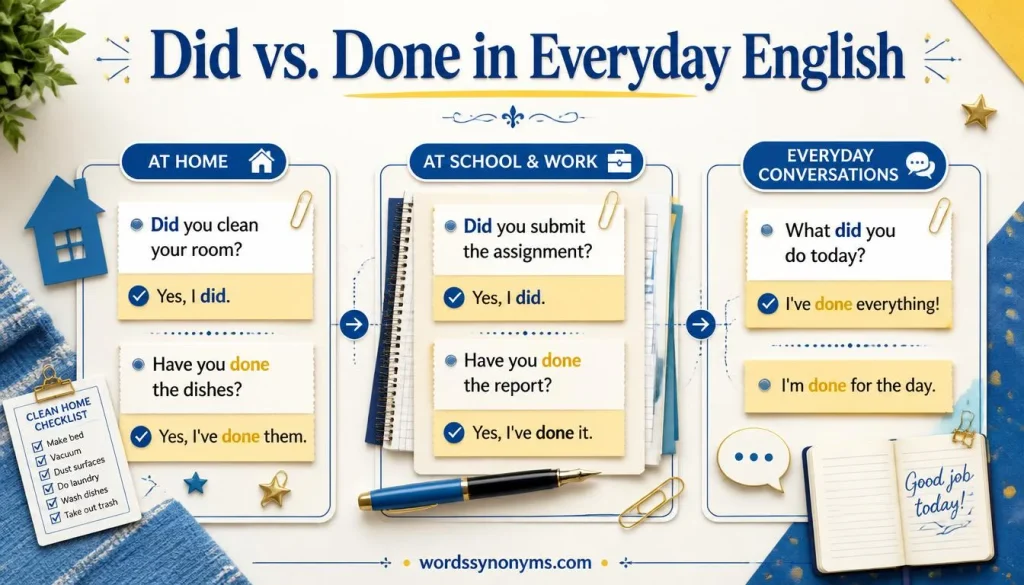
Did vs. Done in Everyday English
The distinction between did and done appears in ordinary situations, from household chores to school assignments and workplace projects.
Did vs. Done at Home
Household tasks provide simple examples of both forms.
- Did you clean your room?
- I did the laundry this morning.
- Have you done the dishes?
- The kitchen is done.
- I haven’t done the grocery shopping yet.
Imagine that a family member asks whether you’ve cleaned the kitchen. If the question is “Did you clean it?” you might answer, “Yes, I did.”
If the question is “Have you done the cleaning?” you could answer, “Yes, I’ve done it.”
Both exchanges are natural. The auxiliary verb in the question determines the structure of the answer.
Did vs. Done at School or Work
School and workplace situations often involve deadlines, assignments, and completed tasks.
Examples:
- Did you submit the assignment?
- I did the research last night.
- Have you done the report?
- She has done an excellent job.
- We had done the initial testing before the presentation.
Suppose a teacher asks, “Did you finish the assignment yesterday?” The student might respond, “Yes, I did.”
If the teacher asks, “Have you done the assignment?” the student might say, “Yes, I’ve done it.”
The first question refers to a past action. The second asks about completion using the present perfect.
In professional settings, choosing the right tense can make updates clearer. “I did the analysis yesterday” gives a specific past-time reference. “I’ve done the analysis” emphasizes its completion in the current context.
Did vs. Done in Casual Conversations
Everyday conversations frequently use both words, especially when people discuss plans, experiences, and finished activities.
Examples:
- What did you do today?
- Did you enjoy the movie?
- I’ve done everything on my list.
- I’m done for the day.
- Have you done what I asked?
The phrase “I’m done for the day” usually means the speaker has finished their work or activities for the day.
However, “I’m done with this conversation” may suggest frustration or a desire to stop talking. The word done can express more than simple completion, depending on context and tone.
Did vs. Done: More Example Sentences
Seeing the words in several sentence patterns makes their differences easier to recognize. Use these examples as a quick reference when writing or speaking.
Examples With Did
The following sentences use did as a main verb or auxiliary.
- I did my homework after dinner.
- She did the cleaning before the guests arrived.
- We did everything we could to help.
- They did a fantastic job on the project.
- Did you receive my email?
- Why did he cancel the appointment?
- I didn’t hear the announcement.
- She did tell me about the change.
- What did they do after school?
- He did all the repairs himself.
In the last few examples, did acts as an auxiliary or adds emphasis. The grammatical role depends on the sentence structure.
Examples With Done
These sentences show done in perfect tenses and completed-state constructions.
- I have done my part.
- She has done the grocery shopping.
- They had done the work before noon.
- We have done enough practice.
- The painting is done.
- Dinner is done, so let’s eat.
- Have you done your homework?
- He hasn’t done the paperwork yet.
- I’m done with my assignment.
- The preparations were done before the event.
Notice that done appears with different auxiliary verbs or as a description of a completed state.
Did vs. Done in Paired Examples
Paired examples make the contrast especially clear because the subject and action remain similar.
| With Did | With Done |
| I did the work yesterday. | I have done the work. |
| She did the shopping last night. | She has done the shopping. |
| They did the repairs before lunch. | They had done the repairs before lunch. |
| Did you do the assignment? | Have you done the assignment? |
| I didn’t do the dishes. | I haven’t done the dishes. |
The words are related, but their sentence patterns aren’t interchangeable. Choose the form that matches the tense and construction you need.
A Practical Case Study: Choosing Between Did and Done
Imagine that Alex is preparing a presentation for work. His manager wants to know whether he completed the slides, reviewed the data, and sent the final report.
Alex could use different verb forms depending on the questions he receives.
Situation one: Asking about a finished past action
Manager: “Did you prepare the slides yesterday?”
Alex: “Yes, I did.”
The manager asks about a specific past period. The simple past is appropriate.
Situation two: Checking whether a task is complete
Manager: “Have you done the data review?”
Alex: “Yes, I’ve done it.”
The present perfect connects the completed review to the current situation.
Situation three: Describing a task completed before another past event
Alex: “I had done the data review before the meeting started.”
The past perfect shows that the review was complete before the meeting began.
Situation four: Describing the current state
Alex: “The final report is done.”
Here, done describes the report as complete.
This example demonstrates why context matters. The same general activity can appear with did or done, but each sentence follows a different grammatical pattern.
How to Remember the Difference Between Did and Done
A simple memory trick can help you choose between these words without overthinking every sentence.
Remember the three principal forms of the verb do:
Do → Did → Done
- Do: Base form — “I do my homework every evening.”
- Did: Simple past — “I did my homework last night.”
- Done: Past participle — “I have done my homework.”
The sequence shows how the verb changes across its principal forms. The correct choice depends on the grammatical structure around it.
Use these quick checks when you’re unsure:
- Check for a past-time expression. If you’re describing an action at a finished past time, did may be appropriate.
- Look for have, has, or had. If the sentence uses one of these auxiliaries to form a perfect tense, use done.
- Check for a form of be. In sentences such as “The work is done,” done describes completion.
- Check the main verb after did. In questions and negatives, use the base form: “Did you do it?” or “I didn’t do it.”
Try testing yourself with these sentences:
- I ___ the dishes last night.
- She has ___ her homework.
- ___ you call your friend?
- The work is ___.
Answers: did, done, did, done.
Once you recognize the patterns, the distinction becomes much easier to apply in everyday writing.
FAQs
1. What is the main difference between did and done?
Did is the simple past tense of do, while done is its past participle. Use did for completed past actions, as in “I did my homework.” Use done with a helping verb, as in “I have done my homework.”
2. Is it grammatically correct to say “I done my homework”?
In standard English, “I done my homework” is generally considered incorrect. The correct sentence is “I did my homework.” However, you can say “I have done my homework” because done follows the helping verb have.
3. Should I use did or done in a question?
Use did when asking about a completed past action. For example, “Did you finish the assignment?” The main verb stays in its base form after did. Avoid saying “Did you finished the assignment?”
4. Can I use done without a helping verb?
Yes, done can sometimes appear without a helping verb, especially as an adjective or in informal expressions. For example, “The work is done” uses is as a linking verb. In standard sentences describing past actions, however, done usually needs a helping verb.
5. How do I use did and done in negative sentences?
Use did not or didn’t with the base form of the main verb. For example, “She didn’t do the work.” To use done, you can say, “She hasn’t done the work.” Remember that didn’t done is not correct in standard English.
6. What is an easy way to remember when to use did and done?
Think of did as a complete past-tense verb and done as a form that often needs help. Say “I did the task” when describing a past action. Say “I have done the task” when using the present perfect tense. Practicing these sentence patterns can improve your grammar accuracy and everyday communication.
Conclusion
Understanding did vs. done becomes easier when you remember how each verb works in a sentence. Use did to describe completed past actions, such as “I did my homework.” Use done with a helping verb in sentences like “I have done my homework.” This small difference can prevent common grammar mistakes and make your writing clearer.
Whether you’re writing emails, completing school assignments, or speaking in everyday conversations, choosing the correct verb form helps you communicate with confidence. Practice a few examples each day, and soon you’ll know when to use did and when done fits naturally.

Franklin Hayes is a writer and editor at WordsConfusing.com, focused on making English vocabulary, grammar, and commonly confused words easy to understand. He writes clear, practical articles with simple explanations and useful examples to help readers improve their English with confidence.
His goal is simple: Making Confusing Words Simple.


