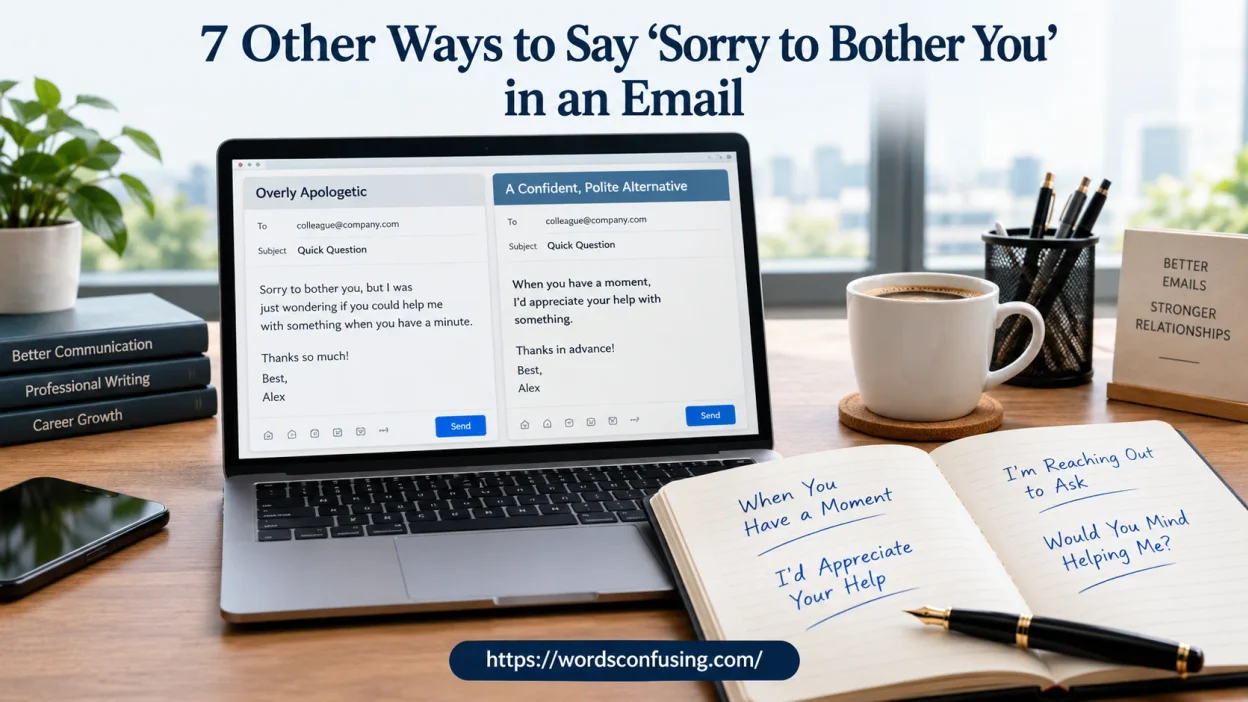
7 Other Ways to Say “Sorry to Bother You” in an Email can help you choose polite wording that keeps your message warm, clear, and professional.
When writing an email, sending a text, or speaking in person, the right words can show care, respect, and consideration without sounding overly apologetic. I’ve found that thoughtful alternatives often make a request feel more natural and confident, especially in workplace conversations.
You can acknowledge someone’s time and attention while communicating your request clearly and warmly.
Good email etiquette also matters during scheduling, meetings, project coordination, online appointments, and client interactions. Instead of repeating an overused phrase, choose wording that matches the situation and your relationship with the recipient.
Expressions such as “Sorry to be a bother” or “Sorry to bring this up again” may suit some contexts, while more direct wording can create a stronger impression.
These choices can improve your communication skills, professionalism, courtesy, and writing ability in professional and everyday situations.
Quick Answer
| Alternative | Best For |
| I hope I’m not interrupting | Unexpected requests |
| When you have a moment… | Non-urgent requests |
| I have a quick question about… | Simple questions |
| I’m reaching out to ask about… | Professional inquiries |
| I’d appreciate your help with… | Asking for assistance |
| Apologies for the interruption | Genuine interruptions |
| Thank you for your time | Showing appreciation |
For everyday work emails, “When you have a moment…” and “I have a quick question about…” often sound more confident than “Sorry to bother you.”
For example:
Instead of: Sorry to bother you, but could you review this file?
Try: When you have a moment, could you review this file?
You don’t need to apologize simply because you’re asking a reasonable question. Keep the request clear, respect the other person’s time, and save apologies for situations where you’ve actually caused an inconvenience.
Is “Sorry to Bother You” Professional in an Email?
Yes. “Sorry to bother you” is grammatically correct and can sound perfectly polite in an email. It acknowledges that you’re asking for someone’s attention and shows consideration for their time.
However, being grammatically correct doesn’t automatically make a phrase the best choice for every situation.
For example, imagine that you need your manager to approve a document that’s already part of their normal responsibilities:
Sorry to bother you, but could you approve the attached document?
There’s nothing wrong with this sentence. Still, the apology may be unnecessary. A cleaner version would be:
Could you please approve the attached document when you have a moment?
The second version doesn’t sound rude. It simply removes the unnecessary self-apology.
When “Sorry to Bother You” Works Well
The phrase can make sense when you’re genuinely interrupting someone or making an inconvenient request.
Use it when:
- You’re contacting someone unexpectedly.
- You need help with something outside the normal workflow.
- You’re interrupting someone during a busy period.
- You’re asking for an unusual favor.
- You’re contacting someone who may not have expected your message.
- You need to acknowledge a genuine inconvenience.
For example:
Sorry to bother you while you’re preparing for the meeting, but could you confirm the final figures?
Here, the apology has a clear purpose. You’re recognizing that the timing may be inconvenient.
When You Don’t Need It
You usually don’t need an apology when:
- You’re asking a routine work question.
- You’re following up on an expected response.
- You’re requesting information that falls within someone’s role.
- You’re communicating about an existing project.
- Someone has already invited you to contact them.
- You’re asking for a reasonable deadline clarification.
Consider this example:
Sorry to bother you again, but could you tell me when the report is due?
If the person expects you to ask questions about the report, there’s no real reason to apologize.
Instead:
Could you confirm when the report is due?
That’s direct, polite, and confident.
7 Other Ways to Say “Sorry to Bother You” in an Email
The right alternative should match your relationship with the recipient, the urgency of your request, and the level of formality.
Here are seven useful options that cover different professional situations.
| Alternative | Tone | Best Used For | Formality |
| I hope I’m not interrupting | Considerate | Unexpected contact | Medium |
| When you have a moment… | Respectful | Non-urgent requests | Medium |
| I have a quick question about… | Direct | Simple questions | Medium |
| I’m reaching out to ask about… | Professional | Inquiries and first contact | Medium-High |
| I’d appreciate your help with… | Warm | Assistance and feedback | Medium |
| Apologies for the interruption | Formal | Genuine interruptions | High |
| Thank you for your time | Appreciative | Requests and reviews | Medium-High |
The important point is that these aren’t interchangeable in every situation. Each one communicates a slightly different attitude.
I Hope I’m Not Interrupting
“I hope I’m not interrupting” works when you want to acknowledge the recipient’s time without making your email sound overly apologetic.
It suggests that you understand the person may be busy. At the same time, it doesn’t frame your communication as an inconvenience from the outset.
Example
I hope I’m not interrupting. Could you clarify which version of the proposal we should use?
This works particularly well when you don’t know whether the recipient is available.
When to Use It
Choose this alternative when:
- You’re contacting someone unexpectedly.
- You don’t know their schedule.
- You’re asking for help from a busy person.
- You’re starting a conversation outside a normal email thread.
- You want to sound considerate without sounding timid.
When to Avoid It
Don’t use it repeatedly in everyday communication.
If you email your coworker several times a week, opening every message with “I hope I’m not interrupting” can become awkward. It may even suggest that you feel uncomfortable communicating with them.
For routine communication, a direct opening usually works better.
Better for routine communication:
Could you clarify the deadline for the revised proposal?
The request gets to the point immediately.
When You Have a Moment…
“When you have a moment…” is one of the most useful alternatives to “Sorry to bother you.”
It works because it gives the recipient flexibility. You’re essentially saying, “This matters, but it doesn’t need to happen this second.”
That distinction makes the phrase especially useful in professional email.
Example
When you have a moment, could you review the attached contract?
The wording feels courteous without sounding apologetic.
Why It Works
The phrase quietly communicates three things:
- You respect the recipient’s schedule.
- You don’t expect an immediate response.
- You still need something from them.
It’s a bit like leaving a door open instead of pushing your way through it.
Best Situations
Use it for:
- Document reviews
- Feedback requests
- Routine approvals
- Non-urgent questions
- Project updates
- Internal workplace requests
Don’t Use It for Urgent Matters
Suppose a client needs an answer before a contract expires today.
Writing:
When you have a moment, could you confirm whether we can proceed?
could make the situation sound less urgent than it really is.
Instead, be clear:
Could you please confirm whether we can proceed by 3 p.m. today?
Politeness doesn’t require vagueness. When timing matters, clarity becomes part of professionalism.
I Have a Quick Question About…
Sometimes you don’t need an apology at all. You simply need to explain why you’re writing.
That’s where “I have a quick question about…” works beautifully.
Example
I have a quick question about the updated project timeline.
This opening immediately tells the reader what to expect.
Compare it with:
Sorry to bother you, but I was just wondering if you might have a chance to explain the updated project timeline.
The second version takes longer to reach the point. It also sounds less certain.
The first version is cleaner.
Why This Alternative Is Effective
A good email opening answers the reader’s first question:
“Why are you emailing me?”
“I have a quick question about…” answers that immediately.
Use It For
- Clarifying instructions
- Asking about deadlines
- Confirming details
- Requesting brief information
- Checking a small issue
- Communicating with coworkers
One Important Rule
Only call something a “quick question” when it really is quick.
If your request requires the recipient to research several documents and prepare a detailed response, don’t disguise it as a quick question.
Instead, write:
I have a few questions about the revised contract and would appreciate your guidance.
Honest wording builds more trust than artificial brevity.
I’m Reaching Out to Ask About…
“I’m reaching out to ask about…” works especially well in professional correspondence.
It clearly establishes the reason for the email without unnecessary apology.
Example
I’m reaching out to ask about the status of my application.
This sounds appropriate for a hiring manager, admissions office, vendor, client, or other professional contact.
Why It Works
The phrase creates a neutral bridge between the sender and recipient. You’re not assuming that you’ve inconvenienced them. You’re simply explaining why you’re contacting them.
That’s particularly valuable when you’re writing to someone for the first time.
Common Uses
Use this phrase when:
- You’re making a first contact.
- You’re asking about an application.
- You’re contacting a company.
- You’re requesting information.
- You’re following up with an external professional.
- You’re introducing a business-related question.
Example for a Client
I’m reaching out to ask about your availability for next week’s project review.
Example for a Job Application
I’m reaching out to ask whether there have been any updates regarding my application.
Example for a Vendor
I’m reaching out to ask about the expected delivery date for our order.
This alternative is particularly useful when “Sorry to bother you” would feel too casual or apologetic.
I’d Appreciate Your Help With…
When your email genuinely asks someone to help you, “I’d appreciate your help with…” can sound warmer than an apology.
Instead of focusing on the possibility that you’re bothering someone, the phrase focuses on the value of their assistance.
Example
I’d appreciate your help with reviewing the final figures before Friday.
That sentence sounds respectful without making the request sound like a burden.
Why Gratitude Can Work Better Than Apology
An apology says:
I may be causing you trouble.
Gratitude says:
I value your time and assistance.
Those messages aren’t identical. The second one often feels more constructive in professional communication.
Best Situations
Use this phrase for:
- Feedback
- Guidance
- Document reviews
- Technical assistance
- Project support
- Recommendations
- Professional advice
Example
I’d appreciate your help with identifying the correct format for the report.
Or:
I’d appreciate your guidance on how we should handle the next stage of the project.
The wording stays professional while still sounding human.
Apologies for the Interruption
If you actually are interrupting someone, “Apologies for the interruption” offers a more formal alternative.
It’s especially suitable when the situation genuinely warrants an apology.
Example
Apologies for the interruption. Could you please confirm whether the meeting is still scheduled for Thursday?
This sounds more formal than “Sorry to bother you.”
When It Makes Sense
Use it when:
- You’re interrupting an ongoing conversation.
- You’re contacting someone during a particularly busy period.
- You’re raising an unexpected urgent matter.
- You’re entering an existing workflow without much notice.
- The interruption genuinely creates inconvenience.
Don’t Overuse It
This phrase can sound stiff in casual workplace communication.
For example, sending this to a close coworker may feel unnecessarily formal:
Apologies for the interruption. I require clarification regarding the spreadsheet.
A more natural version would be:
Quick question about the spreadsheet—should I use the latest figures?
Match the language to the relationship. Professional doesn’t always mean formal.
Thank You for Your Time
Sometimes the best alternative to an apology is gratitude.
“Thank you for your time” recognizes that the recipient has given attention to your message. It shifts the emotional focus from inconvenience to appreciation.
Example
Thank you for your time. I’d appreciate your feedback on the attached proposal.
This works especially well when the request requires thought or review.
Why This Works
Imagine two doors.
One says:
Sorry for taking your time.
The other says:
Thank you for your time.
Both acknowledge the recipient’s attention. However, the second one creates a more positive tone.
Best Uses
Try it when:
- You’re requesting detailed feedback.
- You’re asking for professional advice.
- You’re contacting someone senior.
- You’re sending a lengthy request.
- You’re asking someone to review substantial material.
For example:
Thank you for your time. When you have a chance, I’d appreciate your thoughts on the proposed changes.
That sounds appreciative without being overly deferential.
“Sorry to Bother You” Alternatives at a Glance
If you need to choose quickly, this table can help.
| If You Need To… | Use This |
| Acknowledge an unexpected interruption | I hope I’m not interrupting |
| Make a non-urgent request | When you have a moment… |
| Ask something simple | I have a quick question about… |
| Contact someone professionally | I’m reaching out to ask about… |
| Ask for assistance | I’d appreciate your help with… |
| Apologize for a genuine interruption | Apologies for the interruption |
| Show appreciation | Thank you for your time |
The trick isn’t memorizing seven phrases. It’s knowing which one fits the situation.
Which Alternative Should You Use?
Your relationship with the recipient matters almost as much as the request itself.
A message to a teammate can sound relaxed. A message to a client needs more polish. An urgent request needs clarity regardless of who receives it.
When You’re Asking a Coworker a Quick Question
Use:
I have a quick question about the presentation.
Or:
When you have a moment, could you check slide six?
These phrases sound natural without creating unnecessary formality.
When You’re Emailing Your Manager
A manager may appreciate direct communication more than excessive apologizing.
Try:
I’d appreciate your guidance on the revised timeline.
Or:
When you have a moment, could you review the attached proposal?
Both acknowledge the manager’s time without suggesting that your request is inappropriate.
When You’re Contacting Someone for the First Time
A first-contact email benefits from a clear purpose.
Try:
I’m reaching out to ask about your consulting services.
Or:
I hope I’m not interrupting. I wanted to ask about the availability of your team next month.
The recipient immediately understands why you’re contacting them.
When You Need a Fast Response
Don’t hide urgency behind overly soft language.
Instead of:
Sorry to bother you, but could you possibly get back to me sometime today?
Try:
Could you please confirm this by 3 p.m. today?
If possible, explain why:
Could you please confirm this by 3 p.m. today so we can finalize the order?
That’s polite. It’s also actionable.
When You’re Following Up
A follow-up email usually doesn’t require an apology.
Instead of:
Sorry to bother you again about the invoice.
Write:
I’m following up on my previous email regarding the invoice.
Or:
I wanted to check whether there’s an update on the invoice.
The second approach treats the follow-up as a normal part of communication.
When You Actually Caused an Inconvenience
This is where an apology makes sense.
For example:
I apologize for the delay in sending the revised figures.
Or:
I’m sorry for the confusion regarding the meeting time.
Here, you’re apologizing for something specific. That’s much stronger than automatically saying sorry before every request.
“Sorry to Bother You” vs. “Sorry for Bothering You”
These expressions have very similar meanings, but they appear in slightly different grammatical structures.
“Sorry to Bother You”
This construction commonly introduces a request or interruption.
Sorry to bother you, but could you check this file?
The phrase focuses on the possibility that your action may inconvenience the person.
“Sorry for Bothering You”
This version uses “for” + gerund, which refers to the act of bothering someone.
Sorry for bothering you again about this issue.
It can sound particularly natural when you’re referring back to an ongoing interaction.
Which One Should You Choose?
In everyday professional emails, both can work.
However, neither should become an automatic opening for every message. If you’re making a normal request, you can often skip the apology entirely.
When You Shouldn’t Apologize in an Email
One of the most useful email-writing skills is knowing when not to apologize.
Apologizing has a place. It shouldn’t become verbal wallpaper.
You’re Asking Someone to Do Their Job
Suppose an accounting colleague normally sends invoices.
Instead of:
Sorry to bother you, but could you send the invoice?
Try:
Could you please send the invoice when you have a chance?
The request falls within their normal responsibilities.
You’re Following Up on an Expected Response
You don’t need to apologize simply because someone hasn’t responded yet.
Instead of:
Sorry to bother you again about my previous email.
Try:
I’m following up on my previous email regarding the proposal.
This keeps the tone professional without sounding impatient.
You Have a Scheduled Meeting
If you already have a meeting scheduled with someone, you don’t need to apologize for communicating about it.
Try:
Could you confirm whether we’re still meeting at 10 a.m. tomorrow?
That’s normal coordination.
You Need Legitimate Information
If someone has the information you need, asking for it isn’t automatically an inconvenience.
For example:
Could you confirm which version of the contract is final?
You don’t need:
Sorry to bother you, but I was wondering if you might know which version is final.
The shorter version respects everyone’s time.
You’re Making a Normal Workplace Request
A reasonable request doesn’t become unreasonable simply because someone is busy.
You can be considerate without shrinking your message.
Politeness and confidence can coexist.
How to Sound Polite Without Sounding Apologetic
Professional email doesn’t require you to apologize for existing in someone’s inbox.
Instead, focus on five habits.
Respect the Recipient’s Time
If the request isn’t urgent, give the person flexibility.
When you have a moment, could you review this?
That’s courteous without sounding insecure.
State Your Purpose Early
Don’t make the reader dig through three sentences to discover why you emailed.
Instead of:
Sorry to bother you. I know you’re probably busy, and I apologize for reaching out unexpectedly. I was just wondering whether you might know…
Try:
I have a quick question about the revised schedule.
The reader gets the point immediately.
Make the Request Specific
Vague requests create more work.
Compare:
Could you take a look at this?
with:
Could you review the budget figures in section three?
The second request tells the recipient exactly what you need.
Use Gratitude When Appropriate
A simple thank-you can create warmth.
Thank you for taking the time to review this.
That often works better than repeatedly apologizing.
Match Your Wording to the Urgency
Your language should reflect the clock.
| Situation | Better Wording |
| No rush | “When you have a moment…” |
| Normal priority | “Could you please…” |
| Time-sensitive | “Could you please confirm by 3 p.m.?” |
| Urgent | “Could you please confirm this as soon as possible?” |
The goal isn’t to sound demanding. It’s to make the required response unmistakably clear.
Before-and-After Email Examples
Seeing the difference in complete messages makes these alternatives easier to apply.
Example: Asking a Manager for a Review
Less effective:
Sorry to bother you, but I was wondering if you could possibly review this proposal whenever you have some free time.
Stronger:
When you have a moment, could you review the attached proposal? I’d particularly appreciate your feedback on the revised budget section.
The second email is shorter and more specific.
Example: Asking a Coworker for Information
Less effective:
Sorry to bother you again, but do you happen to know what time the client meeting starts?
Stronger:
I have a quick question about tomorrow’s client meeting. What time does it start?
The second version sounds natural between coworkers.
Example: Following Up
Less effective:
Sorry to bother you again about my last email. I just wanted to see if you had a chance to look at it.
Stronger:
I’m following up on my previous email regarding the contract. Do you have an update on the review?
There’s no need to apologize for a legitimate follow-up.
Example: First Contact
Less effective:
Sorry to bother you, but I wanted to ask if your company provides website accessibility audits.
Stronger:
I’m reaching out to ask whether your company provides website accessibility audits.
The purpose is clear from the first sentence.
Example: Genuine Interruption
Appropriate:
Apologies for the interruption. Could you please confirm whether the client has approved the revised figures? We need to finalize the report this afternoon.
Here, the interruption has a real reason. The email also explains the urgency.
Read more: Countries or Country’s or Countries’? Real Examples
A Simple Formula for Replacing “Sorry to Bother You”
You don’t need a massive collection of email phrases. A simple structure can handle most situations:
Respectful opener + clear purpose + specific request
For example:
When you have a moment + I’d appreciate your feedback + on the attached proposal.
Put those pieces together:
When you have a moment, I’d appreciate your feedback on the attached proposal.
That’s concise, respectful, and easy to understand.
Direct Formula
Purpose + request
I have a quick question about the schedule. Could you confirm the deadline?
Professional Formula
Reason for contact + specific request
I’m reaching out to ask about the status of our order. Could you provide an updated delivery date?
Appreciative Formula
Gratitude + request
Thank you for your time. Could you review the attached figures before Friday?
Urgent Formula
Specific request + deadline + reason
Could you please confirm the final figures by 2 p.m. today so we can submit the report?
These formulas help you avoid filler while keeping your tone courteous.
Case Study: Turning an Apologetic Email Into a Confident One
Consider a common workplace scenario.
An employee needs their manager to approve a document before the end of the day.
Original Version
Sorry to bother you, but I know you’re busy. I was wondering if you might have a chance to look at the document whenever you have some time. We need to submit it today.
The message sounds polite. However, it buries the actual request beneath apologies and uncertainty.
Improved Version
Could you please review the attached document by 3 p.m.? We need to submit the final version today.
The improved email removes unnecessary cushioning while preserving courtesy.
Why the Second Version Works
- The request appears immediately.
- The deadline is clear.
- The reason explains the urgency.
- The tone remains respectful.
- The recipient knows exactly what action to take.
That’s the real goal of professional email writing: make the message easy to understand and easy to act on.
Common Mistakes to Avoid
Even polite phrases can weaken an email when you use them incorrectly.
Repeating “Sorry” Throughout the Same Email
If your message contains several apologies, stop and reconsider.
For example:
Sorry to bother you. Sorry for the follow-up. Sorry for asking again. Sorry for the confusion.
That’s too much.
If you made one genuine mistake, apologize once and explain the correction.
I apologize for the confusion. The correct meeting date is Thursday, September 10.
Then move forward.
Using “When You Have a Moment” for an Urgent Request
This phrase signals flexibility.
If you need an answer immediately, don’t disguise the urgency.
Instead:
Could you please confirm this by noon?
Clear timing helps the recipient prioritize your message.
Saying “Sorry to Bother You” Before Every Question
The phrase loses its meaning through repetition.
If someone has an established working relationship with you, routine communication doesn’t need an apology.
Using Extremely Formal Language With Everyone
Not every workplace email needs to sound like a legal notice.
For a close colleague:
Quick question about the spreadsheet.
may sound much better than:
Apologies for the interruption. I would appreciate clarification regarding the spreadsheet.
Professional communication should still sound like something a real person would say.
Apologizing Instead of Explaining
An apology doesn’t tell the recipient what you need.
Context does.
Instead of:
Sorry to bother you about this.
Try:
Could you confirm whether the revised figures have been approved?
The second version gives the reader something useful.
FAQs
1. Is “Sorry to Bother You” professional in an email?
Yes. “Sorry to Bother You” is polite and professional, but it can sound overly apologetic when you use it too often.
2. What can I say instead of “Sorry to Bother You” in an email?
You can say “Sorry to be a bother,” “Sorry to bring this up again,” or “Forgive me for the interruption,” depending on the situation.
3. Is “Sorry to be a bother” better than “Sorry to Bother You”?
“Sorry to be a bother” sounds slightly more natural in many casual or workplace messages. Your choice should match the recipient and context.
4. How can I apologize for taking someone’s time professionally?
Use a brief expression that shows respect without over-apologizing. For example, you can acknowledge their time before making your request directly.
5. Should I use “Sorry to Bother You” when emailing a manager?
You can, but you don’t always need to apologize. A confident, respectful request often sounds more professional than repeatedly saying sorry.
6. Why should I use alternatives to “Sorry to Bother You”?
Using different phrases helps prevent repetitive wording and lets you adjust your tone for formal, professional, casual, or personal situations.
Conclusion
Choosing the right words can make a simple email feel more thoughtful and professional. While “Sorry to Bother You” is polite, you don’t always need to apologize for reaching out. Depending on the situation, a more direct or friendly expression can sound more confident while still showing respect and consideration.
Try a few of these alternatives and choose the one that fits your relationship, purpose, and tone. With the right wording, you can make your emails clearer, warmer, and more natural without overthinking every message.

Franklin Hayes is a writer and editor at WordsConfusing.com, focused on making English vocabulary, grammar, and commonly confused words easy to understand. He writes clear, practical articles with simple explanations and useful examples to help readers improve their English with confidence.
His goal is simple: Making Confusing Words Simple.