You All vs. All of You: Meaning and Correct Usage explains how both phrases address a group of people while expressing slightly different tones and emphasis.
Both expressions are grammatically correct and often share the same meaning. However, their style, tone, and usage can affect how your sentence sounds. In everyday conversations, native speakers use both naturally.
For example, “You all did a great job” and “All of you did a great job” communicate similar messages. However, you all sounds shorter and more conversational, especially in American English. Meanwhile, all of you creates stronger emphasis when recognizing every person in the entire group.
Understanding their grammatical functions helps with phrase selection in spoken English and written English. Your audience, purpose, and communication style determine which expression fits best.
In informal conversations, you all sounds friendly, while all of you feels more deliberate. Both work in formal writing, professional communication, business meetings, and academic writing. Clear language also improves workplace communication, team coordination, project management, and teamwork.
Whether writing an email, sending a group message, or speaking during a meeting, choose the phrase that suits your situation. Learning these grammar rules and regional differences helps prevent common mistakes and builds confidence in everyday, professional, and academic English.
Quick Answer
“You all” and “all of you” are both grammatically correct expressions that refer to two or more people.
The main difference involves sentence structure, emphasis, and regional usage.
- You all: A plural form of you commonly used when directly addressing a group. It has a strong association with Southern American English.
- All of you: An expression referring to every person within a particular group. It can place extra emphasis on complete inclusion.
Consider these examples:
- You all: You all did an excellent job on this project.
- All of you: All of you did an excellent job on this project.
Both sentences communicate that everyone in the group performed well. However, the second expression can place slightly more emphasis on every individual.
| Feature | You All | All of You |
| Meaning | Refers to a group | Refers to every group member |
| Grammar | Correct | Correct |
| Main use | Directly addressing a group | Referring to the entire group |
| Tone | Often conversational | Neutral and flexible |
| Regional association | Strongly associated with Southern American English | Widely used across English varieties |
| Emphasis | Collective group | Often emphasizes everyone |
| Formality | Depends on context | Depends on context |
| Example | You all are welcome. | All of you are welcome. |
Remember: Neither expression is universally better. Your choice depends on the sentence, audience, and intended emphasis.

What Does “You All” Mean?
“You all” is a plural expression used to address two or more people. It makes the plural meaning of you clear without changing the pronoun itself.
In everyday English, you can refer to one person or an entire group. For example, someone might say, “Are you coming?” when speaking to one friend. The same question can address several people.
Adding all removes that uncertainty.
For example:
- You all need to arrive before noon.
- Are you all ready for the meeting?
- I hope you all have a wonderful weekend.
- You all deserve recognition for your hard work.
- Did you all receive the invitation?
In each sentence, the speaker addresses multiple people rather than one individual.
The expression appears frequently in spoken English, especially in American conversations. It also works in informal messages, emails, group announcements, and other everyday writing.
Is “You All” Grammatically Correct?
Yes, “you all” is grammatically correct in standard English.
Some people mistakenly believe that the expression is incorrect because you already functions as a plural pronoun. However, English speakers commonly add words to clarify number, emphasis, and meaning.
Consider these expressions:
- You two should come with us.
- You both look happy.
- You all need to listen.
- You guys can sit here.
Each expression identifies or emphasizes a group in a slightly different way.
The word all doesn’t make you grammatically incorrect. Instead, it emphasizes that the statement applies to the entire group.
Subject–verb agreement also remains important. When you all functions as the subject, it normally takes a plural verb.
Correct examples:
- You all are invited to dinner.
- You all have important responsibilities.
- You all were extremely helpful.
Incorrect examples:
- You all is invited to dinner.
- You all has important responsibilities.
- You all was extremely helpful.
The correct forms are are, have, and were.
This follows the standard agreement pattern associated with the pronoun you.
Is “You All” Formal or Informal?
“You all” generally sounds conversational, but it isn’t restricted to casual speech.
You can use it in friendly conversations, workplace discussions, classroom instructions, and group messages. Its suitability depends more on the audience and setting than on a strict formality rule.
For example:
- Casual: You all should come over this weekend.
- Workplace: You all need to review the updated schedule.
- Classroom: You all should complete the assignment before Friday.
- Group announcement: You all are welcome to attend the presentation.
These sentences sound natural in their respective situations.
However, some speakers prefer “everyone” or “all participants” in highly formal documents. These alternatives can create a more neutral institutional tone.
Why Is “You All” Common in Southern American English?
One interesting feature of “you all” is its strong connection with Southern American English.
In many Southern communities, speakers use the expression naturally when addressing friends, relatives, coworkers, and larger groups. It has become a recognizable feature of regional conversation.
For example:
- How are you all doing today?
- You all come back soon!
- Are you all going to the game?
- I appreciate you all being here.
However, the expression isn’t exclusive to the American South. English speakers in other regions also use it.
Its popularity can vary according to family habits, local speech patterns, and personal preference.
What Does “All of You” Mean?
“All of you” refers to every person within a particular group. It emphasizes that nobody in the identified group is excluded.
The expression combines all, of, and you to identify the complete group.
For example, imagine a teacher speaking to twenty students. Instead of addressing one student, the teacher wants everyone to understand the instructions.
The teacher might say:
“All of you must submit your assignments by Monday.”
The statement applies to every student in the classroom.
Here are additional examples:
- All of you are invited to my birthday party.
- I appreciate all of you for your support.
- All of you should read the instructions carefully.
- The manager wants all of you in the conference room.
- All of you have contributed something valuable.
The phrase works naturally in spoken and written English. You can use it in personal conversations, professional messages, speeches, and announcements.
Is “All of You” Grammatically Correct?
Yes, “all of you” is a standard and grammatically correct English expression.
The phrase uses all to express completeness. The preposition of connects that idea with the pronoun you.
It can appear in different parts of a sentence.
As a subject:
- All of you are responsible for this decision.
- All of you deserve an opportunity.
- All of you have worked incredibly hard.
As an object:
- I want to thank all of you.
- She invited all of you to the celebration.
- We need all of you to participate.
After a preposition:
- This announcement is for all of you.
- There is enough food for all of you.
- The coach is proud of all of you.
Notice that the expression maintains its basic meaning across these sentence structures.
It identifies the complete group rather than selecting only a few members.
Is “All of You” Formal or Informal?
“All of you” works in both formal and informal communication.
It often sounds neutral because speakers use it across many situations. However, the surrounding words determine whether the entire sentence feels casual, professional, or formal.
For example:
- Friendly: I hope all of you have a fantastic evening.
- Professional: All of you must review the revised policy.
- Academic: All of you are expected to complete the examination independently.
- Formal announcement: All of you are cordially invited to attend the ceremony.
The expression doesn’t automatically make a sentence formal. Even a casual message can contain it naturally.
For instance, “I miss all of you so much!” sounds personal and affectionate.
The best approach is to consider the entire sentence rather than judging formality through one phrase.
You All vs. All of You: Key Differences
Although “you all” and “all of you” often mean the same thing, their structures create slightly different effects.
Both expressions identify a complete group. However, speakers may choose one over the other because of emphasis, sentence rhythm, or regional speech habits.
Let’s examine their main differences more closely.
| Feature | You All | All of You |
| Basic meaning | A group of people being addressed | Every person in a group |
| Word order | You + all | All + of + you |
| Grammatical role | Commonly used as a subject or part of direct address | Can function as a subject, object, or complement |
| Conversational tone | Often sounds relaxed and familiar | Sounds natural in both casual and formal contexts |
| Regional use | Especially associated with Southern American English | Common across different English-speaking regions |
| Group emphasis | Highlights the group being addressed | Can emphasize the inclusion of every member |
| Questions | Are you all coming? | Are all of you coming? |
| Statements | You all did well. | All of you did well. |
| Appreciation | I appreciate you all. | I appreciate all of you. |
| Invitations | You all are invited. | All of you are invited. |
The Difference in Word Order
The most obvious difference appears in the arrangement of words.
In “you all,” the pronoun comes first, followed by the word all. In “all of you,” the expression begins with all and uses of to connect it with the pronoun.
Compare these examples:
- You all should listen carefully.
- All of you should listen carefully.
Both sentences give the same instruction. The second version may place slightly more attention on every individual receiving it.
This difference becomes clearer when you examine how the phrases function in sentences.
For example:
- I invited you all to dinner.
- I invited all of you to dinner.
Both sentences communicate that the speaker invited the entire group.
However, “all of you” can sound more explicit when the speaker wants to stress complete inclusion.
The Difference in Emphasis
Emphasis is another small but useful distinction.
“You all” often treats the group as a collective audience. It’s particularly natural when someone speaks directly to several people.
For example:
” You all need to pay attention.”
The speaker addresses everyone present as a group.
Meanwhile, “all of you” can draw attention to every member individually.
For example:
“Every one of you needs to pay attention.”
Although this example uses a related expression, it highlights individual responsibility more strongly.
Compare the original phrases:
- You all made this celebration special.
- All of you made this celebration special.
Both express appreciation. The second may sound slightly more inclusive or emphatic depending on the speaker’s delivery.
However, these differences aren’t fixed grammar rules. Stress, context, and speaking style can change how either sentence sounds.
The Difference in Regional Usage
Regional preference also influences which expression people choose.
“You all” has a particularly strong association with Southern American English. Many speakers use it naturally in everyday conversations.
“All of you” is widely understood across American English and other English varieties. It doesn’t carry the same strong regional association.
For example:
- A Southern speaker might naturally say, “Are you all coming over?”
- Another speaker might prefer, “Are all of you coming over?”
Neither sentence is incorrect.
The choice often reflects someone’s speech habits rather than a difference in grammatical knowledge.
When to Use “You All”
Choose “you all” when you’re addressing multiple people directly and want your sentence to sound natural and conversational.
The expression works especially well in everyday situations. You can use it when greeting friends, giving instructions, asking questions, or appreciating a group.
Here are some situations where it fits naturally.
Use “You All” When Addressing a Group
When speaking directly to several people, “you all” clearly identifies your audience.
For example:
- You all look wonderful tonight.
- You all can sit wherever you like.
- You all should introduce yourselves first.
- You all have been very supportive.
- You all need to bring your notebooks tomorrow.
These sentences address everyone in the group.
The expression also works when you want to make a friendly statement without sounding overly formal.
For instance, a host might say:
“Thank you all for coming to the party.”
This sentence uses a slightly different structure, but it expresses the same general idea.
Use “You All” in Questions
Questions are one of the most natural places to use “you all.”
It helps clarify that you’re asking several people rather than one individual.
Examples include:
- Are you all ready to leave?
- Did you all enjoy the movie?
- Where are you all going?
- Have you all finished your homework?
- Will you all attend the meeting tomorrow?
Imagine organizing a weekend trip with several friends. Asking, “Are you all ready?” sounds friendly and straightforward.
You could also ask, “Are all of you ready?”
Both questions work. The first may feel more conversational to speakers who regularly use you all.
Use “You All” in Everyday Statements
The expression also fits naturally into ordinary statements about a group.
Consider these examples:
- You all made the right decision.
- I hope you all feel better soon.
- You all deserve a little recognition.
- You all handled that situation beautifully.
- You all have something important to contribute.
These sentences sound friendly without requiring complicated wording.
In workplace conversations, you can also use the expression when addressing colleagues.
For example:
“Before we begin, you all need to review the presentation.”
The sentence communicates a clear instruction while maintaining a conversational tone.
Use “You All” to Express Appreciation
Sometimes, a short expression can make a group feel included.
“You all” works particularly well when thanking people for their time, kindness, or support.
Examples:
- I appreciate you all for helping me.
- You all made my birthday unforgettable.
- I’m grateful to you all for your encouragement.
- I couldn’t have completed this project without you all.
Notice that the phrase can appear before or after other sentence elements.
Both positions are useful. Choose the arrangement that creates the smoothest sentence.
Read more: Helpful To or Helpful For: What’s the Difference?
When to Use “All of You”
Choose “all of you” when you want to refer explicitly to every member of a group.
It works especially well in invitations, instructions, appreciation messages, and situations involving shared responsibility.
Unlike some regional expressions, it fits comfortably into many varieties of English.
Use “All of You” to Emphasize Everyone
When a statement applies to every person, “all of you” makes that inclusion clear.
For example:
- All of you must follow the safety instructions.
- All of you have equal opportunities to participate.
- All of you deserve to be treated fairly.
- All of you should understand the new rules.
- All of you played an important role.
These sentences emphasize the complete group.
Imagine a teacher explaining examination rules to a classroom. Saying, “All of you must write your names on the answer sheets” makes the instruction apply to every student.
There’s no uncertainty about who needs to follow it.
Use “All of You” in Invitations
Invitations often involve an entire group of people.
The expression works naturally when you want to welcome everyone without excluding anyone.
Examples:
- All of you are invited to our wedding.
- We’d love to see all of you at the celebration.
- All of you are welcome to join us.
- I hope all of you can attend the ceremony.
- Please let all of you know about the event.
The phrase sounds warm and inclusive.
You can also use it when addressing guests in speeches or announcements.
For example:
“All of you have made this occasion truly memorable.”
This sentence acknowledges the contribution of every person attending.
Use “All of You” When Expressing Appreciation
When thanking an entire group, “all of you” can make your gratitude feel especially inclusive.
Consider these examples:
- I want to thank all of you for your kindness.
- Your support means everything to all of you?
- I’m truly grateful to all of you.
- This achievement belongs to all of you.
- I appreciate all of you for standing by me.
One important distinction deserves attention: the sentence “Your support means everything to all of you” changes the intended meaning. It suggests that the support means something to the group itself.
A clearer alternative would be:
“Your support means everything to me, and I’m grateful to all of you.”
Small changes like these can prevent confusing sentences.
Use “All of You” in Professional Communication
Professional writing often requires clear instructions and inclusive language.
“All of you” works well when communicating responsibilities to a team or department.
For example:
- All of you must complete the training before Monday.
- We expect all of you to follow the updated procedures.
- All of you are welcome to share your suggestions.
- Please make sure all of you receive the revised schedule.
The expression is suitable for workplace communication. However, the surrounding wording should match the level of formality you need.
For highly formal announcements, alternatives such as all employees, all participants, or everyone involved may sound more appropriate.

Can You Use “You All” and “All of You” Interchangeably?
Yes, “you all” and “all of you” are interchangeable in many everyday sentences.
Both expressions can refer to the same group without changing the central meaning.
However, sentence structure sometimes makes one option sound more natural.
Consider these examples:
| You All | All of You |
| You all are welcome. | All of you are welcome. |
| Did you all finish? | Did all of you finish? |
| You all deserve a reward. | All of you deserve a reward. |
| I appreciate you all. | I appreciate all of you. |
| I want you all to listen. | I want all of you to listen. |
| I’m proud of you all. | I’m proud of all of you. |
Each pair communicates substantially the same message.
Nevertheless, the speaker might prefer one version because of rhythm, emphasis, or regional habits.
When They Have Slightly Different Effects
Although their meanings overlap, the phrases can create different impressions.
For example:
Sentence A: You all need to participate.
Sentence B: All of you need to participate.
Both sentences require participation from the entire group.
However, sentence B may sound more emphatic in a situation where someone wants to make sure nobody feels excluded.
Similarly:
Sentence A: I appreciate you all.
Sentence B: I appreciate all of you.
Both express gratitude. The second can feel slightly more deliberate or personal.
These are differences in emphasis rather than strict grammatical distinctions.
When You Shouldn’t Force Interchangeability
Sometimes, a phrase fits a sentence better because of its structure.
For example:
- I’m proud of you all.
- I’m proud of all of you.
Both are correct.
However, consider:
- You all should introduce yourselves.
- All of you should introduce yourselves.
Both work naturally because the phrases function as subjects.
The important point is to check how the complete sentence sounds. Don’t replace words mechanically just because two expressions have similar meanings.
“You All” vs. “All of You” in American English
American English uses both expressions, although regional preferences differ.
“You all” is particularly recognizable in Southern American speech. Meanwhile, “all of you” is familiar across the United States.
Neither expression belongs to only one state, city, or community.
Why Americans Say “You All”
English uses you for both singular and plural meanings. This can sometimes create confusion when speakers address groups.
For example:
“Are you coming to dinner?”
Depending on the situation, the speaker might be addressing one person or several people.
Adding all makes the intended audience clearer:
“Are you all coming to dinner?”
This is one reason the expression remains useful in everyday conversation.
What Does “Y’all” Mean?
“Y’all” is a contraction of “you all.”
It combines the words into one expression and commonly functions as a plural second-person pronoun.
Examples:
- Y’all should come over tomorrow.
- How are y’all doing?
- I hope y’all enjoy yourselves.
- Are y’all ready to leave?
The apostrophe replaces the omitted letters in the contraction.
Although y’all has a strong Southern American association, its use has spread into other regions and online communication.
It commonly appears in:
- Text messages
- Social media posts
- Friendly conversations
- Informal emails
- Everyday greetings
However, y’all may not suit every formal document. In professional writing, consider your audience and the tone you want.
You All vs. Y’all vs. All of You
These three expressions share a similar basic meaning, but their style differs.
| Expression | Meaning | Typical Usage |
| You all | A group being addressed | Conversational and general |
| Y’all | A contraction of you all | Informal and conversational |
| All of you | Every person in a group | Casual, professional, and formal contexts |
For example:
- You all should come inside.
- Y’all should come inside.
- All of you should come inside.
All three sentences address a group.
The main differences involve spelling, tone, and regional associations.
Common Mistakes to Avoid When Using “You All” and “All of You”
Both expressions are simple, but a few mistakes can make your sentences awkward or grammatically incorrect.
Understanding these common problems helps you use them confidently.
Assuming “You All” Is Incorrect
One common misconception is that “you all” isn’t proper English.
That’s incorrect.
The expression has an established place in English usage. It’s particularly common in American conversation.
Correct:
“You all are welcome to join us.”
Incorrect:
“You all is welcome to join us.”
The problem in the second sentence involves subject–verb agreement, not the expression itself.
Thinking “All of You” Is Always More Formal
Another mistake involves treating “all of you” as the formal version of you all.
Neither phrase has a fixed formality level.
For example:
“All of you should grab some snacks!”
This sentence sounds casual despite using all of you.
Likewise:
“You all must follow the safety procedure.”
This sentence can appear in a professional setting.
Always consider the complete sentence rather than judging formality through one expression.
Using a Singular Verb With “You All”
When you all functions as a subject, use the appropriate verb form for you.
Examples:
| Incorrect | Correct |
| You all is invited. | You all are invited. |
| You all has finished. | You all have finished. |
| You all was late. | You all were late. |
Remember these standard combinations:
- You are
- You have
- You were
- You do
These forms remain the same whether you refers to one person or several people.
Confusing “You All” With “Y’all”
Although y’all comes from you all, the two expressions have different spellings.
- You all: Two separate words.
- Y’all: One contracted word with an apostrophe.
Correct:
“You all should visit us.”
Correct:
“Y’all should visit us.”
Incorrect:
“Ya’ll should visit us.”
The apostrophe belongs after the letter y, not after a.
Using the Expressions When Addressing One Person
Both expressions normally refer to a group.
If you’re speaking to one person, using either phrase can create confusion.
For example:
- Awkward: You all should take your seat.
- Natural: You should take your seat.
However, context matters. If the speaker addresses a group, the first sentence becomes appropriate.
You All vs. All of You: Example Sentences
Examples make grammatical differences easier to recognize. The following comparisons show how both expressions work in common situations.
| Situation | You All | All of You |
| Greeting | How are you all doing? | How are all of you doing? |
| Invitation | You all are invited to dinner. | All of you are invited to dinner. |
| Question | Did you all finish the work? | Did all of you finish the work? |
| Instruction | You all need to listen carefully. | All of you need to listen carefully. |
| Appreciation | I appreciate you all. | I appreciate all of you. |
| Praise | You all did a wonderful job. | All of you did a wonderful job. |
| Workplace | You all should review the report. | All of you should review the report. |
| Classroom | You all must complete the exercise. | All of you must complete the exercise. |
| Celebration | You all made this day special. | All of you made this day special. |
| Responsibility | You all need to contribute. | All of you need to contribute. |
More Examples of “You All” in Sentences
Here are additional examples showing how the expression appears naturally in different situations.
Everyday conversations:
- You all look happy today.
- Are you all going shopping?
- You all should try this restaurant.
- I hope you all get home safely.
- You all made me laugh.
Professional communication:
- You all need to attend tomorrow’s briefing.
- I appreciate you all meeting the deadline.
- You all have access to the updated documents.
- Please make sure you all understand the instructions.
Family and friendship:
- I miss you all so much.
- You all mean a lot to me.
- I hope you all enjoy your vacation.
- You all are always welcome at my house.
More Examples of “All of You” in Sentences
These examples demonstrate how the phrase works in different grammatical positions.
Everyday conversations:
- All of you can come inside.
- I hope all of you enjoy the weekend.
- All of you look wonderful.
- We saved enough seats for all of you.
Professional communication:
- All of you must submit your reports by Friday.
- The supervisor wants to meet all of you.
- All of you should review the updated guidelines.
- This announcement applies to all of you.
Family and friendship:
- I’m grateful for all of you.
- All of you made my day brighter.
- I wish all of you happiness and success.
- Sending love to all of you.
Read more: 5 Good Synonyms for Willful Ignorance And What It Means
Practical Case Studies: You All vs. All of You
Real-life situations help show why both expressions are useful.
The following examples demonstrate how context influences the choice.
Case Study: A Teacher Addressing Students
Imagine a teacher speaking to a classroom of twenty students.
The teacher wants everyone to complete an assignment before leaving.
Two possible instructions are:
- “You all must finish this assignment before leaving.”
- “All of you must finish this assignment before leaving.”
Both sentences are grammatically correct.
The first sounds conversational and direct. The second may place slightly more emphasis on every student’s responsibility.
Best takeaway: Both expressions work when addressing an entire classroom.
Case Study: A Manager Addressing Employees
Imagine a manager preparing a team for an important presentation.
The manager wants every employee to review the updated schedule.
Possible instructions include:
- “You all need to review the schedule before tomorrow.”
- “All of you need to review the schedule before tomorrow.”
Both communicate the same requirement.
However, the manager might prefer all of you when emphasizing that nobody should overlook the instruction.
Best takeaway: Choose the phrase that communicates your intended emphasis without making the sentence unnecessarily complicated.
Case Study: Friends Planning a Vacation
Imagine a group of friends discussing an upcoming vacation.
One person wants to know whether everyone has packed.
They might ask:
- “Have you all packed your bags?”
- “Have all of you packed your bags?”
Both questions sound natural.
The first may feel more relaxed in everyday conversation. The second makes the complete group particularly explicit.
Best takeaway: In casual conversations, personal speaking habits often determine which expression sounds more natural.
Which Expression Should You Use: “You All” or “All of You”?
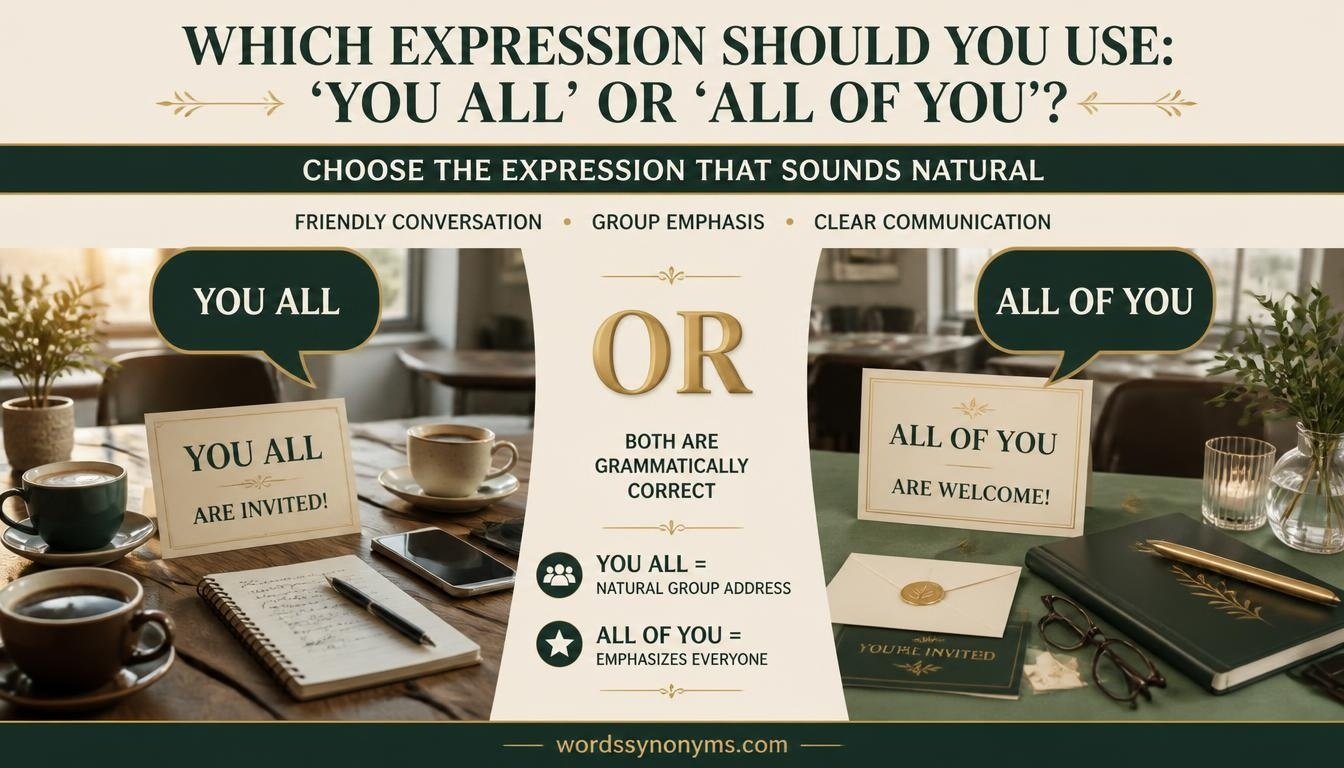
Choosing between “you all” and “all of you” becomes easier when you understand your audience and intended meaning.
Both expressions are correct. Neither one needs to replace the other in every situation.
However, a few practical guidelines can help you decide.
Choose “you all” when:
- You’re addressing several people in everyday conversation.
- You want a friendly, conversational tone.
- You’re asking a group a direct question.
- The expression matches your natural speaking style.
- You’re writing an informal message to friends or colleagues.
Choose “all of you” when:
- You want to emphasize every person in a group.
- You’re giving instructions that apply to everyone.
- You’re thanking an entire group.
- You’re writing an invitation or announcement.
- You want to make complete inclusion especially clear.
Consider these final examples:
| Your Situation | Recommended Expression | Example |
| Greeting friends | You all | You all look fantastic! |
| Thanking everyone | All of you | I’m grateful to all of you. |
| Asking a group question | Either | Are you all ready? |
| Giving group instructions | Either | All of you must participate. |
| Sending a casual message | You all | I miss you all! |
| Making an inclusive announcement | All of you | All of you are welcome. |
The simplest rule: Use the expression that sounds natural and communicates your meaning clearly. You don’t need to follow an artificial distinction between formal and informal English.
FAQs
1. Are “you all” and “all of you” grammatically correct?
Yes, both expressions are grammatically correct. You can use either when speaking to a group of people. The main difference is their tone and emphasis.
2. Is “you all” more common in American English?
Yes, “you all” is especially common in American English, particularly in Southern regions. Many speakers also use it in everyday conversations because it sounds friendly and natural.
3. Does “all of you” sound more formal than “you all”?
Sometimes. “All of you” can sound more deliberate because it emphasizes every person in a group. However, it isn’t automatically more formal in every situation.
4. Can I use “you all” in professional emails?
Absolutely! You can use “you all” when addressing colleagues or team members. For example, “Thank you all for your hard work” sounds friendly and professional.
5. Which expression emphasizes every person in a group?
“All of you” usually places stronger emphasis on every individual. For example, “I appreciate all of you” makes your appreciation feel more personal and inclusive.
6. Is “you all” appropriate for academic writing?
Yes, but consider your institution’s writing guidelines and the surrounding sentence. In formal academic writing, “all of you” or a more specific expression may sometimes fit better.
Conclusion
Choosing between “you all” vs “all of you” doesn’t have to be confusing. Both expressions are grammatically correct and work when addressing multiple people. The main difference comes down to tone, emphasis, and context. “You all” sounds shorter and more conversational, while “all of you” often highlights every person in the group. You’ll hear both in everyday conversations, professional settings, and American English. Instead of worrying about which phrase is always correct, consider your audience and what you want to communicate.
The best way to remember this difference is through regular practice. Try using both expressions in emails, group discussions, and everyday conversations. Pay attention to how native speakers use them in different situations. Once you understand their subtle differences, choosing the right phrase becomes much easier. Remember, good English isn’t just about following grammar rules. It’s also about expressing your thoughts clearly and naturally.

Franklin Hayes is a writer and editor at WordsConfusing.com, focused on making English vocabulary, grammar, and commonly confused words easy to understand. He writes clear, practical articles with simple explanations and useful examples to help readers improve their English with confidence.
His goal is simple: Making Confusing Words Simple.