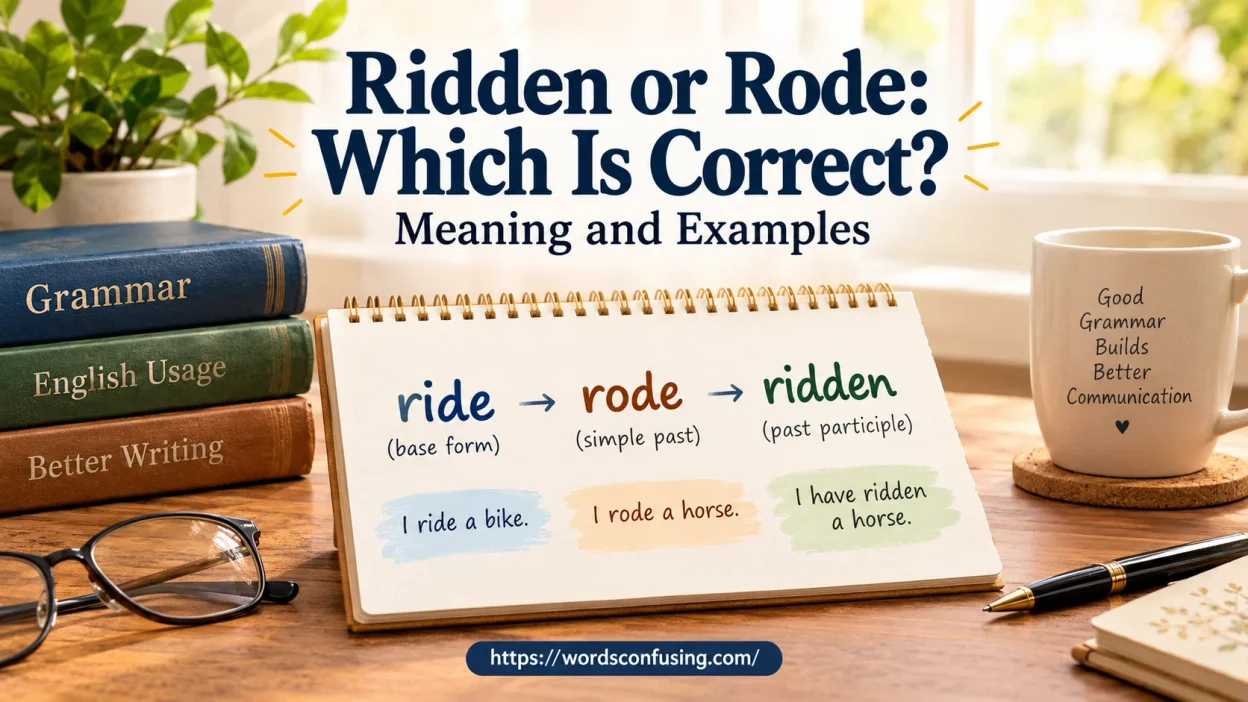
Ridden or Rode: Which Is Correct? Learn how English grammar, verb forms, and past tense rules help you choose the correct word in everyday writing.
The difference between rode and ridden depends on grammar, not spelling or differences between British English and American English. Both come from the irregular verb ride, but they serve different purposes. Rode is the simple past form used for completed past actions. Ridden is the past participle, which follows a helping verb such as have or has.
For example, “I have rode a horse” is an incorrect sentence. The correct sentence is “I have ridden a horse.” Similarly, “She rode a bicycle yesterday” is correct, while “She has ridden a bicycle” follows the present perfect tense structure.
A simple memory trick can help you avoid mistakes: use rode for past actions and ridden after have or has. Understanding these grammar rules improves your English writing, word choice, and writing confidence in emails, school assignments, social media posts, and professional articles. With regular practice, you can use both forms correctly in everyday English.
Quick Answer
Use rode when you describe a completed past action without a perfect-tense helping verb. Use ridden when the sentence requires a past participle.
Rode: She rode a horse during her vacation.
Have ridden: She has ridden horses since childhood.
Had ridden: She had ridden a horse before she entered the competition.
Was ridden: The horse was ridden by an experienced trainer.
Notice that ridden doesn’t always require have, has, or had. Passive constructions can also use this past participle with forms of be, such as was and is.

Ridden or Rode: What’s the Difference?
The main difference between ridden and rode involves their grammatical roles. Both words describe riding, but each serves a different purpose in a sentence.
Rode is the simple past form of ride. Use it when describing an action that happened in the past.
Ridden is the past participle of ride. It usually appears with a helping verb to form perfect tenses. It can also appear in passive constructions.
Consider these examples:
| Word | Grammatical form | Example |
| Ride | Base form and present tense | I ride my bike every morning. |
| Rode | Simple past tense | I rode my bike yesterday. |
| Ridden | Past participle | I have ridden my bike before. |
These three forms belong to an irregular verb. Unlike regular verbs such as walk, walked, and walked, the verb ride changes its form in the past tense and past participle.
You don’t write rided in standard English. Instead, remember the correct sequence: ride → rode → ridden.
What Does Rode Mean?
The word rode is the simple past tense of ride. It describes an action that took place before the present moment.
You can use it when talking about bicycles, horses, motorcycles, scooters, and other things people ride. The word can also describe traveling in a vehicle as a passenger.
For example, imagine that you went cycling with friends yesterday. When someone asks what you did, you might say, “I rode my bicycle around the park.”
The action happened in the past, so rode is the right choice.
Rode as the Simple Past Tense
The simple past tense describes an action or event that occurred at a particular time in the past. The action may have lasted several minutes or several hours, but the sentence presents it as a past event.
Common time expressions used with rode include:
- Yesterday
- Last night
- Last week
- Two days ago
- When I was younger
- During our vacation
- In 2024
These expressions often help you recognize when the simple past tense fits naturally.
Consider the following examples:
- My brother rode his motorcycle to work yesterday.
- We rode horses during our trip to the countryside.
- She rode the bus home after school.
- They rode their bicycles along the river last weekend.
- I rode a scooter for the first time last summer.
- He rode the train to another city during his vacation.
Each sentence describes an event that occurred in the past. Therefore, rode is the appropriate verb form.
However, a past-time expression isn’t the only factor that determines your choice. The structure of the sentence matters, too.
For example, “I had ridden a horse before the competition” describes a past experience that happened before another past event. Even though the sentence refers to the past, it requires had ridden, not had rode.
Examples of Rode in Everyday Sentences
The easiest way to understand rode is to see how people use it in ordinary conversations.
| Situation | Example sentence |
| Cycling | I rode my bike to the grocery store. |
| Horseback riding | Emma rode a horse for the first time. |
| Public transportation | We rode the bus to the museum. |
| Motorcycle travel | Daniel rode his motorcycle through the mountains. |
| Childhood memory | I rode my bicycle every afternoon as a child. |
| School trip | Our class rode a train to the capital. |
| Weekend activity | They rode scooters at the skate park. |
| Family outing | My cousins rode horses at the ranch. |
These examples show that rode works with different kinds of transportation and riding activities.
The object doesn’t determine whether you need rode or ridden. Instead, the verb’s grammatical role determines the correct form.
Rode in Negative Sentences
Negative sentences in the simple past usually use did not or its contraction didn’t, followed by the base form ride.
For example:
- Correct: I didn’t ride my bicycle yesterday.
- Incorrect: I didn’t rode my bicycle yesterday.
- Correct: She didn’t ride the horse during the lesson.
- Incorrect: She didn’t ridden the horse during the lesson.
Why does this happen?
The helping verb did already marks the sentence as past tense. Therefore, the main verb returns to its base form, ride.
The same rule applies to questions.
- Correct: Did you ride your bike yesterday?
- Incorrect: Did you rode your bike yesterday?
- Correct: Did he ride a horse during the trip?
- Incorrect: Did he ridden a horse during the trip?
Remember this simple rule: after did or didn’t, use ride, not rode or ridden.
Read more: What Does Education Level Mean?
What Does Ridden Mean?
Ridden is the past participle of the verb ride. It helps form perfect tenses and appears in passive constructions.
Unlike rode, ridden generally doesn’t stand alone as the main verb in an ordinary active sentence describing a completed past action.
For example, “I ridden a horse yesterday” is incorrect in standard English. You need a helping verb or a different sentence structure.
Compare these examples:
- Correct: I rode a horse yesterday.
- Correct: I have ridden a horse before.
- Correct: I had ridden a horse before the competition.
- Incorrect: I ridden a horse before.
The word ridden communicates the action through the grammatical structure surrounding it. Understanding that structure makes the difference easier to remember.
Ridden With Have, Has, and Had
One of the most common uses of ridden occurs in perfect tenses. These tenses combine a form of have with a past participle.
The three common patterns are:
- Have ridden: I have ridden a bicycle before.
- Has ridden: She has ridden that motorcycle several times.
- Had ridden: They had ridden for an hour before stopping.
Each helping verb serves a different grammatical purpose.
Have ridden forms the present perfect tense. It often connects a past action or experience to the present.
For example, “I have ridden a horse” tells someone that you have that experience. The sentence doesn’t specify exactly when the ride happened.
Has ridden follows the same rule but works with third-person singular subjects, such as he, she, and it.
For example, “Mia has ridden a horse before” tells us about Mia’s experience.
Had ridden forms the past perfect tense. It describes an action that happened before another past event or reference point.
For example, “Mia had ridden a horse before she entered the riding competition.” Her earlier experience came before the competition.
Here’s a quick comparison:
| Helping verb | Correct form | Example |
| Have | Have ridden | I have ridden a horse. |
| Has | Has ridden | He has ridden a horse. |
| Had | Had ridden | She had ridden a horse before. |
A reliable way to check your sentence is to look for have, has, or had. When you’re using one of these verbs to form a perfect tense, choose ridden rather than rode.
Ridden in the Present Perfect Tense
The present perfect tense connects an earlier action with the present. It often describes experiences, repeated activities, or actions whose results matter now.
For example:
- I have ridden a horse several times.
- She has ridden this bicycle since childhood.
- We have ridden that train before.
- My father has ridden motorcycles for many years.
- They have ridden together on several cycling trips.
These sentences focus on experience or a connection to the present rather than a specific completed time.
Compare the following statements:
“I rode a horse last Saturday.”
This sentence identifies a specific past event. The simple past tense fits naturally because the speaker tells us when the ride occurred.
“I have ridden a horse before.”
This sentence describes an experience without specifying when it happened. The present perfect tense is appropriate.
In standard English, the present perfect usually doesn’t accompany a finished-time expression such as yesterday or last Saturday when that expression identifies the completed event.
For example, write “I rode a horse yesterday,” rather than “I have ridden a horse yesterday.”
The difference isn’t about whether the action is complete. Both rides may be over. The distinction involves how the speaker connects the event to the present and how the sentence expresses its timing.
Ridden in the Past Perfect Tense
The past perfect tense describes an action that happened before another past event or reference point.
Its structure is simple:
Subject + had + ridden
For example:
- I had ridden a horse before I started riding lessons.
- She had ridden the bicycle for years before buying a new one.
- They had ridden for three hours when the rain began.
- We had ridden that route before the road closed.
- He had ridden a motorcycle before he turned eighteen.
In each example, had ridden establishes an earlier event. Another past event provides the reference point.
Consider this situation: Alex arrived at a riding school and joined a beginner’s class. The instructor asked whether he had any experience.
Alex replied, “I had ridden a horse once before I joined this class.”
The past perfect helps explain that his earlier ride happened before he joined the class.
You don’t need the past perfect every time you mention two past events. However, it can clarify the sequence when you want to emphasize that one event preceded another.
Ridden in Passive Constructions
Another important use of ridden appears in passive sentences.
In an active sentence, the subject performs the action:
- An experienced rider rode the horse.
- The trainer has ridden the horse several times.
In a passive sentence, the subject receives the action:
- The horse was ridden by an experienced rider.
- The horse has been ridden several times.
- The motorcycle was ridden during the demonstration.
These examples show why ridden doesn’t always need have, has, or had. Passive constructions use forms of be with the past participle.
Common patterns include:
| Structure | Example |
| Was + ridden | The horse was ridden by a beginner. |
| Is + ridden | The horse is ridden during training sessions. |
| Has been + ridden | The horse has been ridden by several students. |
| Will be + ridden | The horse will be ridden in tomorrow’s demonstration. |
The phrase was ridden is grammatically correct because was introduces the passive construction and ridden supplies the past participle.
One caution matters here: don’t assume every sentence containing ridden is passive. “I have ridden a horse” is active because the subject, I, performs the action.

Ridden or Rode: Examples in Everyday English
Sometimes the easiest way to learn grammar is to compare two sentences that describe similar situations. When you see the difference side by side, the correct form becomes easier to recognize.
Comparing Rode and Ridden in Similar Sentences
| Rode | Ridden |
| I rode a horse yesterday. | I have ridden a horse before. |
| She rode her bike to school. | She has ridden her bike to school many times. |
| We rode the train last weekend. | We have ridden that train several times. |
| He rode a motorcycle last summer. | He had ridden a motorcycle before his accident. |
| They rode the roller coaster on Friday. | They have ridden that roller coaster before. |
| My grandfather rode horses as a young man. | My grandfather had ridden horses before he bought his first car. |
The first column uses the simple past tense to report past events. The second column uses ridden in perfect-tense constructions.
However, the choice doesn’t depend only on whether the event has ended. It also depends on how you connect that event to another time.
For instance, both “I rode a horse yesterday” and “I have ridden a horse” can describe a completed ride. The first identifies a specific past occasion, while the second emphasizes experience.
A Practical Example: Choosing the Correct Word
Imagine that Sarah is talking to her friend about a horseback-riding trip.
Her friend asks, “What did you do last weekend?”
Sarah replies, “I rode a horse at a ranch.”
Later, her friend asks, “Have you ever ridden a horse before?”
Sarah answers, “Yes, I have ridden horses several times.”
Both answers are correct because the questions use different grammatical structures.
The first question asks about a particular past period. The second asks about Sarah’s experience at any time before the present.
Now imagine Sarah describing an earlier event: “I had ridden horses before I visited that ranch.”
The past perfect establishes that her earlier riding experience preceded the visit.
This simple conversation illustrates three common uses:
- Rode: Reports a past event.
- Have ridden: Describes an experience or past action connected to the present.
- Had ridden: Establishes an action that occurred before another past event.
Common Mistakes When Using Ridden and Rode
Even confident English speakers sometimes confuse irregular verbs. The mistake usually happens when someone uses the simple past form where the sentence needs a past participle.
Learning a few common errors will help you catch these problems before they appear in your writing.
Mistake: Saying “I Have Rode”
Incorrect: I have rode a bicycle before.
Correct: I have ridden a bicycle before.
The present perfect tense requires have or has followed by a past participle. Since ridden is the past participle of ride, it completes the sentence correctly.
Other examples include:
- Incorrect: She has rode a horse.
- Correct: She has ridden a horse.
- Incorrect: We have rode that train.
- Correct: We have ridden that train.
- Incorrect: He has rode his motorcycle today.
- Correct: He has ridden his motorcycle today.
Whenever you see have or has introducing a perfect-tense construction, check whether the following verb uses its past participle form.
Mistake: Saying “Yesterday, I Ridden a Horse”
Incorrect: Yesterday, I ridden a horse.
Correct: Yesterday, I rode a horse.
The sentence describes a completed event that happened yesterday. The simple past tense is the natural choice, and rode provides the correct form.
You could also write “I rode a horse yesterday afternoon” or “I rode a horse during my vacation.”
Both sentences use the simple past correctly.
If you want to use ridden, you need to change the sentence structure:
- Correct: I have ridden a horse before.
- Correct: I had ridden a horse before the lesson.
- Correct: The horse was ridden yesterday.
Notice that the last example uses ridden in a passive construction. It doesn’t require a perfect-tense helping verb.
Mistake: Writing “Had Rode” Instead of “Had Ridden”
Incorrect: She had rode a horse before the competition.
Correct: She had ridden a horse before the competition.
The past perfect tense follows the pattern had + past participle. Therefore, had ridden is the correct construction.
More examples make this rule easier to remember:
- Incorrect: They had rode the bus before.
- Correct: They had ridden the bus before.
- Incorrect: I had rode a bicycle as a child.
- Correct: I had ridden a bicycle as a child.
- Incorrect: He had rode a motorcycle before moving abroad.
- Correct: He had ridden a motorcycle before moving abroad.
The word had signals the past perfect construction. Once you recognize it, choosing ridden becomes much easier.
Mistake: Using “Rode” After “Did”
Incorrect: Did you rode your bike to school?
Correct: Did you ride your bike to school?
Questions with did use the base form of the main verb. The helping verb already marks the question as past tense.
The same principle applies to negative statements.
- Incorrect: I didn’t rode the bus.
- Correct: I didn’t ride the bus.
- Incorrect: She didn’t ridden a horse.
- Correct: She didn’t ride a horse.
- Incorrect: Did he rode the motorcycle?
- Correct: Did he ride the motorcycle?
Here’s a quick reminder: use ride after did and didn’t.
Mistake: Assuming Every Past Action Requires Ridden
Some learners believe ridden is always correct because it sounds more formal. However, ridden isn’t a replacement for rode.
Consider these examples:
- Correct: I rode my bike to the park.
- Incorrect: I ridden my bike to the park.
- Correct: We rode the bus yesterday.
- Incorrect: We ridden the bus yesterday.
The simple past tense doesn’t need a past participle. If your sentence describes a straightforward past event, rode is usually the right choice.
Read more: What Are People From India Called?
How to Remember the Difference Between Ridden and Rode
You don’t need to memorize complicated grammar terminology to use these words correctly. A simple pattern and a few examples can help you remember the difference.
Remember the Three Forms of Ride
Start with this sequence:
Ride → Rode → Ridden
Each form has a distinct grammatical role.
- Ride: The base form, used in the present tense and after certain helping verbs.
- Rode: The simple past form, used to report past events.
- Ridden: The past participle, used in perfect tenses and passive constructions.
Try associating each form with a short sentence:
- Every day, I ride my bicycle.
- Yesterday, I rode my bicycle.
- I have ridden my bicycle many times.
The examples follow a logical progression. The first describes a present habit, the second reports a past event, and the third describes experience.
Use the Helping-Verb Trick
When you’re unsure whether to write rode or ridden, look at the words around the verb.
If you see have, has, or had forming a perfect tense, use ridden.
- I have ridden.
- She has ridden.
- They had ridden.
If the sentence uses did in a question or negative statement, use ride.
- Did you ride?
- I didn’t ride.
If you’re describing a completed past event without those constructions, rode usually fits.
- We rode yesterday.
- He rode to work.
- They rode together last weekend.
This trick won’t replace every grammar rule, but it will help you solve most everyday questions involving these forms.
Quick Practice: Ridden or Rode?
Test your understanding by choosing the correct form for each sentence. Try answering before checking the solutions.
- I have never _____ a motorcycle.
- She _____ her bicycle to school yesterday.
- They had _____ the train before the service was canceled.
- Did you _____ a horse during your vacation?
- The horse was _____ by an experienced rider.
- We _____ the roller coaster last weekend.
- He has _____ that route many times.
- My brother didn’t _____ his bike yesterday.
Answers and explanations
| Number | Answer | Explanation |
| 1 | Ridden | Present perfect uses have + past participle. |
| 2 | Rode | Yesterday identifies a completed past event. |
| 3 | Ridden | Past perfect uses had + past participle. |
| 4 | Ride | Questions with did take the base form. |
| 5 | Ridden | Passive constructions use a past participle. |
| 6 | Rode | The simple past describes the weekend event. |
| 7 | Ridden | Present perfect uses has + past participle. |
| 8 | Ride | Negative statements with didn’t take the base form. |
If you answered all eight correctly, you’ve understood the main distinction. If you missed a few, review the helping-verb patterns before moving on.

Ridden or Rode: Which One Should You Use?
Choosing between ridden and rode becomes much easier when you identify the sentence structure first. Instead of guessing which word sounds better, look for the tense and any helping verbs.
Use this quick guide whenever you’re uncertain.
| If your sentence… | Use | Example |
| Describes a completed past event | Rode | I rode a bicycle yesterday. |
| Uses the present perfect tense | Ridden | I have ridden a bicycle before. |
| Uses the past perfect tense | Ridden | I had ridden before the lesson. |
| Uses the passive voice | Ridden | The bicycle was ridden by a child. |
| Uses did in a question | Ride | Did you ride yesterday? |
| Uses didn’t in a negative sentence | Ride | I didn’t ride yesterday. |
| Describes a present habit | Ride | I ride my bicycle every morning. |
| Uses the future tense with will | Ride | I will ride tomorrow. |
The most reliable approach is to identify the grammatical pattern before choosing the word.
For example, the sentence “I have ridden a horse” requires the past participle. However, “I rode a horse yesterday” requires the simple past tense.
Remember: The time of an event alone doesn’t determine whether you need rode or ridden. The sentence structure matters just as much.
FAQs
1. Is it “I have rode” or “I have ridden”?
“I have ridden” is correct because the helping verb have requires the past participle. For example, “I have ridden my bike to school.”
2. Is rode the past tense of ride?
Yes, rode is the simple past tense of ride. Use it when describing an action that happened in the past, such as “We rode horses last weekend.”
3. When should I use ridden in a sentence?
Use ridden with helping verbs such as have, has, or had. For example, “She has ridden a horse before” and “They had ridden the train several times.”
4. Is “I rode a horse” grammatically correct?
Yes, “I rode a horse” is grammatically correct. The sentence describes a completed past action without needing a helping verb.
5. Are ridden and rode used differently in American and British English?
No, both American English and British English follow the same basic rule. Rode is the simple past form, while ridden is the past participle.
6. What is an easy way to remember rode vs. ridden?
Remember this simple pattern: ride → rode → ridden. Use rode for a past action and ridden after have, has, or had. For example, “I rode yesterday” and “I have ridden before.”
Conclusion
Choosing between ridden and rode becomes easier once you understand how each word works. Use rode when describing a completed past action, such as “I rode my bike yesterday.” Choose ridden when a helping verb like have, has, or had appears in the sentence, as in “I have ridden my bike many times.” Both forms come from the verb ride, but they cannot always replace each other.
A helpful way to remember the difference is to practice the pattern ride, rode, ridden with everyday examples. You might say, “We rode horses during our vacation,” but “We have ridden horses before.” Notice how the helping verb changes the form you need. This small grammar rule can prevent common mistakes and improve your English writing.
Whether you’re writing a school assignment, sending a professional email, posting on social media, or speaking in everyday conversations, choosing the correct form makes your sentences sound more natural. With a little practice, you’ll recognize when to use rode and when ridden fits best.

Franklin Hayes is a writer and editor at WordsConfusing.com, focused on making English vocabulary, grammar, and commonly confused words easy to understand. He writes clear, practical articles with simple explanations and useful examples to help readers improve their English with confidence.
His goal is simple: Making Confusing Words Simple.