


In Yep vs. Yup: Which One Should You Use?, tone, context, and casual English help you choose the right expression for everyday conversations.
Both yep and yup are correct informal ways to say yes in American English. Yep often sounds straightforward, neutral, and natural, while yup can feel more relaxed, friendly, or matter of fact. Their meaning, pronunciation, and usage are similar, but subtle differences can affect message interpretation.
Neither word is automatically rude or incorrect. When answering a question, confirming meetings, or sending a short reply, consider your audience, purpose, and conversation to communicate with confidence and clarity.
Your choice between yep and yup also depends on your communication settings. In texts, chats, online conversations, and workplace chats, both expressions can sound natural. However, texting habits, punctuation, and the situation can make a message feel cold or warm. For business communication, emails, workplace platforms, and professional communication, a full yes may suit formal writing and important workplace interactions better.
The same applies to online booking, a shared calendar, project management, scheduling, time management, and broadcasting information. Good grammar, consistency, and readability support clear written communication and spoken English. When you compare yep, yup, yeah, and yes, consider formality, conversational style, and appropriate tone.
These language choices, language differences, and nuances become easier to understand through simple examples, practical examples, and useful usage rules, helping you use these common expressions confidently and correctly in everyday usage and different communication purposes.
Quick Answer
“Yep” and “yup” are informal ways to say “yes.” They express agreement, confirm information, and answer questions in everyday conversations. Their primary difference is pronunciation, although some speakers associate each spelling with a slightly different tone.
- Yep: Pronounced with a short e sound, as in “bed.”
- Yup: Pronounced with a short u sound, as in “cup.”
- Meaning: Both generally mean “yes.”
- Formality: Both are informal and suit casual conversations.
- Usage: Both work in text messages, friendly chats, and informal dialogue.
Consider this simple exchange:
Person A: “Are we still meeting at six?”
Person B: “Yep!”
You could replace “Yep!” with “Yup!” without changing the basic meaning. The choice depends on which spelling you prefer and how you want your response to sound.
| Feature | Yep | Yup |
| Meaning | Yes | Yes |
| Pronunciation | /jɛp/ | /jʌp/ |
| Formality | Informal | Informal |
| Common use | Casual confirmation | Casual confirmation |
| Text messaging | Appropriate | Appropriate |
| Formal writing | Usually avoid | Usually avoid |
| Main distinction | Short e vowel | Short u vowel |
The key takeaway is simple: both words are correct in informal English, but “yes” is generally safer in formal situations.
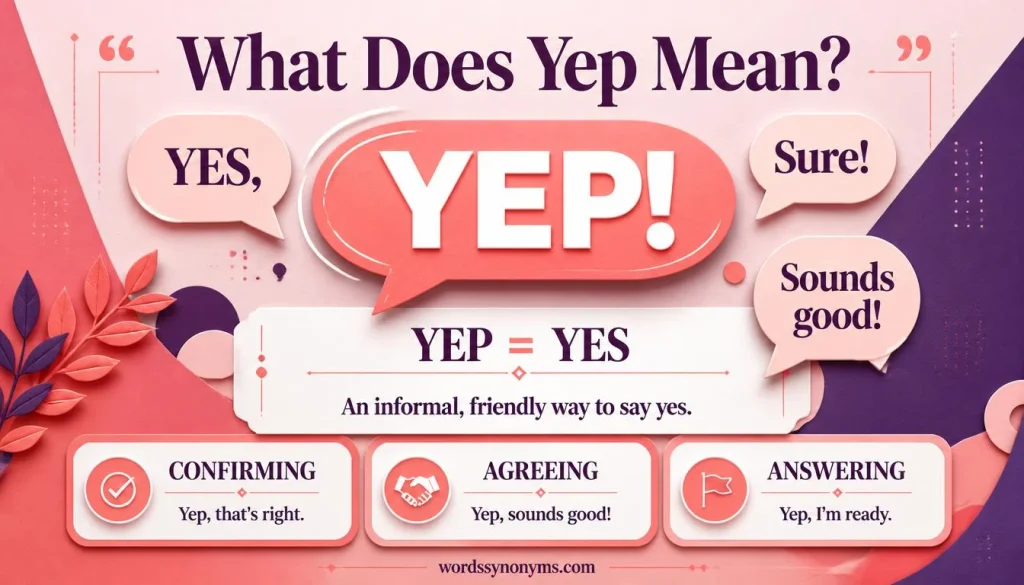
What Does Yep Mean?
“Yep” is an informal expression that means “yes.” People use it to answer questions, confirm details, agree with statements, or acknowledge information.
It’s especially common in everyday conversations because it offers a quick, natural response without sounding overly formal. Instead of saying “Yes, I have completed the assignment,” you might simply say, “Yep, I finished it.”
The word can stand alone or appear as part of a longer sentence. Its meaning usually becomes clear from the surrounding conversation.
For example:
- “Did you lock the door?” “Yep.”
- “Are you free this afternoon?” “Yep, after three.”
- “Is this the right document?” “Yep, that’s the one.”
- “Did you understand the instructions?” “Yep, everything makes sense.”
- “Are you coming to dinner?” “Yep, I’ll be there.”
In each example, “yep” communicates an affirmative answer. The additional words simply provide more detail or make the response sound warmer.
Examples of Yep in Different Situations
Although “yep” generally means “yes,” its role can change slightly depending on the conversation.
Confirming information
“Yep, that’s my email address.”
Here, the speaker confirms that the information is correct.
Agreeing with a suggestion
“Yep, let’s meet at the coffee shop.”
The speaker agrees with a proposed plan and adds a next step.
Acknowledging a completed task
“Yep, I sent the report this morning.”
The response confirms that the task is finished.
Answering a simple question
“Did you bring your keys?”
“Yep.”
The short reply answers the question without unnecessary explanation.
These examples show why “yep” works well in everyday speech. It communicates agreement quickly while leaving room for additional information when needed.
Is Yep a Real Word?
Yes. “Yep” is an established informal English expression, not a spelling mistake or a made-up internet abbreviation.
It appears in dictionaries and is widely understood by English speakers. Although it belongs to informal language, that doesn’t make it incorrect.
Think of the difference between “yes” and “yep” as a difference in register. Register refers to the level of formality you choose for a particular situation.
For example:
- Formal: “Yes, I have received your application.”
- Neutral: “Yes, I received your message.”
- Informal: “Yep, I got your message.”
All three sentences communicate confirmation. However, they suit different conversational settings.
Use “yep” when the situation calls for a relaxed response. Choose “yes” when you need a more formal or neutral tone.
What Does Yup Mean?
“Yup” is another informal expression meaning “yes.” Like “yep,” it helps people answer questions, express agreement, and confirm details in casual conversations.
The main difference is its vowel sound. “Yup” uses the short u sound found in words such as “cup,” “luck,” and “sun.”
For many speakers, “yup” feels relaxed and conversational. However, this impression isn’t a strict language rule. Some people use “yup” and “yep” interchangeably without attaching any difference in tone to either word.
Here are some examples:
- “Did you get my message?” “Yup.”
- “Are you coming with us?” “Yup, I’ll be there.”
- “Is everything ready?” “Yup, we’re all set.”
- “Do you need anything from the store?” “Yup, just some milk.”
- “Did you finish the book?” “Yup, I read the last chapter.”
Notice that you can replace “yup” with “yep” in each example. The essential meaning stays the same.
Examples of Yup in Everyday Conversation
“Yup” works in several common situations.
Confirming a plan
“Are we leaving at seven?”
“Yup, I’ll meet you outside.”
The response confirms the time and adds a practical detail.
Agreeing with a friend
“That’s exactly what I was thinking.”
“Yup!”
Here, the word signals agreement with the other person’s opinion.
Confirming receipt
“Did you get the photos I sent?”
“Yup, they look great.”
The speaker acknowledges receiving the photos and offers a brief comment.
Responding to a routine question
“Did you remember to charge your laptop?”
“Yup, it’s ready to go.”
The response confirms that the task is complete.
These examples demonstrate that “yup” is useful whenever a short affirmative answer feels natural.
Is Yup a Real Word?
Yes. “Yup” is an established informal English word that appears in dictionaries and everyday writing.
Some people mistakenly assume that “yup” is incorrect because “yes” is the more standard form. However, informal expressions don’t become incorrect simply because they differ from formal vocabulary.
English includes many accepted conversational forms. “Yeah,” “yep,” and “yup” are familiar examples, although they differ in pronunciation and style.
The important point is to match your wording to your audience. In a friendly text message, “Yup, sounds good” is perfectly understandable. In a formal application or academic paper, “Yes, that is correct” is a better choice.
Read more: Bosses or Boss’s or Boss’: What’s the Difference?
The Main Difference Between Yep and Yup
The most noticeable difference between “yep” and “yup” is their vowel sound. Both communicate agreement, but they use different spellings to represent different pronunciations.
Beyond pronunciation, the distinction becomes less definite. Some speakers feel that “yep” sounds more direct, while “yup” sounds more relaxed. Others hear no meaningful difference in tone.
Therefore, it’s better to treat those tonal differences as possible impressions rather than universal rules.
Difference Between Yep and Yup in Pronunciation
Although the two words differ by only one letter, their vowel sounds are distinct in many varieties of American English.
Yep: /jɛp/
The vowel resembles the sound in “bed,” “get,” and “step.” To pronounce it, begin with the initial y sound, use the short e vowel, and finish with the p sound.
Yup: /jʌp/
The vowel resembles the sound in “cup,” “luck,” and “sun” in many American accents. Begin with the same y sound, use the short u vowel, and finish with the p sound.
Try saying these pairs aloud:
- Yep — bed
- Yup — cup
- Yep — step
- Yup — luck
The vowel provides the clearest distinction between the words. However, accents can influence how vowels sound, so pronunciation may vary somewhat between speakers.
Difference Between Yep and Yup in Tone
Tone is where personal interpretation enters the picture.
Some speakers perceive “yep” as a straightforward, matter-of-fact response. They might use it to confirm information without adding much emotion.
Others associate “yup” with a laid-back or casual conversational style. In certain contexts, it can sound friendly, relaxed, or simply brief.
However, neither word automatically communicates enthusiasm, annoyance, friendliness, or indifference.
Compare these examples:
Example one:
“Are you ready?”
“Yep, let’s go!”
The extra words and exclamation mark make the response sound enthusiastic.
Example two:
“Are you ready?”
“Yup.”
This answer is shorter and may sound more neutral because it offers no additional emotional cues.
Now switch the words:
“Are you ready?”
“Yep.”
“Are you ready?”
“Yup, let’s go!”
The perceived tone changes with the complete response, not just the spelling.
Practical rule: Consider the entire message rather than judging someone’s feelings from “yep” or “yup” alone.
Difference Between Yep and Yup in Usage
Both words appear in informal conversations, text messages, online chats, and casual dialogue.
Neither has an exclusive purpose. You don’t need to use “yep” for questions about facts or “yup” for questions about plans.
For example, both responses work naturally:
- “Did you finish the assignment?” “Yep.”
- “Did you finish the assignment?” “Yup.”
- “Are you free tomorrow?” “Yep.”
- “Are you free tomorrow?” “Yup.”
The speaker’s personal habits often determine which word feels more natural.
If you’re writing a story, you might choose one spelling consistently for a character’s dialogue. That decision can help maintain a consistent voice, especially when several characters have different speech patterns.
In ordinary conversation, though, there’s no need to overthink the choice.
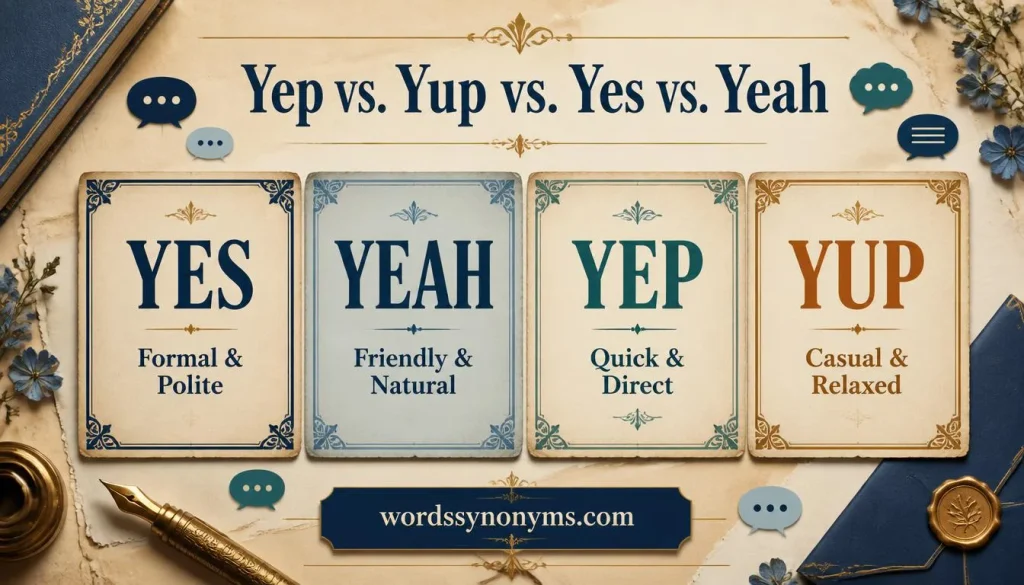
Yep vs. Yup vs. Yes vs. Yeah
“Yep,” “yup,” “yes,” and “yeah” all express affirmation, but they don’t always create the same impression.
“ Yes” is the standard affirmative word. “Yeah” is a familiar conversational alternative, while “yep” and “yup” are short, informal responses.
The best choice depends on the setting, your relationship with the other person, and the tone you want to convey.
| Word | General style | Example |
| Yes | Neutral or formal | “Yes, I received the file.” |
| Yeah | Informal and conversational | “Yeah, that sounds good.” |
| Yep | Informal and direct | “Yep, I received it.” |
| Yup | Informal and casual | “Yup, got it.” |
These descriptions represent common impressions rather than fixed rules. A speaker can use any of these words with different levels of enthusiasm depending on delivery and context.
Yep vs. Yup vs. Yeah
“Yeah” often works as a conversational alternative to “yes.” It can express agreement, acknowledge a point, or introduce a response.
For example:
“Do you like the new design?”
“Yeah, it looks great.”
“Yep” and “yup” can answer the same question, but they may feel more like brief confirmations.
- “Yeah, it looks great.”
- “Yep, it looks great.”
- “Yup, it looks great.”
All three responses communicate approval. The precise emotional meaning depends on the speaker and conversation.
When Should You Use Yes Instead of Yep or Yup?
Choose “yes” when clarity and formality matter more than casual style.
It works well in:
- Professional emails to clients or senior colleagues.
- Academic assignments and formal reports.
- Official forms and written statements.
- Job applications and interviews.
- Serious conversations that require a clear answer.
For example, imagine a manager asks whether you have reviewed an important contract.
Casual workplace chat: “Yep, I’ve reviewed it.”
Formal email: “Yes, I’ve reviewed the contract and completed my comments.”
Both are understandable, but the second response provides a more professional tone and additional information.
Remember that “yes” isn’t always stiff or formal. It can sound perfectly natural in everyday conversation. The main advantage is its flexibility across different settings.
When Should You Use Yep or Yup?
Choosing between “yep” and “yup” rarely requires a complicated decision. Since both expressions communicate agreement, personal preference and context usually matter more than strict rules.
Still, a few practical guidelines can help you decide.
When to Use Yep
Use “yep” when you want a brief, informal response that feels natural in conversation.
It works particularly well when confirming information or answering a straightforward question.
Common situations include:
- Confirming plans with friends.
- Answering routine questions from family members.
- Acknowledging instructions in a casual group chat.
- Agreeing with someone during an informal conversation.
- Responding quickly when the answer is already clear.
Examples:
“Can you pick me up at five?”
“Yep, I’ll be there.”
“Did you save the document?”
“Yep, it’s in the folder.”
“Should we order dinner now?”
“Yep, I’m hungry.”
In each exchange, “yep” keeps the conversation moving without unnecessary formality.
When to Use Yup
Choose “yup” when it matches your usual conversational style or the voice you want to convey.
It works in many of the same situations as “yep.” Some people simply prefer its sound or spelling.
Common situations include:
- Relaxed conversations with friends.
- Casual messages in group chats.
- Informal online discussions.
- Quick confirmations between people who know each other.
- Dialogue where a character naturally uses “yup.”
Examples:
“Are you home yet?”
“Yup, just got in.”
“Want to watch another episode?”
“Yup, let’s do it.”
“Did you bring your notebook?”
“Yup, it’s right here.”
There’s no need to force a distinction where none exists. If “yup” feels more natural to you, it’s a reasonable choice in informal settings.
When to Use Yes Instead of Yep or Yup
Although “yep” and “yup” work well in casual conversation, some situations call for a more standard expression.
Consider the following example.
Question: “Can you confirm that you received the revised proposal?”
A short answer such as “Yep” might work in a relaxed internal chat. However, a client-facing email usually benefits from a fuller response.
Better formal response: “Yes, I received the revised proposal. I’ll review it and send my feedback tomorrow.”
The longer answer confirms receipt and explains the next step.
When you’re unsure which expression fits, consider three things:
- Audience: Are you talking to a friend, teacher, manager, or client?
- Purpose: Are you confirming a simple fact or addressing an important matter?
- Tone: Would a casual response fit the situation?
If the situation is formal or sensitive, “yes” is usually the safer option.
Can You Use Yep and Yup Interchangeably?
Yes. In most everyday situations, you can replace “yep” with “yup” without changing the central meaning.
Both words serve as informal affirmative responses. Neither has a special grammatical function that the other lacks.
Consider this exchange:
Person A: “Did you finish the presentation?”
Response A: “Yep, I finished it this morning.”
Response B: “Yup, I finished it this morning.”
Both responses confirm that the presentation is complete.
The same principle applies to text messages:
- “Yep, that works for me.”
- “Yup, that works for me.”
Either version expresses agreement with a proposed arrangement.
Does Interchanging Yep and Yup Change the Tone?
It can affect the impression a reader gets, but the effect isn’t consistent across all speakers.
One person might find “yep” slightly more direct. Another might consider “yup” more relaxed. A third might treat them as identical.
The surrounding words usually provide stronger clues.
Compare:
- “Yep.”
- “Yep, absolutely!”
- “Yup.”
- “Yup, that sounds perfect.”
The added wording and punctuation influence the tone more clearly than the choice between the two spellings.
When writing dialogue, consistency may matter for characterization. In everyday messages, either spelling is fine.
Are Yep and Yup Appropriate in Text Messages?
Both expressions are common choices for informal text messages. They let you answer quickly without typing a full sentence every time.
If a friend asks, “Are we still meeting tonight?” you can reply “Yep” or “Yup.” The message is short, clear, and appropriate for a casual conversation.
However, short replies can sometimes feel abrupt. This doesn’t mean the words themselves are rude. It simply means the recipient may interpret a brief answer differently depending on the circumstances.
Examples of Yep in Texting
Here are several natural ways to use “yep” in messages:
- “Yep, I’m on my way!”
- “Yep, that works for me.”
- “Yep, I’ll send it tonight.”
- “Yep, I got your email.”
- “Yep, see you tomorrow.”
Each response confirms something while keeping the conversation casual.
Examples of Yup in Texting
You can use “yup” in the same types of messages:
- “Yup, just got home.”
- “Yup, sounds good.”
- “Yup, see you tomorrow.”
- “Yup, I saved the file.”
- “Yup, that’s what I meant.”
These examples demonstrate how easily “yup” fits into everyday digital communication.
Can Yep or Yup Sound Rude in a Text?
Neither word is inherently rude, but a one-word reply can feel dismissive in certain situations.
Imagine that a friend sends you a long message about an important personal problem. Responding with only “Yup” might make the friend feel that you haven’t engaged with what they shared.
The issue isn’t necessarily the spelling. It’s the lack of acknowledgment or emotional support.
Compare these responses:
Very brief: “Yep.”
More engaged: “Yep, I understand what you mean. That sounds really frustrating.”
Supportive: “Yeah, I can see why you’re upset. Do you want to talk about it?”
The longer responses show more attention to the situation.
On the other hand, a one-word answer may be completely appropriate when someone asks a simple question.
“Did you lock the door?”
“Yep.”
No additional explanation is needed.
The lesson: Match the length and warmth of your response to the conversation. A casual confirmation is fine for a routine question, while a sensitive exchange may deserve more care.
Common Mistakes When Choosing Between Yep and Yup
Because these expressions look similar, people sometimes assume that one must be correct and the other incorrect. Most confusion disappears once you understand their shared meaning.
Assuming Yep Is Correct but Yup Is Wrong
Both are established informal expressions. Choosing “yup” doesn’t automatically make your writing grammatically incorrect.
For example, both sentences work in casual dialogue:
- “Yep, I’ll bring the snacks.”
- “Yup, I’ll bring the snacks.”
The spelling changes, but the meaning remains the same.
Assuming Yep Is More Formal Than Yup
Neither expression is a formal substitute for “yes.” Although individual speakers may perceive one as more neutral, both remain informal.
For a formal report, use a complete sentence rather than relying on either word.
Instead of writing:
“Yup, the results were reviewed.”
Write:
“Yes, the results were reviewed and approved.”
The second sentence sounds more appropriate in a professional document.
Assuming Yup Always Sounds Friendlier
Tone doesn’t come from spelling alone. Punctuation, additional wording, and the relationship between speakers all influence how a message feels.
“Yep, absolutely!” may sound enthusiastic, while “Yep.” may sound matter-of-fact.
Likewise, “Yup, no problem!” can sound friendly, while “Yup.” may feel brief.
Don’t assume someone’s mood from one short word without considering the conversation.
Using Yep or Yup in Every Situation
Informal vocabulary has its place, but it doesn’t suit every audience.
A quick “Yep” may work perfectly in a team chat. In a formal complaint response or an important client email, a fuller answer often communicates greater care.
Choose your words based on the situation rather than using the same response everywhere.
Overthinking the Choice
The opposite mistake is treating the distinction as more important than it really is.
If you’re texting a friend, you generally don’t need to spend several minutes choosing between “yep” and “yup.” Both communicate agreement.
Focus on clarity, context, and the message you want to convey.
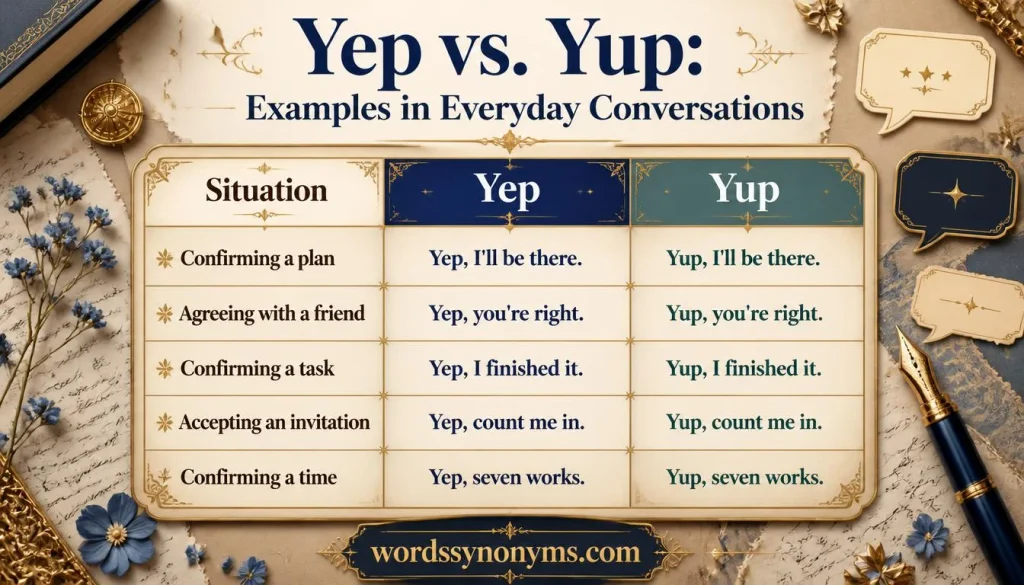
Yep vs. Yup: Examples in Everyday Conversations
The easiest way to understand the difference is to compare both words in similar situations.
The following examples show how the spellings can change while the central meaning stays the same.
| Situation | Example with Yep | Example with Yup |
| Confirming a plan | “Yep, I’ll be there.” | “Yup, I’ll be there.” |
| Answering a question | “Yep, that’s mine.” | “Yup, that’s mine.” |
| Agreeing with a friend | “Yep, you’re right.” | “Yup, you’re right.” |
| Confirming a task | “Yep, I finished it.” | “Yup, I finished it.” |
| Accepting an invitation | “Yep, count me in.” | “Yup, count me in.” |
| Confirming receipt | “Yep, I got it.” | “Yup, I got it.” |
| Responding to a reminder | “Yep, I remember.” | “Yup, I remember.” |
| Confirming a time | “Yep, seven works.” | “Yup, seven works.” |
Practical Case Study: Choosing a Reply at Work
Imagine that a coworker sends you a message asking whether you’ve completed a presentation.
Coworker: “Have you finished the presentation for tomorrow’s meeting?”
You have several possible responses.
A Option: “Yep, it’s ready.”
B Option: “Yup, it’s ready.”
C Option: “Yes, I’ve completed the presentation. I’ll share the final file shortly.”
In an informal workplace chat, Options A and B both sound natural. Your choice between them doesn’t change the essential message.
Option C is more informative and may suit a situation where your coworker needs a clear update. It confirms completion and explains what happens next.
This example highlights an important distinction: the usefulness of a response often depends more on its detail and context than on whether you write “yep” or “yup.”
Practical Case Study: Replying to a Friend
Suppose a friend asks whether you want to watch a movie.
Friend: “Want to watch a movie tonight?”
You could respond:
- “Yep!”
- “Yup!”
- “Yeah, sounds good.”
- “Absolutely! What time?”
All four replies can communicate agreement, but they offer slightly different levels of enthusiasm and detail.
The first two are brief affirmations. The third sounds conversational, while the fourth adds enthusiasm and invites the next step.
There’s no single correct response. Choose the one that reflects what you mean.
Read more: Others or Other’s or Others’: The Correct Usage Explained
FAQs
1. What is the difference between yep and yup?
Yep and yup both mean “yes” and are common in casual English. Yep often sounds straightforward and neutral, while yup can feel a little more relaxed or friendly. The difference is subtle, so either word usually works in everyday conversations.
2. Is yep or yup more professional?
Yep may sound slightly more neutral, but neither word is especially formal. In professional emails, official messages, or important workplace conversations, yes is usually a safer choice. It sounds clear and respectful without being too casual.
3. Is yup a real word or just slang?
Yup is a recognized informal word used to say “yes.” It appears in everyday speech, text messages, online chats, and casual dialogue. Although it is informal, that doesn’t make it incorrect.
4. Can I use yep and yup in text messages?
Yes, both words work well in text messages and online conversations. Use yep for a simple, direct confirmation or yup when you want a relaxed tone. Remember that punctuation and context can affect how your message sounds.
5. Does yep sound rude or unfriendly?
No, yep isn’t inherently rude. However, a very short reply can sometimes seem cold, depending on the conversation and relationship. If you want to sound warmer, try “Yep, sounds good!” or “Yep, thanks for letting me know.”
6. Should I use yep, yup, yeah, or yes?
Choose the word that matches your audience and situation. Yep is straightforward, yup is relaxed, yeah is conversational, and yes works well in both casual and formal settings. When you’re unsure, yes is generally the most versatile option.
Conclusion
Choosing between yep and yup comes down to tone, context, and personal style. Both words mean “yes” and work naturally in casual conversations, text messages, and online chats. Yep often feels direct and neutral, while yup can sound more relaxed and friendly. Neither is incorrect, so you don’t need to worry about choosing the wrong one in everyday English.
For formal emails, professional messages, or important workplace discussions, yes is usually the better choice. Pay attention to your audience and the situation, and you’ll know which expression fits your message best.

Shafiq Ur Rehman is a writer and content contributor at WordsConfusing.com. He enjoys exploring the English language, common word confusions, vocabulary, and practical writing tips. His goal is to make English easier to understand through clear, simple, and useful articles.