


The right words help you describe people who ignore others’ feelings. 8 Words for Someone Who Doesn’t Care About Others’ Feelings explains useful terms for everyday situations.
In everyday conversations and professional settings, people’s behavior, words, and actions can reveal a lack of empathy, consideration, or emotional awareness. Sometimes, it feels difficult to pick a word out of thin air, especially when you want to describe someone without making unfair judgments about their personality.
The English language offers descriptive words and expressions for someone who doesn’t care, but each term has a different meaning and tone. Understanding these subtle differences helps you choose accurate descriptions for different situations. These words can also improve communication and clarity when explaining the impact of someone’s behavior on others.
Using the right vocabulary strengthens your English usage, grammar accuracy, and word choice in formal writing and business communication. Workplace discussions about project management, meetings, time management, and scheduling often require sensitivity and cooperation.
Similar needs arise in modern communication contexts, such as online booking, calendar coordination, and broadcasting environments, where clear messages and awareness of other people’s needs matter.
Choosing precise, respectful language helps you describe a lack of care, disregard for others, or limited emotional sensitivity with confidence and consistency. These descriptive words make your written content clearer and help you reference different behaviors fairly.
Quick Answer
Words for someone who doesn’t care about others’ feelings include insensitive, unempathetic, selfish, callous, inconsiderate, heartless, uncaring, and remorseless. Each word describes a different behavior, from ignoring emotional needs to showing no regret after causing harm. The best choice depends on how the person treats others and responds to their feelings.
What Do You Call Someone Who Doesn’t Care About Others’ Feelings?
The right word depends on how someone treats other people and responds to their emotions. You might describe the person as insensitive if they make hurtful comments, selfish if they consistently put themselves first, or uncaring if they show little interest in another person’s well-being.
In some situations, a stronger word may fit better. For instance, heartless describes behavior that seems cruel or devoid of compassion, while remorseless emphasizes the absence of regret after causing harm.
However, these terms aren’t interchangeable. Someone may struggle to recognize emotional cues without intending to hurt anyone. Another person may recognize those cues perfectly well but choose to disregard them.
It’s also important to distinguish a person’s behavior from their entire character. A single thoughtless comment doesn’t necessarily mean someone lacks empathy. Repeated patterns provide a clearer picture of how a person treats others.
Read more: Can You Start a Sentence With “So”? Rules and Examples
8 Words for Someone Who Doesn’t Care About Others’ Feelings
The following words describe different forms of emotional indifference, self-centeredness, and disregard for other people’s feelings. Each includes a definition, an explanation, and practical examples to help you understand when to use it.
Unempathetic
Meaning: Unable or unwilling to understand, recognize, or share another person’s feelings.
Unempathetic describes someone who struggles to understand another person’s emotional experience or shows little effort to appreciate their perspective. The word relates directly to empathy, which involves recognizing or understanding what someone else might be feeling.
For example, imagine telling a friend that you’re anxious about an important exam. Instead of acknowledging your worries, they dismiss your concerns because they don’t understand why the situation matters to you. Their response may seem unempathetic.
An unempathetic person might struggle to recognize when someone feels embarrassed, disappointed, frightened, or overwhelmed. They may focus on practical facts while overlooking the emotional meaning behind a situation.
However, a lack of empathy doesn’t always indicate deliberate cruelty. Some people have difficulty interpreting emotional cues, while others simply haven’t learned how to respond supportively.
Example sentences:
- His unempathetic response made her feel as though her worries didn’t matter.
- An unempathetic manager may overlook how constant criticism affects employees.
- She sounded unempathetic when she dismissed her friend’s disappointment without listening.
When to use it: Choose unempathetic when you want to emphasize someone’s difficulty understanding or responding to other people’s emotions.
Insensitive
Meaning: Not showing enough awareness of or concern for other people’s feelings.
Insensitive is one of the most common words for someone who doesn’t care about others’ feelings. It describes behavior that ignores emotional boundaries, overlooks personal circumstances, or causes unnecessary hurt.
An insensitive person might make jokes about a sensitive subject, criticize someone in public, or bring up a painful experience without considering how the other person might react.
For example, imagine someone recently lost their job. An insensitive acquaintance might say, “You probably weren’t good at it anyway.” Even if the speaker intended the comment as a joke, the timing and wording can make it hurtful.
Insensitivity can involve careless words, thoughtless actions, or a failure to notice obvious emotional signals. Unlike remorseless, however, the word doesn’t automatically suggest that someone feels no regret afterward.
A person may realize they’ve been insensitive, apologize sincerely, and change their behavior. That possibility makes the term useful when describing a particular action rather than judging someone’s entire personality.
Example sentences:
- His insensitive remark upset everyone at the dinner table.
- It was insensitive to criticize her appearance after she shared her insecurities.
- She apologized after realizing how insensitive her comment sounded.
When to use it: Use insensitive when someone’s words or actions disregard another person’s emotions, especially when they could reasonably have shown more consideration.
Selfish
Meaning: Primarily concerned with one’s own needs, desires, or interests at the expense of others.
A selfish person tends to put personal comfort or advantage ahead of other people’s needs. They may expect others to accommodate them while showing little willingness to return the favor.
For instance, imagine a friend who always chooses the restaurant, controls the plans, and ignores everyone else’s preferences. When you suggest an activity you enjoy, they dismiss it because it doesn’t suit them. That pattern may reasonably be described as selfish.
Selfishness isn’t exactly the same as a lack of empathy. A person can understand how others feel and still choose to prioritize themselves. The problem lies in how they balance their own interests against other people’s needs.
It’s also worth remembering that looking after yourself isn’t automatically selfish. Setting boundaries, protecting your time, and refusing unreasonable demands are healthy choices. Selfishness becomes a concern when someone repeatedly disregards others or expects one-sided sacrifices.
Example sentences:
- He was selfish to expect everyone to change their plans for him.
- Her selfish behavior made the friendship feel one-sided.
- It seemed selfish to take all the credit for a team effort.
When to use it: Choose selfish when someone consistently prioritizes personal interests while neglecting the reasonable needs or feelings of others.
Callous
Meaning: Showing little or no concern for other people’s suffering or distress.
Callous is a strong word that describes emotional hardness or indifference toward another person’s pain. It often suggests more than an ordinary mistake or an awkward comment.
Consider a situation in which an employee shares news of a serious family problem. Instead of responding with basic understanding, a supervisor mocks the employee’s distress and treats it as an inconvenience. That response could be described as callous.
A callous person may recognize that someone is suffering but show little interest in offering comfort or avoiding further harm. Their response can seem cold, harsh, or dismissive.
The word is especially useful when the situation involves grief, hardship, humiliation, or another serious emotional experience. It conveys a sense that compassion is missing when it would normally be expected.
Still, context matters. Someone who appears emotionally distant during one difficult conversation may be overwhelmed or unsure how to respond. Repeated disregard for other people’s suffering provides stronger grounds for describing behavior as callous.
Example sentences:
- His callous reaction to her grief shocked their friends.
- The manager made a callous decision without considering its effect on struggling employees.
- It was callous to laugh at someone who was clearly distressed.
When to use it: Use callous when someone displays a striking lack of concern for another person’s suffering, particularly in a serious situation.
Inconsiderate
Meaning: Failing to think about how one’s behavior affects other people.
An inconsiderate person often acts without giving enough thought to other people’s needs, comfort, time, or emotions. The behavior may seem careless rather than deliberately cruel.
For example, a friend might repeatedly cancel plans at the last minute without informing you until you’re already waiting. They may not intend to hurt you, but their actions show little consideration for your time and effort.
Inconsiderate behavior can also involve emotional situations. Interrupting someone who is sharing a personal problem, making decisions that affect everyone without consultation, or ignoring an important boundary may all demonstrate a lack of consideration.
The main distinction is that inconsiderate focuses on failing to think about others. It doesn’t necessarily mean someone lacks empathy or has no compassion.
Someone may be inconsiderate because they’re distracted, self-absorbed, or accustomed to having others accommodate them. If they recognize the problem and make a genuine effort to change, the behavior may improve.
Example sentences:
- It was inconsiderate to cancel our plans without giving me notice.
- His inconsiderate comments made the conversation uncomfortable.
- She realized that interrupting her colleague had been inconsiderate.
When to use it: Choose inconsiderate when someone neglects other people’s feelings or needs through thoughtless words, decisions, or actions.
Heartless
Meaning: Showing little or no compassion, kindness, or sympathy.
Heartless is an emotionally powerful word for behavior that appears cruel or deeply lacking in compassion. It often expresses strong disapproval of how someone treats another person.
Imagine someone mocking a grieving friend instead of offering support. Their response may seem heartless because it shows a striking absence of kindness during a painful moment.
The word can also describe actions that disregard another person’s vulnerability. Refusing reasonable help purely to punish someone, deliberately humiliating a person who is already distressed, or treating another person’s suffering as entertainment may all be described as heartless in the right context.
However, heartless is more forceful than insensitive or inconsiderate. An insensitive comment may result from poor judgment, while a heartless action usually suggests a much more serious lack of compassion.
Because the word carries a strong emotional judgment, it’s best used when the behavior clearly warrants it. It may be too harsh for someone who simply made an awkward remark or misunderstood a situation.
Example sentences:
- It was heartless to ridicule someone who had just received devastating news.
- His heartless response left the family feeling unsupported.
- She considered the decision heartless because it ignored the family’s hardship.
When to use it: Use heartless when you want to emphasize behavior that seems cruel, deeply unkind, or lacking in compassion.
Uncaring
Meaning: Showing little interest, concern, or affection toward other people.
Uncaring describes someone who appears indifferent to another person’s needs or emotional well-being. Unlike heartless, which often carries a strong accusation of cruelty, uncaring can describe a quieter and more general lack of concern.
For example, imagine telling someone close to you that you’ve been feeling lonely. They repeatedly change the subject, never ask how you’re doing, and show no interest in what you’ve shared. Over time, their behavior may leave you feeling that they’re uncaring.
The word can describe a general attitude rather than one specific incident. An uncaring person might consistently fail to offer support, check on others, or respond when someone needs help.
However, a person who appears uncaring isn’t necessarily indifferent inside. Stress, exhaustion, communication difficulties, or emotional struggles can sometimes make people seem distant. It’s helpful to consider repeated behavior rather than relying on one interaction.
Example sentences:
- Her uncaring attitude made it difficult to discuss personal problems with her.
- He seemed uncaring when he ignored his friend’s request for support.
- The employee felt overlooked by an uncaring supervisor.
When to use it: Choose uncaring when someone regularly shows little interest in or concern for other people’s emotional well-being.
Remorseless
Meaning: Showing no regret, guilt, or remorse after doing something wrong or causing harm.
Remorseless differs from the other words because it focuses on a person’s response after wrongdoing. A remorseless person shows little or no regret for the harm they’ve caused, even when the consequences are clear.
For example, imagine someone spreads a private story about a friend. When the friend explains how humiliating the experience was, the person refuses to acknowledge the damage and shows no regret for betraying their trust. Their response may be described as remorseless.
The word can be particularly appropriate when someone repeatedly harms others without expressing genuine regret or accepting responsibility. It suggests a lack of remorse rather than simply a failure to understand emotions.
Nevertheless, remorse and empathy aren’t identical. Someone might understand another person’s pain but feel no guilt about causing it. Conversely, a person might regret an action even if they initially failed to understand its emotional impact.
A remorseless person doesn’t necessarily lack every form of compassion in every situation. The term describes the absence of regret regarding a particular wrong or pattern of harmful behavior.
Example sentences:
- He remained remorseless after his cruel remarks damaged the friendship.
- Her remorseless response made it difficult to rebuild trust.
- The repeated deception continued without any sign of remorse.
When to use it: Use remorseless when someone shows no meaningful regret after causing harm or behaving wrongly.
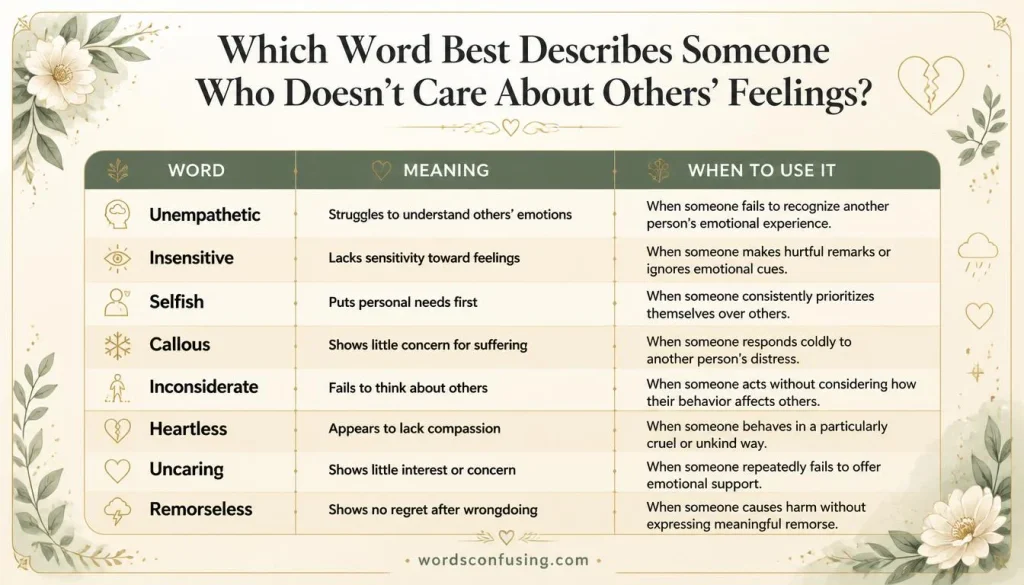
Which Word Best Describes Someone Who Doesn’t Care About Others’ Feelings?
Choosing the right word becomes easier when you identify the specific behavior you want to describe. The best term depends on whether the person ignores emotions, prioritizes themselves, or shows no regret after causing harm.
| Word | Main meaning | Best used when someone… |
| Unempathetic | Struggles to understand others’ feelings | Fails to recognize another person’s emotional experience |
| Insensitive | Disregards emotional sensitivity | Makes hurtful remarks or ignores emotional cues |
| Selfish | Puts personal interests first | Consistently prioritizes themselves over others |
| Callous | Shows little concern for suffering | Responds coldly to another person’s distress |
| Inconsiderate | Fails to think about others | Acts without considering the effect on other people |
| Heartless | Appears deeply lacking in compassion | Behaves in a particularly cruel or unkind way |
| Uncaring | Shows little interest or concern | Repeatedly fails to offer emotional support |
| Remorseless | Shows no regret after wrongdoing | Causes harm without expressing meaningful remorse |
These distinctions reflect common dictionary usage. For instance, Oxford defines insensitive in terms of failing to recognize or care about other people’s feelings, while Collins emphasizes the effect of words and actions in its definition of inconsiderate.
For everyday conversations, insensitive and inconsiderate are useful choices when describing thoughtless behavior. Use selfish when personal interests take priority, and callous when someone shows little concern for serious suffering.
If the behavior involves a lack of regret after wrongdoing, remorseless is more precise than simply calling the person uncaring.
Examples of Someone Who Doesn’t Care About Others’ Feelings
The words become easier to understand when you see how they apply to everyday situations. The following examples illustrate behaviors that may show emotional disregard without assuming that every mistake reveals someone’s character.
Dismissing Someone’s Sadness
Imagine telling a friend that you’ve had a difficult week. Instead of listening, they say, “You’re making a big deal out of nothing.”
This response may be insensitive because it dismisses your emotions. If the friend repeatedly refuses to acknowledge your struggles, you might also describe their behavior as uncaring.
Making Hurtful Jokes
Humor can bring people together, but jokes can also cross personal boundaries. Mocking someone’s appearance, financial difficulties, or painful experiences may show insensitivity.
If the speaker realizes the joke caused embarrassment but continues making similar comments, the behavior may also appear callous.
Always Putting Personal Needs First
Suppose a friend expects you to help whenever they need something but disappears when you ask for support. They may expect you to rearrange your schedule while refusing to make similar adjustments themselves.
This pattern suggests selfish behavior. The problem isn’t that they have personal priorities. It’s that they consistently expect consideration without offering it in return.
Ignoring Someone’s Boundaries
Imagine asking a coworker not to discuss your private life with other colleagues. They ignore your request and continue sharing personal details.
Their behavior is inconsiderate because they disregard a clearly stated boundary. If they knowingly expose private information to humiliate you, stronger terms may fit the situation.
Showing No Regret After Causing Harm
Consider someone who spreads a damaging rumor about another person. After learning about the consequences, they refuse to acknowledge the harm or take responsibility.
Their response may be described as remorseless if they show no meaningful regret for their actions.
The important distinction: An isolated mistake may reflect poor judgment, while repeated disregard for other people’s feelings can reveal a more persistent behavior pattern.
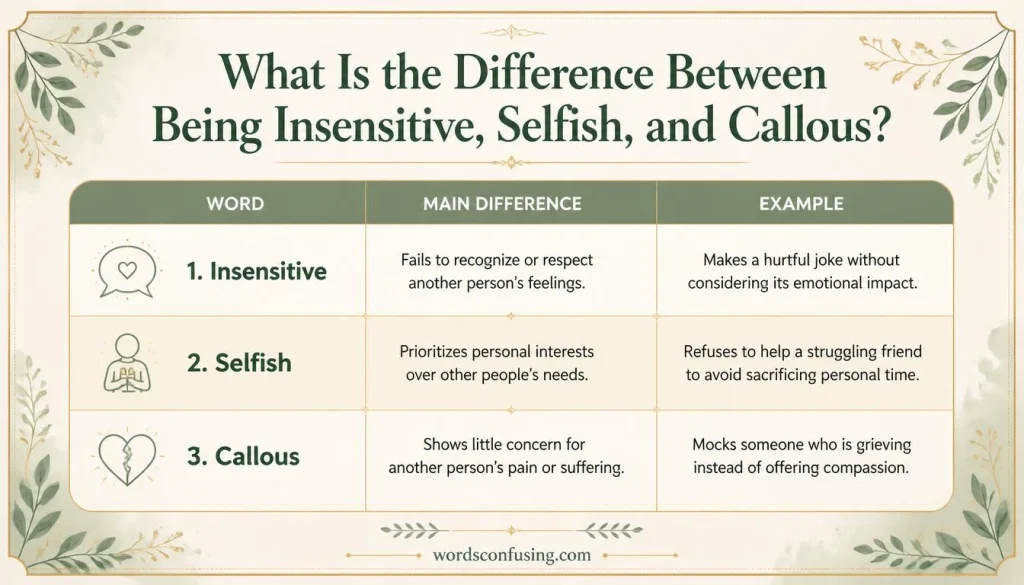
What Is the Difference Between Being Insensitive, Selfish, and Callous?
Although these three words overlap, they emphasize different problems. Understanding those differences helps you describe a situation accurately instead of relying on the same adjective every time.
Insensitive vs. Selfish
An insensitive person fails to recognize or respect another person’s emotional experience. A selfish person prioritizes personal interests, even when doing so disadvantages others.
For example, someone might make a hurtful joke because they haven’t considered how it sounds. That behavior is insensitive.
By contrast, someone who refuses to help a struggling friend because they don’t want to sacrifice a little time may be acting selfishly.
The distinction isn’t always clear-cut. A selfish person may also be insensitive, but one word doesn’t automatically imply the other.
Selfish vs. Callous
Selfishness centers on personal interests. Callousness centers on a lack of concern for other people’s suffering.
A selfish person might decline to help because they want to protect their own time or money. A callous person might respond to another person’s distress with mockery or indifference.
Both behaviors can hurt others. However, callous carries a stronger emphasis on emotional hardness.
Insensitive vs. Callous
An insensitive comment may happen because someone hasn’t thought carefully about another person’s feelings. A callous response suggests a more pronounced lack of concern for another person’s pain.
For instance, accidentally bringing up a painful memory may be insensitive. Deliberately mocking someone who is grieving may be callous.
The context matters because intention, awareness, and repeated behavior can change how an action is understood.
A Practical Case Study: Choosing the Right Word
Consider a fictional workplace situation involving three colleagues. Each responds differently when a teammate shares difficult personal news.
Scenario one: The insensitive colleague
Jordan tells a coworker that a family problem has made it difficult to concentrate. The coworker responds, “Everyone has problems. Just get over it.”
Best fit: Insensitive. The response dismisses Jordan’s feelings instead of acknowledging the situation.
Scenario two: The selfish colleague
Another coworker repeatedly asks Jordan to cover shifts but refuses to help when Jordan needs a schedule adjustment.
Best fit: Selfish. The coworker expects support without showing comparable consideration for Jordan’s needs.
Scenario three: The callous colleague
A third coworker learns about Jordan’s family difficulties and makes jokes about the situation in front of the team.
Best fit: Callous. The behavior shows a striking lack of concern for another person’s distress.
These scenarios show why word choice matters. All three colleagues behave poorly, but each example highlights a different form of disregard.
Real situations can be more complicated. Someone might act selfishly in one interaction and show genuine compassion in another. Describe the behavior you can observe rather than assuming you know everything about the person’s motives.
Read more: Charles’ or Charles’s: Which Should You Use?
How to Describe Someone Who Ignores Your Feelings Without Being Rude
Sometimes you need to address someone’s behavior without insulting them. Choosing precise, neutral language can help you explain what happened and why it bothered you.
Here are several practical alternatives:
- “That comment felt insensitive.” Use this when someone’s words hurt you.
- “That decision seemed inconsiderate.” Choose this when someone overlooked your needs or time.
- “I feel like my concerns aren’t being heard.” This works when someone repeatedly dismisses what you’re saying.
- “It feels as though this relationship is one-sided.” Use this when support and effort seem unequal.
- “I need you to take my feelings seriously.” This clearly communicates an expectation without attacking someone’s character.
- “That response showed very little compassion.” Choose this when someone reacts coldly to a difficult situation.
These statements focus on specific behavior rather than making sweeping judgments about a person’s personality. They also give the other person an opportunity to understand your concern and respond.
However, you don’t have to soften every statement. If someone repeatedly violates your boundaries or deliberately humiliates you, direct language may be appropriate. Clear communication and personal boundaries can matter more than finding the perfect adjective.
FAQs
1. What do you call someone who doesn’t care about others’ feelings?
You can call such a person inconsiderate, insensitive, unempathetic, or selfish, depending on their behavior. Each word describes a slightly different attitude toward other people’s feelings.
2. What is another word for someone who lacks empathy?
Unempathetic is a direct choice for someone who struggles to understand or share another person’s feelings. You can also use insensitive when someone ignores how their words or actions affect others.
3. What is the difference between inconsiderate and insensitive?
An inconsiderate person fails to think about other people’s needs or comfort. An insensitive person may say or do things without recognizing, or caring about, the emotional impact.
4. How do you describe someone who disregards other people’s feelings?
Words such as callous, thoughtless, selfish, and uncaring can describe someone who disregards others’ feelings. Choose the term that best matches the person’s actions rather than making assumptions about their entire personality.
5. Is it rude to call someone insensitive?
It can sound critical, especially during an argument. However, you can use the word respectfully by describing a specific action, such as saying, “That comment seemed insensitive because it hurt her feelings.”
6. How can I describe someone who doesn’t care without sounding offensive?
Choose neutral, behavior-focused language instead of insulting labels. For example, say, “They don’t always consider how their actions affect others” or “They seem unaware of other people’s emotional needs.” These expressions communicate your concern without unnecessarily escalating the situation.
Conclusion
Finding the right words for someone who doesn’t care about others’ feelings helps you express your thoughts clearly and confidently. Terms such as inconsiderate, insensitive, selfish, callous, and uncaring describe different behaviors, so choosing the right one depends on the situation. Someone might overlook another person’s feelings without meaning to cause harm, while another person may repeatedly ignore how their actions affect others.
Understanding these differences helps you communicate more accurately in everyday conversations, personal relationships, and professional settings. Instead of rushing to judge someone, focus on their behavior and its impact on others. The right words can help you explain your concerns honestly while keeping your message fair, respectful, and easy to understand.

Shafiq Ur Rehman is a writer and content contributor at WordsConfusing.com. He enjoys exploring the English language, common word confusions, vocabulary, and practical writing tips. His goal is to make English easier to understand through clear, simple, and useful articles.