What Does “Pipeline” Mean in a Business Context? The term describes how work and opportunities move through a company in planned stages.
In a business context, a pipeline is a structured flow of tasks, opportunities, prospects, or projects that move through different stages toward completion. This business term appears in modern workplaces across many industries, including sales, project management, recruitment, and operations.
A sales pipeline tracks sales opportunities, while a project pipeline organizes upcoming work and a hiring pipeline follows candidates through the hiring process. These business processes help organizations track progress, improve decision-making, strengthen business communication, and anticipate future outcomes.
Unlike a physical gas pipeline or building plumbing, a company pipeline describes how work, people, or opportunities follow a predefined sequence. Understanding this business meaning requires looking at similar workplace terms and their contextual meaning in professional situations.
A pipeline also supports task management, opportunity tracking, project tracking, and the recruitment process. Teams use pipeline management to improve workflow management, operational workflow, and organizational processes. It can help with scheduling, time management, meetings, calendar planning, time planning, and calendar management by showing which activities need attention.
Businesses may use online booking systems, while media companies manage broadcasting schedules and other planned activities. These workflow processes can improve workplace efficiency, progress tracking, and future outcomes when teams update their information regularly.
For professionals, students, and writers, understanding this business terminology helps with business reading, formal writing, professional writing, and professional conversations. Clear workplace communication, professional communication, and corporate communication depend on accurate word usage, proper English usage, and terminology consistency.
The seven practical examples and seven helpful examples that follow illustrate common usage patterns and support organizational consistency across business contexts and everyday contexts. These ideas show how a pipeline organizes business operations, business activities, and a company’s overall workflow.
Quick Answer
In a business context, a pipeline is a series of stages that opportunities, tasks, or information move through toward a goal. For example, a sales pipeline tracks potential customers from their first contact to a completed sale. Businesses also use pipelines to manage hiring, projects, product development, marketing, partnerships, and data. Simply put, a pipeline helps you see what’s in progress, where things stand, and what may happen next.

What Does “Pipeline” Mean in Business?
The word pipeline refers to a connected sequence of stages that moves something toward an intended result. In business, that “something” might be a sales opportunity, a new employee, an upcoming project, or information traveling between computer systems.
Think of a physical pipeline that carries water from one location to another. Water enters at one end, travels through the system, and reaches its destination. A business pipeline follows a similar idea, although it usually tracks progress rather than moving a physical substance.
For example, a company might receive 100 potential customer inquiries in one month. Some prospects respond to follow-up messages, others schedule demonstrations, and a smaller group eventually makes a purchase. The sales pipeline helps the company understand where those prospects stand.
A business pipeline generally includes three essential elements:
- Entry point: Where an opportunity, task, candidate, or piece of information enters the process.
- Stages: The steps it passes through before reaching the intended outcome.
- Outcome: The result the organization hopes to achieve, such as closing a sale, hiring an employee, or launching a product.
Not every pipeline follows a fixed sequence. Some include parallel activities, repeated steps, or opportunities that never reach completion.
The central idea remains the same: a pipeline gives people a structured way to understand what is happening now and what may happen next.
Why Is the Term “Pipeline” Used in Business?
Businesses use the term because it offers a simple way to describe ongoing work and future opportunities.
Consider a company that plans to introduce five new products. Some products might still be ideas, while others are undergoing testing. Two may already have launch dates. Calling these products a product pipeline gives managers a shared way to discuss their progress.
The same idea applies to sales, hiring, marketing, and project management.
The term also helps businesses identify potential problems. If dozens of opportunities remain stuck at one stage, managers can investigate the delay and decide what needs to change.
However, a pipeline doesn’t guarantee that every item will reach its final destination. A prospect might reject an offer, a project might lose funding, or a product might fail testing.
A pipeline shows what is progressing and what may happen next. It doesn’t promise a particular result.
What Does “In the Pipeline” Mean?
The expression “in the pipeline” means something is planned, being developed, under consideration, or expected to happen in the future.
People commonly use this expression when discussing projects, products, announcements, opportunities, and upcoming changes.
For example:
- “We have two new products in the pipeline.” This means the company is developing or planning two products.
- “Several changes are in the pipeline.” This suggests that changes are being considered or prepared.
- “A promotion may be in the pipeline.” This means a promotion could be coming, although it isn’t necessarily confirmed.
The precise meaning depends on the context. A project in the pipeline might already have approval, while a product in the pipeline could still be an early-stage idea.
For this reason, the expression doesn’t automatically mean that something is finished, approved, or guaranteed to happen.
Read more: 6 Better Ways to Say “Thank You for Trying”
How Does a Business Pipeline Work?
A business pipeline organizes items according to their current stage. Instead of treating every opportunity as identical, it shows how far each one has progressed.
Imagine a small marketing agency that receives inquiries from potential clients. The agency might organize its sales pipeline into these stages:
New inquiry
A potential client contacts the agency.
Qualification
The agency checks the client’s needs and budget.
Proposal
The agency sends a plan and pricing.
Closed deal
The client agrees to work with the agency.
The agency can review this pipeline to determine which clients need follow-up and which deals might close soon.
For instance, if several clients have received proposals but haven’t responded, the agency might contact them to answer questions or clarify pricing.
A well-managed pipeline usually answers four practical questions:
- What opportunities or tasks are currently active?
- Which stage has each item reached?
- What action should happen next?
- What obstacles might prevent progress?
These answers help employees coordinate their work and make more informed decisions.
7 Helpful Examples of “Pipeline” in Business
The word pipeline appears across many industries. The following examples explain how businesses use it in everyday operations.
Sales Pipeline
A sales pipeline tracks potential deals as they move through the sales process. Sales representatives use it to monitor customer conversations, follow up on opportunities, and estimate possible revenue.
A typical sales pipeline includes these stages:
- Lead identification: Finding people or businesses that might need the product.
- Qualification: Determining whether a prospect has a suitable need, budget, and buying potential.
- Discovery: Understanding the prospect’s challenges and requirements.
- Proposal: Presenting a solution, price, or contract.
- Negotiation: Discussing terms, scope, or pricing.
- Closing: Recording the outcome when the prospect becomes a customer or the deal ends without a sale.
Not every company uses these exact stages. A retail business might have a short sales process, while an enterprise software company could spend months negotiating a contract.
Example: Imagine a company that sells accounting software to small businesses. Its sales representative contacts 30 prospects, arranges eight demonstrations, sends four proposals, and closes two deals.
The sales pipeline helps the company understand which opportunities remain active and where its sales process needs attention.
A representative might say:
“Our sales pipeline includes several promising deals for next quarter.”
This sentence means the company has potential sales opportunities it expects to pursue. It doesn’t mean every deal has been confirmed.
Sales managers can also use pipeline data to estimate future revenue. However, those estimates depend on the accuracy of deal values, expected closing dates, and the likelihood of success.
Hiring or Recruitment Pipeline
A hiring pipeline tracks candidates as they move through the recruitment process. Employers use it to organize applications, schedule interviews, evaluate qualifications, and fill open positions.
A recruitment pipeline might include:
- Sourcing potential candidates.
- Receiving applications.
- Screening resumes and qualifications.
- Conducting interviews.
- Checking references when appropriate.
- Making an offer.
- Completing the hiring process.
Some organizations also maintain a talent pipeline for future vacancies. This allows recruiters to build relationships with qualified people before a specific position becomes available.
Example: A technology company expects to expand its engineering team over the next six months. Its recruiters identify qualified developers, attend professional events, and maintain contact with promising candidates.
When new positions open, the company already has potential applicants to approach.
A manager might say:
“We need a stronger hiring pipeline for experienced software engineers.”
This means the company wants more qualified candidates entering or progressing through its recruitment process.
A healthy hiring pipeline can help recruiters identify shortages early. If too few candidates reach the interview stage, the company might need to improve its job descriptions, sourcing methods, or screening criteria.
However, maintaining a large candidate pool isn’t enough by itself. Recruiters must also communicate clearly and evaluate candidates fairly.
Project Pipeline
A project pipeline refers to proposed, approved, or upcoming projects that an organization tracks as they move toward execution or completion.
Businesses use project pipelines to decide which initiatives deserve attention, estimate resource requirements, and coordinate future work.
A project pipeline may include these stages:
- Idea submission
- Initial evaluation
- Feasibility assessment
- Approval and prioritization
- Scheduling and resource allocation
- Execution
- Completion
The exact structure depends on the organization. A construction company might evaluate projects based on costs, permits, and available crews. A marketing agency might focus on client deadlines, campaign budgets, and staff availability.
Example: A marketing agency has five potential client campaigns. Two are awaiting client approval, one is scheduled for next month, and two are already underway.
Its project pipeline helps the agency understand upcoming demand and avoid assigning too much work to the same team.
An employee might say:
“The agency has four client projects in its pipeline for next month.”
This means the agency is tracking projects that may require attention during that period. Some might still need approval, so the statement doesn’t necessarily mean all four will begin.
Project pipelines are particularly useful when teams must balance several initiatives. They make upcoming work more visible and help managers identify scheduling conflicts before deadlines become urgent.
Product Development Pipeline
A product development pipeline tracks ideas, features, or products as they move from early planning toward release.
Companies use this type of pipeline to organize development work and determine which ideas deserve investment.
A product development pipeline may include:
- Idea generation
- Market research
- Feasibility evaluation
- Design and planning
- Development
- Testing and quality checks
- Release preparation
- Launch
Not every idea makes it to market. Businesses may reject concepts that cost too much, fail to meet customer needs, or prove technically difficult to deliver.
Example: A software company receives requests for ten new features. After reviewing customer feedback and development costs, the team approves three for further work.
One feature enters development, another undergoes design review, and the third waits for testing resources.
A product manager might say:
“The next software update includes two features already in the product pipeline.”
This suggests the features are part of the company’s planned development work. Their final release dates may still depend on testing and approval.
A product pipeline helps teams compare potential ideas, organize development priorities, and coordinate product launches. It also gives sales and marketing teams a clearer picture of what may become available in the future.
However, a feature being in the pipeline doesn’t mean customers can use it today.
Marketing Pipeline
A marketing pipeline tracks how marketing activities attract potential customers and help move them toward becoming qualified sales opportunities.
Marketing teams use this pipeline to understand whether their campaigns attract the right audience and generate meaningful interest.
A common marketing pipeline includes:
- Audience research
- Campaign planning
- Lead generation
- Lead nurturing
- Lead qualification
- Handoff to the sales team
For example, a company might publish an educational guide, promote it through email, and invite readers to attend a product demonstration.
Some readers may download the guide without showing further interest. Others may attend the demonstration and ask for pricing. The marketing pipeline helps the team track these different levels of engagement.
Example: A business software company runs a webinar that attracts 200 registrations. After the event, the marketing team identifies 25 people who requested product information and passes suitable prospects to sales.
A marketing manager might say:
“The campaign added several qualified leads to our marketing pipeline.”
This means the campaign generated prospects who appear suitable for further engagement.
Marketing and sales pipelines often overlap, but they serve different purposes. Marketing generally focuses on attracting and nurturing prospects, while sales focuses on evaluating opportunities and converting them into customers.
The two teams need clear definitions of a qualified lead. Otherwise, marketing might celebrate a high number of leads while sales struggles to find prospects who are ready to buy.
Business Partnership Pipeline
A business partnership pipeline tracks potential partnerships from initial contact to an agreement. Companies use it to manage relationships with possible distributors, suppliers, technology providers, affiliates, and other business partners.
The pipeline might include:
- Identifying potential partners
- Making initial contact
- Evaluating business compatibility
- Discussing goals and expectations
- Negotiating terms
- Completing legal or commercial reviews
- Signing an agreement
- Beginning the partnership
The process varies according to the partnership’s complexity. A small affiliate arrangement may require only a few steps, while an international distribution agreement could involve extensive negotiations.
Example: A skincare company wants to sell its products through regional retailers. It contacts ten retailers, evaluates their customer bases, and begins detailed discussions with three.
The company tracks each potential partnership and records the next action required.
A business development manager might say:
“We have two potential distribution partnerships in the pipeline.”
This means the company is pursuing two possible partnerships. Neither should be treated as finalized until the relevant parties agree to the terms.
A partnership pipeline helps businesses maintain organized communication and compare opportunities. It also prevents teams from confusing early conversations with commitments that have already been approved.
Data Pipeline
A data pipeline is a system that moves data from one or more sources to a destination. Along the way, the system may clean, combine, validate, or transform that information.
Unlike sales and hiring pipelines, a data pipeline often relies on software rather than people manually advancing each item through stages.
A basic data pipeline might follow this sequence:
- Collection: Gather information from applications, databases, websites, or other sources.
- Processing: Clean, filter, validate, or transform the information.
- Storage: Save the processed data in a database or data warehouse.
- Delivery: Make the information available to dashboards, reports, or other systems.
Some data pipelines operate continuously. Others run at scheduled intervals, such as every hour or once per day.
Example: An online retailer collects information about orders, payments, and inventory. A data pipeline processes these records and updates a reporting dashboard each morning.
Managers can then review sales performance and stock levels without manually combining several files.
A technical employee might say:
“The data pipeline failed to process last night’s records.”
This means a system responsible for moving or processing data encountered a problem. The team may need to investigate missing records, a failed connection, invalid data, or another technical issue.
Data pipelines are important because business decisions often depend on timely and reliable information. A pipeline that delivers incomplete or outdated data can lead to inaccurate reports and poor decisions.
What Are the Benefits of a Business Pipeline?
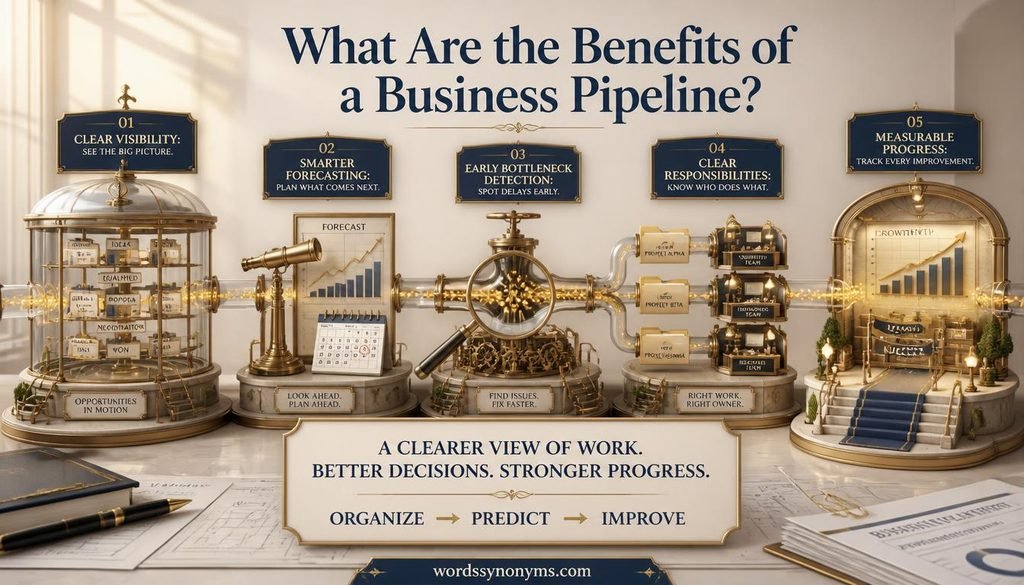
A business pipeline offers more than a convenient way to organize information. When teams maintain accurate records and review progress regularly, they can make better operational decisions.
Here are the main benefits.
Better Visibility Into Ongoing Work
Without a pipeline, employees may struggle to understand which opportunities are active and which tasks need attention.
A shared pipeline provides a clearer picture. Sales representatives can review open deals, recruiters can check candidate progress, and project managers can see upcoming assignments.
This visibility reduces confusion and helps teams coordinate their work.
Improved Planning and Forecasting
Pipelines help managers estimate future demand, although the accuracy of those estimates depends on the quality of the underlying information.
For example, a recruitment pipeline may reveal that a company has several qualified candidates for upcoming vacancies. A project pipeline may show that a team needs additional staff next month.
Sales managers can also use pipeline values and historical conversion rates to estimate potential revenue.
These estimates support planning, but they shouldn’t be treated as guaranteed outcomes.
Earlier Identification of Bottlenecks
A bottleneck occurs when one stage slows down the progress of an entire process.
Suppose a sales team sends 20 proposals each month, but many remain unanswered for weeks. The team could investigate whether its pricing, follow-up process, or proposal quality needs improvement.
Likewise, a hiring pipeline might reveal that candidates wait too long between interviews.
A pipeline makes delays easier to spot before they create larger problems.
Clearer Priorities and Responsibilities
When each item has an owner and a defined next step, employees can identify their responsibilities more easily.
For example, a sales representative may need to contact a prospect, while a project manager must obtain approval before scheduling work.
This structure reduces the chance that important tasks will fall through the cracks.
More Consistent Performance Tracking
Businesses can compare pipeline performance over time by tracking relevant measures.
Examples include:
- Number of active sales opportunities
- Percentage of qualified candidates who reach interviews
- Average time required to complete a project
- Number of product features awaiting testing
- Percentage of marketing leads that become sales opportunities
The right measurements depend on the pipeline. A recruitment team shouldn’t judge its performance using the same metrics as a data engineering team.
Pipeline vs. Funnel: What’s the Difference?
The terms pipeline and funnel sometimes appear in the same business conversation, especially in sales and marketing. Although they overlap, they emphasize different aspects of a process.
A pipeline focuses on the items moving through stages and the progress of each item. A funnel emphasizes how a larger group becomes smaller as people or opportunities leave the process at different stages.
Consider a company that attracts 500 website visitors. Of those visitors, 80 sign up for a webinar, 20 request a demonstration, and five become paying customers.
A marketing funnel helps the company understand how the original audience narrows at each stage. Its sales pipeline, meanwhile, can track individual opportunities and the next actions required to close them.
| Feature | Business pipeline | Business funnel |
| Main focus | Progress through stages | Conversion and drop-off |
| Typical question | Where does each opportunity stand? | How many people move to the next stage? |
| Common use | Sales, hiring, projects, product development | Sales conversion and marketing analysis |
| Typical measurements | Deal value, stage, expected completion date | Conversion rate, abandonment, drop-off |
| Main purpose | Manage ongoing work and opportunities | Understand how effectively a group converts |
These distinctions aren’t absolute. Businesses may use pipeline and funnel views together because each provides useful information.
For example, a sales manager might use a pipeline to monitor individual deals and a funnel report to determine whether too many prospects disappear after receiving proposals.
How Do Businesses Manage a Pipeline Effectively?
Creating a pipeline is only the first step. Teams must maintain it properly if they want reliable information and useful results.
The following practices help keep business pipelines organized.
Define Clear Stages
Every stage should have a clear meaning. Employees need to understand what qualifies an item to enter a stage and what must happen before it moves forward.
For example, a sales opportunity shouldn’t automatically enter the proposal stage simply because a representative has spoken with the prospect. The team might require confirmation of the customer’s needs and budget first.
Clear definitions make pipeline reports more consistent.
Assign Ownership and Next Actions
Each active item should have a responsible person when appropriate. That person should know what needs to happen next and when to act.
A sales representative might schedule a follow-up call, while a recruiter could arrange a second interview. A project manager may need to obtain budget approval.
Recording these actions turns a pipeline from a passive list into a practical management tool.
Keep Information Current
Outdated information can make a pipeline misleading.
A prospect who rejected an offer shouldn’t remain listed as an active opportunity. Similarly, a project that has been canceled shouldn’t continue appearing as upcoming work.
Teams should update statuses, expected dates, ownership, and relevant notes regularly.
Monitor Bottlenecks
A pipeline review should examine more than the number of active items. Managers should also investigate where progress slows down.
For example, if many product features wait for testing, the company might need additional testing capacity or a more efficient review process.
However, the goal isn’t to rush every item forward. Some stages require careful evaluation to protect quality and reduce risk.
Choose Suitable Tools
Small teams may manage straightforward pipelines with spreadsheets. Larger organizations often use specialized software to handle more complex workflows.
Common options include:
- Customer relationship management (CRM) systems: Track customers, sales opportunities, and communications.
- Project management platforms: Organize assignments, deadlines, approvals, and workloads.
- Applicant tracking systems: Manage job applications and recruitment stages.
- Data integration tools: Move, transform, and monitor information across systems.
The best tool depends on the pipeline’s purpose, the number of users, and the complexity of the process.
Measure the Right Performance Indicators
A useful pipeline includes measures that help the team make decisions.
For sales, managers might track deal value, conversion rates, and the average time required to close a deal. For hiring, they might measure time to hire and the number of qualified applicants.
Project teams may focus on delivery times, workload, and completed milestones.
Avoid collecting numbers simply because software makes them easy to display. Each metric should answer a practical question or support a clear decision.

How to Use “Pipeline” in a Business Sentence
The word pipeline works as a noun in business communication. You can use it to describe a collection of opportunities, an ongoing process, or a technical system.
Here are examples of natural workplace usage.
| Business sentence | Meaning |
| “We have several new clients in the pipeline.” | The company is pursuing potential customers. |
| “The hiring pipeline needs more qualified applicants.” | The recruitment process needs stronger candidates. |
| “Three product updates are in the pipeline.” | Three updates are planned or under development. |
| “Our data pipeline updates the dashboard every morning.” | A system processes and delivers data on a schedule. |
| “The team reviewed its project pipeline during Monday’s meeting.” | The team discussed proposed, upcoming, or active projects. |
| “A new partnership is in the pipeline.” | The company is pursuing a potential partnership. |
| “The deal has stalled in the sales pipeline.” | A potential sale has stopped progressing. |
You can also use pipeline in more formal business writing.
For example:
- “The company is expanding its pipeline of qualified sales opportunities.”
- “Management reviewed the project pipeline before approving additional resources.”
- “The recruitment pipeline should support the organization’s upcoming staffing needs.”
When you encounter the word at work, pay attention to the surrounding details. References to deals usually indicate sales, while references to candidates point toward recruitment.
If someone mentions data sources, processing, or dashboards, they probably mean a technical data pipeline.
Read more: 5 Words for Someone Who Plays the Victim
FAQs
1. What does pipeline mean in simple business terms?
A pipeline is a process that moves tasks, projects, sales opportunities, or candidates through several stages. It helps a business see what is happening now and what needs attention next.
2. What is an example of a pipeline in business?
A sales pipeline is a common example. It may include finding potential customers, contacting them, discussing their needs, making offers, and closing deals.
3. What is the difference between a sales pipeline and a project pipeline?
A sales pipeline tracks potential customers and deals as they move toward a sale. A project pipeline tracks planned or ongoing projects as they move toward approval, scheduling, or completion.
4. Why is a pipeline important for a company?
A pipeline helps teams organize work, track progress, and identify delays. It also supports better planning because managers can see which opportunities or tasks require attention.
5. Can pipeline refer to hiring and recruitment?
Yes. A hiring pipeline tracks job candidates through stages such as application, screening, interviews, and selection. It helps recruiters manage applicants and understand where each candidate stands.
6. Is the word pipeline suitable for formal business writing?
Yes. Pipeline is widely used in professional communication, reports, presentations, and business documents. For clarity, explain what the pipeline tracks when your audience may be unfamiliar with the term.
Conclusion
Understanding what pipeline means in a business context helps you communicate more clearly at work. Whether it involves sales opportunities, upcoming projects, or potential employees, a pipeline shows how tasks move through different stages. For example, a sales pipeline tracks potential customers, a project pipeline organizes planned work, and a hiring pipeline follows candidates through recruitment.
A well-managed pipeline helps businesses track progress, identify delays, improve time management, and make better decisions. Its exact meaning depends on what a company is tracking. Once you understand the context, you can use the term confidently in business conversations, professional writing, and everyday workplace communication.