
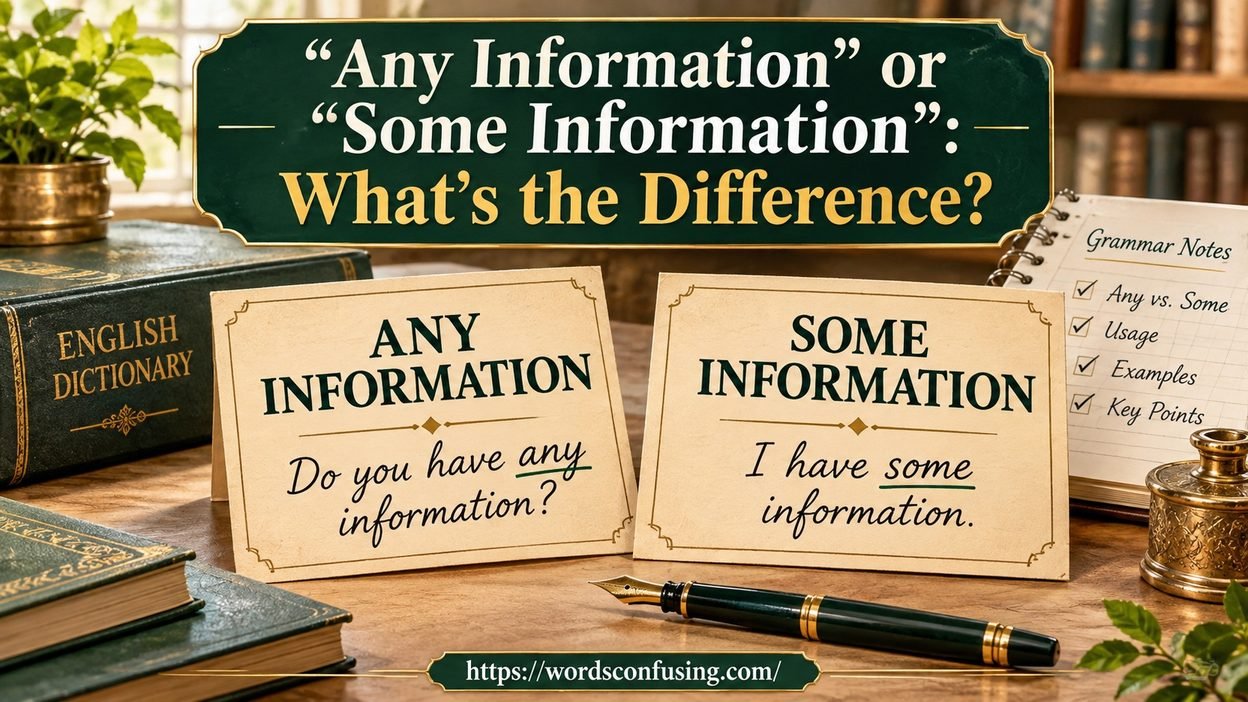
Understanding “Any Information” or “Some Information”: What’s the Difference? helps you choose the right phrase for clear, natural communication.
Both expressions are grammatically correct, but their meaning changes with context and expectation. “Some information” usually refers to an unspecified amount that exists or is expected.
“Any information” often appears when you ask questions, make negative statements, or describe conditions. Since information is an uncountable noun, avoid the incorrect plural “informations.” Say “some useful information” or “any information,” never “some informations.”
“I have some information about the meeting” means the speaker has details to share. “Do you have any information about scheduling?” asks whether details are available. You can also say, “I don’t have any information yet.” In affirmative sentences, “any” can mean information of whatever kind or amount.
Use these rules in everyday conversations, emails, formal writing, and business communication. Choosing carefully improves grammar, clarity, sentence structure, and confidence for questions, instructions, and professional messages about calendars or project management.
Quick Answer
Both “any information” and “some information” are grammatically correct. However, they don’t always communicate the same meaning.
Use any information when asking whether information exists, discussing a lack of information, or referring to possible information.
Use some information when confirming that information exists, offering details, or referring to an unspecified amount.
Consider these examples:
| Any Information | Some Information |
| Do you have any information about the schedule? | I have some information about the schedule. |
| I don’t have any information about the decision. | She gave me some information about the decision. |
| Did they find any information about the problem? | They found some information about the problem. |
| If you receive any information, call me. | I’ll share some information with you. |
Notice how the surrounding sentence influences your choice.
Any often appears when the existence of something remains uncertain. Some usually indicates that something exists or that the speaker expects it to exist.
However, these patterns aren’t absolute rules. Both expressions can appear in questions and affirmative sentences depending on the intended meaning.

What Does “Any Information” Mean?
The expression “any information” refers to information of whatever kind or amount. It doesn’t specify particular details or require a minimum quantity.
You commonly use this expression when you don’t know whether information exists. It also works when you want to ask about available details without restricting the answer.
For example:
- Do you have any information about the new policy?
- I haven’t received any information from the manager.
- Is there any information about tomorrow’s meeting?
- Please let me know if you find any information about the application.
In each example, the speaker doesn’t identify a specific amount of information.
Instead, the expression leaves the possibilities open. The answer could contain one useful detail, several facts, or extensive information.
When to Use “Any Information”
Although any information appears in several grammatical situations, three common contexts deserve particular attention.
In Questions About Available Information
Use any information when you want to discover whether someone knows something or has relevant details.
The expression works naturally because you’re asking about the existence or availability of information.
Examples:
- Do you have any information about the job opening?
- Has anyone received any information about the results?
- Is there any information available about the new course?
- Did the school provide any information about admission requirements?
These questions don’t assume that the listener has information. They simply ask whether anything is available.
In Negative Sentences
Use any information when explaining that information isn’t available or hasn’t been received.
The negative word changes the meaning of the sentence. It indicates that the speaker has no information to share.
Examples:
- I don’t have any information about the incident.
- She hasn’t received any information from the company.
- We couldn’t find any information about the missing document.
- The website doesn’t provide any information about the deadline.
Here, any information emphasizes the absence of available details.
Compare these two sentences:
- I have some information about the incident.
- I don’t have any information about the incident.
The first confirms that information exists. The second clearly communicates its absence.
In Conditional Sentences
Conditional sentences describe situations that may or may not happen. In these situations, any information often sounds natural.
You use it when referring to information that someone might discover, receive, or provide later.
Examples:
- If you receive any information, please contact me.
- Let me know if you find any information about the event.
- If the company shares any information, I’ll forward it.
- Call me if you hear any information about the position.
The expression doesn’t suggest that information definitely exists. It simply covers the possibility of receiving it.
Can “Any Information” Emphasize Even a Small Amount?
Yes. In certain affirmative sentences, any information emphasizes that even a small amount matters.
For example:
- Any information you provide could help solve the problem.
- We welcome any information about the missing documents.
- Any information regarding the incident should reach the authorities.
These sentences don’t use any to express a lack of information. Instead, they emphasize openness and unrestricted possibilities.
This usage is especially common in announcements, instructions, formal notices, and requests for assistance.
Read more: “Here Is” or “Here Are”: Which One Is Correct?
What Does “Some Information” Mean?
The expression “some information” refers to an unspecified amount of information. It usually suggests that information exists, is available, or will be provided.
You don’t need to identify exactly how much information you’re discussing. The context makes your meaning clear.
For example:
- I have some information about the upcoming examination.
- She shared some information about the new project.
- We received some information from the admissions office.
- He gave me some information about the company.
Each sentence confirms that information exists.
However, some information doesn’t necessarily mean a large amount. It could refer to one useful detail or several related facts.
For instance, someone might say, “I have some information about the interview.” That information could include the interview date, location, or expected questions.
When to Use “Some Information”
The expression some information works particularly well in affirmative statements, offers, and certain questions.
In Affirmative Sentences
Use some information when you want to confirm that information exists or that someone possesses it.
Examples:
- I have some information about the scholarship program.
- The teacher provided some information about the examination.
- We discovered some information about the historical building.
- My colleague shared some information about the upcoming changes.
These sentences communicate something positive: information is available.
Unlike questions using any information, affirmative statements using some information generally don’t express uncertainty about its existence.
When Offering Information
When you offer someone details, some information usually sounds natural and polite.
Examples:
- Would you like some information about our services?
- Can I give you some information about the application process?
- I’d like to share some information about the upcoming event.
- May I provide you with some information about the course?
These expressions make the offer sound helpful rather than demanding.
For example, a customer service representative might ask, “Would you like some information about our membership plans?”
The representative assumes the customer might appreciate the details. That’s why some works naturally.
When Asking for Specific Details
You can also use some information when requesting information from someone.
Examples:
- Could you give me some information about the admission process?
- Can you share some information about your experience?
- Would you provide some information about the project?
- Could I get some information about the available positions?
These questions often sound polite and conversational.
The speaker expects that the listener may have relevant details. The request also focuses on receiving information rather than discovering whether any exists.
“Any Information” vs. “Some Information”: Key Differences
Although these expressions share the same noun, their meanings and grammatical uses differ. Understanding those differences helps you choose the right phrase without second-guessing yourself.
The most important distinction involves whether you’re asking about possible information or referring to information that exists.
Here’s a closer comparison:
| Comparison | Any Information | Some Information |
| Basic meaning | Information of any kind or amount | An unspecified amount of information |
| Common usage | Questions, negatives, and conditions | Affirmative statements, offers, and requests |
| Existence | Often uncertain | Usually assumed or established |
| Questions | Common when asking whether information exists | Common when making offers or polite requests |
| Negative sentences | Common and natural | Less common in ordinary negative statements |
| Positive sentences | Used for unrestricted possibilities | Used when confirming available information |
| Example | Do you have any information? | I have some information. |
The Difference in Meaning
Consider these two sentences:
- Do you have any information about Sarah’s application?
- Do you have some information about Sarah’s application?
Both questions are grammatically correct. However, they communicate slightly different expectations.
In the first sentence, you’re asking whether the person has information at all. You don’t assume they know anything about the application.
In the second sentence, you’re asking for information that you expect might already exist. The question can sound like a polite request for details.
Now consider another comparison:
- I didn’t receive any information about the meeting.
- I received some information about the meeting.
The difference is straightforward. One sentence describes a complete lack of information. The other confirms that information arrived.
How Sentence Structure Influences Your Choice
Sentence structure provides useful clues when choosing between these expressions.
| Sentence structure | More natural choice | Example |
| Affirmative statement | Some | I received some information. |
| Ordinary negative statement | Any | I didn’t receive any information. |
| General information question | Any | Do you have any information? |
| Polite offer | Some | Would you like some information? |
| Conditional statement | Any | If you find any information, tell me. |
| Unrestricted possibility | Any | Any information could prove useful. |
Remember that these are common patterns rather than inflexible rules. Your intended meaning always matters.
Can You Use “Any Information” in Positive Sentences?
Yes, any information can appear in positive sentences. In fact, this construction is common in everyday English and professional communication.
The important point is that any doesn’t always mean none. It can also express openness, freedom of choice, or an unrestricted possibility.
For example:
- Any information you provide will remain confidential.
- You can contact us if you need any information.
- Any information about the incident could help investigators.
- We appreciate any information you can share.
Each sentence has a positive grammatical structure. None expresses an absence of information.
Instead, any means that information of whatever kind may be useful, welcome, or relevant.
“Any” Means No Restrictions in These Sentences
When any appears in an affirmative statement, it can suggest that there are no restrictions on the type or amount.
Consider this example:
You can ask me any question.
This sentence doesn’t mean you cannot ask questions. It means you’re free to ask whichever question you want.
The same principle applies to information:
You can share any information that might help.
The speaker welcomes all relevant details without specifying their quantity or type.
Here are additional examples:
- Any information can make a difference in this investigation.
- You may request any information covered by the policy.
- Any information regarding the schedule will be helpful.
- We encourage anyone with any information to contact us.
“Any Information” in Professional Communication
This expression frequently appears in workplace messages, official announcements, and customer support communication.
For example:
Workplace email:
“Please contact the administration department if you need any information about the revised schedule.”
Official announcement:
“Anyone with any information about the missing documents should contact the office.”
Customer support:
“Our representatives can provide any information you need about your account.”
These examples demonstrate how any information works naturally in affirmative sentences.
The expression becomes particularly useful when you want to communicate openness or unrestricted availability.
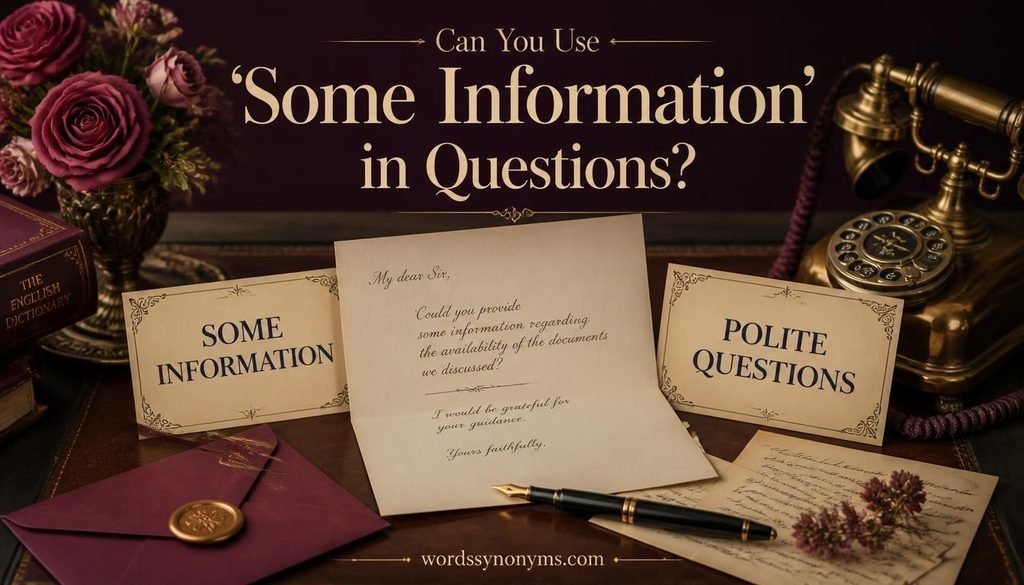
Can You Use “Some Information” in Questions?
Absolutely! Some information is perfectly acceptable in questions.
Although English learners often associate some with affirmative statements, the word also appears naturally in interrogative sentences.
The difference usually involves the speaker’s expectations and intentions.
When you ask a question with some, you often expect the requested information to exist. You might also be offering something or making a polite request.
For example:
- Would you like some information about the program?
- Could you give me some information about the university?
- Can I share some information about the new policy?
- Would you mind providing some information about your experience?
All four questions are grammatically correct.
“Some Information” in Polite Offers
One common use appears when offering something to another person.
For example:
Would you like some information about our services?
This question assumes that the listener might appreciate receiving information.
Compare it with:
Do you have any information about our services?
The first question offers information. The second asks whether information exists.
That distinction changes the entire purpose of the conversation.
“Some Information” in Polite Requests
You can also use some information when asking another person to share details.
Examples:
- Could you give me some information about the examination?
- Would you send me some information about the available courses?
- Can you provide some information about the registration process?
- Could you share some information about your previous experience?
These questions sound courteous and direct.
However, any information would also work in several of these situations. The choice depends on whether you’re requesting information generally or expecting particular details.
For example:
– Could you give me some information about the scholarship?
This sounds like a request for details about the scholarship.
– Could you give me any information about the scholarship?
This emphasizes whether the person has anything useful to share.
Both versions are correct, but their emphasis differs.
Is “Information” Countable or Uncountable?
One important grammar rule explains why both expressions work.
Information is an uncountable noun in standard English. This means you generally cannot count it directly using ordinary numbers.
For example, these sentences are incorrect:
- I received three informations.
- She gave me two informations.
- We need several informations about the project.
Instead, use pieces of information when you want to identify individual facts or details.
Correct examples include:
- I received three pieces of information.
- She gave me two pieces of information.
- We need several pieces of information about the project.
The word information remains unchanged even when the quantity increases.
Why “Some Information” and “Any Information” Are Correct
Because information is uncountable, you can use certain quantifiers with it.
Both some and any work with uncountable nouns.
For example:
- I need some water.
- Do you have any water?
- She bought some furniture.
- We don’t have any furniture.
- He shared some information.
- Did you receive any information?
Notice that the nouns remain in their ordinary uncountable forms.
You don’t add an -s to information when discussing multiple facts.
How to Express Different Amounts of Information
If you want to describe how much information someone has, several expressions can help.
| Expression | Meaning | Example |
| Some information | An unspecified amount | I have some information for you. |
| Any information | Information of any kind or amount | Do you have any information? |
| A piece of information | One individual fact | She shared a useful piece of information. |
| Several pieces of information | Multiple individual facts | We collected several pieces of information. |
| A lot of information | A large amount | The report contains a lot of information. |
| A little information | A small amount | I have a little information about the topic. |
| Little information | Almost no information | We have little information about the incident. |
| Much information | A large amount, usually in questions or negatives | We don’t have much information. |
“A Little Information” vs. “Little Information”
These two expressions deserve special attention because their meanings differ.
A little information suggests that some information exists, even if the amount is small.
Example:
“I have a little information about the upcoming interview.”
This means you know at least a few relevant details.
In contrast, little information emphasizes that the available amount is insufficient or nearly nonexistent.
Example:
“We have little information about the cause of the problem.”
This suggests that very few details are available.
The article’s main expressions follow the same general principle. Small changes in wording can influence the meaning considerably.
Common Mistakes When Using “Any Information” and “Some Information”
Even confident English speakers sometimes confuse these expressions. Most mistakes happen when people focus on sentence structure without considering meaning.
Here are some common errors and their corrections.
Using “Informations” Instead of “Information”
This is one of the most common mistakes involving the word.
Incorrect: “The manager shared several informations.”
Correct: “The manager shared several pieces of information.”
Because information is uncountable, it doesn’t normally take a plural ending.
Use a counting expression such as pieces of information when necessary.
Assuming “Any” Only Appears in Negative Sentences
Many learners memorize a simple rule: use any in questions and negative statements.
That rule provides a helpful starting point. However, it doesn’t cover every situation.
For example:
- Any information you provide will help.
- You can ask me any question.
- Any student can participate.
These affirmative sentences use any correctly.
The word can express unrestricted choice or possibility rather than absence.
Assuming “Some” Cannot Appear in Questions
Another common misconception is that some belongs exclusively in affirmative sentences.
However, questions such as these are perfectly natural:
- Would you like some information?
- Could you share some information?
- Can I offer you some information?
These questions usually involve offers, polite requests, or expectations that something exists.
Using “Some Information” When You Mean No Information
Consider this sentence:
“I don’t have some information about the project.”
Although negative constructions with some can occur in specific contexts, this sentence usually sounds unnatural when you mean that no information is available.
A clearer version would be:
“I don’t have any information about the project.”
The revised sentence communicates the intended meaning directly.
Confusing “A Few Information” With “A Few Pieces of Information”
Remember that a few generally modifies countable plural nouns.
Since information is uncountable, you cannot normally say:
“I have a few information about the examination.”
Instead, write:
“I have a few pieces of information about the examination.”
You can also simplify the sentence:
“I have some information about the examination.”
Both alternatives are grammatically correct.
“Any Information” and “Some Information” in Everyday Conversations
Understanding grammar rules becomes easier when you see how people use expressions in real situations.
Both phrases appear in professional communication, academic discussions, customer service, and everyday conversations. The right choice depends on what you want to communicate.
Let’s examine several practical situations.
In Workplace Communication
Workplace conversations often involve sharing updates, requesting details, or checking whether information is available.
Examples:
Using any information:
- Do you have any information about the client meeting?
- I haven’t received any information from the supervisor.
- Please forward any information related to the project.
Using some information:
- I have some information about the new client.
- The manager shared some information about the upcoming changes.
- I’d like to provide some information before the meeting.
Why does the choice matter?
Use any information when checking availability or inviting unrestricted details. Choose some information when confirming that details exist or offering them.
In Academic Communication
Students and teachers regularly use these expressions when discussing assignments, examinations, research, and educational resources.
Examples:
| Situation | Example |
| Asking about resources | Do you have any information about the recommended books? |
| Sharing research | I found some information about the topic. |
| Asking about an examination | Has the university released any information about the results? |
| Providing details | The professor gave us some information about the assignment. |
| Requesting updates | Please share any information about the admission schedule. |
These examples show how naturally both expressions fit academic discussions.
In Customer Service
Customer service representatives frequently use some information when offering assistance.
For example:
Representative: Would you like some information about our available plans?
Customer: Yes, please. I’d like to know more about the monthly charges.
However, when checking whether information exists, any information sounds more appropriate.
Customer: Do you have any information about my refund?
Representative: Yes. I have some information about your refund status.
Notice how the expressions work together in one conversation. The customer asks about availability, and the representative confirms that information exists.
In Casual Conversations
Everyday conversations also provide plenty of opportunities to use these expressions.
Consider these examples:
1. Conversation about travel
- Person A: Do you have any information about the train schedule?
- Person B: Yes, I have some information. The next train leaves at noon.
2. Conversation about a job
- Person A: Have you received any information about the interview?
- Person B: No, I haven’t received any information yet.
3. Conversation about an event
- Person A: Would you like some information about the event?
- Person B: Sure. I’d love to know more.
These short exchanges demonstrate the difference without complicated grammatical explanations.
Practical Case Studies: Choosing the Right Expression
The following situations show how your choice changes depending on the intended message.
Case Study: Asking About University Admissions
Imagine you’re waiting for a university to announce its admission results.
You might ask:
“Have you received any information about the merit list?”
This question works because you’re unsure whether an update exists.
If your friend has already received an update, they might respond:
“Yes, I have some information about the merit list.”
Here, some information confirms that your friend knows something relevant.
Case Study: Requesting Workplace Updates
Suppose your manager asks employees to report anything relevant to an ongoing project.
The manager might write:
“Please share any information that could help us complete the project.”
This wording welcomes all useful details without limiting their type or quantity.
However, an employee might respond:
“I have some information about the supplier’s revised delivery date.”
The employee uses some information because they already possess specific details.
Case Study: Customer Support
Imagine contacting a company about a delayed order.
You might ask:
“Do you have any information about my delivery?”
The representative could answer:
“Yes, I have some information about your delivery. Your package should arrive tomorrow.”
The first expression checks whether information exists. The second introduces the available details.
These examples demonstrate an important point: Neither expression is automatically better. The intended meaning determines the correct choice.
Read more: “Sure” vs. “Yes”: What’s the Difference and When Should You Use Each?
FAQs
1. Is “any information” grammatically correct?
Yes, “any information” is grammatically correct. You can use it in questions, negative sentences, and conditional statements. For example, “Do you have any information about the upcoming meeting?”
2. Is it correct to say “some information”?
Yes, “some information” is also correct. It usually refers to details that someone has or expects to receive. For example, “I have some information to share with you.”
3. Why can’t we say “some informations”?
Because information is an uncountable noun in English. It does not normally take a plural form. Instead of saying “informations,” use “some information,” “pieces of information,” or “useful information.”
4. Can I use “any information” in a positive sentence?
Yes, you can use “any information” in affirmative sentences when you mean information of any kind. For example, “Please share any information that might help us.”
5. Should I use “any information” or “some information” in an email?
It depends on what you want to communicate. Use “any information” when asking whether details are available. Use “some information” when offering details or referring to information you expect to receive.
6. Which sounds more polite: “any information” or “some information”?
Both can sound polite when used correctly. However, “Could you please share some information about the project?” often sounds more specific and friendly. “Do you have any information about the project?” works well when you are simply checking for available details.
Conclusion
Choosing between “any information” or “some information” becomes easier when you understand what each phrase communicates. Use “some information” when referring to details that exist, offering something to someone, or expecting a particular response. Choose “any information” when asking whether details are available, making negative statements, or discussing possibilities. Although both expressions are correct, using them in the right context makes your sentences sound more natural.
Remember that information is an uncountable noun, so it never takes the ordinary plural form “informations.” Whether you’re writing an email, asking a question, or having an everyday conversation, these small grammar choices matter. Pay attention to the meaning you want to express rather than memorizing rules without context. With regular practice, you’ll use both phrases naturally and communicate with greater clarity and confidence.

Shafiq Ur Rehman is a writer and content contributor at WordsConfusing.com. He enjoys exploring the English language, common word confusions, vocabulary, and practical writing tips. His goal is to make English easier to understand through clear, simple, and useful articles.