

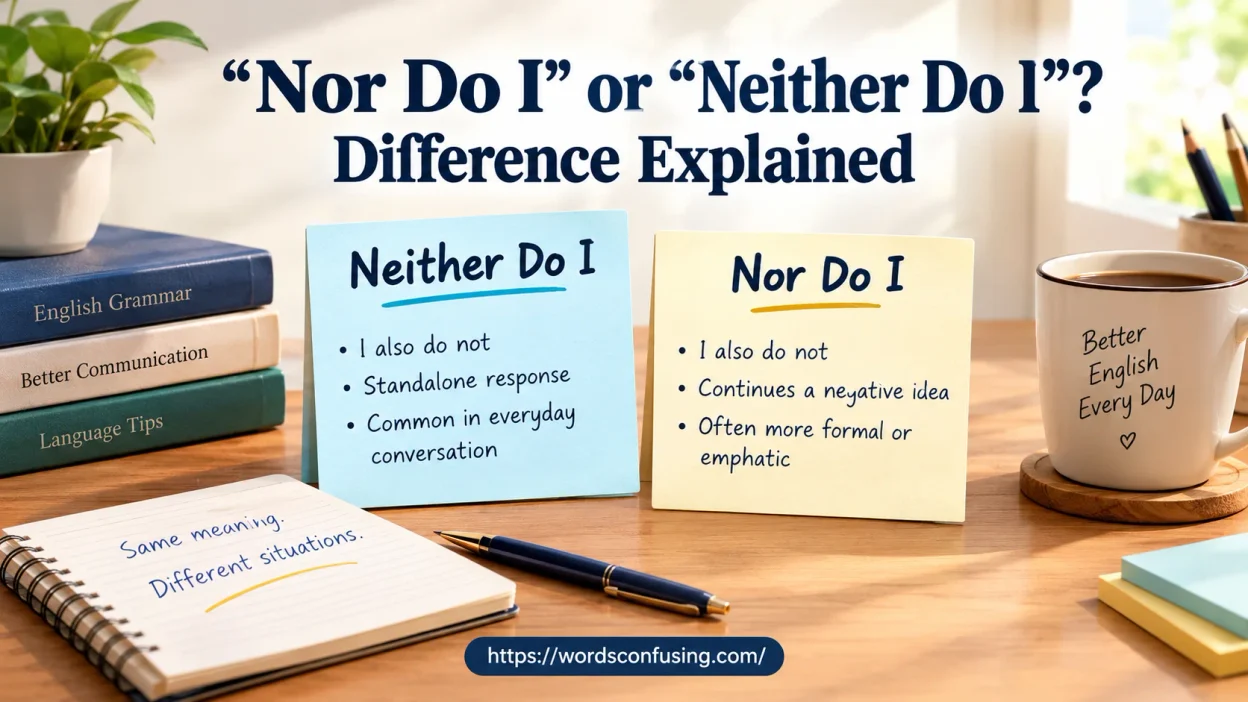
“Nor Do I” or “Neither Do I”? Difference Explained helps English learners understand two grammatically correct expressions with the same meaning.
Both show negative agreement when you agree with a negative statement. For example, if someone says, “I don’t like loud music,” you can reply, “Neither do I.” This is the common response in casual conversation, spoken English, and everyday communication.
However, nor do I often suits formal writing, speeches, and academic writing. Although these interchangeable expressions share a similar meaning, their tone, structure, and level of formality influence the best choice.
You don’t need complicated grammar rules to master the difference. Real-life examples and practical usage make English grammar easier to understand. Neither works as an adverb in this expression, while nor acts as a conjunction that can connect negative ideas. These rules explain sentence structure and correct usage.
Whether you’re writing emails, preparing for exams, or improving professional communication, clarity matters. Pay attention to tone differences, formal English, and informal English to avoid common mistakes and unnatural English. Remember, neither do I is usually the everyday choice, while nor do I often fits a more formal context.
Quick Answer
“Nor do I” and “neither do I” both mean “I also do not.” You can use either expression to agree with a negative statement when the verb structure matches the original sentence.
However, their typical uses differ slightly.
- Neither do I: Best for everyday conversations when you want to agree with a negative statement.
- Nor do I: Often used to add another negative point, continue a negative statement, or create a more formal tone.
- I don’t either: A natural alternative that keeps the usual subject–verb word order.
- Me neither: A short, informal response commonly used in casual conversations.
Consider these examples:
Example 1: A simple conversation
Person A: “I don’t like horror movies.”
Person B: “Neither do I.”
The second person means they don’t like horror movies either.
Example 2: Adding another negative idea
Person A: “I don’t like horror movies, nor do I enjoy violent thrillers.”
Here, the speaker connects two negative preferences in one sentence.
Example 3: Another natural alternative
Person A: “I don’t like horror movies.”
Person B: “I don’t either.”
This response communicates the same basic meaning without subject–auxiliary inversion.
The key is to choose the expression that fits your sentence and the tone you want.
Key Differences at a Glance
| Feature | Neither Do I | Nor Do I |
| Basic meaning | I also do not | I also do not |
| Common use | Standalone negative agreement | Continuing or adding a negative idea |
| Everyday conversation | Very natural | Correct, but sometimes more formal |
| Grammar pattern | Neither + auxiliary + subject | Nor + auxiliary + subject |
| Example | “I don’t drink coffee.” “Neither do I.” | “I don’t drink coffee, nor do I drink tea.” |
| Can it stand alone? | Yes | Yes |
| Suitable for formal writing? | Yes | Yes, especially when connecting negative clauses |
Neither expression is universally better than the other. “Neither do I” is usually the easiest choice for a short, everyday reply, while “nor do I” often works well when you want to continue a thought.
What Does “Neither Do I” Mean?
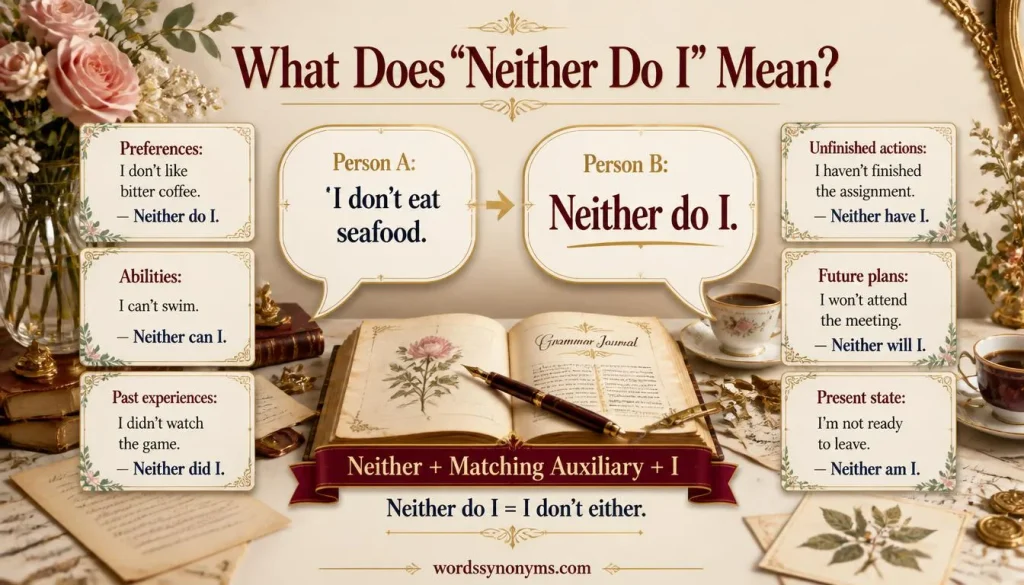
The expression “neither do I” means that a negative statement is also true for you. It allows you to agree with another person’s experience, feeling, preference, or situation without repeating the entire sentence.
For example:
Person A: “I don’t eat seafood.”
Person B: “Neither do I.”
The complete meaning of the response is “I don’t eat seafood either.”
The phrase saves time and keeps the conversation moving. Instead of repeating the original statement, you use a short grammatical structure that carries the same meaning.
You can use “neither do I” when discussing everyday preferences, personal abilities, past experiences, and future plans. The auxiliary verb changes according to the original sentence.
When to Use “Neither Do I”
Use “neither do I” when someone makes a negative statement and you want to express the same situation.
Here are the most common situations.
When discussing preferences
Person A: “I don’t like bitter coffee.”
Person B: “Neither do I.”
Both people dislike bitter coffee.
When discussing abilities
Person A: “I can’t swim.”
Person B: “Neither can I.”
The second person also lacks the ability to swim.
When discussing past experiences
Person A: “I didn’t watch the game last night.”
Person B: “Neither did I.”
Neither person watched the game.
When discussing completed actions
Person A: “I haven’t finished the assignment.”
Person B: “Neither have I.”
Both people still have unfinished assignments.
When discussing future plans
Person A: “I won’t attend the meeting tomorrow.”
Person B: “Neither will I.”
Both people intend not to attend.
Notice how the auxiliary verb changes in every example. The response uses can with can’t, did with didn’t, have with haven’t, and will with won’t.
This matching pattern is essential for correct grammar.
Is “Neither Do I” Natural in Everyday English?
Yes. “Neither do I” is a natural and widely understood expression in everyday English.
People use it to agree with negative statements without sounding overly casual or overly formal. It works between friends, family members, classmates, and coworkers.
For example:
- “I don’t understand this chapter.” “Neither do I.”
- “I’m not ready to leave.” “Neither am I.”
- “I haven’t seen that movie.” “Neither have I.”
- “I can’t concentrate with all this noise.” “Neither can I.”
You can also use “me neither” in informal conversations.
For example:
Person A: “I don’t want to go shopping today.”
Person B: “Me neither.”
This response sounds relaxed and natural. However, “neither do I” is a better choice when you want a complete, standard grammatical response.
Both expressions are useful. Your choice depends on the situation and the tone you want to convey.
Read more: 5 Words for Someone Who Plays the Victim
What Does “Nor Do I” Mean?
“Nor do I” also means “I don’t either” or “I also do not.” It expresses negative agreement, but it often appears when the speaker wants to connect another negative idea to something already mentioned.
Consider this sentence:
“I don’t enjoy crowded places, nor do I like noisy restaurants.”
The speaker dislikes crowded places and noisy restaurants. The word nor introduces the second negative idea and links it to the first.
You can also use “nor do I” as a standalone response.
For example:
Person A: “I don’t enjoy crowded places.”
Person B: “Nor do I.”
This is grammatically acceptable. Depending on the speaker and context, however, it may sound more deliberate or formal than “Neither do I.”
The important point is that “nor do I” isn’t incorrect simply because it sounds less common in casual conversation.
When to Use “Nor Do I”
Use “nor do I” when it helps you express a related negative idea clearly.
When adding a second negative point
“I don’t support the proposal, nor do I trust its timing.”
The speaker expresses two connected concerns.
When continuing a negative statement
“She hasn’t replied to my message, nor do I expect her to.”
The second clause adds another point about the same situation.
When writing formally
“I cannot approve this request, nor do I intend to make an exception.”
This construction suits formal correspondence because it connects related ideas in a concise way.
When emphasizing a negative point
“He didn’t explain the problem. Nor did he offer a solution.”
The second sentence emphasizes that he failed to take another useful action.
In these examples, nor helps the writer avoid unnecessary repetition while maintaining a clear connection between negative ideas.
Can “Nor Do I” Stand Alone?
Yes. You can use “nor do I” as a standalone response to a negative statement.
For example:
Person A: “I don’t believe the plan will work.”
Person B: “Nor do I.”
The second person agrees that the plan probably won’t work.
You don’t need to add another negative clause for the response to be grammatical. However, “nor do I” often feels more formal or emphatic than “neither do I” in this setting.
Compare the following examples:
| Conversation | Natural response |
| “I don’t like cold weather.” | “Neither do I.” |
| “I haven’t received the email.” | “Nor have I.” |
| “I can’t attend the event.” | “Nor can I.” |
| “I didn’t understand the instructions.” | “Nor did I.” |
All these responses can express negative agreement.
Still, if you’re speaking casually and want the simplest option, “neither do I” is usually the safer default.
What Is the Grammar Rule for “Nor Do I” and “Neither Do I”?
Both expressions follow a specific word order. Understanding this structure will help you use them correctly across different tenses.
The basic patterns are:
- Neither + auxiliary verb + subject
- Nor + auxiliary verb + subject
An auxiliary verb helps form a tense, question, or other grammatical construction. Common examples include do, does, did, am, is, are, have, and has. Modal verbs such as can, could, will, and should also appear in these responses.
Look at these examples:
- “I don’t work on Sundays.” → “Neither do I.”
- “I’m not hungry.” → “Neither am I.”
- “She hasn’t arrived.” → “Nor has he.”
- “They couldn’t find the address.” → “Nor could we.”
Notice that the auxiliary verb comes before the subject. This arrangement is called subject–auxiliary inversion.
The same word order appears with both neither and nor in these negative-agreement constructions.
Why Do We Say “Neither Do I” Instead of “Neither I Do”?
Standard English uses subject–auxiliary inversion in this construction.
The correct expression is:
“Neither do I.”
The incorrect expression is:
“Neither I do.”
In the correct version, do comes before I. The incorrect version places the subject before the auxiliary verb, which doesn’t follow the required pattern.
The same rule applies to nor.
- Correct: “Nor do I.”
- Incorrect: “Nor I do.”
Remember this simple formula: Neither or nor + the matching auxiliary verb + the subject.
Once you understand this order, you can form many negative responses without memorizing every sentence individually.
How to Choose the Correct Auxiliary Verb
The original statement determines which auxiliary verb you need.
| Original statement | Correct response | Why it works |
| I don’t like coffee. | Neither do I. | Uses do for the simple present |
| I’m not ready. | Neither am I. | Matches the verb am |
| I can’t drive. | Neither can I. | Matches the modal verb can |
| I didn’t call. | Neither did I. | Uses did for the simple past |
| I haven’t eaten. | Neither have I. | Matches the present perfect |
| I won’t participate. | Neither will I. | Matches the modal verb will |
| I wasn’t invited. | Nor was I. | Matches the past form of be |
| I shouldn’t worry. | Nor should I. | Matches the modal verb should |
You can replace neither with nor in these patterns when the context supports it.
For instance, “Neither have I” and “Nor have I” can both express agreement with “I haven’t finished.”
The auxiliary verb carries important grammatical information. Choosing the wrong one can make an otherwise understandable response sound incorrect.
“Nor Do I” vs. “Neither Do I”: Examples in Real Conversations
Grammar rules become easier to remember when you see how people use them. The following conversations show how both expressions fit different situations.
Casual Conversations
Imagine two friends discussing their morning routines.
Example one:
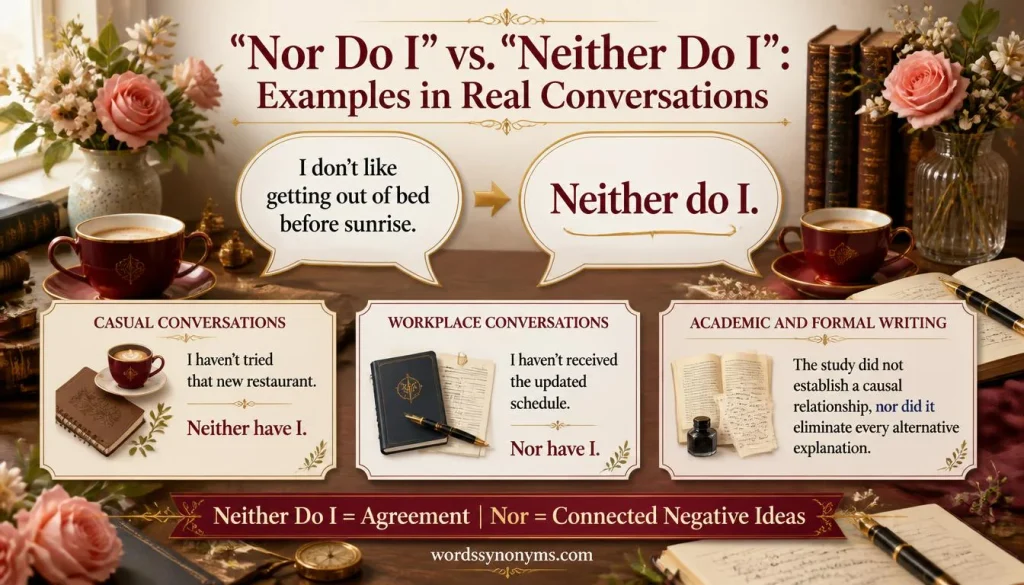
Alex: “I don’t like getting out of bed before sunrise.”
Sam: “Neither do I.”
This is a straightforward response. Sam agrees with Alex’s dislike of early mornings.
Example two:
Alex: “I haven’t tried that new restaurant.”
Sam: “Neither have I.”
Both friends have the same experience. The present perfect auxiliary have makes the response grammatically consistent.
Example three:
Alex: “I can’t stay awake during long movies.”
Sam: “Me neither!”
This response is informal and conversational. It communicates the same basic agreement without using subject–auxiliary inversion.
In everyday conversations, you generally don’t need a complicated response. Choose the expression that sounds natural and matches the original statement.
Workplace and Professional Conversations
Both expressions can also work in professional settings. The best choice depends on whether you’re answering briefly or connecting related points.
Example one:
Manager: “I don’t think we have enough information to approve this request.”
Employee: “Neither do I.”
The employee agrees without repeating the manager’s entire statement.
Example two:
Colleague A: “I haven’t received the updated schedule.”
Colleague B: “Nor have I.”
This is a concise and grammatically correct response. It may sound slightly more formal than “Neither have I,” but both work.
Example three:
Project lead: “We can’t ignore the budget limits, nor can we overlook the deadline.”
The speaker connects two important restrictions. Using nor helps present them as related concerns.
These examples show that neither expression belongs exclusively to casual or formal English. The surrounding sentence matters more than a rigid formality label.
Academic and Formal Writing
In academic writing, nor can help connect negative clauses while preserving a clear line of reasoning.
For example:
“The study did not establish a causal relationship, nor did it eliminate every alternative explanation.”
This sentence communicates two limitations. The first clause describes what the study failed to establish. The second explains another limitation.
Similarly:
“The report contains no detailed cost analysis, nor does it explain the proposed implementation schedule.”
The writer uses nor does it to add a second negative point.
You can also use neither do I in formal discussions when you need to express personal agreement. However, a full sentence may be more appropriate in research papers or technical reports.
For instance:
“I do not agree with the proposed interpretation, nor do I consider the available evidence sufficient.”
This construction is clear and suitable for formal argument.
Avoid choosing nor merely because you want your writing to sound sophisticated. Use it when the sentence benefits from a connected negative idea.
Common Mistakes to Avoid
Even though both expressions are simple, several grammatical mistakes can make them confusing. Here are the most important ones to watch for.
Using “Neither I Do”
One common error involves placing the subject before the auxiliary verb.
Incorrect: “Neither I do.”
Correct: “Neither do I.”
The correct response uses subject–auxiliary inversion. The same pattern applies to other verbs:
- Neither can I.
- Neither am I.
- Neither did I.
- Neither have I.
When in doubt, place the auxiliary verb before the subject.
Using the Wrong Auxiliary Verb
The auxiliary verb must match the structure of the original statement.
Incorrect:
Person A: “I can’t swim.”
Person B: “Neither do I.”
Correct:
Person A: “I can’t swim.”
Person B: “Neither can I.”
The first statement uses can’t, so the response uses can. Saying “Neither do I” would fail to match the original verb structure.
Here are a few more examples:
| Incorrect response | Correct response |
| “I haven’t eaten.” “Neither did I.” | “Neither have I.” |
| “I wasn’t invited.” “Neither did I.” | “Neither was I.” |
| “I won’t go.” “Neither do I.” | “Neither will I.” |
| “I can’t help.” “Neither do I.” | “Neither can I.” |
Matching the auxiliary verb is one of the most useful habits you can develop when learning negative agreement.
Confusing Negative and Positive Agreement
“Neither do I” agrees with a negative statement. It doesn’t normally agree with a positive one.
Incorrect:
Person A: “I love pizza.”
Person B: “Neither do I.”
The response contradicts the positive statement instead of agreeing with it.
Correct:
Person A: “I love pizza.”
Person B: “So do I.”
Use so to express agreement with a positive statement.
Compare these patterns:
- Positive: “I like tea.” → “So do I.”
- Negative: “I don’t like tea.” → “Neither do I.”
- Positive: “I can swim.” → “So can I.”
- Negative: “I can’t swim.” → “Neither can I.”
The distinction is simple: use so for positive agreement and neither or nor for negative agreement.
Assuming “Nor Do I” Is Always Too Formal
Some learners avoid “nor do I” because they believe it only belongs in formal writing. That’s too restrictive.
Consider this exchange:
Person A: “I don’t want to argue.”
Person B: “Nor do I.”
The response is grammatical. Depending on the speakers and context, it may sound more emphatic than “Neither do I.”
You can use nor in conversation, formal writing, or a connected sentence. Just remember that “neither do I” is often the more familiar choice for everyday standalone replies.
Using Both Expressions Together Unnecessarily
You generally don’t need to combine both expressions to communicate the same negative agreement.
Awkward: “Neither do I, nor do I either.”
Better: “Neither do I.”
You could also say “I don’t either” or “Me neither,” depending on the context.
However, using both neither and nor in the same sentence isn’t automatically wrong. They often work together to connect alternatives.
For example:
“Neither my brother nor I enjoy driving at night.”
Here, neither … nor links two subjects. It serves a different grammatical purpose from the standalone response “Neither do I.”
“Nor Do I” vs. “Neither Do I” vs. “I Don’t Either”
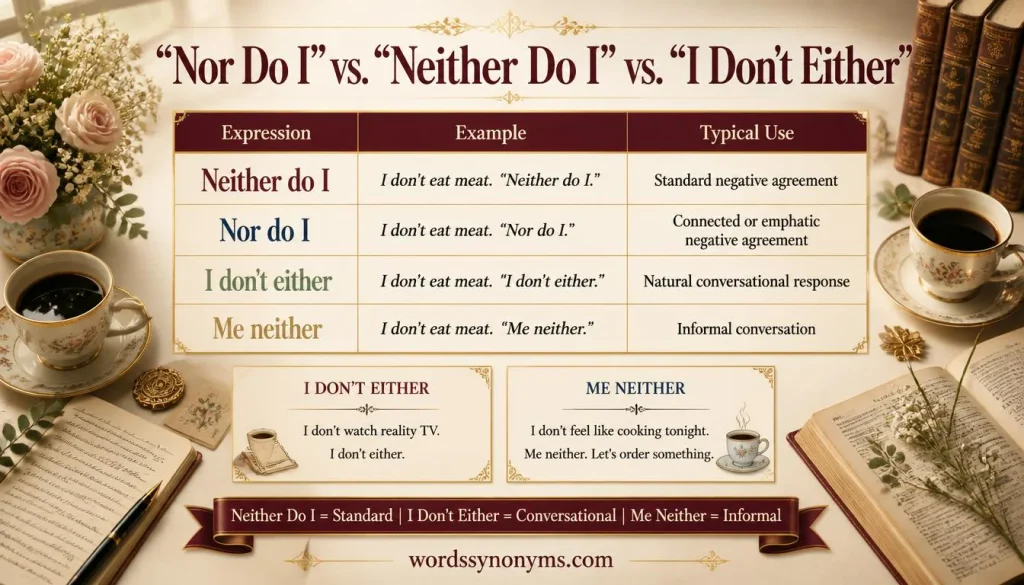
English offers several ways to agree with a negative statement. Although these expressions communicate similar meanings, their structures and tones differ.
| Expression | Example | Typical use |
| Neither do I | “I don’t eat meat.” “Neither do I.” | Standard negative agreement |
| Nor do I | “I don’t eat meat.” “Nor do I.” | Negative agreement, sometimes more emphatic |
| I don’t either | “I don’t eat meat.” “I don’t either.” | Natural conversational response |
| Me neither | “I don’t eat meat.” “Me neither.” | Informal conversation |
When Should You Use “I Don’t Either”?
Use “I don’t either” when you want a natural response without changing the usual subject–verb order.
For example:
Person A: “I don’t watch reality TV.”
Person B: “I don’t either.”
This means the second person also doesn’t watch reality TV.
The construction follows the usual sentence order:
Subject + negative auxiliary + either
Examples include:
- “I can’t drive.” “I can’t either.”
- “I haven’t finished.” “I haven’t either.”
- “I didn’t see him.” “I didn’t either.”
These responses are especially useful in conversation because they sound direct and familiar.
When Should You Use “Me Neither”?
“Me neither” is an informal expression of negative agreement. It’s common in relaxed conversations with friends, family, and people you know well.
For example:
Person A: “I don’t feel like cooking tonight.”
Person B: “Me neither. Let’s order something.”
This response sounds natural and friendly.
However, me neither doesn’t follow the same subject–auxiliary inversion pattern as “neither do I.” It’s a conventional conversational expression rather than a full clause with the same grammatical structure.
For formal writing, choose “neither do I” or a complete sentence instead.
Case Studies: Choosing the Right Expression
A few realistic situations can help you decide between these expressions without overthinking the grammar.
Case Study: Agreeing With a Friend
Your friend says, “I don’t like studying late at night.”
You also prefer studying earlier in the day.
Best response: “Neither do I.”
Why? You’re agreeing with a negative statement in a simple conversation. The phrase is concise and natural.
You could also say “Me neither” for a more casual tone.
Case Study: Adding a Point in a Work Email
You’re writing a message about a project that lacks sufficient planning.
You write:
“The proposal doesn’t explain the budget, nor does it identify the project timeline.”
Why does nor work here? It connects two related problems and keeps the sentence concise.
Using “neither does it” in the same construction is also possible in some contexts, but nor does it is a natural choice for continuing the negative statement.
Case Study: Responding to a Shared Experience
A classmate says, “I haven’t submitted the application yet.”
You haven’t submitted yours either.
Best response: “Neither have I.”
Why? The original statement uses the present perfect, so the response uses have.
“Nor have I” is also grammatical. The choice depends on the tone and context.
Case Study: Agreeing With a Positive Statement
Your coworker says, “I enjoy working on creative projects.”
You feel the same way.
Best response: “So do I.”
Why? The original statement is positive. Neither neither nor nor is the right choice for ordinary positive agreement here.
These examples show that the best response depends on three things: the original meaning, the auxiliary verb, and the context.
Read more: Governor “Guv” in British Slang: Origin, and Examples
Quick Practice: Choose “Nor Do I” or “Neither Do I”
Test your understanding with these five questions. Choose the expression that completes each sentence naturally.
Question one
“I don’t understand this question.”
Response: “__________.”
Question two
“I haven’t visited New York.”
Response: “__________.”
Question three
“I can’t attend the event.”
Response: “__________.”
Question four
“I don’t like the plan, __________ do I think it will work.”
Question five
“She didn’t call me. __________ did she send a message.”
Answer Key and Explanations
One: Neither do I.
The original statement uses don’t, so the response uses do. “Nor do I” is also possible.
Two: Neither have I.
The present perfect construction uses have. “Nor have I” is also correct.
Three: Neither can I.
The original statement uses the modal verb can. The response must match it.
Four: Nor
The complete sentence is “I don’t like the plan, nor do I think it will work.” The word nor connects two negative ideas.
Five: Nor
The complete sentence is “She didn’t call me. Nor did she send a message.” The second sentence continues the negative idea and uses subject–auxiliary inversion.
Remember that the goal isn’t to memorize one response for every situation. Instead, learn to recognize the original verb structure and decide whether you’re replying or extending a negative statement.
FAQs
1. What is the difference between “Nor Do I” and “Neither Do I”?
Both expressions show agreement with a negative statement. “Neither do I” sounds more natural in everyday conversation, while “nor do I” often sounds more formal or connects another negative idea.
2. Is “Neither Do I” grammatically correct?
Yes, “neither do I” is grammatically correct. You can use it to agree with someone who says something negative, such as “I don’t watch horror movies.”
3. Can I use “Nor Do I” in everyday conversation?
Yes, you can. However, “nor do I” may sound more formal than “neither do I.” It’s often more suitable for formal discussions, speeches, or sentences that continue a negative thought.
4. Should I say “Neither Do I” or “Me Neither”?
Both are common ways to agree with a negative statement in everyday English. “Neither do I” follows a more formal grammatical structure, while “me neither” is informal and conversational.
5. How do I use “Nor Do I” in a sentence?
You can use “nor do I” to add another negative idea. For example: “She doesn’t enjoy spicy food, nor do I.” This structure connects two negative statements and uses the auxiliary verb before the subject.
6. Is “Nor Do I” more correct than “Neither Do I”?
No. Both expressions are correct when used in the right context. “Neither do I” is usually the easier choice for everyday conversations, while “nor do I” can work better in formal writing or connected negative clauses.
Conclusion
Choosing between “nor do I” and “neither do I” becomes easier when you understand the situation. Both expressions help you agree with a negative statement, but they can sound different depending on the context. If you’re chatting with a friend, answering a coworker, or speaking in everyday English, “neither do I” is usually the most natural choice. On the other hand, “nor do I” often fits formal writing and sentences that connect negative ideas. Neither expression is automatically better or more correct than the other. The key is knowing how each one works and choosing the phrase that fits your tone.
You can build confidence by practicing both expressions in real conversations and short writing exercises. For example, if someone says, “I don’t enjoy waking up early,” you can naturally reply, “Neither do I.” If you’re writing a more formal sentence, you might say, “He doesn’t support the proposal, nor do I.” Notice how the second example connects two negative ideas. These small differences can improve your grammar, make your responses sound more natural, and help you communicate clearly in different situations. With regular practice, you’ll know when to use each expression without overthinking every sentence.

Shafiq Ur Rehman is a writer and content contributor at WordsConfusing.com. He enjoys exploring the English language, common word confusions, vocabulary, and practical writing tips. His goal is to make English easier to understand through clear, simple, and useful articles.