“As Evidenced By” or “As Evident By”: Which Is Correct? The answer depends on the grammatical role of each word.
English has many interchangeable phrases, but their grammatical rules can differ. Here, evidenced is a past participle, while evident is an adjective meaning clear or obvious. Therefore, as evidenced by is the correct phrase in standard English, formal writing, academic writing, and professional communication.
It introduces proof, evidence, or supporting information. In contrast, as evident by is generally considered a grammatical error because it lacks an appropriate linking verb or correct sentence structure. Understanding this grammatical distinction helps you avoid common mistakes and improve your writing accuracy.
This grammar comparison matters in academic papers, research papers, journalism, business communication, and professional correspondence. You can use the correct expression in reports, essays, articles, business documents, and professional emails. It also works when explaining results, project updates, or project management decisions.
For example, “The project succeeded, as evidenced by its results” demonstrates proper usage. Remember this simple memory trick: evidenced introduces proof. Choosing the preferred expression improves grammatical accuracy, clear communication, and polished writing.
Quick Answer
The correct expression is “as evidenced by,” not “as evident by.” Use it when introducing facts, examples, or results that support a statement. For example, “Her hard work paid off, as evidenced by her excellent results.” If you prefer evident, use “as evident from” instead.

Is It “As Evidenced By” or “As Evident By”?
“As evidenced by” is the correct expression in standard English. It introduces information that supports or demonstrates a particular statement.
The word evidenced is the past participle of the verb evidence. In this expression, it indicates that something has been demonstrated through available facts, examples, or observations.
Consider this example:
- The company’s growth is impressive, as evidenced by its increasing annual revenue.
Here, the increasing annual revenue provides evidence of the company’s growth. The phrase connects the main statement with information that supports it.
Now consider the alternative:
- The company’s growth is impressive, as evident by its increasing annual revenue.
Although the intended meaning remains understandable, the construction is grammatically awkward. The adjective evident doesn’t function like the past participle evidenced.
However, there’s another expression worth remembering: “as evident from.” This construction is grammatically acceptable because it uses the adjective evident with the preposition from.
For example:
- The company’s growth is impressive, as is evident from its increasing annual revenue.
You can also write:
- The company’s growth is impressive, as evident from its increasing annual revenue.
Both constructions communicate that something becomes clear through the available information.
Quick answer: Choose as evidenced by when introducing supporting evidence. Use as evident from when describing something that becomes clear from particular facts or circumstances.
Why Is “As Evidenced By” Correct?
The correctness of this expression depends on the grammatical role of evidenced. Understanding that role helps you avoid confusing it with the adjective evident.
The verb evidence means to demonstrate, indicate, or provide proof of something. Its past participle, evidenced, describes something that has been demonstrated through supporting information.
When you write “as evidenced by,” you essentially mean:
- As demonstrated by
- As shown by
- As supported by
- As indicated by
The expression introduces information that makes a previous statement more convincing.
For instance:
The student has improved significantly, as evidenced by her examination results.
The examination results support the claim about the student’s improvement. Without those results, the statement would have less concrete support.
This construction appears frequently in academic papers, research reports, business documents, news articles, and professional communication.
Understanding the Word “Evidenced”
The word evidenced is the past participle of evidence, which functions as a verb.
According to its grammatical meaning, to evidence something means to demonstrate its existence or provide information that supports its truth.
Here are the different forms of the word:
| Word | Part of Speech | Meaning | Example |
| Evidence | Noun | Information supporting a claim | The evidence supports her argument. |
| Evidence | Verb | To demonstrate or indicate | The results evidence a clear improvement. |
| Evidenced | Past participle | Demonstrated or supported | Her ability was evidenced by her results. |
| Evidencing | Present participle | Demonstrating or indicating | The report is evidencing positive changes. |
| Evident | Adjective | Clear or obvious | Her improvement is evident. |
Notice how evidenced and evident serve different grammatical purposes.
For example:
- Evidenced: His leadership skills were evidenced by his team’s success.
- Evident: His leadership skills were evident throughout the project.
The first example emphasizes the information demonstrating his leadership skills. The second describes those skills as clear or noticeable.
This difference explains why as evidenced by works while as evident by does not.
How “As Evidenced By” Works in a Sentence
The expression “as evidenced by” introduces supporting information that helps readers understand why a statement is reasonable.
It can appear at the beginning, middle, or end of a sentence. Its placement depends on the sentence structure and the emphasis you want.
At the beginning of a sentence:
As evidenced by recent examination results, students performed better after receiving additional tutoring.
Here, the introductory phrase identifies the evidence before presenting the main statement.
In the middle of a sentence:
The team has made considerable progress, as evidenced by its improved performance.
The phrase follows the main statement and adds supporting information.
After a longer statement:
The organization has strengthened its financial position over the past year, as evidenced by reduced operating costs and higher revenue.
This structure works particularly well in reports and formal explanations.
Punctuation matters, too. When the phrase introduces a sentence, place a comma after the introductory expression.
When it appears at the end of a sentence, a comma usually separates it from the main statement.
For example:
- As evidenced by the survey results, customer satisfaction has increased.
- Customer satisfaction has increased, as evidenced by the survey results.
The comma helps readers recognize the supporting phrase without interrupting the sentence’s meaning.
Read more: 5 Terms to Describe Being Hard on the Outside But Soft on the Inside
Why Is “As Evident By” Incorrect?
The expression “as evident by” is considered nonstandard because it uses an adjective where the construction calls for a past participle.
The confusion usually comes from the similarity between evident and evidenced. Both words relate to proof, clarity, and demonstration. However, their grammatical functions differ.
An adjective describes a person, object, situation, or condition. A past participle can participate in verb constructions and passive structures.
Consider these examples:
- Correct: The problem became evident after the investigation.
- Correct: The problem was evidenced by several witness statements.
- Incorrect: The problem was evident by several witness statements.
The third sentence uses evident with by in a construction where evidenced is needed.
You might encounter as evident by in online articles, informal messages, or everyday writing. Its appearance doesn’t make it standard English.
If you want to express the same idea using evident, choose “as is evident from” or “as evident from.”
For example:
- Incorrect: His confidence increased, as evident by his presentation.
- Correct: His confidence increased, as evidenced by his presentation.
- Correct: His confidence increased, as is evident from his presentation.
Both corrected versions communicate the intended meaning naturally.
Understanding the Word “Evident”
The word evident is an adjective that means clear, noticeable, or easy to recognize.
You use it when something doesn’t require much explanation because the available facts or circumstances make it obvious.
For example:
- Her excitement was evident when she received the award.
- The effects of regular exercise became evident over time.
- His disappointment was evident from his facial expression.
- The differences between the two proposals are evident.
In each sentence, evident describes something that appears clear or noticeable.
Unlike evidenced, it doesn’t introduce supporting information through the same grammatical construction.
Here are some common expressions that correctly use evident:
| Expression | Example |
| Clearly evident | The improvement was clearly evident. |
| Become evident | The problem became evident later. |
| Make something evident | Her actions made her intentions evident. |
| Be evident from | His experience is evident from his work. |
| As is evident from | As is evident from the results, progress has been substantial. |
| It is evident that | It is evident that the plan needs improvement. |
These examples demonstrate how naturally evident works when you use it as an adjective.
Common Mistake: Confusing “Evident” With “Evidenced”
Even experienced writers sometimes confuse these words because their meanings overlap.
Both relate to information that makes something understandable or believable. Nevertheless, they perform different jobs within a sentence.
Think of it this way:
- Evident describes something that is clear or obvious.
- Evidenced indicates that something has been demonstrated through supporting information.
For example:
Using evident:
The manager’s experience was evident during the difficult negotiations.
Here, evident describes the manager’s noticeable experience.
Using evidenced:
The manager’s experience was evidenced by her successful handling of difficult negotiations.
Here, evidenced introduces the actions that demonstrate her experience.
The difference becomes even clearer when you compare their sentence patterns.
| Incorrect or Correct | Sentence | Explanation |
| Incorrect | Her talent was as evident by her performance. | The adjective doesn’t fit this construction. |
| Correct | Her talent was evident from her performance. | Evident describes something clear. |
| Correct | Her talent was evidenced by her performance. | Evidenced introduces supporting information. |
| Correct | Her talent was clear, as evidenced by her performance. | The phrase introduces proof of her talent. |
Remember: Use evident to describe clarity. Use evidenced when explaining what demonstrates or supports a statement.
“As Evidenced By” vs. “As Evident From”: What’s the Difference?
Although these expressions communicate similar ideas, they use different grammatical structures.
“As evidenced by” introduces something that demonstrates or supports a statement. Meanwhile, “as evident from” describes something that becomes clear through particular information.
Both expressions are acceptable in standard English. Your choice depends on the sentence and the emphasis you want.
Consider these examples:
- The employee’s dedication is clear, as evidenced by her excellent work.
- The employee’s dedication is clear, as evident from her excellent work.
Both sentences communicate that the employee’s work demonstrates dedication. However, the first emphasizes the evidence, while the second emphasizes the clarity of the conclusion.
For a more explicit construction, you can write:
- The employee’s dedication is clear, as is evident from her excellent work.
This version includes the verb is and creates a complete, natural expression.
Here’s a practical comparison:
| Feature | As Evidenced By | As Evident From |
| Main word | Evidenced | Evident |
| Part of speech | Past participle | Adjective |
| Main purpose | Introduces supporting evidence | Describes something as clear |
| Common structure | As evidenced by the results | As evident from the results |
| Formality | Formal and professional | Formal and professional |
| Correct usage | Yes | Yes |
When to Use “As Evidenced By”
Choose “as evidenced by” when you want to connect a statement with specific information that supports it.
The expression works particularly well when discussing measurable results, documented facts, observations, and examples.
For instance:
Academic writing:
The intervention improved student performance, as evidenced by higher examination scores.
The examination scores support the statement about improved performance.
Business communication:
The company has strengthened its market position, as evidenced by increased sales and customer retention.
The sales figures and retention rates demonstrate business progress.
Scientific research:
The treatment produced measurable changes, as evidenced by the recorded experimental results.
The recorded results provide support for the research finding.
Everyday writing:
She genuinely enjoys teaching, as evidenced by the enthusiasm she brings to every lesson.
Her enthusiasm provides a practical example of her interest.
Use this expression when your sentence needs a clear connection between a claim and its supporting information.
When to Use “As Evident From”
Choose “as evident from” when you want to describe something as clear based on available information.
The expression works naturally with observations, behavior, circumstances, and visible results.
For example:
- His nervousness was apparent, as evident from his trembling hands.
- The project’s success is clear, as evident from the positive feedback.
- Her interest in literature is obvious, as evident from her extensive book collection.
- The need for improvement is clear, as evident from the recent performance review.
You can also use the fuller expression “as is evident from.”
For example:
As is evident from the latest survey, customers prefer simpler checkout processes.
This construction is especially useful in formal writing because it makes the grammatical relationship explicit.
One important distinction remains: as evident from describes clarity, while as evidenced by directly introduces supporting evidence.
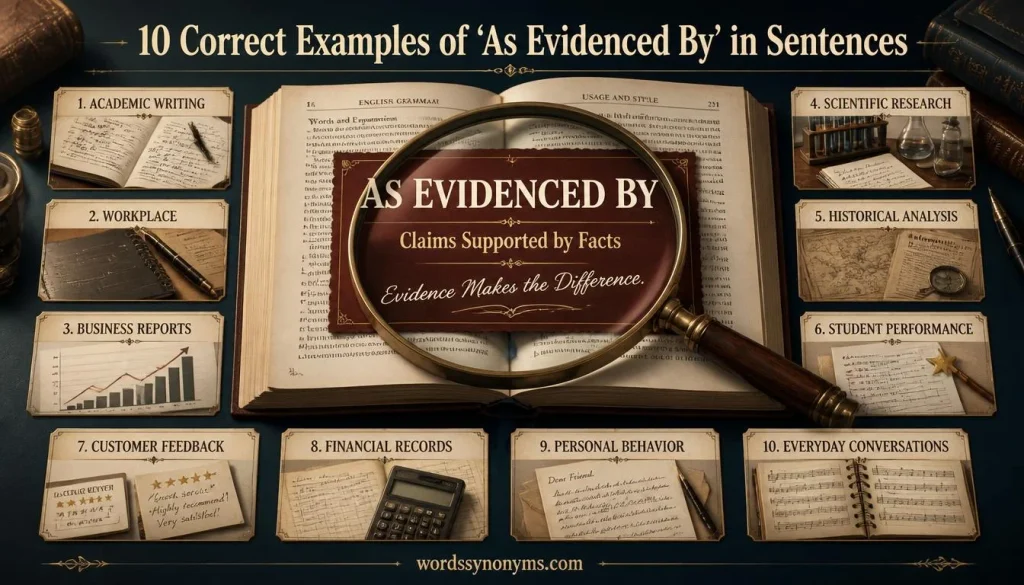
10 Correct Examples of “As Evidenced By” in Sentences
Examples make grammatical rules easier to understand and remember. The following sentences demonstrate how you can use “as evidenced by” in different situations.
Each example connects a statement with information that supports it.
Academic Writing
The student’s writing skills have improved considerably, as evidenced by her recent research paper.
The research paper demonstrates progress in writing ability. It gives readers a specific example instead of an unsupported claim.
Workplace Communication
The employee has become more confident, as evidenced by her ability to lead team meetings.
Her leadership during meetings provides practical support for the statement.
Business Reports
The business is experiencing steady growth, as evidenced by its increasing quarterly revenue.
The financial figures support the claim about business performance.
Scientific Research
The experiment produced consistent results, as evidenced by similar findings across multiple trials.
The repeated findings support the reliability of the experiment.
Historical Analysis
The civilization maintained extensive trade networks, as evidenced by archaeological discoveries and historical records.
Physical discoveries and written records provide supporting historical information.
Student Performance
The students understand the subject better, as evidenced by their improved examination scores.
The examination results demonstrate their academic progress.
Customer Feedback
The new service has improved customer satisfaction, as evidenced by positive reviews and fewer complaints.
Customer responses provide measurable support for the statement.
Financial Records
The organization has reduced unnecessary spending, as evidenced by its lower operating expenses.
The financial records demonstrate a reduction in costs.
Personal Behavior
He values his friendships, as evidenced by his willingness to help others during difficult times.
His actions demonstrate consideration and loyalty.
Everyday Conversations
She has been practicing regularly, as evidenced by how confidently she plays the piano now.
Her improved performance demonstrates the results of consistent practice.
These examples show that the expression works across several writing styles. You can use it in professional documents, academic discussions, and everyday explanations.

Common Alternatives to “As Evidenced By”
Repeating the same expression throughout an article can make your writing feel monotonous. Fortunately, English offers several alternatives that communicate similar ideas.
The best replacement depends on the type of evidence you’re discussing and the meaning you want to emphasize.
Here are eight useful alternatives.
As Shown By
“As shown by” introduces information that demonstrates or reveals something.
It works well when discussing results, measurements, examples, or visible changes.
Example:
The new training program improved employee performance, as shown by the latest evaluation results.
This expression is straightforward and suitable for both formal and informal writing.
As Demonstrated By
“As demonstrated by” emphasizes that something has been clearly established through an example, result, or action.
It’s especially useful in academic, scientific, and professional contexts.
Example:
The new teaching method encourages better participation, as demonstrated by increased classroom engagement.
Choose this alternative when you want to emphasize a clear demonstration.
As Indicated By
“As indicated by” introduces information that suggests or points toward a particular conclusion.
It doesn’t always imply absolute proof. Instead, it highlights signs or findings that support an interpretation.
Example:
The market may recover soon, as indicated by recent improvements in consumer confidence.
This expression works well when discussing trends, estimates, and preliminary findings.
As Illustrated By
“As illustrated by” introduces an example that helps explain or clarify an idea.
Writers frequently use it in educational articles, reports, and explanatory discussions.
Example:
Effective communication requires patience, as illustrated by the manager’s handling of workplace disagreements.
Use it when an example makes an abstract idea easier to understand.
As Confirmed By
“As confirmed by” suggests that additional information verifies an earlier statement.
It’s particularly useful when discussing official records, test results, and verified reports.
Example:
The appointment has been scheduled, as confirmed by the hospital’s confirmation email.
Choose this expression when the supporting information provides verification.
As Supported By
“As supported by” emphasizes that available information strengthens an argument or conclusion.
It’s common in academic writing, legal discussions, and research reports.
Example:
The proposed explanation is reasonable, as supported by the findings from three independent studies.
Use this alternative when connecting an argument with relevant supporting material.
As Seen In
“As seen in” introduces a source, example, or situation where something becomes noticeable.
It works particularly well when referring to published material, observations, or real-world examples.
Example:
The trend appears across several industries, as seen in recent employment reports.
This expression sounds natural and avoids unnecessary formality.
As Reflected In
“As reflected in” describes how a particular condition, quality, or development appears through specific information.
It’s especially useful in business reports and discussions about measurable changes.
Example:
The company’s improved financial health is reflected in its stronger annual results.
Choose this phrase when discussing how information represents a broader situation.
Comparison of Alternatives
| Alternative | Best Used For | Example |
| As shown by | Results and visible changes | As shown by the figures, sales increased. |
| As demonstrated by | Clear demonstrations | As demonstrated by the experiment, the method works. |
| As indicated by | Signs and trends | As indicated by the survey, preferences are changing. |
| As illustrated by | Examples and explanations | As illustrated by the case study, planning matters. |
| As confirmed by | Verified information | As confirmed by the report, the figures are accurate. |
| As supported by | Arguments and research | As supported by the evidence, the conclusion is reasonable. |
| As seen in | Sources and observations | As seen in the records, attendance improved. |
| As reflected in | Broader conditions and results | As reflected in the data, performance improved. |
Writing tip: Don’t replace as evidenced by simply to avoid repetition. Choose an alternative that accurately represents the relationship between your statement and its supporting information.
Common Mistakes to Avoid When Using “As Evidenced By”
Even when you understand the correct expression, a few common mistakes can weaken your writing.
Avoid these problems to make your sentences clearer and more accurate.
Using “As Evident By” Instead of “As Evidenced By”
This is the main mistake writers make when choosing between these expressions.
Incorrect: The improvement was noticeable, as evident by the latest results.
Correct: The improvement was noticeable, as evidenced by the latest results.
Alternatively, you can write:
The improvement was noticeable, as evident from the latest results.
Remember that evident works naturally with from in this construction.
Confusing Evidence With Proof
Evidence and proof are related, but they don’t always mean exactly the same thing.
Evidence supports a claim or helps establish its credibility. However, one piece of evidence doesn’t necessarily prove something beyond doubt.
For example:
The employee’s performance improved, as evidenced by her latest evaluation.
This sentence introduces information supporting the claim. It doesn’t automatically establish every possible reason behind her improvement.
Be careful not to present limited observations as conclusive proof.
Using the Phrase Without Supporting Information
The expression should introduce something that genuinely supports your statement.
Consider this example:
Incorrect: The company is successful, as evidenced by its success.
This sentence repeats the original claim without providing meaningful support.
A better version would be:
Correct: The company is successful, as evidenced by its growing customer base and consistent annual profits.
The revised sentence provides specific information that readers can evaluate.
Repeating “As Evidenced By” Too Frequently
Although the expression is grammatically correct, excessive repetition makes writing dull.
For example:
The project was successful, as evidenced by the results. Employee satisfaction increased, as evidenced by the survey. Productivity improved, as evidenced by the latest report.
The repetition creates an awkward rhythm.
Instead, vary your language:
The project was successful, as demonstrated by its results. Employee satisfaction increased according to the survey. The latest report also showed improved productivity.
This version communicates the same information more naturally.
Creating Unnecessarily Complicated Sentences
Formal expressions don’t automatically make writing better.
Consider this example:
The department’s overall operational effectiveness has been substantially enhanced, as evidenced by the numerous favorable performance indicators documented throughout the reporting period.
Although grammatically acceptable, the sentence contains unnecessary complexity.
A clearer version would be:
The department has improved its performance, as evidenced by several positive indicators in the latest report.
Simple language often communicates complicated ideas more effectively.
Ignoring the Relationship Between Evidence and Claims
The information following as evidenced by should directly support the statement before it.
For example:
Weak: The restaurant provides excellent service, as evidenced by its attractive interior design.
The restaurant’s appearance doesn’t necessarily demonstrate service quality.
Better: The restaurant provides excellent service, as evidenced by positive customer reviews and consistently high satisfaction ratings.
The revised example connects the evidence with the actual claim.
Read more: Comma Before “Even”: When to Use It and When to Skip It
FAQs
1. Is “as evidenced by” grammatically correct?
Yes, “as evidenced by” is grammatically correct in standard English. It introduces evidence or facts that support a statement. For example, “Her dedication is clear, as evidenced by her consistent work.”
2. Why is “as evident by” considered incorrect?
The phrase “as evident by” is generally considered nonstandard because evident is an adjective. It doesn’t introduce supporting evidence in the same way as the past participle evidenced.
3. Can I use “as evidenced by” in academic writing?
Absolutely. “As evidenced by” works well in research papers, essays, reports, and academic discussions. It helps connect an argument with facts, findings, or supporting information.
4. What is another way to say “as evidenced by”?
You can use several alternatives, depending on your sentence. These include “as demonstrated by,” “as shown by,” “as indicated by,” “as supported by,” and “as proven by.”
5. Is “as evidenced by” suitable for professional emails?
Yes, it’s suitable for professional emails, business reports, and workplace communication. However, simpler alternatives like “as shown by” may sound more natural in everyday conversations.
6. What is the difference between “evidenced” and “evident”?
Evidenced is the past participle of the verb evidence and refers to something supported by proof. Evident is an adjective that describes something clear or obvious. For example, “Her progress is evident” and “Her progress is shown, as evidenced by her results.”
Conclusion
Choosing between “as evidenced by” or “as evident by” becomes easier once you understand their grammatical roles. Although both expressions look similar, they don’t serve the same purpose. “As evidenced by” is the correct and widely accepted expression because it introduces facts, proof, or supporting details. On the other hand, “as evident by” is generally considered grammatically incorrect in standard English. Remembering the difference between evidenced and evident can help you avoid this common writing mistake.
Whether you’re preparing an academic paper, writing a professional email, or explaining research findings, accuracy matters. Use “as evidenced by” when connecting a statement with supporting evidence. If you want a simpler alternative, consider “as shown by” or “as demonstrated by.” Small grammatical choices can make a noticeable difference in how readers understand your writing.

Franklin Hayes is a writer and editor at WordsConfusing.com, focused on making English vocabulary, grammar, and commonly confused words easy to understand. He writes clear, practical articles with simple explanations and useful examples to help readers improve their English with confidence.
His goal is simple: Making Confusing Words Simple.