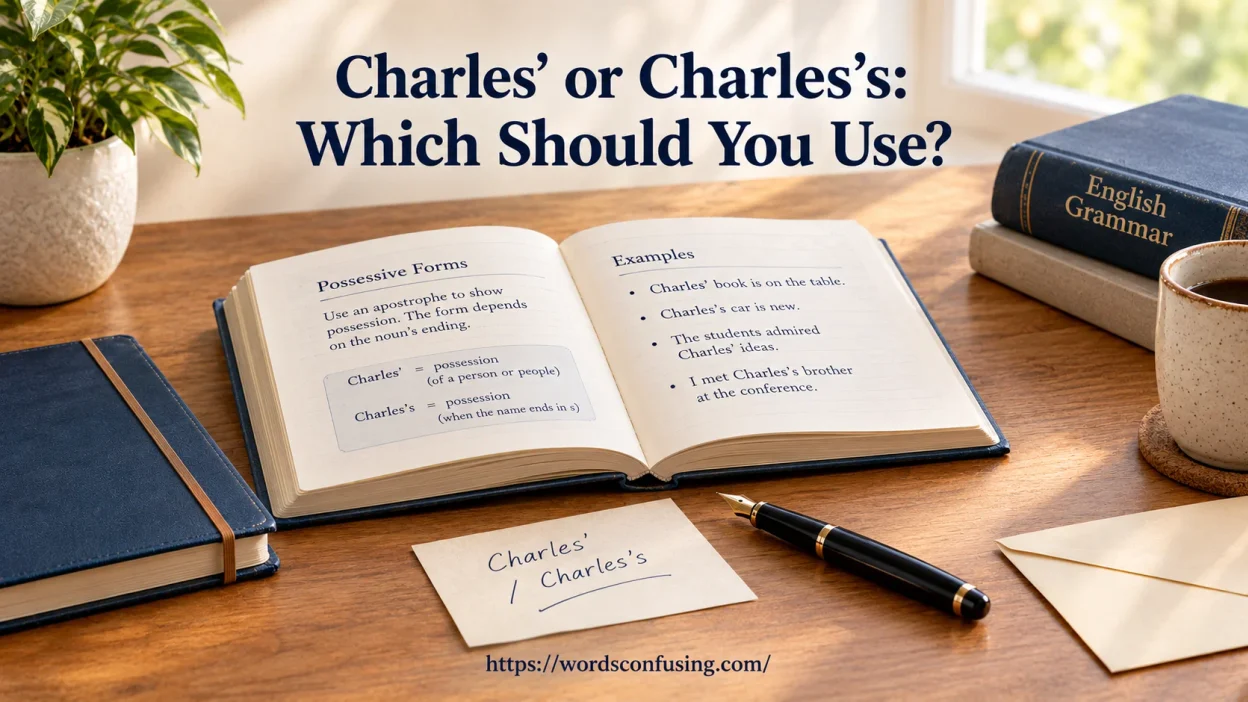
Choosing between Charles’ or Charles’s: Which Should You Use? can confuse experienced writers, especially when names end in “s” and possessive forms follow different style rules.
In English grammar, a singular possessive shows ownership by one person. For example, Charles’s book and Charles’ book both indicate that the book belongs to Charles. The possessive apostrophe helps ensure correct punctuation and makes the right choice easier. In formal writing, professional writing, and academic content, maintaining consistency is essential.
Many major grammar authorities recommend adding apostrophe s, while some style guides accept an apostrophe after s. A reliable grammar guide explains the difference, covers important grammar rules and writing conventions, and provides helpful examples to strengthen your grammar skills.
You can apply these rules through practical examples in real-world contexts. Write Charles’s report when preparing reports, Charles’s email when drafting emails, and Charles’s project when handling business communication or project management workflows. These examples also apply to creating content for business emails, calendar scheduling, a shared calendar entry, scheduling updates, online booking confirmations, and booking confirmations.
Consistent possessive forms create polished writing that looks accurate and professional. Clear wording improves clarity in meetings, broadcasting, and everyday written communication. Although common style-guide rules can differ, using one standard throughout each piece of communication helps you strengthen formal writing and maintain greater consistency.
Remember to check usage exceptions and punctuation rules when choosing between Charles’ and Charles’s. These easy tips support consistent professional content and help you use possessive nouns correctly in different situations.
Quick Answer
Both Charles’ and Charles’s are correct ways to show possession by someone named Charles. The difference depends on the style guide you follow. Chicago, APA, and MLA generally prefer Charles’s, while AP style uses Charles’. If no specific style guide applies, Charles’s is a reliable choice for everyday American English writing.
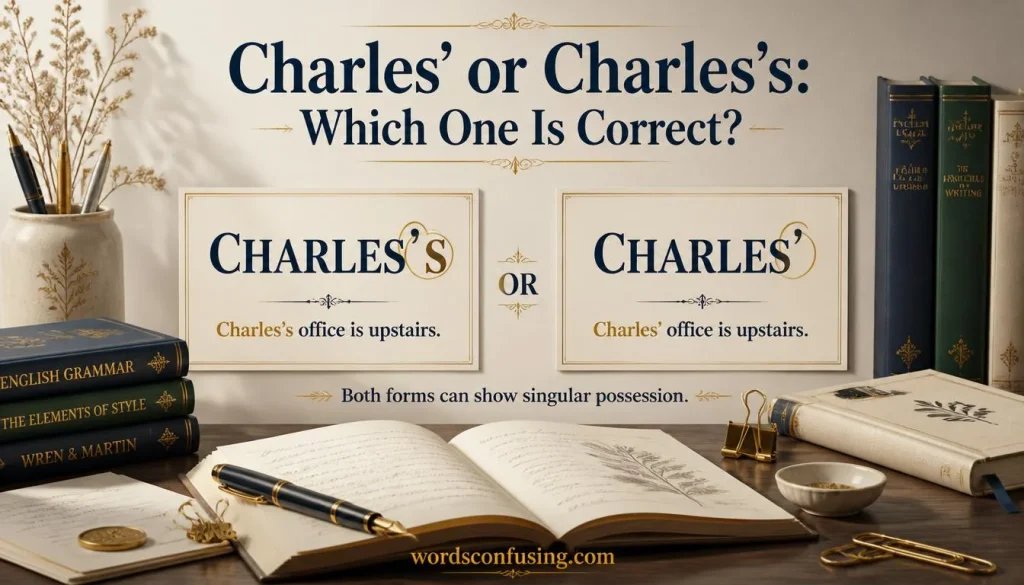
Charles’ or Charles’s: Which One Is Correct?
Both Charles’ and Charles’s can be correct when you want to show possession by one person named Charles. However, the preferred form depends on the style guide or editorial rules you follow.
English uses apostrophes to show possession, but writers don’t always handle names ending in s the same way. Some style guides recommend adding ’s, while others recommend adding only an apostrophe.
Consider these examples:
- Charles’s bicycle needs a new tire.
- Charles’ bicycle needs a new tire.
Both sentences express the same basic idea. The spelling changes, but the relationship between Charles and the bicycle remains the same.
Here is a quick comparison:
| Form | Usage | Example |
| Charles’s | Singular possessive with ’s | Charles’s office is upstairs. |
| Charles’ | Alternative singular possessive with an apostrophe only | Charles’ office is upstairs. |
| Charleses | Plural of the name Charles | Two Charleses joined the meeting. |
| Charleses’ | Plural possessive | The Charleses’ house is nearby. |
Notice that Charles’s and Charles’ refer to one person’s possession, while Charleses’ refers to possession involving multiple people named Charles.
When to Use Charles’s
Use Charles’s when you follow the general rule of adding an apostrophe and s to a singular noun to show possession. This rule applies even when the noun already ends in the letter s.
For example:
- Charles’s laptop is on the desk.
- I borrowed Charles’s dictionary yesterday.
- Charles’s garden looks beautiful in spring.
- Everyone appreciated Charles’s honest opinion.
- The teacher checked Charles’s assignment.
In each sentence, the name refers to one person. The apostrophe and additional s indicate that the following object, idea, or responsibility belongs to or relates to Charles.
This form is common in general American English and follows the approach used by The Chicago Manual of Style. It also appears in ordinary APA and MLA writing.
If you’re writing an essay, personal letter, school assignment, or general blog post, Charles’s is a reliable choice unless your required style guide says otherwise.
When to Use Charles’
Use Charles’ when you follow a style convention that adds only an apostrophe to certain singular proper names ending in s. The Associated Press Stylebook generally follows this approach.
For example:
- Charles’ laptop is on the desk.
- I borrowed Charles’ dictionary yesterday.
- Charles’ garden looks beautiful in spring.
- Everyone appreciated Charles’ honest opinion.
- The teacher checked Charles’ assignment.
These sentences communicate the same relationships as the examples using Charles’s. The difference is editorial preference rather than meaning.
You may encounter Charles’ in newspaper articles, news websites, and publications that follow AP style. Some writers also prefer this spelling because it looks shorter.
However, don’t assume that every publication follows the same convention. If an editor, teacher, or publisher provides a style guide, follow its instructions.
Why Do Charles’ and Charles’s Both Exist?
The difference between Charles’ and Charles’s comes from two established ways of forming singular possessives. English grammar provides a general rule, while some editorial traditions use a different convention for names ending in s.
Under the general rule, writers add ’s to a singular noun to show possession. For example, you write the teacher’s desk, James’s book, and Charles’s coat. The ending s doesn’t prevent the addition of another s.
However, some style guides handle singular proper names differently. They place an apostrophe after the final s without adding another letter. Under this convention, you write James’ book or Charles’ coat.
Neither convention changes the basic meaning of the possessive. Both identify a relationship between a person and something associated with them.
Why does this matter? Different publications value consistent editorial rules. A newspaper may use Charles’, while a book publisher may use Charles’s. Readers can understand both forms without difficulty.
The key is to distinguish grammar from style. Grammar explains the function of the possessive, while a style guide determines which accepted spelling to use in a particular publication.
Charles’s vs. Charles’: What Do Style Guides Recommend?
Style guides help writers make consistent decisions about spelling, punctuation, capitalization, and grammar. Their recommendations matter when you’re preparing academic papers, newspaper articles, professional documents, or books.
For names ending in s, several widely used American style guides favor Charles’s. AP style generally favors Charles’. The following table summarizes their usual approaches.
| Style guide | General preference | Example |
| Chicago Manual of Style | Add ’s | Charles’s desk |
| APA Style | Generally add ’s | Charles’s research |
| MLA Style | Generally add ’s | Charles’s essay |
| AP Style | Add an apostrophe only | Charles’ desk |
These recommendations describe general practice rather than every possible exception. Special cases, publication-specific rules, and the current edition of a style guide may affect individual decisions.
Charles’s in Chicago, APA, and MLA Style
The Chicago Manual of Style generally forms singular possessives by adding ’s, including when a person’s name already ends in s. This approach makes the possessive pattern easy to recognize across different names.
For example:
- Charles’s appointment begins at noon.
- James’s new book arrived today.
- Chris’s presentation covered the main findings.
- Alexis’s computer needs an update.
APA Style and MLA Style also generally use the additional s for singular names ending in s. Therefore, Charles’s is usually appropriate when these conventions govern your writing.
Imagine you’re preparing an academic paper about Charles’s research project. Under these general conventions, you would write:
“Charles’s research examines how children develop reading skills.”
The apostrophe and additional s clearly mark the relationship between Charles and the research. You don’t need to rewrite the sentence simply because the name ends in s.
Still, academic institutions sometimes provide their own instructions. If your professor specifies a particular style manual or a local variation, follow that guidance.
Charles’ in AP Style
The Associated Press Stylebook generally uses an apostrophe alone for singular proper names ending in s. This convention is common in news writing, where publications follow established rules for spelling and punctuation.
Under AP style, you would generally write:
- Charles’ car was parked near the entrance.
- James’ speech attracted considerable attention.
- Chris’ report included the latest figures.
- Alexis’ office closes at five.
The approach differs from the general ’s rule, but the possessive meaning remains unchanged.
Suppose you’re writing a newspaper report about a local business owner named Charles. If the publication follows AP style, its editors would generally prefer Charles’ business over Charles’s business.
However, don’t automatically apply AP style to every article or school assignment. Different publications use different standards, and consistency matters more than personal preference.
Read more: 21 Best Replies to “God Bless You” for Every Situation
Charles’s vs. Charles’: Examples in Sentences
Examples make possessive rules easier to understand because they show how the spelling works in everyday writing. The following pairs use both forms in the same context.
| Using Charles’s | Using Charles’ |
| Charles’s house needs repairs. | Charles’ house needs repairs. |
| We read Charles’s report. | We read Charles’ report. |
| Charles’s dog chased the ball. | Charles’ dog chased the ball. |
| I attended Charles’s wedding. | I attended Charles’ wedding. |
| Charles’s presentation impressed everyone. | Charles’ presentation impressed everyone. |
| The manager reviewed Charles’s application. | The manager reviewed Charles’ application. |
| Charles’s keys were missing. | Charles’ keys were missing. |
| We discussed Charles’s proposal. | We discussed Charles’ proposal. |
Each pair communicates essentially the same information. The difference lies in the possessive spelling, not the relationship being described.
When proofreading, identify the person or thing that possesses something. Then check your chosen style guide before changing the apostrophe.
Charles’s or Charles’ for Ownership
Possessive forms often connect a person to a physical object. You might use them when discussing a car, a house, a phone, or a book.
Consider these sentences:
- Charles’s phone rang during the meeting.
- Charles’ phone rang during the meeting.
- I left my jacket in Charles’s car.
- I left my jacket in Charles’ car.
Both spellings can work in these examples. Your choice depends on the editorial convention you follow.
Possession doesn’t always mean legal ownership, either. Someone might borrow a car, use a shared office, or temporarily hold another person’s belongings. The possessive identifies the relevant relationship without necessarily proving ownership.
For example, “Charles’s desk is near the window” could describe a desk assigned to Charles at work. It doesn’t have to mean that Charles purchased the desk.
This distinction helps you use possessives naturally without treating every relationship as literal ownership.
Charles’s or Charles’ for Relationships and Events
A possessive can also show a connection to a person, event, opinion, or responsibility. English uses possessives for these relationships even when nobody owns a physical object.
For example:
- Charles’s wedding takes place next month.
- Charles’ wedding takes place next month.
- Everyone supported Charles’s decision.
- Everyone supported Charles’ decision.
- We discussed Charles’s responsibilities.
- We discussed Charles’ responsibilities.
In these examples, the possessive connects Charles to an event, a decision, or a set of responsibilities.
This pattern appears frequently in professional and personal writing. You might mention Charles’s appointment, Charles’s opinion, or Charles’s performance without implying that he owns an object.
The same principle applies to both spellings. Once you’ve chosen a style, you can use it across different types of relationships.
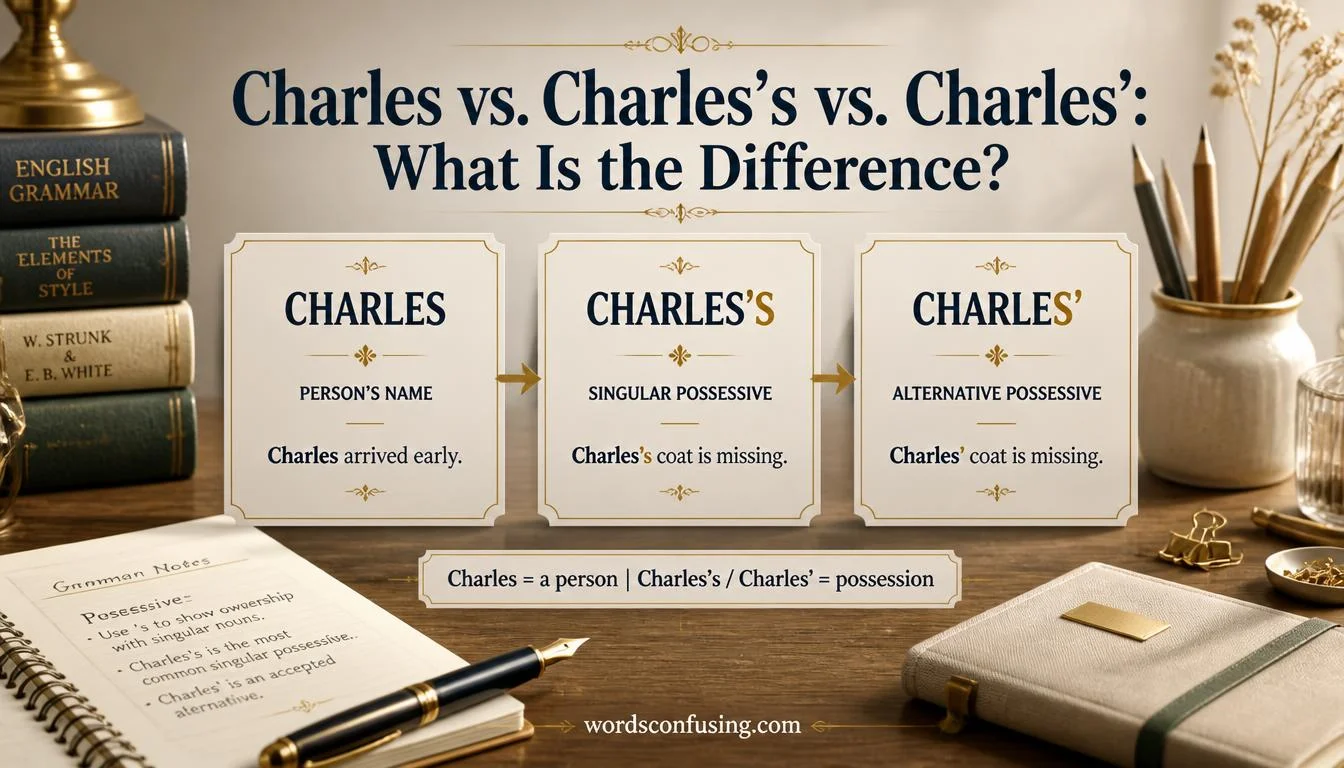
Charles vs. Charles’s vs. Charles’: What Is the Difference?
The words Charles, Charles’s, and Charles’ look similar, but they perform different roles in a sentence. Understanding those roles helps you avoid confusing a person’s name with its possessive form.
| Form | Grammatical function | Example |
| Charles | Names one person | Charles arrived early. |
| Charles’s | Shows singular possession | Charles’s coat is missing. |
| Charles’ | Alternative singular possessive | Charles’ coat is missing. |
Charles is the ordinary form of the name. You use it when referring to the person without marking possession.
For example, “Charles arrived early” tells readers who arrived. The name doesn’t need an apostrophe because the sentence expresses no possessive relationship.
By contrast, “Charles’s coat is missing” connects Charles to the coat. The possessive ending tells readers whose coat you’re discussing.
The form Charles’ serves the same possessive purpose under conventions that omit the additional s. It doesn’t automatically indicate a plural name.
That last point matters because apostrophes don’t usually form English plurals. To refer to several people named Charles, you need the plural form Charleses.
What Is the Plural of Charles?
When you refer to more than one person named Charles, the standard plural form is Charleses. You add -es because the name already ends in s.
This plural follows a familiar English spelling pattern. Many nouns ending in s, x, z, ch, or sh form their plurals with -es. For example, class becomes classes, and box becomes boxes.
The same principle applies when several people share the name Charles.
Examples include:
- Two Charleses attended the family reunion.
- The Charleses arrived before the ceremony.
- Three Charleses work in the same department.
- Our school has two students named Charles.
Although Charleses may look unusual, it serves a clear grammatical purpose. It distinguishes several people with the same name from one person named Charles.
Charleses vs. Charles’s
The difference between Charleses and Charles’s is important because the two forms serve different grammatical purposes.
Charleses is plural. It refers to two or more people named Charles.
Charles’s is possessive. It indicates that something belongs to or relates to one person named Charles.
Compare these examples:
- Charleses: Two Charleses joined the discussion.
- Charles’s: Charles’s presentation started at noon.
- Charleses: The Charleses arrived together.
- Charles’s: Charles’s friends arrived together.
In the first and third sentences, Charleses identifies multiple people. In the other examples, Charles’s connects one person to a presentation or group of friends.
Here’s another useful comparison:
“Two Charleses attended the conference, but Charles’s presentation received the most attention.”
The first use identifies two people with the same name. The second shows that the presentation belongs to or is associated with one Charles.
Remember this distinction when proofreading. A plural answers “how many?” while a possessive answers “whose?” That simple question can help you choose the correct form.
What Is the Plural Possessive of Charles?
The standard plural possessive of Charles is Charleses’. You form it by creating the plural Charleses first and then adding an apostrophe to show possession.
This follows the usual rule for plural nouns ending in s. For example, you write the teachers’ lounge and the students’ books. The apostrophe comes after the final s because the plural already ends in that letter.
The same pattern applies to multiple people named Charles.
Examples:
- The Charleses’ house has a spacious garden.
- We attended the Charleses’ annual gathering.
- The Charleses’ children go to the same school.
- Both Charleses’ opinions were included in the report.
In these sentences, Charleses’ refers to something associated with multiple people named Charles. The exact relationship depends on the surrounding sentence.
For instance, “The Charleses’ house has a spacious garden” indicates that the house belongs to or is associated with the people called the Charleses.
Charles’s vs. Charles’ vs. Charleses’
These three forms can look confusing until you separate their grammatical functions.
| Form | Meaning | Example |
| Charles’s | Singular possessive under the ’s convention | Charles’s house is large. |
| Charles’ | Alternative singular possessive | Charles’ house is large. |
| Charleses’ | Plural possessive | The Charleses’ house is large. |
The first two examples refer to one person named Charles. The final example refers to multiple people named Charles.
Context matters, especially when you’re reading quickly. If a sentence mentions Charles’ house, the spelling alone doesn’t tell you that multiple people named Charles own it. Under the usual convention, the phrase expresses singular possession.
Likewise, Charleses’ house isn’t another spelling of the singular possessive. It begins with the plural form and then marks possession.
Common Mistakes to Avoid With Charles’ and Charles’s
Even experienced writers sometimes hesitate over names ending in s. Most mistakes happen when writers confuse style preferences with grammatical rules or accidentally mix singular and plural forms.
A few simple checks can help you avoid those errors.
Assuming Charles’s Is Always Correct
Many American English writers use Charles’s because it follows the general singular possessive rule. However, that doesn’t mean Charles’ is always wrong.
AP style generally prefers the shorter form for singular proper names ending in s. Other publications may follow different conventions.
For example, an editor working on a newspaper article might change Charles’s statement to Charles’ statement to match the publication’s style. A book editor following Chicago style would generally retain Charles’s statement.
Neither edit necessarily changes the sentence’s meaning. The editor is applying a particular convention.
How to avoid this mistake: Check the style requirements before correcting someone else’s possessive spelling. Don’t label an accepted alternative as a grammatical error without considering the relevant context.
Using Charles’ to Make the Name Plural
An apostrophe doesn’t normally make a singular noun plural. Therefore, Charles’ isn’t the standard way to write the plural of Charles.
For example:
- Incorrect for an ordinary plural: Two Charles’ attended the meeting.
- Correct plural: Two Charleses attended the meeting.
The possessive spelling Charles’ serves a different purpose. Under the relevant style convention, it indicates possession by one person named Charles.
This distinction applies to many English names. You generally don’t add an apostrophe simply because a name ends in a particular letter.
If you’re talking about multiple people named Charles, write Charleses. If you’re showing singular possession, choose Charles’s or Charles’ according to your style guide.
Confusing Singular and Plural Possessives
Singular and plural possessives can look similar, but the placement of the apostrophe matters.
Compare these examples:
- Charles’s book: A book belonging to or associated with one Charles.
- Charles’ book: The same basic meaning under an alternative convention.
- The Charleses’ book: A book belonging to or associated with multiple people named Charles.
Notice that the plural possessive uses Charleses’, not Charles’s.
Consider a family gathering where two cousins share the name Charles. You might write, “Both Charleses attended the reunion, and the Charleses’ photographs were displayed.” The first Charleses is plural, while the second is plural possessive.
Understanding this difference helps you write more precise sentences. It also prevents readers from mistaking multiple people for one person.
Switching Between Charles’ and Charles’s
Using both forms in the same document can make your writing look inconsistent. Unless you’re quoting a source or explaining the difference between styles, choose one convention and apply it consistently.
For example, this passage switches forms without a clear reason:
“Charles’s car was parked outside. Later, Charles’ keys turned up in the kitchen.”
The sentences may be grammatically understandable, but the spelling changes unexpectedly. If your document follows a convention that uses Charles’s, write both sentences that way.
A consistent version would read:
“Charles’s car was parked outside. Later, Charles’s keys turned up in the kitchen.”
If you’re following AP style, use Charles’ consistently instead.
Consistency makes editing easier and helps readers focus on your message rather than your punctuation.
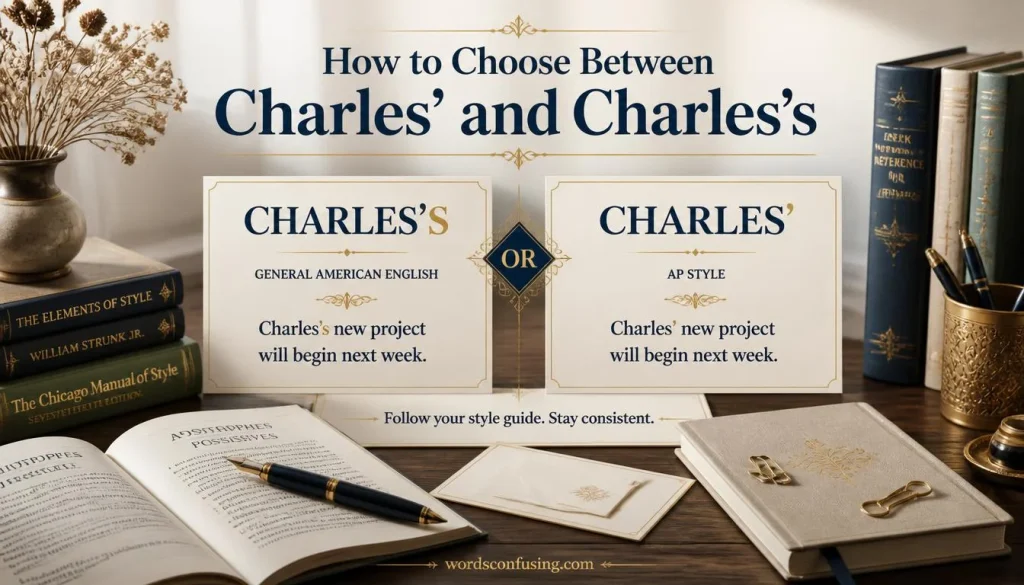
How to Choose Between Charles’ and Charles’s
Choosing the correct spelling doesn’t require a complicated grammar analysis. In most situations, you only need to identify the type of writing and check whether a style guide applies.
Use this straightforward process:
- Check the requirements: Your teacher, employer, publisher, or editor may specify a particular style guide.
- Follow Chicago, APA, or MLA conventions: These styles generally favor Charles’s for ordinary singular possessives.
- Follow AP style: Use Charles’ under AP’s general convention for singular proper names ending in s.
- Stay consistent: Avoid switching between the two spellings without a clear reason.
- Check special instructions: A publication may have additional rules for names, quotations, or house style.
What if nobody has specified a style guide?
In that case, Charles’s is a reliable choice for general American English writing. It follows the common rule for singular possessives and clearly shows the relationship between Charles and the following noun.
For example, you can write:
“Charles’s new project will begin next week.”
That sentence is straightforward, grammatically sound, and suitable for many general writing situations.
Still, the alternative Charles’ new project is appropriate when the applicable style convention calls for it. The goal isn’t to declare one form universally correct. It’s to choose the form that fits your writing context.
FAQs
1. Is Charles’ or Charles’s grammatically correct?
Both Charles’ and Charles’s can be correct. The choice depends on the style guide you follow. Many grammar guides prefer Charles’s for the singular possessive form, while some styles accept Charles’.
2. Should I write Charles’s name or Charles’ name?
Both forms are acceptable in many contexts. Charles’s name follows the common rule of adding apostrophe s to a singular name, while Charles’ name follows styles that use only an apostrophe after a final s.
3. What is the plural form of Charles?
The plural form is Charleses. For example, “Two Charleses attended the meeting.” This form refers to two people named Charles, not something owned by one person.
4. Is Charles’s used in formal writing?
Yes. Charles’s is widely accepted in formal and academic writing. However, some publications follow style guides that prefer Charles’. Check your organization’s guidelines and apply the same rule consistently.
5. What is the difference between Charles’ and Charles’s?
Both forms can show possession by someone named Charles. The difference is punctuation style: Charles’s adds apostrophe s, while Charles’ adds only an apostrophe. Your preferred style guide determines which form to use.
6. How do I make Charles’ or Charles’s plural possessive?
For multiple people named Charles, the plural is Charleses, and the plural possessive is Charleses’. For example, “The Charleses’ house is nearby” means the house belongs to a family or group of people named Charles.
Conclusion
Choosing between Charles’ and Charles’s becomes easier once you understand the rules for singular possessives. Both forms can indicate ownership, but the preferred version depends on your chosen style guide. In general, Charles’s follows the common rule of adding apostrophe s to a singular name ending in s.
Some style guides, including AP style, prefer Charles’ in certain contexts. When writing emails, reports, academic assignments, or professional content, check the required style and apply it consistently. A small punctuation choice might seem insignificant, but getting it right makes your writing clearer and more polished.