


Knew or Known: What’s the Difference? Learn how these irregular verb forms express past actions and connect to the past tense of know.
In English grammar, know is an irregular verb with three main verb forms: know (the present tense), knew (the simple past tense), and known (the past participle). Unlike regular verbs, irregular verbs don’t follow standard grammar rules by adding -ed to form the past tense.
Understanding verb conjugation, tense differences, and past tense forms helps you use these words correctly. For example, “I knew the answer yesterday” describes a past event, while “I have known her for years” uses the past participle. These grammatical forms show how grammatical structure and verb structure influence correct verb usage in everyday English.
The word origins of know trace back to Old English cnāwan, meaning to recognize, understand, or perceive something. This etymology reveals part of the language development of the English language.
Unlike spelling variations such as colour and color, which are alternative spellings of the same word, knew and known have different grammatical roles. Learning these distinctions expands your English vocabulary and supports language learning, especially when studying irregular verb forms and their grammatical functions.
Quick answer:
Knew and known are both correct forms of the verb know, but they serve different grammatical purposes. Use knew as the simple past tense and known as the past participle, usually with a helping verb such as have, has, or had.
For example, “I knew the answer yesterday” is correct. So is “I have known the answer for years.” The difference comes down to verb tense and sentence structure.
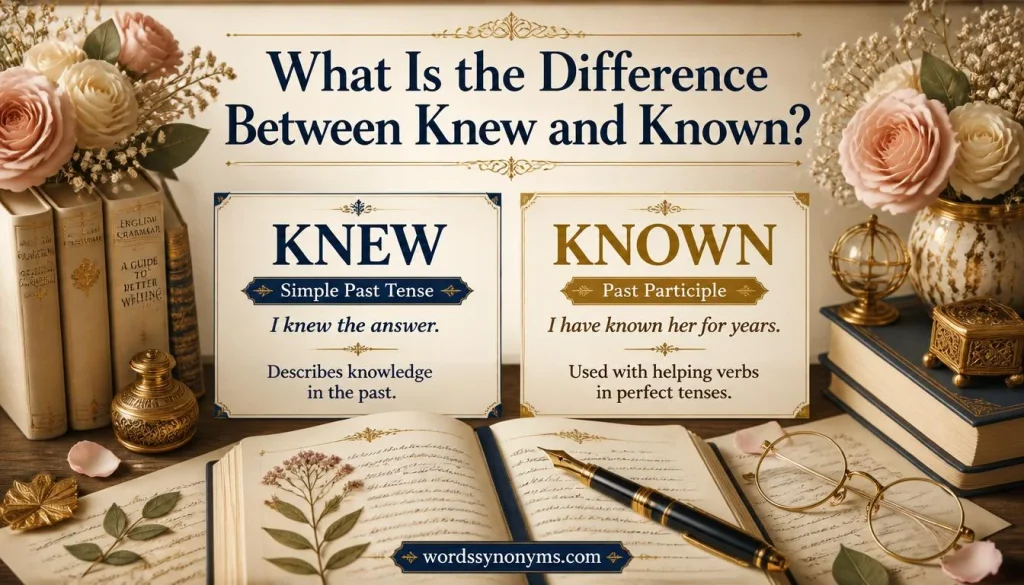
What Is the Difference Between Knew and Known?
The main difference between knew and known is their grammatical role. Although both describe knowledge, you cannot freely replace one with the other.
Knew describes something a person understood, recognized, or was aware of in the past. Known usually appears with a helping verb to form perfect tenses or passive constructions. It can also function as an adjective.
Consider these examples:
- Knew: I knew the meeting started at nine.
- Known: I have known her since childhood.
- Known: The town is known for its beautiful beaches.
The first sentence describes past knowledge. The second connects past knowledge with the present. The third describes how people recognize the town.
Here’s a quick comparison:
| Verb form | Grammatical role | Example |
| Know | Base form | I know the answer. |
| Knows | Simple present tense | She knows the answer. |
| Knew | Simple past tense | She knew the answer. |
| Known | Past participle | She has known the answer for years. |
Notice that knew works as the main verb in a simple past sentence. However, known typically needs a helping verb when it forms a perfect tense.
Understanding this distinction will help you write clearer sentences, avoid common grammar mistakes, and speak more confidently.
When to Use Knew
Use knew when you want to describe knowledge, awareness, or understanding that existed in the past. It is the simple past form of know and often appears without a helping verb in affirmative sentences.
Knew as the Simple Past Tense of Know
When someone knew something in the past, knew is usually the correct choice. The knowledge might involve a fact, a person, a situation, or a particular skill.
For example:
- I knew the answer before the teacher explained it.
- She knew the road was closed.
- We knew each other in high school.
- He knew the truth but remained silent.
- They knew the risks before accepting the offer.
- I knew something was wrong when the lights went out.
Each sentence describes knowledge or awareness at a past time.
You can also use knew when describing a past feeling or understanding. For example, “I knew I could trust her” describes your confidence at that time.
Remember: Use knew when the sentence focuses on what someone knew in the past rather than how long that knowledge has continued.
Knew in Negative Sentences and Questions
Negative sentences and questions follow a slightly different rule. When you use did or didn’t, the main verb returns to its base form, know.
For example:
- Correct: I didn’t know about the meeting.
- Incorrect: I didn’t knew about the meeting.
- Correct: Did you know the answer?
- Incorrect: Did you knew the answer?
Why does this happen? The auxiliary verb did already marks the past tense. Adding knew would mark the past twice.
Compare these structures:
| Sentence type | Correct example |
| Affirmative | I knew about the change. |
| Negative | I didn’t know about the change. |
| Question | Did you know about the change? |
| Negative question | Didn’t you know about the change? |
The same rule applies to other verbs that change in the past tense.
For instance, you say “She went home,” but “Did she go home?” The auxiliary did takes the past-tense marking, so the main verb uses its base form.
Knew in Conditional Sentences
The word knew also appears in conditional sentences, especially when you discuss hypothetical or unreal situations.
For example:
- If I knew the answer, I would tell you.
- If she knew about the surprise, she would be excited.
- I wish I knew how to fix this computer.
- If they knew the truth, they might change their minds.
These sentences describe imagined situations rather than necessarily reporting past events.
In “If I knew the answer, I would tell you,” the speaker suggests that they don’t currently know the answer. The past form knew helps express a hypothetical situation.
This is an important distinction because the past form doesn’t always refer to past time. English also uses past-tense forms to express distance from reality, politeness, or hypothetical meaning.
For example, “I wish I knew” usually expresses a present desire, not a memory of something you once knew.
When to Use Known
Use known when the sentence requires the past participle of know. You’ll often see it after have, has, or had, but it also appears in passive constructions and adjective phrases.
Known With Have, Has, and Had
One of the most common uses of known appears in perfect tenses. These constructions connect knowledge to a particular time, event, or period.
Use the following patterns:
- Have known: I, you, we, they, and plural subjects.
- Has known: He, she, it, and singular third-person subjects.
- Had known: All subjects when referring to an earlier past situation.
Here are examples showing how these forms work.
Present perfect:
- I have known him for ten years.
- She has known the answer since yesterday.
- We have known about the problem for weeks.
The present perfect often describes knowledge that began in the past and remains relevant now.
For example, “I have known her for ten years” means you first became acquainted ten years ago and still know her.
Past perfect:
- I had known the truth before the meeting began.
- She had known about the change before anyone told her.
- They had known each other for years before they married.
The past perfect places one past situation before another past event. In the first example, the speaker already knew the truth when the meeting began.
Compare these two sentences:
- I knew him in college. This describes a past relationship or period of acquaintance.
- I have known him since college. This suggests that the acquaintance began in college and continues now.
The distinction matters because the time expression often influences which tense sounds natural.
Use since to identify a starting point, as in “since 2020.” Use for to describe a duration, as in “for six years.”
Known in Passive Voice
The past participle known also appears in passive constructions. These sentences focus on the person or thing recognized rather than the person doing the recognizing.
For example:
- The author is known for her historical novels.
- The village was known for its traditional markets.
- The discovery has been known to researchers for decades.
- The restaurant is widely known throughout the city.
- He became known for his honest advice.
In these examples, known describes recognition, reputation, or awareness.
The phrase is known for is especially common when describing someone’s qualities, achievements, or reputation.
Consider the difference:
- People knew him for his honesty. The sentence emphasizes what people knew or recognized in the past.
- He was known for his honesty. The sentence emphasizes his reputation during a past period.
Both sentences communicate a similar idea, but their grammatical structures differ.
Also notice that passive constructions don’t always require have, has, or had. For instance, “She is known for her kindness” uses the linking verb is with the participle known.
Known as an Adjective
Sometimes known describes a noun rather than functioning as part of a perfect-tense verb phrase. In these cases, it often communicates that something is familiar, recognized, or established.
Common expressions include:
- Well-known author: An author recognized by many people.
- Known fact: A fact that people already recognize or accept.
- Known issue: A problem that has already been identified.
- Known cause: An identified reason for an event or condition.
- Little-known detail: A detail that few people know.
For example:
- She is a well-known journalist.
- The company has a known issue with its software.
- This is a known fact among experienced researchers.
- The museum displays several works by a little-known artist.
In “a known issue,” the word known modifies the noun issue. It doesn’t require a perfect-tense construction.
This distinction helps explain why known can appear without have, has, or had. Its role depends on the sentence, not simply on the word itself.
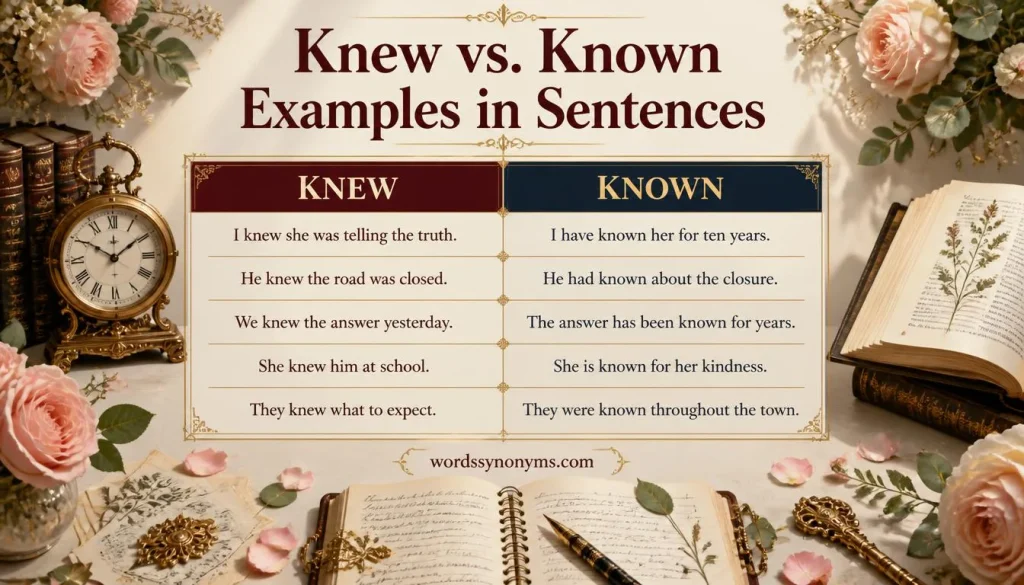
Knew vs. Known Examples in Sentences
The easiest way to understand the difference is to compare complete sentences. Look at the verb structure and the time relationship in each example.
| Using Knew | Using Known |
| I knew she was telling the truth. | I have known her for ten years. |
| He knew the road was closed. | He had known about the closure. |
| We knew the answer yesterday. | The answer has been known for years. |
| She knew him at school. | She is known for her kindness. |
| They knew what to expect. | They were known throughout the town. |
| I knew about the problem. | I have known about the problem since Monday. |
| He knew the risks involved. | The risks are well known. |
Each sentence uses the appropriate form for its grammatical structure.
In the first column, knew describes past knowledge. In the second, known appears in perfect tenses, passive constructions, or adjective phrases.
Knew or Known in Everyday Conversations
Everyday conversations provide useful examples because these words often appear when people discuss memories, relationships, and information.
Talking about a past event:
“I knew you would enjoy that movie.”
This sentence expresses a belief or expectation held before the movie experience.
Talking about a long-term relationship:
“I have known my best friend since elementary school.”
The present perfect connects the beginning of the relationship to the present.
Talking about an earlier discovery:
“She had known about the surprise before the party started.”
The past perfect shows that her knowledge existed before another past event.
Talking about reputation:
“That neighborhood is known for its excellent restaurants.”
Here, known describes the neighborhood’s reputation.
Talking about a question:
“Did you know that the library closes at six?”
The question uses did followed by the base form know.
These examples demonstrate a practical rule: Choose the form that fits the sentence’s structure, not just the time you’re discussing.
Common Mistakes When Using Knew and Known
Although the difference is straightforward, several common errors can make sentences sound unnatural. Most involve choosing the wrong verb form after a helping verb.
Using Known Without the Right Verb Structure
A common mistake occurs when writers use known as the main verb in a simple past sentence.
- Incorrect: I known the answer yesterday.
- Correct: I knew the answer yesterday.
The word yesterday points to a completed past time. The simple past form knew fits this sentence.
However, known is correct when the sentence includes an appropriate structure.
- Correct: I have known the answer for years.
- Correct: The answer is known to everyone.
The important point is that known isn’t a replacement for knew in every past-related sentence.
Using Knew After Have or Has
Perfect tenses require the past participle, not the simple past form.
- Incorrect: I have knew him for years.
- Correct: I have known him for years.
- Incorrect: She has knew the answer since Monday.
- Correct: She has known the answer since Monday.
The same rule applies to had.
- Incorrect: They had knew about the problem.
- Correct: They had known about the problem.
Think of irregular verbs as having separate forms that serve different jobs. For know, those forms are know, knew, and known.
Using the correct form after a helping verb keeps the sentence grammatically sound.
Using Knew After Did
Another frequent mistake is combining did with the past form knew.
- Incorrect: Did you knew about the event?
- Correct: Did you know about the event?
- Incorrect: She didn’t knew the answer.
- Correct: She didn’t know the answer.
The auxiliary did already signals past time. Therefore, the main verb must use its base form.
This pattern applies to other irregular verbs, too:
- Did you go, not “Did you went”?
- Did she see, not “Did she saw”?
- Did they eat, not “Did they ate”?
Once you recognize this pattern, you’ll avoid many common tense errors.
Confusing Past Knowledge With Present Knowledge
Sometimes both knew and have known are grammatically correct, but they express different time relationships.
Compare these examples:
- I knew the answer. The sentence reports knowledge at a past time.
- I have known the answer for years. The sentence connects past knowledge with the present.
- I had known the answer before the test began. The sentence places the knowledge before another past event.
The context determines which sentence communicates your intended meaning.
For instance, if you’re describing a school exam from last year, “I knew the answer” may be the natural choice. If you’re explaining how long you’ve understood a particular concept, “I have known the answer for years” may fit better.
One more detail matters: know often describes a state rather than a short, completed action. For that reason, the present perfect commonly appears with expressions such as for years and since childhood.
Knew vs. Known in Different Tenses
Understanding the verb forms becomes easier when you see how know works across different tenses and constructions.
| Tense or construction | Example | Purpose |
| Simple present | I know the answer. | Describes current knowledge. |
| Simple past | I knew the answer. | Describes knowledge in the past. |
| Present perfect | I have known the answer for years. | Connects past knowledge with the present. |
| Past perfect | I had known the answer before you asked. | Places knowledge before another past event. |
| Simple passive | The answer is known to everyone. | Emphasizes what people recognize or understand. |
| Past passive | The author was known for her novels. | Describes a past reputation. |
| Adjective phrase | She is a well-known author. | Describes someone’s recognition or reputation. |
These examples show why known cannot be assigned to just one tense. It serves as a past participle in several constructions and can also function adjectivally.
How Time Expressions Help You Choose
Time expressions often provide useful clues about which form you need.
Use knew with a specific completed past situation:
- I knew the answer yesterday.
- She knew him when they worked together.
- We knew about the delay last week.
Use have known when the situation connects to the present:
- I have known her since 2018.
- We have known about the issue for several months.
- He has known the family for years.
Use had known when referring to an earlier past situation:
- She had known the truth before the announcement.
- They had known each other long before they became business partners.
These are useful patterns, not absolute rules for every sentence. Context and meaning still matter.
For example, the simple past can describe a past state without mentioning an exact date. “I knew her well” is perfectly natural even without a time expression.

How to Remember the Difference Between Knew and Known
A simple memory trick can help you choose the correct form without memorizing complicated grammar rules.
Remember this pattern:
- Knew = simple past: I knew the answer.
- Known = past participle: I have known the answer.
- Known = description: She is known for her kindness.
Think of knew as a completed snapshot of past knowledge. By contrast, known often works with another verb or describes how someone or something is recognized.
Here’s another helpful trick. If you see have, has, or had immediately before the main verb, check whether you need known.
For example:
- I have known him for years.
- She has known about the situation.
- They had known the risks.
However, don’t turn this trick into an absolute rule. Known also appears in sentences such as “The answer is known” and “a well-known writer.”
A Quick Three-Step Test
When you’re unsure whether to use knew or known, follow these steps:
- Check the main verb. Are you describing knowledge in a simple past sentence? Choose knew.
- Look for a helping verb. Does the sentence use have, has, or had to form a perfect tense? Choose known.
- Check for a description or passive construction. Phrases such as is known and well-known author use known.
For example, consider this sentence: “I ___ her before she became famous.”
The correct answer is knew if you’re simply describing your past acquaintance. You could also write “I had known her before she became famous” to emphasize that your acquaintance preceded another past event.
Both sentences work, but they present the timing differently.
Read more: When Was the Letter “J” Invented? And Was It Before Jesus?
Knew or Known: Quick Grammar Quiz
Test your understanding with these five questions. Choose the correct word or verb form for each sentence before checking the answers.
- I have ___ him since childhood. (knew / known)
- She ___ the truth yesterday. (knew / known)
- Did you ___ about the event? (knew / know)
- The city is ___ for its beautiful architecture. (knew / known)
- They had ___ the risks before starting. (knew / known)
Answers and Explanations
| Question | Correct answer | Explanation |
| 1 | Known | Present perfect uses have plus the past participle. |
| 2 | Knew | The sentence describes knowledge at a completed past time. |
| 3 | Know | The auxiliary did takes the base form of the main verb. |
| 4 | Known | The phrase is known describes the city’s reputation. |
| 5 | Known | Past perfect uses had plus the past participle. |
If you answered all five correctly, you’ve grasped the main distinction. If you missed one, revisit the relevant section and pay attention to the helping verb.
FAQs
1. What is the main difference between knew and known?
Knew is the simple past tense of know, while known is its past participle. Use knew for a completed past action and known with helping verbs such as have, has, or had.
2. Is knew the past tense of know?
Yes, knew is the simple past tense of know. For example, “I knew the answer during yesterday’s test.” It describes something you understood or were aware of in the past.
3. When should I use known in a sentence?
Use known when the sentence requires a past participle. It usually appears with a helping verb, as in “I have known him since childhood” or “She had known the truth for years.”
4. Is known a past tense or a past participle?
Known is the past participle of know, not the simple past tense. It works with helping verbs to form perfect tenses, such as “They have known each other for years.”
5. What are the three forms of the verb know?
The three principal forms are know, knew, and known. Know is the present form, knew is the simple past form, and known is the past participle. Learning this pattern makes English grammar easier to understand.
6. Why do people confuse knew and known?
People often confuse these words because both come from the same irregular verb. However, their grammatical roles differ. Remember this simple pattern: “I knew it yesterday” and “I have known it for years.”
Conclusion
Understanding knew and known becomes much easier once you recognize how each word works in a sentence. Use knew when talking about something you understood or experienced in the past, and choose known when a helping verb such as have, has, or had calls for the past participle. For example, “I knew the answer” and “I have known the answer for years” express different grammatical structures.
One helpful trick is to remember that know, knew, and known represent three different forms of the same irregular verb. You wouldn’t say “I have knew her for years” because have requires the past participle known. Similarly, “I known the answer yesterday” is incorrect because a simple past sentence needs knew. These small differences can make a big impact on your writing.
To strengthen your English grammar, try creating your own sentences using all three forms. Pay attention to helping verbs and the time you’re describing. Reading English books, writing short paragraphs, and practicing everyday conversations can also help you remember the correct forms. With regular practice, you’ll use knew and known more confidently and avoid common mistakes in both speaking and writing.