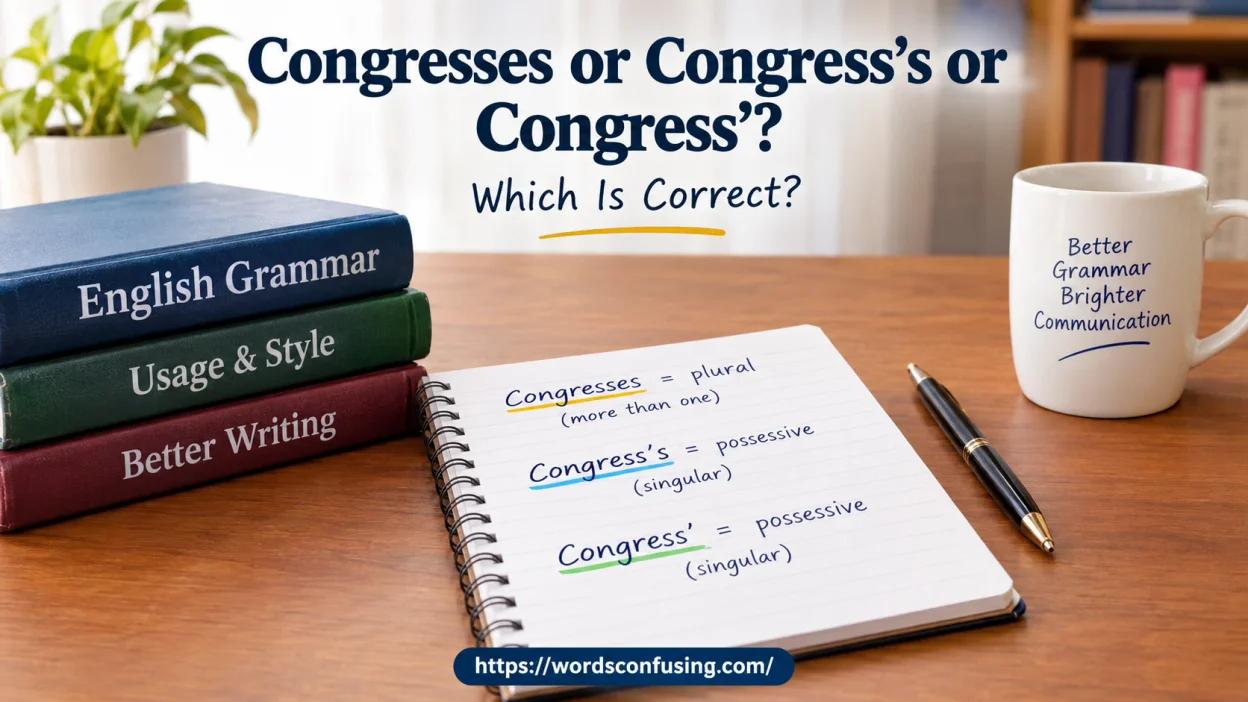
Congresses or Congress’s or Congress’: Which Is Correct? depends on meaning and style-guide rules, especially when writing formal or professional documents.
Conflicting grammar rules can make possessive spelling confusing. Some style guides recommend adding an apostrophe plus s to a singular noun, while others accept an apostrophe alone in certain cases.
For example, Congress’s follows the common singular possessive pattern, whereas Congress’ appears in styles that omit the extra s. Both forms occur in real-world usage, so check your preferred grammar guide before preparing official reports, business documents, or other written communication.
First, identify the intended meaning. Then review punctuation, apostrophe placement, and standard English conventions.
This approach improves clear communication and sentence clarity across professional communication, project management, meetings, calendar planning, scheduling, time management, online booking, broadcasting, administration, and education.
Quick Answer
The quickest way to choose the correct form is to identify what you want to communicate. Are you talking about several congresses, or are you describing something associated with one congress?
| Word | Grammatical function | Meaning | Example |
| Congresses | Plural noun | More than one congress | Several congresses discussed economic policy. |
| Congress’s | Singular possessive | Belonging or relating to one congress | Congress’s decision attracted public attention. |
| Congress’ | Singular possessive variant | Belonging or relating to one congress | Congress’ decision attracted public attention. |
Use congresses for the plural. When you discuss multiple legislative bodies, professional gatherings, or organized assemblies, this is the standard spelling.
For possession, both congress’s and congress’ can appear in published writing. The difference generally reflects a style convention rather than a difference in meaning.
For example, you might write, “Congress’s authority comes from the Constitution” under a style guide that adds ’s to singular nouns. Under a convention that uses only an apostrophe after certain words ending in s, you might write, “Congress’ authority comes from the Constitution.”
One important detail concerns capitalization. When Congress refers specifically to the United States Congress, writers commonly capitalize it. When congress refers to a general assembly or professional gathering, lowercase is usually appropriate unless another capitalization rule applies.
What Does Congresses Mean?
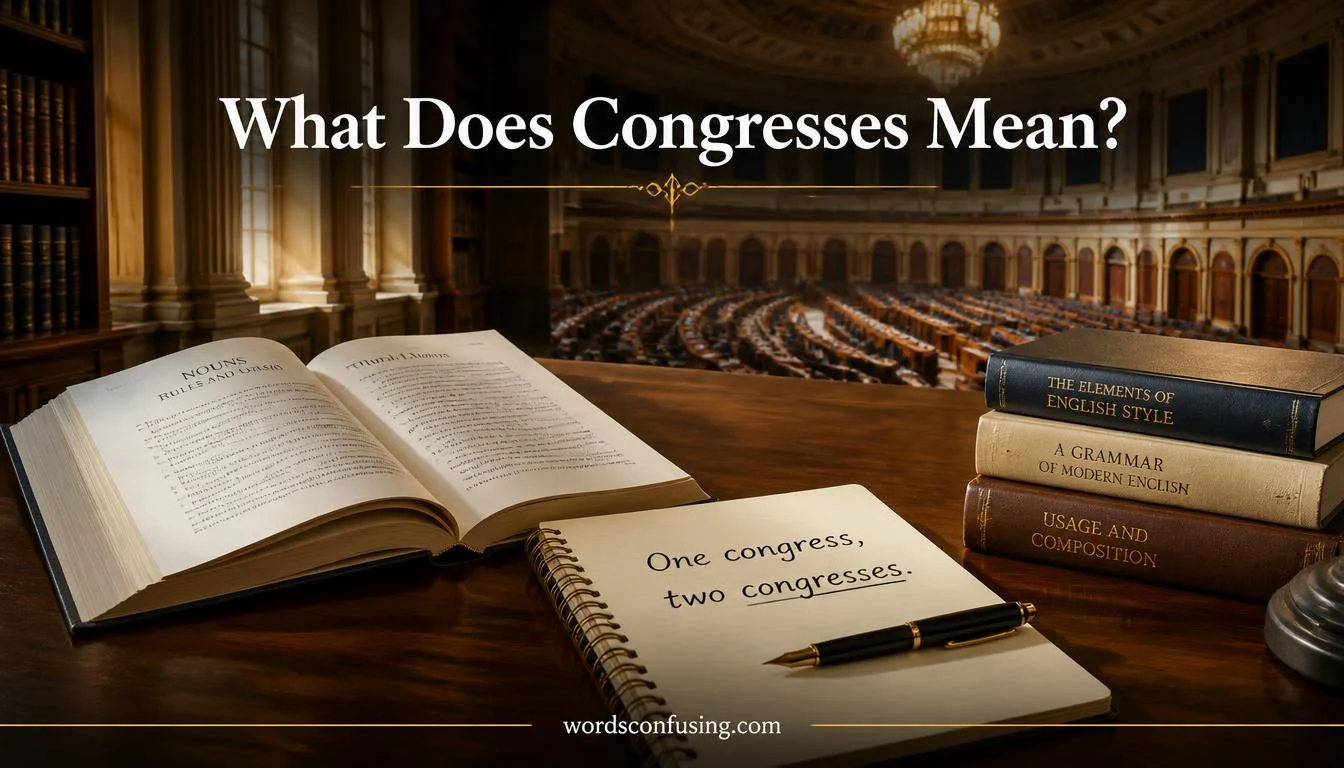
Congresses is the plural form of the noun congress. It refers to two or more legislative bodies, formal assemblies, or organized gatherings.
A congress can be a national legislative institution, a meeting of specialists, or an organized gathering of representatives. The precise meaning depends on the context.
For example, a political article might discuss the congresses of different countries. A medical publication might refer to several international congresses attended by researchers. In both cases, the writer needs the plural form because the sentence refers to more than one gathering or institution.
Congresses as the Plural Form of Congress
English uses several plural endings, and nouns ending in s often take -es to form their plurals.
The word congress ends in two consecutive s letters. Adding -es produces congresses, which is the standard spelling.
Consider these examples:
- One congress, two congresses.
- One international congress, several international congresses.
- One annual congress, three annual congresses.
The same plural pattern appears in other English words:
| Singular | Plural |
| Address | Addresses |
| Business | Businesses |
| Class | Classes |
| Dress | Dresses |
| Process | Processes |
| Success | Successes |
| Congress | Congresses |
Notice that the plural ending does not include an apostrophe. An apostrophe usually marks possession or appears in contractions, not in ordinary plural nouns.
Therefore, congresses is correct when you mean multiple congresses. Writing congress’s to express that meaning would change the grammatical function and confuse the reader.
Examples of Congresses in Sentences
Seeing the word in context makes its meaning easier to recognize.
- Several congresses brought political leaders together to discuss international trade.
- The organization hosts annual scientific congresses for researchers and specialists.
- Historians compared the decisions made by different congresses throughout the period.
- Three professional congresses took place in the city that year.
- The delegates attended two congresses before preparing their final report.
- International congresses often give experts opportunities to exchange research findings.
In each example, congresses refers to more than one assembly or event.
You can test the spelling by replacing the word with the phrase more than one congress. If the sentence still communicates the intended meaning, the plural form is probably appropriate.
For instance, “Several congresses discussed the proposal” means that several separate assemblies discussed it. No possessive apostrophe is necessary.
Common Mistakes With Congresses
One common mistake is adding an apostrophe whenever a word ends in s. However, the final letter alone does not determine whether a noun needs an apostrophe.
Compare these sentences:
- Incorrect for ordinary plural meaning: Several congress’s discussed the proposal.
- Correct: Several congresses discussed the proposal.
- Correct possessive: The congress’s decision influenced the proposal.
The first sentence incorrectly uses a possessive form where a regular plural is needed. The second sentence correctly identifies multiple congresses. The third uses a singular possessive to describe a decision associated with one congress.
Another common error is writing congress’ as the plural. This spelling does not ordinarily mean multiple congresses. Instead, it can serve as a singular possessive form under certain style conventions.
Remember this distinction: a plural tells you how many; a possessive tells you what something belongs to or relates to.
What Does Congress’s Mean?
Congress’s is a singular possessive form. Writers use it to indicate that something belongs to, comes from, or relates to one congress.
The form consists of the noun congress, an apostrophe, and an additional s. This follows a widely used English convention for forming the possessives of singular nouns, including many nouns that already end in s.
For example, “Congress’s decision received widespread attention” identifies a decision associated with Congress. The sentence does not suggest that several congresses made separate decisions.
Possession also extends beyond physical ownership. A legislative body does not literally own every policy, power, or decision associated with it. In these cases, the possessive form expresses a relationship.
Congress’s as the Singular Possessive Form
The general rule for forming a singular possessive is simple: add ’s to the noun.
For example:
- The teacher’s desk.
- The company’s policy.
- The witness’s statement.
- Congress’s decision.
When referring specifically to the United States Congress, writers often capitalize Congress. The possessive then appears as Congress’s.
This form can describe many relationships, including:
- Decisions: Congress’s decision affected the proposed legislation.
- Powers: Congress’s powers include responsibilities established by the Constitution.
- Actions: Congress’s response prompted further debate.
- Responsibilities: Congress’s responsibilities include legislative and oversight functions.
- Proposals: Congress’s proposal received attention from lawmakers and commentators.
The additional s does not create a plural noun. It helps mark possession or association with the singular noun.
One detail deserves attention: the word Congress can refer to an institution rather than a group of people acting independently. The possessive form still works because English commonly uses possessives with organizations, governments, companies, and institutions.
Examples of Congress’s in Sentences
Here are examples showing how congress’s or its capitalized form works in ordinary writing.
- Congress’s decision changed the direction of the legislative debate.
- The journalist examined Congress’s response to the proposed reforms.
- Congress’s authority comes from powers granted by the U.S. Constitution.
- The report described Congress’s role in the investigation.
- Citizens questioned Congress’s handling of the issue.
- The article examined Congress’s responsibilities during the budget process.
Each example describes something associated with one legislative institution.
You can also use the same grammatical pattern with a general congress:
- The congress’s schedule included several keynote presentations.
- The congress’s organizers announced a change of venue.
- The congress’s final statement summarized the delegates’ conclusions.
These examples use lowercase congress because the word describes a general assembly rather than the specifically named U.S. Congress.
Is Congress’s Grammatically Correct?
Yes. Congress’s is grammatically correct under widely used style conventions. It follows the common rule of adding ’s to a singular noun to form its possessive.
However, grammatical correctness and editorial preference are not always the same thing. A style guide may prefer Congress’ instead, even though Congress’s is acceptable under another convention.
This distinction matters when writing academic assignments, newspaper articles, government reports, or website content. Your editor or institution may require a particular style.
For example, a writer following a style guide that favors ’s for singular possessives can write:
“Congress’s investigation continued throughout the summer.”
A writer following a convention that omits the extra s in certain possessives can write:
“Congress’ investigation continued throughout the summer.”
Both sentences can communicate the same relationship. The appropriate choice depends on the style rules governing the document.
What Does Congress’ Mean?
Congress’ is an alternative singular possessive form. It expresses the same basic relationship as Congress’s but places the apostrophe after the final s without adding another letter.
This spelling appears in some American English publications, particularly those that follow conventions for certain singular names and nouns ending in s. The shorter form can look cleaner, although its suitability depends on the style guide.
For example, “Congress’ decision sparked debate” and “Congress’s decision sparked debate” can convey the same meaning. Neither spelling automatically changes the sentence’s meaning.
Congress’ as an Alternative Singular Possessive Form
To understand Congress’, start with the singular noun Congress. The apostrophe indicates a possessive relationship, while the existing final s remains in place.
Writers may use this form when describing an institution’s decisions, powers, actions, or responsibilities.
Consider these examples:
- Congress’ decision prompted further discussion.
- The report examined Congress’ role in the investigation.
- The article explored Congress’ powers under the Constitution.
- Journalists questioned Congress’ response to the proposed changes.
- The committee reviewed Congress’ responsibilities during the legislative process.
These examples illustrate the possessive function. The spelling does not indicate multiple congresses.
The same pattern can appear with a general congress:
- The congress’ schedule included several keynote speeches.
- The congress’ organizers welcomed delegates from different countries.
- The congress’ final statement summarized the meeting’s main findings.
Whether a writer should use this spelling depends on the publication’s rules. If an assignment specifies a style guide, follow its instructions rather than choosing whichever form looks shorter.
Examples of Congress’ in Sentences
The following sentences demonstrate how Congress’ can appear in different contexts.
Political writing: Congress’ proposal attracted criticism from several lawmakers.
Government reporting: The report examined Congress’ oversight responsibilities.
Historical writing: The historian discussed Congress’ response to the crisis.
Professional writing: The article analyzed Congress’ approach to the proposed legislation.
General assembly: The congress’ closing statement outlined the delegates’ recommendations.
In each case, Congress’ functions as a singular possessive. The noun identifies one institution or assembly, and the apostrophe marks its relationship to the following noun.
Notice that these examples could also use Congress’s or congress’s, depending on capitalization and the applicable style rules.
When Should You Use Congress’?
Choose Congress’ when your required style guide recommends the apostrophe-only form for the relevant singular possessive.
This choice can be particularly important in newspaper writing, where editors often apply specific rules to keep articles consistent. Academic publications, government documents, and business communications may use different conventions.
Before making your choice, consider these practical questions:
- Does your teacher or editor require a particular style guide?
- Are you writing for a publication with established editorial rules?
- Have you already used Congress’s or similar possessives elsewhere?
- Does your document need to follow a consistent American English convention?
If your publication requires the apostrophe-only form, use Congress’. If it follows the general rule of adding ’s, use Congress’s.
Without a specified style guide, either form may be acceptable in the appropriate context. The important thing is to use the chosen convention consistently.
Congresses vs. Congress’s vs. Congress’: Key Differences
Although these three spellings look similar, they serve two distinct grammatical purposes. Congresses expresses plurality, while Congress’s and Congress’ express a singular possessive relationship.
The easiest way to remember the distinction is to examine what follows the word and what the sentence means.
| Feature | Congresses | Congress’s | Congress’ |
| Grammatical form | Plural noun | Singular possessive | Singular possessive variant |
| Refers to multiple congresses | Yes | No | No |
| Expresses possession or association | No, not by itself | Yes | Yes |
| Contains an apostrophe | No | Yes | Yes |
| Typical example | Several congresses met. | Congress’s report was published. | Congress’ report was published. |
Plural vs. Possessive
Plural and possessive forms answer different questions.
A plural noun tells you that more than one person, place, thing, or institution exists. A possessive noun indicates ownership, association, responsibility, or another relationship.
Compare these sentences:
- The congresses met in different cities. This sentence refers to multiple assemblies.
- The congress’s meeting began early. This sentence refers to a meeting associated with one congress.
- The congress’ meeting began early. This expresses the same possessive relationship under an alternative convention.
The first sentence needs no apostrophe because it simply identifies multiple assemblies. The other sentences use possessives to connect a meeting with one assembly.
Here’s another useful comparison:
Plural: Three congresses issued separate statements.
Possessive: The congress’s statement received widespread attention.
Alternative possessive: The congress’ statement received widespread attention.
The meaning becomes clear when you ask whether the noun answers how many? or whose?
- If the answer is more than one, use congresses.
- If the answer concerns something belonging or relating to one congress, use a possessive form.
Congress’s vs. Congress’ in American English
American English accepts both Congress’s and Congress’ in appropriate editorial contexts. However, not every style guide treats them equally.
Some conventions generally add ’s to singular nouns, including those ending in s. Others omit the extra s in certain possessives, particularly with singular proper names.
Because Congress names a specific institution in many political contexts, capitalization also matters. The capital letter identifies the institution, while the apostrophe convention determines the possessive spelling.
Consider these two sentences:
- Congress’s oversight role remains important.
- Congress’ oversight role remains important.
Both communicate that the oversight role relates to Congress. The difference is editorial rather than semantic.
For your writing, consistency matters more than switching between the two forms. If you use Congress’s in one paragraph and Congress’ in another without a clear reason, readers may assume the inconsistency is an error.
Read more: 7 Best Ways to Politely Ask Someone to Be Patient
Should You Write Congress’s or Congress’ According to Style Guides?
Style guides help writers make consistent choices about spelling, punctuation, capitalization, and grammar. They are especially useful when more than one accepted convention exists.
The choice between Congress’s and Congress’ is a good example. Rather than assuming one form is always correct, identify the rules that apply to your writing.
The Chicago Manual of Style
The Chicago Manual of Style generally recommends adding ’s to form the possessive of a singular noun, even when the noun ends in s.
Under this general rule, Congress’s follows the expected pattern.
For example:
- Congress’s proposal generated debate.
- Congress’s responsibilities include legislative work.
- The congress’s organizers announced the revised schedule.
Chicago’s general approach favors consistency in singular possessives. Writers using this convention should normally retain the additional s unless a specific exception applies.
However, always consult the current edition when preparing work that must follow Chicago style precisely. A general rule may have exceptions for particular names, expressions, or editorial contexts.
The Associated Press (AP) Stylebook
The Associated Press Stylebook uses its own conventions for possessives and other editorial decisions. Its general approach omits the additional s in certain singular possessives ending in s, particularly some proper names.
Under an applicable AP convention, Congress’ may be preferred.
For example:
- Congress’ proposal generated debate.
- Congress’ responsibilities include legislative work.
- Congress’ response received public attention.
When writing for a newspaper or publication that follows AP style, use the current guidance provided by that organization. Do not assume that every word ending in s follows an identical rule in every context.
The broader lesson is simple: Chicago and AP style may differ even when both forms are grammatically defensible.
How to Choose the Right Form
You don’t need to memorize every style rule to write correctly. Start by identifying your audience and the requirements of your document.
Use this practical guide:
| Writing situation | Recommended approach |
| School assignment | Follow your instructor’s required style. |
| Academic paper | Follow the specified academic style guide. |
| Newspaper article | Follow the publication’s editorial rules. |
| Professional report | Use the organization’s established convention. |
| Website article | Choose a recognized convention and remain consistent. |
| Informal writing | Either possessive form may work when the context permits it. |
If your teacher asks for Chicago style, use its applicable possessive convention. If your editor requires AP style, follow the current AP rules.
When no style guide applies, choose a standard convention and apply it consistently throughout the article.
Congresses or Congress’s or Congress’: Common Mistakes to Avoid
Even experienced writers sometimes confuse plurals and possessives. Fortunately, most errors disappear once you identify the noun’s function.
Here are the mistakes worth watching for.
Using Congress’s as the Plural of Congress
Incorrect for ordinary plural meaning: Several congress’s met to discuss the proposal.
Correct: Several congresses met to discuss the proposal.
The first sentence uses a possessive form instead of the standard plural. The second correctly indicates that multiple assemblies met.
Remember that an apostrophe doesn’t usually create a plural noun in standard English.
Using Congresses When You Mean Possession
Incorrect: The congresses decision received public attention.
Correct: The congress’s decision received public attention.
The first sentence uses a plural noun without the punctuation needed to show the intended possessive relationship. The second correctly identifies a decision associated with one congress under the ’s convention.
If your style guide prefers the apostrophe-only form, write the congress’ decision instead.
Assuming Congress’ Is Always Incorrect
Some writers believe a possessive noun must always end in ’s. That rule is too broad.
Although adding ’s is a common convention, some style guides prescribe an apostrophe alone in particular circumstances. Therefore, Congress’ can be correct under the appropriate editorial rules.
The better approach is to distinguish grammar from style. Grammar identifies the possessive function, while the style guide determines which accepted spelling the publication prefers.
Assuming Congress’s Is Always Incorrect
The opposite misconception causes trouble, too. Some writers remove the additional s whenever the original noun already ends in that letter.
However, many established conventions add ’s to singular nouns ending in s. Under those rules, Congress’s is appropriate.
Don’t remove the extra letter simply because the word already ends in s. Check the relevant convention first.
Confusing Congress’ With Congresses’
These forms do not mean the same thing.
- Congress’ can express the possessive of one Congress under a particular style convention.
- Congresses’ can express the possessive of multiple congresses.
For example:
- Congress’ decision prompted discussion.
- The congresses’ decisions differed significantly.
In the second sentence, the apostrophe follows the plural ending because the decisions belong or relate to multiple congresses.
This distinction becomes especially useful when a sentence refers to several assemblies and their separate decisions, schedules, or recommendations.
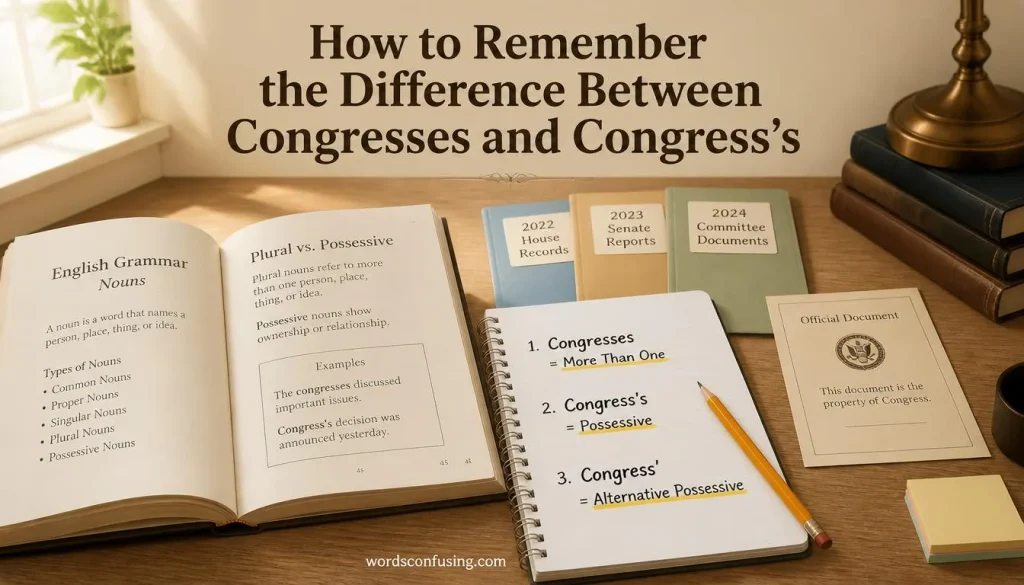
How to Remember the Difference Between Congresses and Congress’s
A simple memory trick can help you choose the correct spelling without stopping to analyze every sentence.
Think of congresses as the counting form and the possessive forms as relationship markers.
A Simple Plural Rule
Use congresses when referring to more than one congress.
Examples:
- One congress becomes two congresses.
- One professional congress becomes several professional congresses.
- One legislative congress becomes multiple congresses in a historical comparison.
The ending -es creates the plural. No apostrophe is necessary.
A Simple Possessive Rule
Use Congress’s or Congress’ when you need to show a relationship with one Congress.
Examples:
- Congress’s decision.
- Congress’ decision.
- The congress’s schedule.
- The congress’ schedule.
Choose between the possessive spellings according to your style guide. Both can express the intended relationship in the appropriate editorial context.
A Quick Editing Test
When you’re unsure, rewrite the sentence in a way that makes its meaning explicit.
Suppose you’ve written:
“Congress’s decision surprised observers.”
Ask whether you mean multiple congresses. If so, revise the sentence to something like “The congresses surprised observers with their decisions.”
If you mean a decision associated with one institution, the possessive form is appropriate.
You can also replace the possessive phrase with of Congress:
“Congress’s authority” becomes “the authority of Congress.”
If the rewritten sentence preserves your intended meaning, you’ve probably identified the correct grammatical function.
This test won’t determine which possessive spelling your style guide requires, but it will help you distinguish possession from plurality.
Read more: 6 More Formal Ways to Say “Please Provide”
Practice Exercises: Congresses, Congress’s, or Congress’
Test your understanding with these sentences. Choose the form that best fits each context, paying attention to whether the sentence needs a plural or a possessive.
Fill in the Blanks
Complete each sentence with congresses, congress’s, or congress’.
- Several international ______ discussed environmental challenges.
- The ______ decision received criticism from the public.
- Historians compared the decisions made by different ______.
- The report examined ______ role in approving legislation.
- Two professional ______ took place during the same week.
- The ______ organizers announced a revised schedule.
- Researchers attended several scientific ______.
- The article discussed ______ authority under the Constitution.
Answer Key and Explanations
| Sentence | Correct answer | Explanation |
| Several international congresses discussed environmental challenges. | Congresses | The sentence refers to multiple assemblies. |
| The congress’s decision received criticism from the public. | Congress’s | The decision relates to one congress. |
| Historians compared the decisions made by different congresses. | Congresses | The plural noun identifies multiple congresses. |
| The report examined Congress’s role in approving legislation. | Congress’s | The sentence uses a singular possessive. |
| Two professional congresses took place during the same week. | Congresses | The number two requires the plural form. |
| The congress’s organizers announced a revised schedule. | Congress’s | The organizers are associated with one congress. |
| Researchers attended several scientific congresses. | Congresses | Several indicates a plural noun. |
| The article discussed Congress’s authority under the Constitution. | Congress’s | This example uses the singular possessive convention. |
Style note: In sentences requiring a singular possessive, congress’ or Congress’ may also be appropriate when the applicable style guide prescribes the apostrophe-only form.
FAQs
1. Is Congresses or Congress’s correct?
Both are correct, but they serve different purposes. Congresses is the plural form of congress, while Congress’s is a singular possessive form showing ownership or association.
2. What is the difference between Congress’s and Congress’?
Both forms can show possession. Congress’s adds an apostrophe and s, while Congress’ places an apostrophe after the final s. The preferred form depends on the style guide you follow.
3. Is Congress’ grammatically correct?
Yes, Congress’ is accepted by some style guides, particularly those that allow an apostrophe alone after certain singular names ending in s. Other guides prefer Congress’s for singular possession.
4. When should I use Congresses in a sentence?
Use Congresses when referring to more than one congress, such as multiple political assemblies or academic conferences. For example, “Several international congresses addressed education reform.”
5. Should I use Congress’s or Congress’ in formal writing?
Check the style guide required by your school, workplace, or publication. Some guides favor Congress’s, while others permit Congress’. Consistency matters more than switching between styles.
6. How can I avoid mistakes with Congress’s, Congress’, and Congresses?
First, determine whether you mean more than one congress or something belonging to a congress. Use Congresses for the plural and choose Congress’s or Congress’ for possession according to your preferred style guide.
Conclusion
Choosing between Congresses, Congress’s, and Congress’ becomes easier when you understand what each form means. Use Congresses when referring to more than one congress. For possession, Congress’s and Congress’ can both be correct, depending on the style guide you follow. The key is to recognize the difference between plural nouns and possessive forms rather than relying on appearance alone.
When writing emails, academic papers, official reports, or professional documents, check your preferred style guide and apply its rules consistently. A small apostrophe can change how readers understand a sentence, so take a moment to review your wording before publishing. With a clear understanding of these grammar rules, you can write more accurately, avoid common punctuation mistakes, and communicate your ideas with confidence.