
Begun vs. Began becomes easier when you understand their roles in English grammar and verb tense.
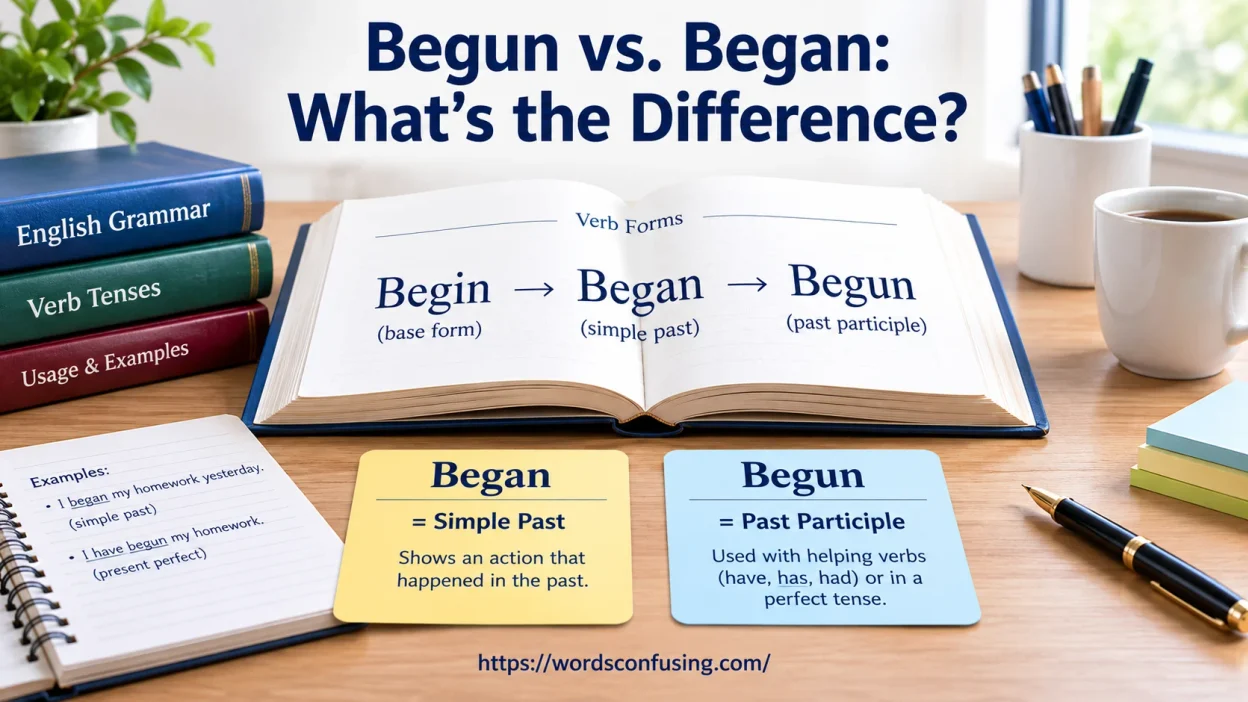
Begin is an irregular verb with three forms of the verb: base form, past tense form, and past participle form. The present tense uses begin or begins, while the future tense uses will begin. The infinitive is to begin.
In the simple past tense, use began, as in “he began,” but begun is the past participle and needs a helping verb or auxiliary verb. Thus, has begun, have begun, and had begun appear in perfect tenses.
To correctly use these verbs, focus on their functions and surrounding words. The party began in the morning, but by morning, it had begun. This guide offers valuable tricks for handling similar verbs, grammar rules, and tricky English words.
Regular practice makes using irregular verbs correctly second nature, improving confidence in writing, speaking, reading, and listening while reducing mistakes and improving correct usage.
Quick Answer
Began or begun? They come from the same verb, but they don’t play the same grammatical role. Began is the simple past form of begin, while begun is the past participle. Use began when you’re describing something that started in the past. Use begun when it follows a helping verb such as has, have, or had.
| Feature | Began | Begun |
| Base verb | Begin | Begin |
| Verb form | Simple past | Past participle |
| Usually used with | No helping verb required | Has, have, had |
| Main purpose | Describes a past starting point | Forms perfect constructions |
| Example | The class began at 9 a.m. | The class has begun. |
| Easy clue | Past action | Helping verb + begun |
Memorable mini-example: Think about a race. “The race began at noon. By 12:05, it had begun.” The first sentence simply reports the starting point. The second uses had with the past participle begun.
So remember the three forms: begin → began → begun. If you’re talking about a straightforward past event, choose began. If has, have, or had comes before it, begun is usually the right choice.
Began vs. Begun at a Glance
The words began and begun both come from the irregular verb begin. They aren’t interchangeable, though.
| Word | Verb form | Main use | Example |
| Begin | Base form | Present tense, infinitive, commands | Please begin the lesson. |
| Began | Simple past | Completed action in the past | The lesson began early. |
| Begun | Past participle | Perfect constructions and some passive constructions | The lesson has begun. |
The most useful distinction involves the difference between a simple past verb and a past participle.
You can normally use began as the main verb when talking about something that started in the past.
The concert began at 7 p.m.
You normally need a helping verb with begun.
The concert has begun.
That helping verb changes the grammatical construction. This is why “The concert begun at 7 p.m.” is incorrect in standard English.
What Does “Began” Mean?
Began is the simple past form of begin. Use it when you describe an action or event that started at a point in the past.
The action may have continued afterward. The important point is that the sentence places the beginning in the past.
Consider these examples:
- The class began at eight o’clock.
- She began reading the novel yesterday.
- The rain began during the night.
- They began construction last month.
- The movie began after dinner.
Notice something important. Began doesn’t need has, have, or had before it.
Began for a Completed Past Action
The simple past often works with a definite or understood past time.
For example:
The company began operations in 2018.
The word began tells you that the starting point occurred in the past.
You can also use it when the exact time isn’t stated:
The children began laughing.
The sentence still describes a past event. The context determines when it happened.
Words such as these commonly appear with began:
- yesterday
- last night
- last week
- last year
- earlier
- previously
- in 2020
- at noon
- two hours ago
- when I arrived
For example:
The storm began two hours ago.
The presentation began when everyone arrived.
The structure remains straightforward:
Subject + began + complement
The show began at seven.
What Does “Begun” Mean?
Begun is the past participle of begin. Unlike began, it generally doesn’t function as the ordinary simple past verb.
Instead, begun commonly appears with auxiliary verbs such as has, have, or had.
Examples include:
- The show has begun.
- The students have begun working.
- The meeting had begun before I arrived.
- The process has begun already.
Here, begun works as part of a perfect verb construction.
This is the key difference between began and begun.
Begun With Has, Have, or Had
The word begun commonly follows forms of the auxiliary verb have.
The choice depends on the tense and subject.
| Construction | Example |
| has begun | The class has begun. |
| have begun | The students have begun. |
| had begun | The meeting had begun. |
| will have begun | The ceremony will have begun by then. |
The basic pattern looks like this:
Subject + have/has/had + begun
For example:
She has begun a new project.
The phrase has begun uses the present perfect.
Now compare it with:
She began a new project yesterday.
The first sentence uses the present perfect. The second uses the simple past.
Begin, Began, and Begun: The Three Forms
The complete irregular verb pattern is:
Begin → Began → Begun
Each form has a specific grammatical role.
| Form | Grammatical role | Example |
| Begin | Base form | I want to begin now. |
| Began | Simple past | We began yesterday. |
| Begun | Past participle | We have begun already. |
This pattern resembles other irregular verbs in English.
For example:
- sing → sang → sung
- drink → drank → drunk
- swim → swam → swum
- ring → rang → rung
- begin → began → begun
These verbs change their internal vowel rather than simply adding -ed.
That’s why you can’t treat began and begun like regular past-tense forms.
You wouldn’t say:
I have began the work.
Standard English requires:
I have begun the work.
The auxiliary have signals the perfect construction. Therefore, the past participle begun follows it.
When to Use Began vs. Begun
Choosing between began and begun becomes much easier when you look at the sentence structure.
Use began when you need the simple past.
Use begun when you need the past participle.
A quick comparison makes the difference clear:
| Incorrect or correct? | Sentence | Reason |
| Correct | The game began at six. | Simple past |
| Correct | The game has begun. | Present perfect |
| Correct | The game had begun before we arrived. | Past perfect |
| Incorrect | The game begun at six. | Past participle used as simple past |
| Incorrect | The game has began. | Simple past used after auxiliary |
Began for a Completed Past Action
Use began when you’re simply reporting a past starting point.
The lecture began at 10 a.m.
The baby began crying.
The workers began repairs last Monday.
The discussion began after lunch.
In each sentence, began acts as the main past-tense verb.
You don’t need another auxiliary before it.
Begun With Has, Have, or Had
Use begun when an auxiliary verb creates a perfect construction.
The lecture has begun.
The workers have begun repairs.
The discussion had begun before the manager arrived.
The distinction becomes especially clear when you compare two sentences describing nearly identical situations:
The meeting began at 9 a.m.
The meeting has begun.
The first sentence focuses on a past starting point. The second emphasizes that the meeting has started and that this fact remains relevant to the present situation.
Began vs. Begun Examples
Examples are one of the fastest ways to understand this grammar rule.
Example: A Meeting
Began:
The meeting began at 9 a.m.
Begun:
The meeting has begun.
The first sentence identifies the past starting time. The second tells you that the meeting is now underway.
Example: A Project
Began:
The team began the project last week.
Begun:
The team has begun the project.
The word last week strongly supports the simple past in the first sentence.
Example: A Storm
Began:
The storm began after midnight.
Begun:
The storm has begun to weaken.
Here, began reports the starting point. Has begun describes an action that has started and remains relevant now.
Example: A Class
Began:
The class began at eight.
Begun:
The class has begun already.
Both sentences are grammatically correct. The choice depends on the structure and meaning you want.
Common Mistakes With Began and Begun
Several errors appear repeatedly because English learners sometimes treat began and begun as interchangeable.
They aren’t.
“I Have Began” Is Incorrect
A common mistake is:
I have began the assignment.
The correct version is:
I have begun the assignment.
Why?
Because have requires the past participle in this perfect construction.
The pattern is:
have + begun
Not:
have + began
“I Begun the Project” Is Incorrect
Another common mistake is:
I begun the project yesterday.
The correct version is:
I began the project yesterday.
Here, the sentence uses the simple past. It doesn’t need an auxiliary verb.
“The Meeting Begun at Noon” Is Incorrect
The sentence:
The meeting begun at noon.
uses the past participle as though it were the simple past.
Use:
The meeting began at noon.
“The Meeting Has Began” Is Incorrect
The phrase has began combines the wrong verb forms.
Use:
The meeting has begun.
The formula is easy to remember:
has + begun
have + begun
had + begun
Read more: Given vs. Gave: Meaning, Grammar and Correct Usage
Began vs. Begun in Questions and Negative Sentences
Questions and negative sentences introduce another useful rule.
When did appears in a question or negative statement, use the base form begin, not began or begun.
For example:
Did the movie begin on time?
Not:
Did the movie began on time?
And not:
Did the movie begun on time?
The same rule applies to negative statements:
The movie didn’t begin on time.
Not:
The movie didn’t began on time.
The reason is grammatical. The auxiliary did already carries the past tense. The main verb returns to its base form.
Questions With Begun
Perfect constructions work differently:
Has the meeting begun?
Have the students begun the test?
Had the ceremony begun before you arrived?
Here, has, have, or had functions as the auxiliary. Therefore, begun appears as the past participle.
This gives you a useful shortcut:
- Did + begin
- Has + begun
- Have + begun
- Had + begun
Began vs. Begun in Different Tenses
Understanding the larger tense system makes this distinction even clearer.
| Tense or structure | Correct form | Example |
| Simple present | begin | Classes begin at nine. |
| Simple past | began | Classes began yesterday. |
| Present perfect | has/have begun | Classes have begun. |
| Past perfect | had begun | Classes had begun before we arrived. |
| Future perfect | will have begun | Classes will have begun by then. |
| Infinitive | to begin | It’s time to begin. |
| Modal construction | begin | We should begin now. |
This table reveals an important principle.
Began belongs specifically to the simple past.
Begun belongs to the past participle form.
The base form begin appears after modal verbs, auxiliary do, and infinitive to.
Simple Past
She began studying at seven.
Present Perfect
She has begun studying.
Past Perfect
She had begun studying before dinner.
Future Perfect
She will have begun studying by then.
The word changes because the grammatical construction changes.
Why “Began” and “Begun” Aren’t Interchangeable
At first glance, the distinction can seem arbitrary. English irregular verbs often work this way, though.
Think of began and begun as two different tools.
Began is the tool for a straightforward past action.
Begun is the tool you use when another auxiliary creates a perfect construction.
Compare:
The race began at noon.
The race has begun.
The first sentence simply reports what happened.
The second connects the starting event with the present.
That difference matters in everyday writing because tense can change the time relationship between events.
How to Remember Began vs. Begun
The easiest memory trick is to memorize all three forms together:
Begin → Began → Begun
Then remember one additional rule:
Began stands alone as the simple past. Begun usually needs a helping verb.
For example:
- I began.
- I have begun.
- I had begun.
- I will have begun.
A useful comparison comes from the verb sing:
sing → sang → sung
You wouldn’t normally say:
I have sang a song.
You’d say:
I have sung a song.
The same pattern applies:
begin → began → begun
I began the work.
I have begun the work.
This pattern is worth memorizing because begin is an irregular verb. Standard English doesn’t form its past tense by simply adding -ed.
A Simple Test for Began vs. Begun
When you’re unsure, inspect the words around the verb.
Check for “Did”
If the sentence uses did, use begin.
Did you begin the assignment?
Check for “Has,” “Have,” or “Had”
If the sentence uses has, have, or had, use begun.
She has begun the assignment.
They had begun the assignment.
Check for a Simple Past Meaning
If you’re simply describing something that started in the past, use began.
She began the assignment yesterday.
This three-step test catches many common mistakes.
Began vs. Begun in Everyday English
You can see the difference in ordinary situations.
At School
The teacher began the lesson at 9 a.m.
The teacher has begun the lesson.
At Work
The company began hiring in January.
The company has begun hiring again.
During an Event
The ceremony began shortly after sunset.
The ceremony has begun.
In a Story
The character began to question everything.
The character had begun to question everything before the final scene.
During a Change
The weather began changing yesterday.
The weather has begun changing.
These examples show why context matters. The words describe similar actions, but their grammatical roles differ.
“Began to” vs. “Begun to”
Both began to and begun to can be correct. The surrounding verb determines which form you need.
Use began to for the simple past:
She began to laugh.
Use has begun to for the present perfect:
She has begun to laugh.
Use had begun to for the past perfect:
She had begun to laugh before anyone noticed.
The word after to remains in its base form.
So these are correct:
- began to rain
- has begun to rain
- had begun to rain
- will begin to rain
Not:
- began to rained
- has begun to raining
- had begun to rained
The infinitive marker to takes the base form.
Began vs. Begun: A Practical Comparison
| Sentence | Correct form | Why? |
| The show began at eight. | Began | Simple past |
| The show has begun. | Begun | Present perfect |
| The show had begun before we arrived. | Begun | Past perfect |
| Did the show begin at eight? | Begin | “Did” takes the base form |
| The show didn’t begin at eight. | Begin | “Did” carries past tense |
| The show will begin soon. | Begin | Modal/future construction |
| The show will have begun by then. | Begun | Future perfect |
This comparison gives you a quick reference whenever the forms start to blur together.
Quick Examples
Simple past:
The game began at six.
Present perfect:
The game has begun.
Past perfect:
The game had begun before we arrived.
Question with did:
Did the game begin at six?
Future:
The game will begin soon.
Once you recognize these patterns, the choice becomes almost automatic.
FAQs
Is “began” the past tense of begin?
Yes. Began is the simple past tense of begin. For example, “She began her homework after dinner.”
Is “begun” a past tense word?
No. Begun is the past participle form of begin. It usually appears with a helping verb, such as has, have, or had.
Can I say “I have began”?
No. The correct form is “I have begun.” The word have requires the past participle begun, not the simple past began.
When should I use “had begun”?
Use had begun when one past action happened before another past event. For example, “The movie had begun before we arrived.”
Is “began” or “begun” used with “has”?
Use begun after has. For example, “The meeting has begun.” You should not write “The meeting has began.”
What is an easy way to remember began vs. begun?
Think of began as a past action that can stand alone. Think of begun as a form that needs a helper, such as has, have, or had.
Conclusion
I know began vs. begun can seem confusing at first, especially when both words come from the same verb. The trick is to slow down and look at what comes before the verb. If you’re describing a simple action in the past, began is usually the word you need.
When has, have, or had appears before it, choose begun. I’ve found that a few simple examples make this difference much easier to remember than memorizing complicated grammar rules. Keep practicing with everyday sentences, and you’ll soon find yourself choosing the right form naturally and writing with much more confidence.