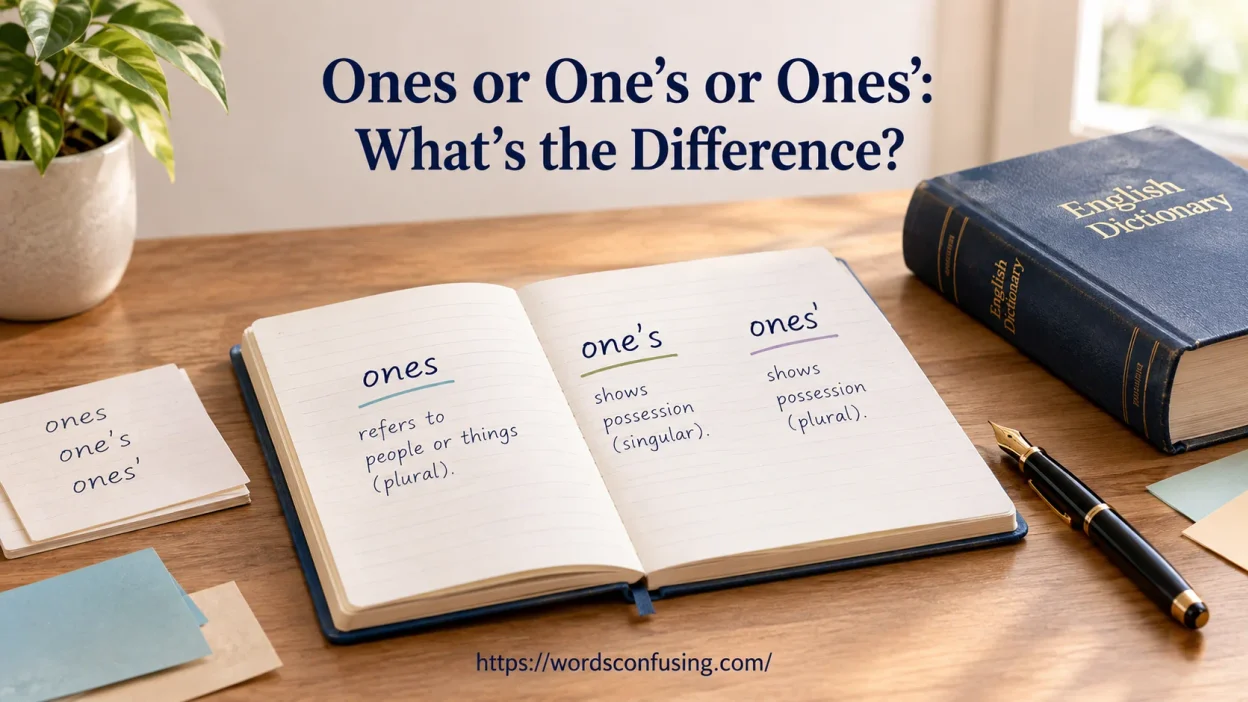
Ones or One’s or Ones’: What’s the Difference? Learn how a small apostrophe changes meaning and helps you choose the correct form in everyday writing.
Have you ever paused while writing and wondered whether to use ones, one’s, or ones’? This common grammar question confuses many writers because these words look almost identical but have different grammatical roles and meanings. Ones is the plural form of one, referring to multiple people or things.
One’s usually shows ownership or association, while ones’ can express plural possession in a suitable context, although it rarely appears in everyday English. Understanding these word differences helps you follow language rules, improve English usage, and avoid common grammar mistakes and punctuation mistakes.
The difference goes beyond punctuation, especially when you’re working on formal writing or aiming for greater consistency. These forms may appear in academic papers, emails, reports, essays, and everyday conversations.
In professional settings, such as business communication, project management, meetings, online booking, broadcasting, and calendar planning, correct grammar helps prevent misunderstandings and strengthen credibility. Using the right possessive form keeps your message accurate and polished.
A good grammar guide uses practical examples, clear examples, simple explanations, and easy-to-follow explanations to break down the rules and highlight common mistakes. With learning and practice, you’ll improve your understanding of pluralization, possessive forms, and other grammatical differences.
This knowledge also supports proper punctuation, effective scheduling, time management, professional writing, and clear communication in any context.
Quick Answer
Ones is the plural form of one and refers to multiple people or things. One’s shows singular possession or can mean one is or one has. Ones’ is the plural possessive form, indicating something belongs to a group. For example, “I prefer the blue ones,” “One’s choices matter,” and “The chosen ones’ names appeared on the list.”
Ones vs. One’s vs. Ones’: Key Differences
The simplest way to understand these words is to examine their meanings, grammatical functions, and sentence examples side by side.
| Word | Grammatical function | Example |
| Ones | Plural pronoun referring to people or things | I prefer the smaller ones. |
| One’s | Possessive form of one; also a contraction of one is or one has | One’s attitude matters. |
| Ones’ | Plural possessive form of ones | The chosen ones’ duties were explained. |
The most important distinction involves the apostrophe. In standard English, you don’t add an apostrophe simply to make a word plural. Instead, an apostrophe can indicate possession or form certain contractions.
Consider the difference between the ones and the ones’ responsibilities. The first phrase identifies a group, while the second indicates that the responsibilities belong to that group.
Similarly, one’s responsibilities refers to the responsibilities of one person in a general statement. The correct choice depends on what you want your sentence to communicate.
What Does Ones Mean?
Ones is the plural form of the pronoun one. Writers use it to refer to multiple people or things that the reader can identify from the surrounding context.
Instead of repeating a noun, you can use ones to make your sentence smoother. This construction appears frequently when comparing objects, describing choices, or distinguishing between different groups.
For example:
- The black jackets look better than the gray ones.
- I prefer homemade cookies to store-bought ones.
- The students who prepared carefully performed better than the ones who didn’t.
In the first example, ones replaces the noun jackets. In the second, it replaces cookies. The final example uses ones to refer to students who belong to a particular group.
Without this pronoun, sentences can become repetitive. You don’t need to repeat the same noun whenever you mention another item of the same type.
Examples of Ones in Sentences
The following examples show how ones works in different situations.
| Example sentence | What Ones Refers To |
| The red apples are sweeter than the green ones. | Green apples |
| These shoes fit better than the old ones. | Old shoes |
| I saved the important documents and deleted the unnecessary ones. | Unnecessary documents |
| The younger players learned quickly from the experienced ones. | Experienced players |
| Which books should we keep? The useful ones. | Useful books |
| I like these designs more than those ones. | Other designs |
In each sentence, ones replaces a plural noun or identifies a group already established by the conversation.
However, the noun it replaces should be clear. If readers cannot determine what ones refers to, the sentence may become confusing.
For example, saying “I like the ones” without any previous context leaves readers wondering which objects you mean. A clearer sentence would be “I like the blue ones” when discussing several colors of shoes.
When Should You Use Ones?
Use ones when you need a plural reference without repeating a noun.
Common situations include:
- Comparing objects: The newer phones work faster than the older ones.
- Describing choices: Choose the ripe bananas rather than the green ones.
- Identifying groups: The volunteers who arrived early helped the ones who arrived later.
- Avoiding repetition: I returned the damaged books and kept the undamaged ones.
- Distinguishing between options: The affordable plans appeal to students more than the expensive ones.
Remember that ones does not show ownership. It simply refers to multiple people or things.
For example, “The blue ones are mine” uses ones to identify the shoes. The word mine expresses ownership, not the plural pronoun itself.
Common Mistakes With Ones
One frequent mistake is adding an apostrophe when you only need the plural form.
Incorrect: I prefer the blue one’s.
Correct: I prefer the blue ones.
The incorrect version suggests possession or a contraction rather than a simple plural reference. If you mean several blue items, you don’t need an apostrophe.
Another mistake involves using ones without enough context. Readers need to know which people or objects the word represents.
Incorrect: Ones are better.
Clearer: The leather ones are more durable than the plastic ones.
The second sentence provides enough information to identify the items being compared.
What Does One’s Mean?
One’s is the possessive form of the indefinite pronoun one. It refers to something belonging to, connected with, or associated with a person in a general sense.
Writers often use one’s when discussing personal responsibility, behavior, health, decisions, or experiences. The pronoun one refers to people in general rather than identifying a particular individual.
For example, consider this sentence:
“One’s health should always be a priority.”
Here, one’s refers to the health of a person in general. The apostrophe shows possession or association, so you need it even though the sentence doesn’t identify a specific person.
Compare these examples:
- One’s attitude can influence relationships.
- One’s responsibilities change over time.
- One’s decisions may have lasting consequences.
- One’s personal values often shape behavior.
In each sentence, one’s connects a person with something associated with that person.
Examples of One’s in Sentences
The following examples demonstrate how one’s works in different contexts.
| Example sentence | Meaning |
| One’s health deserves attention. | A person’s health |
| One’s choices reveal personal priorities. | The choices made by a person |
| One’s words can affect others. | The words spoken by a person |
| One’s reputation takes time to build. | A person’s reputation |
| One’s experience may differ from another’s. | The experience of a person |
| One’s confidence can improve with practice. | A person’s confidence |
Notice that one’s usually appears before a noun. It functions as a possessive determiner, much like my, your, or their.
For example, compare “my decision” with “one’s decision.” Both phrases identify a decision associated with someone, but they use different pronouns.
The first refers to the speaker. The second expresses a general statement about people.
One’s as a Contraction
Although one’s most commonly expresses possession in formal writing, it can also function as a contraction of one is or one has.
Context determines which meaning applies.
For example:
- One’s responsible for the final decision. Here, one’s means one is.
- One’s been working all morning. Here, one’s means one has.
- One’s responsibility is to follow the rules. Here, one’s shows possession or association.
The third example doesn’t contain a contraction. Instead, one’s describes the responsibility associated with a person.
However, contractions with one can sound unusual or overly formal in everyday American English. Writers often choose you’re, they’re, or a direct reference to a person when the context allows.
When clarity matters, writing out one is or one has can help readers understand the intended meaning.
When Should You Use One’s?
Use one’s when you need to express possession or association with a person described by the pronoun one.
Common examples include:
- Personal responsibility: One’s actions should reflect one’s values.
- Health and well-being: One’s health requires regular attention.
- Personal development: One’s skills improve through consistent practice.
- General observations: One’s perspective can change with experience.
- Formal writing: One must consider one’s obligations carefully.
Although these sentences are grammatically correct, repeating one too often can make your writing sound stiff.
For a more conversational tone, you can often replace one with you.
Formal: One should always check one’s work.
Conversational: You should always check your work.
Both versions communicate a similar idea. The second sounds more natural in everyday American English.
What Does Ones’ Mean?
Ones’ is the plural possessive form of ones. It indicates that something belongs to, or is associated with, multiple people or things identified as ones.
This construction is grammatically possible, but it is uncommon in everyday English. Most writers can express the same idea more clearly by naming the people or objects involved.
Consider this example:
“The chosen ones’ names appeared on the list.”
Here, ones refers to several people who were chosen. The apostrophe appears after the s because the possessive form refers to a plural group.
The sentence indicates that the names belong to, or identify, those chosen people.
Compare the following phrases:
- The chosen ones: Identifies a group of people.
- The chosen ones’ names: Refers to the names associated with that group.
- The chosen person’s name: Refers to the name of one person.
The apostrophe’s position helps distinguish singular possession from plural possession.
Examples of Ones’ in Sentences
Because ones’ is uncommon, its examples often require specific context. Here are several sentences showing how it can work.
| Example sentence | Meaning |
| The chosen ones’ names were announced. | The names associated with the chosen group |
| The selected ones’ responsibilities increased. | The responsibilities of the selected group |
| The lucky ones’ prizes arrived yesterday. | The prizes belonging to the lucky group |
| The rescued ones’ condition improved. | The condition of the rescued group |
| The remaining ones’ applications need review. | The applications associated with the remaining group |
These examples demonstrate the grammatical pattern, but they aren’t always the most natural way to express the intended meaning.
For instance, “The selected candidates’ responsibilities increased” sounds clearer than “The selected ones’ responsibilities increased” when the group consists of candidates.
The more specific noun removes ambiguity and helps readers understand the sentence immediately.
When Should You Use Ones’?
Use ones’ only when the surrounding context clearly identifies a plural group described as ones and you need to express possession.
For example, imagine a conversation about two groups of people standing outside a building.
“Speak to the ones on the left first.”
Later, someone might say, “The ones’ instructions were different from ours.”
The second sentence uses a plural possessive construction, although it sounds less natural than “The instructions given to the people on the left were different from ours.”
In most cases, consider these alternatives before using ones’:
- Replace ones with a specific plural noun.
- Rewrite the sentence to avoid an awkward possessive construction.
- Use a phrase beginning with of when it improves clarity.
- Check whether possession is necessary to communicate your meaning.
For example:
Awkward: The lucky ones’ rewards were impressive.
Clearer: The winners’ rewards were impressive.
The second sentence uses a more precise noun, making the relationship easier to understand.
Why Is Ones’ Rarely Used?
The main problem with ones’ isn’t that the grammatical construction is impossible. It’s that the pronoun ones often lacks the precision needed to make a possessive relationship clear.
Readers may understand the blue ones immediately when a conversation concerns shoes. However, the blue ones’ features can sound clumsy when the blue shoes’ features would be clearer.
Three factors explain why writers often avoid ones’:
- Lack of precision: The word ones depends heavily on context.
- Awkward phrasing: A specific noun often produces a smoother sentence.
- Limited need: English offers many straightforward alternatives for expressing plural possession.
Still, don’t confuse rarity with grammatical impossibility. A plural possessive construction can work when the context supports it.
Read more: 23 Best Replies to “It Is What It Is” Witty and Funny
Ones vs. One’s: What Is the Difference?
The difference between ones and one’s comes down to plurality versus possession.
Use ones when referring to multiple people or things. Use one’s when expressing possession or association with a person in a general statement.
Consider these examples:
- The expensive ones are on the top shelf.
- One’s priorities can change over time.
The first sentence identifies several objects. The second refers to the priorities associated with a person.
Ones Refers to Multiple People or Things
The word ones often replaces a plural noun that would otherwise appear repeatedly.
For example:
“I prefer the cotton shirts to the polyester ones.”
Here, ones replaces shirts. The reader understands which items the sentence describes because the noun appears earlier.
Other examples include:
- The ripe peaches taste sweeter than the unripe ones.
- The larger boxes are easier to identify than the smaller ones.
- The students who finished early helped the ones who needed extra time.
In each case, ones avoids unnecessary repetition.
One’s Shows Possession or Association
The word one’s expresses a relationship between a person and something connected with that person.
For example:
“One’s habits can influence long-term success.”
The sentence refers to habits associated with a person. The possessive form makes that relationship clear.
Other examples include:
- One’s behavior affects how others respond.
- One’s goals can change throughout life.
- One’s experience influences personal judgment.
Quick test: If you can replace ones with a plural noun, you probably need ones. If you mean something belonging to or associated with a person described as one, you probably need one’s.
One’s vs. Ones’: What Is the Difference?
Both one’s and ones’ express possession or association, but they differ in number.
One’s is the singular possessive form. Ones’ is the plural possessive form used when ones represents multiple entities.
Compare these sentences:
- One’s responsibility is to follow the rules.
- The selected ones’ responsibilities include training new members.
The first sentence refers to a person in a general sense. The second refers to a group of selected people.
The difference becomes clearer when you replace the pronoun with a specific noun.
| Singular possessive | Plural possessive |
| The student’s assignment | The students’ assignments |
| The winner’s prize | The winners’ prizes |
| One’s responsibility | The chosen ones’ responsibilities |
The same general apostrophe pattern appears in ordinary nouns. A singular noun typically takes apostrophe plus s, while a regular plural noun ending in s typically takes an apostrophe after the final s.
However, one’s and ones’ remain relatively unusual because the pronoun ones often sounds less precise than a specific plural noun.
Ones vs. Ones’: What Is the Difference?
The distinction between ones and ones’ is simple: ones identifies a group, while ones’ indicates possession or association with that group.
Compare these examples:
- The red ones are mine.
- The red ones’ labels are missing.
In the first sentence, ones identifies several red objects. The word mine expresses ownership.
In the second sentence, ones’ indicates that the labels belong to, or are associated with, the red objects.
Apostrophes don’t automatically make a word plural. Instead, they help express certain possessive relationships.
Here’s another comparison:
| Ones | Ones’ |
| The selected ones arrived early. | The selected ones’ names were recorded. |
| I prefer the smaller ones. | The smaller ones’ handles are damaged. |
| The lucky ones received prizes. | The lucky ones’ prizes arrived. |
The first column contains no possessive apostrophe because the sentences merely identify a group.
The second column uses ones’ because the sentences express a relationship between the group and something associated with it.
Nevertheless, consider replacing ones with a precise noun whenever possible. “The smaller cups’ handles are damaged” may be clearer than “The smaller ones’ handles are damaged.”
Common Mistakes With Ones, One’s, and Ones’
Even experienced writers sometimes confuse these forms. Fortunately, a few practical rules can prevent most mistakes.
Using One’s When You Mean Ones
Incorrect: I prefer the blue one’s over the black ones.
Correct: I prefer the blue ones over the black ones.
The first sentence incorrectly uses a possessive apostrophe. The writer isn’t describing ownership, so ones is the correct choice.
Using Ones When You Mean One’s
Incorrect: One should take care of ones health.
Correct: One should take care of one’s health.
The second sentence correctly uses one’s because the sentence refers to the health associated with a person.
Adding an Apostrophe to Form a Plural
Incorrect: I bought three notebook’s.
Correct: I bought three notebooks.
The same principle applies to ones. An apostrophe isn’t necessary simply because you mean more than one.
Using Ones’ Without Expressing Possession
Incorrect: The ones’ are waiting outside.
Correct: The ones are waiting outside.
The incorrect sentence adds an apostrophe without a possessive relationship. If you simply mean that several people or things are waiting, use ones.
Confusing Ones’ With One’s
Incorrect: The winner one’s names were announced.
Correct: The winners’ names were announced.
In this example, winners’ is the natural plural possessive form because several winners are involved.
You could also write “The chosen ones’ names were announced” if the context clearly establishes the group.
Choosing an Awkward Plural Possessive
Grammatically possible constructions can still make writing harder to understand.
Less clear: The remaining ones’ documents were missing.
Clearer: The remaining applicants’ documents were missing.
The second sentence identifies the group directly. As a result, readers don’t have to rely on earlier context to interpret ones.
A Quick Trick to Remember the Difference
You don’t need to memorize complicated grammatical terminology to choose the correct form. Instead, ask what the sentence needs to express.
Ones
Plural reference
Use it to refer to multiple people or things without expressing possession.
Example: The green ones look fresher.
One’s
Singular possession or association
Use it when something belongs to or is associated with a person described as one.
Example: One’s choices matter.
Ones’
Plural possession
Use it when ones represents a group and you need to show possession or association.
Example: The chosen ones’ duties were explained.
Remember this simple pattern:
- No apostrophe: Ones refers to multiple people or things.
- Apostrophe before s: One’s indicates singular possession or may form a contraction.
- Apostrophe after s: Ones’ indicates plural possession.
When you’re unsure, remove the apostrophe temporarily and check whether the sentence still communicates the intended meaning. If you mean a simple plural reference, you probably don’t need it.
Read more: 5 Good Synonyms for Having Mixed Feelings: Meaning
Practical Examples: How to Choose the Correct Form
Let’s apply the rules to situations you might encounter while writing emails, essays, articles, or everyday messages.
Example: Comparing Products
Suppose you’re comparing several pairs of shoes.
Correct: The leather ones are more expensive than the canvas ones.
Here, ones replaces shoes. Neither phrase expresses possession, so no apostrophe is needed.
However, if you’re describing the shoes’ features, you might write:
“The leather ones’ soles are thicker.”
This sentence uses a plural possessive construction. A clearer alternative would be “The leather shoes’ soles are thicker.”
Example: Writing About Personal Responsibility
Suppose you’re discussing the importance of making good decisions.
Correct: One’s decisions can affect other people.
The word one’s expresses the relationship between a person and that person’s decisions.
Incorrect: Ones decisions can affect other people.
Without the apostrophe, ones becomes a plural reference rather than the possessive form needed before decisions.
Example: Describing a Group of People
Imagine a teacher has selected several students for a special project.
Correct: The selected students’ names appeared on the noticeboard.
You could also write “The selected ones’ names appeared on the noticeboard” if the context makes the group clear.
However, the first sentence is usually better because students identifies the group precisely.
Example: Understanding a Contraction
Consider this sentence:
“One’s going to need more time.”
Here, one’s means one is. It doesn’t express possession.
However, this contraction sounds formal or unusual in many everyday American English contexts. A more natural alternative might be “You’re going to need more time” when addressing someone directly.
These examples show why you must examine the entire sentence rather than judging a word by its spelling alone.
FAQs
1. What is the difference between ones and one’s?
Ones is the plural form of one and refers to multiple people or things. One’s is the possessive form of one, showing ownership or association. For example, “I prefer the blue ones” uses the plural form, while “One’s actions reveal one’s character” shows possession or association.
2. Is ones’ a correct word?
Yes, ones’ can be grammatically correct when you need to show possession by multiple people or things referred to as ones. However, this form is uncommon because writers usually choose a clearer noun. The apostrophe comes after the s to indicate plural possession.
3. When should I use ones without an apostrophe?
Use ones when referring to more than one person or thing without showing ownership. For example, “The red shoes look better than the black ones.” Here, ones replaces the plural noun shoes. You don’t need an apostrophe because the word simply represents a plural.
4. Does one’s always indicate possession?
One’s usually indicates possession or a connection to a person represented by the pronoun one. For example, “One’s health deserves attention.” It can also appear in expressions such as “one’s own choices.” In this usage, the apostrophe and s mark the possessive form.
5. How can I remember the difference between ones, one’s, and ones’?
Remember these three simple rules: ones means more than one, one’s indicates possession by one, and ones’ can indicate possession by multiple ones. Check the meaning of your sentence before adding an apostrophe. If you’re only referring to several items, ones is usually correct.
6. Are ones, one’s, and ones’ interchangeable in formal writing?
No, these forms aren’t interchangeable because each serves a different grammatical purpose. Using the wrong form can create confusion in academic papers, emails, reports, and professional communication. Choose ones for the plural, one’s for singular possession, and ones’ only when plural possession is genuinely intended.
Conclusion
Understanding the difference between ones, one’s, and ones’ makes your writing clearer and helps you avoid common grammar mistakes. Remember that ones refers to multiple people or things, one’s usually shows singular possession, and ones’ can indicate plural possession in specific contexts. Although these forms look similar, the apostrophe changes their grammatical roles and meaning.
Before you finish an email, essay, or report, take a moment to check your punctuation. Ask yourself whether you’re referring to several things or showing ownership. This simple habit can improve your English usage, strengthen your professional communication, and help you choose the correct form with confidence.

Shafiq Ur Rehman is a writer and content contributor at WordsConfusing.com. He enjoys exploring the English language, common word confusions, vocabulary, and practical writing tips. His goal is to make English easier to understand through clear, simple, and useful articles.