
Wrote or Written: Which One Is Correct? makes the difference between wrote and written clear through simple English grammar and practical examples.
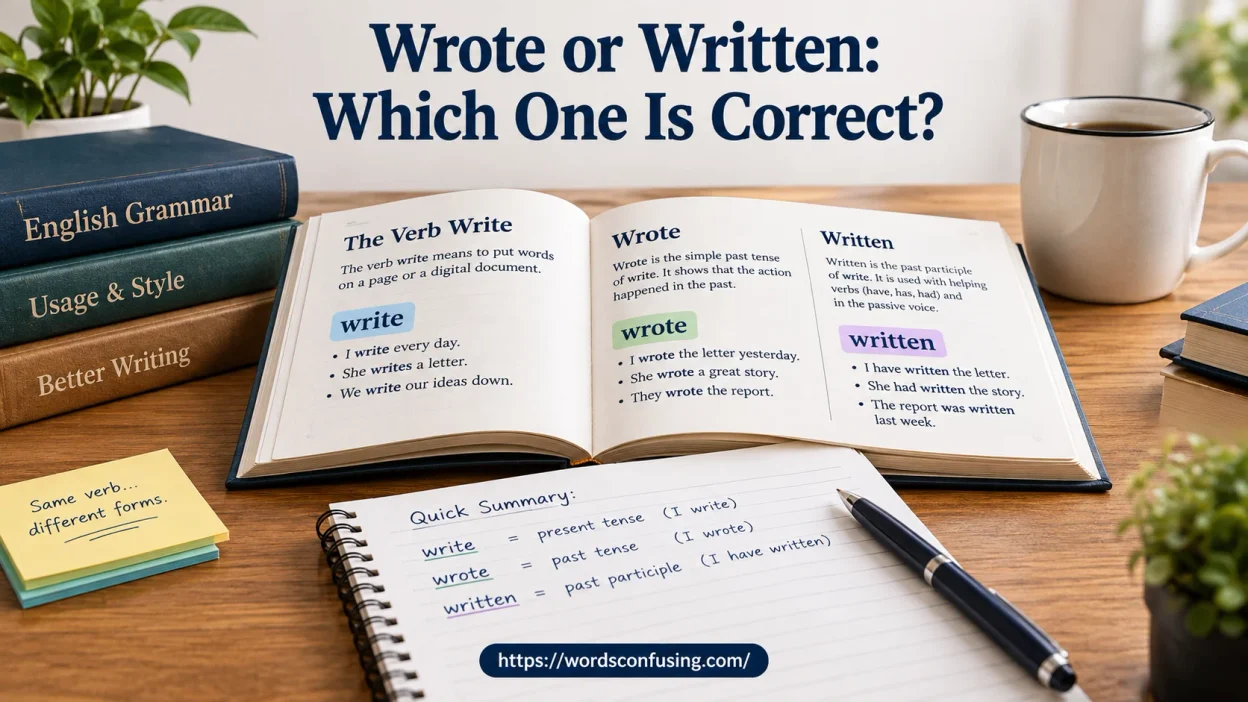
Wrote is the simple past form of write, while written is the past participle form. This important rule helps you avoid a common grammar mistake. You can say, “I wrote an email yesterday,” but you should say, “I have written an email.”
The second sentence needs an auxiliary verb or helping verb before the past participle. In English grammar, wrote describes completed past actions or past events.
These commonly confused verb forms appear in everyday English, written communication, professional communication, academic writing, and email writing. The same distinction matters in a job application, report, essay, or workplace document.
Using the wrong form can reduce clarity and credibility. Before you press send, proofreading can help you prevent errors, avoid mistakes, and improve your overall writing.
Quick Answer
Use wrote when you describe a completed action in the simple past.
I wrote the email yesterday.
Use written when the sentence requires the past participle, usually with an auxiliary verb such as have, has, or had, or in a passive construction.
I have written the email.
Here’s the basic distinction:
| Word | Verb form | Main use | Example |
| write | Base form | Present tense, infinitives, after do/did | I write every day. |
| wrote | Simple past | Completed past action | I wrote yesterday. |
| written | Past participle | Perfect tenses and passive voice | I have written it. |
| writing | Present participle | Continuous forms | I am writing now. |
So, if you’re choosing between wrote or written, first look at the words around the verb.
If the sentence stands in the simple past, choose wrote. If another verb requires a past participle, choose written.
What Does “Wrote” Mean?
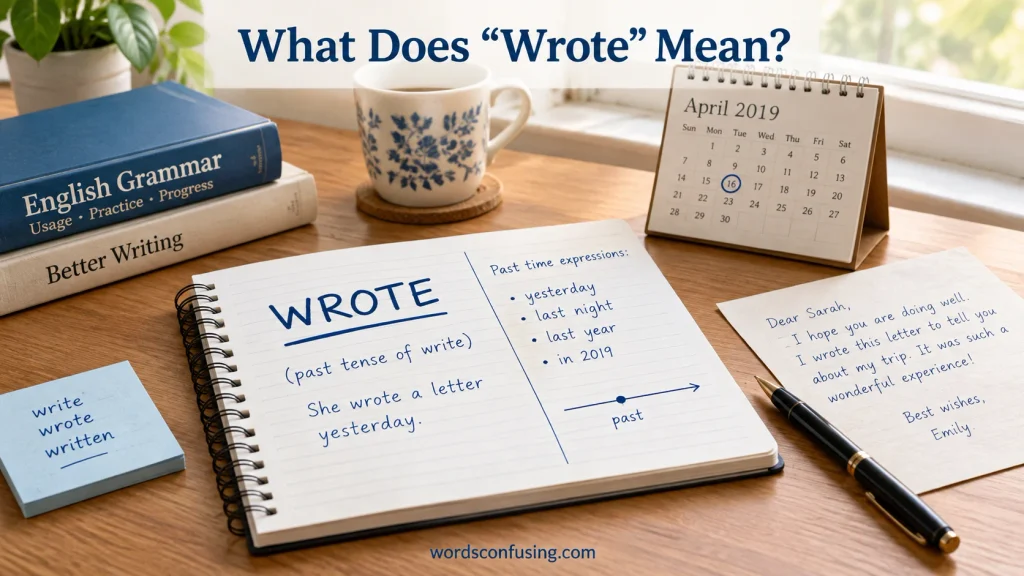
Wrote is the simple past tense of write.
It describes an action that happened and finished in the past. The action may have happened recently or long ago. What matters is that you’re presenting it as a completed past event.
Consider these examples:
- I wrote a letter yesterday.
- Sarah wrote a short story last night.
- James wrote three pages during class.
- We wrote our names on the form.
- They wrote about their experience in 2022.
In each sentence, wrote directly carries the past-tense meaning.
Wrote With Specific Past Times
You will often see wrote alongside expressions that clearly place an action in the past.
Common examples include:
- yesterday
- last night
- last week
- last month
- last year
- two days ago
- three years ago
- in 2019
- when I was younger
- earlier this morning
For example:
She wrote the report last Friday.
The phrase last Friday identifies a completed past period. The verb therefore uses the simple past form wrote.
Another example makes the contrast clearer:
She has written the report.
This sentence doesn’t simply place the action at a finished point in the past. Instead, it connects the completed action to the present. That’s why written appears after has.
Read more: 8 Words for Someone Who Is Good With Words
What Does “Written” Mean?
Written is the past participle of write.
Unlike wrote, it usually cannot function as the main verb by itself when you want to express a completed action. It generally needs another verb to create the correct grammatical structure.
For example:
I have written the report.
Here, have is the auxiliary verb and written is the past participle.
You can also use written with has:
She has written three books.
Or with had:
He had written the letter before lunch.
The pattern is straightforward:
have/has/had + written
Written in Perfect Tenses
The perfect tenses use a form of have followed by a past participle.
Because written is the past participle of write, it fits this structure.
Examples include:
- I have written the email.
- She has written a novel.
- They have written several reports.
- He had written the note before leaving.
- We had written everything down before the meeting began.
Notice the pattern. The auxiliary verb carries the tense while written supplies the participle form.
That distinction explains why “I have wrote” is incorrect.
The verb after have must be a past participle. Since wrote is the simple past form, it doesn’t fit that construction.
Wrote vs. Written: The Three Main Forms of Write
Understanding the verb family makes this entire topic easier.
| Verb form | Word | Example |
| Base form | write | I write every morning. |
| Simple past | wrote | I wrote yesterday. |
| Past participle | written | I have written today. |
The same pattern appears with many irregular English verbs.
For example:
| Base | Simple past | Past participle |
| write | wrote | written |
| eat | ate | eaten |
| see | saw | seen |
| take | took | taken |
| speak | spoke | spoken |
| break | broke | broken |
This pattern matters because wrote and written aren’t interchangeable versions of the same past tense. They perform different grammatical jobs.
Think of them as tools in the same toolbox.
Wrote handles the simple past. Written handles the past participle position.
Wrote or Written in the Simple Past
When you simply describe something that happened in the past, use wrote.
For example:
Maria wrote a poem yesterday.
The sentence tells us what Maria did at a completed point in the past.
You don’t need an auxiliary verb before wrote.
More examples:
- I wrote a message this morning.
- She wrote her first book in college.
- He wrote the instructions on the board.
- We wrote our answers before the bell rang.
- The student wrote a detailed essay last night.
The formula is simple:
Subject + wrote + object
For example:
Daniel wrote a letter.
However, don’t assume that every sentence about a past action needs wrote. English chooses verb forms based on grammatical structure, not simply because something happened in the past.
That’s where written enters the picture.
Wrote or Written With Have, Has, and Had
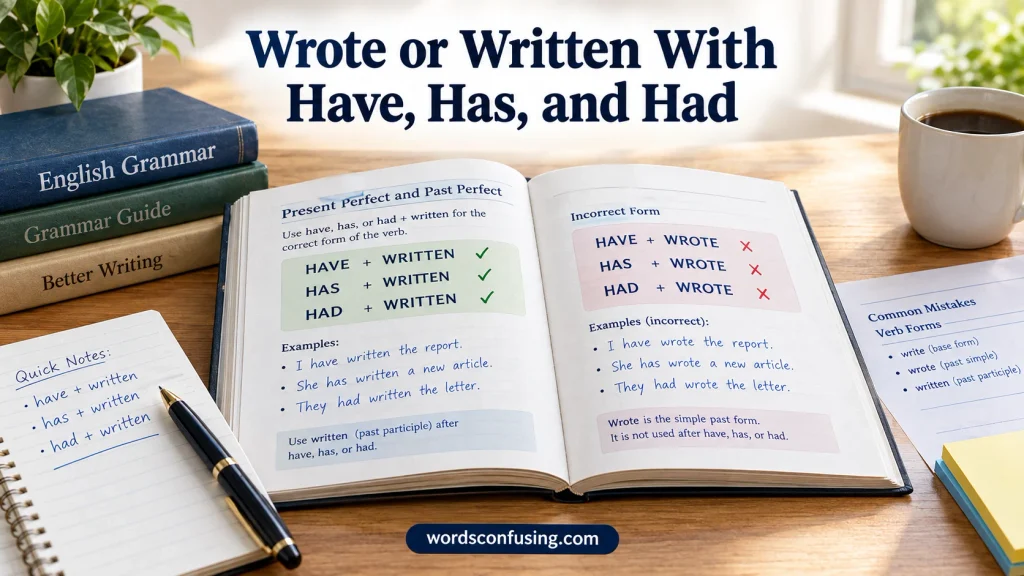
One of the most useful rules is easy to remember:
Have + written
Has + written
Had + written
Never use wrote directly after these auxiliary verbs when forming a perfect tense.
Have Written
Use have written with subjects such as I, you, we, and they.
Examples:
- I have written the report.
- You have written an excellent introduction.
- We have written several emails.
- They have written their final answers.
Has Written
Use has written with singular third-person subjects such as a person’s name, the author, the writer, or it.
Example:
- Sarah has written a new article.
- The author has written several novels.
- The writer has written three letters.
Had Written
Use had written for the past perfect.
Examples:
- Sarah had written the letter before dinner.
- The author had written the report before the meeting started.
- The writer had written everything down before the teacher arrived.
The important point is that have, has, and had already establish the grammatical structure. The next verb needs the past participle.
Therefore:
- I have written. ✓
- Sarah has written. ✓
- The writer had written. ✓
- I have wrote. ✗
- Sarah has wrote. ✗
- The writer had wrote. ✗
Wrote or Written With Did?
This is another common trap.
After did, use the base form of the verb.
That means the correct structure is:
did + write
Not:
did + wrote
And not:
did + written
For example:
Did you write the letter?
Not:
Did you wrote the letter?
The same rule applies to negative sentences:
I didn’t write the report.
Not:
I didn’t wrote the report.
Why does this happen?
The auxiliary verb did already carries the past tense. Adding wrote would effectively mark the past twice.
Compare these structures:
| Sentence | Correct? | Reason |
| I wrote the letter. | ✓ | Simple past |
| Did you write the letter? | ✓ | Did + base form |
| I didn’t write the letter. | ✓ | Did + base form |
| Did you wrote the letter? | ✗ | Two past markers |
| I didn’t wrote the letter. | ✗ | Base form required |
This rule applies beyond write.
You say:
- Did you eat?
- Did Sarah see it?
- Did they take the bus?
- Did the teacher speak to you?
You don’t say:
- Did you ate?
- Did Sarah saw it?
- Did they took the bus?
- Did the teacher spoke to you?
The same grammatical principle controls all of them.
Wrote or Written in Passive Voice
Written also appears frequently in passive constructions.
For example:
The book was written by a famous author.
Here, was is the auxiliary verb and written is the past participle.
The sentence focuses on the book rather than the person who performed the action.
Compare the active and passive versions:
The author wrote the book.
The book was written by the author.
Both sentences describe the same basic event. However, their grammatical structures differ.
The active sentence uses wrote because the subject directly performs the action.
The passive sentence uses written because the construction requires a past participle.
Common Passive Structures With Written
You may encounter:
- is written
- are written
- was written
- were written
- has been written
- have been written
- had been written
Examples:
- The article was written last year.
- These instructions are written clearly.
- The reports were written by different researchers.
- The letter has been written already.
- Several chapters have been written.
- The document had been written before the meeting.
This is why “The article was wrote” is incorrect.
The correct sentence is:
The article was written.
Wrote vs. Written: Side-by-Side Examples
Sometimes the easiest way to understand the difference is to place the forms next to each other.
| Wrote | Written |
|---|---|
| I wrote the letter yesterday. | I have written the letter. |
| Sarah wrote the report last night. | Sarah has written the report. |
| The author wrote a novel in 2020. | The author had written a novel before becoming famous. |
| The students wrote the answers. | The answers were written clearly. |
| We wrote three pages. | We have written three pages. |
Notice how wrote can stand alone as the main past-tense verb.
By contrast, written usually works as part of a larger verb phrase.
That distinction is more reliable than trying to memorize individual sentences.
Wrote or Written: Common Mistakes
“I Have Wrote”
This construction is incorrect.
The correct version is:
I have written the report.
The reason is simple. Have requires the past participle, and written is the past participle of write.
“She Has Wrote a Book”
Again, use written.
She has written a book.
The structure is:
has + written
“He Had Wrote the Letter”
Use:
He had written the letter.
The word had signals the past perfect construction. The following verb must therefore appear as a past participle.
“Did You Wrote This?”
Use:
Did you write this?
Remember the rule:
did + base verb
Since write is the base form, it follows did.
“I Didn’t Wrote Anything”
The correct sentence is:
I didn’t write anything.
Again, did already carries the past-tense function.
“The Letter Was Wrote”
The correct version is:
The letter was written.
The passive construction requires the past participle.
These errors often happen because wrote feels like the obvious past form. Grammatically, however, the auxiliary verb determines which form belongs in the sentence.
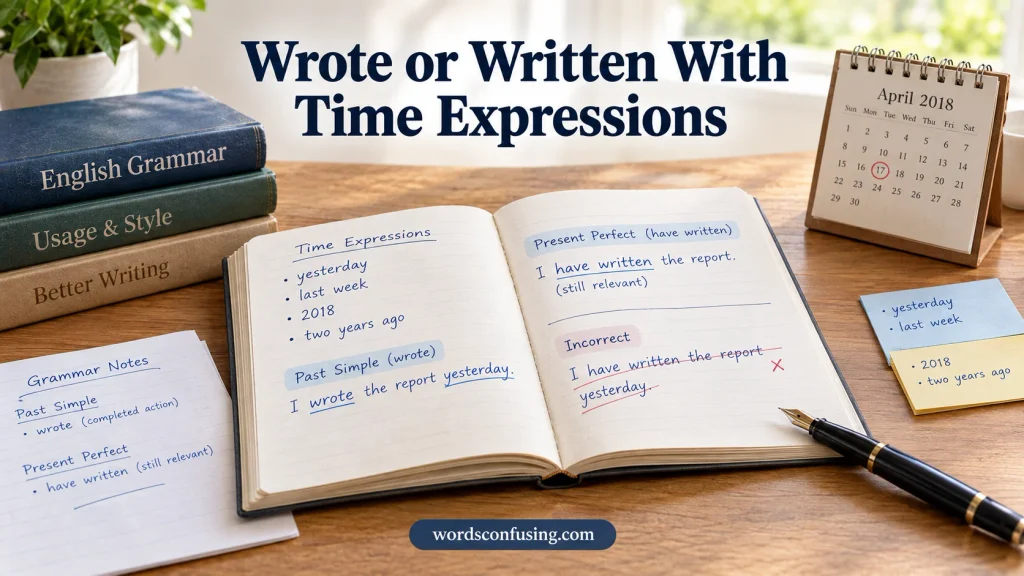
Wrote or Written With Time Expressions
Time expressions can provide a useful clue, although they don’t tell the whole story.
Expressions such as yesterday, last week, and two years ago commonly accompany the simple past.
Examples:
I wrote the email yesterday.
She wrote the article last week.
He wrote that book in 2018.
However, present perfect constructions behave differently.
I have written the email.
The present perfect usually focuses on the connection between a past action and the present rather than simply identifying a finished past time.
That’s why this distinction matters:
I wrote the report yesterday.
I have written the report.
The first sentence places the action at a specific completed time. The second emphasizes the current relevance or completion of the task.
In standard American English, a specific finished past-time expression generally doesn’t pair with the present perfect.
For example:
I wrote the report yesterday. ✓
I have written the report yesterday. ✗
The second sentence conflicts with the usual use of the present perfect because yesterday refers to a finished past period.
Wrote or Written in Questions
Questions can become confusing because auxiliary verbs change the verb form.
Consider these examples:
Did you write the article?
Have you written the article?
These questions ask related things, but they use different grammatical structures.
The first uses did + write.
The second uses have + written.
Compare them:
| Question | Structure |
| Did you write it? | did + base form |
| Have you written it? | have + past participle |
| Has Sarah written it? | has + past participle |
| Had they written it? | had + past participle |
A useful trick is to identify the auxiliary first. Once you spot did, have, has, or had, the correct verb form becomes much easier to choose.
Wrote or Written in Everyday Examples
Emails
I wrote the email last night.
I have written the email.
The first sentence refers to a completed past action. The second emphasizes completion without using a simple past structure.
Books
The author wrote the book in 2015.
The author has written five books.
The first sentence identifies when one book was written. The second focuses on the author’s experience or completed body of work.
Letters
She wrote a letter yesterday.
She has written three letters today.
Both sentences describe writing, but the verb structures differ.
Reports
We wrote the report last week.
We have written the report.
Again, the first uses the simple past. The second uses the present perfect.
Stories
He wrote a short story for class.
He has written several short stories.
The choice depends on the grammatical construction and intended meaning.
A Simple Way to Remember Wrote vs. Written
If grammar terminology feels like alphabet soup, use this shortcut.
Think “Wrote = Past Event”
When you simply state what happened, wrote usually fits.
I wrote a letter yesterday.
Think “Written = Helper Verb”
When you see have, has, had, or a passive construction, look for written.
I have written a letter.
The letter was written yesterday.
Think “Did = Write”
When did appears, return to the base form.
Did you write the letter?
This three-part memory trick covers many everyday situations:
Wrote = simple past
Written = past participle
Did = write
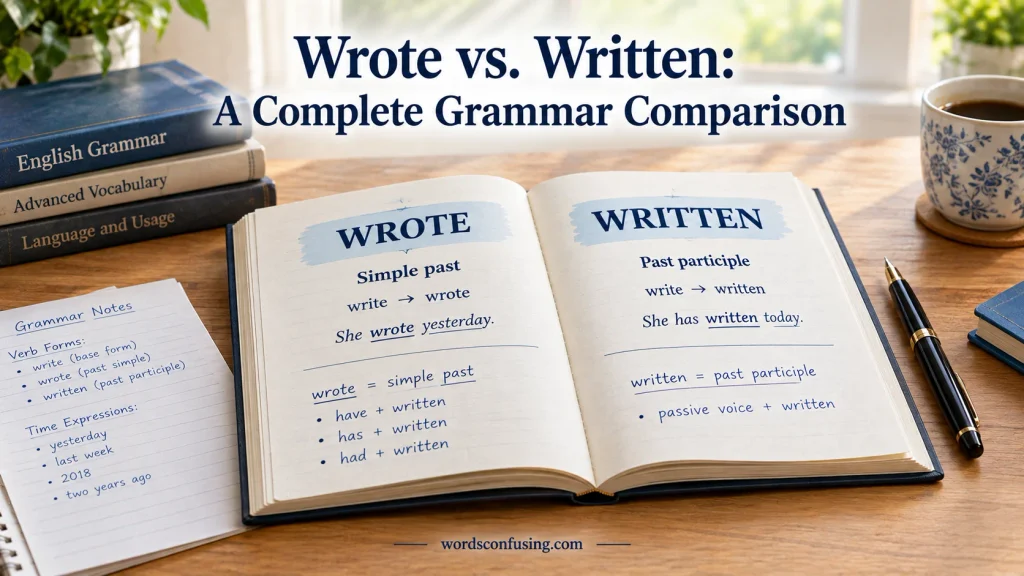
Wrote vs. Written: A Complete Grammar Comparison
| Feature | Wrote | Written |
| Verb type | Simple past | Past participle |
| Base verb | write | write |
| Can stand as a simple past verb? | Yes | No |
| Used after have? | No | Yes |
| Used after has? | No | Yes |
| Used after had? | No | Yes |
| Used in passive voice? | No | Yes |
| Used after did? | No | No |
| Example | She wrote yesterday. | She has written today. |
This table captures the central grammatical distinction.
However, one detail deserves emphasis: written isn’t simply a more formal version of wrote. The two forms belong to different grammatical constructions.
You can’t swap them based on style.
For example:
I wrote the letter yesterday. ✓
Changing wrote to written doesn’t make the sentence more polished. It makes it grammatically incomplete:
I written the letter yesterday. ✗
Likewise:
I have written the letter. ✓
Replacing written with wrote creates an error:
I have wrote the letter. ✗
Grammar controls the choice.
Read more: Great Minds Think Alike: Meaning and Origin
Wrote or Written: A Practical Decision Guide
When you’re unsure which form to use, walk through these questions.
Is the sentence a simple statement about a completed past action?
Use wrote.
I wrote the message yesterday.
Does the sentence contain have, has, or had before the verb?
Use written.
I have written the message.
Does the sentence use a passive construction such as was or were?
Use written.
The message was written yesterday.
Does the sentence contain did?
Use write, not wrote or written.
Did you write the message?
This approach works better than memorizing dozens of isolated examples.
Wrote or Written: Quick Reference Table
| Situation | Correct form | Example |
| Simple past | wrote | I wrote it yesterday. |
| Present perfect | written | I have written it. |
| Present perfect with singular subjects | written | Sarah has written it. |
| Past perfect | written | The author had written it. |
| Passive voice | written | It was written by John. |
| Question with did | write | Did you write it? |
| Negative with didn’t | write | I didn’t write it. |
| Present tense | write/writes | I write daily. |
| Continuous tense | writing | I am writing now. |
Why “Wrote” and “Written” Are Easy to Confuse
English contains many irregular verbs whose forms don’t follow a predictable -ed pattern.
With a regular verb, you might have:
walk → walked → walked
But write behaves differently:
write → wrote → written
The past tense changes completely, while the past participle changes again.
That creates a three-form system learners must remember.
The good news is that the forms become much easier once you connect each one to its grammatical job.
Instead of memorizing:
write, wrote, written
memorize:
write = base
wrote = simple past
written = past participle
That small shift turns memorization into a usable grammar rule.
Case Study: Choosing the Correct Form
Consider these five sentences:
I wrote the essay last night.
Simple past. Wrote is correct.
I have written the essay.
Present perfect. Written is correct.
I had written the essay before class.
Past perfect. Written is correct.
Did you write the essay?
Question with did. The base form write is correct.
The essay was written by Alex.
Passive voice. Written is correct.
Although all five sentences describe the same basic activity, the grammatical structure changes the verb form.
That’s the real lesson behind wrote vs. written.
Read more: 5 Words for a Person Who Finds Fault in Everything
Wrote or Written: Examples You Can Copy
Here are natural examples showing the difference in everyday English.
1. Correct Uses of Wrote
- I wrote a note before leaving.
- Sarah wrote the answer on the board.
- The author wrote a book in their twenties.
- We wrote the report last weekend.
- They wrote to their parents yesterday.
2. Correct Uses of Written
- I have written the email.
- Sarah has written several articles.
- The author had written the instructions earlier.
- The book was written in English.
- The answers were written clearly.
3. Correct Uses of Write After Did
- Did you write the report?
- Did Sarah write the letter?
- I didn’t write anything.
- We didn’t write the final answer.
- Why did the author write that message?
These examples show the pattern without relying on complicated terminology.
FAQs
Is “wrote” the past tense of “write”?
Yes. Wrote is the simple past form of write. You use it for an action that happened in the past, such as “She wrote a letter yesterday.”
Is “written” a past tense word?
Written is the past participle of write, not the simple past. It usually works with a helping verb, such as “has written,” “had written,” or “was written.”
Can I say “I have wrote”?
No. The correct form is “I have written.” After have, has, or had, you need the past participle written, not wrote.
When should I use “wrote” in a sentence?
Use wrote when describing a completed past action without a helping verb. For example, “I wrote the report last night.”
When should I use “written” in a sentence?
Use written with helping verbs or in passive constructions. For example, “She has written three emails” or “The report was written yesterday.”
Why do people confuse “wrote” and “written”?
They’re easy to mix up because both forms come from write and refer to past writing. Remembering their grammatical roles makes the difference much easier to spot.
Conclusion
Once you see the pattern, wrote and written become much easier to handle. Think of wrote as the form you use for something that happened in the past: “I wrote the email yesterday.” Written, on the other hand, usually needs a helping verb, as in “I have written the email.” This small distinction can save you from a surprisingly common grammar mistake.
The next time you hesitate between these two words, don’t guess. Look at the sentence and check whether you need the simple past or past participle form. A few seconds of proofreading can make your writing clearer, more accurate, and more professional.

Shafiq Ur Rehman is a writer and content contributor at WordsConfusing.com. He enjoys exploring the English language, common word confusions, vocabulary, and practical writing tips. His goal is to make English easier to understand through clear, simple, and useful articles.