

The 7 Best Ways to Politely Ask Someone to Be Patient can make waiting feel less agonizing for a client, customer, or employee.
In modern professional communication, the right tone, wording, empathy, and respect help you communicate clearly during a delay. A blunt, robotic request like please be patient may create instant frustration or sound dismissive. Instead, use human alternatives that feel natural, thoughtful, and reassuring.
In customer service, professional email, casual conversation, and workplace messages, phrases such as appreciate your patience can support maintaining trust, improve clarity, and create a positive experience.
When someone needs to wait, friendly phrases like hold on, bear with me, hang tight, one moment, or kindly wait can sound warmer. Thanking someone for waiting can reduce frustration and show courtesy, attentiveness, and care.
The right wording depends on the situation, whether you are addressing customers, colleagues, or someone experiencing a stressful moment. A simple message can reassure people, manage expectations, and make a polite request feel more supportive.
Quick Answer
If you need someone to be patient, choose your words based on the situation. You can say “Please be patient,” “Please bear with me,” “Could you give me a little more time?” or “Would you mind waiting a little longer?” For someone who’s already waiting, “Thanks for your patience” or “I appreciate your patience” sounds warmer. If you know the delay, give a clear estimate such as “I just need five more minutes.” A short explanation and genuine appreciation can turn a blunt request into a respectful one.
What Does It Mean to Ask Someone to Be Patient?
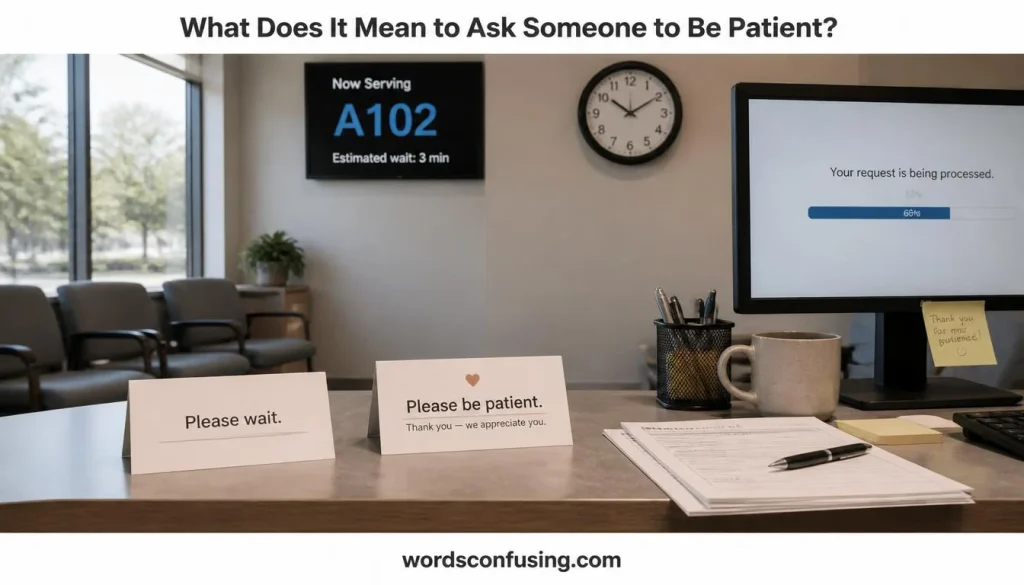
Patience means the ability to wait or deal with difficulty without becoming annoyed or angry. In everyday English, asking someone to be patient means asking them to wait calmly while something takes place.
For example:
Please be patient while I check your account.
The speaker isn’t necessarily asking the person to stop doing anything. Instead, they’re asking them to allow enough time for a process to finish.
That’s an important distinction.
When you say “Please wait,” you’re usually focusing on the physical act of waiting. When you say “Please be patient,” you’re focusing more on the person’s attitude during the delay.
Consider these examples:
- Please wait here for a moment.
- Please be patient while I find the information.
- Could you give me a few more minutes?
- Please bear with me while I finish this.
- Thank you for your patience.
All five sentences involve waiting. However, each one carries a slightly different tone and purpose.
Why Context Matters
A polite phrase doesn’t exist in a vacuum. Your relationship with the listener, the length of the delay, and the reason for waiting all affect how your words sound.
For example, a manager might tell a coworker:
Could you give me another ten minutes to finish the report?
A customer-service representative might say:
Thank you for your patience while we investigate the issue.
A friend might simply say:
Give me a few minutes. I’m almost done.
The basic message stays the same. The social setting changes the most natural wording.
7 Best Ways to Politely Ask Someone to Be Patient
Please Be Patient
“Please be patient” is the most direct expression on this list. It asks someone to remain calm and allow a situation to take its course.
The word please makes the sentence more polite because it marks the statement as a request rather than a bare command. Oxford describes please as a polite way to ask for something or tell someone to do something.
For example:
Please be patient while I look into this issue.
Please be patient. The technician is working on the problem.
Please be patient while we prepare your order.
This expression works particularly well when the reason for the delay is already obvious.
However, there’s a subtle point worth remembering. “Please be patient” can still sound firm. Your tone matters.
Compare:
Please be patient.
with:
Please be patient while I check that for you.
The second version provides context. It tells the listener what you’re doing and why waiting is necessary.
That small addition can make the request feel less like a command.
When to Use “Please Be Patient”
Use this phrase when:
- A process is already underway.
- Someone needs to wait for an answer.
- You’re dealing with a delay.
- You need to calm a situation without sounding overly casual.
- You want a short and clear request.
It works in both professional and everyday settings.
Please Bear With Me
“Please bear with me” is one of the most useful alternatives when you need someone to remain patient while you do something.
Cambridge defines bear with someone as being patient and waiting while that person does something.
For example:
Please bear with me while I pull up your information.
Bear with me for a moment while I finish this calculation.
Please bear with me while I explain what happened.
The phrase doesn’t literally mean “carry me.” Here, bear means to tolerate or endure something.
That makes “bear with me” an idiomatic expression rather than a literal request.
It often sounds more conversational than “Please be patient.” It also places the focus on the speaker’s situation.
Compare:
Please be patient.
The listener needs to remain patient.
Please bear with me.
The speaker needs the listener to tolerate a temporary difficulty.
That difference makes “bear with me” especially useful when you’re the reason someone has to wait.
Examples in Real Situations
During a presentation:
“Please bear with me while I get the next slide ready.”
During a phone call:
“Bear with me for a moment while I check your account.”
During a technical problem:
“Please bear with me while I restart the system.”
During an explanation:
“Bear with me. There’s one more detail that matters here.”
It’s a flexible phrase that works in professional conversations without sounding excessively formal.
Could You Give Me a Little More Time?
When you need additional time, “Could you give me a little more time?” sounds respectful and clear.
Instead of telling someone to become more patient, you’re directly explaining what you need from them.
For example:
Could you give me a little more time to finish the report?
Could you give me another ten minutes?
Could you give me a little more time to think about it?
This wording works especially well when the other person expects an answer, decision, or completed task.
The question structure also softens the request. Rather than issuing an instruction, you’re asking whether the person can accommodate your need.
That distinction matters in workplace communication.
Why “Could You” Works Well
English frequently uses indirect questions and modal verbs to soften requests. Oxford gives examples such as “Could you possibly help me?” and “Would you mind…?” as polite request forms.
You can apply the same principle to requests for patience.
Instead of:
Give me more time.
Try:
Could you give me a little more time?
Instead of:
Wait another ten minutes.
Try:
Could you give me another ten minutes?
The second versions sound less commanding.
When This Expression Works Best
Use it when:
- You need more time to complete something.
- You haven’t finished preparing an answer.
- You’re making a decision.
- You need to correct a problem.
- Someone is waiting for your response.
It also works well in professional emails:
Could you give me until tomorrow afternoon to finalize the document?
That sentence gives the other person something useful: a clear expectation.

Thanks for Your Patience
Sometimes the most effective way to ask for patience is not to ask directly at all.
Instead, acknowledge the patience you expect or have already received.
Thanks for your patience.
This expression works particularly well during delays.
For example:
Thanks for your patience while we resolve the issue.
Thanks for your patience. I’ll have the updated file ready shortly.
Thank you for your patience while I check those details.
The phrase sounds appreciative rather than commanding.
That’s useful when someone has already been waiting.
“Please Be Patient” vs. “Thanks for Your Patience”
These expressions perform different conversational jobs.
| Expression | Main purpose | Typical situation |
| Please be patient. | Directly asks for patience | Someone needs to wait |
| Thanks for your patience. | Shows appreciation | Someone is already waiting |
| I appreciate your patience. | Expresses stronger appreciation | A longer or inconvenient delay |
| Please bear with me. | Asks someone to tolerate a temporary difficulty | You’re handling something |
Imagine a customer has already spent ten minutes waiting.
Saying:
Please be patient.
may sound as though you’re focusing on their behavior.
Saying:
Thank you for your patience.
acknowledges their experience instead.
That doesn’t mean one phrase always works better than the other. The situation determines the appropriate choice.
I Appreciate Your Patience
“I appreciate your patience” adds a more personal note of gratitude.
It’s especially useful when the delay has created inconvenience.
For example:
I appreciate your patience while we work through this issue.
I appreciate your patience as we review your application.
I really appreciate your patience. I’ll update you as soon as I have an answer.
The expression fits professional communication particularly well.
It can appear in emails, customer-service messages, workplace conversations, and formal updates.
“Thanks” vs. “I Appreciate”
Both expressions communicate gratitude. Their tone can differ slightly.
“Thanks for your patience” sounds natural and concise.
“I appreciate your patience” can sound more deliberate and personal.
Consider these examples:
Thanks for your patience while I finish this.
This sounds friendly and straightforward.
I appreciate your patience while we work to resolve the issue.
This sounds more polished and deliberate.
Neither phrase needs elaborate wording. In fact, adding too much can make a simple message sound artificial.
Read more: 15 Best Replies to “You’re Mine” Funny and Confident
Would You Mind Waiting a Little Longer?
“Would you mind waiting a little longer?” is a polite way to ask someone to continue waiting.
The structure “Would you mind…?” commonly introduces a polite request. Oxford specifically lists “Would you mind…?” among structures used to ask someone politely to do something.
For example:
Would you mind waiting a little longer?
Would you mind giving me five more minutes?
Would you mind waiting while I confirm the details?
This form is useful when you want to sound considerate rather than forceful.
However, be careful with the response pattern.
A question such as:
Would you mind waiting?
technically asks whether the person objects to waiting.
A natural response can therefore be:
No, I don’t mind.
That means the person is willing to wait.
This can confuse English learners because “Would you mind?” contains a negative idea but functions as a polite request.
When to Use “Would You Mind?”
This expression fits when:
- You want to make a respectful request.
- The listener has a choice.
- You need a little additional time.
- You don’t want to sound demanding.
For a close friend, it might sound more formal than necessary.
You might simply say:
Can you give me five minutes?
At work, however, this may sound more appropriate:
Would you mind giving me another five minutes?
The relationship and setting shape the choice.
I Just Need a Few More Minutes
When possible, give people a realistic timeframe.
“I just need a few more minutes” works because it doesn’t merely ask someone to wait. It tells them what to expect.
For example:
I just need a few more minutes to finish this.
I just need five more minutes. Thanks for waiting.
I just need another ten minutes to review the document.
Specific information can make a vague delay feel more manageable.
Compare:
Wait a little longer.
with:
I just need five more minutes to finish this section.
The second sentence gives the listener a clearer picture.
Why Time Estimates Matter
Imagine waiting for someone who keeps saying, “Just a little longer.”
Five minutes becomes ten. Ten becomes twenty. Eventually, the problem isn’t only the delay. It’s the uncertainty.
A realistic estimate changes that experience.
If you genuinely need fifteen minutes, say so:
I need about fifteen more minutes. Thanks for your patience.
If you’re unsure, don’t invent a precise deadline.
Instead, say:
I need a little more time. I’ll update you as soon as I know more.
Honesty is often more useful than false precision.
How to Ask Someone to Be Patient Without Sounding Rude
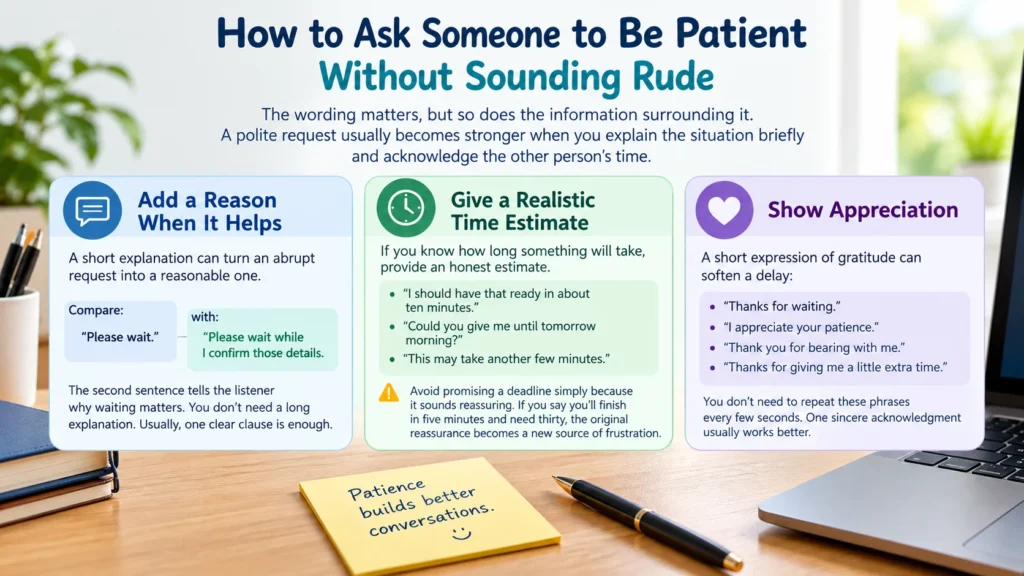
The wording matters, but so does the information surrounding it.
A polite request usually becomes stronger when you explain the situation briefly and acknowledge the other person’s time.
Add a Reason When It Helps
A short explanation can turn an abrupt request into a reasonable one.
Compare:
Please wait.
with:
Please wait while I confirm those details.
The second sentence tells the listener why waiting matters.
You don’t need a long explanation.
Usually, one clear clause is enough.
Give a Realistic Time Estimate
If you know how long something will take, provide an honest estimate.
I should have that ready in about ten minutes.
Could you give me until tomorrow morning?
This may take another few minutes.
Avoid promising a deadline simply because it sounds reassuring.
If you say you’ll finish in five minutes and need thirty, the original reassurance becomes a new source of frustration.
Show Appreciation
A short expression of gratitude can soften a delay:
- Thanks for waiting.
- I appreciate your patience.
- Thank you for bearing with me.
- Thanks for giving me a little extra time.
You don’t need to repeat these phrases every few seconds. One sincere acknowledgment usually works better.
Match the Tone to the Relationship
The same message can require different wording depending on who you’re addressing.
| Situation | Natural wording |
| Close friend | Give me a few minutes. |
| Coworker | Could you give me a few more minutes? |
| Manager | Could I have a little more time to finish this? |
| Customer | Thank you for your patience while I check that for you. |
| Formal email | I appreciate your patience while we review the matter. |
| Technical support | Please bear with me while I troubleshoot this. |
The goal isn’t to sound formal at all times.
The goal is to sound appropriate.
Polite Ways to Ask for Patience in Different Situations
At Work
Workplace requests should usually be clear and respectful.
Good examples include:
Could you give me another ten minutes to finish this?
Please bear with me while I work through the numbers.
I appreciate your patience while I sort this out.
I should have an update for you by this afternoon.
Avoid vague phrases when the task has a real deadline.
Instead of:
I’ll get to it soon.
say:
I’ll send you the revised version by 3 p.m.
The second statement gives the other person something concrete.
In Customer Service
Customer service requires particular care because the person may already feel frustrated.
Instead of:
Be patient.
try:
Thank you for your patience while I check that for you.
Or:
Please bear with me for a moment while I review your account.
A useful customer-service structure is:
Acknowledgment + action + timeframe
For example:
Thanks for your patience. I’m checking the issue now and should have an update shortly.
This structure works because it tells the customer that something is happening.
In an Email
Written communication removes facial expressions and vocal tone. That makes word choice especially important.
Useful email phrases include:
Thank you for your patience while we review your request.
I appreciate your patience as we work through the remaining details.
Could you give us a little more time to complete the review?
We appreciate your understanding and patience during this process.
Keep the explanation proportional to the delay.
A two-hour delay doesn’t require a five-paragraph apology.
When You’re Running Late
If you’re late, simply telling someone to be patient can sound careless.
Instead, acknowledge the delay.
For example:
I’m sorry I’m running late. I need about fifteen more minutes. Thanks for waiting.
Or:
I’m on my way. I should be there in about ten minutes. Thanks for your patience.
Notice the structure:
Apology → realistic estimate → appreciation
That combination communicates responsibility without overexplaining.
During a Technical Problem
Technical issues often require troubleshooting before you can provide an answer.
Try:
Please bear with me while I check the system.
Could you give me a few minutes while I troubleshoot this?
Thanks for your patience while I investigate the problem.
These phrases work because they connect the waiting period to a specific action.
“Be Patient” vs. “Please Wait” vs. “Bear With Me”
These expressions overlap, but they aren’t interchangeable in every situation.
| Phrase | Core meaning | Tone | Best use |
| Please be patient. | Remain calm while waiting | Direct | Delays and ongoing processes |
| Please wait. | Stop and remain until something happens | Direct | Physical or immediate waiting |
| Please bear with me. | Tolerate the temporary difficulty | Conversational | When you’re handling something |
| Could you give me more time? | Allow additional time | Respectful | Work and personal requests |
| Thanks for your patience. | Appreciation for waiting | Warm | Existing delays |
| I appreciate your patience. | Personal appreciation | Professional | Longer or inconvenient delays |
| Would you mind waiting? | Politely asks someone to continue waiting | Considerate | Requests where the person has a choice |
A simple way to remember the distinction is this:
“Be patient” focuses on their patience.
“Bear with me” focuses on your difficulty.
“Give me more time” focuses on your need.
“Thanks for your patience” focuses on appreciation.
That difference makes choosing the right phrase much easier.
Polite vs. Impolite Ways to Ask Someone to Wait
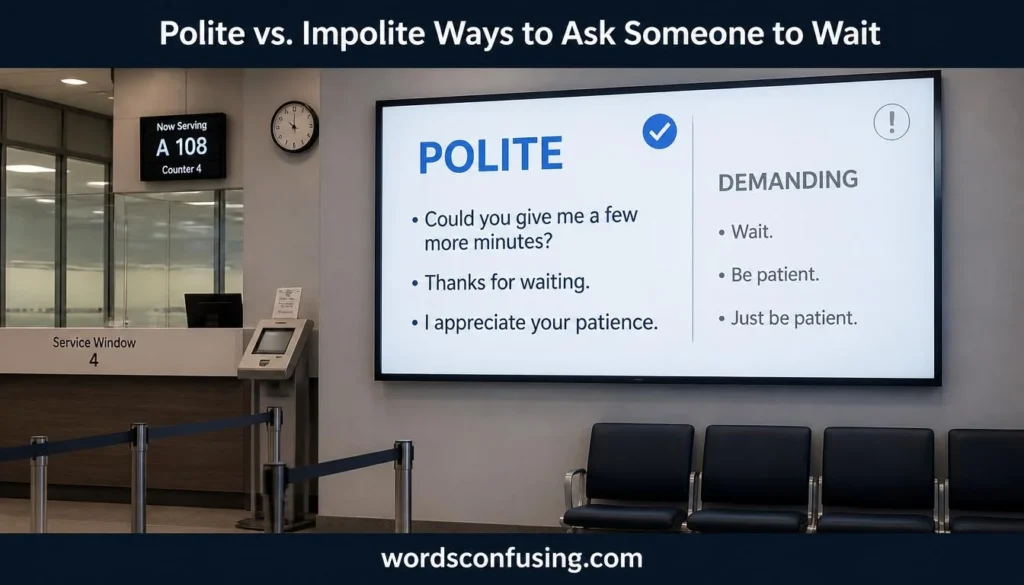
Even correct English can sound unpleasant when the wording feels dismissive.
Polite Examples
- Could you give me a few more minutes?
- Please bear with me while I finish this.
- Thanks for waiting.
- I appreciate your patience.
- Would you mind waiting a little longer?
- I should have an answer for you shortly.
- I’m sorry for the delay. I just need another ten minutes.
Expressions That Can Sound Demanding
- Wait.
- Be patient.
- Just be patient.
- Calm down and wait.
- You need to be patient.
- Stop rushing me.
- You’ll have to wait.
None of these expressions is automatically rude in every possible context. Tone, relationship, and circumstances matter.
Still, several can sound dismissive when someone is already frustrated.
For example:
Just be patient.
The word “just” can minimize the person’s concern.
Compare that with:
I know this is taking longer than expected. Thanks for your patience while I finish it.
The second sentence recognizes the delay rather than brushing it aside.
How to Choose the Right Expression
You don’t need to memorize dozens of phrases. Match the expression to your actual situation.
| What you need to communicate | Useful phrase |
| A direct request for patience | Please be patient. |
| You need someone to tolerate a temporary difficulty | Please bear with me. |
| You need additional time | Could you give me a little more time? |
| Someone is already waiting | Thanks for your patience. |
| You want to show appreciation | I appreciate your patience. |
| You want to ask politely for more waiting | Would you mind waiting a little longer? |
| You know the approximate delay | I just need a few more minutes. |
This approach keeps your English natural.
You don’t have to force a formal phrase into every conversation.
If you’re talking to a friend, “Give me five minutes” may be perfectly appropriate.
If you’re answering a customer, “Thank you for your patience” usually fits the situation better.
Common Mistakes When Asking Someone to Be Patient
Being Too Direct
A command can create tension when a request would work just as well.
Instead of:
Wait for me.
try:
Could you wait for me for a few minutes?
The second sentence gives the request a softer frame.
Giving No Information
A vague delay can feel longer than it actually is.
Instead of:
Wait.
try:
Please give me five minutes while I finish this.
The listener now understands both the request and the approximate duration.
Making Unrealistic Promises
Don’t say “I’ll be done in two minutes” when you know the task will probably take twenty.
A realistic estimate builds more trust than an optimistic guess.
Try:
I need about fifteen more minutes. I’ll let you know if that changes.
That sentence manages expectations without overpromising.
Repeating “Be Patient”
Repeatedly telling someone to be patient rarely solves the underlying problem.
If the person has waited longer than expected, give them an update.
For example:
Thanks for waiting. I’m still checking the issue. I should have an answer in about ten minutes.
That provides useful information instead of repeating the same instruction.
Ignoring the Other Person’s Frustration
Sometimes people don’t need a lecture about patience. They need acknowledgment.
Consider this situation:
A customer has been waiting for twenty minutes.
Saying:
Please be patient.
may not address the real issue.
A better response might be:
I’m sorry for the delay. I know you’ve been waiting. I’m checking the issue now and will update you shortly.
The difference is substantial.
The second version recognizes the inconvenience and explains the next step.

A Practical Formula for Asking Someone to Be Patient
When you’re unsure what to say, use this simple structure:
Acknowledge + explain + estimate + appreciate
For example:
I’m sorry for the delay. I’m still checking the details and need about ten more minutes. Thanks for your patience.
You don’t always need all four parts.
For a small delay:
I just need five more minutes. Thanks for waiting.
For a professional email:
I appreciate your patience while we complete the review. I’ll provide an update by tomorrow afternoon.
For a customer-service situation:
Thank you for your patience. I’m checking that information now and will update you shortly.
The formula works because it addresses the person’s experience without making the message unnecessarily long.
Read more: Wrote or Written: Which One Is Correct?
Quick Examples You Can Use
Here are natural alternatives for common situations.
When You Need Five More Minutes
Could you give me five more minutes?
When You’re Checking Information
Please bear with me while I check those details.
When Someone Has Already Been Waiting
Thanks for your patience. I’m almost finished.
When the Delay Is Longer Than Expected
I’m sorry for the delay. I appreciate your patience while we work through this.
When You Need Time to Think
Could you give me a little more time to think about it?
When You Need Someone to Continue Waiting
Would you mind waiting a little longer?
When You’re Handling a Technical Issue
Please bear with me while I troubleshoot the problem.
When You’re Running Late
I’m sorry I’m running late. I should be there in about fifteen minutes. Thanks for waiting.
When You Don’t Know Exactly How Long It Will Take
I need a little more time to sort this out. I’ll update you as soon as I know more.
When You Want a Professional Tone
I appreciate your patience while we review the matter.
FAQs
What is a polite way to ask someone to be patient?
You can say, “Thank you for your patience,” “Please bear with me,” or “Could you give me a moment?” These sound more considerate than simply saying “Please be patient.”
How can I ask a customer to wait without sounding rude?
Explain the situation briefly and acknowledge their time. For example, “Thank you for waiting while we resolve this issue. We’ll update you as soon as possible.”
Is “Please be patient” professional?
Yes, but it can sound blunt when used without context. A warmer alternative, such as “We appreciate your patience while we work on this,” often sounds more thoughtful.
What can I say instead of “Please wait”?
Try phrases such as “One moment, please,” “Kindly give me a moment,” “Thanks for bearing with me,” or “Please hang tight for a little while.”
How do I politely ask a coworker to wait?
Keep the message friendly and direct. You could say, “Could you give me a few minutes to finish this?” or “Please bear with me while I wrap this up.”
How can I ask someone to be patient during a delay?
Acknowledge the delay instead of ignoring it. You might say, “I understand this is taking longer than expected. Thank you for your patience while we get everything sorted.”
Conclusion
Asking someone to be patient doesn’t have to sound cold or repetitive. A few thoughtful words can change the entire mood of a conversation. Whether you’re dealing with a customer, coworker, friend, or someone waiting for an update, acknowledge their time and explain what’s happening when possible. Simple phrases like “Thanks for waiting” or “Please bear with me” can feel far more genuine than a flat “Please be patient.”
The key is to match your words with the situation. A professional email may need a polished expression, while a casual conversation can stay warm and relaxed. When you choose language that shows respect, empathy, and genuine consideration, waiting becomes easier to accept. Sometimes, the right phrase is all it takes to turn an awkward delay into a smoother interaction.