
6 More Formal Ways to Say “Please Provide” can make business communication sound clearer, more respectful, and more suitable for a professional setting.
When writing an email about requesting documents or asking for information, your wording can shape your professional image. The phrase “Please Provide” is common in business contexts, but a polished way to make a request may produce a more respectful and effective response.
You may ask somebody to give something to us that you asked for in the past, so the right expression matters. A courteous tone also works well in modern workplaces, especially during meetings, project management, scheduling, and daily correspondence.
The same approach helps when requesting details for an online booking, coordinating a calendar update, or managing time management tasks. It also applies when sharing information through internal broadcasting channels. Good formal writing habits improve clarity, professionalism, and consistency during every interaction.
This guide covers six professional alternatives for different professional situations, while considering English usage, grammar, workplace etiquette, and tone selection. These practical insights can help you use each alternative correctly and communicate with greater confidence and credibility.
Quick answer
The best formal alternatives to “Please provide…” at work include “Could you please provide…?”, “Would you be able to provide…?”, “I would appreciate it if you could provide…”, “Kindly provide…”, “Please forward…”, and “Could you share…?” Choose the phrase based on what you’re requesting. For everyday workplace requests, “Could you please provide…?” sounds polite and natural. If the request requires extra effort, “Would you be able to provide…?” feels more considerate.
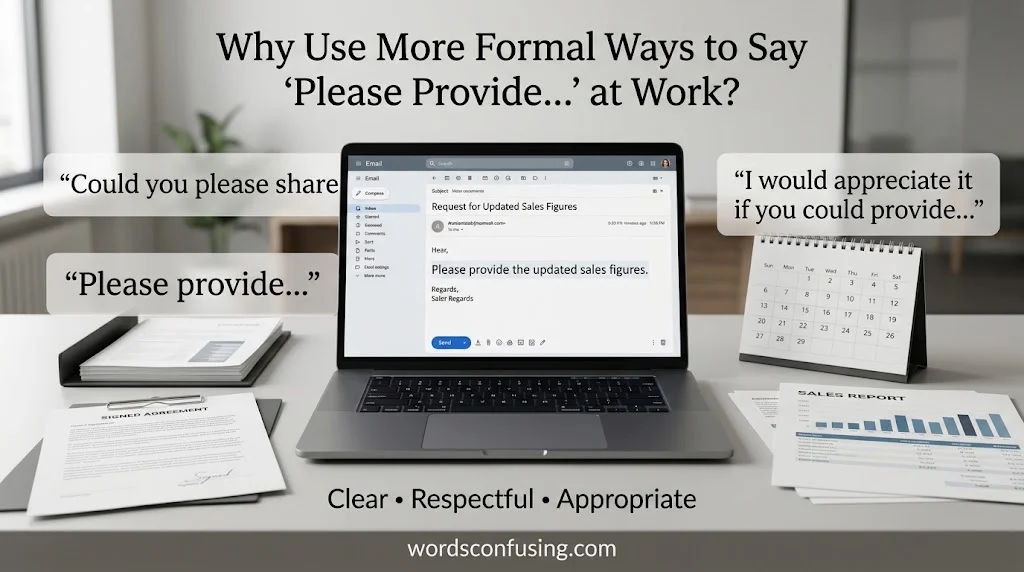
Why Use More Formal Ways to Say “Please Provide…” at Work?
“Please provide…” already sounds professional. You don’t need to replace it simply because it appears in a workplace email.
However, repetition can make your writing sound mechanical. Imagine receiving five emails from the same colleague during one week, all beginning with “Please provide…” The wording isn’t wrong, but it starts to feel like a form letter.
Professional writing works best when the language matches the situation.
A request to a coworker might sound natural with “Could you please share…” A request to an external client may call for “I would appreciate it if you could provide…” Meanwhile, an administrative notice might appropriately use “Kindly provide…”
The goal isn’t to make every request sound more formal. The goal is to make every request clear, respectful, and appropriate.
When “Please Provide…” Works Well
You can confidently use “Please provide…” when you need information, documents, details, or materials.
For example:
- Please provide the updated sales figures.
- Please provide a copy of the signed agreement.
- Please provide your availability for next week.
- Please provide the requested documentation.
- Please provide additional details about the issue.
These sentences are concise and professional.
The problem usually isn’t the phrase itself. It’s overusing the same construction when another verb or sentence structure would communicate the request more naturally.
Formality Isn’t the Same as Professionalism
A common mistake is assuming that more formal wording always sounds more professional.
It doesn’t.
A sentence can contain sophisticated vocabulary and still sound awkward. In workplace communication, clarity usually beats ceremony.
Compare these examples:
Please provide the information at your earliest convenience.
with:
Could you please share the information by Thursday?
The second version gives the reader a clear action and deadline. It also sounds less bureaucratic.
A polished professional request should feel like a well-written road sign. It should tell the reader where to go without making them decipher the directions.
6 More Formal Ways to Say “Please Provide…” at Work
There isn’t one perfect replacement for “Please provide…” Every alternative carries a slightly different tone.
Here are six useful choices:
- Could you please provide…?
- Would you be able to provide…?
- I would appreciate it if you could provide…
- Kindly provide…
- Please forward…
- Could you share…?
Each expression has a practical place in professional communication.
Could You Please Provide…?
“Could you please provide…” is one of the safest alternatives to “Please provide…”
It turns a direct instruction into a polite question. That small change can make the request feel more collaborative without sacrificing clarity.
For example:
Please provide the updated project timeline.
becomes:
Could you please provide the updated project timeline?
Both sentences communicate the same basic request. However, the second version feels slightly less commanding.
This expression works particularly well when communicating with coworkers, managers, clients, vendors, or other professional contacts.
Examples of “Could You Please Provide…”
- Could you please provide the revised proposal?
- Could you please provide the tracking information?
- Could you please provide the figures from last quarter?
- Could you please provide a copy of the invoice?
- Could you please provide your feedback by Friday?
- Could you please provide the information requested below?
When Should You Use It?
Use this phrase when you want to sound professional, polite, and straightforward.
It’s especially useful for routine workplace requests where you don’t need to emphasize the amount of effort involved.
For instance, if a coworker already has a document on hand, there’s little reason to use an elaborate request. A simple “Could you please provide…” gets the job done.
Why It Works
The word “could” softens the request. You’re asking whether the person can fulfill it rather than simply issuing an instruction.
That distinction matters when you’re communicating across departments or with someone you don’t know well.
Still, don’t mistake “could” for uncertainty. In ordinary professional English, “Could you please provide…” functions as a polite request rather than a literal question about ability.
Would You Be Able to Provide…?
“Would you be able to provide…” offers an even more considerate approach.
This expression works especially well when fulfilling the request may require time, research, coordination, or extra effort.
Compare:
Please provide the historical sales data.
with:
Would you be able to provide the historical sales data?
The second version acknowledges that the recipient may need to do some work before responding.
That makes it useful when you’re asking for something that isn’t immediately available.
Examples of “Would You Be Able to Provide…”
- Would you be able to provide the previous year’s sales figures?
- Would you be able to provide a detailed breakdown of the costs?
- Would you be able to provide additional documentation?
- Would you be able to provide an estimated completion date?
- Would you be able to provide the original report?
- Would you be able to provide more information about the proposed changes?
When Should You Use It?
Choose this expression when you want to sound respectful and considerate.
It works particularly well when:
- The recipient may need to research the answer.
- The request isn’t urgent.
- You’re communicating with another department.
- You’re contacting a client or vendor.
- The request requires meaningful effort.
- You want to avoid sounding demanding.
However, there’s no need to use this longer expression for every tiny request.
If you simply need a file that’s sitting in someone’s inbox, “Could you please send…” is often cleaner.
A Useful Workplace Distinction
Think about the difference between availability and effort.
“Could you please provide…” works well when the information is readily available.
“Would you be able to provide…” works better when the recipient may need to do something substantial first.
That subtle distinction can make your professional writing feel more thoughtful.
I Would Appreciate It If You Could Provide…
When you want to emphasize courtesy, “I would appreciate it if you could provide…” is a strong choice.
This construction makes your appreciation part of the request itself. It can work especially well in formal emails, client communication, and situations where cooperation matters.
For example:
I would appreciate it if you could provide the requested documentation by Friday.
The sentence sounds respectful without becoming overly ceremonial.
Examples of “I Would Appreciate It If You Could Provide…”
- I would appreciate it if you could provide the revised contract.
- I would appreciate it if you could provide the requested details by Monday.
- I would appreciate it if you could provide an update on the project.
- I would appreciate it if you could provide the relevant account information.
- I would appreciate it if you could provide confirmation once the payment has been processed.
- I would appreciate it if you could provide any additional information that may help us resolve the issue.
When Should You Use It?
This phrase works well when the request carries some importance or when you want to maintain a particularly courteous tone.
It’s useful for:
- Client emails
- External business communication
- Formal follow-ups
- Requests involving cooperation
- Requests for important documents
- Sensitive workplace situations
Don’t Overuse This Expression
There’s one catch.
The phrase is considerably longer than “Could you please provide…” If you use it in every message, your emails can become unnecessarily wordy.
Professional writing isn’t a contest to see who can use the most syllables.
Use this construction when the added courtesy serves a purpose. Otherwise, a shorter alternative may be stronger.
Kindly Provide…
“Kindly provide…” has a distinctly formal tone.
You’ll often see it in administrative correspondence, official notices, business letters, forms, and other formal communication.
Examples include:
- Kindly provide the completed application form.
- Kindly provide the required documentation.
- Kindly provide your confirmation by Friday.
- Kindly provide the requested information.
- Kindly provide a copy of the receipt.
Why “Kindly” Can Be Useful
The word “kindly” signals that you’re making a polite request. It can help maintain a formal tone when you’re communicating with someone in an official capacity.
However, context matters.
In some workplace cultures, “kindly” sounds perfectly normal. In others, it can sound stiff, old-fashioned, or even slightly commanding.
Consider these two sentences:
Kindly provide the information at your earliest convenience.
Could you please share the information when you have a chance?
The first sounds more formal. The second feels warmer and more conversational.
Neither is inherently better.
When Should You Use “Kindly Provide”?
Use it when your communication genuinely calls for a formal register, such as:
- Administrative notices
- Formal business correspondence
- Official requests
- Documentation requirements
- Compliance-related communication
- Formal instructions
For everyday conversations with teammates, however, “Could you please…” may feel more natural.
A Common Mistake With “Kindly”
Don’t assume that “kindly” automatically makes an order sound friendly.
For example:
Kindly send this immediately.
can sound quite forceful because of the word “immediately.”
The overall sentence determines the tone. One polite word can’t magically soften an aggressive deadline.
Instead, consider:
Could you please send this by 3 p.m. today?
It’s clear, specific, and professional.
Please Forward…
Sometimes the best alternative to “Please provide…” isn’t another form of “provide” at all.
If you’re asking someone to send an existing email, message, document, or attachment, “Please forward…” is more precise.
For example:
Please provide the previous email.
could be replaced with:
Please forward the previous email.
That distinction matters because “forward” describes a specific action. You’re asking the recipient to pass along something they already received or possess.
Examples of “Please Forward…”
- Please forward the original email for reference.
- Please forward the signed agreement when available.
- Please forward the client’s latest message.
- Please forward the attachment to the accounting team.
- Please forward the previous correspondence regarding this matter.
- Please forward the confirmation email once you receive it.
Why Precision Matters
Consider these three requests:
1. Please provide the report.
2. Please send the report.
3. Please forward the report.
They aren’t necessarily interchangeable.
Provide is broad.
Send focuses on transmission.
Forward usually suggests passing along something that already exists.
Using the most precise verb helps the recipient understand exactly what you expect.
When Should You Use “Please Forward”?
Choose this wording when requesting:
- Existing email threads
- Previous correspondence
- Messages from clients
- Attachments
- Documents that someone already received
- Confirmation emails
It’s a small wording choice, but it makes professional communication more exact.
Could You Share…?
“Could you share…” has become a natural choice in collaborative workplace communication.
It’s particularly useful when requesting information, files, links, feedback, ideas, or resources.
For example:
Could you share the latest project timeline?
sounds collaborative rather than transactional.
That’s often exactly what you want when working with teammates.
Examples of “Could You Share…”
- Could you share the latest version of the presentation?
- Could you share the meeting notes?
- Could you share the project timeline?
- Could you share the link to the report?
- Could you share your feedback on the proposal?
- Could you share the updated figures with the team?
When Should You Use It?
Use “Could you share…” when the request involves collaboration or information exchange.
It works particularly well for:
- Internal team communication
- Shared documents
- Links
- Feedback
- Ideas
- Project information
- Meeting materials
The phrase can feel warmer than “Please provide…” because “share” implies cooperation rather than simply supplying something.
When “Share” Isn’t the Best Choice
“Share” doesn’t fit every situation.
For example:
Could you share your completed tax form?
may sound less precise than:
Could you please submit your completed tax form?
If the person must formally submit a document, “submit” describes the action more accurately.
The best professional wording isn’t always the most formal wording. It’s the wording that describes the requested action clearly.
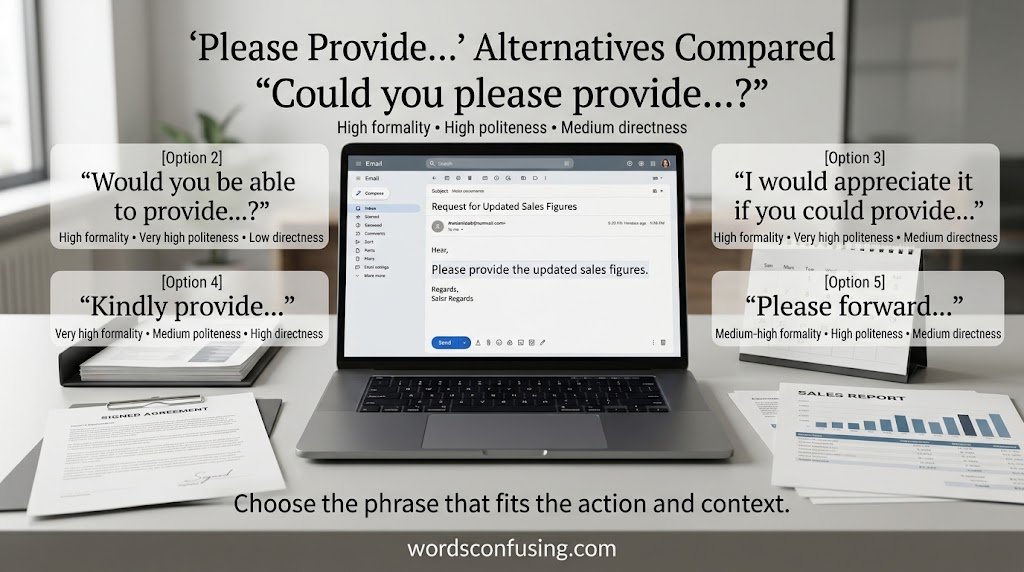
“Please Provide…” Alternatives Compared
The following table makes the differences easier to see:
| Phrase | Formality | Politeness | Directness | Best Context |
| Could you please provide…? | High | High | Medium | General workplace requests |
| Would you be able to provide…? | High | Very high | Low | Requests requiring extra effort |
| I would appreciate it if you could provide… | High | Very high | Medium | Formal or sensitive requests |
| Kindly provide… | Very high | Medium | High | Official or administrative communication |
| Please forward… | High | High | High | Existing emails and documents |
| Could you share…? | Medium-high | High | Medium | Collaborative workplace communication |
The key takeaway is simple: don’t choose an expression based on formality alone.
Choose it based on the action you need.
How to Choose the Right Formal Alternative
Choosing the right phrase becomes much easier when you identify the purpose behind the request.
When You Need a Routine Professional Request
Use:
Could you please provide…?
This is the dependable all-purpose option.
It works for information, documents, updates, and many other workplace requests.
When the Request Requires Extra Effort
Use:
Would you be able to provide…?
This wording recognizes that the recipient may need time or resources to fulfill your request.
For example:
Would you be able to provide a breakdown of the expenses from the previous quarter?
That’s more considerate than issuing a bare instruction.
When You Want to Show Extra Courtesy
Use:
I would appreciate it if you could provide…
This option works well when you’re making an important request or communicating with someone outside your immediate team.
When the Communication Is Highly Formal
Use:
Kindly provide…
This works particularly well in administrative and official communication.
Still, don’t force it into casual team conversations.
When You’re Requesting an Existing Email or Document
Use:
Please forward…
This is more precise than “provide” when the recipient already has the material.
When You’re Collaborating With a Team
Use:
Could you share…?
This sounds natural when you’re exchanging information, files, ideas, or feedback.
Read more: 8 Words for Someone Who Is Good With Words
Examples of “Please Provide…” in Professional Emails
The easiest way to understand these expressions is to see them in realistic workplace situations.
Requesting a Document
Instead of repeating:
Please provide the signed contract.
You could write:
Could you please provide the signed contract by Thursday?
Or:
I would appreciate it if you could provide the signed contract by Thursday.
If the person already received it:
Please forward the signed contract when you have a chance.
The best version depends on the situation.
Requesting Project Information
A vague request might say:
Please provide an update.
A stronger professional version gives the recipient more direction:
Could you please provide an update on the testing phase and expected completion date?
Now the recipient knows exactly what information you need.
Specific requests reduce unnecessary back-and-forth.
Requesting Client Information
For client communication, you may want a warmer and more courteous tone:
Could you please provide the account details needed to complete the review?
For a more formal message:
I would appreciate it if you could provide the requested account details at your earliest convenience.
Requesting Feedback
“Provide” works, but “share” often sounds more natural:
Could you share your feedback on the revised proposal?
This wording feels collaborative.
You aren’t merely collecting an item. You’re inviting another person’s perspective.
Requesting a File
If the recipient needs to send a file:
Could you please send the updated spreadsheet?
If you’re asking them to pass along an existing file:
Please forward the spreadsheet you received from the finance team.
If the file lives in a shared system:
Could you share the latest version with the team?
Each verb tells the reader something different.
“Please Provide…” vs. “Please Send…” vs. “Please Share…”
These verbs often overlap, but they aren’t identical.
| Verb | Typical Meaning | Example |
| Provide | Supply information or materials | Please provide the requested details. |
| Send | Transmit something to someone | Please send the revised report. |
| Share | Give someone access to information or materials | Please share the project folder. |
| Forward | Pass along something already received | Please forward the original email. |
| Submit | Formally deliver something for review or processing | Please submit the completed form. |
Provide
Use provide when the request is broad.
Please provide the information requested below.
It can cover documents, details, explanations, figures, and other materials.
Send
Use send when transmission is the main action.
Please send the invoice to the accounting department.
It’s straightforward and highly natural in workplace English.
Share
Use share when collaboration or access matters.
Could you share the presentation with the marketing team?
It works especially well for digital files, links, information, and ideas.
Forward
Use forward when someone already has the email or document.
Please forward the client’s original message.
This is more specific than “send.”
Submit
Use submit when the recipient needs to formally deliver something.
Please submit the completed application by Friday.
This verb often appears in administrative, academic, legal, and workplace processes.
Common Mistakes When Making Professional Requests
Even polite phrases can create problems if you use them poorly.
Making Every Request Sound Like an Order
Compare:
Send me the report.
with:
Could you please send me the report?
The second version generally sounds more courteous.
However, don’t bury every request under excessive politeness. A professional email should remain efficient.
Using “Kindly” in Every Email
“Kindly” has a formal flavor. That can be useful, but repetition can make your writing sound stiff.
Instead of:
1. Kindly provide the report.
2. Kindly provide the figures.
3. Kindly provide the invoice.
4. Kindly provide confirmation.
vary the wording naturally:
Could you please send the report?
Could you share the updated figures?
Please forward the invoice.
Could you confirm once it’s complete?
Variation makes professional writing feel more natural.
Asking for Something Without Saying What You Need
“Please provide the information” may be technically correct, but it’s vague.
What information?
A better request might say:
Could you please provide the customer’s order number and delivery date?
Specificity saves time.
Adding Too Much Politeness
Professional requests can become cumbersome when you stack several courtesy phrases together.
For example:
I would really appreciate it if you would kindly be able to provide the requested information at your earliest convenience.
That’s far too heavy for most workplace situations.
A cleaner version is:
Could you please provide the requested information by Friday?
Shorter. Clearer. Easier to act on.
Ignoring the Recipient and Context
The same request shouldn’t sound identical in every situation.
A message to a close coworker can be conversational:
Could you share the latest figures?
A formal client email might say:
I would appreciate it if you could provide the latest figures.
An official notice could use:
Kindly provide the requested figures.
Context determines tone.
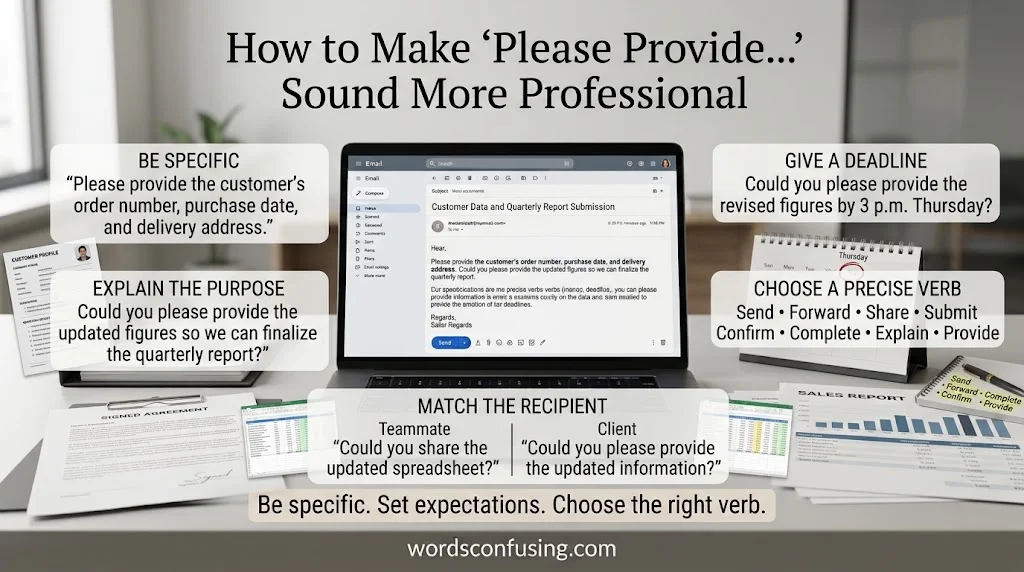
How to Make “Please Provide…” Sound More Professional
You don’t always need a completely different phrase. Sometimes, improving the request itself makes a bigger difference.
Name the Exact Information
Instead of:
Please provide the details.
Try:
Please provide the customer’s order number, purchase date, and delivery address.
The recipient immediately understands the task.
Give a Clear Deadline
If timing matters, say so.
Could you please provide the revised figures by 3 p.m. Thursday?
A specific deadline is much more useful than:
Please provide the figures soon.
Explain the Purpose When Necessary
A short explanation can make a request feel reasonable.
Could you please provide the updated figures so we can finalize the quarterly report?
The recipient now understands why the information matters.
Choose a Precise Verb
Don’t automatically reach for “provide.”
Ask what the recipient actually needs to do.
- Send a file.
- Forward an email.
- Share a link.
- Submit a form.
- Confirm an appointment.
- Complete a document.
- Explain an issue.
- Provide information.
Precision makes writing stronger.
Match the Recipient’s Position
You don’t need the same level of formality with everyone.
For a teammate:
Could you share the updated spreadsheet?
For a client:
Could you please provide the updated information?
For an official request:
Kindly provide the required documentation.
The relationship helps determine the right register.
Read more: 8 Words for Someone Who Is Good With Words
Case Study: Turning a Repetitive Email Into Better Workplace Writing
Consider a project manager who frequently sends requests to a design team.
Their original emails might look like this:
1. Please provide the updated design.
2. Please provide the revised timeline.
3. Please provide the final images.
4. Please provide the client feedback.
Nothing is grammatically wrong. Yet the repetition makes the communication feel robotic.
A more polished version might read:
Could you please share the updated design?
Would you be able to provide the revised timeline by Wednesday?
Please forward the final images once they’re approved.
Could you share the client’s latest feedback with the team?
The meaning hasn’t changed dramatically.
The precision and variety have.
Each sentence now reflects the actual action required. The writer isn’t simply replacing words for the sake of variety.
That’s the important lesson.
Professional variety should improve meaning, not merely decorate it.
Professional Email Templates Using Formal Alternatives
Requesting Information
Could you please provide the updated customer information by Thursday? We need it to complete the account review.
Requesting a Document
I would appreciate it if you could provide a copy of the signed agreement for our records.
Requesting an Existing Email
Please forward the original email thread so we can review the previous correspondence.
Requesting Feedback
Could you share your feedback on the revised proposal before tomorrow’s meeting?
Requesting Detailed Research
Would you be able to provide a detailed breakdown of the expenses from the previous quarter?
Formal Administrative Request
Kindly provide the completed form and supporting documentation by the stated deadline.
These examples demonstrate an important principle: the strongest professional request combines polite wording with specific instructions.
Quick Reference: The Best Alternative for Each Situation
| Situation | Recommended Wording |
| General workplace request | Could you please provide…? |
| Request requiring research | Would you be able to provide…? |
| Highly courteous request | I would appreciate it if you could provide… |
| Official request | Kindly provide… |
| Existing email or document | Please forward… |
| Team collaboration | Could you share…? |
| Sending a file | Could you please send…? |
| Formal document delivery | Please submit… |
| Request for confirmation | Could you please confirm…? |
| Request for an explanation | Could you please explain…? |
FAQs
1. Is “Please Provide” formal enough for business emails?
Yes. “Please provide” is polite and professional, especially when you need documents, details, or other information. However, alternatives can sound more natural depending on the situation.
2. What is a more formal way to say “Please Provide”?
You can say “Could you please provide…”, “Kindly provide…”, or “Would you please provide…”. The best choice depends on how formal and direct you want your request to sound.
3. Is “Kindly Provide” more professional than “Please Provide”?
Not necessarily. Both phrases are professional. “Kindly provide” can sound more formal, while “please provide” usually feels more natural in everyday business communication.
4. How can I politely ask someone to provide documents?
You can write, “Could you please provide the requested documents?” This sounds courteous without being overly formal or demanding.
5. Can I use “Please Provide” when asking for information?
Yes. It works well when requesting information, details, records, or documents. For example, “Please provide your updated contact information” is clear and professional.
6. Should I use “Please Provide” in every formal request?
No. Repeating the same phrase can make your emails feel mechanical. Using alternatives such as “Could you share,” “Would you send,” or “Please forward” can make your communication more natural and specific.
Conclusion
Choosing a better alternative to “Please Provide” isn’t about making every sentence sound overly formal. It’s about matching your words to the situation, your relationship with the reader, and the information you need. A small change in phrasing can make a request feel more thoughtful without weakening its purpose.
Whether you’re writing an email, requesting documents, or following up on missing details, aim for language that feels clear and courteous. The best professional wording usually sounds natural rather than stiff. When your request is precise, respectful, and easy to understand, you make it easier for the other person to respond—and that’s what good business communication should accomplish.

Shafiq Ur Rehman is a writer and content contributor at WordsConfusing.com. He enjoys exploring the English language, common word confusions, vocabulary, and practical writing tips. His goal is to make English easier to understand through clear, simple, and useful articles.