
For English learners, the grammar question “Hid or Hidden: Which Is Correct?” becomes easier when you see the same verb and same root behind these words.
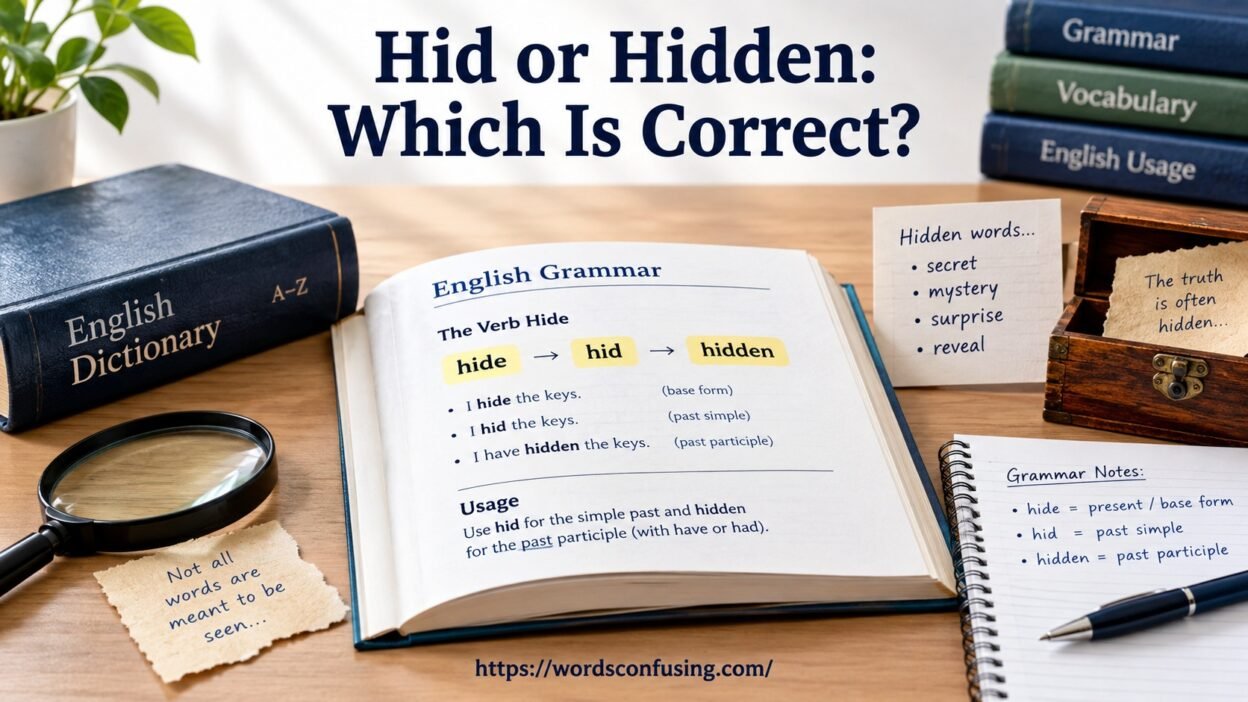
Hide is the base form for the present tense, hid is the simple past tense, and hidden is the past participle. Their correct spelling, meaning, usage, and verb forms become clearer when you compare them side by side.
The rule is straightforward, and this understanding helps writers, native speakers, and learners avoid common mistakes in writing skills, speaking skills, and everyday communication. These irregular verbs don’t follow normal -ed rules, so learning their correct use, correct usage, and sentence structure makes your English clearer.
The reassuring truth is that the rules governing these forms aren’t hard once you understand the full picture. Although hide and hid may look identical and sound similar, their different situations make them easy to distinguish with some assistance.
Real-life examples, etymology, complete conjugation, and every tense provide a useful guide, while this article also explains passive constructions, adjective usage, idioms, and memory tricks. These details help confident writers stop second-guessing each sentence because there are no obscure exceptions or major regional quirks disrupting the logical system.
Once you understand the two different forms, the difference becomes easier to believe and apply through practical examples instead of wondering constantly which form fits.
Quick Answer
Hid is the simple past form of hide. Hidden is the past participle.
Use hid when you describe an action that happened in the past:
- He hid the money.
- She hid behind the tree.
- They hid the present in the closet.
Use hidden when a sentence requires a past participle:
- He has hidden the money.
- She had hidden behind the tree.
- The present was hidden in the closet.
Here’s the basic rule:
| Verb Form | Grammatical Name | Example |
| hide | Base form | I hide the keys. |
| hid | Simple past | I hid the keys. |
| hidden | Past participle | I have hidden the keys. |
A common mistake is saying “I have hid it.” In standard English, the correct form is “I have hidden it.”
Hid vs. Hidden: What’s the Difference?
The difference between hid and hidden isn’t about meaning alone. Both forms describe putting something out of sight or staying out of sight. The important distinction is how the verb works grammatically.
Hid expresses a completed action in the simple past.
Maria hid the documents yesterday.
The action happened in the past. The sentence doesn’t need a helping verb before hid.
Hidden, however, is the past participle. It normally works with another verb to create perfect tenses or passive constructions.
Maria has hidden the documents.
Here, has is the helping verb and hidden supplies the past participle.
The same pattern appears in:
- He hid the letter.
- He has hidden the letter.
- He had hidden the letter.
- The letter was hidden.
Think of hid as a standalone past-tense form. Think of hidden as a form that often needs grammatical support.
Hid: Meaning and Correct Usage
Hid is the simple past tense of hide.
You use it when someone or something performed the action at a specific or understood time in the past.
For example:
James hid the birthday gift under his bed.
The sentence tells us that James performed the hiding action in the past.
You can also use hid when a person hides themselves:
The child hid behind the sofa.
The same form works whether the object being hidden is a physical thing or the person performing the action.
Examples of Hid in Sentences
- I hid the spare key beneath the flowerpot.
- She hid her phone inside her backpack.
- Tom hid behind the door.
- The dog hid under the table.
- They hid the surprise from their friends.
- We hid the presents before the guests arrived.
- He hid the evidence of his mistake.
- The children hid when they heard the thunder.
Notice that hid doesn’t need has, have, or had before it.
You can use time expressions with hid as well:
- yesterday
- last night
- last week
- an hour ago
- when I was young
- earlier that day
For example:
She hid the letter yesterday.
That sentence uses the simple past correctly.
Hidden: Meaning and Correct Usage
Hidden is the past participle of hide.
A past participle doesn’t normally function as the simple past tense. Instead, it appears in several grammatical structures, including perfect tenses and passive constructions.
Consider this sentence:
I have hidden the keys.
The word have acts as the auxiliary verb. Hidden functions as the past participle.
You can also use hidden with had:
She had hidden the documents before anyone arrived.
Here, had hidden forms the past perfect.
The same principle applies with has:
He has hidden the gift somewhere upstairs.
Hidden in Passive Sentences
Hidden also appears in passive constructions.
For example:
The treasure was hidden beneath the floorboards.
The sentence focuses on the treasure rather than the person who hid it.
Other examples include:
- The keys were hidden in a drawer.
- The documents were hidden from the public.
- The money was hidden inside the wall.
- A secret passage was hidden behind the bookshelf.
In these sentences, hidden follows a form of be.
That’s one of the clearest clues that you shouldn’t replace hidden with hid.
Hide, Hid, and Hidden: The Three Main Forms
The easiest way to master this verb is to learn all three principal forms together.
| Base Form | Simple Past | Past Participle |
| hide | hid | hidden |
These forms behave differently.
Hide
Use hide for the base form, present tense, infinitives, and certain other constructions.
Examples:
- I hide the spare key here.
- They hide when they hear loud noises.
- You should hide the gift.
- Don’t hide the truth.
Hid
Use hid for simple past actions.
Examples:
- I hid the key yesterday.
- She hid from the crowd.
- They hid the presents last night.
Hidden
Use hidden as the past participle.
Examples:
- I have hidden the key.
- She had hidden the letter.
- The key was hidden under the rug.
Remembering this three-part sequence prevents most mistakes:
hide → hid → hidden
Hid or Hidden in Different Tenses
Understanding verb tense makes the distinction much easier.
Simple Present
Use hide for habitual actions or general statements.
I hide the spare key under the mat.
This doesn’t necessarily describe one completed event. It can describe a regular practice.
Simple Past
Use hid for a completed past action.
I hid the spare key yesterday.
The action happened and finished in the past.
Present Perfect
Use have hidden or has hidden.
I have hidden the spare key.
The present perfect connects a past action to the present in some way.
For example, the speaker may be emphasizing that the key remains hidden now.
Past Perfect
Use had hidden.
I had hidden the spare key before the guests arrived.
The past perfect shows that one past event occurred before another past event.
Future Perfect
Use will have hidden.
By noon, I will have hidden all the presents.
The action will be complete by a particular future point.
Passive Construction
Use a form of be + hidden.
The spare key was hidden beneath the mat.
The focus shifts toward the thing that someone hid.
Hid vs. Hidden Examples at a Glance
| Sentence | Correct? | Why? |
| I hid the keys. | ✅ | Simple past |
| I have hidden the keys. | ✅ | Present perfect |
| I had hidden the keys. | ✅ | Past perfect |
| The keys were hidden. | ✅ | Passive construction |
| She hid behind the door. | ✅ | Simple past |
| She has hidden behind the door. | ✅ | Present perfect |
| She has hid behind the door. | ❌ | Past participle needed |
| They had hid the money. | ❌ | Past participle needed |
| They had hidden the money. | ✅ | Past perfect |
| The money was hidden. | ✅ | Passive construction |
Is “I Have Hid It” Correct?
In standard modern English, “I have hid it” is generally incorrect.
The correct sentence is:
I have hidden it.
Why? Because have requires the past participle in this construction.
The three forms are:
- I hide it.
- I hid it.
- I have hidden it.
You wouldn’t normally say:
❌ I have went home.
You say:
✅ I have gone home.
The same grammatical principle applies to hide.
Because hid already looks like a completed past-tense form, learners sometimes use it after have. However, the structure requires hidden.
Common Incorrect Examples
❌ She has hid the documents.
✅ She has hidden the documents.
❌ They had hid the treasure.
✅ They had hidden the treasure.
❌ He has hid behind the wall.
✅ He has hidden behind the wall.
This distinction becomes especially important in formal writing, academic work, professional communication, and edited content.
Is “Hidden” Always a Verb?
Not necessarily.
Hidden can function as a past participle or as an adjective, depending on the sentence.
Compare these examples:
Someone has hidden the documents.
Here, hidden forms the present perfect construction has hidden.
Now consider:
The documents remained hidden.
Here, hidden describes the condition or state of the documents.
That difference can be subtle because the word looks exactly the same.
Hidden as a Past Participle
She has hidden the necklace.
The sentence describes an action.
Hidden as an Adjective
The necklace remained hidden for years.
The word describes the necklace’s state.
You may also encounter phrases such as:
- hidden costs
- hidden dangers
- hidden meaning
- hidden compartment
- hidden camera
- hidden message
- hidden talent
In these expressions, hidden describes something that isn’t immediately visible, obvious, or known.
“I Hid It” vs. “I Have Hidden It”
These two sentences are both grammatically correct, but they don’t communicate exactly the same thing.
I Hid It
I hid it yesterday.
This uses the simple past.
The speaker presents the hiding as a completed event in the past. The sentence often works naturally with a finished time expression.
For example:
1 I hid it yesterday, but I can’t remember where.
I Have Hidden It
This uses the present perfect.
The speaker connects the past action with the present situation. The exact time isn’t the central point.
For example:
Don’t worry about the gift. I have hidden it somewhere safe.
The distinction becomes clearer when you add time expressions.
Simple past:
I hid it last night.
Present perfect:
I have hidden it already.
The first emphasizes a completed event at a past time. The second emphasizes the current result.
“She Hid the Money” vs. “The Money Was Hidden”
These sentences use different grammatical structures.
She hid the money.
This is an active sentence. The subject, she, performs the action.
The money was hidden.
This is a passive sentence. The sentence focuses on the money rather than the person who hid it.
Both can describe the same general event.
However, the emphasis changes.
| Sentence | Focus |
| She hid the money. | The person who performed the action |
| The money was hidden. | The money and its hidden state |
You could combine both ideas:
She hid the money, and it remained hidden for several years.
This sentence uses hid for the completed action and hidden to describe the resulting state.
“He Hid Behind the Door” vs. “He Was Hidden Behind the Door”
These sentences may look similar, but their meanings differ.
He hid behind the door.
This means he deliberately placed himself out of sight.
The subject performs the hiding action.
Now consider:
He was hidden behind the door.
This suggests that someone or something concealed him, or it describes his concealed position.
The grammatical structure also changes:
- He hid → active simple past
- He was hidden → passive construction
That distinction matters in storytelling.
For example:
The frightened child hid behind the door.
The child chose to hide.
By contrast:
The child was hidden behind the door by his older brother.
Someone else concealed the child.
“They Had Hid It” vs. “They Had Hidden It”
This is one of the most common mistakes involving hid and hidden.
The correct sentence is:
They had hidden it.
Not:
❌ They had hid it.
The reason is simple. Had introduces the past perfect, which requires a past participle.
The structure is:
had + past participle
Since hidden is the past participle of hide, we get:
had hidden
The same pattern appears with other irregular verbs:
- had gone
- had eaten
- had written
- had taken
- had hidden
You can remember the pattern this way:
Simple past = hid
Past perfect = had hidden
For example:
They hid the box before dinner.
But:
They had hidden the box before dinner started.
The second sentence places the hiding action before another past event.
Common Mistakes With Hid and Hidden
A few recurring errors cause most confusion.
Using Hid After Have
❌ I have hid the letter.
✅ I have hidden the letter.
Use the past participle after have, has, or had.
Using Hid After Had
❌ She had hid the keys.
✅ She had hidden the keys.
The past perfect requires had + past participle.
Using Hid in a Passive Construction
❌ The money was hid under the floor.
✅ The money was hidden under the floor.
Passive constructions use the past participle.
Confusing Past Tense With Past Participle
The words hid and hidden represent different verb forms.
Hid doesn’t mean “more hidden.” It isn’t an alternative spelling of hidden.
Instead:
- hid = simple past
- hidden = past participle
That grammatical distinction is the key.
Hid or Hidden: A Simple Memory Trick
If you’re unsure which word to use, remember this three-word sequence:
hide → hid → hidden
Then ask yourself what the sentence requires.
Does the sentence describe a simple past action?
Use hid.
She hid the note.
Does the sentence contain has, have, or had?
Usually use hidden.
She has hidden the note.
She had hidden the note.
Does the sentence use a passive structure?
Use hidden.
The note was hidden.
This quick check solves most hid or hidden questions.
Hid or Hidden in Questions
Questions follow the same grammatical rules.
For simple past questions, use did + hide, not did + hid.
Correct:
Did she hide the keys?
Incorrect:
❌ Did she hid the keys?
Why does this happen?
The auxiliary did already carries the past tense. Therefore, the main verb returns to its base form, hide.
Compare:
- She hid the keys.
- Did she hide the keys?
Not:
- ❌ Did she hid the keys?
For present perfect questions, use have/has + hidden:
Has she hidden the keys?
For past perfect questions:
Had she hidden the keys before you arrived?
This creates three useful patterns:
| Sentence Type | Correct Structure | Example |
| Past statement | subject + hid | She hid the keys. |
| Past question | did + hide | Did she hide the keys? |
| Perfect question | has/have/had + hidden | Has she hidden the keys? |
Negative Sentences With Hid and Hidden
Negative sentences follow the same rules.
For the simple past, use did not + hide:
She didn’t hide the letter.
Not:
❌ She didn’t hid the letter.
Again, did already marks the past tense.
For the present perfect:
She hasn’t hidden the letter.
For the past perfect:
She hadn’t hidden the letter.
These patterns are worth memorizing:
- didn’t hide
- hasn’t hidden
- haven’t hidden
- hadn’t hidden
Each one uses the correct verb form for its structure.
Real-World Examples of Hid and Hidden
The difference becomes easier when you see the words working naturally.
Everyday Conversation
I hid your birthday card in the kitchen.
This describes a completed action.
I’ve hidden your birthday card somewhere you won’t find it.
This emphasizes the current result.
Storytelling
The fox hid beneath the bushes when it heard footsteps.
The simple past tells the story.
The fox had hidden beneath the bushes before the hunters arrived.
The past perfect establishes which event happened first.
Workplace Writing
The employee hid the document in a private folder.
Simple past.
The employee had hidden the document before the audit began.
Past perfect.
Descriptive Writing
A small door was hidden behind the bookcase.
Passive construction.
The architect had hidden the door behind the bookcase.
Past perfect active construction.
These examples show why context matters more than memorizing isolated definitions.
Read more: Williams’ or Williams’s? The Correct Possessive Form
A Closer Look at “Hidden” as an Adjective
English often turns past participles into adjectives. Hidden is a good example.
Consider:
We discovered a hidden room.
Here, hidden describes the room.
The phrase doesn’t necessarily tell us who hid it. Instead, it tells us that the room wasn’t visible or obvious.
Other examples include:
- hidden treasure
- hidden valley
- hidden message
- hidden feature
- hidden charge
- hidden weakness
- hidden talent
The meaning can become figurative, too.
For example:
She has a hidden talent for painting.
No physical object is being concealed. Hidden means the talent wasn’t previously known or obvious.
That flexibility makes hidden more than just a grammatical past participle. It also functions naturally as a descriptive word.
Why “Hide” Is an Irregular Verb
Hide belongs to a group of English verbs that don’t form their past tense by simply adding -ed.
Regular verbs often follow this pattern:
walk → walked → walked
But hide changes internally:
hide → hid → hidden
Other irregular verbs show similar changes:
| Base | Past | Past Participle |
| write | wrote | written |
| drive | drove | driven |
| break | broke | broken |
| speak | spoke | spoken |
| choose | chose | chosen |
| hide | hid | hidden |
This explains why learners sometimes struggle with hid and hidden. The verb doesn’t follow the regular -ed pattern.
English has many irregular verbs like this. Learning their three principal forms together is usually more effective than memorizing one form at a time.
Hid vs. Hidden: Practical Comparison
| Feature | Hid | Hidden |
| Base verb | hide | hide |
| Verb form | Simple past | Past participle |
| Used alone as simple past? | Yes | No |
| Used with has/have/had? | No | Yes |
| Used in passive constructions? | No | Yes |
| Example | She hid the letter. | She has hidden the letter. |
| Common phrase | He hid yesterday. | It was hidden yesterday. |
The most important distinction is grammatical rather than semantic.
Both words relate to the same action. Their sentence roles differ.
FAQs
Is “hid” the past tense of “hide”?
Yes. Hid is the simple past tense of hide. For example, “She hid the keys yesterday.” You use hid for an action that happened in the past.
Is “hidden” the past tense of “hide”?
No. Hidden is the past participle of hide, not the simple past tense. It usually appears with helping verbs such as has, have, had, or be.
Should I say “I hid” or “I hidden”?
You should say “I hid.” The word hid works as the simple past form by itself. Hidden needs a helping verb, as in “I have hidden the letter.”
What is the difference between “hid” and “hidden”?
Hid describes a completed past action, while hidden usually works as a past participle or adjective. Compare “He hid the gift” with “He has hidden the gift.”
Is “hide” present tense or past tense?
Hide is the base form and present-tense form. You can use it for habits, general statements, or actions happening with an appropriate helping verb, such as “I hide my notes carefully.”
How can I remember hide, hid, and hidden?
Think of the three forms as hide → hid → hidden. Use hide for the base or present form, hid for simple past, and hidden after helping verbs such as has, have, or had.
Conclusion
The difference between hide, hid, and hidden becomes much simpler once you see how each form works. Hide is the base form, hid is the simple past, and hidden is the past participle. The tricky part is remembering that hidden cannot normally replace hid in a simple past sentence. A quick review of real examples can make these forms feel almost automatic.
When you’re unsure, look at the helping verb and the time of the action. If you’re talking about something that happened yesterday, hid is usually the form you need. If has, have, or had appears before the verb, hidden will often fit. Keep practicing the three forms together, and this once-confusing grammar point will soon become second nature.

Shafiq Ur Rehman is a writer and content contributor at WordsConfusing.com. He enjoys exploring the English language, common word confusions, vocabulary, and practical writing tips. His goal is to make English easier to understand through clear, simple, and useful articles.