
For clarity, Series or Series’s or Series’? Grammar Guide helps explain the singular and plural possessive form.
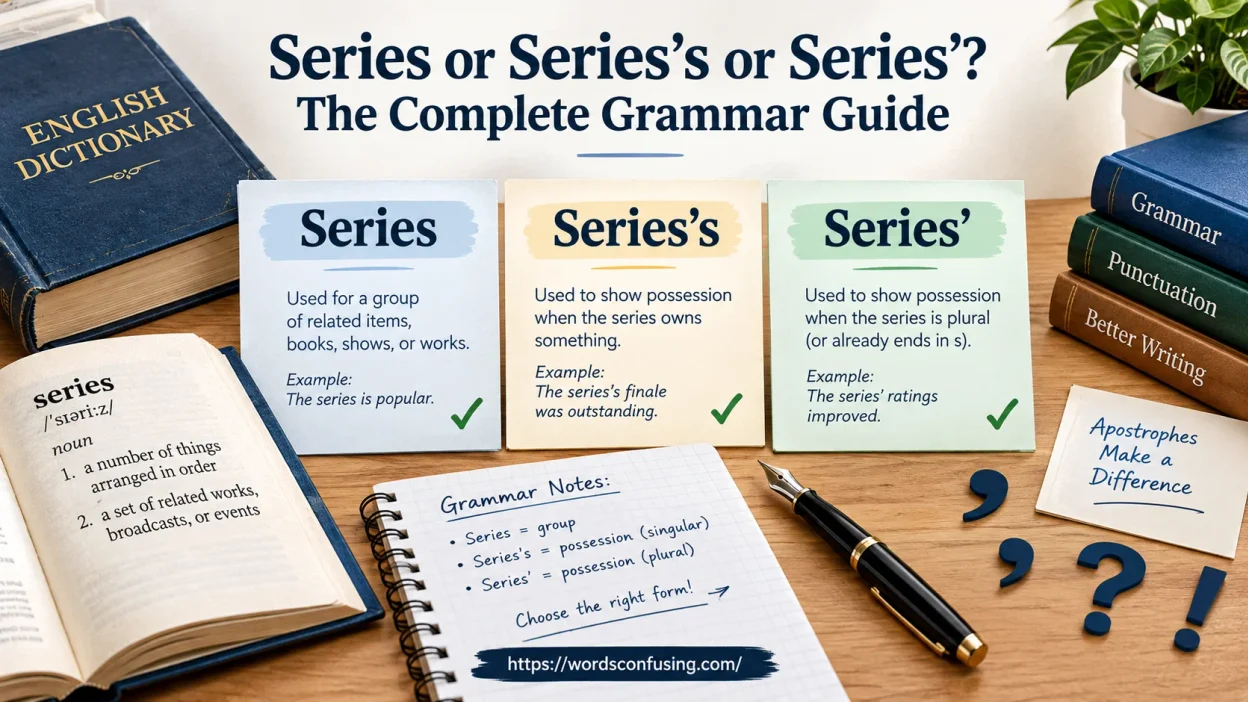
When writing about series, treat it as a noun and consider its meaning and context in the sentence. In English grammar, no standard rule works for every noun, so you should examine each word individually. When series is a singular noun, Series’s is the correct singular possessive form for showing ownership or possession, as in “The series’s final episode became popular.”
The apostrophe-s makes the singular possessive form clear, although some people use Series’ in this usage. Series’s remains the preferred form, and understanding these possessive words makes the rules easier to understand and helps readers determine the intended meaning.
The plural possessive form works slightly differently when series means more than one. In that case, Series’ can show possession, while Series’s isn’t the correct form for a plural meaning. The distinction between singular and plural becomes clearer when you check the surrounding word, words, and complete expression.
In everyday writing, the right form depends on whether you mean one series or several. These cases become easy once you recognize the basic possessive pattern, but context remains important when choosing the appropriate form.
This approach also supports clearer grammatical usage and makes the intended reference easier for readers to follow.
Quick Answer
Here’s the short answer:
| Form | Meaning | Example |
| series | One series | This series is excellent. |
| series | More than one series | Several series are available. |
| series’s | Possession by one series | The series’s ending was surprising. |
| series’ | Possession by multiple series | The series’ endings were different. |
The most important point is this:
Series can be both singular and plural.
Unlike many English nouns, it doesn’t change spelling when you make it plural.
For example:
- one series
- two series
- three series
- several series
You don’t normally write serieses for the ordinary plural of series.
When possession enters the picture, the number becomes important.
If one series owns or relates to something, series’s is the standard singular possessive form under styles that use ’s for singular nouns.
If multiple series possess or relate to something, use series’ as the plural possessive.
That distinction solves most questions about series or series’s or series’.
Is “Series” Singular or Plural?
The word series has an unusual grammatical feature called a zero plural. Its singular and plural forms look exactly alike.
That means you can’t always determine its number simply by looking at the word.
Instead, you need to examine the surrounding sentence.
“Series” as a Singular Noun
When series refers to one collection, sequence, group, or set, it functions as a singular noun.
Consider these examples:
- This series is popular.
- The series has eight episodes.
- A new series begins next week.
- That series was surprisingly short.
- The series contains several important lessons.
Notice the verbs.
The sentence says is, has, begins, was, and contains. These singular verbs tell you that series refers to one thing.
The same principle applies outside entertainment.
The series of experiments is complete.
Here, series means one organized sequence of experiments.
“Series” as a Plural Noun
The same spelling can represent multiple groups or sequences.
For example:
- Several series are available.
- These series have different themes.
- Two series were published last year.
- Multiple series contain related stories.
- The three series are aimed at different audiences.
Here, words such as several, these, two, and multiple show that series is plural.
The verbs also provide clues.
The two series are completely different.
The word are confirms that series refers to more than one series.
How Can You Tell Whether “Series” Is Singular or Plural?
When you’re unsure, look for a word that identifies quantity.
| Clue | Number | Example |
| a | Singular | a series |
| one | Singular | one series |
| this | Singular | this series |
| that | Singular | that series |
| two | Plural | two series |
| several | Plural | several series |
| many | Plural | many series |
| these | Plural | these series |
| those | Plural | those series |
| multiple | Plural | multiple series |
This is a useful habit because series itself doesn’t reveal its number.
Think of the word as a suitcase with the same label on the outside. The surrounding words tell you what’s inside.
What Is the Singular Possessive Form of “Series”?
When one series possesses something or has a close grammatical relationship with something else, the standard singular possessive form is generally series’s.
For example:
The series’s ending surprised everyone.
The sentence discusses one series and its ending.
Likewise:
- The series’s creator announced a sequel.
- The series’s main character changed dramatically.
- The series’s final episode received strong reviews.
- The series’s storyline became more complex.
- The series’s popularity increased rapidly.
The basic construction is:
singular noun + ’s = singular possessive
Since series is singular in these sentences, the form becomes:
series + ’s = series’s
Is “Series’s” Correct?
Yes. Series’s is a legitimate singular possessive form.
It may look awkward at first because the word already ends in s. However, English commonly uses ’s to form the possessive of singular nouns.
For example:
- the class’s schedule
- the boss’s office
- the glass’s surface
- the series’s ending
The spelling can look unusual without being grammatically wrong.
Why Does “Series’s” Look Strange?
Your eyes may expect an apostrophe to finish the word because series already ends with s.
That’s where the confusion begins.
Compare these:
The series’s ending
and:
The series’ endings
The first sentence refers to one series.
The second refers to multiple series.
The extra s in series’s isn’t decorative. It helps show that the possessive noun is singular under the convention that forms singular possessives with ’s.
When Should You Use “Series’s”?
Use series’s when one series has, contains, produces, or relates to something.
For example:
The series’s first episode introduced the main conflict.
Only one series appears in the sentence.
Another example:
The series’s characters became more developed over time.
Again, the sentence concerns one series.
The same rule works with less obvious meanings of possession:
- the series’s structure
- the series’s theme
- the series’s production
- the series’s audience
- the series’s conclusion
- the series’s format
Possession doesn’t always mean literal ownership. In grammar, the possessive often expresses a relationship between two nouns.
What Is the Plural Possessive Form of “Series”?
When multiple series possess or relate to something, the plural possessive form is series’.
For example:
The series’ endings were completely different.
Why?
Because the sentence refers to multiple series and their endings.
More examples include:
- The series’ characters had different personalities.
- The series’ creators announced new projects.
- The series’ ratings improved significantly.
- The series’ storylines followed different paths.
- The series’ final episodes aired simultaneously.
The pattern is:
plural noun ending in s + apostrophe = plural possessive
Since the plural of series remains series, the possessive becomes:
series + ’ = series’
How Do You Know When “Series’” Is Plural Possessive?
Look for evidence that more than one series exists.
For example:
The two series’ finales aired on the same evening.
The word two tells you that series is plural.
Another example:
Several series’ characters appeared in the event.
The word several signals plurality.
You can often identify the intended meaning by asking:
How many series are we talking about?
If the answer is one, use series’s for the singular possessive under the standard ’s convention.
If the answer is two or more, use series’.
Series or Series’s or Series’: The Main Difference
The easiest way to understand these forms is to separate the noun from its possessive form.
| Form | Singular/Plural | Possessive? | Example |
| series | Singular | No | This series is popular. |
| series | Plural | No | These series are popular. |
| series’s | Singular | Yes | The series’s ending was excellent. |
| series’ | Plural | Yes | The series’ endings were excellent. |
This creates a simple four-part system.
One Series
This series is fascinating.
No possession exists.
Multiple Series
These series are fascinating.
Again, no possession exists.
One Series Possesses Something
The series’s ending is fascinating.
The ending belongs to or relates to one series.
Multiple Series Possess Something
The series’ endings are fascinating.
The endings belong to multiple series.
Once you see the pattern, series or series’s or series’ becomes much less intimidating.
“Series’s” vs. “Series’”: Which One Should You Use?
The choice depends primarily on whether the possessive noun is singular or plural.
Use “Series’s” for One Series
Use series’s when you’re talking about one series.
Examples:
- the series’s ending
- the series’s creator
- the series’s main character
- the series’s first episode
- the series’s production team
Consider this sentence:
The series’s final episode answered several unanswered questions.
The word series refers to one specific series.
Use “Series’” for Multiple Series
Use series’ when you’re talking about multiple series.
Examples:
- the series’ endings
- the series’ creators
- the series’ characters
- the series’ ratings
- the series’ production teams
For example:
The two series’ characters share several similarities.
The phrase two series makes the plural meaning clear.
A Simple Test That Prevents Mistakes
Here’s a useful trick.
Replace series with show or shows.
Consider:
The series’s ending was disappointing.
Replace series with show:
The show’s ending was disappointing.
That works because both are singular.
Now consider:
The series’ endings were disappointing.
Replace series with shows:
The shows’ endings were disappointing.
That also works.
This replacement test gives you a quick way to identify whether you need a singular or plural possessive.
Is “Series’” Ever Correct for a Singular Series?
This is where style guides can make the subject slightly more complicated.
Different editorial traditions don’t always handle singular nouns ending in s identically.
Some styles prefer ’s for singular possessives regardless of the final letter. Under that approach, series’s is the expected form for one series.
The Chicago Manual of Style, for example, generally recommends adding ’s to singular nouns that end in s.
Other editorial styles may omit the additional s in certain singular possessive constructions.
That means you may encounter:
the series’ ending
even when the writer means one series.
This doesn’t necessarily mean the writer doesn’t understand grammar. It may reflect a particular style convention.
For professional writing, consistency matters.
If your school, publisher, employer, or publication follows a specific style guide, follow that guide.
For general American English writing, however, series’s clearly communicates the singular possessive relationship when using the standard ’s rule.
Why “Series” Is Such a Confusing Word
Most possessive problems become easier when you identify the singular and plural forms.
With series, that shortcut doesn’t work because both forms look identical.
Consider:
One series
Two series
Nothing changes.
Now add possession:
One series’s ending
Two series’ endings
Suddenly the difference appears.
That’s why the real challenge isn’t the apostrophe itself. The real challenge is identifying how many series you’re discussing.
Examples of “Series” Used Correctly
The word appears in many contexts beyond television.
Singular “Series”
- This series is based on historical events.
- The series has twelve chapters.
- That series was published in three volumes.
- A new series begins next month.
- The series contains several difficult exercises.
Each sentence refers to one series.
Plural “Series”
- Several series are available.
- These series have different themes.
- The two series were published decades apart.
- Multiple series contain similar material.
- The three series are designed for different readers.
Here, the context establishes plurality.
Singular Possessive “Series’s”
- The series’s ending divided viewers.
- The series’s creator discussed the project.
- The series’s central theme became clearer later.
- The series’s characters developed naturally.
- The series’s popularity grew over time.
Each example involves one series.
Plural Possessive “Series’”
- The two series’ endings were completely different.
- Several series’ creators attended the event.
- The competing series’ ratings changed throughout the year.
- The three series’ characters share similar traits.
- Different series’ storylines often overlap.
Here, multiple series own or relate to the following noun.
Common Mistakes With “Series”
Understanding the rules becomes easier when you know which mistakes to avoid.
Mistake 1: Using “Serieses” as the Normal Plural
A common assumption is that adding -es must create the plural.
For example:
Incorrect: Three serieses were released.
The normal plural form is:
Correct: Three series were released.
The word series already works as both singular and plural. Major dictionaries list series as a noun with the same singular and plural form.
So you can write:
one series
and:
several series
The spelling stays unchanged.
Mistake 2: Using “Series’s” for Multiple Series
Consider:
The two series’s endings were different.
If you’re referring to two series, series’s isn’t the normal plural possessive construction.
Use:
The two series’ endings were different.
The apostrophe comes after the plural noun because you’re dealing with multiple series.
Mistake 3: Assuming an Apostrophe Makes a Noun Plural
An apostrophe doesn’t normally create a plural.
Compare:
series
series’
The apostrophe in series’ indicates possession. It doesn’t simply mean “more than one series.”
For example:
Several series are popular.
This is plural but not possessive.
Meanwhile:
Several series’ endings are popular.
This is plural and possessive.
Mistake 4: Choosing the Form Based Only on Appearance
Grammar isn’t a beauty contest.
Series’s may look unusual. That doesn’t make it incorrect.
Likewise, series’ may look simpler. That doesn’t automatically make it correct for every situation.
Always determine the grammatical meaning first.
Mistake 5: Confusing “Series” With “Serieses”
Because many English nouns form plurals with -s or -es, writers sometimes expect series to follow the same pattern.
It doesn’t need that extra ending.
Think of words such as:
- species → species
- series → series
- deer → deer
- sheep → sheep
These nouns use unchanged forms in certain singular and plural contexts.
Series or Series’s or Series’: Real-World Sentence Comparison
A side-by-side comparison makes the difference much clearer.
| Meaning | Correct Form | Example |
| One series | series | This series is popular. |
| Multiple series | series | These series are popular. |
| One series + possession | series’s | The series’s ending was unexpected. |
| Multiple series + possession | series’ | The series’ endings were unexpected. |
Notice how series appears in three different roles.
It can be singular.
In other cases, it can be plural.
The same basic noun form can also become possessive.
That’s what makes this word unusual.
“A Series of” and Why It Causes Grammar Confusion
The phrase a series of creates another common grammar question.
For example:
A series of tests is required.
Many writers see the plural noun tests and instinctively choose are.
However, the grammatical subject is series.
The phrase a series is singular.
Therefore:
A series of tests is required.
Compare that with:
Several series of tests are required.
Now series is plural because several modifies it.
More Examples
Correct:
- A series of interviews is scheduled.
- A series of events was announced.
- A series of experiments has begun.
- Several series of experiments have begun.
- Multiple series of questions are included.
The trick is simple:
Find the head noun before “of.”
In a series of tests, the head noun is series.
In several series of tests, the head noun is still series, but the determiner makes it plural.
Read more: “As In” Meaning and Correct Use With Examples
How to Make “Series’s” Less Awkward
Although series’s is grammatically clear, some sentences can become visually heavy.
You can sometimes rewrite the sentence using an of-phrase.
For example:
The series’s final episode was emotional.
You could write:
The final episode of the series was emotional.
Both constructions communicate the same basic relationship.
Another example:
The series’s main character changes dramatically.
Alternative:
The main character of the series changes dramatically.
The second version can sound smoother in certain formal contexts.
When Should You Use an “Of” Phrase?
An of-phrase can help when:
- several possessives appear close together
- the sentence already contains multiple words ending in s
- the possessive structure becomes difficult to scan
- you’re writing formal or technical material
- clarity matters more than brevity
Still, don’t avoid series’s simply because it looks unusual.
If the possessive construction is clear and natural, there’s nothing inherently wrong with using it.
Series vs. Similar Words Ending in “S”
The confusion surrounding series becomes easier to understand when you compare it with related nouns.
| Word | Singular | Plural | Singular Possessive | Plural Possessive |
| series | series | series | series’s | series’ |
| species | species | species | species’s | species’ |
| class | class | classes | class’s | classes’ |
| bus | bus | buses | bus’s | buses’ |
The important difference is that class and bus change spelling when they become plural.
Series doesn’t.
That creates an unusual possessive pattern.
Series and Species
The nouns series and species are especially similar.
For example:
This species is endangered.
Several species are endangered.
The noun itself stays unchanged.
The possessive distinction then follows the same basic number-based logic:
The species’s habitat
The species’ habitats
As always, individual style guides may differ in how they treat singular possessives ending in s.
Series in Formal and Academic Writing
Academic writing often contains phrases such as:
- a series of experiments
- a series of studies
- several series of observations
- the series’s methodology
- the series’ findings
Precision matters because readers need to understand whether you’re describing one sequence or multiple sequences.
Consider:
The series of experiments was designed to test the hypothesis.
The sentence describes one organized sequence of experiments.
Now compare:
The two series of experiments were conducted independently.
Here, two separate sequences exist.
The difference is small on the page. The meaning changes significantly.
Style Guides Matter
If you’re writing for a university, newspaper, journal, or professional organization, check its preferred style guide.
A style guide can establish whether singular possessives ending in s should use ’s or an apostrophe alone.
For example, Chicago’s guidance generally uses ’s for singular nouns ending in s.
The important lesson isn’t to memorize every editorial preference.
Instead, understand the underlying grammar and then apply the required style consistently.
Series in Everyday English
In everyday conversation, context usually makes the intended meaning obvious.
For example:
“I watched two series this weekend.”
The word two immediately tells you that series is plural.
Likewise:
“I loved the series’s ending.”
The context indicates one particular series.
When a sentence becomes more complex, however, the possessive forms can create a moment of hesitation.
That’s why rewriting can sometimes help.
Instead of:
The series’s final episode…
You might say:
The final episode of the series…
Neither construction is automatically better. The best choice depends on rhythm, clarity, and the surrounding sentence.
Case Study: Understanding the Difference in Context
Consider this short example:
A streaming service released two new series. The first series’s finale attracted attention while the second series’s finale received less interest.
The grammar is technically understandable, but repeating series’s can make the sentence feel cumbersome.
A cleaner version might be:
A streaming service released two new series. The finale of the first series attracted attention while the second received less interest.
This example shows an important writing principle.
Correct grammar isn’t always the same thing as the smoothest prose.
When a possessive construction becomes clunky, restructuring the sentence can improve readability without changing the meaning.
Series Possessive Rules You Can Memorize
If you want the shortest possible rule, remember this:
One series → series’s
Two or more series → series’
One or more series as a noun → series
Here’s another useful version:
Count the series first. Add the possessive second.
Suppose you see:
The ______ ending was controversial.
Ask:
How many series?
If it’s one:
The series’s ending was controversial.
If it’s several:
The series’ endings were controversial.
That tiny question can save you from most errors.
Quick Grammar Test: Series or Series’s or Series’?
Try these sentences before checking the answers.
Question 1
This ______ has ten episodes.
Answer: series
It’s one series.
Question 2
The ______ ending shocked viewers.
Answer: series’s
The sentence refers to one series and its ending.
Question 3
Several ______ are available online.
Answer: series
The word several makes the noun plural.
Question 4
The two ______ endings were completely different.
Answer: series’
Two series possess or relate to their endings.
Question 5
A series of tests ______ required.
Answer: is
The subject is singular series.
Question 6
Multiple series of tests ______ required.
Answer: are
The subject is plural series.
Question 7
The ______ creator announced another project.
Answer: series’s
The sentence refers to one series.
Question 8
The competing ______ creators met at the conference.
Answer: series’
The sentence refers to multiple series and their creators.
FAQs
Is “Series’s” grammatically correct?
Yes. Series’s is commonly used as the singular possessive form when series refers to one series and shows ownership.
Can “Series’” be used for a singular series?
Yes, some style guides and writers use Series’ for singular possession. However, Series’s clearly follows the apostrophe-s pattern and is often preferred.
What is the plural possessive form of “series”?
When series refers to multiple series, Series’ can be used as the plural possessive form. The surrounding context helps readers understand the intended meaning.
Is “series” singular or plural?
Series can be either singular or plural. The form stays the same, so you must use the context and surrounding words to determine whether it means one series or several.
Should I write “the series’s final episode”?
Yes. If you’re talking about one series, the series’s final episode clearly shows that the final episode belongs to that series.
How can I remember the difference between “Series’s” and “Series’”?
Think about the number first. For one series, use Series’s for singular possession. For more than one series, Series’ can indicate plural possession.
Conclusion
Understanding series, Series’s, and Series’ becomes much easier when you first decide whether you mean one series or more than one. For a singular possessive, Series’s clearly shows ownership, while Series’ can be used for a plural possessive.
The key is to focus on the context, meaning, and surrounding words rather than trying to memorize a complicated rule. Once you recognize this distinction, choosing the correct form becomes a simple part of clear and confident English writing.

Shafiq Ur Rehman is a writer and content contributor at WordsConfusing.com. He enjoys exploring the English language, common word confusions, vocabulary, and practical writing tips. His goal is to make English easier to understand through clear, simple, and useful articles.