Sang or Sung: Meaning, Rules and Examples explains why these two verb forms confuse English learners and how simple grammar rules help you choose correctly in everyday writing.
Many English learners find sang and sung confusing because both describe singing in the past. However, their different uses depend on English grammar, not meaning. The simple rule is that sang is the simple past form of the verb sing, while sung is its past participle.
For example, “She sang at the concert” uses sang as a past-tense verb that can stand alone. In contrast, “She has sung at that venue before” uses sung with the helping verb has.
Understanding these word differences helps you follow grammar rules, recognize verb forms, and improve your English vocabulary. When learning irregular verbs, remember that their verb conjugation does not always follow regular patterns.
The key difference becomes clearer when you examine sentence structure and tense formation. Sang expresses the simple past tense, while sung commonly appears in the present perfect tense with has or have, or the past perfect tense with had.
These grammatical forms follow specific usage rules, whether you practice spoken English, improve written English, or communicate in everyday conversations. Comparing clear examples is a practical way to distinguish verb forms and avoid common mistakes.
This grammar guide explains the grammatical differences through examples in context, helping you understand grammar and improve your language learning.
With regular practice in writing and studying singing examples, you can recognize the correct verb usage, understand tense differences, and avoid grammar mistakes when using the English language.
Quick Answer
Sang and sung are both correct forms of the verb sing, but they serve different grammatical purposes. Use sang when describing an action that happened in the past. Use sung when a sentence requires the past participle, usually with a helping verb such as has, have, or had.
For example, you would say, “She sang beautifully at the concert.” However, you would write, “She has sung at several concerts this year.” Both sentences describe singing in the past, yet their grammatical structures differ.
The easiest way to remember the distinction is to learn the three principal forms of the verb:
| Verb form | Grammatical name | Example |
| Sing | Base form | I sing every morning. |
| Sang | Simple past tense | I sang yesterday. |
| Sung | Past participle | I have sung before. |
These forms are irregular, so you cannot create them by simply adding -ed. Once you understand how each form works, choosing between sang and sung becomes much easier.

What Does Sang Mean?
Sang is the simple past tense of sing. Use it to describe an action that happened at an earlier time, whether the event lasted a few seconds or several hours.
Unlike sung, sang usually works as the main verb without requiring a helping verb. You can use it to describe a performance, a casual activity, or something someone did during a particular event.
Consider these examples:
- My sister sang at the school concert yesterday.
- The children sang their favorite song during the trip.
- He sang beautifully at the wedding.
- We sang together around the campfire.
- The choir sang three songs before the ceremony ended.
Each sentence describes a completed action in the past. The verb sang tells readers what happened without needing has, have, or had.
When to Use Sang in a Sentence
Use sang when you want to report a past singing activity directly. The sentence often includes a time expression, although one isn’t always necessary.
For example:
- With a specific time: Maria sang at the festival last Saturday.
- With a past event: Everyone sang during the birthday celebration.
- With a completed performance: The artist sang two songs before leaving the stage.
- With a past experience: My grandfather sang in a choir when he was younger.
Notice that the action itself determines the tense. You don’t need to mention an exact date if the context already makes the past clear.
For instance, “The audience sang along” is a complete sentence. The reader understands that the singing happened during an earlier event.
Sang in Negative Sentences
Negative sentences in the simple past generally use did not or its contraction, didn’t, followed by the base form sing.
Correct examples include:
- She did not sing at the ceremony.
- He didn’t sing his usual song.
- They did not sing during the rehearsal.
Avoid writing “She didn’t sang.” The helping verb did already marks the past tense, so the main verb returns to its base form.
Sang in Questions
The same rule applies when you ask questions about past singing activities. Place did before the subject and use sing, not sang.
Examples:
- Did you sing at the party?
- Did he sing the national anthem?
- Did the students sing together yesterday?
The question “Did you sang?” is incorrect in standard English. Remember this simple pattern: did + subject + sing.
What Does Sung Mean?
Sung is the past participle of sing. It usually appears with a helping verb to form perfect tenses or passive constructions.
Unlike sang, sung generally doesn’t stand alone as the main verb in a standard past-tense sentence. Instead, it works with words such as has, have, had, is, or was, depending on the sentence structure.
Consider these examples:
- She has sung in several competitions.
- I have sung this song before.
- They had sung together before the band separated.
- The national anthem was sung before the match.
- This song is sung in many schools.
Each sentence uses sung in a grammatical structure that requires a past participle.
When to Use Sung With Has, Have, and Had
One of the most common uses of sung involves perfect tenses. These structures connect an action to a particular point in time or another event.
| Helping verb | Tense | Example |
| Has | Present perfect | She has sung professionally for years. |
| Have | Present perfect | They have sung together many times. |
| Had | Past perfect | He had sung before the audience arrived. |
Use has sung with he, she, or it, and with singular nouns. Use have sung with I, you, we, they, and plural nouns.
The past perfect construction had sung works with every subject. It describes a singing action that occurred before another past event.
For example, “The singer had sung two songs before the power went out” establishes the order of events. The singing happened first, and the power outage followed.
Sung in Passive Voice
The past participle sung also appears in passive constructions. In these sentences, the focus shifts from the person performing the action to the song or performance itself.
Examples include:
- The anthem was sung before the game.
- Several traditional songs were sung at the festival.
- The song has been sung by generations of musicians.
- A beautiful melody was sung during the ceremony.
Compare these two sentences:
- Active: The choir sang the anthem.
- Passive: The anthem was sung by the choir.
Both sentences describe the same basic event. However, the active sentence emphasizes the choir, while the passive sentence emphasizes the anthem.
Sang vs. Sung: Key Differences
The main difference between sang and sung is their grammatical function. Both refer to singing, but they don’t usually fit into the same sentence patterns.
Use sang for the simple past tense. Choose sung when a helping verb or passive construction requires the past participle.
| Feature | Sang | Sung |
| Verb form | Simple past | Past participle |
| Typical use | Describes a past action | Forms perfect tenses and passive constructions |
| Example | She sang yesterday. | She has sung before. |
| With has | Incorrect in standard English: has sang | Correct: has sung |
| With had | Incorrect in standard English: had sang | Correct: had sung |
| With was in passive voice | Incorrect: was sang | Correct: was sung |
The distinction becomes clearer when you compare similar sentences.
Example one:
- Correct: He sang at the event.
- Correct: He has sung at the event before.
The first sentence reports a past event. The second uses the present perfect to connect the experience with the present.
Example two:
- Correct: The children sang a song.
- Correct: The song was sung by the children.
The first sentence uses active voice and the simple past. The second uses passive voice and the past participle.
A useful rule is to examine the words surrounding the verb. If the sentence already contains a helping verb that requires a past participle, sung is usually the appropriate choice.

When to Use Sang in a Sentence
Use sang when the main verb needs to express a completed singing action in the simple past tense. This form works especially well when you describe a particular event, past habit, or finished performance.
Sang With a Specific Past Time
When you mention a definite past time, the simple past often provides the most natural structure.
Examples:
- I sang at the school assembly yesterday.
- She sang her favorite song last night.
- We sang together during our vacation.
- The performer sang for two hours on Friday.
Expressions such as yesterday, last night, and on Friday often signal that the simple past is appropriate.
However, the time expression isn’t the only factor. The sentence’s meaning and grammatical structure also matter.
Sang for Completed Events
You can use sang without mentioning a specific date or time. The surrounding context may already establish that the event happened in the past.
For example:
- Everyone sang when the celebration began.
- The audience sang along with the performer.
- My brother sang while we prepared dinner.
These sentences describe past actions without requiring exact dates. Their tense comes from the event being described.
Sang in Stories and Personal Experiences
Writers frequently use sang to narrate past events. It helps readers follow the order of actions in a story.
Consider this short example:
“Lena walked onto the stage, adjusted the microphone, and sang her favorite song. The audience applauded when she finished.”
The verbs walked, adjusted, and sang all use the simple past tense. This consistent structure makes the sequence easy to follow.
Read more: 6 More Formal Ways to Say “Please Provide”
When to Use Sung in a Sentence
Choose sung when your sentence calls for a past participle. The most common patterns include the present perfect, past perfect, and passive voice.
Sung With the Present Perfect Tense
The present perfect uses has or have + past participle. It often describes past experiences, actions connected to the present, or activities that began earlier and remain relevant.
Examples:
- I have sung this song many times.
- She has sung in three school competitions.
- We have sung together since childhood.
- The band has sung at several local events.
Compare “I sang at the festival last year” with “I have sung at several festivals.”
The first sentence identifies a finished event at a specific past time. The second emphasizes experience without specifying exactly when each performance occurred.
In standard English, don’t write “I have sang.” The present perfect requires the past participle, so the correct form is “I have sung.”
Sung With the Past Perfect Tense
The past perfect follows the pattern had + past participle. It shows that one event happened before another past event.
Examples:
- The singer had sung before the guests arrived.
- They had sung the opening song before the ceremony started.
- I had sung that melody before I learned its name.
This tense helps establish chronology. If a story contains several past events, the past perfect can clarify which happened first.
For example, “By the time we entered the hall, the choir had sung its opening song.” The choir finished singing before the group entered.
Sung With Passive Voice
Passive sentences use a form of be followed by a past participle. With sing, the resulting form is sung.
Examples:
- The song was sung by a local artist.
- The hymns were sung during the service.
- The melody is sung in a lower register.
- The final verse will be sung by the entire choir.
The helping verb changes according to the sentence’s tense and subject. However, the participle remains sung.
Remember that passive voice isn’t automatically wrong. It’s useful when the action or the person receiving it matters more than the performer.
Sang or Sung Examples in Everyday English
Real-world examples can make the difference easier to remember. The following comparisons show how each form works in common situations.
Everyday Conversations
| Sentence with sang | Sentence with sung |
| I sang in the car yesterday. | I have sung in the car many times. |
| She sang at my birthday party. | She has sung at several birthday parties. |
| We sang our school song last week. | We had sung our school song before graduation. |
| He sang beautifully last night. | He has sung beautifully at every performance. |
The sentences in the left column use sang to report completed past events. The right column uses sung with helping verbs to create different grammatical meanings.
School and Music Examples
- Simple past: The students sang the school anthem.
- Present perfect: The students have sung the anthem many times.
- Past perfect: The students had sung the anthem before the principal arrived.
- Passive voice: The anthem was sung by the students.
These examples use the same basic action but change the grammatical structure. Rather than memorizing every sentence individually, learn the pattern behind each one.
A Short Case Study: Choosing the Correct Verb
Imagine you’re writing a report about a school concert. You want to explain what happened during the event and describe the students’ previous experience.
You might write:
“The students sang three songs during Friday’s concert. They have sung together throughout the school year. Before the final performance began, the choir had sung two songs during rehearsal. The closing song was sung by all the students.”
Each verb has a specific job:
- Sang: Reports what happened during the concert.
- Have sung: Describes the students’ experience over the school year.
- Had sung: Shows that the rehearsal happened before the final performance.
- Was sung: Uses passive voice to emphasize the closing song.
This example demonstrates why choosing between sang and sung requires more than checking whether an action happened in the past. You must also consider the sentence structure.
Common Mistakes When Using Sang and Sung
Even confident English speakers sometimes confuse irregular verbs. The good news is that most mistakes involving sang and sung follow a few predictable patterns.
Mistake: Writing “I Have Sang”
Incorrect: I have sang this song before.
Correct: I have sung this song before.
The present perfect requires have or has followed by the past participle. Since sung is the past participle of sing, it’s the correct choice.
The same rule applies to other subjects:
- Incorrect: She has sang at the concert.
- Correct: She has sung at the concert.
- Incorrect: They have sang together.
- Correct: They have sung together.
Mistake: Writing “I Sung Yesterday”
Incorrect in standard American English: I sung at the school concert yesterday.
Correct: I sang at the school concert yesterday.
The sentence describes a completed past event and doesn’t contain a helping verb that calls for a past participle. Therefore, sang is the appropriate form.
Although sung appears in some regional dialects and informal speech as a simple past form, standard written American English uses sang in this construction.
Mistake: Writing “She Had Sang”
Incorrect: She had sang before the show began.
Correct: She had sung before the show began.
The past perfect always uses had followed by a past participle. This rule applies regardless of the subject.
More examples:
- Incorrect: We had sang that song before.
- Correct: We had sung that song before.
- Incorrect: He had sang in the choir.
- Correct: He had sung in the choir.
Mistake: Writing “The Song Was Sang”
Incorrect: The song was sang by the choir.
Correct: The song was sung by the choir.
This sentence uses passive voice. Passive constructions require a form of be followed by the past participle, which is sung.
Compare these examples:
- Active: The choir sang the song.
- Passive: The song was sung by the choir.
The active sentence uses sang because the choir performs the action. The passive sentence uses sung because the sentence focuses on the song.
Mistake: Using Sang After Did
Incorrect: Did she sang at the ceremony?
Correct: Did she sing at the ceremony?
The word did already marks the question as past tense. Adding sang creates an unnecessary second past-tense marker.
Use the same pattern for negative statements:
- Incorrect: He didn’t sang.
- Correct: He didn’t sing.
- Incorrect: They didn’t sang together.
- Correct: They didn’t sing together.
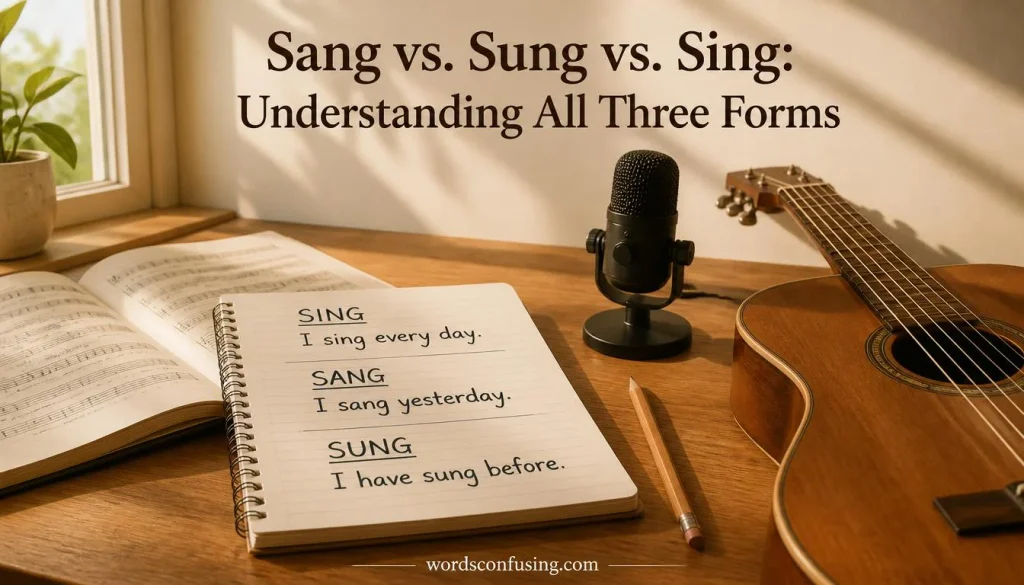
Sang vs. Sung vs. Sing: Understanding All Three Forms
To master sang and sung, you should also understand sing. All three forms belong to the same irregular verb, but each appears in different grammatical situations.
| Verb form | Main function | Example |
| Sing | Base form | I sing in the shower. |
| Sings | Present tense with third-person singular subjects | She sings every morning. |
| Sang | Simple past tense | She sang yesterday. |
| Sung | Past participle | She has sung before. |
| Singing | Present participle or gerund | She is singing now. |
Learning this family of verb forms helps you avoid errors in everyday writing.
When to Use Sing
Use sing for the base form of the verb. It appears after modal verbs, after do and does in questions or negatives, and in infinitive constructions.
Examples:
- I sing in the school choir.
- They sing together every weekend.
- She wants to sing professionally.
- Can you sing this melody?
- Did he sing at the event?
- We don’t sing during the examination.
Notice that modal verbs such as can, will, should, and might take the base form.
For example, “She can sing” is correct, while “She can sang” is not.
When to Use Sang
Use sang for a simple past action.
Examples:
- He sang at the concert.
- We sang after dinner.
- They sang during the celebration.
You don’t need a helping verb for an ordinary affirmative statement in the simple past.
When to Use Sung
Use sung when a perfect tense or passive construction requires a past participle.
Examples:
- I have sung that song.
- She had sung before the event.
- The song was sung beautifully.
- The anthem has been sung for decades.
A quick way to remember the difference is to study the structure rather than the meaning alone. All three forms describe singing, but grammar determines which one belongs in your sentence.
Read more: Comma Before or After “Now”? Rules and Common Mistakes
How to Remember the Difference Between Sang and Sung
You don’t need to memorize dozens of complicated grammar rules. A simple pattern can help you choose the correct form quickly.
Remember: Sing, sang, sung.
- Sing: The base form.
- Sang: A simple past action.
- Sung: A past participle used with the appropriate helping verb.
Try remembering these three short sentences:
- I sing every day.
- I sang yesterday.
- I have sung before.
The sentences follow a natural progression from the base form to the simple past and then the past participle.
Look for Helping Verbs
When you’re unsure whether to use sang or sung, look at the words immediately before the main verb.
If the sentence contains has, have, or had as part of a perfect tense, use sung.
- She has sung.
- They have sung.
- He had sung.
If you’re describing a completed past action without a helping verb, use sang.
- She sang yesterday.
- They sang at the party.
- He sang beautifully.
For passive voice, use a form of be with sung.
- The song was sung.
- The songs were sung.
This method won’t replace every grammar rule, but it will solve most everyday questions about these forms.
Practice Exercise: Sang or Sung?
Test your understanding by choosing the correct word for each sentence.
Fill in the blanks:
- She _____ at the school concert yesterday.
- I have _____ this song many times.
- They had _____ before the guests arrived.
- The anthem was _____ by the choir.
- We _____ together last weekend.
- Has he ever _____ in public?
- Did you _____ at the ceremony?
- The children have _____ that song before.
Answers and explanations:
| Sentence | Correct answer | Reason |
| She _____ yesterday. | Sang | Simple past tense |
| I have _____ many times. | Sung | Present perfect |
| They had _____ before the guests arrived. | Sung | Past perfect |
| The anthem was _____ by the choir. | Sung | Passive voice |
| We _____ last weekend. | Sang | Simple past tense |
| Has he ever _____ in public? | Sung | Present perfect question |
| Did you _____ at the ceremony? | Sing | Base form after did |
| The children have _____ before. | Sung | Present perfect |
If you answered all eight correctly, you’ve grasped the essential patterns. If you missed a few, focus on the helping verbs and try the exercise again.
FAQs
1. Is it sang or sung?
Both words are correct forms of the verb sing. Use sang for the simple past tense and sung with a helping verb, such as has, have, or had.
2. Is “I have sang” grammatically correct?
No, “I have sang” is incorrect in standard English. The correct sentence is “I have sung.” The present perfect tense requires the past participle sung.
3. Should I say “I sang a song” or “I sung a song”?
Say “I sang a song” when describing a completed action in the past. For example, “I sang a song at my friend’s birthday party.” Without a helping verb, sang is the correct choice.
4. When should I use sung in a sentence?
Use sung when a sentence requires the past participle of sing. It usually follows a helping verb, as in “She has sung in several school concerts” or “They had sung together before.”
5. Is sung the past tense of sing?
No. Sang is the simple past tense of sing, while sung is its past participle. Remember the three main forms: sing, sang, sung.
6. How can I remember the difference between sang and sung?
Remember this simple pattern: sing, sang, sung. Use sang for a past action, such as “He sang yesterday.” Use sung after a helping verb, such as “He has sung before.” Practicing these examples aloud can help you remember the correct forms.
Conclusion
Understanding sang or sung becomes much easier when you remember how each form works. Sang describes a past action, as in “She sang beautifully at the school concert.” Sung is the past participle and usually appears with a helping verb, as in “She has sung at many concerts.” Once you recognize this pattern, you can avoid common grammar mistakes and write more confidently.
Whether you’re improving your English vocabulary, practicing everyday conversations, or polishing your writing, keep the three verb forms in mind: sing, sang, sung. Try creating your own sentences and checking which form fits the sentence structure. A little practice goes a long way, and soon, choosing between sang and sung will feel natural.

Franklin Hayes is a writer and editor at WordsConfusing.com, focused on making English vocabulary, grammar, and commonly confused words easy to understand. He writes clear, practical articles with simple explanations and useful examples to help readers improve their English with confidence.
His goal is simple: Making Confusing Words Simple.