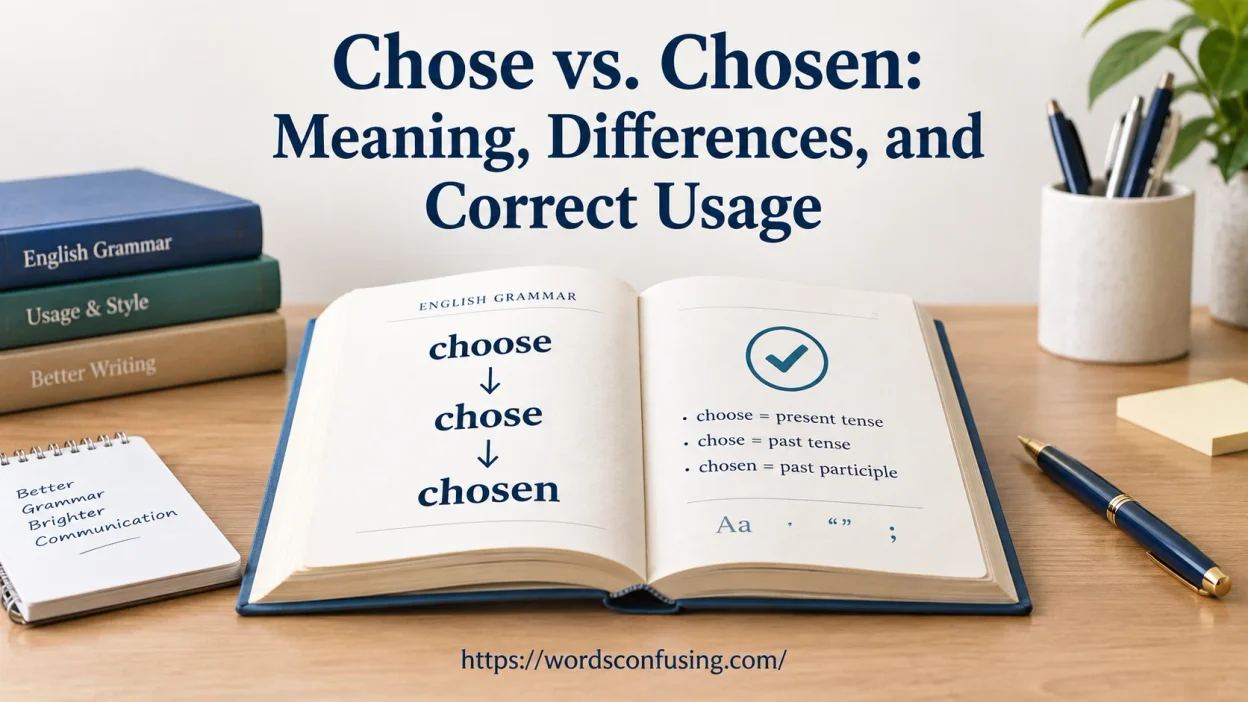
Chose vs. Chosen: Meaning and Correct Usage explains how these two forms work in English, so you can use each one correctly in the past tense.
If you feel confused about chose and chosen, their meaning becomes clearer when you learn how the irregular verb choose changes in different grammatical situations. Chose is the simple past tense, while chosen is the past participle.
For example, “Yesterday, I chose the blue shirt” describes an action that happened at a specific time in the past. This simple rule makes the correct usage of these words easy to follow. The key is to notice the pattern and remember that choose is the base form, while chose normally describes a completed past action.
The two main forms may seem like difficult things when you’re still building your understanding, but the difference becomes easier with a clear example. “I have chosen the blue shirt” uses have with You can also use had with chosen when one past event happened before another, and be can appear in other structures. These helping verbs help show the tense and explain when an action occurs.
chosen, while “She has chosen the blue shirt” uses has.
This article helps you explore the small difference, overcome the difficult part of understanding it, and see how these forms are used naturally. Once you recognize this pattern, choosing between chose and chosen becomes much easier.
Quick Answer
Chose is the simple past tense of choose. Use it when someone made a decision or selection in the past.
She chose the red dress.
Chosen is the past participle of choose. It normally appears with an auxiliary verb in perfect tenses or passive constructions.
She has chosen the red dress.
Here is the basic difference:
| Word | Verb form | Main use | Example |
| Choose | Base form | Present, infinitive, commands | I choose carefully. |
| Chose | Simple past | Completed past action | I chose carefully. |
| Chosen | Past participle | Perfect tenses and passive voice | I have chosen carefully. |
A quick memory trick helps:
Choose → present
Chose → past
Chosen → past participle
Once you recognize that pattern, chose vs. chosen becomes much easier.
Chose vs. Chosen: The Basic Difference
The words chose and chosen represent two different forms of the same irregular verb.
The base verb is choose. Its three prin
choose → chose → chosen
English has many irregular verbs that change their form rather than simply addicipal forms are:ng -ed. For example:
- go → went → gone
- see → saw → seen
- take → took → taken
- write → wrote → written
- choose → chose → chosen
The important point is that chose and chosen cannot normally replace each other.
Consider these examples:
I chose the blue car.
I have chosen the blue car.
The first sentence uses the simple past. The second uses the present perfect.
Now look at this sentence:
I have chose the blue car.
That sentence is incorrect because have requires the past participle chosen, not the simple past chose.
The distinction becomes clearer when you look at the verb forms individually.
What Does “Chose” Mean?
Chose means that someone made a selection or decision in the past.
It is the simple past tense of choose.
When you use chose, the action belongs to a completed past event. The sentence doesn’t need has, have, or had to form the tense.
For example:
- She chose the green jacket.
- We chose the Italian restaurant.
- He chose a different route.
- They chose the cheaper option.
- I chose to stay home.
In each example, chose tells you that the selection happened in the past.
When to Use “Chose”
Use chose when you simply want to describe a past choice.
A common structure looks like this:
Subject + chose + object
Examples:
Maria chose the window seat.
James chose the larger package.
The team chose a new captain.
You can also use chose with an infinitive:
Subject + chose + to + verb
Examples:
She chose to leave early.
He chose to study abroad.
We chose to wait.
They chose to cancel the meeting.
The verb following chose takes the infinitive form with to. You don’t say “chose to went” or “chose to studied.”
Instead, use:
- chose to go
- chose to study
- chose to leave
- chose to wait
Chose With Past-Time Expressions
Because chose is a simple past form, it commonly appears with expressions that identify a past period.
Examples include:
- yesterday
- last night
- last week
- last year
- earlier
- two days ago
- during the meeting
- when I was younger
For example:
She chose the blue option yesterday.
We chose that hotel last summer.
He chose the wrong answer during the test.
The time expression isn’t always necessary. Context can establish the past on its own.
After comparing both cars, she chose the smaller one.
The word chose already places the action in the past.
What Does “Chosen” Mean?
Chosen is the past participle of choose.
Unlike chose, it usually doesn’t function as the simple past by itself.
Instead, chosen works with auxiliary verbs to form perfect tenses and passive constructions.
Common combinations include:
- has chosen
- have chosen
- had chosen
- is chosen
- was chosen
- are chosen
- were chosen
- has been chosen
- had been chosen
For example:
She has chosen a new career.
They had chosen the location before the event.
He was chosen for the position.
The form chosen signals a grammatical structure that differs from simple past chose.
When to Use “Chosen”
Use chosen when the sentence requires a past participle.
The most common situation involves perfect tenses.
For the present perfect, use:
has/have + chosen
Examples:
She has chosen a college.
They have chosen a new leader.
I have chosen the blue one.
For the past perfect, use:
had + chosen
Examples:
She had chosen the dress before the sale ended.
They had chosen their seats before the doors opened.
I had already chosen my answer.
Chosen also appears in passive constructions.
For example:
She was chosen for the scholarship.
Here, she didn’t make the choice. Someone else selected her.
That distinction matters.
Chose vs. Chosen Grammar Comparison
The easiest way to understand the difference is to compare their grammatical roles.
| Feature | Chose | Chosen |
| Verb type | Simple past | Past participle |
| Basic verb | Choose | Choose |
| Used alone as past tense | Yes | No |
| Used with has/have | No | Yes |
| Used with had | No | Yes |
| Used in passive voice | No | Yes |
| Example | She chose it. | She has chosen it. |
| Meaning | She made the choice. | She has made the choice. |
One useful test is to look at the word immediately before the verb.
If you see has, have, or had, you generally need chosen.
She has chosen.
They have chosen.
We had chosen.
If you use a straightforward simple past sentence without an auxiliary verb, chose is usually correct.
She chose.
They chose.
We chose.
However, there’s another important detail. When did appears in a question or negative statement, you use the base form choose, not chose.
Did she choose the red one?
Not:
Did she chose the red one?
This three-way distinction is worth remembering:
did + choose
chose
has/have/had + chosen
“I Chose” vs. “I Have Chosen”
These expressions look similar, but they don’t always communicate the same idea.
“I Chose”
I chose uses the simple past.
It presents the choice as a past event.
I chose the blue shirt yesterday.
The sentence focuses on what happened in the past.
“I Have Chosen”
I have chosen uses the present perfect.
It connects a past choice with the present situation.
I have chosen the blue shirt.
This can imply that the decision matters now. Perhaps someone is waiting for your answer or needs to know your selection.
Compare these examples:
I chose a major last year.
I have chosen my major.
The first sentence points toward a past event. The second emphasizes the completed decision as relevant now.
That difference isn’t always dramatic. Context controls the precise meaning. Still, the grammatical distinction remains firm.
“She Chose” vs. “She Had Chosen”
The difference between chose and had chosen involves two points in the past.
Consider:
She chose the restaurant before we arrived.
This uses the simple past.
Now consider:
She had chosen the restaurant before we arrived.
The second sentence uses the past perfect.
Had chosen makes the sequence particularly clear. Her choice happened before another past event: our arrival.
Think of it as a timeline:
She chose the restaurant → We arrived
The past perfect highlights the earlier action:
She had chosen the restaurant → We arrived
This construction becomes useful when you need to establish the order of past events.
For example:
By the time the meeting started, the manager had chosen a new location.
The choosing happened first. The meeting started later.
“He Was Chosen” vs. “He Chose”
These sentences contain completely different meanings.
He chose the winner.
Here, he made the selection.
He was chosen as the winner.
Here, someone selected him.
The first sentence uses chose as an active verb. The second uses chosen in the passive voice.
This distinction can change the entire meaning of a sentence.
| Sentence | Meaning |
| She chose the winner. | She selected someone. |
| She was chosen as the winner. | Someone selected her. |
| They chose a captain. | They selected a captain. |
| They were chosen as captains. | Someone selected them. |
This is one of the most important applications of chosen.
Chose vs. Chosen in Different Sentence Structures
Different sentence structures naturally call for different forms.
Simple Past
Use chose:
He chose the first option.
Present Perfect
Use has/have chosen:
He has chosen the first option.
Past Perfect
Use had chosen:
He had chosen the first option before the discussion began.
Passive Voice
Use a form of be + chosen:
He was chosen for the role.
Perfect Passive
Use has/have/had + been + chosen:
He has been chosen for the role.
These patterns aren’t arbitrary. Each one follows the normal rules of English verb formation.
Chose vs. Chosen With “To”
The phrase chose to is extremely common.
Use:
chose + to + base verb
Examples:
She chose to stay.
He chose to apologize.
They chose to continue.
I chose to wait.
When the sentence uses a perfect tense, chosen replaces chose:
She has chosen to stay.
He had chosen to apologize.
They have chosen to continue.
This creates a useful contrast:
| Incorrect or correct? | Sentence |
| Correct | She chose to leave. |
| Correct | She has chosen to leave. |
| Incorrect | She has chose to leave. |
| Incorrect | She chosen to leave. |
The auxiliary verb determines the form.
Chose vs. Chosen in Questions
Questions often create another source of confusion.
When you use did, the main verb returns to its base form.
Correct:
Did you choose the blue one?
Incorrect:
Did you chose the blue one?
Why?
Because did already carries the past tense. English doesn’t normally mark the same past tense twice.
The structure is:
Did + subject + choose…?
For present-perfect questions, use chosen:
Have you chosen the blue one?
For past-perfect questions:
Had you chosen the blue one before the meeting?
Notice the pattern:
- Did you choose…?
- Have you chosen…?
- Had you chosen…?
This is a powerful shortcut for avoiding mistakes.
Chose vs. Chosen in Negative Sentences
Negative sentences follow the same grammatical patterns.
With did not, use choose:
I did not choose the red one.
Not:
I did not chose the red one.
With has not, have not, or had not, use chosen:
She has not chosen a college yet.
They have not chosen a date.
He had not chosen a replacement.
Again, the auxiliary verb controls the form.
A Simple Comparison
| Structure | Correct form | Example |
| Simple past | chose | She chose the red one. |
| Past with did | choose | She did not choose the red one. |
| Present perfect | chosen | She has chosen the red one. |
| Past perfect | chosen | She had chosen the red one. |
Common Mistakes With Chose and Chosen
Several mistakes appear repeatedly in everyday writing.
“I Have Chose”
This is incorrect.
Have requires the past participle.
Correct:
I have chosen a new option.
Incorrect:
I have chose a new option.
“She Chosen”
This is also incorrect when chosen acts as the main verb without an auxiliary.
Correct:
She chose the blue dress.
Correct:
She has chosen the blue dress.
Incorrect:
She chosen the blue dress.
“He Did Chose”
After did, use the base form.
Correct:
He did choose the right answer.
More commonly:
He chose the right answer.
The construction did choose can be grammatical when you want emphasis. However, ordinary statements usually don’t need it.
“They Had Chose”
After had, use the past participle.
Correct:
They had chosen another route.
Incorrect:
They had chose another route.
Chose vs. Chosen vs. Choose
Learning all three forms together makes the distinction much easier.
| Form | Grammatical role | Example |
| Choose | Base form | I choose carefully. |
| Chose | Simple past | I chose carefully. |
| Chosen | Past participle | I have chosen carefully. |
The same pattern appears in many irregular verbs.
Consider:
write → wrote → written
You wouldn’t normally say:
I have wrote the letter.
You say:
I have written the letter.
Likewise:
choose → chose → chosen
So:
I chose the letter.
but:
I have chosen the letter.
Once you understand how irregular verb forms work, the distinction feels much less mysterious.
Read more: Begun vs. Began: What’s the Difference?
Chose vs. Chosen Pronunciation
Pronunciation can also help you recognize these words.
Chose is generally pronounced:
/tʃoʊz/
It has one syllable.
Chosen is generally pronounced:
/ˈtʃoʊzən/
It has two syllables.
The ending in chosen sounds roughly like “zən.”
You can hear the difference clearly:
- chose — one syllable
- chosen — two syllables
For English learners, this pronunciation difference can reinforce the grammatical distinction.
When speaking naturally, the extra syllable in chosen makes it easy to hear that the word isn’t simply another pronunciation of chose.
Chose vs. Chosen: Real-Life Examples
Grammar becomes easier when you see these forms in realistic situations.
Choosing a Meal
We chose pizza for dinner last night.
The choice happened in the past.
We have chosen pizza for tonight’s dinner.
The decision has been made and remains relevant now.
Choosing a Career
She chose nursing after graduation.
This describes a past decision.
She has chosen nursing as her career.
This emphasizes the completed decision and its current relevance.
Choosing a Travel Route
They chose the coastal road yesterday.
Simple past.
They had chosen the coastal road before the weather changed.
Past perfect.
Being Selected
The committee chose Daniel for the position.
Daniel wasn’t making the selection. The committee was.
Daniel was chosen for the position.
Here, chosen expresses the selection Daniel received.
These examples show why context matters. The words aren’t interchangeable simply because they describe related actions.
A Practical Case Study: Choosing Between Two Sentences
Imagine you’re writing about a student who selected a university.
You might write:
Maya chose the university after visiting three campuses.
This works because the sentence describes a completed past decision.
Now suppose the focus shifts to the decision’s present result:
Maya has chosen the university she wants to attend.
That works because has chosen uses the present perfect.
Now add another past event:
Maya had chosen the university before her parents arrived.
The past perfect shows that her choice occurred first.
Finally, suppose the university selected Maya for a scholarship:
Maya was chosen for the scholarship.
The meaning changes completely. Maya didn’t select the scholarship. Someone selected Maya.
This small example demonstrates all the major uses of chose and chosen.
How to Remember Chose vs. Chosen
A compact memory trick can save you from repeated mistakes.
Remember “Chose” as Past
Think:
Yesterday, I chose.
If you’re describing a straightforward completed past action, chose is often the form you need.
Examples:
- I chose.
- She chose.
- We chose.
- They chose.
Remember “Chosen” With Helping Verbs
Think:
I have chosen.
Common combinations include:
- has chosen
- have chosen
- had chosen
- was chosen
- were chosen
- has been chosen
- had been chosen
This doesn’t mean every appearance of chosen must follow exactly the same word. However, the auxiliary-verb pattern covers most everyday uses.
Chose vs. Chosen: A Fast Decision Guide
When you’re unsure which word to use, ask yourself a few questions.
Is the sentence describing a simple past action?
Use chose.
She chose the smaller box.
Does the sentence contain has, have, or had?
Use chosen.
She has chosen the smaller box.
Is the sentence passive?
Use chosen with the appropriate form of be.
She was chosen for the position.
Does the sentence contain did?
Use choose, not chose or chosen.
Did she choose the smaller box?
This four-question check catches most errors immediately.
Chose vs. Chosen: Quick Practice
Choose the correct form in each sentence.
Practice Questions
1. She ___ the blue dress yesterday.
2. She has ___ the blue dress.
3. They ___ the cheapest option last week.
4. They had ___ another option before the meeting.
5. Did he ___ the correct answer?
6. He was ___ as team captain.
Answers
1. chose
She chose the blue dress yesterday.
The sentence uses the simple past.
2. chosen
She has chosen the blue dress.
The word has requires the past participle.
3. chose
They chose the cheapest option last week.
The sentence describes a completed past action.
4. chosen
They had chosen another option before the meeting.
The word had requires the past participle.
5. choose
Did he choose the correct answer?
The auxiliary did takes the base form.
6. chosen
He was chosen as team captain.
The sentence uses the passive voice.
Chose vs. Chosen: The Most Important Rules
If you only remember a handful of rules, remember these:
- Choose is the base form.
- Chose is the simple past form.
- Chosen is the past participle.
- Use chose for a straightforward past action.
- Use chosen after has, have, or had.
- Use chosen in passive constructions such as was chosen.
- Use choose after did.
- Don’t write has chose.
- Don’t write had chose.
- Don’t write did chose in an ordinary past-tense question.
The pattern is simple once you see it:
1 I choose today.
2 I chose yesterday.
3 I have chosen already.
Those three sentences capture the core difference.
Chose vs. Chosen in Everyday Writing
In emails, essays, reports, conversations, and casual messages, the same rules apply.
You might write:
We chose the second proposal during yesterday’s meeting.
Or:
We have chosen the second proposal after reviewing all the options.
In a report, you might write:
The committee had chosen a different approach before the new evidence appeared.
In a workplace announcement, you could write:
Jordan was chosen to lead the project.
The context changes, but the grammar doesn’t.
That’s why learning the underlying verb forms is more useful than memorizing isolated sentences.
FAQs
Is “chose” the past tense of “choose”?
Yes. Chose is the simple past tense of choose. Use it when you’re talking about an action that happened in the past. For example, “She chose the red dress yesterday.”
Is “chosen” the past tense of “choose”?
No. Chosen is the past participle of choose. It usually works with a helping verb such as have, has, or had. For example, “They have chosen a new location.”
When should I use “chose” in a sentence?
Use chose when the action happened and finished in the past. You don’t normally need a helping verb before it. For example, “I chose the blue shirt last week.”
When should I use “chosen” instead of “chose”?
Use chosen when the sentence needs a past participle. It commonly appears after have, has, or had. For example, “She has chosen her favorite option.”
Can “chosen” be used without a helping verb?
Yes, but the structure changes. Chosen can appear after forms of be in passive constructions, such as “He was chosen for the team.” Here, was works as the helping verb.
What is an easy way to remember chose vs. chosen?
Think of chose as a completed past action and chosen as a form that usually needs help. Compare “I chose the book” with “I have chosen the book.” This simple pattern can help you avoid the most common mistake.
Conclusion
At first glance, chose and chosen can seem like two versions of the same word. The trick is to focus on how they function in a sentence. Chose stands on its own as the simple past form: “I chose the blue shirt yesterday.” Chosen, on the other hand, usually needs a helping verb: “I have chosen the blue shirt.”
Once you get used to this pattern, the difference becomes surprisingly simple. When you’re talking about a finished action in the past, reach for chose. When the sentence calls for a past participle, chosen is your word. Keep that small distinction in mind, and you’ll be much less likely to second-guess yourself the next time you need to choose the right form.

Shafiq Ur Rehman is a writer and content contributor at WordsConfusing.com. He enjoys exploring the English language, common word confusions, vocabulary, and practical writing tips. His goal is to make English easier to understand through clear, simple, and useful articles.