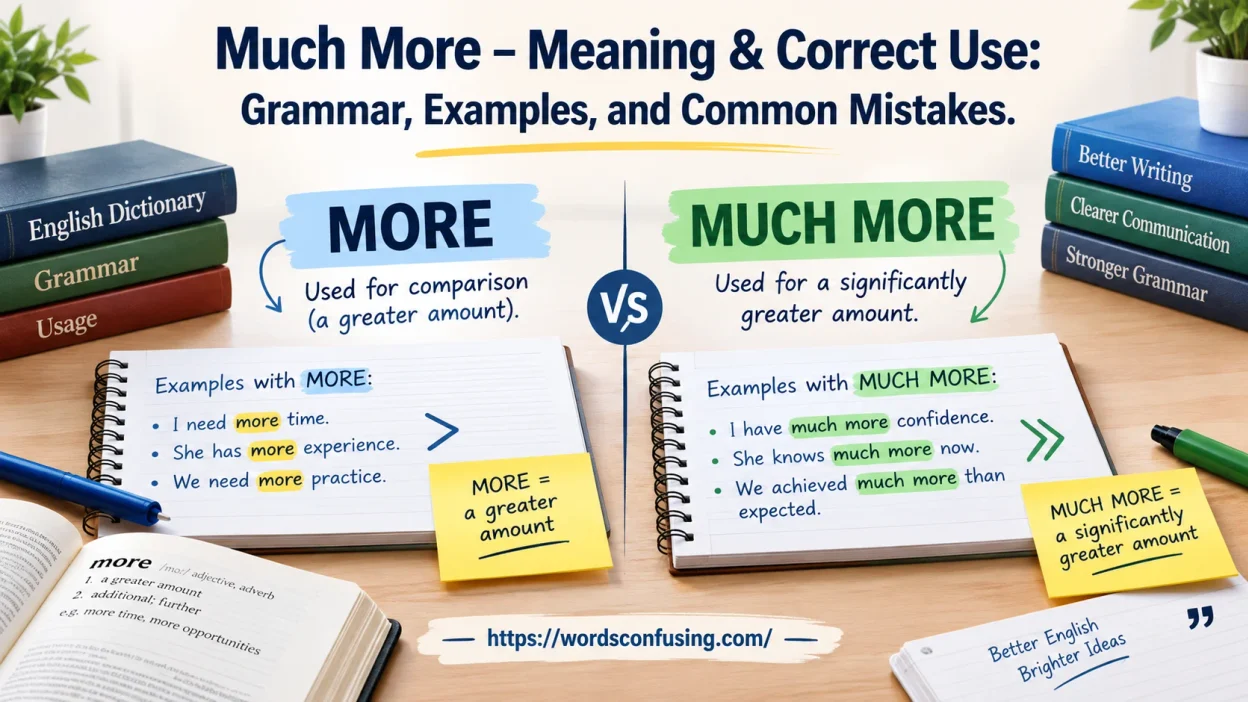
“Much”, more, and everyday English often work together naturally. “Much More” Meaning & Correct Use explains how “much” adds emphasis when “more” shows a greater degree, amount, value, or usefulness in everyday use.
When we combine these words, the phrase “much more” becomes a natural expression for making a comparison. It can show a greater amount, greater degree, greater value, or greater usefulness when we compare one thing with something else or another option. In simple terms, it means something is noticeably more than another.
For example, “This method is much more useful” tells us that the choice provides greater benefits or more practical value.
From my experience with English usage, this wording makes comparisons clearer and stronger without making the sentence complicated. It can describe something valuable or useful to somebody, depending on the context.
As a quantifiable term, “much more” can refer to quantity, but its use extends beyond numbers. It can compare quality, importance, likelihood, value, or usefulness and emphasizes a noticeable difference between two options or similar things. When something ranks highly in a particular context, words such as better or stronger can make that difference easier for readers to understand.
The phrase also works when you want to show a greater amount of a particular quality. That makes “much more” a good word choice when you need a simple, natural, and precise way to explore a difference.
Quick Answer
“Much more” means a considerably greater amount, degree, or extent. It adds emphasis to more and shows that the difference is noticeable. For example, “This option is much more affordable than the other one” means it costs noticeably less than the alternative. You can use much more with comparative adjectives, adverbs, and uncountable nouns, such as much more useful, much more carefully, and much more information. However, use many more with plural countable nouns, such as many more books or many more examples.
| Expression | Meaning | Example |
| More | A greater amount or degree | This method is more useful. |
| Much more | A considerably greater amount or degree | This method is much more useful. |
| Many more | A greater number of countable things | We need many more examples. |
| A lot more | A noticeably greater amount or degree | This option costs a lot more. |
| Far more | A significantly greater amount or degree | This solution is far more effective. |
What Does “Much More” Mean?
The basic much more meaning is a considerably greater amount, degree, or extent.
The phrase combines two words:
- Much = a large amount or degree
- More = a greater amount or degree than before or than something else
When you put them together, much emphasizes more.
Compare these sentences:
- This phone is more expensive.
- This phone is much more expensive.
The first sentence gives a simple comparison. The second suggests that the price difference is noticeable or substantial.
That small word much changes the strength of the statement.
Simple Definition of “Much More”
Much more means considerably more, significantly more, or to a much greater degree.
For example:
- I need much more time.
- She has much more experience.
- The second option is much more practical.
- He speaks much more confidently now.
The exact meaning depends on what follows much more. It can describe quantities, qualities, actions, or degrees.
Is “Much More” Grammatically Correct?
Yes. “Much more” is grammatically correct.
English commonly uses much before comparative forms to emphasize a difference.
You can say:
- much better
- much worse
- much easier
- much harder
- much faster
- much slower
- much more useful
- much more expensive
- much more carefully
For example:
The new system is much more efficient.
The comparative expression is more efficient. The word much intensifies it.
Without much:
The new system is more efficient.
With much:
The new system is much more efficient.
Both sentences are grammatically correct. The second one simply expresses a stronger difference.
Breaking Down the Grammar of “Much More”
Understanding each word makes the entire expression easier to use.
What Does “More” Do?
More is a comparative word. It tells you that one thing has a greater amount or degree than another.
For example:
- more time
- more money
- more information
- more useful
- more difficult
- more quickly
Consider:
This book is more useful.
The word more establishes a comparison. The book has a greater degree of usefulness.
What Does “Much” Do?
In much more, the word much works as an intensifier.
It doesn’t replace more. Instead, it strengthens it.
Compare:
This task is more difficult.
with:
This task is much more difficult.
The second sentence tells you that the difference in difficulty feels considerably larger.
A useful way to remember the structure is:
much + comparative expression
Examples include:
- much better
- much worse
- much faster
- much more useful
- much more expensive
Basic “Much More” Sentence Structure
Several common structures appear in natural English.
Much More + Adjective
Use this structure when you want to emphasize a greater degree of a quality.
Pattern:
Subject + be + much more + adjective
Examples:
- This plan is much more practical.
- The new design is much more attractive.
- That route is much more convenient.
- The second question is much more difficult.
You can also add than when you want to identify the comparison.
This plan is much more practical than the original one.
Much More + Adverb
You can also use much more with comparative adverbial expressions.
Examples:
- She works much more efficiently now.
- He explained the problem much more clearly.
- They responded much more quickly this time.
- The machine operates much more quietly.
Here, much emphasizes the comparative adverb.
Compare:
She works more efficiently now.
with:
She works much more efficiently now.
The second sentence highlights a stronger improvement.
Much More + Uncountable Noun
Much more commonly appears before uncountable nouns.
Examples include:
- much more time
- much more money
- much more information
- much more water
- much more effort
- much more patience
- much more experience
- much more work
For example:
We need much more information before making a decision.
The noun information is uncountable. That’s why much more information works naturally.
“Much More Than” Meaning and Correct Use
The expression “much more than” makes an explicit comparison.
It means that something exceeds another thing by a significant amount or degree.
For example:
This apartment is much more expensive than the previous one.
The structure clearly compares two apartments.
Another example:
She knows much more about the subject than I do.
Here, much more indicates a significantly greater amount of knowledge.
Common “Much More Than” Patterns
Much More + Adjective + Than
This solution is much more effective than the first one.
The new model is much more reliable than the older version.
Much More + Adverb + Than
He completed the work much more quickly than expected.
She speaks much more confidently than she did last year.
Much More + Noun + Than
We need much more time than we originally planned.
The project requires much more money than expected.
Verb + Much More Than
Sometimes much more than follows a verb directly.
He earns much more than his brother.
She studies much more than she used to.
They travel much more than before.
In these sentences, much more doesn’t need an adjective after it.
Can You Use “Much More” Without “Than”?
Yes. You don’t need “than” every time you use “much more.”
English speakers often leave the comparison unstated when the context already makes it obvious.
For example:
This version is much more useful.
The sentence doesn’t say exactly what it is being compared with. However, the listener can usually understand that the speaker means it is more useful than another version or than it was previously.
Other examples include:
- I feel much more confident now.
- This explanation is much more helpful.
- The new process is much more efficient.
- We need much more information.
- She seems much more relaxed.
In each example, the comparison can be understood from the surrounding context.
Explicit vs. Implied Comparison
Consider these two sentences:
This car is much more comfortable than my old car.
The comparison is explicit.
Now consider:
This car is much more comfortable.
The comparison is implied.
The second sentence works when everyone already knows what the speaker is comparing.
“Much More” With Adjectives
One of the most common uses of much more involves comparative adjectives.
Some adjectives naturally use more rather than an -er ending.
For example:
- more beautiful
- more interesting
- more important
- more expensive
- more complicated
- more comfortable
- more effective
- more reliable
You can strengthen these comparisons with much.
Examples
The second design is much more attractive.
This approach is much more effective.
The new software is much more complicated.
That explanation is much more understandable.
Online shopping is much more convenient for many people.
The pattern remains simple:
much + more + adjective
“Much More” With Adverbs
The same idea works with adverbs.
For example:
She answered much more carefully.
He drives much more slowly at night.
The team performed much more consistently this season.
They handled the complaint much more professionally.
The word much emphasizes the comparative adverb.
Without much, the comparison sounds more neutral:
They handled the complaint more professionally.
With much:
They handled the complaint much more professionally.
The second version emphasizes the size of the improvement.
“Much More” With Uncountable Nouns
This is another major use of the phrase.
Uncountable nouns refer to things that English generally treats as substances, concepts, or quantities rather than individual units.
Common examples include:
| Uncountable noun | Correct phrase |
| information | much more information |
| time | much more time |
| money | much more money |
| water | much more water |
| advice | much more advice |
| experience | much more experience |
| patience | much more patience |
| effort | much more effort |
| work | much more work |
| energy | much more energy |
For example:
The doctor needs much more information before reaching a conclusion.
This project will require much more time.
The company invested much more money this year.
The important point is that much more can describe a larger quantity of something uncountable.
“Much More” vs. “Many More”
This distinction causes frequent grammar mistakes.
The easiest rule is:
Use “much more” with uncountable nouns. Use “many more” with plural countable nouns.
Compare:
- much more information
- many more books
You can’t normally say:
- ❌ much more books
- ❌ many more information
The correct versions are:
- ✅ many more books
- ✅ much more information
Countable vs. Uncountable Examples
| Incorrect | Correct | Reason |
| much more books | many more books | Books are countable |
| many more information | much more information | Information is uncountable |
| much more students | many more students | Students are countable |
| many more money | much more money | Money is uncountable |
| much more questions | many more questions | Questions are countable |
| many more time | much more time | Time is uncountable |
A Simple Test
Ask yourself whether you can naturally count the noun individually.
You can say:
- one book
- two books
- three books
Therefore:
many more books
You don’t normally say:
- one information
- two informations
Therefore:
much more information
This simple test can prevent many common errors.
Read more: Can an Opinion Be Right or Wrong? Real Examples
“Much More” vs. “More”
The difference between more and much more mainly involves emphasis.
More
More expresses a greater amount or degree.
This option is more affordable.
Much More
Much more emphasizes that the difference is substantial.
This option is much more affordable.
The first statement is neutral. The second makes the contrast stronger.
| Expression | Strength | Example |
| more | Neutral comparison | This method is more useful. |
| much more | Stronger comparison | This method is much more useful. |
Neither expression is automatically better. Choose much more when the larger difference matters.
“Much More” vs. “A Lot More”
A lot more and much more often communicate a similar idea.
Compare:
This version is much more reliable.
This version is a lot more reliable.
Both sentences suggest a noticeable difference.
The main distinction involves tone and context.
Much more works comfortably in formal and informal English.
A lot more tends to sound more conversational.
Examples
Formal or neutral:
The revised process is much more efficient.
Conversational:
The revised process is a lot more efficient.
Neither is wrong. Your audience and setting should guide the choice.
“Much More” vs. “Far More”
Far more also strengthens a comparative statement.
Compare:
This option is much more practical.
This option is far more practical.
Both express a significant difference. However, far more can create a particularly strong contrast.
For example:
The new system is far more reliable than the old one.
That sentence puts strong emphasis on the difference.
In many situations, much more and far more can replace each other without changing the basic meaning.
“Much More” vs. “Much”
These expressions look similar, but they don’t mean the same thing.
Compare:
I don’t have much time.
with:
I need much more time.
In the first sentence, much describes the amount of time.
In the second sentence, more indicates an additional amount. Much strengthens that increase.
Another comparison:
She doesn’t have much experience.
She needs much more experience.
The first means her experience is limited. The second says she needs a substantially greater amount.
“Much More” in Questions
You can naturally use much more in questions.
Examples:
- Do you need much more time?
- Will this require much more money?
- Does the project need much more work?
- Do we need much more information?
You can also use how much more when asking about an additional amount.
For example:
How much more time do you need?
This asks for the additional amount of time required.
Another example:
How much more money will the project cost?
Here, how much more asks about the additional cost.
“Much More” in Negative Sentences
Negative sentences can also contain the phrase.
Examples:
We don’t need much more time.
She doesn’t need much more practice.
They can’t spend much more money.
The machine doesn’t require much more energy.
These sentences often suggest that only a limited additional amount is needed, available, or possible.
The meaning comes from the combination of much, more, and the negative verb.
Common Mistakes With “Much More”
Although the phrase is straightforward, several errors appear regularly.
Using “Much More” With Plural Countable Nouns
Incorrect:
❌ There are much more students this year.
Correct:
✅ There are many more students this year.
Because students are countable, use many more.
Using “Many More” With Uncountable Nouns
Incorrect:
❌ We need many more information.
Correct:
✅ We need much more information.
Information is uncountable in standard English.
Assuming “Much More” Needs “Than”
Incorrect assumption:
You must always use “than” after much more.
That’s not true.
Correct:
This version is much more useful.
You can add than when you want to state the comparison:
This version is much more useful than the previous one.
Treating “Much More” as Redundant
Some learners think much and more repeat the same meaning.
They don’t.
More establishes the comparison.
Much intensifies it.
Think of the difference this way:
more = greater
much more = considerably greater
That’s why both words have a useful grammatical role.
Common “Much More” Sentence Patterns
These patterns cover most everyday situations.
Much More + Adjective
The new plan is much more realistic.
Much More + Adjective + Than
The new plan is much more realistic than the old one.
Much More + Adverb
She works much more efficiently now.
Much More + Uncountable Noun
We need much more information.
Much More + Uncountable Noun + Than
We need much more information than we expected.
Verb + Much More Than
He exercises much more than before.
Much More Without “Than”
I feel much more comfortable here.
These structures are worth learning because they let you produce natural sentences without memorizing isolated examples.
“Much More” Examples in Everyday English
Real-world examples make the grammar easier to remember.
At Work
The new system is much more efficient.
This project requires much more planning.
The updated report contains much more useful information.
At School
This chapter is much more difficult than the previous one.
She understands the topic much more clearly now.
You need much more practice before the exam.
While Shopping
The premium model is much more expensive.
This product offers much more value for the price.
The larger package contains much more product.
During Travel
The train is much more comfortable than the bus.
This route is much more convenient.
We need much more time to reach the airport.
In Everyday Conversation
I feel much more relaxed today.
That sounds much more interesting.
She seems much more confident now.
These examples show how naturally much more fits into ordinary communication.
Case Study: Choosing Between “More” and “Much More”
Imagine that someone compares two laptops.
The first sentence says:
Laptop B is more powerful than Laptop A.
That’s a normal comparison.
Now change it:
Laptop B is much more powerful than Laptop A.
The second sentence communicates a stronger difference. The speaker doesn’t merely want to say that Laptop B has an advantage. They want to emphasize that the advantage is substantial.
Now imagine a different comparison:
Laptop B costs much more than Laptop A.
Here, much more refers to a significantly higher price.
The phrase can therefore describe both quality and quantity.
How “Much More” Changes Meaning Through Context
The phrase doesn’t always indicate the same numerical difference.
For example:
This bag costs much more.
That could mean $20 more, $200 more, or $2,000 more depending on the context.
Likewise:
She has much more experience.
The sentence doesn’t specify the exact number of years.
This matters because much more describes relative difference rather than a fixed measurement.
You shouldn’t assume that “much” always equals a specific percentage or quantity.
Instead, it signals that the difference feels large enough to deserve emphasis.
“Much More” in Formal and Informal English
You can use much more in almost any English setting.
Academic Writing
The revised method is much more effective for long-term analysis.
Professional Writing
The updated process is much more efficient than the previous system.
Everyday Conversation
This place is much more comfortable.
The expression isn’t slang. It doesn’t sound unprofessional. It’s a normal part of standard English.
That makes much more a useful choice when you want a strong comparison without sounding overly dramatic.
Quick Decision Guide for “Much More”
When you’re unsure which expression to use, follow this simple guide.
Are you describing a greater degree or amount?
→ Use more.
Do you want to emphasize a substantial difference?
→ Use much more.
Are you describing plural countable nouns?
→ Use many more.
Do you want a conversational alternative?
→ Use a lot more.
Do you want strong comparative emphasis?
→ Use far more.
Quick Reference
| Phrase | Main Use | Example |
| more | General comparison | more useful |
| much more | Stronger comparison | much more useful |
| many more | Plural countable nouns | many more books |
| a lot more | Conversational strong comparison | a lot more useful |
| far more | Strong comparative emphasis | far more useful |
FAQs
1. What does “much more” mean?
“Much more” means a noticeably greater amount or degree of something compared with another thing. It adds emphasis to the word “more.”
2. Is “much more” grammatically correct?
Yes. “Much more” is a common and grammatically correct expression in everyday English. It’s often used to make comparisons stronger.
3. Can “much more” describe quantity?
Yes. You can use “much more” to describe a greater quantity, such as “I need much more time” or “She has much more experience.”
4. Can “much more” be used with adjectives?
Yes. It commonly comes before comparative adjectives, such as much more useful, much more valuable, much more important, or much more practical.
5. What is the difference between “more” and “much more”?
“More” shows an increase or comparison, while “much more” emphasizes that the difference is larger or more noticeable.
6. Is “much more” formal or informal?
“Much more” works in both formal and informal English. You can use it naturally in conversations, academic writing, professional communication, and everyday sentences.
Conclusion
Understanding “much more” is simple once you see how it strengthens a comparison. We use it when more alone doesn’t fully express the difference and we want to show a greater degree, quantity, value, or importance. It fits naturally into everyday English and can make your sentences clearer and more expressive.
Whether you’re comparing two choices, describing a noticeable change, or explaining why one option is much more useful than another, this phrase gives your writing extra clarity. The key is to use “much more” when the difference feels significant rather than simply saying “more.” With a little practice, you’ll be able to use it naturally in both casual conversations and formal writing.

Franklin Hayes is a writer and editor at WordsConfusing.com, focused on making English vocabulary, grammar, and commonly confused words easy to understand. He writes clear, practical articles with simple explanations and useful examples to help readers improve their English with confidence.
His goal is simple: Making Confusing Words Simple.