
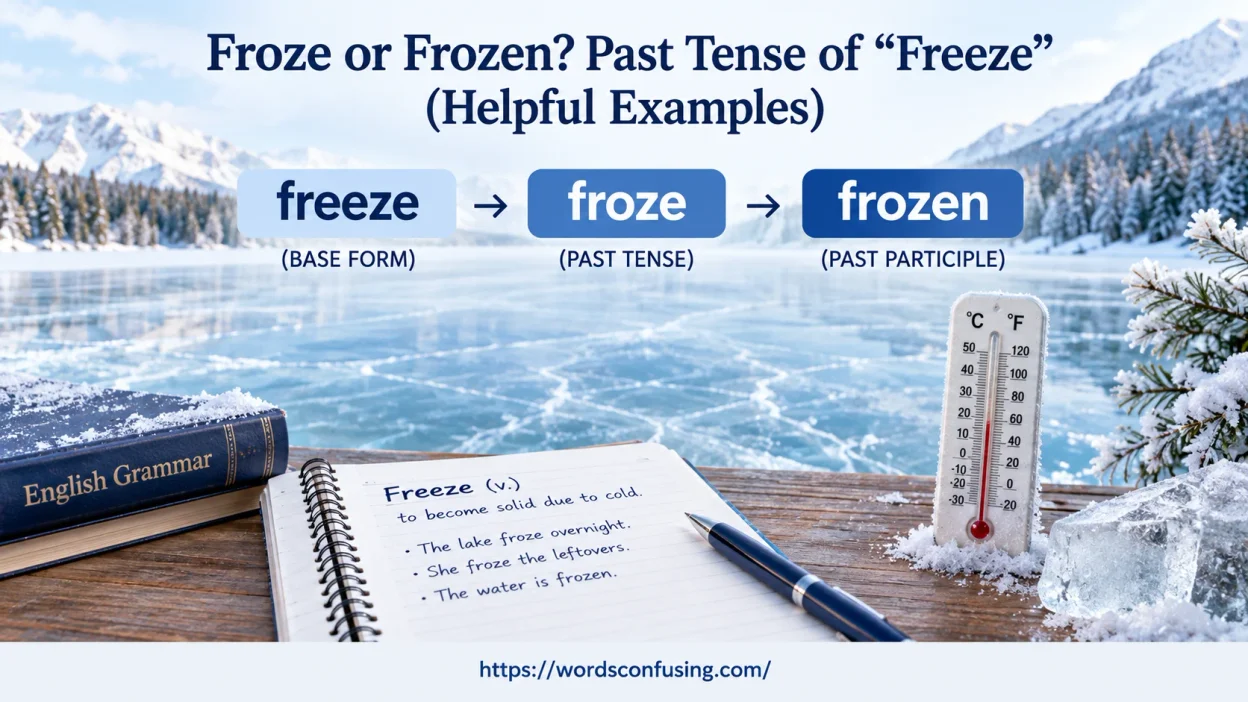
This guide to Froze or Frozen? Past Tense of “Freeze” Helpful Examples helps English learners understand forms, tense, and grammar rules clearly.
English grammar can seem tricky because freeze is an irregular verb. Froze is the simple past, while frozen is the past participle. The difference becomes clearer when you check the sentence structure and auxiliary verbs.
In “The lake froze overnight,” the event is complete. “The lake has frozen” uses an auxiliary with the participle for learners and teachers.
For writers and students, this simple habit improves correct usage and clear communication. First check the tense, then notice the forms and roles in the sentence. These practical examples help you avoid common mistakes in everyday communication, professional emails, academic writing, and business communication.
Regular practice, memory tricks, and reviewing terms can make the pattern feel natural. Remember: standard verbs often use -ed, but irregular verbs change form, so careful understanding builds confidence and clarity.
Quick Answer
Froze is the simple past tense of freeze.
Frozen is the past participle of freeze.
The basic verb forms are:
| Verb form | Word | Example |
| Base form | freeze | Water can freeze quickly. |
| Simple past | froze | The lake froze last night. |
| Past participle | frozen | The lake has frozen. |
| Present participle | freezing | The lake is freezing. |
A useful pattern to remember is:
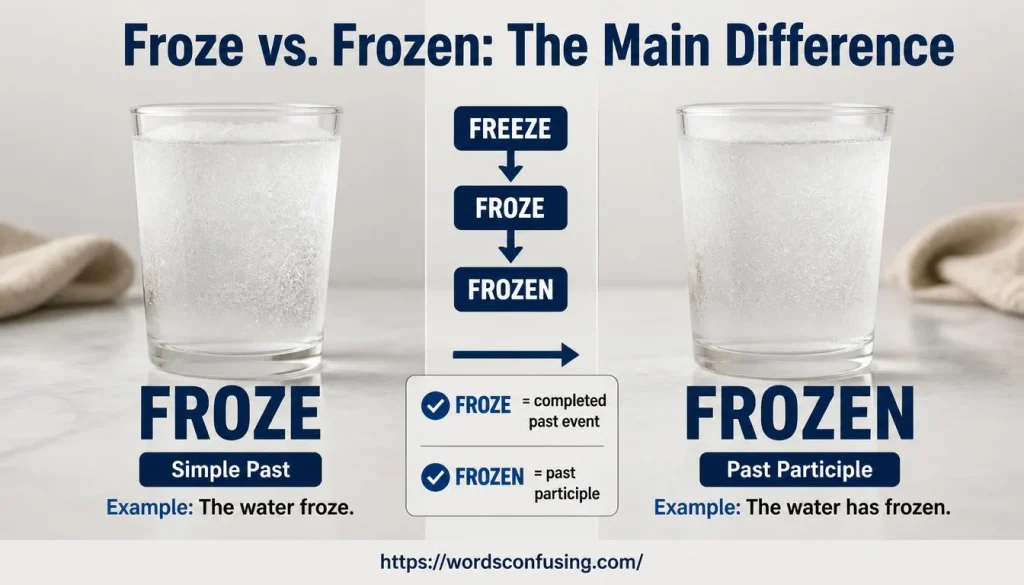
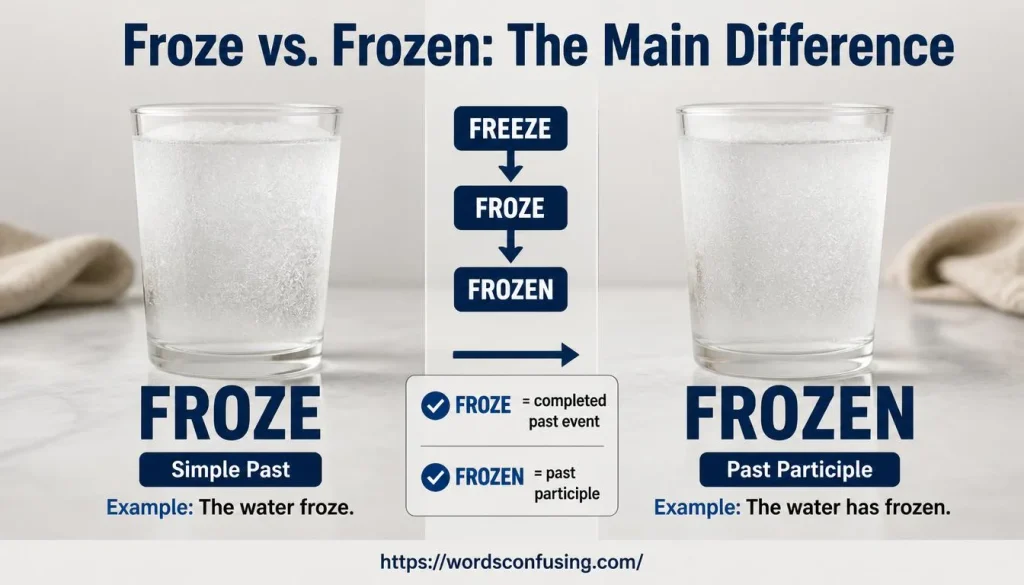
Freeze → Froze → Frozen
Use froze when describing a completed action in the past without an auxiliary verb.
Use frozen after helping verbs such as has, have, or had, or when describing something that exists in a frozen state.
Compare These Sentences
The pipes froze last night.
Here, froze tells you what happened in the past.
The pipes have frozen.
Here, frozen works with have to form the present perfect.
The pipes are frozen.
Here, frozen describes the current condition of the pipes.
That small grammatical difference makes a big difference in your sentence.
What Is the Past Tense of “Freeze”?
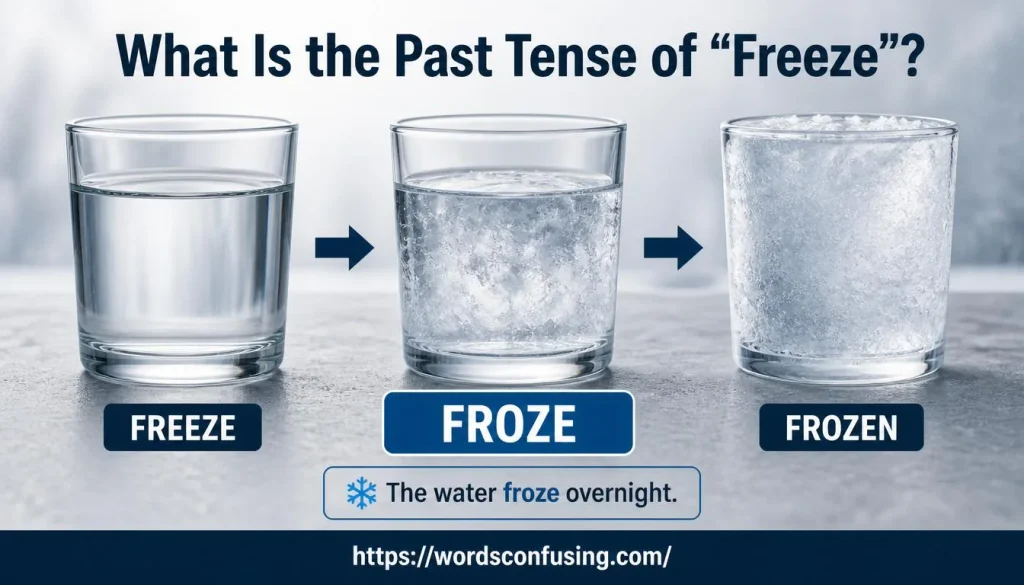
The simple past tense of freeze is froze.
Unlike regular verbs such as walk → walked or jump → jumped, freeze changes its internal vowel. That’s why you can’t form the past tense by simply adding -ed.
The correct forms are:
- Present: freeze
- Past: froze
- Past participle: frozen
For example:
- I freeze leftover food every Sunday.
- I froze the leftovers yesterday.
- I have frozen the leftovers for later.
The word froze describes something that happened in the past. It doesn’t require another helping verb.
Examples of “Froze” in the Simple Past
- The lake froze during the cold snap.
- The water froze overnight.
- My hands froze while I waited outside.
- The pipes froze during the storm.
- She froze when she heard the unexpected noise.
- My computer froze during the presentation.
- The children froze when the teacher entered.
- The machine froze after the software update.
Notice the common feature. Each sentence presents froze as a completed past event.
What Is the Past Participle of “Freeze”?
The past participle of freeze is frozen.
Unlike froze, the word frozen normally needs a helping verb when it functions as part of a perfect verb construction.
For example:
- I have frozen the food.
- She has frozen the leftovers.
- They had frozen the water.
- The temperature has frozen the pipes.
You can also find frozen in passive constructions:
- The food was frozen immediately.
- The pipes were frozen by the cold.
- The samples were frozen for storage.
In addition, frozen frequently works as an adjective:
- The lake is frozen.
- The chicken is frozen.
- The ground remained frozen all morning.
This versatility explains why frozen appears in many different sentence structures.
Freeze, Froze, Frozen, and Freezing
Understanding all four forms makes the froze vs. frozen distinction much easier.
| Form | Grammatical role | Example |
| freeze | Base form | Water can freeze below 32°F. |
| froze | Simple past | The pond froze last night. |
| frozen | Past participle | The pond has frozen. |
| freezing | Present participle/gerund | The water is freezing. |
The forms don’t work interchangeably.
You wouldn’t normally say:
The pond frozen last night.
You’d say:
The pond froze last night.
Likewise, you wouldn’t say:
The pond has froze.
The standard form is:
The pond has frozen.
The auxiliary verb gives you an important grammatical clue.
Froze: When Should You Use It?
Use froze when you want to describe a completed event in the past.
The action may involve actual ice or something more figurative. Either way, froze functions as the simple past form.
Literal Examples
When water changes from liquid to solid, use froze for a completed past event.
- The pond froze overnight.
- The lake froze after several days of subfreezing temperatures.
- The water in the bucket froze before sunrise.
- The pipes froze during the unusually cold night.
The same pattern applies to food and other objects.
- The soup froze in the outdoor refrigerator.
- The berries froze before we could use them.
- The wet clothes froze outside.
Figurative Examples
The verb freeze also has several figurative meanings.
A person can freeze because of fear, surprise, uncertainty, or shock.
For example:
- I froze when everyone looked at me.
- She froze when she heard the alarm.
- He froze during the interview.
- They froze when the dog suddenly ran toward them.
In these examples, the person doesn’t literally turn into ice. Instead, froze means the person suddenly stopped moving, speaking, or reacting.
Technology Examples
Technology provides another common use.
When a computer, phone, application, or screen stops responding, English speakers often say it froze.
- My laptop froze during the meeting.
- The app froze when I tried to upload the file.
- My phone froze while I was watching a video.
- The screen froze after I opened the program.
Here, froze means the device or software temporarily became unresponsive.
Frozen: When Should You Use It?
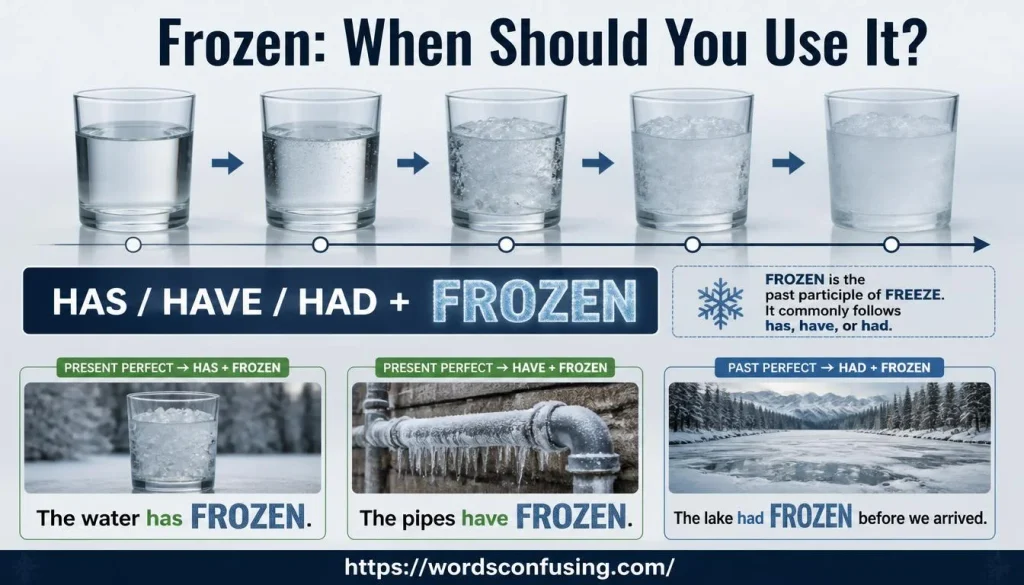
Use frozen when the grammar requires a past participle or when you describe something as being in a frozen condition.
You’ll commonly see it after has, have, and had.
Present Perfect
The present perfect uses has/have + past participle.
Therefore:
- The water has frozen.
- The pipes have frozen.
- She has frozen the leftovers.
- We have frozen several meals.
The construction connects a past action or event with the present situation.
For instance:
The pipes have frozen.
This sentence tells you that freezing happened and that the result matters now.
Past Perfect
The past perfect uses had + past participle.
Therefore:
- The water had frozen before we arrived.
- The pipes had frozen by midnight.
- She had frozen the food before the power went out.
- The lake had frozen before winter officially began.
The past perfect places one past event before another past event.
Consider this example:
The water had frozen before the workers arrived.
First, the water froze. Later, the workers arrived.
That sequence is exactly what the past perfect can clarify.
Frozen as an Adjective
One of the most useful details about frozen is that it can function as an adjective.
When you say:
The lake is frozen.
You’re describing the lake’s current state.
Compare that sentence with:
The lake froze yesterday.
The first sentence describes a condition. The second tells you about a past event.
This distinction is subtle but important.
Froze vs. Frozen in Context
| Sentence | What it emphasizes |
| The lake froze last night. | The freezing event happened last night. |
| The lake is frozen this morning. | The lake is currently in a frozen state. |
| The lake has frozen completely. | The freezing has happened and matters now. |
| The lake had frozen before sunrise. | The freezing happened before another past event. |
The word frozen doesn’t always mean you’re looking at a conventional perfect tense. Context matters.
For example:
The frozen lake looked beautiful.
Here, frozen directly describes the lake.
Froze vs. Frozen: The Main Difference
The easiest way to separate these words is to focus on their grammatical jobs.
| Froze | Frozen |
| Simple past tense | Past participle |
| Usually stands alone as the main past verb | Often works with a helping verb |
| Describes a completed past event | Helps form perfect and passive constructions |
| “The water froze.” | “The water has frozen.” |
| “My computer froze.” | “My computer has frozen.” |
| “She froze in fear.” | “She was frozen with fear.” |
A simple rule can save you from most mistakes:
Use “froze” for the simple past. Use “frozen” after the appropriate helping verb or as a description of a frozen state.
Common Mistakes With Froze and Frozen
Because froze and frozen share the same root, people often swap them incorrectly.
Here are the most common errors.
“I Have Froze” vs. “I Have Frozen”
The correct sentence is:
I have frozen the leftovers.
Not:
I have froze the leftovers.
Why?
Because have requires the past participle in the present perfect. The past participle of freeze is frozen.
The same rule applies to has and had.
- She has frozen the meat.
- We have frozen the vegetables.
- They had frozen the samples.
Not:
- She has froze the meat.
- We have froze the vegetables.
- They had froze the samples.
“It Froze” vs. “It Frozen”
If you’re describing a simple past event, use froze.
Correct:
The water froze overnight.
Incorrect:
The water frozen overnight.
The second sentence lacks the grammatical structure needed for frozen.
You could instead say:
The water has frozen overnight.
Or:
The water is frozen.
The surrounding words determine which form belongs there.
“The Water Is Froze” vs. “The Water Is Frozen”
Standard English uses:
The water is frozen.
Not:
The water is froze.
Here, is frozen describes the current condition of the water.
The same pattern appears in everyday expressions:
- The food is frozen.
- The road is frozen.
- The pipe is frozen.
- The lake is frozen.
- The meat is frozen solid.
Froze vs. Frozen in Perfect Tenses
Perfect tenses provide one of the clearest tests for choosing between these forms.
The basic structure is:
Helping verb + past participle
Because frozen is the past participle, it appears after has, have, and had.
Present Perfect
has/have + frozen
Examples:
- The water has frozen.
- The pipes have frozen.
- She has frozen the fruit.
- We have frozen enough food for the week.
Past Perfect
had + frozen
Examples:
- The lake had frozen before the storm ended.
- The pipes had frozen before the plumber arrived.
- They had frozen the samples before shipping them.
Future Perfect
will have + frozen
Examples:
- By midnight, the water will have frozen.
- By morning, the pipes will have frozen if the temperature stays low.
Notice the pattern:
has frozen
have frozen
had frozen
will have frozen
The word froze doesn’t fit these perfect constructions.
Read more: 26 Best Replies to “Mind Your Own Business” Witty Comebacks
Froze vs. Frozen in Passive Voice
The passive voice provides another important use for frozen.
A passive construction generally places the receiver of an action before the verb.
Compare:
The cold weather froze the pipes.
This is active voice. The cold weather performs the action.
Now compare:
The pipes were frozen by the cold weather.
This is passive voice. The pipes receive the action.
The two sentences describe essentially the same event from different grammatical angles.
More Examples
Active:
- The cold air froze the water.
- The technician froze the samples.
- The temperature froze the pipes.
Passive:
- The water was frozen by the cold air.
- The samples were frozen by the technician.
- The pipes were frozen by the low temperature.
The key point is simple: passive constructions commonly use frozen, not froze.
Froze, Frozen, and Freezing: What’s the Difference?
These three forms can appear in similar situations, yet they express different grammatical ideas.
Freeze
Freeze is the base form.
Examples:
- Water can freeze at 32°F under standard atmospheric pressure.
- Don’t let the pipes freeze.
- Some foods freeze better than others.
Froze
Froze is the simple past.
Examples:
- The water froze last night.
- The pipes froze during the storm.
- My computer froze again.
Frozen
Frozen is the past participle and can also act as an adjective.
Examples:
- The water has frozen.
- The pipes were frozen.
- The lake is frozen.
Freezing
Freezing is the present participle and can also function as a gerund.
Examples:
- The water is freezing.
- Freezing food can extend its usable life.
- The pipes are freezing quickly.
These forms describe different grammatical stages of the same verb.
Freeze in Different Tenses
A complete tense chart makes the pattern easier to recognize.
| Tense | Example |
| Simple present | Water freezes at 32°F under standard conditions. |
| Present continuous | The water is freezing. |
| Simple past | The water froze last night. |
| Past continuous | The water was freezing when we checked it. |
| Present perfect | The water has frozen. |
| Past perfect | The water had frozen before sunrise. |
| Future | The water will freeze tonight. |
| Future perfect | The water will have frozen by morning. |
This table reveals something important.
Froze appears specifically in the simple past. Frozen appears in perfect constructions and several other structures.
Literal Uses of “Freeze”
The most familiar meaning of freeze involves a liquid becoming solid because of low temperature.
Water provides the classic example.
Under standard atmospheric pressure, pure water freezes at 32°F (0°C). However, real-world freezing behavior can vary because dissolved substances, pressure, and other conditions affect the freezing point.
Salt provides a familiar example.
Salt lowers the freezing point of water, which is why people use salt to help manage icy roads and sidewalks. The same principle explains why seawater doesn’t freeze at exactly the same temperature as pure freshwater.
In ordinary writing, though, you usually don’t need the scientific detail.
You can simply say:
The pond froze overnight.
Or:
The pond is frozen this morning.
Figurative Uses of “Freeze”
English frequently uses freeze beyond its literal meaning.
Someone can freeze when they become suddenly unable to respond.
For example:
I froze when the interviewer asked that question.
The speaker didn’t become physically frozen. Instead, they momentarily couldn’t respond.
The same idea appears in expressions involving fear:
- She froze with fear.
- He stood frozen in place.
- The audience froze when the lights went out.
- They were frozen with shock.
The choice between froze and frozen still follows grammar rather than meaning.
Froze
She froze when she heard the scream.
Frozen
She stood frozen when she heard the scream.
Both sentences describe a similar reaction. Their structures simply differ.
“Freeze” in Technology
Modern English uses freeze constantly when discussing technology.
A computer program may stop responding. A phone screen may become unresponsive. A video game may stop displaying new information.
In each situation, freeze works naturally.
Simple Past
My computer froze during the meeting.
Present Perfect
My computer has frozen twice today.
Current State
My computer is frozen again.
These three sentences offer an excellent real-world comparison.
Froze reports a completed past event.
Has frozen connects the event to the present.
Is frozen describes the current condition.
The same pattern works with apps, browsers, tablets, games, and other digital devices.
“Freeze” in Food and Cooking
Food provides another everyday context for these verb forms.
Consider these examples:
- I froze the chicken yesterday.
- I have frozen the chicken.
- The chicken is frozen.
- The chicken was frozen before shipping.
- We will freeze the leftovers tonight.
Each sentence uses a different grammatical structure.
A Practical Example
Imagine preparing several meals on Sunday.
You might say:
I froze the meals on Sunday.
Later, you could say:
I have frozen enough meals for the week.
When someone opens the freezer, they might say:
The meals are frozen solid.
Same basic action. Different grammar.
“Freeze” in Weather and Everyday Life
Cold weather creates countless opportunities to use these forms.
Here are some natural examples:
- The temperature dropped suddenly and the pond froze.
- The roads had frozen before sunrise.
- The pipes are frozen.
- The garden hose froze overnight.
- The wet ground remained frozen all morning.
- The water will freeze if the temperature stays below its freezing point.
- By morning, the puddles will have frozen.
These examples demonstrate why context matters more than memorizing isolated rules.
A Simple Test for Choosing Froze or Frozen
When you’re unsure, look at the words surrounding the verb.
Ask: Is this a simple past event?
If yes, froze is usually the correct choice.
The river froze last night.
Ask: Does the sentence use has, have, or had?
If yes, use frozen.
The river has frozen.
The river had frozen.
Ask: Are you describing a current condition?
If the sentence uses is, are, or was/were to describe a state, frozen may be appropriate.
The river is frozen.
The pipes were frozen.
This isn’t a substitute for understanding the entire sentence. Still, it’s an excellent quick check.
Froze vs. Frozen: Examples Side by Side
| Situation | Correct example | Why? |
| Completed past event | The lake froze last night. | Simple past |
| Present perfect | The lake has frozen. | Has + past participle |
| Past perfect | The lake had frozen by dawn. | Had + past participle |
| Current condition | The lake is frozen. | Describes a state |
| Passive construction | The lake was frozen by the extreme cold. | Passive structure |
| Future event | The lake may freeze tonight. | Base form |
| Ongoing process | The lake is freezing. | Present participle |
This comparison captures most everyday uses.
Case Study: One Situation, Four Forms
Imagine a cold winter night when a small pond begins to freeze.
At 8 p.m., someone observes:
The pond is freezing.
The process is happening now.
At 6 a.m., they report:
The pond froze overnight.
Now the event belongs to the past.
Later that morning, they say:
The pond has frozen completely.
The present perfect connects the completed process with the current result.
Finally, they describe what they see:
The pond is frozen solid.
Here, frozen describes its present condition.
This single scenario shows why the four forms shouldn’t be treated as interchangeable.
Pronunciation of Freeze, Froze, and Frozen
The spelling changes noticeably across the three principal forms.
| Word | Approximate pronunciation |
| freeze | /friːz/ |
| froze | /froʊz/ |
| frozen | /ˈfroʊzən/ |
The vowel changes are worth noticing.
Freeze contains the long ee sound.
Froze changes to the long o sound.
Frozen keeps the vowel from froze but adds another syllable.
The pronunciation pattern can help reinforce the spelling:
freeze → froze → frozen
Learning them together is usually easier than memorizing each word separately.
Why “Froze” and “Frozen” Are Irregular Forms
Many English verbs form their past tense by adding -ed.
For example:
- walk → walked
- clean → cleaned
- open → opened
Freeze doesn’t follow that pattern.
Instead, it changes internally:
freeze → froze → frozen
This makes it an irregular verb.
Other common irregular verbs behave similarly:
- speak → spoke → spoken
- break → broke → broken
- choose → chose → chosen
- steal → stole → stolen
Notice the broader pattern. English has many verbs where the simple past and past participle differ.
That means you shouldn’t assume that froze and frozen are interchangeable simply because they come from the same verb.
Common Sentences With “Froze”
Here are practical examples worth remembering:
- The pond froze overnight.
- The water froze before dawn.
- My hands froze in the cold wind.
- The pipes froze during the storm.
- The road froze after sunset.
- She froze when she heard the noise.
- He froze during the interview.
- My computer froze while I was working.
- The screen froze during the video.
- The food froze faster than expected.
- The puddles froze overnight.
- The flowers froze during the unexpected cold snap.
Each example uses froze as the simple past form.
Common Sentences With “Frozen”
Now compare these examples:
- The lake has frozen.
- The pipes have frozen.
- The water had frozen before we arrived.
- The food is frozen.
- The road is frozen.
- The vegetables were frozen immediately.
- The samples were frozen for testing.
- The lake remained frozen all morning.
- The computer has frozen again.
- The screen is frozen.
- She stood frozen in place.
- The leftovers have been frozen for several days.
Here, frozen performs several grammatical jobs, including past participle and adjective-like functions.
Read more: 25 Best Replies to “Just Kidding” When It’s Used as a Bad Excuse
Which Is Correct: Froze or Frozen?
The answer depends on the sentence.
Use froze when you need the simple past tense:
The lake froze last night.
Use frozen with perfect constructions:
The lake has frozen.
Use frozen to describe a state:
The lake is frozen.
Use frozen in passive constructions:
The lake was frozen by the cold weather.
The mistake usually happens when writers focus on the meaning rather than the grammar. Both words relate to freezing. Their grammatical roles differ.
Quick Reference: Which Form Should You Use?
| What you want to express | Correct form | Example |
| Present action or general fact | freeze/freezes | Water can freeze quickly. |
| Completed past event | froze | The water froze last night. |
| Present perfect | frozen | The water has frozen. |
| Past perfect | frozen | The water had frozen. |
| Future event | freeze | The water will freeze tonight. |
| Current frozen condition | frozen | The water is frozen. |
| Ongoing process | freezing | The water is freezing. |
| Passive construction | frozen | The water was frozen quickly. |
Keep this chart nearby if you regularly struggle with irregular verbs.
FAQs
What is the past tense of “freeze”?
The simple past tense of freeze is froze. For example, “The lake froze overnight.” Use froze when describing a completed action in the past.
What is the past participle of “freeze”?
The past participle is frozen. It usually appears with an auxiliary verb, such as has, have, or had. For example, “The water has frozen.”
Is “froze” or “frozen” correct?
Both are correct, but they serve different grammatical roles. Use froze as the simple past and frozen as the past participle.
Can I say “I have froze it”?
No. The correct sentence is “I have frozen it.” After have, you need the past participle frozen, not the simple past froze.
Is “The lake was froze” grammatically correct?
No. In standard English, say “The lake was frozen.” Here, frozen follows the auxiliary verb was and works as the past participle.
How can I remember the difference between “froze” and “frozen”?
A simple trick is to connect froze with a finished past action. Think of frozen when you see an auxiliary verb such as has, have, had
Conclusion
Choosing between froze and frozen becomes much easier once you stop treating them as interchangeable forms. Remember the simple rule: froze describes a completed action in the past, while frozen usually works with an auxiliary verb in perfect or passive structures. Once you recognize the sentence pattern, the choice becomes almost automatic.
A little regular practice can make a big difference. Read examples aloud, notice how these forms appear in real sentences, and try writing a few of your own. Before long, froze and frozen won’t feel like confusing words anymore. They’ll simply become two familiar forms of the same irregular verb.