
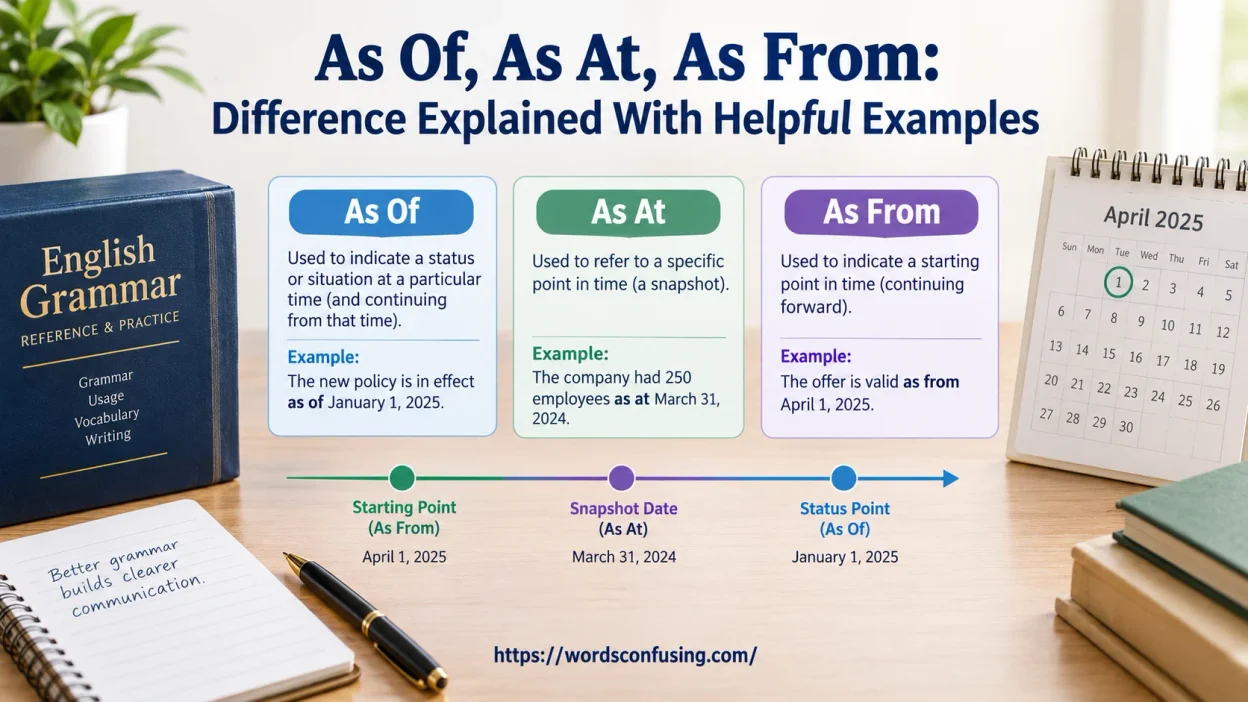
As Of, As At, As From: Difference Explained With Helpful Examples shows how as and related phrases carry slightly different meanings.
This guide will explain the precise meaning, usage, and correct phrase for each expression, helping you know how to use them naturally. In business communication, formal writing, contracts, announcements, and official documents, these terms can appear interchangeably, creating common mistakes.
Understanding their meanings improves clarity, professionalism, and accurate English usage, especially when describing an exact point in time or an exact period in time.
These time-related phrases also appear in project management, a project deadline, updating a calendar, an online booking, and meeting notes. They can help with managing timelines, scheduling, time management, meetings, broadcasting, and workplace correspondence.
The wording differences may seem small, yet they affect consistency, readability, and your message across professional contexts and everyday contexts. In written English, spoken English, modern English, and other common situations, effective communication depends on choosing the right expression.
With practical examples and real-world scenarios, this article can help you use these phrases more confidently.
Quick Answer
Here’s the simplest way to remember the difference:
| Expression | Basic meaning | Main purpose | Typical usage |
| As of | At, by, or beginning from a specified time | Gives the status or effective point at a date | Very common in American English |
| As at | At a particular date or time | Gives a snapshot of a condition, figure, or position | Accounting, finance, formal British English |
| As from | Starting from a specified date | Marks when something begins or becomes effective | Formal British English |
For example:
- As of Monday, the office is closed.
- The account balance was $8,500 as at December 31.
- The new policy applies as from January 1.
The first sentence focuses on the status at a date. The second gives a snapshot of a financial position. The third emphasizes the starting point of a new rule.
However, there’s an important wrinkle. As of has more than one established time-related use. Dictionaries describe it both as referring to a particular time and as meaning beginning from a particular time.
That means context matters.
What Does “As Of” Mean?
As of is the most flexible expression of the three. In American English, speakers and writers commonly use it to identify a particular point in time and describe what is true, known, measured, or effective around that point.
For example:
As of September 21, the company has received 2,000 applications.
The sentence tells you the number recorded by that point in time. It doesn’t necessarily say that applications stopped arriving afterward.
You can use as of with the past, present, or future depending on the sentence.
As Of With the Past
As of last Friday, the project had reached its final stage.
Here, as of last Friday establishes the reference point. The sentence describes the project’s status at that time.
Another example:
As of December 2025, the store had three locations.
The phrase doesn’t mean the store suddenly acquired three locations on December 1. Instead, it gives the situation at that point.
As Of With the Present
As of today, the application remains under review.
This tells the reader the current status.
You’ll often see this construction in announcements, business updates, reports, news writing, and everyday conversation. It works particularly well when information may change later.
For example:
As of today, no final decision has been announced.
The sentence leaves room for a later decision. That’s one reason as of today is so useful.
As Of With the Future
As of can also introduce a future effective date.
Starting January 1, the new rates will apply.
Here, the expression means that the new rates will apply beginning at that point.
Cambridge gives the same general sense for as of, defining it as starting from a particular time. Collins also recognizes a meaning equivalent to beginning on or from a specified date.
Common Examples of As Of
- As of Monday, the office is open again.
- As of today, the balance is $4,200.
- As of last month, she had completed the course.
- As of January 1, the new rules apply.
- As of this morning, the system was working normally.
- As of 5 p.m., the company had received 300 applications.
Notice how the exact meaning depends on the surrounding sentence.
What Does “As At” Mean?
As at means at a particular date or time. It commonly appears when a writer wants to present a specific snapshot of information.
Cambridge specifically identifies as at as a Business English and accounting expression meaning at a particular date or time.
For example:
The company’s total assets were $12 million as at December 31.
The phrase points to the company’s financial position on that date.
This is where as at differs most clearly from the everyday use of as of. The word at naturally suggests a precise point on a timeline.
Imagine a photograph.
You take the photograph on December 31. It captures what the situation looked like at that moment. As at December 31 can serve a similar purpose in formal writing.
As At in Accounting
Accounting documents frequently need to identify the date associated with a financial position.
For example:
Cash and cash equivalents totaled $750,000 as at June 30.
The phrase identifies the date associated with that figure.
You might also see:
- Assets as at December 31
- Liabilities as at March 31
- Account balance as at June 30
- Financial position as at September 30
- Outstanding debt as at the reporting date
This wording is especially common in British and Commonwealth business contexts.
As At in Formal Writing
As at isn’t restricted to finance.
You may encounter it in formal reports, legal documents, administrative records, statistics, and other contexts where precision matters.
For example:
The register contained 1,250 entries as at March 1.
The writer wants to identify the state of the register at a defined point.
In ordinary American conversation, however, as at can sound unusual.
An American reader would generally find this more natural:
The register contained 1,250 entries as of March 1.
That doesn’t mean as at is grammatically defective. It reflects a difference in regional and professional usage.
What Does “As From” Mean?
As from means starting from a particular date or time. It marks the point when something begins, changes, or becomes effective.
Cambridge defines as from as meaning from a particular date or time. Collins similarly identifies it as a formal British expression meaning from a specified time.
For example:
The new schedule applies as from Monday.
The important idea is the starting point.
Before Monday, the old schedule applied. Beginning Monday, the new schedule applies.
Examples of As From
- The revised fees apply as from January 1.
- Employees will use the new system as from Monday.
- The new timetable takes effect as from June 1.
- The office will operate under new hours as from next month.
- The increased rate applies as from April 1.
The phrase often appears in formal notices and administrative writing.
Is As From Correct English?
Yes. As from is an established English expression.
The main issue isn’t grammatical correctness. It’s regional and stylistic preference.
In American English, as of or simply from will often sound more natural:
The new schedule starts on Monday.
Or:
The new schedule applies from Monday.
In British English, particularly formal writing, as from can sound entirely normal:
The new schedule applies as from Monday.
Collins specifically labels as from as a formal British expression.
As Of vs. As At: What’s the Difference?
This is probably the most confusing pair because they can overlap.
Both can connect information to a particular date. The difference often lies in regional usage, context, and emphasis.
Consider these sentences:
The balance was $15,000 as of December 31.
The balance was $15,000 as at December 31.
Both can communicate the balance associated with December 31. The first is more natural for a general American audience. The second has a stronger formal accounting or British-English flavor.
The Main Distinction
As of is broad and flexible.
As at is more strongly associated with a precise snapshot.
You can remember the difference this way:
As of → information connected to a point in time.
As at → information captured at a particular point in time.
This isn’t an absolute grammatical rule. English usage overlaps, especially across countries and professional fields.
Example: Company Employees
As of June 1, the company employs 250 people.
This sounds natural in American English.
Now consider:
The company had 250 employees as at June 1.
The second version emphasizes the company’s recorded position at that date.
Example: Financial Records
As of December 31, the company reported $5 million in cash.
This is perfectly understandable and natural in American business writing.
A British or Commonwealth financial document might instead say:
The company reported $5 million in cash as at December 31.
The underlying information can be identical. The wording reflects the document’s style and regional convention.
As Of vs. As From: What’s the Difference?
The distinction becomes clearer when you focus on the timeline.
As of can describe the status at a point in time or indicate that something begins from that point.
As from is more directly focused on the beginning of a new situation.
Compare these:
As of January 1, the company has a new pricing structure.
As from January 1, the company has a new pricing structure.
Both can indicate that the new structure begins on January 1. The second expression sounds more formal and is particularly associated with British usage.
Now compare:
As of Friday, 400 applications had been received.
Here, as from Friday wouldn’t express the same idea naturally.
Why?
Because the sentence describes a recorded status, not the beginning of an ongoing rule.
That’s the key.
As Of Often Describes a Status
As of Friday, 400 people had registered.
The writer reports a figure at a particular point.
As From Marks a Beginning
As from Friday, registration will close at 5 p.m.
The writer establishes when the new arrangement starts.
One phrase looks at a point in the information. The other points forward from a starting date.
As At vs. As From: What’s the Difference?
These expressions have a clearer functional divide.
As at generally identifies the condition, value, or position at a particular time.
As from identifies when a new condition begins.
Compare:
The account contained $9,000 as at June 30.
This gives a financial snapshot.
Now:
The new interest rate applies as from July 1.
This establishes an effective date.
The first sentence looks at a point.
The second looks from a point onward.
That’s a useful mental shortcut.
As Of, As At, and As From in American English
If you’re writing for a US audience, as of is usually the safest everyday choice.
You’ll see it in:
- Business reports
- News articles
- Company announcements
- Government information
- Statistics
- Financial reporting
- Everyday conversation
- Academic writing
- Online documentation
For example:
As of September 2026, the program has 12,000 participants.
That’s straightforward American English.
By contrast:
As at September 2026, the program has 12,000 participants.
is understandable, but it sounds more formal and regionally marked.
Likewise:
As from September 2026, the program will accept new applications.
is grammatical but may sound more British or formal to many American readers.
For US writing, these alternatives are often more natural:
- As of September 2026
- Starting in September 2026
- Beginning September 2026
- From September 2026
- Effective September 2026
The best choice depends on the sentence.
As Of, As At, and As From in British English
British English uses all three expressions, although their distribution differs.
As from is a recognized formal expression meaning from a particular date. As at is also well established, especially in business and accounting contexts.
For example:
The new charges apply as from April 1.
And:
The balance was £7,500 as at March 31.
These constructions don’t need to be rewritten simply because American English uses different preferences.
Regional English is not a contest where one variety gets the crown. Different varieties develop different conventions.
Why “As Of” Can Be Ambiguous
Here’s an important detail that many quick grammar guides overlook.
As of can sometimes express either a snapshot-like meaning or an effective-from meaning.
Compare:
As of Monday, the store was closed.
This can describe the store’s status at that point.
Now:
As of Monday, the new policy applies.
Here, Monday functions as the point when the policy takes effect.
The surrounding verb and context help determine the intended meaning.
That flexibility makes as of useful. It can also create ambiguity in technical documents.
When absolute precision matters, writers can choose a clearer construction.
Instead of:
As of January 1, the rule changes.
you could write:
Starting January 1, the rule changes.
Or:
The rule takes effect January 1.
Those versions make the timeline explicit.
Read more: Hid or Hidden: Which Is Correct?
Common Mistakes With As Of, As At, and As From
Mistake: Treating All Three Expressions as Identical
They overlap, but they aren’t simply interchangeable labels.
When reporting a financial position, as at may suit the document’s convention.
For an effective date, as from can express the intended starting point more directly.
In ordinary American English, as of will often be the natural choice.
Mistake: Assuming As At Is Incorrect
As at is a legitimate expression.
Cambridge specifically records it as an accounting and business expression meaning at a particular date or time.
The problem usually isn’t correctness. It’s audience.
A phrase that sounds normal in a British financial report may sound unusually formal in an American email.
Mistake: Assuming As From Is Wrong
The same principle applies to as from.
It’s an established formal expression. Collins labels it as British English and defines it as meaning from a specified time.
So this sentence is valid:
The new rules apply as from January 1.
For an American audience, however, this may sound more natural:
The new rules apply starting January 1.
Mistake: Using As From for a Snapshot
Consider:
The company’s cash balance was $2 million as from December 31.
That sounds wrong for the intended meaning because as from points toward a beginning.
A better choice is:
The company’s cash balance was $2 million as of December 31.
Or in a formal accounting context:
The company’s cash balance was $2 million as at December 31.
Mistake: Using As At for an Effective Date
Consider:
The new policy takes effect as at January 1.
If the intention is to say that January 1 is when the policy begins, as from or as of is usually clearer.
Better:
The new policy takes effect as of January 1.
Or:
The new policy takes effect as from January 1.
The second option has a more formal British flavor.
As Of, As At, and As From: Side-by-Side Examples
| Situation | Example | Why it works |
| Current status | As of today, the office remains closed. | Reports the current situation |
| Historical status | As of June 1, the company had 500 employees. | Reports a past status |
| Financial snapshot | The balance was $20,000 as at June 30. | Identifies a financial position at a date |
| New rule | The new rule applies as from July 1. | Marks the beginning of the rule |
| New US policy | The new rule applies as of July 1. | Gives the effective date |
| Recorded figure | As of December 31, sales totaled $4 million. | Gives information tied to a date |
| Formal financial report | Assets stood at $10 million as at December 31. | Presents a dated snapshot |
| Administrative change | The new schedule applies as from Monday. | Marks the starting date |
Case Study: A Company’s New Policy
Imagine a company changes its remote-work policy.
The old policy allows employees to work remotely two days per week. The company announces that a new three-day policy will begin on October 1.
Several sentences could describe this change.
Using As Of
As of October 1, employees may work remotely three days per week.
This identifies October 1 as the effective point.
Using As From
As from October 1, employees may work remotely three days per week.
This emphasizes that the new arrangement begins on October 1.
Using As At
As at October 1, the company had 800 employees.
Now the meaning changes completely.
This sentence doesn’t describe when the remote-work policy starts. Instead, it gives the company’s employee count at that date.
That example reveals the central distinction better than any memorized rule.
The phrase as of can establish a date associated with a status or effective change.
By contrast, as from emphasizes a starting point.
Meanwhile, as at focuses on a state or figure at a particular point.
Case Study: A Bank Account
Suppose a bank account contains $6,500 on December 31.
You could write:
The account balance was $6,500 as of December 31.
That’s natural in American English.
A formal accounting document might say:
The account balance was $6,500 as at December 31.
The second version gives the same basic snapshot while using a more specialized construction.
Now suppose the bank introduces a new monthly fee beginning January 1:
The new fee applies as from January 1.
For American readers, this may be more natural:
The new fee applies as of January 1.
Or simply:
The new fee starts January 1.
Each sentence places the event differently on the timeline.
How to Choose the Correct Expression
When you’re unsure, ask one simple question:
Am I describing a status at a date or announcing what starts from that date?
For a status, figure, or situation, as of often works well.
When presenting a precise snapshot in formal or financial writing, as at may fit better.
To identify the beginning of a new arrangement, you can use as from, especially in formal British English.
Choose As Of When You Mean:
- A status at a particular time
- Information recorded by a particular date
- A current position
- A historical position
- An effective date
- A date from which something applies
Example:
As of March 1, the company has 75 employees.
Choose As At When You Mean:
- A precise snapshot
- A financial position
- An accounting figure
- A formal record at a particular date
- A British or Commonwealth business context
Example:
The company’s liabilities totaled $3 million as at December 31.
Choose As From When You Mean:
- Something begins on a particular date
- A new rule takes effect
- A new arrangement starts
- A formal administrative change begins
- You’re following British English conventions
Example:
The revised rates apply as from April 1.
A Simple Memory Trick
Here’s an easy way to keep the three expressions straight:
A status or effective point is expressed with as of.
A snapshot at a particular point is described with as at.
For a starting point, as from emphasizes when something begins.
Think of a camera.
Think of as at as taking a photograph of a situation on a specific date.
By comparison, as of tells you what is true or effective around that date.
Meanwhile, as from draws an arrow forward from that date.
That mental picture works especially well when you’re editing business or grammar content.
What Should You Use in American English?
For most general American English writing, as of is the most natural choice among these three.
For example:
As of today, the application is still pending.
The company had 1,200 employees as of December 31.
Starting January 1, the new rates apply.
If you’re writing a specialized financial document, you may encounter as at. There’s no need to automatically change it if the document follows a particular professional or regional convention.
Similarly, as from is valid English but often sounds more formal or British to an American audience.
For a general US audience, you can often simplify it:
Starting January 1, the new rates apply.
Simple wording often wins when the meaning stays intact.
Is “As Of” More Common Than “As At” and “As From”?
In general usage, as of is substantially more common than the other two expressions.
That doesn’t make as at or as from incorrect. Frequency and correctness are different questions.
A phrase can be less common because it belongs to a particular professional register or regional variety.
For instance, as at has a strong association with accounting and business usage. As from has a formal British association. As of crosses many more contexts.
That’s why a general reader is much more likely to encounter as of.
FAQs
1. Is “as of” the most common phrase in everyday English?
Yes. As of is widely used when you want to show the situation or status at a particular date or time. For example, “As of Monday, the office will operate remotely.”
2. What does “as at” mean in formal writing?
As at refers to the status or position at a specific point in time. It’s especially common in financial, legal, accounting, and formal business contexts. For example, “The balance was $5,000 as at June 30.”
3. What does “as from” mean?
As from indicates that something begins to apply from a particular date or time. It often appears in formal announcements or official notices. For example, “The new policy applies as from January 1.”
4. Can I use “as of” and “as from” interchangeably?
Not always. As of usually describes a situation existing at a particular time, while as from emphasizes the starting point of a new situation, rule, or arrangement. The surrounding sentence determines which phrase fits naturally.
5. Is “as at” correct in American English?
Yes, but it’s less common in everyday American English than as of. You’ll mainly encounter as at in formal documents, financial statements, legal writing, or contexts influenced by British English.
6. Which phrase should I use for a deadline or effective date?
Use the phrase that matches your intended meaning. As of works well when describing a status on a specific date, while as from can emphasize when a new rule or arrangement starts. For a simple deadline, however, “by,” “on,” or “before” may be more natural.
Conclusion
Choosing between as of, as at, and as from becomes much easier once you focus on what the sentence actually means. As of usually points to the status at a particular date, while as at often appears in formal or financial contexts to describe a position at a specific point. As from highlights when a new rule, arrangement, or situation begins. The differences are subtle, but they can make your writing sound much more precise.
When you’re writing an email, contract, report, announcement, or everyday message, pause for a moment and consider the timeline. Ask yourself whether you’re describing a current status, recording a position at a specific time, or marking the beginning of something new. Once that distinction becomes familiar, these phrases stop feeling interchangeable and start working as useful tools for clear communication.

Franklin Hayes is a writer and editor at WordsConfusing.com, focused on making English vocabulary, grammar, and commonly confused words easy to understand. He writes clear, practical articles with simple explanations and useful examples to help readers improve their English with confidence.
His goal is simple: Making Confusing Words Simple.