
This guide to “In Fact”: When to Use a Comma Before and After It explains how comma placement, context, and punctuation shape clear sentences.
“In fact” adds emphasis, corrects an assumption, or introduces a detail. When it opens a sentence, place a comma after it: “In fact, the results improved.” This pause separates the introductory phrase from the main statement and makes the meaning easier to follow. In other positions, punctuation depends on sentence structure, rhythm, and the emphasis you want.
A missing comma can confuse readers or change an intended message, especially in emails and professional writing. Remember the comma rules, too: use commas to separate items in a list, join independent clauses with conjunctions when needed, address someone directly, and set off non-essential information.
Regular reading and writing practice help you recognize natural language patterns without memorizing every grammar rule. Even experienced writers pause over difficult sentences, but a clear approach builds confidence, improves sentence flow, and helps you avoid common punctuation mistakes.
Quick Answer
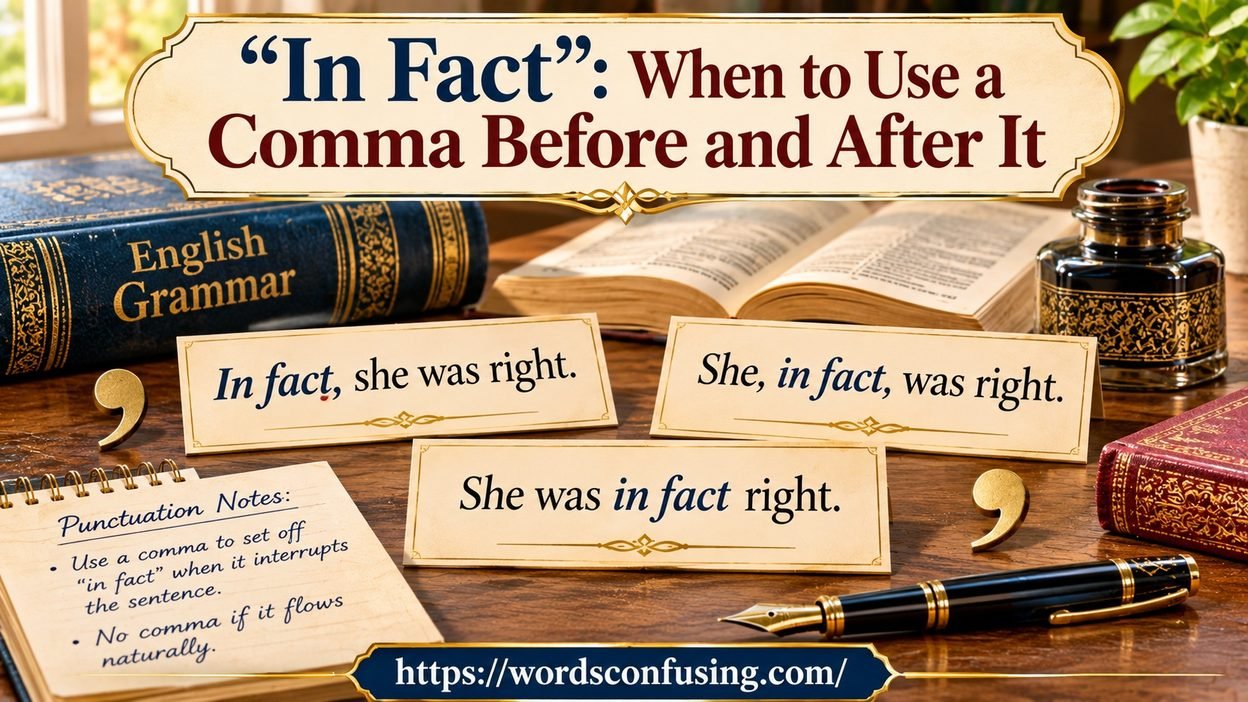
Use a comma after “in fact” when it starts a sentence. Use commas around it when it interrupts a sentence. However, when in fact flows naturally within a sentence, you don’t need commas.
Examples:
- Beginning: In fact, she was right.
- Middle: She, in fact, was right.
- Integrated: She was in fact right.

Does “In Fact” Need a Comma?
No, “in fact” doesn’t always need a comma. Its punctuation depends on its position and grammatical function within a sentence.
Writers commonly use in fact to emphasize information, introduce evidence, correct an assumption, or add a stronger statement. Depending on the sentence, the expression can function as an introductory element, a parenthetical expression, or an integrated adverbial phrase.
Consider these examples:
- In fact, she already knew the answer.
- She, in fact, knew the answer before everyone else.
- She was in fact the first person to solve the problem.
- He didn’t reject the invitation; in fact, he welcomed it.
Notice how the punctuation changes in each example. The first sentence uses a comma after the introductory expression. The second places commas around an interrupting expression. The third integrates in fact into the sentence without commas. The fourth uses a semicolon to connect two closely related independent clauses.
The main rule is straightforward: Use commas when “in fact” functions as an introductory or parenthetical expression. When it forms a natural part of the sentence, commas may be unnecessary.
When to Use a Comma With “In Fact”
Several common sentence patterns require or commonly benefit from commas around in fact. Understanding these patterns makes punctuation much easier.
Use a Comma After “In Fact” at the Beginning of a Sentence
When “in fact” appears at the beginning of a sentence, place a comma after it in standard prose.
The expression introduces information that emphasizes, supports, or corrects something. The comma separates this introductory expression from the main statement.
For example:
- In fact, the restaurant closes earlier on Sundays.
- In fact, we already discussed this problem yesterday.
- In fact, learning a new language can improve your memory.
- In fact, the second option costs less than the first.
- In fact, nobody expected the team to win.
- In fact, she had completed the entire assignment before lunch.
In each example, in fact prepares readers for the information that follows. The comma creates a natural pause and makes the sentence easier to understand.
This construction also works when you want to correct an earlier statement.
For example:
The project isn’t difficult. In fact, it’s easier than we originally expected.
The second sentence strengthens the first statement. It tells readers that the project isn’t merely manageable. Its difficulty is actually lower than expected.
Remember: When in fact introduces a complete sentence, follow it with a comma in ordinary formal and informal writing.
Use Commas Around “In Fact” When It Interrupts a Sentence
When in fact interrupts the main flow of a sentence, you can usually place commas before and after it.
This construction treats the expression as parenthetical information. Parenthetical expressions add emphasis or commentary without forming an essential part of the sentence’s grammatical structure.
Consider these examples:
- She, in fact, completed the assignment ahead of schedule.
- The restaurant, in fact, serves breakfast throughout the day.
- His explanation, in fact, answered all our questions.
- The new policy, in fact, applies to every employee.
- Their decision, in fact, surprised the entire department.
Notice that each sentence remains grammatically complete when you remove in fact.
For example:
- Original: She, in fact, completed the assignment ahead of schedule.
- Without the expression: She completed the assignment ahead of schedule.
The central meaning remains intact. The expression simply adds emphasis.
However, you shouldn’t automatically surround every middle-position occurrence with commas. Sometimes in fact works naturally as an integrated part of the sentence.
Compare these constructions:
| With parenthetical commas | Without parenthetical commas |
| She, in fact, agreed with us. | She did in fact agree with us. |
| The results, in fact, surprised everyone. | The results were in fact surprising. |
| He, in fact, knew the answer. | He had in fact known the answer. |
The first column presents in fact as an interruption. The second integrates it more closely into the sentence.
Both patterns can be correct. Your choice depends on emphasis, sentence rhythm, and intended meaning.
Use a Comma Before “In Fact” When It Introduces an Explanation or Correction
Sometimes in fact appears after a complete statement and introduces additional information.
When this happens, you need punctuation that correctly connects the surrounding clauses. A comma alone cannot automatically join two independent clauses.
Consider this example:
Incorrect: She wasn’t disappointed, in fact, she was delighted.
This sentence contains a comma splice. Both parts can stand independently as complete sentences.
You have several better options.
Option 1: Use a semicolon.
She wasn’t disappointed; in fact, she was delighted.
A semicolon connects two closely related independent clauses. The comma after in fact separates the introductory expression from the second clause.
Option 2: Use a period.
She wasn’t disappointed. In fact, she was delighted.
This construction gives the second statement more emphasis. It also creates a natural pause between the two ideas.
Option 3: Use a coordinating conjunction.
She wasn’t disappointed, and in fact, she was delighted.
Here, and connects the two independent clauses. The comma appears before the conjunction, while another comma follows the introductory in fact.
These examples demonstrate an important distinction. The comma after “in fact” doesn’t replace the punctuation needed between independent clauses.
Here are additional examples:
- The store wasn’t closed; in fact, it had just opened.
- He didn’t forget my birthday. In fact, he planned a surprise party.
- The test wasn’t easy, but in fact, it was manageable.
- We didn’t lose money; in fact, our profits increased.
Choose the punctuation that best represents the relationship between your ideas.
Don’t Automatically Use Commas Around “In Fact” in the Middle of a Sentence
A common punctuation mistake involves adding commas whenever in fact appears between other words.
However, the expression doesn’t always interrupt the sentence. It can also modify a verb, adjective, or another part of the statement naturally.
Consider these examples:
- The situation is in fact more complicated than expected.
- She did in fact finish the assignment.
- The decision was in fact necessary.
- His prediction proved in fact correct.
The expression flows directly into the sentence in these constructions. Commas aren’t automatically necessary.
Compare the following sentences:
Without commas:
The new arrangement is in fact more convenient.
With parenthetical commas:
The new arrangement, in fact, is more convenient.
Both sentences are grammatically acceptable. The first integrates the expression into the statement. The second gives it more independent emphasis.
When editing, read the sentence aloud. If the expression feels like an interruption, commas may improve readability. If it flows naturally with the surrounding words, you may not need them.
Read more: Of Course: Meaning and Examples in Everyday English
When Not to Use a Comma With “In Fact”
Although commas frequently accompany introductory and parenthetical uses, unnecessary punctuation can interrupt a sentence’s natural flow.
Here are situations where you should avoid adding commas automatically.
When “In Fact” Forms an Integrated Part of the Sentence
When in fact connects closely with the verb or another sentence element, surrounding commas may be unnecessary.
For example:
- The evidence actually supports the theory.
- She did in fact complete the training.
- This is in fact the correct answer.
- Their proposal was in fact reasonable.
- The company has in fact changed its policy.
These sentences don’t need commas simply because they contain in fact.
Now compare:
The company, in fact, changed its policy.
This version treats the expression as parenthetical commentary. The commas create a slight interruption and place additional emphasis on the statement.
The difference is mainly one of sentence structure and emphasis. Neither construction should be treated as universally correct for every context.
A useful editing test: Remove in fact and read the remaining sentence. If the expression works as an optional interruption, parenthetical commas may be appropriate. If it flows naturally within the predicate, you can often leave it unpunctuated.
When “In Fact” Follows a Conjunction Naturally
Writers often place in fact after conjunctions such as and, but, and so. The correct punctuation depends on the relationship between the clauses.
For example:
- And in fact, everyone agreed with the decision.
- But in fact, the situation was completely different.
- So in fact, we needed another solution.
Notice that these sentences don’t require a comma immediately after the conjunction.
However, you can use commas to set off in fact when you want to present it as an interruption.
Compare:
- And in fact, she already knew the answer.
- And, in fact, she already knew the answer.
The first construction treats and in fact as a connected introductory sequence. The second gives in fact more parenthetical emphasis.
Both patterns appear in edited English. The first is generally smoother for ordinary writing.
Here are more examples:
| Construction | Example |
| And in fact | And in fact, the results were better than expected. |
| But in fact | But in fact, nobody had made that promise. |
| So in fact | So in fact, we had already solved the problem. |
| And, in fact, | And, in fact, the team had finished early. |
| But, in fact, | But, in fact, the opposite was true. |
The important point is to avoid inserting a comma after every conjunction automatically. Punctuation should reflect the expression’s actual role.
When “In Fact” Appears in a Short, Direct Statement
Short sentences sometimes contain in fact without requiring commas.
For example:
- That is in fact true.
- She did in fact call.
- He was in fact right.
- They have in fact arrived.
- This is in fact possible.
These sentences use the expression as an integrated part of the statement.
However, you can also place in fact at the beginning of a short sentence:
- In fact, that’s true.
- In fact, she called.
- In fact, he was right.
- In fact, they’ve arrived.
The comma remains appropriate because in fact introduces the statement.
Sentence length alone doesn’t determine comma placement. Position and grammatical function matter more than the number of words.
“In Fact” Comma Rules: Examples at a Glance
Sometimes a quick reference table explains punctuation better than several paragraphs. The following examples summarize the most common ways to use in fact.
| Sentence position | Comma placement | Example |
| Beginning | Comma after the expression | In fact, she already knew. |
| Middle as an interruption | Commas around the expression | She, in fact, already knew. |
| Middle as an integrated expression | Usually no commas | She did in fact know. |
| After an independent clause | Semicolon or period before it | She was early; in fact, she arrived first. |
| After a conjunction | Usually no comma immediately after the conjunction | But in fact, she was correct. |
| After a conjunction as an interruption | Commas can set off the expression | But, in fact, she was correct. |
More Examples of Correct “In Fact” Punctuation
Here are additional examples showing how the expression works in everyday writing.
At the beginning of a sentence:
- In fact, the weather improved throughout the afternoon.
- In fact, we received more applications than expected.
- In fact, the book contains several useful examples.
In the middle of a sentence:
- The answer was, in fact, surprisingly simple.
- Our manager did in fact approve the request.
- Her explanation, in fact, clarified the entire situation.
After an independent clause:
- He wasn’t angry; in fact, he seemed relieved.
- The event wasn’t canceled. In fact, it started early.
- She didn’t complain, and in fact, she offered to help.
After a conjunction:
- But in fact, the decision was already final.
- And in fact, everyone supported the proposal.
- Yet in fact, the two accounts tell different stories.
These examples give you practical models for different sentence structures.

“In Fact” vs. Similar Expressions: Do They Follow the Same Comma Rules?
Several English expressions perform a similar function to in fact. They emphasize information, introduce corrections, or strengthen statements.
However, their punctuation depends on how each expression functions within its sentence.
“In Fact” vs. “As a Matter of Fact”
Both expressions emphasize information or introduce something that supports a previous statement.
However, as a matter of fact often sounds more conversational and emphatic. It can also introduce a correction.
Compare these examples:
Using “in fact”:
In fact, she had already submitted the application.
Using “as a matter of fact”:
As a matter of fact, she had already submitted the application.
Both introductory expressions take a comma afterward in these constructions.
They can also appear in the middle of sentences:
- She, in fact, submitted the application early.
- She, as a matter of fact, submitted the application early.
Both expressions can receive parenthetical commas when they interrupt the sentence.
Key difference: In fact is shorter and often fits more naturally into formal writing. As a matter of fact can sound more conversational or emphatic.
“In Fact” vs. “Indeed”
The word indeed also adds emphasis or confirms information. However, its meaning and placement can differ slightly.
For example:
- In fact, the results were impressive.
- Indeed, the results were impressive.
Both expressions introduce a statement that emphasizes the information.
They can also appear within sentences:
- The results, indeed, were impressive.
- The results were indeed impressive.
- She was, indeed, the right person for the position.
Notice that indeed doesn’t always require commas. Its punctuation depends on whether it functions as an interruption or an integrated adverb.
Here is a quick comparison:
| Expression | Introductory example | Middle-position example |
| In fact | In fact, she was right. | She, in fact, was right. |
| Indeed | Indeed, she was right. | She was indeed right. |
| As a matter of fact | As a matter of fact, she was right. | She, as a matter of fact, was right. |
“In Fact” vs. “Actually”
Writers often confuse in fact and actually because both expressions can correct assumptions or emphasize information.
However, they don’t always communicate exactly the same tone.
In fact commonly introduces stronger evidence or additional information.
In fact, the company hired more employees this year.
Actually often corrects an assumption or clarifies what really happened.
Actually, the company hired fewer employees this year.
Both expressions can introduce sentences with commas.
They can also appear naturally within sentences:
- She actually enjoyed the experience.
- She did, in fact, enjoy the experience.
- The answer was actually quite simple.
- The answer was, in fact, quite simple.
The punctuation changes according to the sentence structure. Don’t assume that similar meanings always produce identical comma rules.
Common “In Fact” Comma Mistakes to Avoid
Even a short expression can create several punctuation problems. Fortunately, most mistakes become easier to recognize once you understand its grammatical role.
Adding Commas Every Time “In Fact” Appears
This is one of the most common mistakes.
Some writers believe in fact always needs commas around it. However, integrated uses don’t necessarily require punctuation.
Incorrectly overpunctuated:
She did, in fact, finish the assignment.
This sentence isn’t necessarily incorrect. The commas are acceptable when the expression is parenthetical. However, they may be unnecessary if the writer wants a smooth, integrated sentence.
Alternative:
She did in fact finish the assignment.
Choose the construction that best matches your intended emphasis.
Forgetting the Comma After Introductory “In Fact”
When in fact introduces a complete sentence, writers sometimes forget the comma.
Less suitable in standard edited prose:
In fact we already knew about the changes.
Preferred:
In fact, we already knew about the changes.
The comma helps readers recognize the introductory expression before moving into the main statement.
Using Only One Comma Around a Parenthetical Expression
When in fact interrupts a sentence, you generally need two commas if you choose to set it off parenthetically.
Incorrect:
The manager in fact, approved the request.
Correct:
The manager, in fact, approved the request.
The opening comma marks the beginning of the interruption. The closing comma marks its end.
However, you can also remove both commas and integrate the expression naturally:
The manager did in fact approve the request.
Don’t leave one parenthetical comma without the other.
Joining Two Independent Clauses With a Comma Splice
A comma splice happens when two independent clauses are connected using only a comma.
For example:
The weather wasn’t terrible, in fact, we enjoyed the trip.
Both parts can function as complete sentences. Therefore, a comma alone cannot properly connect them.
Use one of these alternatives:
- Semicolon: The weather wasn’t terrible; in fact, we enjoyed the trip.
- Period: The weather wasn’t terrible. In fact, we enjoyed the trip.
- Conjunction: The weather wasn’t terrible, and in fact, we enjoyed the trip.
Each option creates a grammatically sound construction.
Confusing Commas With Semicolons
A semicolon can connect two closely related independent clauses. A comma cannot perform that job by itself.
Compare:
Incorrect:
She didn’t miss the deadline, in fact, she submitted everything early.
Correct:
She didn’t miss the deadline; in fact, she submitted everything early.
The semicolon connects the complete clauses. The comma after in fact handles the introductory expression.
Remember that these punctuation marks perform different jobs. Don’t use them interchangeably.
Adding an Unnecessary Comma After a Conjunction
Writers sometimes place a comma directly after and or but before in fact.
For ordinary connected constructions, that comma often interrupts the natural flow.
Less natural:
But, in fact, the results were accurate.
More straightforward:
But in fact, the results were accurate.
The first version can work when the writer deliberately sets off in fact as parenthetical commentary. However, the second usually reads more smoothly.
Read more: “Involved With” or “Involved In”: What’s the Difference?
Practical Case Studies: How to Punctuate “In Fact”
The best way to understand punctuation is to apply the rules to realistic writing situations.
The following examples demonstrate how a small punctuation choice can change sentence rhythm and emphasis.
Case Study: Correcting a Misunderstanding
Imagine someone believes a colleague hasn’t completed an important assignment.
You want to correct that assumption and provide accurate information.
Original statement:
Maria hasn’t finished the report.
Correction:
In fact, Maria finished the report yesterday.
The expression introduces information that contradicts the earlier assumption. The comma after in fact separates the introductory expression from the main clause.
You could also write:
Maria hasn’t fallen behind; in fact, she finished the report yesterday.
The semicolon connects two related independent clauses. The comma after in fact remains necessary in this introductory construction.
Case Study: Adding Emphasis in Professional Writing
Imagine you’re writing a business report about improved customer satisfaction.
You want to emphasize an important result without changing the sentence’s meaning.
Integrated construction:
Customer satisfaction has in fact improved significantly.
Parenthetical construction:
Customer satisfaction, in fact, has improved significantly.
Both sentences communicate the same basic information. The second gives in fact greater emphasis through parenthetical placement.
For straightforward business writing, either construction can work. Choose the version that best suits the surrounding paragraphs.
Case Study: Connecting Two Related Ideas
Suppose you’re explaining why a new training program succeeded.
You want to connect the outcome with an additional observation.
Incorrect construction:
The program wasn’t expensive, in fact, it saved money.
Correct construction:
The program wasn’t expensive; in fact, it saved money.
The semicolon connects the two complete thoughts. The comma after in fact separates the introductory expression from the second clause.
You could also divide the information into two sentences:
The program wasn’t expensive. In fact, it saved money.
This version gives the second statement more attention.
Case Study: Using “In Fact” in Everyday Conversation
Imagine a friend asks whether you enjoyed a particular restaurant.
You want to explain that the experience exceeded your expectations.
Example:
In fact, I enjoyed the restaurant more than I expected.
The expression introduces your response and emphasizes your experience.
You could also say:
I enjoyed the restaurant. In fact, I’d happily visit again.
Both constructions sound natural. The second uses in fact to introduce an additional statement.
These examples show that punctuation rules apply across professional, academic, and casual writing.

How to Remember the “In Fact” Comma Rule
You don’t need to memorize dozens of individual sentences. Instead, remember the three main ways writers use this expression.
Beginning of a sentence: Usually place a comma after in fact.
In fact, the answer was correct.
Middle as a parenthetical expression: Use commas around in fact.
The answer, in fact, was correct.
Middle as an integrated expression: Commas are often unnecessary.
The answer was in fact correct.
There is one additional rule worth remembering. When in fact introduces another independent clause, choose a semicolon, period, or suitable coordinating conjunction instead of joining the clauses with a comma alone.
Keep this simple checklist nearby when editing:
- Does in fact introduce the sentence? Add a comma afterward.
- Does it interrupt the sentence? Consider commas around it.
- Does it flow naturally into the sentence? Commas may be unnecessary.
- Does it introduce another independent clause? Check the punctuation connecting both clauses.
- Does it follow a conjunction? Avoid adding a comma automatically after the conjunction.
With these patterns in mind, you’ll recognize the correct punctuation much faster.
FAQs
1. Should you always put a comma after “In Fact”?
Yes, when “In fact” introduces a sentence, place a comma after it. For example: “In fact, she already knew the answer.” The comma separates the introductory phrase from the main statement.
2. Can “In Fact” appear in the middle of a sentence?
Yes, you can use “in fact” in the middle of a sentence to add emphasis or clarify an idea. For example: “The task was, in fact, easier than expected.” Commas around the phrase help distinguish it from the rest of the sentence.
3. Is “In Fact” considered an introductory phrase?
Yes, “in fact” is commonly used as an introductory expression. It adds information, strengthens a statement, or corrects an earlier assumption. When it begins a sentence, follow it with a comma.
4. Does “In Fact” need commas on both sides?
Not always. When “in fact” interrupts a sentence, commas usually appear before and after it. For example: “The plan, in fact, worked perfectly.” Its placement determines the punctuation.
5. What happens if you forget the comma after “In Fact”?
Forgetting the comma can make your sentence less clear or harder to read. Although readers may understand your meaning, the punctuation won’t follow standard introductory-expression conventions.
6. Is “In Fact” suitable for formal and academic writing?
Yes, “in fact” works well in formal writing, academic papers, professional emails, and everyday communication. It helps emphasize evidence, clarify information, and introduce a statement that supports your main point.
Conclusion
Using “in fact” correctly doesn’t require complicated grammar rules. You simply need to understand its position and the message you want to convey. When the phrase begins a sentence, add a comma to separate it from the main idea. When it appears elsewhere, consider how it connects with the surrounding words. These small punctuation choices make your writing clearer and easier to read.
The best way to master comma placement is through regular reading and practical writing. Pay attention to how authors use introductory phrases, interrupting expressions, and commas in everyday sentences. Don’t let every punctuation question slow you down. With a little practice, you’ll use “in fact” naturally and avoid common comma mistakes in emails, essays, and professional writing.