
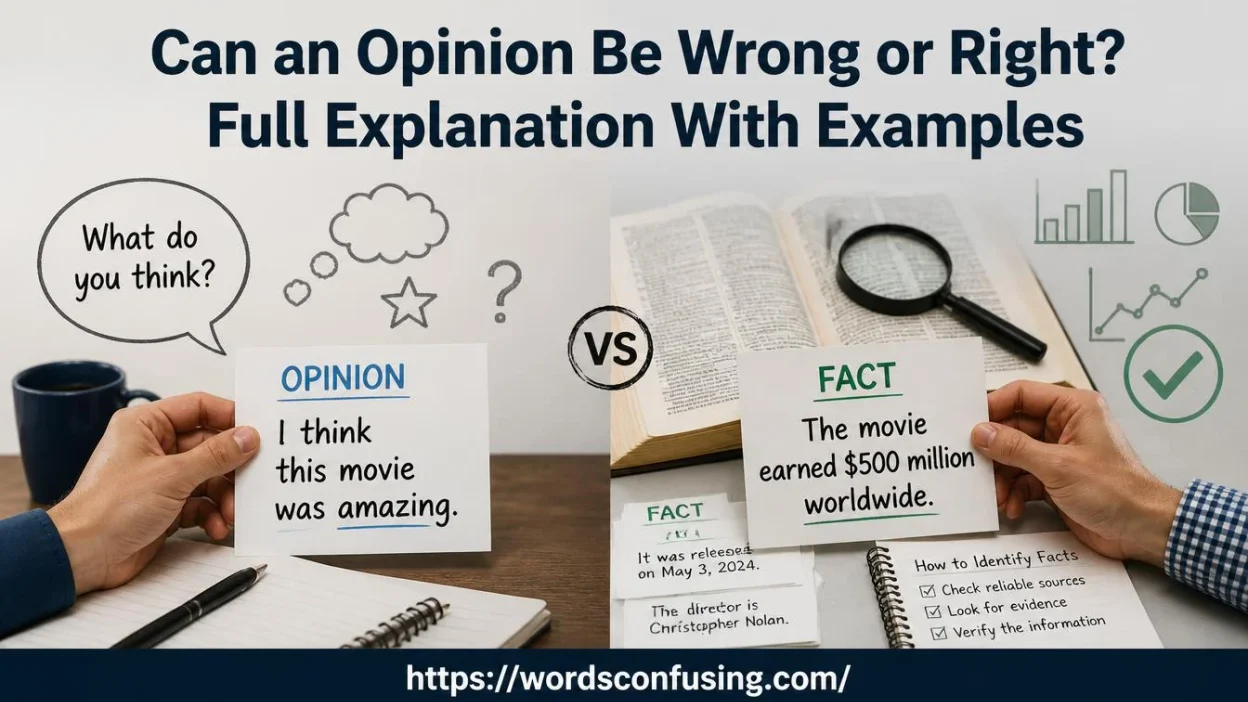
Can an Opinion Be Wrong or Right depends on whether it expresses a personal preference or makes a claim that can be checked with evidence and reasoning.
We frequently hear one person tell another, “That’s your opinion,” as if an opinion ends every finished argument. Yet an opinion can deserve examination. A subjective opinion may include a factual statement, while an opinion statement can be tested by observing a statement and asking whether the statement is an opinion or a claim that is right or wrong or true or false.
In my experience, this creates the beginning of a useful discussion by raising questions about the reasoning behind what was claimed and whether the evidence supports it.
In actuality, opinions are capable of being supported or challenged. A personal belief, personal idea, or personal preferences can be always right for you, such as “I like chocolate ice cream”, even when someone doesn’t agree.
However, an opinion based on false evidence can be proven wrong, creating wrong opinions overall. These cases are an invitation to think deeper, build a better argument, and avoid closing an argument too quickly.
Quick Answer
Yes, an opinion can be right or wrong—but it depends on what kind of opinion it is. A personal preference, such as “I prefer coffee to tea,” usually isn’t objectively right or wrong. However, an opinion that makes a factual claim can be checked against evidence. For example, saying “In my opinion, Earth has two moons” is still factually incorrect. The phrase “in my opinion” doesn’t change a fact.
In short:
- Personal preference: Usually neither right nor wrong.
- Factual opinion: Can be right or wrong.
- Evidence-based opinion: Can be stronger or weaker depending on the evidence.
- Prediction: Can eventually prove correct or incorrect.
- Moral or aesthetic opinion: Often depends on values, standards, and perspective.
The simplest rule is: You have a right to your opinion, but that doesn’t make every factual claim within it true.
Can an Opinion Be Right or Wrong?
An opinion can be right or wrong when it makes a claim about something that has an objective answer.
For example:
“In my opinion, the Pacific Ocean is smaller than the Atlantic Ocean.”
Although the speaker introduces the statement as an opinion, the comparison concerns measurable geography. The claim can be checked against reliable geographic data.
If the evidence contradicts the claim, the opinion is factually wrong.
Compare that with:
“In my opinion, the Pacific Ocean is more beautiful than the Atlantic Ocean.”
That statement doesn’t have the same kind of objective answer. Beauty involves personal judgment. One person might prefer the Pacific while another prefers the Atlantic.
Neither person necessarily holds a factually wrong opinion.
This gives us a useful rule:
An opinion’s status depends partly on what the opinion is about.
| Type of opinion | Example | Can it be objectively right or wrong? |
| Personal preference | “I prefer tea.” | Usually no |
| Taste judgment | “Pizza tastes better than burgers.” | Usually no |
| Factual claim | “The Earth has one natural satellite.” | Yes |
| Prediction | “This team will win tomorrow.” | Eventually testable |
| Interpretation | “The novel is about grief.” | Can be better or worse supported |
| Moral judgment | “Honesty is more important than wealth.” | Depends on ethical principles |
| Generalization | “Everyone hates public speaking.” | Potentially false and testable |
The phrase “in my opinion” doesn’t change a factual claim into a subjective fact.
If someone says, “In my opinion, Paris is the capital of France,” the speaker has expressed a belief about a fact. The statement remains testable.
Philosophical discussions of facts emphasize that facts are connected with what is actually the case and with truth.
When an Opinion Is Neither Right Nor Wrong
Some opinions simply express personal experience or preference.
Imagine two friends choosing dessert.
One says:
“Vanilla is the best ice cream flavor.”
The other replies:
“No, chocolate is better.”
There’s no universal scientific instrument capable of measuring which flavor is objectively “best” for every person. The disagreement largely reflects taste.
The first person’s opinion isn’t objectively wrong because the second person disagrees.
Personal preferences include things such as:
- Favorite foods
- Preferred colors
- Music preferences
- Clothing styles
- Movie tastes
- Interior design choices
- Vacation preferences
- Personal hobbies
Your preference can be real and meaningful without being objectively true.
That’s an important distinction. Subjective doesn’t mean meaningless. It simply means the judgment depends substantially on the individual or their standards.
When an Opinion Can Be Factually Wrong
Now consider this statement:
“I think humans have lived on Mars.”
That’s presented as an opinion, but the underlying claim concerns an event that either happened or didn’t happen.
The statement can therefore be investigated.
The same principle applies to claims such as:
- “The Moon is larger than Earth.”
- “The Amazon River flows through Egypt.”
- “World War II ended in 1950.”
- “Water freezes at 100°F under normal atmospheric pressure.”
These aren’t merely questions of personal taste.
Someone can certainly believe such claims. However, belief doesn’t determine truth.
That distinction sits at the heart of epistemology, the branch of philosophy concerned with knowledge, belief, justification, and related questions.
When an Opinion Is Reasonable but Still Debatable
Not every opinion falls neatly into “correct” or “incorrect.”
Suppose two economists study the same economic data and disagree about what a particular policy will accomplish. Both might have reasonable arguments.
The disagreement doesn’t necessarily mean one person lacks intelligence or integrity.
They might:
- Interpret uncertain evidence differently.
- Assign different probabilities to possible outcomes.
- Emphasize different risks.
- Use different assumptions.
- Have different models.
- Place different weight on competing evidence.
In these situations, it helps to distinguish truth from justification.
An opinion can be well-reasoned even when its conclusion later turns out to be wrong.
That’s one reason intellectual humility matters. A person can say, “Based on the evidence available today, this seems most likely,” without pretending to possess absolute certainty.
What Makes an Opinion Right or Well-Supported?
A strong opinion usually has something behind it.
That “something” might be evidence, experience, reasoning, reliable information, or a coherent set of principles. The exact standard depends on the subject.
For factual questions.
Personal preferences.
When dealing with moral questions…
A useful way to evaluate an opinion is to ask:
- What exactly is the person claiming?
- Does the claim contain factual information?
- What evidence supports it?
- Is the evidence reliable?
- Does the evidence actually support the conclusion?
- Has contradictory evidence been considered?
- Does the reasoning contain an obvious logical error?
- How certain should someone reasonably be?
These questions help separate a thoughtful opinion from a confident guess.
Evidence Matters More Than Confidence
Confidence can make an opinion sound convincing. It doesn’t make the opinion true.
Someone might confidently claim that a particular historical event happened in a certain year. Another person might speak cautiously while presenting documented evidence.
The cautious person can still be right.
Knowledge isn’t simply a matter of feeling certain. Contemporary epistemological discussions commonly distinguish knowledge from mere true belief by asking whether the belief is appropriately supported rather than correct merely by luck.
That distinction is crucial.
Being right by accident isn’t the same as knowing you’re right.
A Well-Supported Opinion Can Still Change
Good reasoning doesn’t require stubbornness.
If new evidence appears, a reasonable person can revise an opinion. In fact, willingness to reconsider beliefs can be a sign of intellectual strength.
A healthy reasoning process often looks like this:
Question → Evidence → Interpretation → Conclusion → New evidence → Reassessment
This process isn’t a weakness.
It’s how responsible thinking works.
Examples of Opinions That Can Be Wrong
Some opinions become wrong because the factual assumptions underneath them don’t survive examination.
An Opinion Based on a False Fact
Consider:
“I think the Atlantic Ocean is larger than the Pacific Ocean.”
That’s an opinion in wording. However, the underlying comparison is factual.
Geographic measurements can settle the question.
The problem isn’t that the speaker has a different taste. The problem is that the opinion rests on an inaccurate factual claim.
An Opinion Based on Outdated Information
Information changes.
A person might hold an opinion based on research, statistics, or circumstances that were accurate years ago but no longer reflect current knowledge.
For example, someone could continue believing that a particular scientific explanation is correct despite substantial later evidence showing otherwise.
An old opinion isn’t automatically foolish. It may have been reasonable when the available evidence looked different.
What matters is whether the person updates the opinion when credible evidence changes.
An Opinion Based on Faulty Reasoning
An opinion can also fail because the reasoning doesn’t support the conclusion.
Suppose someone says:
“I met two rude tourists from Country X, so people from Country X must be rude.”
The conclusion doesn’t logically follow from two encounters.
This is a classic hasty generalization.
Other reasoning problems include:
- False cause: Assuming one event caused another simply because it happened first.
- False dilemma: Pretending only two possibilities exist when more options are available.
- Cherry-picking: Selecting favorable evidence while ignoring relevant contrary evidence.
- Appeal to popularity: Assuming something is true because many people believe it.
- Appeal to authority: Treating someone’s status as proof that their claim must be correct.
An opinion can therefore reach the right conclusion for the wrong reason. It can also reach the wrong conclusion despite sounding persuasive.
An Opinion That Misrepresents Evidence
Evidence needs context.
Imagine someone says:
“This product worked for my friend, so it works for everyone.”
One person’s experience may be genuine. However, it doesn’t establish a universal conclusion.
Anecdotes can provide useful information, especially about personal experience. They don’t automatically establish broad causal or statistical claims.
That’s why evidence-based reasoning asks not only “Do you have evidence?” but also “What does that evidence actually show?”
Examples of Opinions That Can Be Right
Opinions can also turn out to be correct.
An Evidence-Based Opinion
Suppose someone says:
“I think this explanation is more convincing because it fits the available evidence better.”
That’s an opinion, but it’s not an arbitrary one.
The person has connected the conclusion to evidence and reasoning.
A well-supported opinion can therefore deserve serious consideration even when reasonable people might still debate the conclusion.
A Correct Prediction
Predictions provide another interesting example.
Imagine someone says:
“I think the company will report higher revenue next quarter.”
That’s an opinion or prediction about a future event.
At the time of the statement, the outcome hasn’t happened yet. Later, the relevant financial results can establish whether the prediction was accurate.
This creates an important difference:
A prediction can be reasonable before it becomes verifiable.
Someone could make a correct prediction with poor reasoning. Someone else could make an incorrect prediction using excellent reasoning under uncertainty.
The result alone doesn’t tell the whole story.
A Well-Reasoned Interpretation
Interpretations occupy a middle ground.
Suppose two readers interpret a novel differently. One argues that the central theme concerns loneliness. Another argues that it concerns identity.
Both interpretations might be defensible.
However, one interpretation could have stronger textual support.
The reader who points to recurring symbols, dialogue, narrative structure, and character development may have a more persuasive interpretation than someone who simply says, “That’s what I feel.”
Interpretations don’t always have one simple factual answer. Yet they aren’t necessarily arbitrary either.
Personal Preference vs. Factual Opinion
This distinction solves much of the confusion surrounding whether an opinion can be right or wrong.
Personal preferences describe what someone likes, dislikes, values, or enjoys.
Factual opinions make claims about reality.
| Statement | Category | Evaluation |
| “I like blue.” | Preference | Subjective |
| “Blue is the world’s best color.” | Value judgment | Subjective |
| “The sky appears blue under ordinary daytime conditions.” | Factual claim | Testable |
| “This movie is boring.” | Taste judgment | Subjective |
| “The movie was released in 2024.” | Factual claim | Testable |
| “This restaurant serves the best pizza.” | Preference/evaluation | Subjective |
| “This restaurant opened in 2024.” | Factual claim | Testable |
The wording can sometimes disguise the category.
For example:
“In my opinion, this restaurant opened in 2024.”
The phrase “in my opinion” doesn’t make the opening date subjective.
It’s still a factual claim.
Read more: Sewed or Sewn: Meaning, Grammar and Examples
What Is the Difference Between an Opinion and a Fact?
A fact generally concerns what is actually the case. An opinion generally expresses a person’s belief, judgment, evaluation, interpretation, or preference.
That sounds straightforward until real-world language enters the picture.
People frequently mix facts and opinions in a single sentence.
Consider:
“This phone costs $900, so it’s overpriced.”
The first part is a factual claim if the price can be verified.
The second part is an evaluation. Whether $900 is “overpriced” depends partly on what standard the speaker uses.
The sentence therefore contains both descriptive and evaluative elements.
Philosophical work on facts recognizes facts as connected to truth and what obtains in the world. At the same time, philosophical discussions of values caution against assuming that every real-world judgment fits neatly into a simple fact-versus-value split.
Simple Fact and Opinion Examples
Here are some easy comparisons:
Fact:
“The Pacific Ocean is an ocean.”
Opinion:
“The Pacific Ocean is the most beautiful ocean.”
Fact:
“The book contains 300 pages.”
Opinion:
“The book is too long.”
Fact:
“The company was founded in 1998.”
Opinion:
“The company’s products are excellent.”
The first statements are primarily descriptive.
The second statements evaluate or interpret those descriptions.
Why Facts and Opinions Aren’t Always Perfect Opposites
Real conversations rarely behave like multiple-choice questions.
An opinion can depend on facts. Facts can influence judgments. Values can affect which evidence people prioritize or how they interpret situations.
Hannah Arendt, for example, emphasized the importance of keeping facts and opinions distinct while recognizing that factual information helps shape legitimate opinions.
That relationship is especially important in public debates.
If two people disagree about a policy, they may disagree about values. However, they can also disagree because one person has incorrect information.
Those are different problems.
A factual disagreement requires evidence.
A value disagreement may require ethical reasoning, priorities, or discussion of principles.
Can an Opinion Be a Fact?
An opinion itself isn’t normally a fact simply because someone believes it.
However, a statement about someone’s opinion can be a fact.
Consider these examples:
“Pizza is the best food.”
That’s a subjective judgment.
Now consider:
“James believes pizza is the best food.”
That’s a factual claim about James’s belief. If James genuinely holds that belief, the statement can be true.
This distinction is subtle but useful.
| Statement | What it describes |
| “Coffee tastes better than tea.” | Personal evaluation |
| “Maria prefers coffee to tea.” | Maria’s preference |
| “Water freezes at 32°F under standard atmospheric pressure.” | Factual claim |
| “David believes water freezes at 50°F.” | David’s belief |
The fact that someone believes something doesn’t make the belief true.
Belief and truth are separate concepts. Philosophical treatments of belief describe beliefs as mental attitudes toward propositions or possible states of affairs.
Can You Have an Opinion Without Knowledge?
Yes.
You can form an opinion about almost anything without knowing much about it.
That’s one of the easiest things humans do.
Someone might have an opinion about:
- A historical event they haven’t studied
- A scientific topic they barely understand
- A political proposal they haven’t read
- A technical product they’ve never used
- A medical claim they haven’t researched
- A book they haven’t finished
Having an opinion requires very little.
Having a well-informed opinion requires considerably more.
That distinction is often overlooked.
Uninformed Opinion vs. Informed Opinion
| Uninformed opinion | Informed opinion |
| Relies heavily on assumptions | Uses relevant evidence |
| May rely on one anecdote | Considers broader information |
| Often ignores opposing evidence | Examines competing explanations |
| May use emotional reactions | Separates emotion from evidence |
| Can show unjustified certainty | Matches confidence to evidence |
| May change when challenged | Can explain why the conclusion was reached |
An informed opinion doesn’t need to be infallible.
Nobody has perfect information.
Instead, an informed opinion has a stronger relationship between evidence, reasoning, and conclusion.
Is It Better to Say “I Don’t Know”?
Sometimes, yes.
“I don’t know” isn’t an intellectual failure.
It’s an accurate response when the available evidence doesn’t justify a confident conclusion.
Epistemology examines precisely these questions about belief, justification, knowledge, and rational confidence.
A person who understands the limits of their knowledge can make better judgments than someone who confidently fills every gap with speculation.
Can an Opinion Be Good or Bad?
Yes, but “good” and “bad” need clarification.
A good opinion might mean:
- Well-supported
- Clearly expressed
- Logically consistent
- Relevant to the question
- Based on reliable information
- Open to revision
- Proportionate to the available evidence
A bad opinion might mean:
- Factually inaccurate
- Poorly reasoned
- Unsupported
- Based on misleading information
- Built on a faulty generalization
- Overconfident despite uncertainty
- Dependent on irrelevant evidence
Calling an opinion “bad” doesn’t necessarily mean the person is bad.
That’s an important distinction.
Criticizing an argument isn’t the same as attacking the person who made it.
For example, saying “That conclusion doesn’t follow from the evidence” is very different from saying “You’re an unintelligent person.”
The first evaluates reasoning.
The second attacks a person.
Can Two Opposing Opinions Both Be Right?
Sometimes.
It depends on what the opinions claim.
Consider:
“Chocolate ice cream is better than vanilla.”
and
“Vanilla ice cream is better than chocolate.”
Both can be perfectly legitimate expressions of personal preference.
Now consider:
“The Moon is Earth’s only natural satellite.”
and
“Earth has five natural moons.”
Those claims cannot both be correct under the same definitions and circumstances.
This gives us another useful distinction:
Two people can have different preferences without contradiction. They can’t make mutually exclusive factual claims that are both true in the same sense.
Philosophical work on disagreement distinguishes disagreements about matters of fact from disagreements about taste and recognizes that confidence can also vary between people who discuss the same proposition.
Why Reasonable People Sometimes Disagree
Disagreement doesn’t automatically prove that nobody knows the answer.
People can disagree because:
- Evidence is incomplete.
- The evidence is ambiguous.
- Different assumptions produce different conclusions.
- People assign different probabilities.
- Values influence judgments.
- Information quality differs.
- One person may simply be mistaken.
The existence of disagreement therefore tells you very little by itself.
The next question should be:
Why do they disagree?
That’s where the interesting part begins.
How Can You Tell Whether an Opinion Is Correct?
You don’t need a philosophy degree to evaluate an opinion.
Start with a few practical questions.
Ask What Kind of Claim It Makes
First, identify the type.
Is it:
- A personal preference?
- A factual claim?
- A prediction?
- A moral judgment?
- An interpretation?
- A generalization?
- A recommendation?
This first step prevents you from judging every opinion by the same standard.
You wouldn’t evaluate a favorite song in exactly the same way you evaluate a claim about the population of a country.
Check the Evidence
Next, ask where the opinion comes from.
Does it rely on:
- Direct evidence?
- Reliable records?
- Scientific research?
- Firsthand experience?
- Expert analysis?
- An isolated anecdote?
- Social media posts?
- Rumors?
- Assumptions?
Not all evidence carries equal weight.
The source matters.
The quality of the evidence matters.
The connection between the evidence and the conclusion matters, too.
Examine the Reasoning
Even accurate information can support a weak argument if the reasoning goes off the rails.
Ask:
“Does the conclusion actually follow from the evidence?”
For example:
“My neighbor owns an expensive car, so everyone in this neighborhood is wealthy.”
The observation may be true.
The conclusion doesn’t necessarily follow.
Consider Alternative Explanations
Strong reasoning doesn’t stop at the first explanation that seems convenient.
Suppose sales increased after a company launched a new advertising campaign.
Was the advertising responsible?
Possibly.
However, other factors might have contributed:
- Seasonal demand
- Lower prices
- A competitor leaving the market
- A new distribution channel
- A viral social-media trend
- A broader economic change
Correlation alone doesn’t automatically establish causation.
Match Confidence to Evidence
A useful habit is to match certainty with support.
Think of confidence as a volume knob.
Weak evidence should usually produce lower confidence.
Strong evidence can justify greater confidence.
That doesn’t mean every uncertain question requires hesitation forever. It means confidence should have a reason.
Can an Opinion Become a Fact?
An opinion doesn’t literally transform into a fact simply because it becomes popular or because someone repeats it many times.
Instead, an opinion may turn out to be correct.
Suppose someone says:
“I think there is another planet in that distant system.”
Later, researchers gather strong evidence confirming the planet.
The original belief was an opinion or hypothesis at the time. The subsequent evidence established a factual basis for the claim.
This distinction matters because truth and belief aren’t interchangeable.
A belief can be:
- True
- False
- Well-supported
- Poorly supported
- Accidentally correct
- Reasonably uncertain
Philosophical accounts of knowledge commonly treat truth as necessary for knowledge while also emphasizing that merely arriving at a true belief by luck isn’t enough.
Why Saying “It’s Just My Opinion” Doesn’t End an Argument
The phrase “it’s just my opinion” can be perfectly reasonable in one situation and misleading in another.
If someone says:
“It’s just my opinion, but I prefer jazz.”
There’s little to fact-check.
They’re expressing a personal preference.
However:
“It’s just my opinion, but the Earth is flat.”
The phrase doesn’t shield the factual claim from evidence.
You can use “in my opinion” before almost any sentence. That doesn’t magically turn objective claims into subjective ones.
Compare:
| Statement | Does “in my opinion” change its status? |
| “I prefer tea.” | Mostly subjective |
| “Tea tastes better than coffee.” | Subjective evaluation |
| “The store opens at 9 a.m.” | No |
| “The Earth has one natural moon.” | No |
| “This policy is unfair.” | Primarily evaluative |
| “This event happened in 1990.” | No |
The wording matters less than the underlying claim.
Opinion vs. Belief vs. Knowledge vs. Fact
These words often overlap in everyday conversation. They aren’t identical.
| Term | Simple meaning |
| Opinion | A person’s view, judgment, interpretation, or preference |
| Belief | Something a person accepts as true |
| Knowledge | A successful cognitive state involving truth and appropriate epistemic support, though philosophers debate its exact definition |
| Fact | What is actually the case |
| Preference | Something a person likes or chooses |
| Judgment | A conclusion or evaluation |
Imagine someone says:
“I believe this treatment works.”
That’s a belief.
If they add:
“I think it works because several high-quality studies support it.”
That’s an evidence-based opinion or belief.
If the claim is true and satisfies the relevant conditions for knowledge, it may count as knowledge. Philosophers have debated those conditions extensively.
The important point is simple:
Believing something doesn’t make it a fact.
What Happens When New Evidence Proves an Opinion Wrong?
A wrong opinion isn’t necessarily the end of the story.
What matters is how someone responds after discovering the mistake.
Imagine a person strongly believes that a product contains a particular ingredient. They later check the manufacturer’s documentation and discover that it doesn’t.
There are two possible responses.
They could say:
“I was wrong. The evidence changed my mind.”
Or they could ignore the evidence and keep repeating the original claim.
The first response demonstrates intellectual flexibility.
The second demonstrates resistance to correction.
Changing your mind isn’t automatically a sign that your original thinking was terrible. Sometimes it’s evidence that you’re paying attention.
Case Study: Taste vs. Evidence
Consider two statements about a movie:
“I think this movie is boring.”
and:
“I think this movie was released in 2022.”
The first is primarily subjective.
The second is factual.
Now add another:
“I think the movie is historically inaccurate.”
That statement sits somewhere in between.
It might involve factual claims about history. It might also involve interpretation concerning what counts as “accurate enough.”
To evaluate it properly, you’d need to examine the historical evidence and the specific scenes being criticized.
This example shows why opinion isn’t one single category.
The same sentence structure can conceal very different kinds of claims.
Case Study: The Prediction Problem
Imagine two people predict that a company will lose money next year.
Person A says:
“I think it will happen because the company has declining sales, rising costs, and shrinking margins.”
Person B says:
“I just have a feeling.”
If the company eventually loses money, both predictions were correct.
However, their reasoning wasn’t equally strong.
Person A offered an evidence-based prediction.
Person B happened to guess correctly.
This is a valuable lesson:
A correct conclusion doesn’t always prove that the reasoning behind it was good.
Likewise, a wrong prediction doesn’t necessarily prove that the reasoning was foolish.
Predictions involve uncertainty.
Case Study: Moral Opinions
Moral opinions create another layer of complexity.
Consider:
“Honesty is more important than wealth.”
This isn’t a simple factual statement like “The building has ten floors.”
It’s a value judgment.
To evaluate it, you might ask:
- What ethical principles are being used?
- What does “important” mean?
- Are there exceptions?
- What consequences matter?
- Are there competing moral duties?
- How should conflicting values be ranked?
Reasonable people can disagree about such questions without either person making a basic factual error.
However, moral arguments can still contain factual mistakes.
Someone might argue:
“Lying is always harmless because nobody gets hurt.”
That second part is an empirical claim. If evidence shows that a particular lie causes serious harm, the factual premise becomes vulnerable.
This demonstrates an important principle:
Value judgments can depend on factual assumptions.
Can an Opinion Be Good Without Being Correct?
Yes.
This distinction is easy to miss.
Suppose you make a prediction using the best information available. You carefully examine the evidence, consider alternatives, and reach a cautious conclusion.
The prediction later turns out to be wrong because an unexpected event occurs.
Was the original opinion necessarily a bad opinion?
No.
An opinion can be well-reasoned but mistaken.
Similarly, an opinion can be correct but poorly reasoned.
That distinction helps explain why evaluating thinking requires more than checking the final answer.
Can an Opinion Be Wrong Because It Lacks Knowledge?
Sometimes.
Lack of knowledge doesn’t automatically make every opinion wrong. However, it can make an opinion poorly supported.
Imagine someone forms a strong opinion about a complex scientific topic after reading one social-media post.
The person may still have an opinion.
What they don’t necessarily have is a well-informed basis for confidence.
This is why expertise and research matter when questions become complicated.
The more specialized the subject, the more dangerous it becomes to confuse familiarity with understanding.
What Is the Best Way to Think About Opinions?
A useful framework is to place opinions into three broad categories.
Subjective Opinions
These mainly concern personal taste or preference.
Examples:
- “I prefer summer.”
- “Jazz is more enjoyable than rock.”
- “That painting is beautiful.”
These usually aren’t objectively right or wrong.
Evidence-Based Opinions
These involve judgments supported by facts or evidence.
Examples:
- “This policy is likely to reduce costs because previous data shows a similar pattern.”
- “This explanation is more convincing because it fits the available evidence.”
These can be stronger or weaker depending on the quality of the support.
Factual Opinions
These look like opinions but make claims that evidence can directly test.
Examples:
- “I think the meeting starts at 3 p.m.”
- “In my opinion, the company was founded in 2005.”
- “I believe the event happened in March.”
These can be objectively correct or incorrect.
Quick Reference: Can an Opinion Be Wrong or Right?
| Question | Short answer |
| Can an opinion be wrong? | Yes, when it makes a false factual claim or rests on faulty reasoning. |
| Can an opinion be right? | Yes, when its claim is true or its judgment is well-supported under appropriate standards. |
| Are all opinions subjective? | No. Some opinions contain objectively testable claims. |
| Can personal preferences be wrong? | Usually not in an objective factual sense. |
| Can an uninformed opinion be correct? | Yes, but it may be correct by luck. |
| Can an informed opinion be wrong? | Yes. Good reasoning doesn’t guarantee a correct prediction. |
| Can two opinions both be right? | Yes, especially when they express different preferences or defensible interpretations. |
| Does “in my opinion” make a fact subjective? | No. |
| Can an opinion become a fact? | An opinion doesn’t transform into a fact, but it can turn out to be correct. |
| Should opinions use evidence? | Factual and evidence-based opinions generally should. Personal preferences usually don’t require evidence. |
FAQs
Can an opinion actually be wrong?
Yes. An opinion based on incorrect facts, misleading information, or false evidence can be shown to be wrong.
Is every personal opinion automatically right?
Not necessarily. Personal preferences can be valid for the person who holds them, but factual claims within an opinion can still be tested.
Can two people have different opinions and both be right?
Yes. When their opinions reflect personal tastes or preferences, both can be valid without one person being objectively wrong.
What makes an opinion more reliable?
An opinion becomes more reliable when it uses accurate facts, strong evidence, and reasonable thinking rather than assumptions or misinformation.
How can you tell whether an opinion is based on facts?
Look at the evidence supporting it. If the factual claims can be independently checked and confirmed, the opinion has a stronger foundation.
Should you argue when someone has a different opinion?
Not always. A respectful discussion can help you understand their reasoning, examine the evidence, and decide whether the disagreement comes from facts or personal preferences.
Conclusion
An opinion doesn’t become automatically right simply because someone calls it a personal view. Personal preferences can be valid because they describe what you like or believe, while opinions that depend on facts can be checked against evidence. If the facts are incorrect or the reasoning doesn’t hold up, that opinion can be wrong.
The best approach is to stay open to questions, listen to different views, and examine the information before deciding what you believe. A thoughtful opinion isn’t about winning an argument. It’s about understanding the difference between personal preference and a claim that can actually be proven or disproven.

Franklin Hayes is a writer and editor at WordsConfusing.com, focused on making English vocabulary, grammar, and commonly confused words easy to understand. He writes clear, practical articles with simple explanations and useful examples to help readers improve their English with confidence.
His goal is simple: Making Confusing Words Simple.