Families or Family’s or Families’: What’s the Difference? Learn the grammar rules for choosing the correct possessive form of family in English.
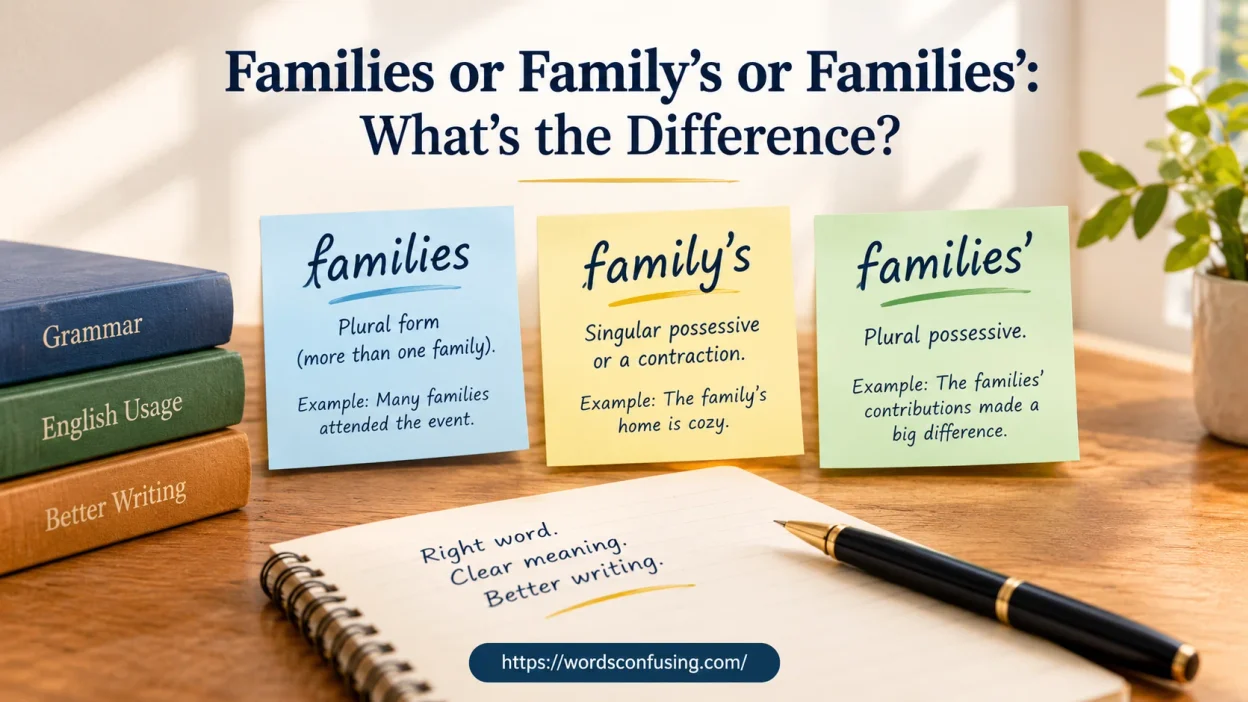
In English grammar, the possessive form of family depends on whether you mean one family or several. Family is a singular noun, while families is the plural form. Adding an apostrophe changes their meaning: family’s is the singular possessive form, showing ownership by one family, as in “The family’s house is near the park.”
Meanwhile, families’ is the plural possessive form, showing ownership by multiple families, as in “The families’ houses are near the park.” These word forms help you identify the correct meaning in different sentences.
Understanding possessive nouns makes common grammatical rules, apostrophe usage, punctuation, and spelling easier to follow. When writing, identify the noun’s singular or plural meaning before applying the relevant possessive rules. This approach improves word usage and makes remembering rules easier.
In this article, these distinctions show how to use family, family’s, families, and families’ correctly. With practice, you’ll develop a better understanding of these certain words and their everyday usage.
Quick Answer
The main difference between these words is how they express number, ownership, or a shortened phrase. A single apostrophe can change the meaning of an otherwise similar word.
| Word | Grammatical function | Meaning | Example |
| Families | Plural noun | More than one family | Several families attended the event. |
| Family’s | Singular possessive or contraction | Belonging to one family; family is or family has | The family’s house is beautiful. |
| Families’ | Plural possessive | Belonging to multiple families | The families’ homes are nearby. |
Here’s a quick way to remember the difference:
- Families: More than one family.
- Family’s: Something belongs to one family, or the word contracts family is or family has.
- Families’: Something belongs to more than one family.
Notice how the apostrophe changes position. In family’s, it comes before the final s. In families’, it comes after the final s because the noun is already plural.
What Does Families Mean?
Families is the plural form of family. Use it whenever you refer to two or more families without indicating possession.
For example, imagine a school organizing a picnic for parents and children from several households. You might write, “Many families attended the school picnic.” The word families tells readers that multiple family groups attended.
The word doesn’t need an apostrophe because ordinary English plurals don’t use apostrophes. Adding one would suggest a possessive form or a contraction rather than a simple plural noun.
Why Does Family Become Families?
The spelling change follows a common English pluralization rule. When a noun ends in a consonant followed by y, you usually change the y to ies to form its plural.
For example:
- Family → families
- Baby → babies
- City → cities
- Country → countries
- Party → parties
The rule applies because the letter before the y is a consonant. If a noun ends in a vowel followed by y, you generally add s instead.
For example, boy becomes boys, and key becomes keys. These words keep the y because a vowel comes before it.
Examples of Families in Sentences
The following examples show how to use families correctly in everyday writing.
- Several families gathered at the community center for the annual celebration.
- The school invited local families to attend its open house.
- Many families enjoy spending weekends together outdoors.
- The neighborhood has welcomed several new families this year.
- Local families participated in the charity event.
- The program provides educational resources to low-income families.
- Different families follow different holiday traditions.
- Hundreds of families visited the festival last weekend.
In each sentence, families simply identifies multiple family groups. None of the examples requires an apostrophe because the word doesn’t show ownership.
Families vs. Family’s: A Common Mistake
One common error occurs when writers use family’s simply because they mean more than one family.
Incorrect: Many family’s attended the meeting.
Correct: Many families attended the meeting.
The incorrect version uses a possessive form where a plural noun belongs. Nothing in the sentence indicates ownership, so the apostrophe serves no purpose.
However, the possessive form becomes correct when a sentence identifies something belonging to one family.
Correct: The family’s contribution helped the organization reach its goal.
Here, the contribution belongs to one family. The apostrophe is necessary because the sentence expresses possession.
Read more: Witnesses or Witness’s or Witness’: What’s the Difference?
What Does Family’s Mean?
Family’s is the singular possessive form of family. It indicates that something belongs to, relates to, or is associated with one family.
To form the singular possessive, keep the noun in its singular form and add an apostrophe followed by s. Because family ends in y, the possessive form becomes family’s, not families’.
Consider this example: “The family’s garden looks beautiful.”
The sentence refers to one family and its garden. The apostrophe shows the relationship between the family and the garden.
Possession doesn’t always mean legal ownership. It can also express a relationship, responsibility, characteristic, or connection.
For example, a family’s history refers to that family’s past. Similarly, a family’s needs refers to the needs associated with that household.
Examples of Family’s Showing Possession
These sentences demonstrate the singular possessive form:
- The family’s home stands near the river.
- Our family’s tradition brings everyone together each December.
- The family’s decision surprised their relatives.
- Every family’s situation is different.
- The family’s dog loves playing in the garden.
- The family’s history includes several interesting stories.
- The family’s support helped the student succeed.
- A family’s budget often depends on its income and expenses.
Each example connects something to one family. The apostrophe comes before the s because family is singular.
Family’s Can Also Be a Contraction
The word family’s has another grammatical use. It can shorten family is or family has when the surrounding sentence supports that meaning.
A contraction combines two words and replaces omitted letters with an apostrophe. English speakers commonly use contractions in conversation, informal writing, and some forms of professional communication.
For example:
- The family’s arriving soon.
Expanded: The family is arriving soon. - The family’s already eaten dinner.
Expanded: The family has already eaten dinner. - The family’s planning a vacation.
Expanded: The family is planning a vacation. - The family’s lived here for years.
Expanded: The family has lived here for years.
The apostrophe marks the omitted letters in the contraction. It doesn’t indicate ownership in these sentences.
Context helps you identify the intended meaning. If you can replace family’s with family is or family has without changing the intended meaning, you’re probably looking at a contraction.
How to Tell Whether Family’s Shows Possession or a Contraction
Sometimes, you need to examine the words that follow family’s to determine its function.
Compare these sentences:
Possessive: The family’s house needs repairs.
Here, family’s identifies who the house belongs to. Replacing it with family is would produce “The family is house needs repairs,” which doesn’t make grammatical sense.
Contraction: The family’s moving to another city.
Here, family’s means family is. The expanded sentence reads, “The family is moving to another city.”
Contraction: The family’s finished its project.
Here, family’s means family has. The expanded sentence reads, “The family has finished its project.”
A practical test makes the distinction easier: expand the contraction and see whether the sentence still makes sense. If it does, the contraction interpretation may be correct. Otherwise, the word may be possessive.
What Does Families’ Mean?
Families’ is the plural possessive form of family. Use it when something belongs to, relates to, or is associated with two or more families.
The spelling follows a straightforward rule. First, change family to its plural form, families. Then add an apostrophe after the final s to show possession.
The result is families’.
For example, consider this sentence: “The families’ homes were decorated for the festival.”
The sentence refers to homes belonging to multiple families. The plural noun identifies the owners, and the apostrophe indicates possession.
Compare that sentence with “The family’s home was decorated for the festival.” The second example refers to one family’s home, while the first refers to homes associated with multiple families.
Examples of Families’ in Sentences
Here are several examples of the plural possessive form in context:
- The families’ homes were decorated with colorful lights.
- The school considered the families’ concerns before changing its schedule.
- The families’ contributions helped fund the community garden.
- The organization listened to the families’ requests for additional support.
- The families’ experiences varied throughout the program.
- The meeting addressed the families’ needs during the transition.
- The families’ opinions helped shape the final decision.
- The families’ traditions reflected their different cultural backgrounds.
In each sentence, the apostrophe follows the final s because the possessors are plural.
Families vs. Families’: What’s the Difference?
The difference is simple: families identifies multiple family groups, while families’ indicates a relationship or possession involving those groups.
Compare the following examples:
| Without an apostrophe | With an apostrophe |
| The families attended the meeting. | The families’ concerns were discussed. |
| Several families joined the program. | The families’ participation improved the program. |
| The families live nearby. | The families’ homes are nearby. |
| Many families requested assistance. | The families’ requests were reviewed. |
In the left column, families functions as a regular plural noun. In the right column, families’ modifies another noun to show a possessive relationship.
Remember that plural possession doesn’t require separate ownership of every item. The apostrophe can express a shared relationship or association as well.
For example, “The families’ community center” could refer to a center associated with several families. The exact relationship depends on the surrounding context.
How to Form the Plural Possessive Correctly
Follow these steps whenever you need the plural possessive form:
- Start with the singular noun: family.
- Change the noun to its plural form: families.
- Add an apostrophe after the final s: families’.
- Check that the sentence refers to multiple families.
For example:
- Singular: The family needs assistance.
- Singular possessive: The family’s needs are important.
- Plural: The families need assistance.
- Plural possessive: The families’ needs are important.
This pattern works for many regular plural nouns ending in s. For instance, students’ projects, teachers’ offices, and neighbors’ opinions all use an apostrophe after the plural s.
Families vs. Family’s vs. Families’: Key Differences
Although these three forms share the same root word, their grammatical functions differ. Understanding those differences helps you choose the correct spelling without relying on guesswork.
| Feature | Families | Family’s | Families’ |
| Number | Plural | Singular in possessive use | Plural |
| Apostrophe | No | Before s | After s |
| Main purpose | Refers to multiple families | Shows singular possession | Shows plural possession |
| Other meaning | None as a standard contraction | Can mean family is or family has | No standard contraction meaning |
| Example | Families gathered outside. | The family’s car is new. | The families’ cars are new. |
Compare the Words in Similar Sentences
Sometimes, the easiest way to understand a grammar rule is to compare nearly identical sentences.
Families: Families gathered outside the school.
This sentence describes several family groups gathering. The word is plural, but it doesn’t show possession.
Family’s: The family’s car was parked outside the school.
This sentence refers to a car associated with one family. The apostrophe appears before the s to form the singular possessive.
Families’: The families’ cars were parked outside the school.
This sentence refers to cars associated with multiple families. The apostrophe follows the s because the possessors are plural.
Notice that the words after the possessive forms can also help reveal the intended meaning. One family’s car differs from multiple families’ cars.
Why Apostrophe Placement Matters
An apostrophe may look like a tiny punctuation mark, but its position carries grammatical meaning.
Consider these three phrases:
- Families’ needs: Incorrectly written if you intend the standard plural possessive? No. This form is actually correct for plural possession, just like families’ needs.
- Family’s needs: The needs associated with one family.
- Families needs: Usually incorrect when the intended meaning is that multiple families have needs; write families’ needs.
The key is to identify the intended meaning before choosing the punctuation. Don’t add an apostrophe simply because a word ends in s, and don’t remove one when the sentence requires possession.

How to Choose Between Families, Family’s, and Families’
Choosing the correct form becomes easier when you ask what the sentence means. Instead of memorizing three separate spellings, follow a simple decision-making process.
Follow These Simple Grammar Rules
Use families when you mean more than one family.
Example: Many families attended the neighborhood celebration.
You’re describing multiple family groups. No apostrophe is necessary.
Use family’s when something belongs to one family.
Example: The family’s garden needs more sunlight.
The garden belongs to or is associated with one family.
Use families’ when something belongs to multiple families.
Example: The families’ gardens received awards.
The sentence refers to gardens associated with several families.
Use family’s when it means family is or family has.
Example: The family’s moving tomorrow.
You can expand the contraction to “The family is moving tomorrow.” The sentence retains its intended meaning.
A Simple Decision Tree
Use these questions to identify the correct form:
- Are you referring to multiple families without showing possession? Write families.
- Does something belong to one family? Write family’s.
- Does something belong to multiple families? Write families’.
- Can you replace family’s with family is or family has? If the sentence still makes sense, you’re using a contraction.
This approach works well for school assignments, emails, blog posts, and everyday writing.
Read more: Jesus’ or Jesus’s: Rules and Examples
Common Mistakes With Families, Family’s, and Families’
Apostrophe mistakes often happen when writers focus on spelling instead of meaning. Learning to spot these errors will help you edit your work more confidently.
Using Family’s Instead of Families
Incorrect: The local family’s attended the meeting.
Correct: The local families attended the meeting.
The sentence refers to several family groups rather than something belonging to one family. Therefore, the plural form is correct.
Using Families Instead of Families’
Incorrect: The families needs were discussed.
Correct: The families’ needs were discussed.
The sentence describes the needs of multiple families. Because families is plural and expresses possession, the apostrophe belongs after the final s.
Placing the Apostrophe in the Wrong Position
Incorrect: The families’s homes were renovated.
Correct: The families’ homes were renovated.
The plural noun already ends in s. You only need to add an apostrophe, not another s.
Assuming Family’s Always Shows Possession
Incorrect interpretation: In “The family’s arriving soon,” the apostrophe must indicate ownership.
Correct interpretation: The family’s arriving soon means “The family is arriving soon.”
The apostrophe can indicate omitted letters in a contraction. Check the sentence structure before deciding what the word means.
Adding Apostrophes to Ordinary Plurals
Incorrect: Three family’s registered for the program.
Correct: Three families registered for the program.
Ordinary plural nouns don’t need apostrophes. Use one only when the grammatical meaning requires possession or a contraction.

Families, Family’s, and Families’ in Real-Life Examples
Real-life examples make these distinctions easier to remember. The same topic can require different forms depending on whether you’re describing people, ownership, or a contraction.
Example: A School Announcement
Imagine a school sending an announcement about its annual family event.
- Families: Families are invited to attend the school celebration.
- Family’s: Each family’s registration must be completed before Friday.
- Families’: The school reviewed the families’ suggestions before planning the event.
The first sentence invites multiple family groups. The second refers to the registration associated with each individual family. The third identifies suggestions from multiple families.
Although all three sentences discuss the same event, each form communicates a different relationship.
Example: A Community Fundraiser
A community organization is raising money to improve a local park.
- Families: Several families volunteered to clean the park.
- Family’s: One family’s donation paid for new benches.
- Families’: The families’ contributions helped fund the playground.
These examples demonstrate how number and possession affect spelling. The plural form identifies participants, the singular possessive identifies one donor, and the plural possessive connects contributions with multiple families.
Example: A Neighborhood Meeting
Suppose several households are discussing parking problems in their neighborhood.
- Families: Families attended the meeting to discuss parking.
- Family’s: One family’s driveway blocks part of the sidewalk.
- Families’: The families’ concerns prompted the neighborhood association to act.
Each example uses the form that matches its intended meaning. This matters in formal writing because a misplaced apostrophe can make a sentence confusing or inaccurate.
A Quick Case Study: Editing a Paragraph
Consider this paragraph with several grammar mistakes:
Many family’s attended the community meeting. The families concerns were discussed first. One families suggestion led to a new parking plan.
Here’s the corrected version:
Many families attended the community meeting. The families’ concerns were discussed first. One family’s suggestion led to a new parking plan.
Why are these corrections necessary?
- Families is plural because several family groups attended.
- Families’ concerns indicates concerns associated with multiple families.
- Family’s suggestion identifies a suggestion from one family.
A few punctuation changes make the paragraph clearer without changing its overall message.
FAQs
1. What is the difference between families, family’s, and families’?
Families is the plural form of family. Family’s shows ownership by one family, while families’ shows ownership by multiple families.
2. Is family’s singular or plural?
Family’s is the singular possessive form. It refers to something that belongs to one family, such as “The family’s car is new.”
3. When should you use families’ in a sentence?
Use families’ when something belongs to two or more families. For example, “The families’ homes are close to the school.”
4. Is families grammatically correct without an apostrophe?
Yes, families is correct when you mean more than one family without showing ownership. For example, “Several families attended the event.”
5. Why does family become families in the plural form?
The word family ends in a consonant followed by y. To make it plural, replace the y with ies, giving you families.
6. How can you remember when to use family’s or families’?
Think about the number of families involved. Use family’s for one family and families’ for multiple families. The apostrophe in families’ comes after the s because the noun is already plural.
Conclusion
Understanding the difference between families, family’s, and families’ becomes easier when you know how each form works. Families refers to more than one family, family’s shows ownership by one family, and families’ indicates ownership by multiple families. For example, “The family’s garden looks beautiful” refers to one family’s garden, while “The families’ gardens look beautiful” refers to gardens belonging to several families. If you simply want to talk about more than one family without showing ownership, use families without an apostrophe.
The easiest way to remember these grammar rules is to identify whether you’re talking about one family or several before deciding where the apostrophe belongs. Use family’s when the singular noun shows possession, and place the apostrophe after the s in families’ to show plural possession. With regular practice, you’ll become more confident about using these forms correctly in everyday conversations, school assignments, emails, and professional writing.

Franklin Hayes is a writer and editor at WordsConfusing.com, focused on making English vocabulary, grammar, and commonly confused words easy to understand. He writes clear, practical articles with simple explanations and useful examples to help readers improve their English with confidence.
His goal is simple: Making Confusing Words Simple.