
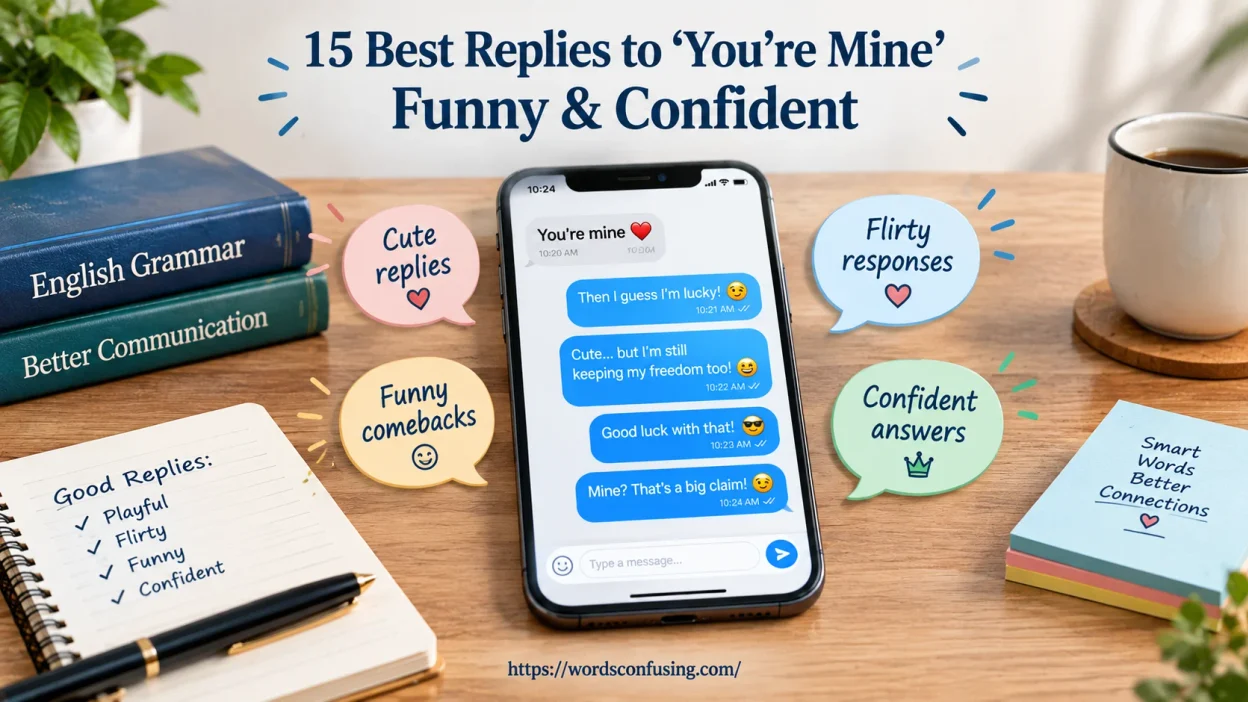
15 Best Replies to “You’re Mine” Funny & Confident can help when a guy or romantic partner uses this phrase.
Its tone, intent, meaning, relationship stage, situation, and context can make it romantic, playful, flirty, teasing, intense, sweet, cute, or possessive. During flirty conversations, it can show affection, attraction, attachment, romantic excitement, or emotional intent.
In healthy relationships, it may suggest deep bonding, while possessiveness, control, dominance, emotional insecurity, insecurity, jealousy, or exclusivity can feel uncomfortable.
The key is to understand the words, timing, and feelings before choosing a response. A whispered phrase can bring shivers of pleasure through your whole body, while a text may make you smile at your phone.
Choose ready-to-send replies that flirt back, match the vibe, keep things playful, or set clear boundaries. A thoughtful reply can spark romance, make someone laugh, deepen connection, and create a sweet moment or core memory. Stay natural, respectful, honest, and confident, while respecting your own comfort level too.
Quick Answer
The best reply to “You’re mine” depends on your relationship and how you feel about the person. If you like the playful tone, try “Only if you’re mine too,” “That’s a bold claim,” or “I was hoping you’d say that.” For a funny response, “Where’s the contract?” can lighten the moment. If the phrase feels too possessive, be honest with “I like you, but I’m not anyone’s possession.”
The trick is to match the mood without losing your own voice. A flirty reply can keep the spark alive, while a calm boundary can prevent an uncomfortable conversation from getting worse. Choose words that fit the relationship, the moment, and your comfort level.
What Does “You’re Mine” Mean?
The phrase “You’re mine” doesn’t have one fixed meaning. Its meaning changes dramatically with the relationship and context.
For example, someone might say it while cuddling with their partner. In that setting, the phrase can communicate affection, closeness, or romantic attachment. The same words from someone you barely know could feel very different.
Tone also matters. A playful smile can completely change the meaning of a sentence.
Here are some common interpretations:
| Situation | Possible meaning |
| Romantic partner says it | Affection or emotional attachment |
| Crush says it while flirting | Romantic interest or playful confidence |
| Close friend says it jokingly | Teasing or humor |
| Someone says it during an argument | Possible possessiveness |
| Someone repeatedly ignores your boundaries | Controlling behavior may be involved |
| Someone says it casually over text | The meaning may depend heavily on previous messages |
The phrase can therefore range from adorably romantic to uncomfortable.
You shouldn’t automatically assume that every use is controlling. Likewise, you don’t have to accept possessive language simply because someone claims they’re joking.
Your feelings provide important context.
How to Respond to “You’re Mine”
Before choosing one of the best replies to “You’re mine,” take a second to understand the situation.
Ask yourself three quick questions:
- Do I like this person?
- Do I understand what they mean?
- Am I comfortable with the way they phrased it?
If you like them, a playful response can keep the chemistry alive. If you’re unsure, choose something light that doesn’t make a commitment.
For example, “That’s a bold claim” gives the conversation room to develop.
If you’re uncomfortable, you can be straightforward instead. You don’t need an elaborate speech. A simple statement such as “I like you, but I’m not comfortable with possessive language” can communicate the point clearly.
Remember, a good reply should fit your personality too. The funniest line in the world won’t work if it sounds completely unnatural coming from you.
15 Best Replies to “You’re Mine”
Sometimes you don’t need a complicated answer. A short sentence with the right tone can carry the entire conversation.
Here are 15 replies covering romantic, cute, funny, flirty, and boundary-conscious situations.
“Only If You’re Mine Too.”
This is one of the easiest flirty replies to “You’re mine.”
It turns the possessive wording into something mutual. Instead of accepting the idea that one person owns the other, you create a playful sense of togetherness.
It works particularly well when you already share romantic chemistry.
Example:
“You’re mine.”
“Only if you’re mine too.”
The response feels confident without becoming overly serious.
“Looks Like We Belong Together.”
This reply takes the conversation in a sweeter direction.
Rather than focusing on possession, it emphasizes connection and compatibility. It works especially well between couples who already have a comfortable relationship.
You can also make it slightly more playful:
“Looks like we belong together, then.”
It sounds warm without being excessively dramatic.
“Then Take Good Care of Me.”
This response adds a playful twist to the conversation.
Instead of arguing about the phrase, you turn it into a lighthearted challenge. The person now has to respond to the idea of taking care of someone they care about.
It’s especially useful when you’re already comfortable with each other.
You might say:
“I’m yours? Then take good care of me.”
That small change makes the reply sound more teasing and personal.
“I Was Hoping You’d Say That.”
If you want a confident romantic reply, this one gets straight to the point.
It tells the other person that their feelings aren’t one-sided. There’s no need for excessive explanation.
The line also creates room for the conversation to become more affectionate.
For example:
“You’re mine.”
“I was hoping you’d say that.”
Simple. Smooth. Clear.
“And Who Gave You Permission?”
Sometimes teasing works better than an immediate romantic response.
“And who gave you permission?” creates playful resistance without necessarily rejecting the other person. It can be especially effective when both people already joke around with each other.
The tone matters, though. A playful message can become confusing if the relationship isn’t already comfortable.
A laughing emoji or playful follow-up can make your intention clearer in casual texting.
“Prove It.”
Few replies are shorter.
That’s exactly why this one can work so well.
“Prove it” challenges the person to explain what they mean. In a flirty conversation, it can sound confident and teasing.
However, context matters. Without an established playful tone, the response could sound demanding.
Use it when the conversation already has obvious chemistry.
“Careful, I Might Start Believing You.”
This line combines flirting and humor.
It doesn’t immediately accept the statement. Instead, it gives the other person an opening to continue flirting.
For example:
“You’re mine.”
“Careful, I might start believing you.”
The response feels relaxed rather than overly rehearsed. It also keeps the conversation moving.
“Guess You’re Stuck With Me.”
This is a cute option for someone you’re already close to.
The phrase suggests mutual attachment while keeping the mood light. It doesn’t need a serious declaration of love to communicate affection.
You could make it even warmer:
“Guess you’re stuck with me now.”
That version sounds natural in everyday texting.
“That Sounds Like a Promise.”
This reply gives the phrase a slightly deeper meaning.
Instead of focusing on ownership, you’re asking the person to stand behind what they’ve said. It works well when you want something flirty but meaningful.
It can also create an interesting conversational opening.
They might explain what they meant. You can then decide whether their answer matches your feelings.
“Then I’m Keeping You Too.”
This response turns the original statement into a mutual exchange.
If someone says, “You’re mine,” you can answer:
“Then I’m keeping you too.”
The wording sounds affectionate and playful. It also avoids making the relationship feel one-sided.
This response works best when both people already understand that the phrase is affectionate rather than literal.
“You’re Pretty Confident, Aren’t You?”
Want to tease them without immediately giving them what they want?
Try this response.
“You’re pretty confident, aren’t you?” gently challenges their assumption while keeping the conversation playful.
It can work especially well with someone who enjoys witty banter.
You can also follow it with a smile or another light comment if the conversation happens over text.
“I’m Nobody’s Possession.”
Not every reply to “You’re mine” needs to be flirty.
If the phrase makes you uncomfortable, a clear boundary may be the better choice.
“I’m nobody’s possession” communicates that relationships don’t involve ownership. It keeps the focus on personal autonomy rather than turning the exchange into an argument.
If you want a softer version, try:
“I like you, but I’m not anyone’s possession.”
The second version acknowledges the relationship while still making your position clear.
“I Like You, But Let’s Keep It Mutual.”
This is useful when you appreciate the person’s affection but dislike possessive wording.
The phrase “let’s keep it mutual” shifts the conversation toward shared choice.
That distinction matters.
Healthy romantic language can express closeness without suggesting that one person owns another. You can care deeply about someone while still maintaining your independence.
“Mine? That’s a Bold Claim.”
This is a great funny and confident reply to “You’re mine.”
It doesn’t shut the conversation down. Instead, it throws the challenge back to the speaker.
You might follow it with:
“Mine? That’s a bold claim. Convince me.”
Now the conversation becomes playful rather than awkward.
“If You Mean You Care About Me, Then I’m Listening.”
This response works when you want to redirect the conversation.
Instead of accepting the word “mine” literally, you give it a more affectionate interpretation.
The message becomes:
If you mean you care about me, show me what that means.
That can lead to a more meaningful conversation without creating unnecessary tension.
Cute Replies to “You’re Mine”
Sometimes you want something softer than a clever comeback.
Cute replies to “You’re mine” work particularly well with partners, close crushes, or someone who already understands your sense of humor.
Try these:
- “Only if you’re mine too.”
- “Looks like we’re stuck with each other.”
- “I kinda like the sound of that.”
- “Then I’m keeping you too.”
- “You make that sound pretty sweet.”
- “Guess we found each other.”
- “I was already choosing you.”
- “That’s actually adorable.”
- “Then don’t let me go.”
- “I’m happy being yours.”
These responses emphasize affection and mutual connection rather than control.
If you’re talking to a new crush, choose something lighter. A message like “That’s actually adorable” gives them encouragement without making the situation unnecessarily serious.
Flirty Replies to “You’re Mine”
Flirting works best when both people understand the game.
A good flirty reply doesn’t need to sound like a movie script. In fact, simple lines often feel more natural.
Consider these:
- “Prove it.”
- “That’s a bold claim.”
- “And what makes you so sure?”
- “Maybe I like being yours.”
- “You sound very confident.”
- “Then come a little closer.”
- “I was wondering when you’d admit it.”
- “Careful. I might hold you to that.”
- “Is that your way of flirting with me?”
- “You’re making a convincing argument.”
The goal isn’t to sound impressive. It’s to keep the exchange enjoyable.
If the other person responds positively, you can continue. If they seem uncomfortable, confused, or overly serious, ease off the teasing.
Funny Replies to “You’re Mine”
Humor can rescue an awkward conversation in seconds.
When someone says “You’re mine” jokingly, you can answer with something deliberately ridiculous.
Try:
- “Do I at least get snacks?”
- “Where’s the contract?”
- “Is there a return policy?”
- “Bold of you to assume.”
- “Who approved this arrangement?”
- “That sounds suspiciously official.”
- “Do I get employee benefits?”
- “I’d like to speak to management.”
- “That escalated quickly.”
- “Interesting. I don’t remember signing anything.”
These lines work because they exaggerate the original statement.
The humor changes the frame. Instead of debating whether you’re “theirs,” you turn the statement into a playful joke.
Still, read the room. Humor works best when both people enjoy the same style of banter.
Confident Replies to “You’re Mine”
Confidence doesn’t require aggression.
A confident response simply makes your position clear while keeping your personality intact.
You can say:
- “That’s a bold claim.”
- “I decide that for myself.”
- “Let’s not get ahead of ourselves.”
- “I choose who I give my heart to.”
- “I like you, but I choose myself too.”
- “Affection is mutual.”
- “You don’t get to claim me.”
- “If we’re together, it’s because we choose each other.”
These responses are particularly useful when someone uses possessive language and you want to establish a healthier tone.
The strongest response isn’t always the sharpest one. Sometimes a calm sentence has more impact because it doesn’t invite an unnecessary argument.
Read more: 25 Best Replies to “Just Kidding” When It’s Used as a Bad Excuse
Respectful Replies When You Don’t Like “You’re Mine”
What happens when the phrase genuinely bothers you?
You don’t need to laugh it off.
You also don’t need to insult the person.
A respectful response can be direct:
“I know you may mean it affectionately, but I don’t like being called someone’s possession.”
Or:
“I care about you, but I prefer language that shows we’re choosing each other.”
Another option is:
“I understand what you mean, but that wording makes me uncomfortable.”
These responses accomplish something important. They explain your boundary without attacking the person.
If they respect your response, the conversation can move forward. If they repeatedly ignore the boundary, you have useful information about how seriously they take your preferences.
How to Choose the Right Reply
Choosing among the best replies to “You’re mine” becomes much easier when you consider the context.
| If this is happening… | Consider this style | Example |
| Your partner says it affectionately | Cute | “Then I’m keeping you too.” |
| Your crush says it flirtatiously | Flirty | “Prove it.” |
| A friend says it as a joke | Funny | “Where’s the contract?” |
| You’re unsure what they mean | Neutral | “That’s a bold claim.” |
| You like them but dislike possessive wording | Clear and warm | “Let’s keep it mutual.” |
| You feel uncomfortable | Direct | “I’m nobody’s possession.” |
| Someone keeps ignoring your boundaries | Firm | “I’ve already said I’m not comfortable with that.” |
There’s no universal winner here.
Your relationship determines which response makes sense.
Think About Your Relationship
A romantic partner gives the phrase one context. A stranger gives it another.
If someone you love says it playfully, you might respond with affection. If someone you barely know says it, a neutral response may make more sense.
Consider Their Tone
Text messages remove facial expressions and vocal cues.
A sentence that sounds playful in person can look surprisingly serious on a screen. Look at the surrounding messages before deciding how to respond.
Think About Your Own Feelings
This is perhaps the most important factor.
Don’t send a flirty response simply because it sounds clever if you don’t actually feel attracted to the person.
Likewise, don’t feel pressured to reject an affectionate phrase if you genuinely enjoy the playful dynamic.
Your reply should reflect your comfort level.
What to Consider Before Replying to “You’re Mine”
Before you hit send, consider the bigger picture.
Your Feelings Matter
If you like the person, you can return the affection. If you don’t, you can remain friendly without encouraging romantic expectations.
Context Changes Everything
The phrase could appear during a romantic conversation, a joke, an argument, or casual texting.
Each situation calls for a different response.
Boundaries Matter
Romantic language should still respect personal autonomy.
A relationship doesn’t erase individuality. You can be deeply committed to someone while maintaining your own choices, friendships, interests, and identity.
Don’t Send Mixed Signals
A jokingly flirty response can sometimes be interpreted as genuine interest.
If you’re not interested, choose wording that doesn’t accidentally encourage expectations.
Watch for Repeated Behavior
One playful sentence doesn’t tell you everything about someone.
However, if someone repeatedly uses possessive language after you’ve asked them to stop, the issue becomes less about one phrase and more about whether they respect your boundary.
“You’re Mine” vs. “I Choose You”
These two phrases can sound similar emotionally. Their underlying messages differ.
“You’re mine” centers the speaker’s claim.
“I choose you” centers mutual agency.
That doesn’t mean everyone who says “You’re mine” intends something controlling. Many people use it as a harmless romantic expression.
Still, the distinction can help explain why some people enjoy the phrase while others dislike it.
Consider the difference:
“You’re mine.”
versus:
“I choose you.”
The second statement communicates affection without suggesting ownership.
Another warm alternative is:
“I’m glad we chose each other.”
That wording emphasizes mutual commitment.
Relationships can contain affection, devotion, and exclusivity without treating either person like property.
Case Study: When “You’re Mine” Is Flirty
Imagine a couple texting late at night.
One person writes:
“You’re mine.”
The other already understands the playful tone and feels comfortable with it.
A response such as “Only if you’re mine too” keeps the exchange affectionate. It transforms the statement into mutual flirting.
In this situation, the phrase functions as a romantic shorthand rather than a literal claim.
The important factor isn’t the exact sentence. It’s the shared understanding between both people.
Case Study: When “You’re Mine” Feels Uncomfortable
Now consider a different situation.
Someone you’re dating repeatedly says, “You’re mine,” even after you explain that you don’t like possessive language.
Instead of joking back, you might say:
“I know you care about me, but that wording makes me uncomfortable. Please don’t describe me as something you own.”
That’s clear without being insulting.
If the person respects the request, the conversation can move toward language that feels comfortable for both people.
If they ignore it repeatedly, the problem isn’t merely the phrase. It’s the disregard for the boundary.
Case Study: When a Friend Says “You’re Mine”
Friends often use exaggerated language for humor.
A close friend might say:
“You’re mine now. We’re getting matching hoodies.”
A serious romantic response would probably feel out of place.
Instead, you could answer:
“Do I at least get a say in this?”
Or:
“Where do I sign the imaginary contract?”
Matching the social context keeps the exchange natural.
Why Tone Matters So Much
Words don’t exist in isolation.
Imagine someone saying, “You’re mine!” while laughing during a playful conversation. It can sound affectionate and silly.
Now imagine the same words during an angry argument. The emotional meaning changes.
That’s why reading the surrounding context matters more than memorizing a perfect comeback.
Look for clues such as:
- The relationship between you.
- The conversation immediately before the statement.
- Whether they normally joke this way.
- Whether they are flirting.
- Whether the statement follows an argument.
- Whether you’ve previously expressed discomfort.
- How they respond when you set boundaries.
A good response fits those clues.
How to Keep Your Reply Natural
The best responses to “You’re mine” shouldn’t sound copied from a list.
Use the suggestions as starting points. Then adjust them to match your normal texting style.
For example, instead of:
“That sounds like a promise.”
You might naturally say:
“Oh, so that’s a promise now?”
The second version feels more conversational.
Likewise, instead of:
“You’re pretty confident, aren’t you?”
You could write:
“Wow, you’re confident.”
Tiny changes can make a response sound more authentic.
Keep These Tips in Mind
- Match their energy without copying their exact wording.
- Keep flirting mutual when romance is involved.
- Use humor when the situation is clearly playful.
- Stay direct when something makes you uncomfortable.
- Avoid unnecessary insults when setting boundaries.
- Don’t promise feelings you don’t actually have.
- Let the conversation develop naturally.
FAQs
What does it mean when someone says “you’re mine”?
It can express affection, attraction, attachment, or romantic excitement. The meaning usually depends on the person’s tone, relationship, and context.
What is a cute reply to “you’re mine”?
A cute reply can be simple and warm, such as “Then I guess I’m yours.” It keeps the moment sweet without making things too serious.
How can I give a flirty reply to “you’re mine”?
Try something playful like “Are you sure you can handle me?” This adds a little teasing energy while keeping the conversation light.
What should I say if I feel uncomfortable?
You can respond honestly and set a clear boundary. Try saying, “I like you, but I’m not comfortable with being called someone’s possession.”
Can “you’re mine” be a romantic statement?
Yes. In a healthy relationship, it can be a playful way to express closeness, affection, or exclusivity. Still, both people should feel comfortable with the wording.
How do I choose the right reply to “you’re mine”?
Consider your feelings, relationship, situation, and their tone. Choose a response that feels natural, confident, respectful, and true to you.
Conclusion
When someone says “you’re mine,” the best reply isn’t always the cutest or most flirty one. It’s the response that feels right for the connection you share. If the moment feels sweet, tease them back. If you’re feeling romantic, let your words show it. And if the phrase crosses a line, you can be honest without ruining the moment.
After all, a good reply should sound like you, not like something copied from a list. Whether you want to make them smile, keep the flirting going, or turn a simple message into a memorable moment, choose words that match your feelings. Sometimes one playful sentence is enough to make someone’s heart skip a beat.